Reptiles and amphibians share one thing in common – they confuse almost everyone. Both are cold-blooded, both appear in similar habitats, and both are studied under the same field of biology: herpetology. Yet these two groups of animals are fundamentally different in biology, behavior, and evolutionary history.
The core difference between reptiles and amphibians comes down to skin, reproduction, and life cycle. Reptiles have dry, scaly skin and reproduce through amniotic eggs that don’t require water. Amphibians have moist, permeable skin, begin life as aquatic larvae, and must return to water to breed. Understanding these differences reveals not just two animal classes – but two distinct evolutionary strategies for surviving on land.
What Are Reptiles?
Reptiles belong to Class Reptilia and represent one of the oldest terrestrial vertebrate lineages on Earth, with fossils dating back over 310 million years. Today, approximately 10,000 known species inhabit every continent except Antarctica.
Characteristics of reptiles:
- Skin: Covered in dry, keratinized scales or scutes that prevent water loss
- Thermoregulation: Ectothermic – they rely on external sources like sunlight to regulate body temperature
- Eggs: Lay amniotic eggs with a protective membrane or shell, on land
- Respiration: Breathe exclusively through lungs throughout their entire life
- Heart: Three-chambered heart (crocodilians are the exception with a four-chambered heart)
Common examples of reptiles: Snakes, lizards, crocodiles, alligators, turtles, tortoises, geckos, chameleons, iguanas, and the tuatara.
Reptiles are true land animals. Their waterproof skin and terrestrial eggs freed them from dependence on aquatic environments – an evolutionary leap that allowed them to colonize deserts, forests, mountains, and grasslands across the globe.
What Are Amphibians?
Amphibians belong to Class Amphibia – a name derived from the Greek amphibios, meaning “living a double life.” That name is biologically accurate. With roughly 8,000 described species, amphibians are uniquely tied to both aquatic and terrestrial environments at different stages of their lives.
Characteristics of amphibians:
- Skin: Moist, smooth, and glandular – highly permeable to water and gases
- Thermoregulation: Also ectothermic, but heavily reliant on moisture, not just heat
- Eggs: Lay soft, jelly-coated eggs in or near water – no protective shell
- Respiration: Breathe through gills as larvae, then transition to lungs and cutaneous respiration (through skin) as adults
- Metamorphosis: Undergo a dramatic physiological transformation from larval to adult form
Common examples of amphibians: Frogs, toads, salamanders, newts, and caecilians.
Unlike reptiles, amphibians never fully broke free from water. Their permeable skin – while useful for oxygen absorption – also makes them vulnerable to dehydration, pollution, and climate shifts. This is why amphibians are considered the world’s most threatened vertebrate group.
Explore more animals that start with different letters:
A | B | C | D | E | F | G | H | I | J | K | L | M | N | O | P | Q | R | S | T | U | V | W | X | Y | Z
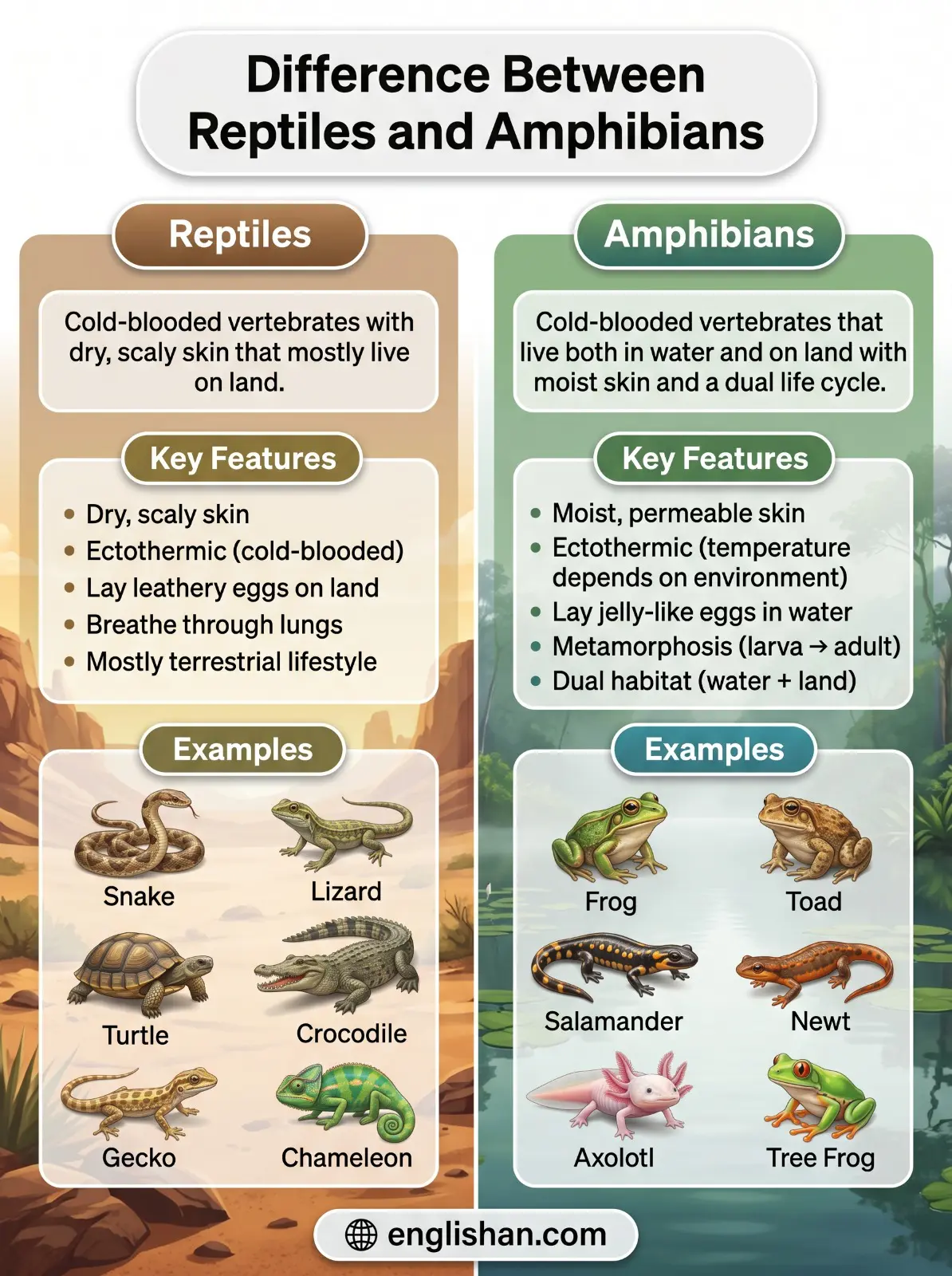
Key Differences Between Reptiles and Amphibians
Reptiles and amphibians may appear similar, but they differ in their skin, reproduction, habitat, and life cycle. These unique traits help them adapt to different environments and distinguish one group from the other.
Skin
This is the single most visible distinction between the two groups.
Reptiles have dry, tough, scaly skin composed of keratin – the same protein in human fingernails. These scales act as a waterproof barrier, protecting against dehydration and physical damage. Reptiles periodically shed this skin (a process called ecdysis).
Amphibians have thin, moist, scaleless skin that stays permeable to water and oxygen. This skin requires constant moisture to function – many amphibians can actually suffocate if their skin dries out. It also makes them particularly sensitive to environmental toxins, which is why they’re used as indicators of ecosystem health.
Reproduction and Eggs
Reproduction marks one of the sharpest biological divides between these two classes.
Reptiles produce amniotic eggs – eggs enclosed in a protective membrane or hard/leathery shell. These eggs can be laid in soil, sand, or leaf litter, far from any water source. Some reptile species (like boas and certain lizards) are viviparous, giving birth to live young.
Amphibians lay anamniotic eggs – soft, gelatinous eggs that lack a shell and must be deposited in or near water to survive. These eggs have no protection against desiccation. Fertilization is typically external (the male fertilizes eggs after they’re laid), unlike most reptiles, where fertilization is internal.
Life Cycle and Metamorphosis
Reptiles hatch from eggs as miniature versions of their adult form. A baby lizard looks – and functions – essentially like an adult lizard from day one. There is no larval stage, no metamorphosis.
Amphibians undergo metamorphosis. A frog, for instance, hatches as a tadpole: fully aquatic, gill-breathing, and tailless after transformation. Over weeks to months, it grows lungs, absorbs its tail, develops limbs, and transitions to semi-terrestrial life. This two-phase existence is the defining feature of the amphibian class.
Respiration
Reptiles breathe through lungs at every stage of life – from hatching onward. There is no transitional phase.
Amphibians use multiple respiratory systems depending on their life stage:
- Larvae: External gills for aquatic breathing
- Adults: Lungs for air breathing and cutaneous respiration (oxygen absorption directly through the skin)
- Some species like the hellbender salamander rely almost entirely on skin respiration as adults
Habitat
Reptiles are predominantly terrestrial, though many species are secondarily aquatic (sea turtles, saltwater crocodiles, sea snakes). Their waterproof skin and cleidoic eggs allow them to thrive in arid environments like deserts, where amphibians simply cannot survive.
Amphibians require humid or aquatic environments throughout their lives. Even adult frogs that venture onto land must remain near water sources for breeding and to keep their skin moist. They are largely absent from true deserts and high-salinity environments.
Thermoregulation Behavior
Both groups are ectothermic, but they regulate temperature differently.
Reptiles are active thermoregulators – they bask in sunlight, move between sun and shade, and select microhabitats to manage body temperature precisely. Many reptiles can tolerate a wide range of temperatures.
Amphibians are more passive. They rely on ambient moisture and temperature but are far more sensitive to temperature extremes. Most amphibians become dormant in cold conditions (hibernation) or drought conditions (estivation).
Heart Structure
Most reptiles have a three-chambered heart: two atria and one partially divided ventricle, which allows some mixing of oxygenated and deoxygenated blood.
Crocodilians (crocodiles, alligators, gharials) are the exception – they have a true four-chambered heart, similar to birds and mammals.
Amphibians also have a three-chambered heart (two atria, one ventricle), but the degree of blood mixing differs from reptiles in ways tied to their dual-environment respiration.
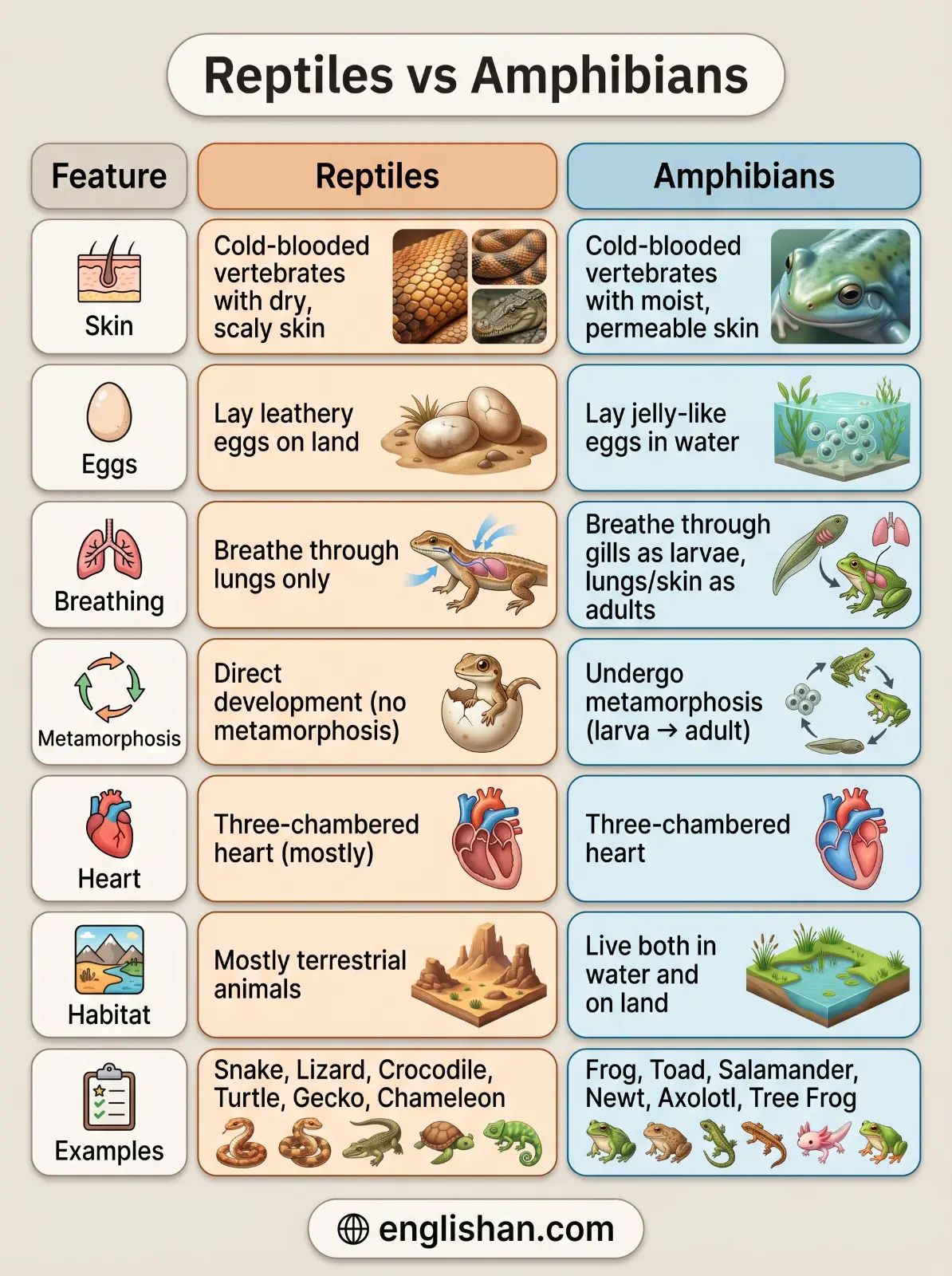
Reptiles vs Amphibians: Quick Comparison
| Feature | Reptiles | Amphibians |
|---|---|---|
| Skin | Dry, scaly, keratinized | Moist, smooth, permeable |
| Eggs | Amniotic (shelled/membranous) | Anamniotic (jelly-coated) |
| Egg environment | Land | Water or moist areas |
| Metamorphosis | None | Yes (larva → adult) |
| Respiration | Lungs only | Gills → lungs + skin |
| Heart | 3-chambered (crocs: 4) | 3-chambered |
| Thermoregulation | Ectothermic, active basking | Ectothermic, moisture-dependent |
| Fertilization | Internal (mostly) | External (mostly) |
| Habitat | Terrestrial / some aquatic | Semi-aquatic / dual-environment |
| Water dependence | Low (waterproof skin) | High (permeable skin) |
| Body covering | Scales or scutes | Bare skin (some with glands) |
| Examples | Snakes, lizards, turtles, crocs | Frogs, toads, salamanders |
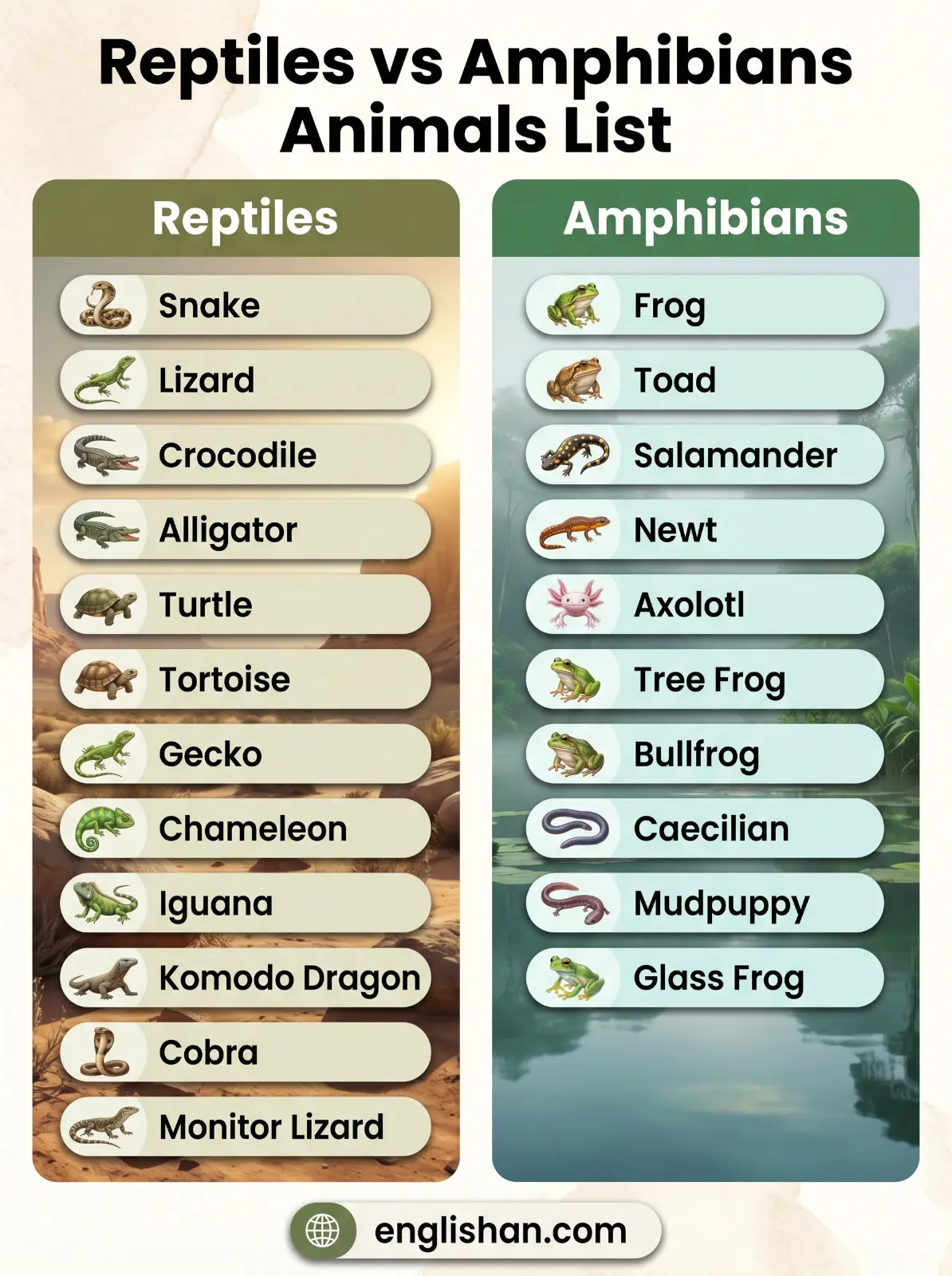
Reptiles vs Amphibians Animals List
Reptiles and amphibians are cold-blooded vertebrates that differ mainly in skin type, habitat, and life cycle. This list shows common examples of both groups for easy comparison.
Reptile Animals Names List
- Snake
- Lizard
- Crocodile
- Alligator
- Turtle
- Tortoise
- Gecko
- Chameleon
- Iguana
- Komodo Dragon
- Cobra
- Monitor Lizard
Amphibian Animals Names List
- Frog
- Toad
- Salamander
- Newt
- Axolotl
- Tree Frog
- Bullfrog
- Caecilian
- Mudpuppy
- Glass Frog
Similarities Between Reptiles and Amphibians
Despite their differences, reptiles and amphibians share several biological traits, which is why herpetology covers both:
- Both are ectothermic (cold-blooded): Neither generates body heat internally. Body temperature depends on the environment.
- Both are vertebrates: They possess a backbone and an internal skeleton.
- Both are largely carnivorous: Most species prey on insects, small mammals, fish, or other animals.
- Both evolved from common ancestors: Amphibians evolved from lobe-finned fish during the Devonian period (~375 million years ago). Reptiles evolved from early amphibian-like ancestors during the Carboniferous period.
- Both use camouflage and cryptic behavior as primary defense mechanisms.
Their shared study under herpetology is largely a historical and practical convenience – not a reflection of close evolutionary relationship. Modern phylogenetics places them in entirely separate clades.
Common Misconceptions About Reptiles vs Amphibians
Reptiles and amphibians are often confused due to shared traits like being cold-blooded and living in similar environments. However, many common beliefs about them are inaccurate. Clearing up these misconceptions helps build a clearer understanding of how these two groups differ in structure, reproduction, and life cycle.
Are Frogs Reptiles?
No, frogs are amphibians, not reptiles. This is arguably the most common misconception in basic zoology. The confusion arises because frogs are often found in similar environments as reptiles, and both groups are cold-blooded. However, biologically, they are in entirely different classes.
Here is why frogs cannot be classified as reptiles:
- Skin: Frogs have smooth, moist, scaleless skin that must remain wet to allow cutaneous respiration. Reptiles have dry, keratinized, scaly skin designed to prevent water loss.
- Eggs: Frogs lay soft, jelly-coated eggs directly in water, with no protective shell. Reptile eggs have a membrane or hard shell and are deposited on land.
- Life cycle: Frogs hatch as tadpoles, fully aquatic and gill-breathing, before transforming into adult frogs through metamorphosis. Reptiles hatch as miniature adults with no larval phase at all.
The shared cold-blooded trait and overlapping habitats are what cause people to group them together instinctively, but from a classification standpoint, frogs and reptiles sit in completely separate biological categories.
Are Turtles Amphibians?
No, turtles are reptiles. Turtles are a classic example of how habitat can mislead classification. Because many turtle species spend most of their time in water, people naturally assume they must be amphibians. But biology, not lifestyle, determines classification.
Key traits that confirm turtles are reptiles:
- Body covering: Turtles have scaly skin on their limbs and head, and a bony shell covered in scutes – a form of hardened, keratinized plate unique to reptiles.
- Respiration: Turtles breathe through lungs throughout their entire life, from hatching onward. They never use gills or skin respiration.
- Reproduction: Turtles lay amniotic eggs with a leathery or hard shell on land. Sea turtles, despite spending years entirely in the ocean, still return to sandy beaches to nest.
The rule of thumb here is straightforward: amphibians are defined by their biological dependence on water for skin moisture and reproduction. Turtles, regardless of how aquatic their lifestyle appears, meet none of those criteria.
Are All Cold-Blooded Animals Reptiles?
No. Ectothermy is widespread across the animal kingdom. Being cold-blooded, or ectothermic, simply means that an animal cannot generate its own body heat and relies on external temperature to stay active. This is not a trait exclusive to reptiles. It is shared by:
- All amphibians (frogs, salamanders, caecilians)
- All fish (both bony and cartilaginous)
- Most invertebrates, including insects and arachnids
Warm-bloodedness, or endothermy, is actually a more recent evolutionary development found only in birds and mammals. So while reptiles are indeed cold-blooded, using that trait alone to identify a reptile is biologically inaccurate. The defining features of reptiles are their scaly skin, amniotic eggs, and lung-only respiration – not their thermoregulation method.
Do All Reptiles Lay Eggs?
No. Several reptile species give birth to live young. Egg-laying (oviparity) is the most common reproductive method among reptiles, but it is not universal. A number of reptile species have evolved viviparity, meaning they carry and deliver live young rather than depositing eggs externally.
Examples of viviparous reptiles include:
- Boa constrictors
- Most viper species (including rattlesnakes and adders)
- Several skink species
- Certain sea snakes
However, there is an important theoretical distinction between viviparous reptiles and mammals. In reptiles, even when young are carried internally, the embryo is still enclosed within an amniotic membrane. There is no placental connection for nutrient exchange as seen in mammals. The mother’s body provides a protected environment, but the embryo remains biochemically self-contained within its membrane. This means the amniotic structure – the defining feature of reptile reproduction – is retained regardless of whether the egg is laid outside or carried internally to term.
Ecological Importance
Reptiles play critical roles as predators and prey across food webs. Snakes control rodent populations; large crocodilians shape freshwater ecosystems; marine turtles maintain seagrass beds and coral reef health.
Amphibians serve as biological gauges of environmental health. Because their permeable skin absorbs pollutants directly from soil and water, population declines in amphibians often signal ecosystem-level deterioration before other species show effects. Frogs and salamanders also consume vast quantities of insects, including agricultural pests and disease vectors like mosquitoes.
Currently, over 40% of all amphibian species are threatened with extinction – making them the most at-risk vertebrate class on Earth, according to the IUCN Red List. Habitat loss, chytrid fungus (Batrachochytrium dendrobatidis), climate change, and pollution are the primary drivers.
Reptiles face significant pressure too, particularly sea turtles, freshwater crocodilians, and many island lizard species.
Conclusion
The difference between reptiles and amphibians is more than skin-deep – it reflects two fundamentally different biological strategies. Reptiles evolved to conquer land fully, with waterproof skin, shelled eggs, and lung-only respiration. Amphibians took a different path – one foot in water, one on land – relying on permeable skin, aquatic breeding, and metamorphosis to survive.
Both groups have existed for hundreds of millions of years and remain ecologically irreplaceable. Whether it’s a saltwater crocodile patrolling a river delta or a tree frog calling through a rainforest at dusk, each represents a remarkable solution to the challenge of life on Earth.
Understanding the difference between these two classes isn’t just academic – it matters for conservation, ecology, and appreciating the true diversity of vertebrate life.
FAQs
Skin type and life cycle. Reptiles have dry, scaly, waterproof skin and no larval stage. Amphibians have moist, permeable skin and undergo metamorphosis from aquatic larvae to air-breathing adults.
Some can tolerate extended time on land (toads are a good example), but all amphibians must return to moist environments to survive and to water for reproduction. True desert habitation is impossible for them.
Amphibians came first. They emerged from aquatic vertebrates during the Devonian period (~375 million years ago). Reptiles evolved from early tetrapods (amphibian-like ancestors) roughly 50–60 million years later during the Carboniferous period.
Historically, both were grouped together as “lower” tetrapods – a convenient classification. Today, herpetology persists as a field for practical reasons, not because the two groups are closely related.
Generally, yes – both are predominantly carnivorous or insectivorous. However, some tortoises are largely herbivorous, and a few frog species also consume plant matter.
Crocodiles are reptiles – specifically, they belong to Order Crocodilia. They have scaly skin, lay amniotic eggs on land, and breathe through lungs. Their four-chambered heart is unique among reptiles but doesn’t change their classification.
You May Also Like
- African Animals Names
- Herbivores vs Carnivores vs Omnivores
- 55+ Rainforest Animal Names In English with Pictures
Reptiles vs Amphibians Quiz
Reptiles vs Amphibians
Which group has dry, scaly skin?
Keratin scales hold water in, which is what lets reptiles live in dry country.
Scales mean reptile; moist bare skin means amphibian.
Its dry scaled back marked it out as a reptile.
Which group breathes partly through its skin?
Gas passes straight through moist amphibian skin, which is why it must stay damp.
Permeable skin means amphibian, and it is why they need damp habitat.
The frog took in oxygen through its skin as well as its lungs.
Which group lays eggs with a protective shell on land?
The amniotic egg carries its own water supply, which freed reptiles from ponds.
Shelled egg means reptile; jelly egg in water means amphibian.
She buried a clutch of leathery eggs well above the waterline.
Complete the sentence with the process name.
The change from tadpole to adult frog is called ___.
Metamorphosis is the full body reorganisation between larval and adult form.
Amphibians metamorphose; reptiles hatch as small adults.
Metamorphosis took eleven weeks in the cool spring water.
Three of these are reptiles. Which one is not?
The newt is an amphibian, close kin to salamanders.
Salamanders, newts, frogs and toads are the amphibians.
Newts belong with the frogs, not with the lizards.
What does the word amphibian mean at its root?
From Greek amphi and bios: one life in water, one on land.
The name describes the two-stage life, not the skin.
Amphibian means both lives, and the tadpole is the first of them.
Turn on JavaScript for the interactive quiz. The full practice set is shown above.