

Noun clauses are an essential component of English grammar, serving a crucial role in constructing complex sentences. They are a group of words that function as a noun within another sentence. They often begin with a subordinating conjunction, such as “that,” “if,” or “whether”. In other words, they are like mini-sentences that can take the place of a noun in a larger sentence. In this article, we will define noun clauses, explain their types, discuss their usage, and provide examples to help you understand this grammatical concept. So, let’s get started!
What is a Noun Clause?
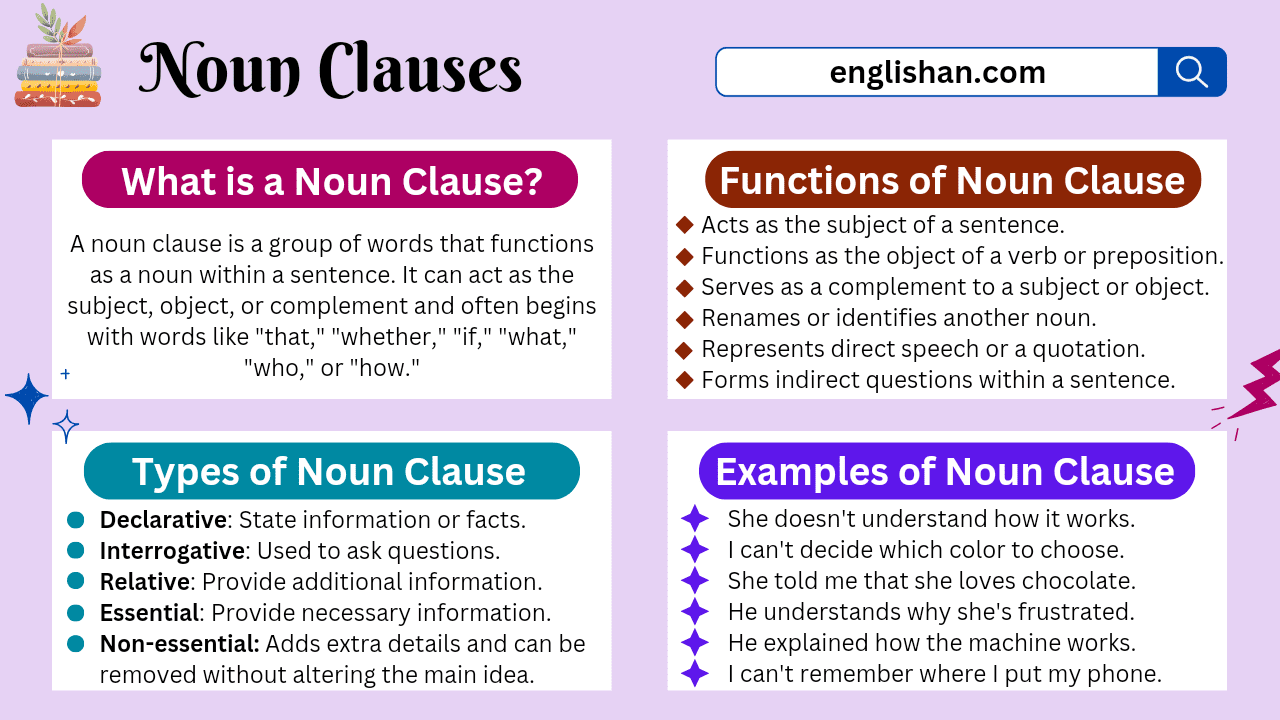
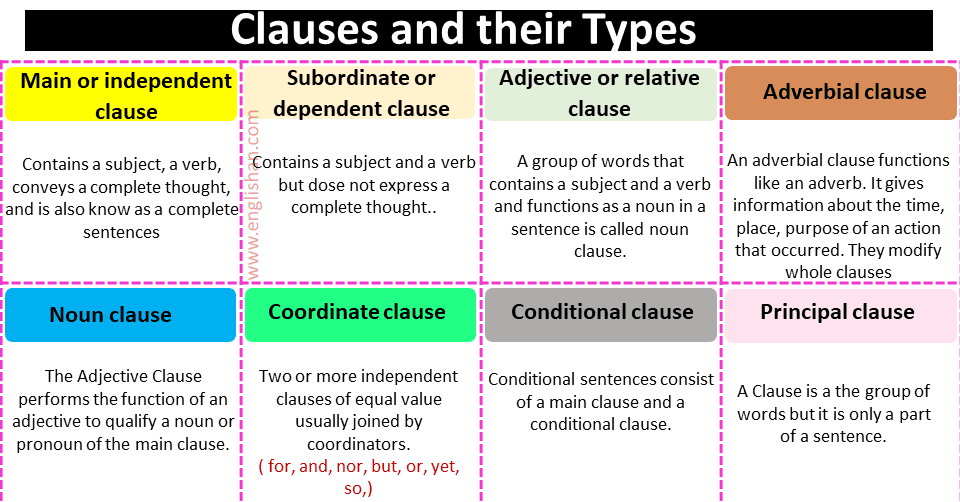
A noun clause is a group of words that functions as a noun within a sentence. Just like a regular noun, a noun clause can act as the subject or object of a verb, the object of a preposition, or even as the subject complement. Unlike a regular noun, which is a single word, a noun clause is a complete clause, comprising a subject and a verb. They are often introduced by words like “that,” “whether,” “if,” “who,” “whom,” “whose,” “what,” “which,” “how,” and “why.” These words are called subordinating conjunctions, and they signal the presence of a noun clause in the sentence.
For instance:
- Subject of a Verb: “What he said” surprised everyone. (“What he said” is the subject.)
- Object of a Verb: She explained “why she was late.” (“Why she was late” is the object.)
- Object of a Preposition: I am interested in “what you have to say.” (“What you have to say” is the object of the preposition “in.”)
- Subject Complement: His goal is “to find out whether it’s feasible.” (“To find out whether it’s feasible” is the complement.)
It can also be used in questions. For example, instead of asking “What did he say about her?” you could ask “I want to know what he said about her.” In this example, the noun clause “what he said about her” is functioning as the object of the preposition “about” in the main sentence.
How to Identify Noun Clause?
Noun clauses function as a noun in a sentence and often begin with words like “that,” “whether,” “if,” “who,” “whom,” “whose,” “what,” “which,” “how,” and “why.” These words, known as subordinating conjunctions, introduce the noun clause and connect it to the rest of the sentence. It frequently answer questions like who, what, or why. If you encounter a group of words that functioning as a noun and providing an answer to these questions within a sentence, you might be staring at a noun clause.
Types of Noun Clauses
Noun clauses can be categorized based on their content and the role they play within a sentence. Some common types include:
Declarative Noun Clauses
These clauses state information or facts within the noun clause.
Examples:
- I believe that the Earth is round.
- She stated that she would arrive by 3 PM.
- We hope that everyone enjoys the party.
Interrogative Noun Clauses
Clause that is used to ask questions often begins with words like who, what, when, where, why, or how.
Examples:
- Tell me what you want for dinner.
- I don’t know whether she will watch the party.
- Can you tell me what the capital of France is?
Relative Noun Clauses
These provide additional information about a noun and begin with relative pronouns like who, whom, whose, which, or that.
Examples:
- The person who won the competition is my friend.
- The book that I borrowed from the library is fascinating.
- This is the house which he built last year.
Essential (Restrictive) Noun Clauses:
These are crucial to the meaning of the sentence, and if removed, the sentence may lose its intended meaning. They are also called defining noun clauses.
Examples:
- The book that you recommended is fascinating.
- I appreciate what you did for me.
- The reason why she resigned remains unknown.
Non-Essential (Non-Restrictive) Noun Clauses:
These provide extra information but are not necessary for the sentence’s core meaning. They are set off by commas.
Examples:
- My sister, who lives in Paris, is visiting next week.
- My friend, who is a doctor, will join us for dinner.
- The latest project, which was completed ahead of schedule, impressed everyone.
Functions of Noun Clauses
Noun clauses can perform various functions within a sentence, just like traditional nouns. They can act as subjects, objects, objects of prepositions, and more. Let’s explore these functions in detail.
Subject of a Verb
Noun clauses can take the place of a traditional noun as the subject of a sentence, the one performing the action. For example, in the sentence “What he said surprised us,” the words “What he said” are the noun clause serving as the subject. They typically begin with words like “what,” “whatever,” “who,” or “whoever.”
- Example: What she said made everyone smile.
Object of a Verb
Just like regular nouns, noun clauses can receive the action of a verb. In “I heard what she whispered,” the words “what she whispered” serve as the object, receiving the action of hearing.
- Example: She explained why she was late.
Object of a Preposition
Noun clauses can also be the object of a preposition, clarifying relationships in more complex sentences. In “I am curious about what you discovered,” the phrase “what you discovered” acts as the object of the preposition “about.”
- Example: I am curious about what you discovered.
Subject Complement
In some sentences, a noun clause plays the role of a subject complement, completing the meaning of the sentence.
- Example: His goal is to find out whether he passed the exam.
In Apposition
Noun clauses can be used in apposition to provide additional information about a noun in the main clause. They often start with words like “that” or “whether.”
- Example: His dream, that he would become a doctor, finally came true.
Direct Speech or Quoting
Noun clauses are often used to directly quote or report what someone has said.
- Example: She said, “I don’t know where he went.”
Indirect Speech or Reporting
Noun clauses are employed to indirectly report or convey information that was spoken.
- Example: He explained why he couldn’t attend the meeting.
After Certain Verbs (wonder, ask, know):
Noun clauses are used after specific verbs that involve questioning, wondering, or knowing.
- Example: We don’t know what caused the problem.
Common Mistakes to Avoid:
While using noun clauses, it’s important to be aware of common mistakes that can affect clarity and grammatical correctness. These include:
- Incorrect Pronoun Usage: Ensure that pronouns within the noun clause agree in number and gender with the antecedent.
- Misplacing Punctuation: Forgetting to use commas correctly around the noun clause can lead to confusion.
- Forgetting Subordinating Conjunctions: Neglecting to use words like ‘that,’ ‘whether,’ or ‘if’ to introduce it.
- Unnecessary Repetition: Repeating information in both the main clause and the noun can lead to redundancy.
Example Sentences:
- I know what you did.
- Tell me if she’s coming.
- He wonders where they went.
- Please explain why you’re late.
- She doesn’t understand how it works.
- I can’t decide <strong>which color to choose.
- She told me that she loves chocolate.
- I’m curious why the sky is blue.
- I doubt if it’s true.
- He asked whether she liked pizza.</li><li>I’m unsure who will win.
- She forgot where she left her keys.
- He explained how the machine works.
- I heard that the movie is fantastic.
- We’ll see [if it rains tomorrow].
- Tell me why you’re upset.
- I can’t remember where I put my phone.
- He understands why she’s frustrated.
- We’ll learn who won the competition.
- We’ll find out whether they passed the exam.
FAQs:
It is a group of words that functions as a noun within a sentence. It can act as the subject, object, or complement and often begins with words like “that,” “whether,” “if,” “what,” “who,” or “how.”
It can be identified by their function in a sentence. They often serve as a subject (“What you said surprised me”), object (“I heard what you said”), or complement (“His goal is to succeed”). They are introduced by words such as “that,” “if,” “whether,” “what,” and others.
Common types include declarative (stating a fact or expressing an opinion), interrogative (posing a question), and relative (providing additional information about a noun). It can also be essential (defining) or non-essential (non-defining).
It can be used in various ways, such as in direct or indirect speech, after certain verbs (e.g., ask, wonder, know), and as subjects, objects, or complements. They add depth and detail to sentences.
Examples include:
1. I don’t care what others think.
2. Tell him what you saw.
3. He asked why the train was late.
4. I’m not sure if he will come.
5. Tell me where you found the keys.
6. I heard that the concert was canceled.
7. They argued why the project failed.
8. Can you explain what happened?
9. She said, “I know that you will succeed.”
10. Can you tell me what you want?
Read More
- Adverbial Clauses
- Dependent Clauses
- Independent Clauses
- Clauses And Their Types
- Clauses with Examples and Functions
- Relative Clauses
- Gerund And Infinitive Rules in English Grammar
- Nouns Worksheets

, Functions and Example Sentences.)