

Many English learners get confused when using the Past Perfect vs Past Simple tenses because both talk about actions in the past. Sometimes it can be difficult to know which tense should come first in a sentence and why one action uses “had” while the other does not. However, once you understand the basic difference between Past Perfect vs Past Simple, these tenses become much easier to use in speaking and writing.
The past simple is used for completed actions in the past, while the past perfect shows that one action happened before another past action. In this article, we’ll learn the differences between Past Perfect vs Past Simple, including their rules, structures, examples, common mistakes, and when to use each tense correctly.
Difference Between Past Perfect and Past Simple
The main difference between past perfect and past simple is the order of actions in the past. Both tenses talk about past events, but they are used in different ways depending on timing.
The past simple is used for actions that started and finished in the past. It does not show any relationship between two past actions, just a completed event.
Example 1: She visited her friend yesterday.
Example 2: They finished the work on time.
In short, the past simple is used for completed actions in the past without showing which action happened first.
The past perfect is used to show that one action happened before another action in the past. It clearly shows the earlier action.
Example 1: She had visited her friend before the meeting started.
Example 2: They had finished the work before the teacher arrived.
In short, the past perfect is used to show the earlier action when two past events are connected.
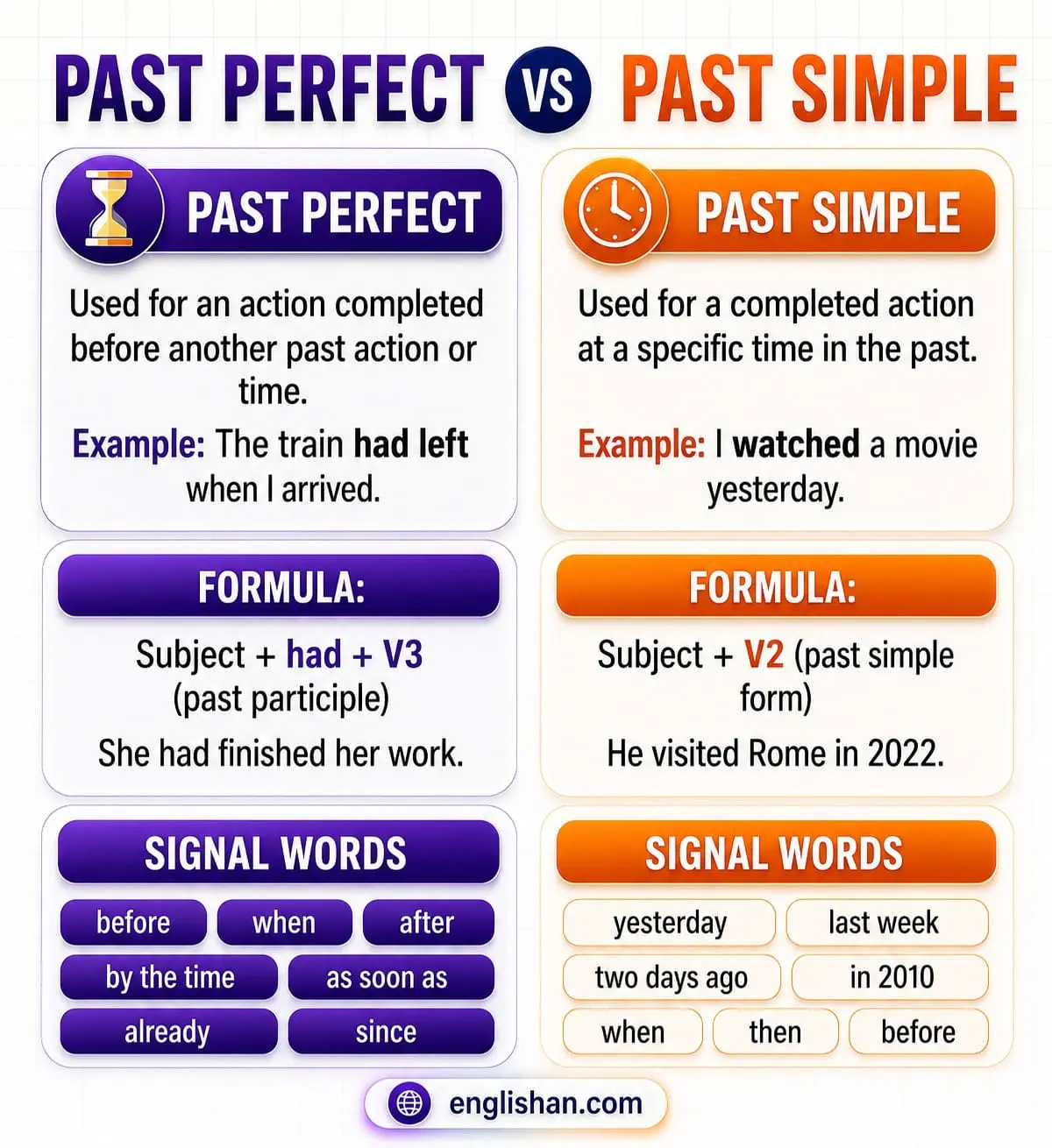
What Is Past Perfect?
The past perfect is a verb tense used to talk about an action that happened before another action in the past. It helps us show the order of events clearly when two past actions are involved.
We use the past perfect to explain which action happened first, especially when the sequence is not already obvious from the sentence.
Example 1: She had left before I arrived.
Example 2: They had finished the work when the teacher came.
Example 3: I had eaten dinner before the movie started.
In each example, the past perfect action shows what happened earlier in the past.
In short, the past perfect is used to show which action happened first in the past when two past actions are mentioned, helping us understand the correct order of events clearly and easily.
Past Perfect Structure
The past perfect tense is formed using “had” + past participle (3rd form of verb). It is used to show that an action was completed before another action in the past.
Affirmative Structure
In affirmative sentences, we use this structure to clearly show that one action was already completed before another action in the past happened.
Structure: Subject + had + Past Participle + Object
Example 1: She had finished her work before dinner.
Example 2: They had left the party when we arrived.
Example 3: I had seen that movie before.
Simply, affirmative sentences show a completed action before another past action using had + past participle.
Negative Sentences
In negative sentences, this structure is used to show that an action was not completed before another past event happened.
Structure: Subject + had not + Past Participle + Object
Example 1: She had not finished her work before dinner.
Example 2: They had not left when we arrived.
Example 3: I had not seen that movie before.
In short, Negative sentences show that an action was not completed before another past action using had not + past participle.
Question Sentences
In question sentences, we use this structure to ask whether one action was completed before another action in the past.
Structure: Had + Subject + Past Participle + Object?
Example 1: Had she finished her work before dinner?
Example 2: Had they left when you arrived?
Example 3: Had you seen that movie before?
In short, Question sentences are used to ask about completed actions in the past using had + past participle.
When to Use Past Perfect
The past perfect can be used in different situations in the past to show that one action was completed before another action or time. It helps us express earlier events clearly and makes the relationship between past actions easier to understand.
Rule 1: To show the earlier of two past actions
The past perfect when we want to make it clear that one action happened first and another happened later in the past. This helps avoid confusion in the sequence of events.
Example 1: She had left before I arrived.
Example 2: They had finished the work when the teacher came.
To sum up: We use the past perfect to clearly show which action happened first when two past actions are mentioned.
Rule 2: To describe an action completed before a specific past time
The past perfect to show that an action was already finished before a certain time or moment in the past.
Example 1: I had eaten dinner before 8 PM.
Example 2: He had completed the assignment before the deadline.
In short, we use the past perfect to show that an action was completed before a specific time in the past.
Rule 3: To explain the reasons in the past
The past perfect to explain why something happened in the past by referring to an earlier completed action. It helps connect cause and effect in past situations.
Example 1: She was tired because she had worked all day.
Example 2: They missed the bus because they had left late.
In conclusion, we use the past perfect to explain reasons in the past by showing an earlier completed action.
What Is Past Simple?
The past simple is a verb tense used to talk about actions or events that started and finished in the past. It describes completed actions, past habits, or situations that happened at a specific time before now.
We often use the past simple with time expressions such as yesterday, last night, last year, ago, and in 2020.
Example 1: She visited her grandmother yesterday.
Example 2: They played football after school.
Example 3: I watched a movie last night.
Example 4: We lived in Lahore in 2018.
Most regular verbs form the past simple by adding -ed to the base verb, while irregular verbs change differently.
- walk → walked
- play → played
- go → went
- eat → ate
In short, the past simple is used when we talk about finished actions or events in the past. It helps us describe what happened, when it happened, and complete past experiences clearly.
Past Simple Structure
The past simple tense is formed by using the past form of the verb. In affirmative sentences, we use the second form of the verb, while negative and question sentences use did with the base form of the verb.
Affirmative Structure
In affirmative sentences, we simply use the second form of the verb (past form) after the subject. This structure is used when we talk about actions that definitely happened and were completed in the past.
Structure: Subject + Verb (2nd Form) + Object
This structure simply states a past action in a positive way, showing that something happened and is now finished.
Example 1: She visited her aunt last week.
Example 2: They watched a movie yesterday.
Example 3: I finished my homework early.
In short, it is simply used to state completed actions in the past using the verb’s second form.
Negative Structure
In negative sentences, we use did not (didn’t) with the base form of the verb to show that something did not happen.
Structure: Subject + did not + base verb + Object
This structure is used to deny an action in the past. The main verb stays in its base form.
Example 1: She did not visit her aunt last week.
Example 2: They did not watch a movie yesterday.
Example 3: I did not finish my homework early.
In short, it is simply used to show that an action did not happen in the past.
Question Structure
In questions, we start with Did followed by the subject and base verb to ask about past actions.
Structure: Did + Subject + base verb + Object?
This structure is used to ask whether something happened in the past.
Example 1: Did she visit her aunt last week?
Example 2: Did they watch a movie yesterday?
Example 3: Did you finish your homework early?
In short, it is used to ask about past actions using “Did” + base verb.
When to Use Past Simple
The past simple is used when we talk about actions, events, or situations that started and finished in the past. It helps us clearly show that something is completely done and has no connection to the present. We use the past simple in different situations:
Rule 1: To describe completed actions at a specific time
We use the past simple to talk about actions that started and finished in the past at a definite time. The time is often mentioned clearly or understood from the context, helping us know exactly when something happened.
Example 1: I met him yesterday.
Example 2: She finished her homework last night.
In short: We use the past simple for actions that are completely finished at a specific time in the past.
Rule 2: To describe past habits or repeated actions
We use the past simple to show actions that happened regularly in the past but are not happening anymore. It is commonly used for old habits, routines, or repeated behaviors.
Example 1: He played football every evening when he was young.
Example 2: We visited our grandparents every weekend last year.
To sum up: We use the past simple to describe repeated actions or habits that happened in the past but are no longer true.
Rule 3: To show a sequence of past events
We use the past simple to describe a series of actions that happened one after another in the past. It is very useful for telling stories or explaining events in order.
Example 1: She woke up, brushed her teeth, and went to school.
Example 2: He entered the room, sat down, and started reading.
In brief: We use the past simple to show a clear order of actions that happened in the past.
Rule 4: To describe finished situations or states
We use the past simple to talk about situations, conditions, or states that were true in the past but are no longer true now. It helps us describe how things were before.
Example 1: They lived in a small village for many years.
Example 2: I was very shy when I was a child.
In conclusion, We use the past simple to describe past situations or states that are no longer true now.
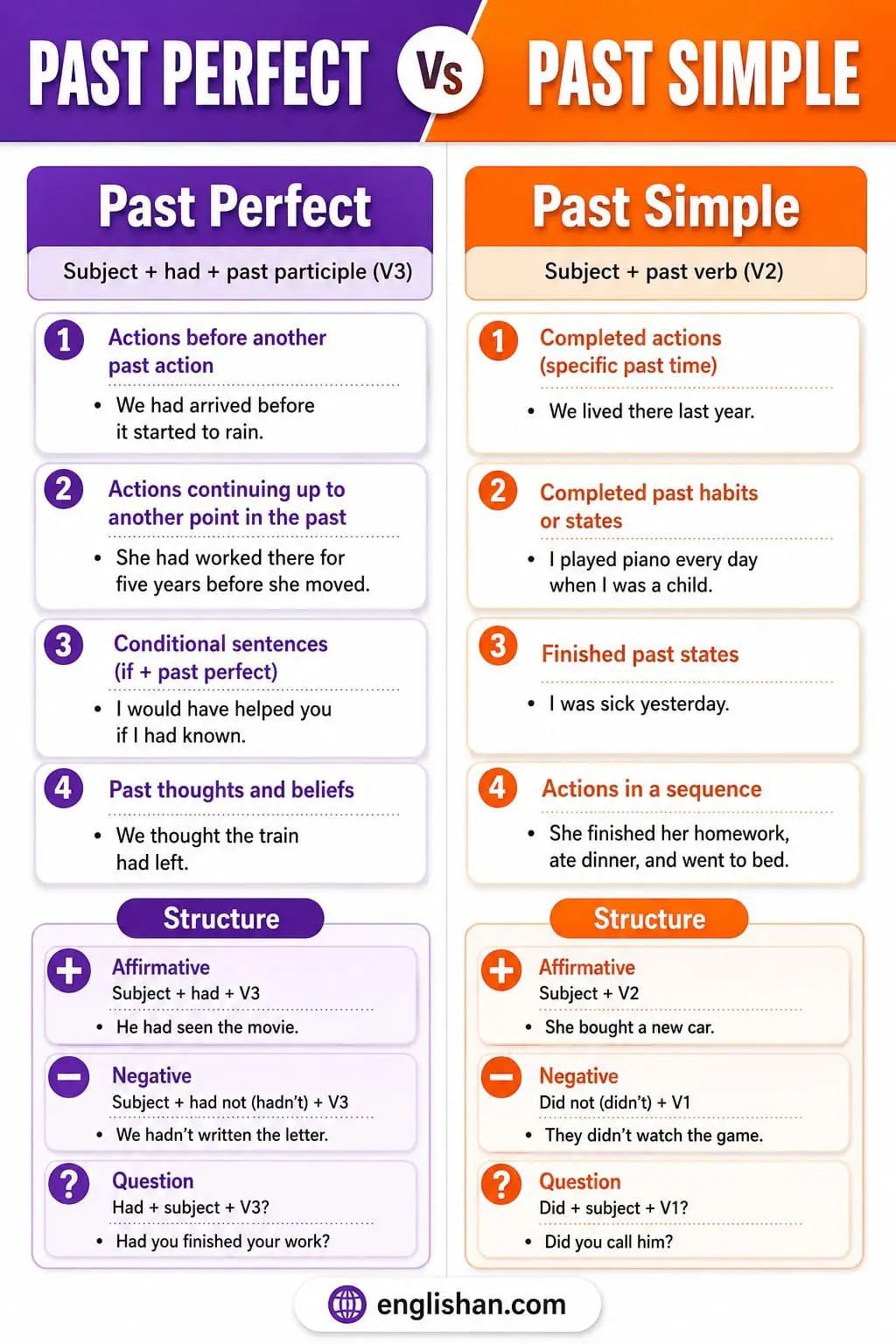
Past Perfect vs Past Simple Comparison Table
Both past perfect and past simple are used to talk about actions in the past, but they are different in how they show time and order of events. The past simple tells us what happened, while the past perfect shows which action happened first when two past actions are connected.
| Feature | Past Simple | Past Perfect |
|---|---|---|
| Use | Talks about completed actions in the past | Shows an action completed before another past action |
| Time relation | No comparison between two past actions | Clearly shows earlier action in the past |
| Structure | Subject + Verb (2nd form) | Subject + had + past participle |
| Focus | Main past event | Earlier past event |
| Example | She left early. | She had left before I arrived. |
| Example | They finished the work. | They had finished the work before the teacher came. |
Overall, the past simple describes completed actions in the past, while the past perfect is used to show which action happened first when two past events are connected.
Timeline: Past Perfect vs Past Simple
The timeline of past simple and past perfect helps us understand the order of events in the past. It shows which action happened first and which action happened later, making sentences clearer when we talk about two past events.
In past simple, we talk about actions that happened and finished in the past without focusing on order.
In past perfect, we show the action that happened first before another past action.
Example Timeline: I had eaten dinner → I went out → I met my friend
Here, “had eaten” (past perfect) shows the first action, while the other actions are in past simple.
Another Example: She had finished her work → She watched TV
In short, the timeline shows that the past perfect is used for the earlier action, while the past simple is used for the later action in the past.
Signal Words for Both Tenses
Signal words help us quickly decide whether to use past simple or past perfect. They act as time clues that show when an action happened and how events are connected in the past.
| Past Simple Signal Words | Past Perfect Signal Words |
|---|---|
| yesterday | before |
| last night / last week / last year | after |
| ago | already |
| in 2020 / in the past | by the time |
| then | just |
| once | when (in some cases) |
Signal words are very helpful in understanding and using past simple and past perfect correctly. They clearly show whether we are talking about a single completed action or an earlier action in the past.
Common Mistakes Learners Make
Many English learners mix up past simple and past perfect because both talk about past actions. These mistakes usually happen when learners are not clear about the order of events or the correct verb form.
Mistake # 1: Using past perfect for single past actions
Learners sometimes use past perfect when only one action is mentioned, which is unnecessary.
❌Incorrect: I had went to school yesterday.
✔ Correct: I went to school yesterday.
In short, we should not use past perfect for a single completed past action; past simple is correct.
Mistake # 2: Using past simple instead of past perfect for order
Sometimes learners forget to show which action happened first and use past simple for both actions.
❌Incorrect: She left before I arrived.
✔Correct: She had left before I arrived.
So, we use past perfect to show the earlier action when two past events are connected.
Mistake # 3: Incorrect verb form with “had”
A common mistake is using the second form of the verb after “had” instead of the past participle.
❌ Incorrect: They had finisheded the work.
✔Correct: They had finished the work.
Keep in mind that after “had,” we always use the third form (past participle), not the second form.
Mistake # 4: Forgetting “did” in negatives and questions
Learners often make mistakes by using incorrect structures in negative and question sentences.
❌ Incorrect: Did she went there?
✔Correct: Did she go there?
In past simple questions and negatives, we always use the base form of the verb with “did.”
Common mistakes in past simple and past perfect usually happen due to confusion in verb forms and time order. Once learners understand when to use each tense and follow the correct structure, these errors become easy to avoid and sentences become much more accurate.
Tips to Remember the Difference
Understanding past simple and past perfect becomes much easier when you remember a few simple points. These tips help you quickly decide which tense to use in different situations without confusion.
- Focus on time order of actions
- Identify which action happened first
- Look for signal words (before, after, already, when)
- Use “had” as a clue for past perfect
- Use past simple for completed past actions
- Check if two past actions are connected
- Practice with two-action sentences
- Remember: past perfect = earlier action
- Remember: past simple = later or single action
In short, these simple tips help you clearly understand the difference between past simple and past perfect. With regular practice, choosing the correct tense becomes quick and natural in both speaking and writing.
Practice Exercises: Past Perfect vs Past Simple
Understanding the difference between past simple and past perfect helps you clearly show the order of events in the past. These exercises are designed to help you practice when to use each tense correctly. Try each question before checking the answers.
Exercise 1: Choose the correct tense (Past Simple or Past Perfect)
She (leave / had left) before I arrived.
Exercise 2: Fix the sentence by correcting the tense
They finished the work before the teacher came.
Exercise 3: Rewrite the sentence using correct tense order
I eat dinner before he arrived.
Exercise 4: Choose the correct option
By the time we reached the station, the train (left / had left).
Exercise 5: Fix the mistake in the sentence
She had went to school when I called her.
Answer Key:
- She had left before I arrived.
- They had finished the work before the teacher came.
- I had eaten dinner before he arrived.
- By the time we reached the station, the train had left.
- She had gone to school when I called her.
Final Thought
Past simple and past perfect are both important tenses used to talk about past actions, but they are used in different ways. The past simple is used to describe completed actions in the past, while the past perfect is used to show which action happened first when two past events are connected.
Once you clearly understand this difference, it becomes much easier to express past events in the correct order. With practice, using both tenses becomes natural, and your English sounds more accurate and confident.
FAQs: Past Perfect vs Past Simple
The main difference is how they show time in the past. Past simple is used to talk about actions that are completed in the past without focusing on order. Past perfect, on the other hand, is used when we want to show which action happened first between two past events.
We use past simple when we talk about actions that started and finished in the past. It is used for finished events, past habits, and actions that happened at a specific time.
Example: I visited Lahore last year.
Example: She called me yesterday.
We use past perfect when we want to show that one action happened before another action in the past. It helps make the sequence of events clear and avoids confusion about which action happened first.
Example: She had left before I arrived.
Example: They had finished the work when the teacher came.
No, past perfect is not used for a single past action. It is only used when there are two past actions and we need to show that one happened earlier than the other. Without a second action, past simple is the correct choice.
Past simple is often used with time words like yesterday, last night, ago, and in 2020 because they show a finished time. Past perfect is used with words like before, after, already, and by the time because they show the order of actions in the past.
You May Also Like
- Past Perfect Tense Sentences
- Past Perfect Tense Worksheets and Exercises with Answers
- 100 Useful Simple Past Tense Sentences List
- 100 Simple Past Examples
Past Perfect vs Past Simple Quiz
Past Perfect vs Past Simple
Mark the earlier action.
When we arrived, the film ___.
The film started before we arrived, so the earlier action takes the past perfect.
earlier past action -> past perfect
When we arrived, the film had already started.
Choose the natural sequence.
I ___ the door and walked in.
Two actions in plain order sit at the same level, so both take the simple past.
simple sequence at the same level -> past simple
I opened the door and walked in.
Complete with 'before'.
She ___ her meal before he called.
The finishing came first, so 'before' pairs with the past perfect.
before + past perfect for the earlier action
She had finished her meal before he called.
Complete the sentence.
By the time the police came, the thief ___.
The escape was complete before the later past event.
By the time + past perfect
By the time the police came, the thief had escaped.
Choose the reported form.
He told me he ___ the keys.
In reported speech the earlier action shifts back to the past perfect.
reported speech backshifts to the past perfect
He told me he had lost the keys.
True or false?
You must use the past perfect whenever a sentence mentions two past actions.
Simple sequences use the past simple, so 'I woke up and made coffee' needs no past perfect.
past perfect marks the earlier action, not every past pair
I woke up and made coffee.
Which came first?
When we got there, the concert ___.
The action finished before another past event takes the past perfect.
past perfect for the earlier of two past actions
When we got there, the concert had ended.
Later action stays simple.
She ___ the door and stepped outside.
The later action in a straightforward past sequence stays in the simple past.
simple past for the later action in a sequence
She opened the door and stepped outside.
Type the correct form of the verb in brackets.
By the time the guests arrived, we ___ (clean) the house.
The cleaning finished before a later past event, so the past perfect marks the order.
past perfect before a later past action
By the time the guests arrived, we had cleaned the house.
Reason before a past state.
He failed the test because he ___.
A cause completed before the past result takes the past perfect.
past perfect for a cause before a past result
He failed the test because he hadn't studied.
True or false?
In 'The plane had taken off when we reached the gate', the plane left before we reached the gate.
The past perfect 'had taken off' places the departure before the arrival.
past perfect marks the earlier past action
The plane had taken off when we reached the gate.
Single past narrative.
Last summer we ___ to Sydney and stayed a week.
A finished trip in plain past narration takes the simple past.
simple past for a finished past narrative
Last summer we flew to Sydney and stayed a week.
Which came first?
By the time the film started, we ___ our seats.
The earlier of two past actions takes the past perfect.
past perfect for the earlier action
By the time the film started, we had found our seats.
Later action stays simple.
She locked the door and ___ .
The later action in a straight past sequence stays in the simple past.
simple past for the later action
She locked the door and left.
Type the correct form of the verb in brackets.
The train ___ (leave) before we arrived.
The departure finished before a later past event, so the past perfect marks the order.
past perfect before a later past action
The train had left before we arrived.
Which came first?
When we reached home, the storm ___ .
The storm ended before the arrival, so the past perfect fits.
past perfect for the earlier action
When we reached home, the storm had passed.
Reason before a past state.
She was upset because she ___ the match.
A cause completed before the past state takes the past perfect.
past perfect for a cause before a past result
She was upset because she had lost the match.
True or false?
In 'After they had eaten, they went out', the eating came first.
The past perfect 'had eaten' places the meal before they went out.
past perfect marks the earlier action
After they had eaten, they went out.
Single past narrative.
Yesterday I ___ up early and went for a run.
A finished sequence in plain narration stays in the simple past.
simple past for a finished narrative
Yesterday I got up early and went for a run.
Reason for not recognizing.
I didn't recognize him; he ___ a lot.
A change completed before the past moment takes the past perfect.
past perfect for a cause before a past result
I didn't recognize him; he had changed a lot.
Turn on JavaScript for the interactive quiz. The full practice set is shown above.