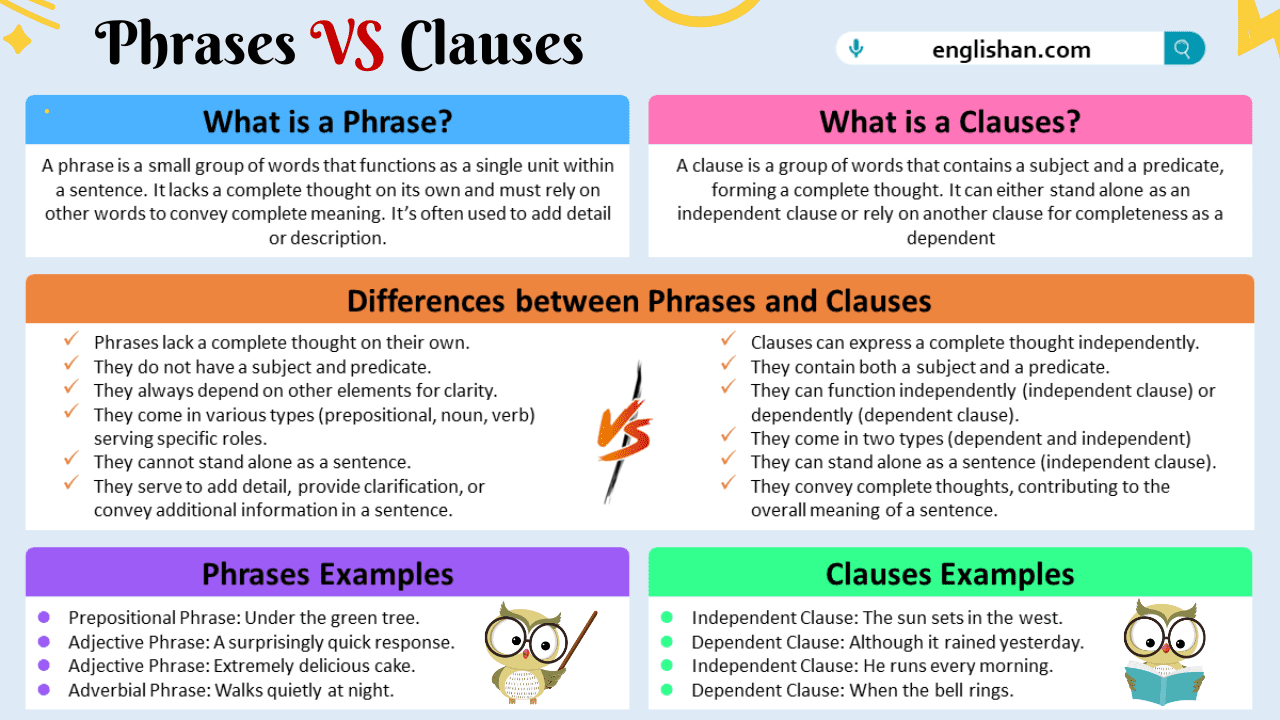
Both phrases and clauses are important grammatical concepts that help us communicate effectively in writing and speaking. A phrase is a group of words that doesn’t have a subject or verb but describes or modifies a noun. For example, “in the park” is a phrase because it doesn’t have a subject or verb to form a complete sentence. Conversely, a clause is a group of words with a subject and verb and can stand alone as a complete sentence. For instance, “She likes to read” is a clause because it has a subject (she) and a verb (likes) that convey action and complete the thought.
Understanding the difference between phrases and clauses is important for clear and effective communication because it helps us use language more precisely and accurately.
What is a Phrase?
A phrase is a collection of words that functions as a single unit within a sentence. Phrases do not have a subject and a verb, so they do not express a complete thought on their own. Instead, they serve to add detail, provide clarification, or convey additional information within a sentence.
There are several types of phrases, each serving a specific purpose in a sentence. Here are some common types of phrases:
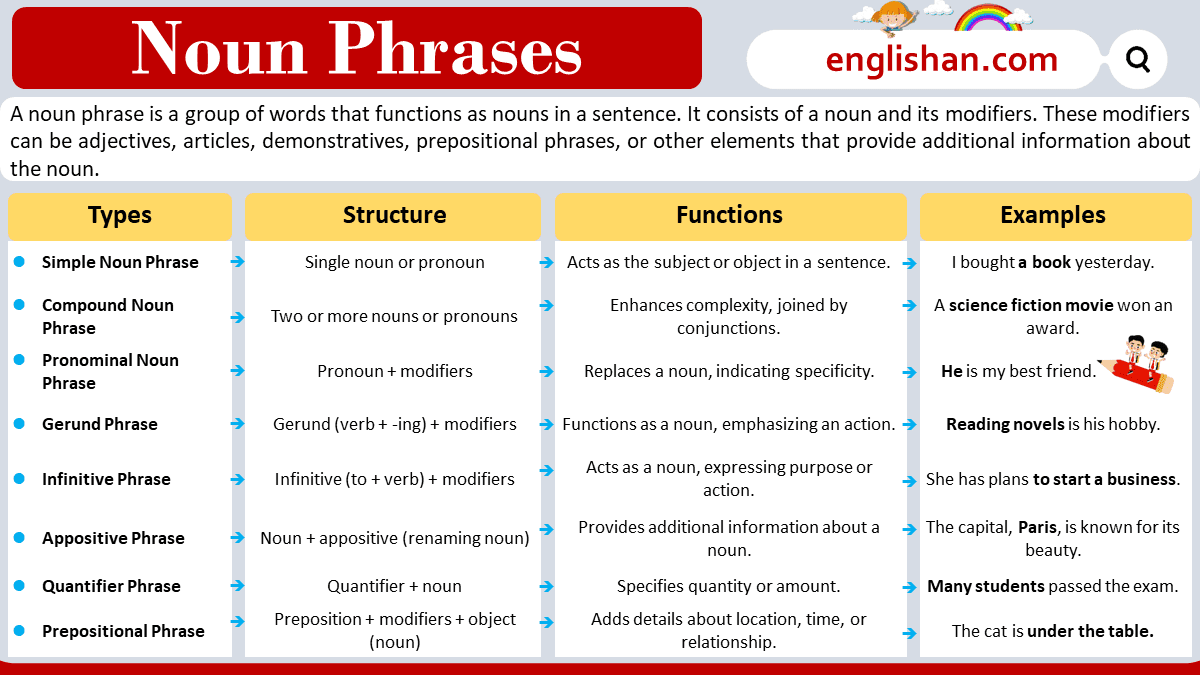
Noun Phrase:
- Definition: A group of words centered around a noun, functioning as a subject, object, or complement in a sentence.
- Example: The bright sun warmed the beach.
Verb Phrase:
- Definition: A group of words centered around a main verb, often including auxiliary (helping) verbs.
- Example: She has been studying all night.
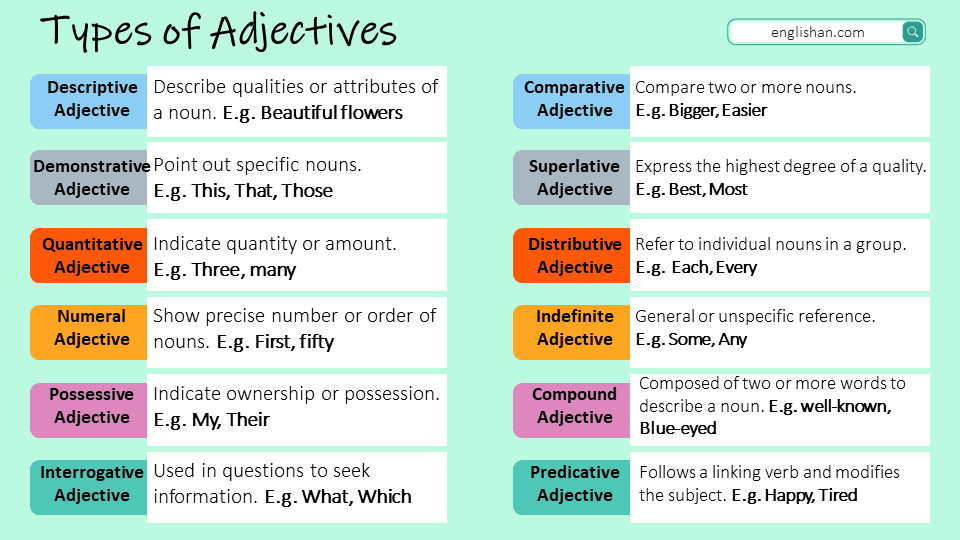
Adjective Phrase:
- Definition: A group of words centered around an adjective, providing more information about a noun.
- Example: The house with the red roof is mine.
Adverb Phrase:
- Definition: A group of words centered around an adverb, modifying a verb, adjective, or another adverb.
- Example: He ran very quickly to catch the bus.
Prepositional Phrase:
- Definition: A group of words that begins with a preposition and includes a noun (the object of the preposition).
- Example: She sat on the comfortable couch.
Gerund Phrase:
- Definition: A phrase that begins with a gerund (an -ing form of a verb) and functions as a noun.
- Example: Swimming in the ocean is my favorite activity.
Infinitive Phrase:
- Definition: A phrase that begins with an infinitive verb (to + base form of the verb) and can function as a noun, adjective, or adverb.
- Example: I want to visit Paris next year.
Participial Phrase:
- Definition: A phrase that includes a participle (often ending in -ing or -ed) and modifies a noun.
- Example: The cat, startled by the noise, ran away.
What is a Clause?
A clause is a group of words that contains a subject and a verb. It is a building block of a sentence and can function as a complete thought or as part of a larger sentence. There are two main types of clauses: independent clauses and dependent clauses.
Independent Clause:
- Simple Definition: An independent clause is a group of words that can stand alone as a complete sentence. It expresses a complete thought and does not rely on another clause to make sense.
- Example: “She went to the store.”
Dependent Clause:
- Simple Definition: A dependent clause is a group of words that contains a subject and a verb but cannot stand alone as a complete sentence. It relies on an independent clause to form a complete thought.
- Example: “Because she was out of milk,” (This clause needs more information to be a complete sentence. For example, “Because she was out of milk, she went to the store.”)
Dependent clauses can be further categorized based on their functions:
- Noun Clause: Functions as a noun in a sentence.
- Example: “What she said” is a direct object.
- Adjective Clause (Relative Clause): Modifies a noun or pronoun in a sentence.
- Example: “The book that she recommended is interesting.”
- Adverb Clause: Modifies a verb, adjective, or adverb in a sentence, answering questions like how, when, where, why, or to what extent.
- Example: “After the rain stopped, we went for a walk.”
Key Differences Between Phrases and Clauses
Let’s explore the key differences between phrases and clauses.
1. Completeness of Thought:
- Phrase: Does not express a complete thought on its own. It’s a building block within a sentence.
- Example: “In the garden,” “under the table,” “without hesitation.”
- Clause: Can stand alone as a complete thought (independent clause) or rely on an independent clause for completeness (dependent clause).Examples:
- Independent Clause: “The cat slept peacefully.”
- Dependent Clause: “Because the cat slept peacefully.”
2. Subject and Verb Presence:
- Phrase: Often lacks a subject or a verb. It functions as a single unit.
- Example: “With a smile,” “the big blue sky.”
- Clause: Contains both a subject and a verb, forming a complete idea.
- Example: “She dances,” “they are laughing.”
3. Independence:
- Phrase: Always depends on other parts of the sentence for clarity and meaning.
- Example: “On the top shelf,” “in the morning.”
- Clause: Can be independent or dependent, providing flexibility in sentence structure. Examples:
- Independent Clause: “The birds are singing.”
- Dependent Clause: “When the birds are singing.”
4. Types and Functions:
- Phrases Types: Categorized into different types based on their role in a sentence—noun, verb, adjective, adverb phrases. They add detail, description, or context to a sentence. Examples:
-
- Noun Phrase: “The old book.”
- Adverb Phrase: “With great enthusiasm.”
- Clause: Classified into independent and dependent clauses, each serving a specific role in forming sentences. Examples:
- Independent Clause: “She is baking a cake.”
- Dependent Clause: “Although she is baking a cake.”
5. Structure:
- Phrase: Phrases do not have a strict structure and can vary based on their functions (noun phrases, verb phrases, etc.).
- Clause: Clauses have a more defined structure, comprising a subject and a verb. The presence of a subject and a verb distinguishes a clause from a phrase.
Phrases vs Clauses
| Aspect | Phrases | Clauses |
|---|---|---|
| Completeness | Lacks a complete thought on its own. | Can express a complete thought independently. |
| Subject and Predicate | Does not have a subject and predicate. | Contains both a subject and a predicate. |
| Independence | Always depends on other elements for meaning. | Can function independently (independent clause) or dependently (dependent clause). |
| Types and Functions | Comes in various types (prepositional, noun, verb) serving specific roles. | Divides into independent and dependent clauses, each with specific functions. |
| Components | Comprises a group of related words. | Comprises a subject and a predicate. |
| Dependency | Always dependent on other elements for clarity. | Can be independent or dependent, providing flexibility in sentence construction. |
| Usage | Used for adding details or modifiers. | Used for constructing complete thoughts and complex sentences. |
| Stand-alone Use | Cannot stands alone as a sentence. | Can stand alone as a sentence (independent clause). |
| Purpose | Adds details, but alone, it doesn’t convey a complete idea. | Conveys complete thoughts, contributing to the overall meaning of a sentence. |
| Examples | Prepositional phrase: “In the garden.” | Independent clause: “She walked to the store.” |
Phrases and Clauses Examples
- In the morning, the sun rises. (Phrase)
- Although it’s raining, we’ll go for a walk. (Clause)
- After the rain, the flowers bloomed. (Phrase)
- Under the bed, he found his lost shoe. (Phrase)
- Although tired, she finished her homework. (Clause)
- He ran fast, trying to catch the bus. (Clause)
- During the movie, they ate popcorn. (Phrase)
- The baby, crying loudly, needed attention. (Phrase)
- Despite the challenge, she persevered. (Clause)
- With a smile, he greeted his friend. (Phrase)
- The old car, with rusty doors, still worked. (Phrase)
- Before bedtime, she reads a story. (Phrase)
- Because of the rain, the game was canceled. (Clause)
- Without hesitation, she answered the question. (Phrase)
- The student, who studied hard, aced the test. (Clause)
- In the dark, they searched for the keys. (Phrase)
- Despite the noise, he focused on his work. (Clause)
- After the storm, the sky cleared up. (Phrase)
- The cake, made by my mom, was delicious. (Phrase)
- Although tired, they continued their journey. (Clause)
FAQs
A phrase is a group of words that forms a meaningful unit within a sentence. It lacks a complete thought on its own and needs to be part of a larger structure to convey meaning.
A clause is a group of words that contains a subject and a predicate, working together to express a complete thought. Clauses can be independent (standalone sentences) or dependent (rely on other clauses for completeness).
The key structural difference is that a phrase does not have a subject and predicate working together, while a clause contains both a subject and a predicate.
Examples of phrases include “in the morning,” “under the table,” and “the big red ball.” Examples of clauses include independent clauses like “The cat jumped over the fence” and dependent clauses like “Although it was raining.”
The two main types of clauses are independent clauses (can stand alone as sentences) and dependent clauses (rely on other clauses for completeness).
1. Prepositional Phrase: “Under the table.”
2. Noun Phrase: “The energetic puppy.”
3. Verb Phrase: “Will have been studying.”
4. Adjective Phrase: “Extremely talented musician.”
5. Adverbial Phrase: “Runs very quickly outside.”
Read More
- Adverbial Clauses
- Dependent Clauses
- Independent Clauses
- Clauses And Their Types
- Phrases And Their Types