Vegetables that start with C are some of the most common in any kitchen. Carrot, cabbage, and celery already feel familiar to most people.
There’s more to the letter than the familiar names. Chayote, cassava, and celeriac belong to regional kitchens. Chili peppers form a huge family of their own, and Swiss chard adds bright stems in yellow, pink, and red.
You’ll learn every C-vegetable worth knowing here, from kitchen staples to names most people have never seen. Quiz fans, students, parents helping with homework, and curious eaters will all leave knowing every C-vegetable that matters.
Quick List Of Vegetables That Start With C
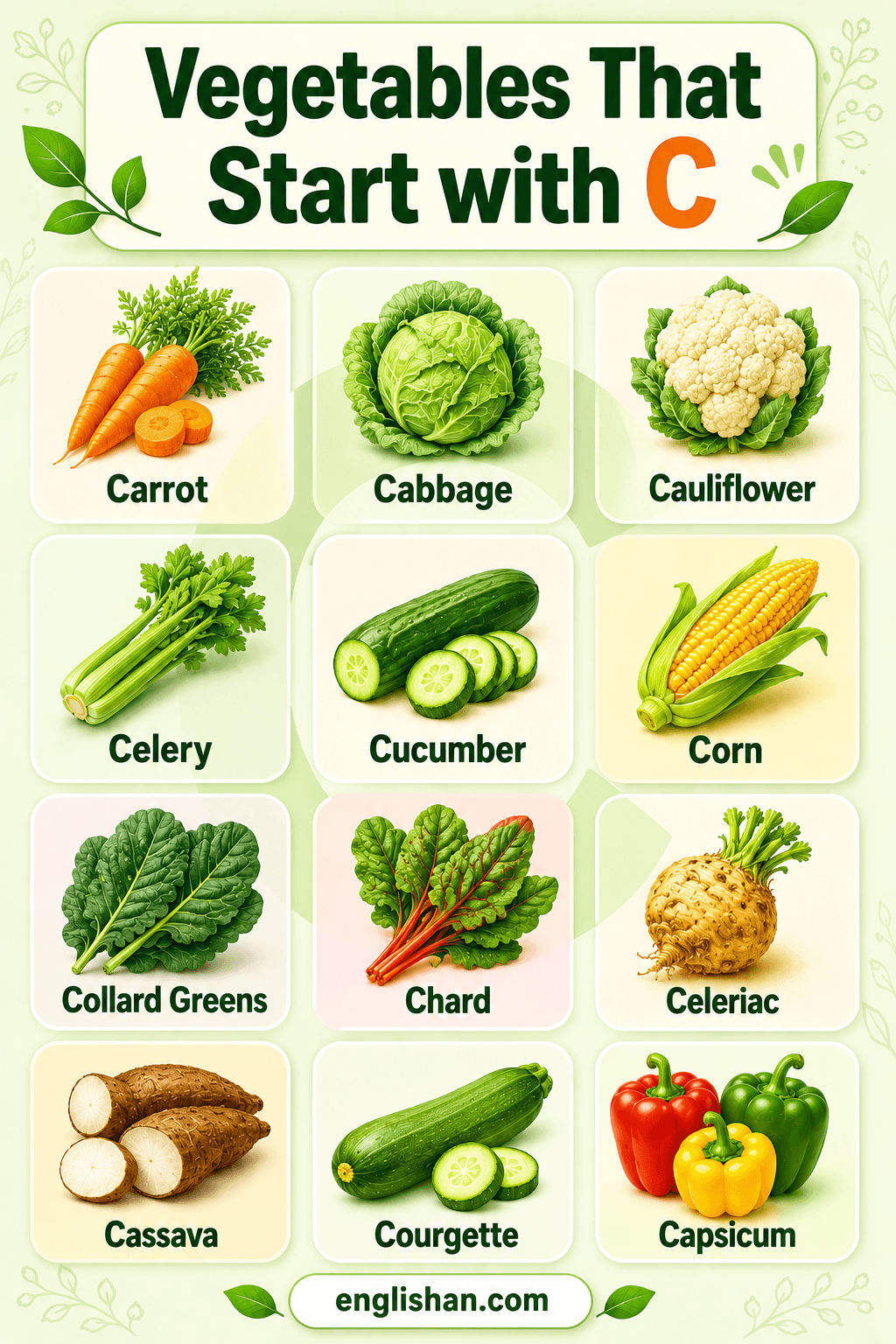
Here are 40 vegetables that start with C, ranging from everyday staples to regional greens, roots, pods, edible flowers, and rare tubers.
- Cabbage
- Calabrese
- Caper
- Capsicum
- Cardoon
- Carrot
- Cassava
- Cauliflower
- Cavolo nero
- Celeriac
- Celery
- Celtuce
- Cha-om
- Chard
- Chayote
- Cherry tomato
- Chickpeas
- Chicory
- Chili pepper
- Chinese artichoke
- Chinese broccoli
- Chinese cabbage
- Choy sum
- Cime de rapa
- Cluster beans
- Collard greens
- Common bean
- Corn
- Corn salad
- Courgette
- Courgette flower
- Cress
- Crookneck squash
- Crosne
- Cucumber
- Culantro
- Curly endive
- Cranberry beans
- Chaya
- Chinese water chestnut
If you only need the familiar names, start with cabbage, carrot, cauliflower, celery, cucumber, corn, capsicum, and courgette. The rest of the list moves into bitter greens, starchy roots, crisp aquatic vegetables, edible buds, and regional produce worth recognizing when you see it.
Vegetables That Start With C With Pictures
The vegetables below move from well-known staples into more unusual market finds, with enough detail to show what each one looks like, tastes like, and does in the kitchen.
Cabbage
Cabbage is the dependable C vegetable almost every kitchen knows, but it is more flexible than people give it credit for. The leaves stay crisp and peppery when raw, turn sweet when braised, and become tangy when fermented into sauerkraut or kimchi.
Choose tight, heavy heads for the best texture. Green cabbage works almost anywhere, red cabbage brings color and bite, and savoy cabbage softens beautifully in soups, rolls, and buttered side dishes.
Calabrese
Calabrese is the green broccoli most supermarkets simply label as broccoli. It has a thick central stalk, branching stems, and tight green florets that cook quickly without losing their shape.
If you dislike overboiled broccoli, try roasting or stir-frying calabrese instead. The edges char, the stalks stay pleasantly firm, and the flavor becomes sweeter and nuttier than the plain steamed version many people grew up with.
Caper
Capers are tiny flower buds, usually pickled or packed in salt, and they bring a sharp briny bite to food. They are not eaten like a side vegetable, but in cooking they behave like a vegetable condiment with serious flavor.
A spoonful can wake up salads, pasta, roasted vegetables, fish, sauces, and Mediterranean dishes. Their saltiness is concentrated, so rinse salted capers or taste before adding extra seasoning.
Capsicum
Capsicum is the name many countries use for what North Americans call bell pepper. The crisp walls, hollow center, and mild sweetness make it easy to use raw, roasted, grilled, stuffed, or sliced into stir-fries.
Green capsicum tastes sharper because it is less ripe, while red, yellow, and orange capsicums taste sweeter. If a dish needs color without heat, capsicum is usually the safer choice than chili pepper.
Cardoon
Cardoon looks a little like oversized celery, but the flavor sits closer to artichoke. The thick stalks are the prized part, and they usually need trimming to remove tough strings and bitter edges.
Mediterranean kitchens braise cardoon, bake it in gratins, or simmer it until the texture turns tender. It is not the fastest vegetable to prepare, but it rewards cooks who like old-world produce with character.
Carrot
Carrot is one of the easiest C vegetables to recognize, yet it still earns its place because it does so many jobs well. Raw carrots bring crisp sweetness, while cooked carrots soften into soups, stews, roasts, purees, and glazed side dishes.
Orange carrots dominate modern markets, but purple, yellow, red, and white varieties also exist. The thinner young ones often taste sweeter, while larger carrots suit slow cooking and stockpots.
Cassava
Cassava, also called yuca in many markets, is a starchy tropical root with rough brown skin and firm white flesh. It is filling, neutral, and excellent at carrying sauces, which makes it important across African, Caribbean, Latin American, and Asian cooking.
This is one vegetable where preparation matters. Cassava should be peeled and cooked properly before eating, then it can be boiled, fried, mashed, or processed into flour and starch.
Cauliflower
Cauliflower looks mild, almost quiet, until heat changes it. The pale florets roast into golden, nutty edges, simmer into curries, mash into creamy sides, and blend into soups without needing much fuss.
Look for firm heads with compact florets and fresh leaves. White cauliflower is the classic, but purple, orange, and green varieties bring extra color to vegetable trays and roasted platters.
Cavolo Nero
Cavolo nero, often called Tuscan kale, has long dark leaves with a bumpy, almost wrinkled surface. It tastes deeper and earthier than tender salad greens, which is why it stands up well to slow cooking.
Italian dishes use it in soups, especially ribollita, but it also works in sautés, pasta, stews, and bean dishes. Strip away the tough central rib if the leaves feel mature.
Celeriac
Celeriac looks rough enough to scare off casual shoppers, but peel away the knobby skin and you get a pale root with a celery-like aroma. It gives soups and mash a savory base without the heaviness of potato.
Try it roasted, pureed, shredded into remoulade, or simmered with leeks and herbs. If you like celery flavor but want something heartier, celeriac is the root to notice.
Celery
Celery is more than a crunchy stick on a snack plate. Its ribs bring fresh snap to salads, while the leaves and stalks build aroma in soups, stocks, sauces, stuffing, and mirepoix.
Look for firm, bright stalks that break cleanly rather than bending. The inner pale stalks taste milder, while the darker outer stalks carry stronger celery flavor and hold up better in cooking.
Celtuce
Celtuce is sometimes called stem lettuce, and the name makes sense once you see it. The thick stem is the main edible part, with a crisp bite and a mild flavor that sits between lettuce, celery, and cucumber.
Chinese cooking often peels and slices the stem for stir-fries, pickles, salads, and light cooked dishes. The leaves can be eaten too, though the stem is the real reason people seek it out.
Cha-Om
Cha-om is a feathery Thai acacia shoot with a strong aroma that can surprise first-time tasters. It is not a gentle lettuce-style green, but that boldness is exactly what makes it memorable.
Thai kitchens often fold cha-om into omelets, soups, curries, and chili pastes. If you enjoy greens with personality rather than quiet softness, cha-om belongs on your radar.
Chard
Chard gives you two textures in one bunch: broad earthy leaves and sturdy edible stems. Rainbow chard adds red, yellow, pink, and orange stalks, which makes it one of the most visually striking greens at the market.
Cook the stems first because they need more time, then add the leaves near the end. Chard works in sautés, soups, gratins, egg dishes, and simple garlic-forward sides.
Chayote
Ever seen a pale green, wrinkled, pear-shaped vegetable and wondered what it was? That was probably chayote, a mild squash-like vegetable with crisp flesh that stays pleasant when lightly cooked.
Chayote is common in Latin American, Caribbean, and Asian kitchens. It slips easily into stir-fries, stews, soups, salads, and stuffed vegetable dishes because it absorbs flavor without turning heavy.
Cherry Tomato
Cherry tomato is botanically a fruit, but cooks treat it like a vegetable because it belongs in salads, sauces, roasting trays, pasta, and savory bowls. Small size gives it concentrated sweetness and a juicy pop.
Use cherry tomatoes raw when you want freshness, or roast them until the skins wrinkle and the juices thicken. They are especially useful when full-size tomatoes are out of season.
Chickpeas
Chickpeas are legumes, but they sit comfortably in vegetable-heavy cooking because they bring nutty flavor, firm texture, and satisfying body. They are the backbone of hummus, but that is only the beginning.
Toss them into curries, salads, stews, grain bowls, soups, or roasted snack mixes. Cooked chickpeas hold their shape well, which makes them useful when you want substance without meat.
Chicory
Chicory is the bitter leaf family that teaches you bitterness can be elegant. Depending on the variety, it may appear as tight pale heads, loose leaves, or related salad greens.
Raw chicory brings bite to salads, especially with citrus, cheese, nuts, or creamy dressings. Braising softens the bitterness and gives the leaves a warmer, richer flavor.
Chili Pepper
Chili pepper brings heat, but heat is not the whole story. Fresh chilies can taste grassy, fruity, smoky, sharp, or sweet before the burn even arrives.
Use them raw for brightness, cooked into curries and stews, blended into sauces, or dried for deeper flavor. If you are cooking for others, taste carefully because chili strength changes wildly from one variety to another.
Chinese Artichoke
Chinese artichoke is a small, pale, knobbly tuber that looks more unusual than it tastes. The texture is crisp and fresh, with a mild nutty flavor that works well when the vegetable is kept simple.
It can be pickled, steamed, sautéed, or added to salads for crunch. You may also see it called crosne, especially in French-influenced markets and recipes.
Chinese Broccoli
Chinese broccoli, also called gai lan, has thick stems, broad leaves, and small flower buds. It tastes slightly bitter in the best way, closer to broccoli crossed with a sturdy leafy green.
Stir-frying is the classic move, especially with garlic or oyster sauce. The stems need a little more time than the leaves, so slice thicker stalks if you want even cooking.
Chinese Cabbage
Chinese cabbage usually refers to napa cabbage, with long pale heads and tender crinkled leaves. It is softer and sweeter than many round cabbages, which makes it easy to cook quickly.
This is the cabbage behind many versions of kimchi, but it also belongs in stir-fries, dumpling fillings, soups, hot pots, and slaws. The thick white ribs stay juicy when cooked.
Choy Sum
Choy sum is a tender flowering green with slender stems, soft leaves, and small yellow blossoms. It tastes sweeter and lighter than many bitter greens, which makes it friendly even for people who hesitate around leafy vegetables.
A quick stir-fry, steam, or blanch is enough. Garlic, ginger, sesame oil, soy sauce, and oyster sauce all flatter its gentle flavor.
Cime De Rapa
Cime de rapa is a bitter Italian green related to turnips, with leaves, stems, and small broccoli-like buds. It is often compared with broccoli rabe, and the sharpness is part of its appeal.
Italian kitchens pair it with olive oil, garlic, chili, sausage, beans, and pasta. If mild greens bore you, cime de rapa brings a more grown-up edge to the plate.
Cluster Beans
Cluster beans, also called guar beans, are slender green pods with a faint bitterness and a firm bite. They are especially common in Indian cooking, where spices, oil, and slow cooking turn that bitterness into depth.
You may see them in dry sabzis, curries, and regional vegetable dishes. They need proper cooking, so they are not usually treated like raw salad beans.
Collard Greens
Collard greens are broad, sturdy leaves that can handle long cooking without falling apart. That strength is why they are so important in Southern American cooking, where they are often simmered until tender and deeply flavored.
You can also slice collards thin for quicker sautés, soups, wraps, and grain bowls. Younger leaves taste milder, while mature leaves bring more chew and character.
Common Bean
Common bean is a broad name, but it matters because the same species gives us snap beans, shell beans, and many dry beans. In vegetable cooking, the tender green pods are often the first version people picture.
Green beans are crisp when briefly cooked and soft when simmered longer. The mature seeds become kidney beans, navy beans, pinto beans, black beans, and other pantry staples.
Corn
Corn can be a grain, a seed, or a vegetable depending on how it is harvested and used. Fresh sweet corn belongs comfortably in the culinary vegetable world, especially when eaten on the cob or cut into salads, soups, and sautés.
Grill it, boil it, roast it, or fold the kernels into chowder, salsa, fritters, and rice dishes. Peak-season corn needs very little help beyond butter, salt, and heat.
Corn Salad
Corn salad, also called mâche or lamb’s lettuce, has small tender leaves that grow in soft rosettes. The flavor is mild, slightly nutty, and much gentler than bitter salad greens.
Use it when you want a delicate salad base rather than a sharp one. It pairs well with eggs, potatoes, beets, citrus, nuts, and light vinaigrettes.
Courgette
Courgette is the British and European name for zucchini, a mild summer squash with tender skin and soft flesh. It cooks quickly, which is both its strength and its weakness.
Slice it for grilling, sautéing, fritters, pasta, ratatouille, or vegetable bakes, but avoid cooking it until it collapses into water. Smaller courgettes usually have better texture and fewer large seeds.
Courgette Flower
Courgette flowers are the edible blossoms of the courgette plant, and they feel more delicate than most vegetables on this list. The petals are soft, golden, and quick to wilt.
Italian and Mediterranean kitchens often stuff them with cheese, herbs, or rice, then fry or bake them gently. If you see them fresh at market, use them quickly because they fade fast.
Cress
Cress is small, peppery, and much louder than its size suggests. Garden cress and watercress both bring a sharp green bite that can lift sandwiches, salads, soups, and egg dishes.
Use it fresh when you want bite without chopping a larger leafy green. It works especially well with potatoes, eggs, creamy dressings, smoked fish, and mild cheeses.
Crookneck Squash
Crookneck squash is easy to spot because of its curved neck and bright yellow skin. It belongs with summer squash, so the flesh is mild, tender, and best when cooked before it becomes watery.
Sauté it, roast it, grill it, or add it to casseroles and vegetable skillets. Smaller squash usually taste sweeter and have a better texture.
Crosne
Crosne looks like a tiny string of pale beads, or even a curled grub, but do not let the shape put you off. This crisp little tuber has a fresh, nutty bite and a texture that makes it interesting fast.
It can be steamed, sautéed, pickled, or added to salads. Some markets also call it Chinese artichoke, so the names may overlap.
Cucumber
Cucumber is the cooling C vegetable people reach for when a dish needs crunch and freshness. Its high water content makes it crisp, juicy, and especially welcome in hot weather.
Use it in salads, pickles, raita, tzatziki, sandwiches, cold noodles, and snack plates. Thin-skinned varieties can often be eaten unpeeled, while thicker-skinned cucumbers may taste better peeled or seeded.
Culantro
Culantro looks nothing like cilantro, but the flavor connection is real. Its long, serrated leaves taste stronger, deeper, and more durable than cilantro, which means they stand up better to heat.
Caribbean, Latin American, and Southeast Asian kitchens use culantro in sofrito, soups, stews, rice dishes, curries, and sauces. A little can carry through a whole pot.
Curly Endive
Curly endive has frilly, narrow leaves with a pleasant bitterness that makes salads taste sharper and more grown-up. The pale inner leaves are milder, while the darker outer leaves carry more bite.
Pair it with rich ingredients such as eggs, bacon, cheese, nuts, creamy dressings, or roasted vegetables. Bitterness works best when the rest of the plate gives it something to balance.
Cranberry Beans
Cranberry beans, also called borlotti beans, are cream-colored beans streaked with pink or red before cooking. The markings fade with heat, but the creamy texture and nutty flavor remain.
They are excellent in soups, stews, bean salads, pasta dishes, and slow-cooked vegetable bowls. If you like beans that taste rich without turning mushy, cranberry beans are worth trying.
Chaya
Chaya, often called tree spinach, is a leafy green used in parts of Mexico and Central America. The leaves are hearty and nutritious, but this is not a raw salad green.
Chaya should be cooked before eating, which is the most important fact to remember. Once cooked, it can go into soups, egg dishes, stews, tamales, and simple greens with garlic or onion.
Chinese Water Chestnut
Chinese water chestnut is not a nut at all, but an aquatic corm with a clean, crisp bite. If you have ever noticed a crunchy white slice in a stir-fry, you may already know its texture.
Fresh water chestnuts taste sweeter and juicier than canned ones, though canned versions are easier to find. Use them in stir-fries, dumpling fillings, salads, soups, and mixed vegetable dishes.
Common Types Of C-Named Vegetables
Once you scan the list, the variety becomes obvious. C vegetables come from different plant parts, and that explains why some are crisp, some are leafy, some are starchy, and some behave more like seasonings than side dishes.
- Leafy vegetables: Cabbage, cavolo nero, chard, chicory, Chinese cabbage, choy sum, cime de rapa, collard greens, corn salad, cress, curly endive, cha-om, chaya, and culantro bring bitterness, sweetness, tenderness, chew, aroma, or peppery bite.
- Roots, tubers, and corms: Carrot, cassava, celeriac, Chinese artichoke, crosne, and Chinese water chestnut range from sweet and earthy to starchy, crisp, and nutty.
- Stems and stalks: Celery, celtuce, and cardoon give structure, crunch, aroma, or a more substantial stalk-like bite.
- Flowers and flower buds: Cauliflower, capers, and courgette flowers show how edible buds and blossoms can move from sharp condiment to delicate seasonal vegetable.
- Fruits used as vegetables: Capsicum, chayote, cherry tomato, chili pepper, corn, courgette, crookneck squash, and cucumber belong here because cooks use them in savory dishes.
- Legumes and pods: Chickpeas, cluster beans, common beans, and cranberry beans bring protein, body, and texture to soups, curries, salads, and stews.
FAQs
Common vegetables that start with C are cabbage, carrot, cauliflower, celery, cucumber, corn, capsicum, courgette, chard, and collard greens. In some regions, celeriac, Chinese cabbage, choy sum, and chili pepper are also everyday vegetables.
Green vegetables that start with C include cabbage, celery, chard, choy sum, Chinese broccoli, Chinese cabbage, collard greens, cress, cucumber, courgette, cavolo nero, and culantro.
Root and underground vegetables that start with C include carrot, cassava, celeriac, Chinese artichoke, crosne, and Chinese water chestnut. Some are true roots, while others are tubers, rhizomes, or corms used like root vegetables in the kitchen.
Leafy vegetables that start with C include cabbage, cavolo nero, chard, chicory, collard greens, Chinese cabbage, choy sum, cime de rapa, corn salad, cress, curly endive, cha-om, chaya, and culantro.
Cucumber is botanically a fruit, but in everyday cooking it is treated as a vegetable. Because it is used in salads, pickles, raita, sandwiches, and savory dishes, cucumber belongs on a culinary list of vegetables that start with C.
Yes. Courgette and zucchini are two names for the same summer squash. Courgette is common in British and European English, while zucchini is the usual name in North American English.
Indian cooking uses several vegetables that start with C, such as carrot, cabbage, cauliflower, capsicum, cluster beans, chickpeas, cucumber, chili pepper, and common beans. Cluster beans, also called guar beans, are especially common in regional sabzis and curries.
Rare vegetables that start with C include cardoon, celeriac, celtuce, cha-om, Chinese artichoke, crosne, chaya, and Chinese water chestnut. Some are common in specific regions but unfamiliar in ordinary supermarkets elsewhere.
Cucumber, carrot, cabbage, cherry tomato, corn salad, cress, chicory, curly endive, capsicum, celery, and courgette all work well in salads. Some are best raw, while others, such as courgette or corn, can be lightly cooked first.
You May Also Like
Vegetables That Start With C Quiz
Vegetables That Start With C
Which vegetable does this describe? Bitter leaves forced in darkness to keep them pale and tender.
Bitter leaves forced in darkness to keep them pale and tender.
Match the description to the fruit rather than to the letter.
Bitter leaves forced in darkness to keep them pale and tender.
Which of these is botanically a fruit, despite being cooked as a vegetable?
Courgette is botanically a fruit, despite being cooked as a vegetable. Picked immature; left to grow it becomes a marrow.
Group by what the thing actually is, not by where it turns up.
Courgette is botanically a fruit, despite being cooked as a vegetable.
Two of these vegetables begin with C. Which one does not?
Sweet potato begins with S, so it is the one that does not belong.
Check each first letter before reading further.
Sweet potato is the odd one out.
Which of these vegetables begins with the letter C?
Picked immature; left to grow it becomes a marrow.
Read the first letter before anything else.
Courgette begins with C.
Name a vegetable beginning with this letter.
A vegetable whose name begins with C is ___.
Accepted here: Cauliflower, Chicory, Courgette.
More than one answer is right; any vegetable starting with the letter counts.
Cauliflower begins with C.
Turn on JavaScript for the interactive quiz. The full practice set is shown above.