Verbal nouns are an important part of English grammar that help us talk about actions or processes in a different way. A verbal noun is a noun form of a verb that shows the action or state of that verb, but it doesn’t tell us who is doing the action. This makes verbal nouns useful when we want to talk about actions in a general way, like completion or growth. In this article, we’ll learn about verbal nouns, how they are formed, how they are used, and how they are different from gerunds.
How to Form Verbal Nouns
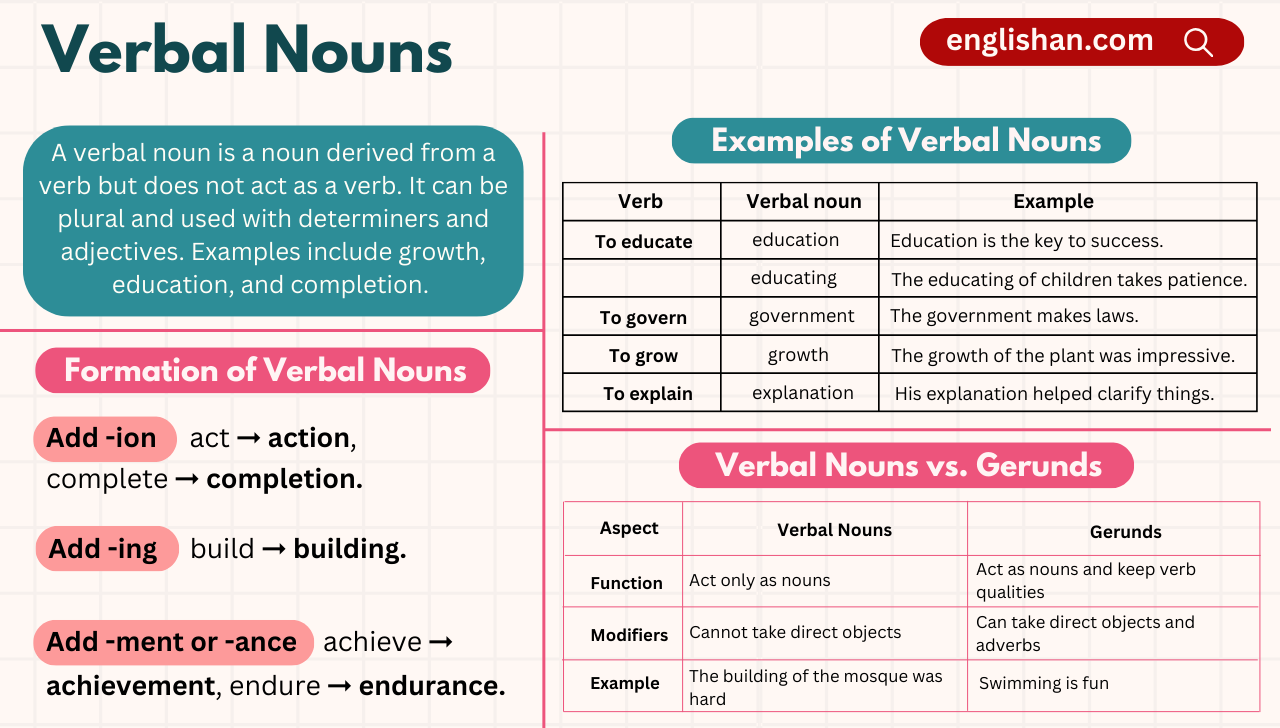
Verbal nouns are made by taking the base form of a verb and adding suffixes like -ion, -ing, -ment, or -ance. They might look like gerunds, but there is a key difference between them.
Adding -ion:
Many verbal nouns are made by adding “-ion” to the base verb.
- act ➞ action
- complete ➞ completion
These verbal nouns are used to talk about the result or process of the verb.
Adding -ing:
Verbs can also become verbal nouns by adding “-ing” to their base form.
- build ➞ building
In the sentence The building of the mosque took years,” building is a verbal noun.
Adding -ment or -ance:
Some verbal nouns are formed by adding “-ment” or “-ance”.
- achieve ➞ achievement
- endure ➞ endurance
These forms are often used to show the result or quality of an action.
Knowing these different ways to form verbal nouns helps us identify them in sentences and understand their role more easily.
Examples of Verbal Nouns
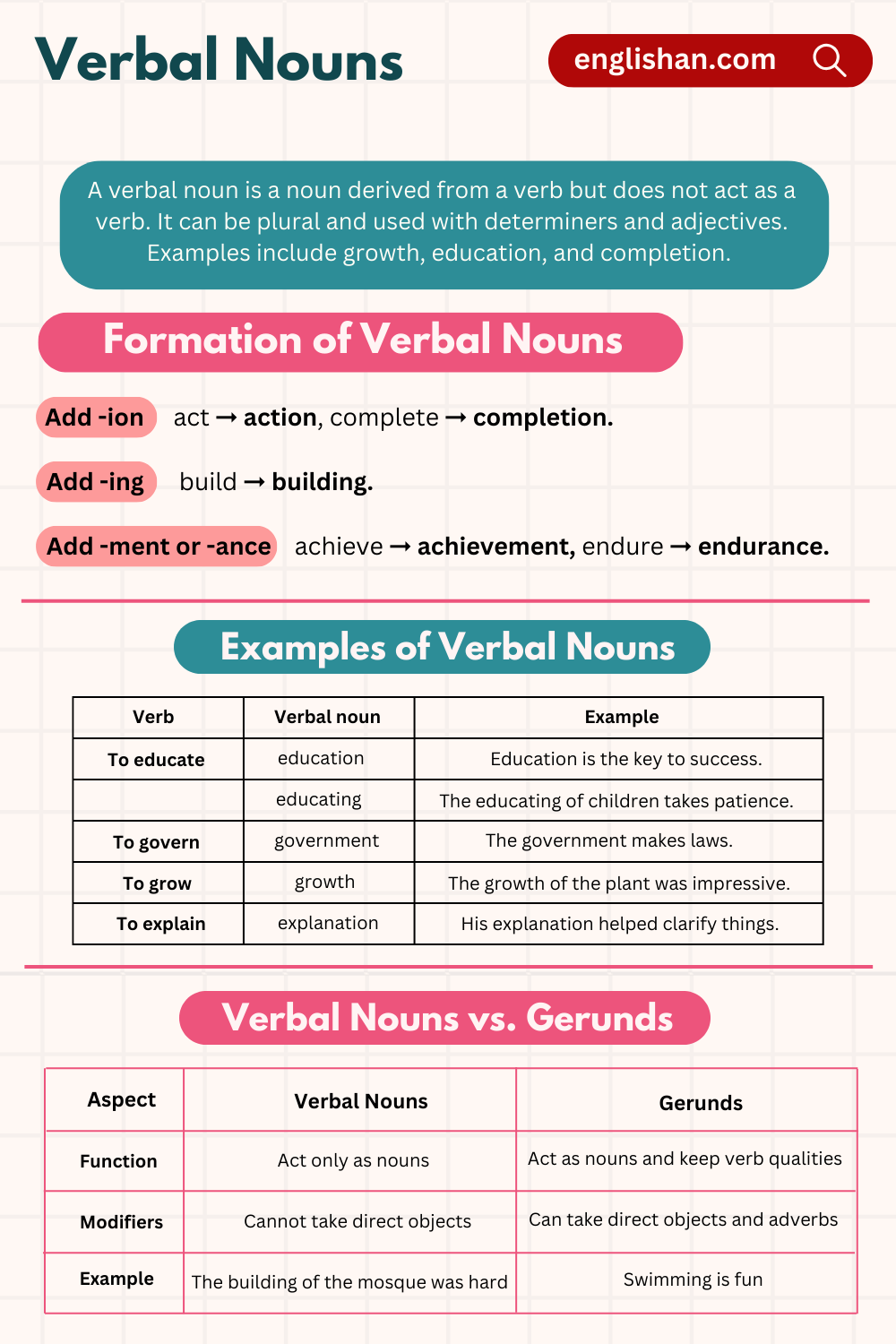
Verbal nouns are used to talk about actions in a noun form, which makes sentences more abstract or descriptive. Below is a table that shows different examples of verbal nouns, along with sentences to show how they are used.
| Verb | Verbal Noun | Example in a Sentence |
| To educate | education | Education is the key to success. |
| educating | The educating of children requires patience. | |
| To govern | government | The government is responsible for making laws. |
| To perform | performance | Her performance was applauded by the entire audience. |
| To grow | growth | The growth of the plant was impressive. |
| To explain | explanation | His explanation helped clarify the topic. |
| To respond | response | Her response was well thought out. |
(Note: With some verbs, the verbal noun is the same as the base form of the verb.)
The Difference Between Verbal Nouns and Gerunds
It can be confusing to tell the difference between verbal nouns and gerunds. Both come from verbs and can look similar, but they work differently in sentences.
| Aspect | Verbal Nouns | Gerunds |
| Function | Act only as nouns | Act as both nouns and keep some verb-like qualities |
| Characteristics | Cannot take direct objects or be modified by adverbs | Can take direct objects and be modified by adverbs |
| Example | The building of the mosque was complex. | Swimming is fun. |
This difference is important because it affects how we use these forms in sentences and what words can modify them.
Why Verbal Nouns Are Important
Verbal nouns are important because they let us talk about actions or processes in a general way without saying who is doing the action. They are especially helpful in academic writing, descriptions, and formal speech.
Abstract Representation:
Verbal nouns let us talk about actions as ideas rather than specific events.
- The management of resources is crucial for success.
Here, management helps us talk about the idea without specifying who is managing.
Clarity in Communication:
Using verbal nouns can make writing clearer and shorter by focusing on the action or process itself.
For example, “The endurance of participants was remarkable” is more concise and focuses on the quality.
FAQs
A verbal noun is a noun derived from a verb but does not act as a verb. It can be plural and used with determiners and adjectives. Examples include growth, education, and completion.
Verbal nouns act only as nouns and cannot take direct objects or be modified by adverbs, while gerunds can take objects and be modified by adverbs.
Sure! In the sentence “The completion of the project was delayed,” completion is a verbal noun that refers to the process of completing the project.
Verbal nouns are formed by adding suffixes like -ion, -ing, -ment, or -ance to the base form of a verb. Examples include completion, building, and achievement.
Conclusion
Verbal nouns are an important part of English grammar that help us talk about actions or processes in an abstract way. By learning to identify and use verbal nouns, we can improve our writing and make our communication clearer and more effective. Whether you’re writing formally or just trying to improve your language skills, understanding verbal nouns is a great way to strengthen your grammar.
You May Also Like