

The suffix -ism is one of the most productive endings in English. It attaches to a root word and creates a noun that names a belief, a practice, a condition, or a system. When you add -ism to real, for example, you get realism, and that single change turns a describing word into a full concept with its own meaning, its own history, and its own place in conversation. The same pattern runs through politics, medicine, art, science, and everyday speech, which is why -ism words appear so often in reading and why recognizing the suffix makes unfamiliar words much easier to understand.
The words that end in -ism below are sorted by word length, starting with the shortest and moving through to the longest, with meanings included for the entries that are most worth learning.
Common Words That End in ISM with Meanings
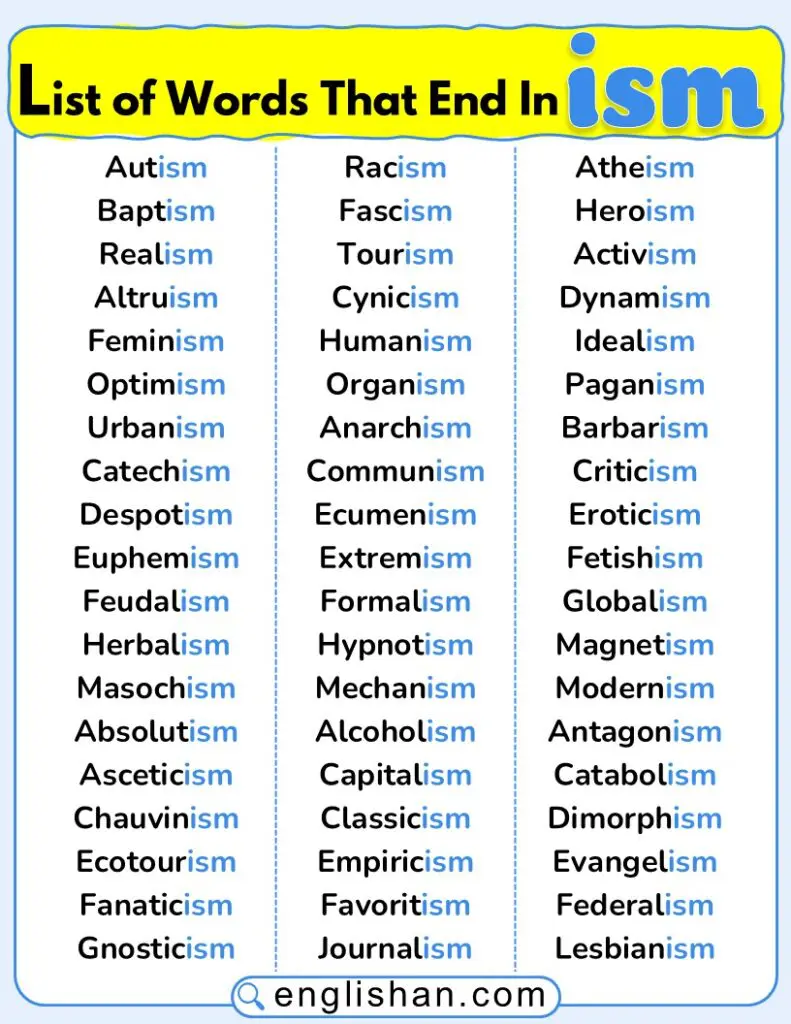
These are the -ism words that come up most in reading, writing, and conversation. If you are building your vocabulary or preparing for an exam, these are the ones to learn first.
- Activism: taking direct action to bring about political or social change.
- Altruism: caring about other people’s well-being without expecting anything in return.
- Atheism: not believing in any god or gods.
- Capitalism: an economic system where businesses and property are privately owned, and owners make decisions for profit.
- Communism: a political system where property and wealth belong to the whole community and are shared equally.
- Criticism: judging the strengths and weaknesses of a work, an idea, or an action.
- Cynicism: distrusting other people’s motives and believing that most people act only for their own benefit.
- Despotism: rule by a single person who holds all the power and uses it without limits.
- Empiricism: the idea that real knowledge comes from direct observation and experience, not from theory alone.
- Extremism: holding radical political or religious views and being willing to use force or pressure to advance them.
- Fascism: a political system run by a dictator, built on nationalism and the forceful silencing of opposition.
- Federalism: a system of government that divides power between a central authority and smaller regional governments.
- Feminism: the belief that all genders deserve equal rights and equal opportunities.
- Feudalism: the medieval system where lords gave land to workers in exchange for labor and loyalty.
- Heroism: great bravery, especially when facing danger or hardship.
- Humanism: a way of thinking that puts human well-being, reason, and potential at the center.
- Idealism: believing in and working toward high principles, even when the practical odds are difficult.
- Journalism: gathering, writing, and sharing news through newspapers, television, radio, or online media.
- Liberalism: a political philosophy that values individual rights, personal freedom, and government by consent.
- Magnetism: the physical force that pulls certain metals toward a magnet, or a person’s natural ability to attract others.
- Masochism: a pattern of getting satisfaction from one’s own pain or suffering.
- Mechanism: the way the parts of a machine or a process work together to produce a result.
- Metabolism: the chemical processes inside a living body that turn food into energy and building material.
- Militarism: the belief that a country should build and maintain a strong military and be ready to use it.
- Narcissism: being overly focused on yourself, your appearance, and your own needs above everyone else’s.
- Nationalism: deep loyalty to one’s own country, often with the belief that it is better than others.
- Nihilism: the belief that life has no higher meaning and that moral or religious rules have no real foundation.
- Optimism: expecting good things to happen and seeing the positive side of situations.
- Organism: any living thing, from a single-celled bacterium to a whale or a redwood tree.
- Pacifism: the belief that war and violence are wrong and that disagreements should be settled through peaceful means.
- Patriotism: love for one’s own country and a willingness to support and defend it.
- Pessimism: expecting bad outcomes and focusing on the negative side of situations.
- Plagiarism: copying someone else’s words, ideas, or work and presenting them as your own.
- Pluralism: a society or system where different groups, beliefs, and viewpoints exist side by side.
- Populism: a political style that claims to speak for ordinary people against a powerful elite.
- Pragmatism: focusing on what works in practice rather than on theories or ideals.
- Racism: treating people unfairly or with hostility because of their race or ethnic background.
- Realism: accepting things as they are and dealing with them practically. In art, showing life as it actually looks.
- Romanticism: an artistic movement from the late 1700s that valued emotion, nature, and individual expression over strict order and reason.
- Surrealism: an art movement that expressed dreams, the unconscious mind, and strange combinations of images that don’t follow logic.
- Terrorism: using violence or threats against civilians to force political change through fear.
- Tourism: traveling for pleasure, and the businesses and services that support it.
- Vandalism: deliberately damaging or destroying someone else’s property.
5 Letter Words That End in ISM
- Agism
- Deism
- Prism
- Seism
Only four five-letter words carry this ending. Prism is the most recognized, the glass shape that splits white light into a rainbow of colors. Deism is the belief that a creator made the universe but does not interfere with it. Seism is another word for an earthquake. Agism is a shorter spelling of ageism, meaning unfair treatment based on a person’s age.
6 Letter Words That End in ISM
- Ageism
- Audism
- Autism
- Chrism
- Civism
- Cubism
- Egoism
- Eonism
- Favism
- Holism
- Iodism
- Lyrism
- Momism
- Monism
- Mutism
- Nanism
- Nomism
- Nudism
- Obiism
- Ogrism
- Porism
- Purism
- Racism
- Sadism
- Schism
- Sexism
- Theism
- Truism
- Verism
- Yogism
7 Letter Words That End in ISM
- Ableism
- Agonism
- Animism
- Atavism
- Atheism
- Atomism
- Baalism
- Baptism
- Bogyism
- Bossism
- Bromism
- Brutism
- Bruxism
- Cambism
- Charism
- Chemism
- Cladism
- Clonism
- Cosmism
- Cultism
- Czarism
- Dadaism
- Dodoism
- Dualism
- Echoism
- Egotism
- Elitism
- Erotism
- Etatism
- Exotism
- Faddism
- Fascism
- Fauvism
- Fideism
- Fogyism
- Heroism
- Hoboism
- Idolism
- Imagism
- Jujuism
- Laddism
- Laicism
- Leftism
- Leucism
- Locoism
- Lookism
- Mobbism
- Narcism
- Obelism
- Ogreism
- Onanism
- Oralism
- Orphism
- Peonism
- Pianism
- Pietism
- Plenism
- Realism
- Sizeism
- Slumism
- Sophism
- Statism
- Tachism
- Tourism
- Tropism
- Tsarism
- Tychism
- Tzarism
- Utopism
- Wholism
8 Letter Words That End in ISM
- Acrotism
- Actinism
- Activism
- Alarmism
- Albinism
- Algorism
- Alienism
- Allelism
- Alpinism
- Altruism
- Aneurism
- Aphorism
- Archaism
- Asterism
- Atropism
- Atticism
- Autecism
- Binarism
- Botulism
- Cabalism
- Casteism
- Centrism
- Chartism
- Civicism
- Classism
- Colorism
- Cronyism
- Cynicism
- Dandyism
- Demonism
- Dimerism
- Ditheism
- Druidism
- Dwarfism
- Dynamism
- Embolism
- Endemism
- Ergotism
- Escapism
- Euphuism
- Exorcism
- Fabulism
- Familism
- Faradism
- Fatalism
- Feminism
- Finalism
- Fogeyism
- Futurism
- Giantism
- Hedonism
- Helotism
- Humanism
- Idealism
- Idiotism
- Jingoism
- Kabalism
- Laconism
- Legalism
- Lobbyism
- Localism
- Loyalism
- Luminism
- Lyricism
- Machoism
- Melanism
- Modalism
- Moralism
- Nativism
- Nepotism
- Nihilism
- Nomadism
- Occultism
- Optimism
- Organism
- Pacifism
- Populism
- Priapism
- Quietism
- Regalism
- Royalism
- Ruralism
- Satanism
- Savagism
- Sciolism
- Snobbism
- Solecism
- Stoicism
- Tokenism
- Totemism
- Unionism
- Urbanism
- Veganism
- Virilism
- Vocalism
- Voltaism
- Zombiism
9 Letter Words That End in ISM
- Absurdism
- Academism
- Amoralism
- Anabolism
- Anarchism
- Animalism
- Atonalism
- Barbarism
- Biologism
- Careerism
- Catechism
- Chimerism
- Cretinism
- Criticism
- Defeatism
- Denialism
- Despotism
- Diabolism
- Dichroism
- Dogmatism
- Ecumenism
- Epicurism
- Eremitism
- Eroticism
- Euphemism
- Exoticism
- Expertism
- Extremism
- Fetishism
- Feudalism
- Formalism
- Galvanism
- Gigantism
- Globalism
- Herbalism
- Hermitism
- Hirsutism
- Hybridism
- Hypnotism
- Isomerism
- Lathyrism
- Magnetism
- Masochism
- Mechanism
- Meliorism
- Mentalism
- Mesmerism
- Modernism
- Mosaicism
- Mutualism
- Mysticism
- Neologism
- Occultism
- Ostracism
- Pantheism
- Pauperism
- Pessimism
- Pluralism
- Privatism
- Syllogism
- Vandalism
- Volcanism
- Vulgarism
- Welfarism
10 Letter Words That End in ISM
- Absolutism
- Alcoholism
- Amateurism
- Antagonism
- Asceticism
- Capitalism
- Catabolism
- Chauvinism
- Classicism
- Dimorphism
- Ecotourism
- Empiricism
- Evangelism
- Fanaticism
- Favoritism
- Federalism
- Journalism
- Metabolism
- Militarism
- Minimalism
- Monarchism
- Monetarism
- Monotheism
- Narcissism
- Naturalism
- Negativism
- Parasitism
- Patriotism
- Plagiarism
- Polytheism
- Positivism
- Pragmatism
- Puritanism
- Radicalism
- Recidivism
- Relativism
- Rheumatism
- Separatism
- Skepticism
- Specialism
- Surrealism
11 Letter Words That End in ISM
- Absenteeism
- Adventurism
- Agnosticism
- Anachronism
- Astigmatism
- Athleticism
- Behaviorism
- Cannibalism
- Catholicism
- Colonialism
- Communalism
- Consumerism
- Corporatism
- Creationism
- Determinism
- Eclecticism
- Esotericism
- Historicism
- Hooliganism
- Illusionism
- Imperialism
- Infantilism
- Isomorphism
- Materialism
- Medievalism
- Monasticism
- Nationalism
- Neuroticism
- Objectivism
- Opportunism
- Orientalism
- Parallelism
- Pastoralism
- Paternalism
- Primitivism
- Rationalism
- Regionalism
- Revisionism
- Romanticism
- Syndicalism
- Vigilantism
- Voluntarism
12 and 13 Letter Words That End in ISM
- Abolitionism
- Bilingualism
- Charlatanism
- Collectivism
- Emotionalism
- Essentialism
- Expansionism
- Isolationism
- Mercantilism
- Metamorphism
- Obscurantism
- Parochialism
- Colloquialism
- Commercialism
- Ethnocentrism
- Exhibitionism
- Functionalism
- Individualism
- Industrialism
- Neoclassicism
- Neoliberalism
- Nonconformism
- Perfectionism
- Postmodernism
- Structuralism
- Vegetarianism
- Ventriloquism
14 and 15 Letter Words That End in ISM
- Abstractionism
- Egalitarianism
- Existentialism
- Hypothyroidism
- Libertarianism
- Neocolonialism
- Sensationalism
- Sentimentalism
- Traditionalism
- Utilitarianism
- Cosmopolitanism
- Humanitarianism
- Hyperthyroidism
- Multilateralism
- Photojournalism
- Professionalism
- Totalitarianism
Uncommon Words That End in ISM Worth Knowing
Not every -ism word is obvious from its root. The ones below have specific meanings that are worth learning when you come across them in reading or word games.
- Acrotism: the absence of a detectable pulse.
- Algorism: the system of writing numbers using Arabic numerals (0 through 9), or doing arithmetic with them.
- Bruxism: grinding or clenching the teeth without realizing it, usually during sleep.
- Cambism: the theory or practice of exchanging one currency for another.
- Charism: a gift or ability believed to be granted by God, such as the power to heal or to prophesy.
- Echoism: forming a word by imitating a natural sound. Another name for onomatopoeia.
- Ergotism: poisoning from eating grain contaminated with ergot fungus. In the Middle Ages it was called St. Anthony’s fire.
- Euphuism: a style of writing that is overly elaborate and decorated. Named after Euphues, a 1578 novel by John Lyly.
- Favism: a reaction to fava beans that causes red blood cells to break down, affecting people with a specific enzyme deficiency called G6PD.
- Galvanism: producing electricity through a chemical reaction. Named after the Italian scientist Luigi Galvani.
- Hirsutism: excessive hair growth on the face and body, particularly in women, in areas where hair is not normally present.
- Laconism: saying something in as few words as possible. Named after the Spartans of ancient Laconia, who were known for their extremely brief way of speaking.
- Meliorism: the belief that the world is getting better over time and that people have the ability to help it improve.
- Mesmerism: putting someone into a trance-like state through focused attention. Named after Franz Mesmer, and it later developed into what we now call hypnosis.
- Solecism: a grammatical mistake in speech or writing. The word comes from Soloi, an ancient Greek colony in modern Turkey whose residents spoke Greek in a nonstandard way.
- Tychism: the philosophical idea that chance and randomness play a real part in how the universe works, proposed by the American philosopher Charles Sanders Peirce.
- Volcanism: volcanic activity of any kind, including eruptions, lava flows, and the movement of magma beneath the surface.
- Vulgarism: a word or phrase that is considered crude or nonstandard, used in informal speech but avoided in polished writing.
FAQs
The suffix -ism forms nouns that name a belief (capitalism, atheism), a practice (journalism, tourism), a condition (alcoholism, dwarfism), or a system (feudalism, federalism). It comes from the Greek ending -ismos through the Latin -ismus.
That depends on the dictionary. The Official Scrabble Players Dictionary has around 824. Broader, unabridged dictionaries list over 3,000, though most of those are rare technical or academic terms that seldom appear in ordinary reading.
The ones you will see most often in newspapers, books, and conversation include capitalism, criticism, feminism, heroism, journalism, mechanism, metabolism, nationalism, optimism, organism, patriotism, pessimism, plagiarism, racism, realism, terrorism, tourism, and vandalism.
The suffix -ism names the belief, system, or practice itself. The suffix -ist names the person connected to it. Feminism is the movement; a feminist is the person who supports it. Journalism is the profession; a journalist is the person who does the work.
You May Also Like
- Words That End In ABLE
- Words That End With OUS
- Words That End In FUL
- Words Ending With LY
- Words Ending in Tion
- Words That End in An
- Five Letter Words Ending in Z