

One of the most common points of confusion in English grammar is the difference between Present Simple vs Present Continuous. At first, both tenses seem to describe actions happening in the present, which often leads to mixing them up. However, each tense has a distinct purpose and is used in different situations.
This article explains both tenses in a clear and simple way, showing how they function in everyday communication. It also highlights the key differences between them so that their usage becomes easier to understand and apply correctly in writing and speech.
Present Simple vs Present Continuous
The difference between Present Simple and Present Continuous lies in how and when each tense is used to describe actions.
The Present Simple is used for actions that are regular, repeated, or always true. It talks about habits, routines, facts, and general truths.
Example 1: The sun rises in the east.
Example 2: She goes to school every day.
Example 3: They play football on Sundays.
In short, the Present Simple describes things that are stable, routine-based, or permanent in nature.
The Present Continuous, on the other hand, is used for actions that are happening right now or around the current moment. It focuses on activity in progress, not routine. It can also show temporary situations or planned future actions.
Example 1: She is studying for her exam.
Example 2: They are playing football in the ground.
Example 3: He is staying with his friend this week.
In simple terms, Present Simple talks about regular or general actions, while Present Continuous focuses on actions happening at the moment or for a temporary period.
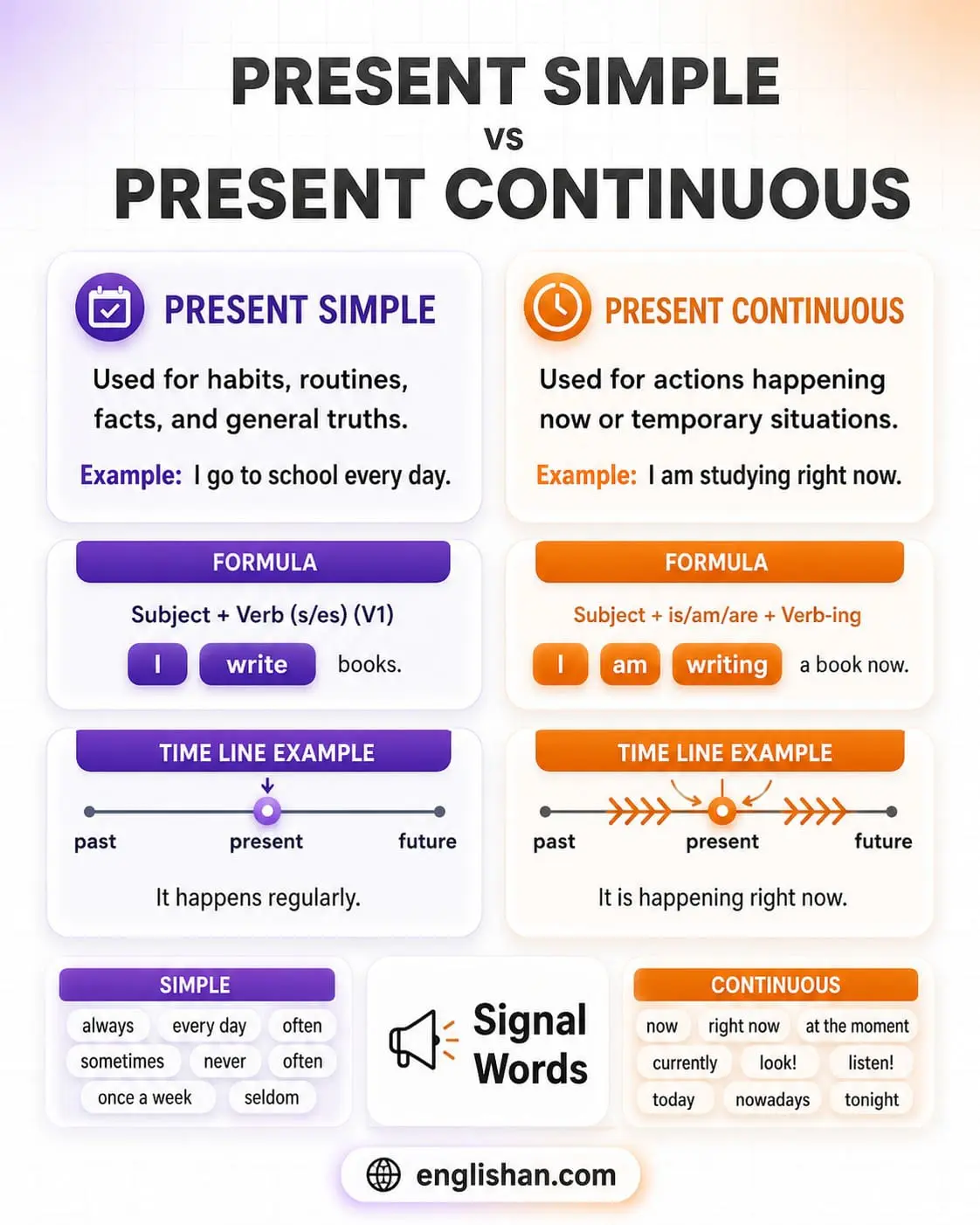
What is the Present Simple?
The Present Simple is a basic tense in English grammar used to describe actions that happen regularly, repeatedly, or are always true. It is also used for habits, routines, general facts, and universal truths.
This tense shows situations that are stable and not changing at the moment of speaking. It often expresses daily activities, fixed schedules, and scientific or general statements.
Example 1: She goes to school every day.
Example 2: The sun rises in the east.
Example 3: They play cricket on weekends.
In simple terms, the Present Simple is used for actions that happen again and again or facts that remain the same.
When we use Present Simple?
The Present Simple is used in different situations where actions are regular, fixed, or generally true. Each use shows a specific type of meaning in everyday English.
Habits and routines
The Present Simple is used to describe actions that happen regularly as part of daily life. These are repeated activities that follow a pattern, such as morning routines, daily tasks, or weekly habits. It shows what normally happens in someone’s life without focusing on the exact moment.
Example 1: He wakes up early every day and goes for a walk.
Example 2: They usually have dinner at 8 PM.
In short, this use of Present Simple describes regular actions that form part of a routine or habit.
General facts and truths
This tense is also used for facts, scientific truths, and statements that are always correct. These are universal ideas that do not change with time or situation. It helps express knowledge that is generally accepted as true.
Example 1: Water boils at 100°C.
Example 2: The Earth orbits the Sun.
In short, this usage expresses permanent truths and facts that remain constant.
Permanent situations
The Present Simple is used for situations that are long-lasting or stable. It often describes life conditions such as where someone lives, works, or basic facts about a person or place that do not change frequently.
Example 1: She lives in Karachi.
Example 2: He works in a private company.
In short, this use refers to situations that are permanent or long-term in nature.
Scheduled events (timetables)
This tense is also used for fixed schedules such as transport systems, school timings, or official programs. Even though these events may happen in the future, they are treated as fixed and planned, so Present Simple is used.
Example 1: The bus leaves at 7 AM.
Example 2: The meeting starts at 10 AM.
In short, this usage is for scheduled events that follow a fixed timetable.
Overall, the Present Simple is used to describe repeated actions, general truths, permanent situations, and fixed schedules. It focuses on what is regular, constant, or officially planned rather than what is happening at the exact moment.
Present Simple Structure
The Present Simple tense follows a clear structure that changes depending on whether the sentence is positive, negative, or a question.
Positive Structure
Structure: Subject + base verb / verb + s/es
In positive sentences, the base form of the verb is used. For third-person singular subjects (he, she, it), -s or -es is added to the verb.
Example 1: She plays tennis every day.
Example 2: They go to school regularly.
In short, positive sentences use the base verb, with -s/-es added for he, she, it.
Negative Structure
Structure: Subject + do/does + not + base verb
In negative sentences, do not (don’t) or does not (doesn’t) is used, and the main verb remains in its base form.
Example 1: She does not (doesn’t) play tennis.
Example 2: They do not (don’t) go to school on Sunday.
In short, negatives are formed using do/does + not + base verb, without changing the main verb.
Question Structure
Structure: Do/Does + subject + base verb
In questions, do or does is placed at the beginning, followed by the subject and base verb.
Example 1: Do they go to school regularly?
Example 2: Does she play tennis every day?
In short, questions in Present Simple start with do/does followed by the subject and base verb.
What is Present Continuous?
The Present Continuous tense is used to describe actions that are happening at the moment of speaking or around the current time. It focuses on activities that are in progress, not completed, and often shows temporary situations.
This tense is also used to describe ongoing changes or planned future actions that are already decided. It helps express what is currently happening in a more active and dynamic way compared to other tenses.
Example 1: She is studying for her exams.
Example 2: They are playing football in the ground.
Example 3: He is staying with his friend this week.
In simple terms, the Present Continuous describes actions that are happening right now or are temporary in nature.
When we use Present Continuous?
The Present Continuous tense is used in several important situations where actions are ongoing, temporary, or already planned. Each use gives a slightly different meaning depending on the context.
Actions happening at the moment of speaking
This tense is used to describe something that is happening right now, at the exact time of speaking. It shows an activity that is in progress and not yet finished.
Example 1: She is reading a book.
Example 2: They are watching a movie.
In short, this use describes actions that are actively happening at this moment.
Temporary situations
Present Continuous is also used for situations that are not permanent and will last for a short period. These are temporary conditions or arrangements in life.
Example 1: He is staying with his friend these days.
Example 2: They are working on a short project.
In short, this usage highlights situations that are temporary and not permanent.
Changing or developing actions
It is used to show actions or situations that are changing over time. This often includes trends, improvements, or developments.
Example 1: The weather is getting colder.
Example 2: Prices are increasing rapidly.
In short, this use describes actions or situations that are gradually changing or developing.
Future planned arrangements
Present Continuous is also used for fixed plans or arrangements in the near future. These are already decided events.
Example 1: I am meeting my friend tomorrow.
Example 2: They are traveling to Lahore next week.
In short, this usage refers to planned future actions that are already arranged.
Overall, the Present Continuous tense is used to describe actions that are happening right now, temporary situations, ongoing changes, and planned future arrangements. It emphasizes activity in progress and helps express actions that are not permanent or completed.
Present Continuous Structure
The Present Continuous tense follows a clear and simple structure that changes depending on whether the sentence is positive, negative, or a question.
Positive Structure
Structure: Subject + am/is/are + verb-ing
In positive sentences, the helping verb (am, is, are) is used with the main verb in its -ing form to show an action in progress.
Example 1: She is reading a book.
Example 2: They are playing football.
IIn short, positive sentences use am/is/are + verb-ing to show ongoing actions.
Negative Structure
Structure: Subject + am/is/are + not + verb-ing
In negative sentences, not is added after the helping verb to show that the action is not happening. The main verb still remains in the -ing form.
Example 1: She is not (isn’t) reading a book.
Example 2: They are not (aren’t) playing football.
In short, negative sentences are formed using am/is/are + not + verb-ing.
Question Structure
Structure: Am/Is/Are + subject + verb-ing
In questions, the helping verb comes first, followed by the subject and the main verb in -ing form.
Example 1: Is she reading a book?
Example 2: Are they playing football?
In short, questions in Present Continuous start with am/is/are + subject + verb-ing.
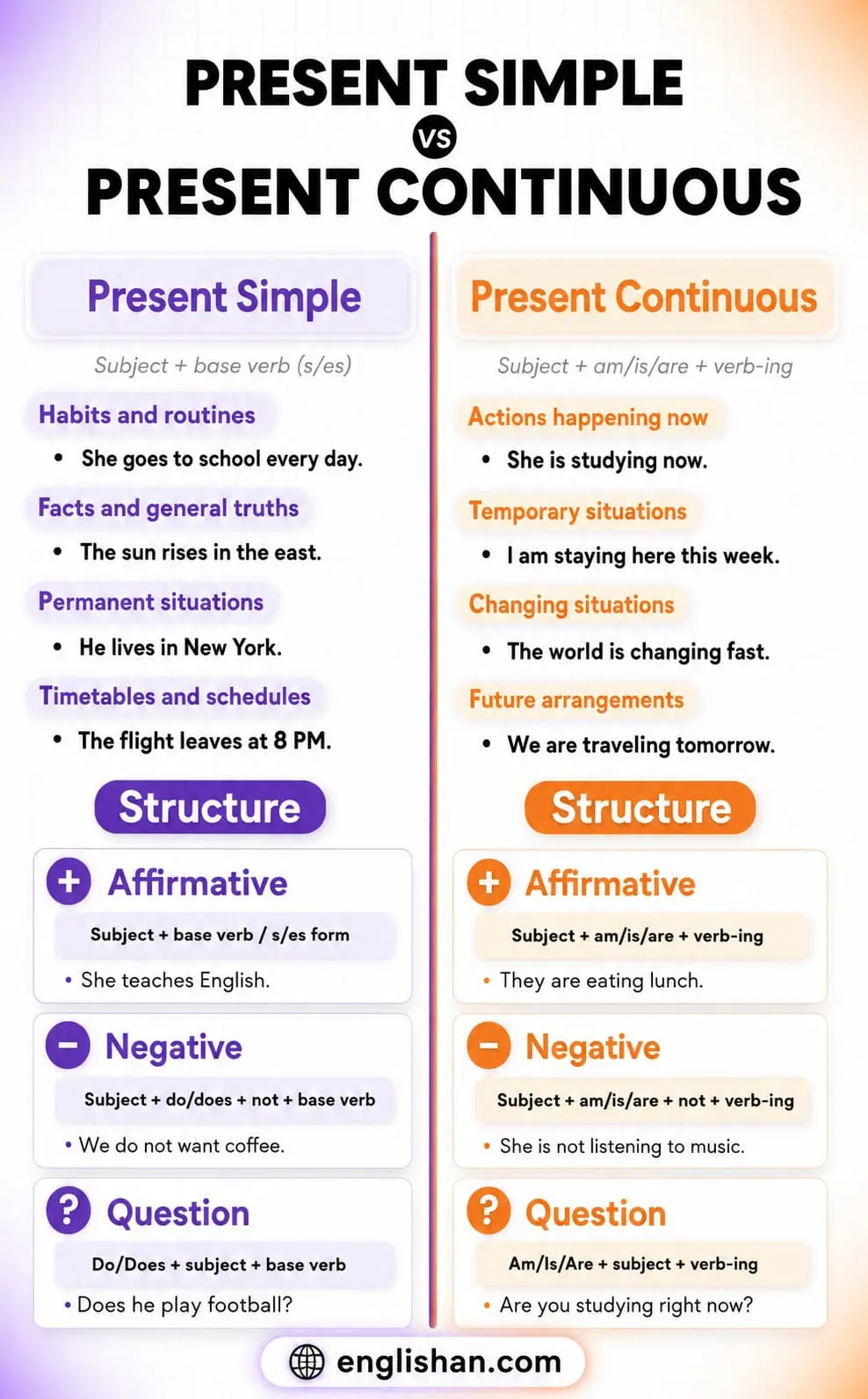
Comparison table: Present Simple vs Present Continuous
Here is a clear comparison table between Present Simple and Present Continuous:
| Feature | Present Simple | Present Continuous |
|---|---|---|
| Main Use | Habits, routines, facts, permanent situations | Actions happening now, temporary situations, ongoing changes |
| Time Focus | Regular or general time | Current or limited time |
| Structure | Subject + base verb / verb + s/es | Subject + am/is/are + verb-ing |
| Negative Form | do/does + not + base verb | am/is/are + not + verb-ing |
| Question Form | Do/Does + subject + base verb | Am/Is/Are + subject + verb-ing |
| Nature of Action | Repeated or permanent | Ongoing or temporary |
| Example | She works in a bank. | She is working in a bank today. |
| Key Idea | Regular and fixed actions | Actions in progress |
So, in simple terms, Present Simple describes regular, permanent, and factual actions, while Present Continuous describes ongoing, temporary, and currently happening actions.
Main Differences Between Present Simple and Present Continuous
The difference between Present Simple and Present Continuous becomes clear when both are compared in real-life usage. Each tense serves a different purpose, depending on whether the action is regular, ongoing, permanent, or planned.
Habitual Actions vs Ongoing Actions
Present Simple is used when an action happens regularly or as part of a routine. It describes what is normal, repeated, or always true in daily life. Present Continuous, in contrast, is used when something is happening at this exact moment or is currently in progress. It focuses on activity, not routine.
Example (Present Simple): She goes to school every day.
Example (Present Continuous): She is going to school right now.
In short, Present Simple shows repeated habits, while Present Continuous shows actions happening at the moment.
Permanent vs Temporary Situations
Present Simple describes situations that are stable and long-lasting. These are permanent conditions that do not change frequently, such as where someone lives or works. Present Continuous is used for temporary situations that are not permanent and will last only for a short time.
Example (Present Simple): He lives in Lahore.
Example (Present Continuous): He is staying in Lahore these days.
In short, Present Simple expresses permanent situations, while Present Continuous expresses temporary ones.
Future Plans vs Daily Routines
Present Simple is used for fixed schedules like timetables, programs, or official events that are already decided. Present Continuous is used for personal plans that are arranged for the near future and are already confirmed.
Example (Present Simple): The train leaves at 6 PM.
Example (Present Continuous): I am meeting my friend tomorrow.
In short, Present Simple is used for fixed routines and schedules, while Present Continuous is used for planned future arrangements.
In simple terms, Present Simple is used for habits, permanent situations, facts, and fixed schedules, while Present Continuous is used for actions happening now, temporary situations, ongoing changes, and planned future events.
Understanding Stative Verbs in Present Tenses
State verbs (also called stative verbs) are verbs that describe a condition or state rather than an action. They express how someone feels, thinks, owns, or perceives something instead of showing physical activity.
These verbs usually do not appear in continuous forms because they are not actions in progress. Instead, they describe situations that are static or unchanging at a given time.
Common categories of state verbs include:
- Feelings: love, like, hate, prefer
- Thoughts: know, believe, understand, remember
- Possession: have, own, belong
- Senses (non-action use): see, hear, smell, taste
- States of being: seem, appear, consist, contain
Example 1: I know the answer. (not I am knowing the answer)
Example 2: She owns a car. (not She is owning a car)
Example 3: He likes coffee. (not He is liking coffee)
In short, state verbs describe conditions, feelings, and thoughts, and they are generally not used in continuous forms.
Common Mistakes in Present Simple and Continuous
Common mistakes often occur when using Present Simple and Present Continuous because both tenses look similar but follow different rules. Understanding these errors helps in using each tense correctly and avoiding confusion in everyday writing and speaking.
Using Continuous Form with State Verbs
State verbs describe feelings, thoughts, possession, or understanding, and they are not normally used in continuous form because they are not active actions.
❌ Incorrect: I am knowing him.
✔ Correct: I know him.
In short, state verbs are used in Present Simple, not in Present Continuous.
Using Subject-Verb Agreement in Present Simple
In Present Simple, verbs must agree with the subject. For third-person singular (he, she, it), -s or -es must be added to the verb.
❌ Incorrect: She go to school.
✔ Correct: She goes to school.
In short, Present Simple requires correct verb form with he, she, and it.
Using “Always” to Show Complaints
Sometimes “always” is used with Present Continuous to express irritation or complaints about repeated unwanted actions.
✔ Correct: He is always making noise.
❌ Incorrect (meaning change): He always makes noise. (neutral statement, not complaint)
In short, “always” with Present Continuous shows annoyance or emotional emphasis.
Wrong Auxiliary in Present Continuous Form
Present Continuous must always use the correct helping verbs am, is, are. Other verbs like “do” cannot be used.
❌ Incorrect: I do working now.
✔ Correct: I am working now.
In short, only am/is/are are correct auxiliaries in Present Continuous.
Using Present Simple Instead of Present Continuous
Present Simple should not be used for actions happening at the moment of speaking.
❌ Incorrect: I eat dinner now.
✔ Correct: I am eating dinner now.
In short, Present Continuous is used for actions happening right now.
Using Continuous Form for Permanent States
Present Continuous should not be used for permanent situations or long-term facts.
❌ Incorrect: He is living in Pakistan (permanent situation).
✔ Correct: He lives in Pakistan.
In short, permanent situations require Present Simple, not Present Continuous.
Practice Exercises: Present Simple vs Present Continuous
This helps practice when to use Present Simple and Present Continuous in different situations like habits, facts, routines, and actions happening now.
Exercise 1: Choose the correct form (Present Simple or Present Continuous).
She usually ___ (go/goes/is going) to school every day.
Exercise 2: Fix the sentence by choosing the correct tense.
I eat dinner now.
Exercise 3: Rewrite the sentence in Present Continuous form.
He reads a book at the moment.
Exercise 4: Choose the correct option for a permanent situation.
He ___ (lives/is living) in Lahore.
Exercise 5: Correct the mistake in the sentence.
They are play football every Sunday.
Answer Key:
- She usually goes to school every day.
- I am eating dinner now.
- He is reading a book at the moment.
- He lives in Lahore.
- They play football every Sunday.
Final Thought
Present Simple and Present Continuous are two of the most commonly used tenses in English, but each has its own clear purpose. Present Simple is mainly used for habits, routines, general facts, and permanent situations, while Present Continuous focuses on actions happening at the moment, temporary situations, and ongoing changes.
Understanding the difference between these two tenses makes English more accurate and natural in both speaking and writing. Choosing the correct form depends on whether the action is regular and fixed or currently in progress and temporary.
FAQs: Present Simple vs Present Continuous
The main difference lies in the type of action each tense describes. Present Simple is used for regular habits, routines, general truths, and permanent situations. Present Continuous, on the other hand, is used for actions that are happening at the moment, temporary situations, or ongoing changes.
No, Present Simple is not used for actions happening at the exact moment of speaking. It is meant for repeated or general actions. For actions happening right now, Present Continuous is used instead, such as “I am studying now.”
In Present Simple, “-s” or “-es” is added to the verb when the subject is third-person singular (he, she, it). This is required for correct subject-verb agreement in English grammar, for example, “She plays football.”
Yes, Present Continuous can also be used to describe planned future arrangements. These are actions that are already decided or arranged, such as “I am meeting my friend tomorrow.”
Generally, state verbs are not used in Present Continuous because they describe feelings, thoughts, possession, or states rather than actions. Instead, they are used in Present Simple, for example, “I know the answer,” not “I am knowing the answer.”
You May Also Like
- 100 Simple Present Tense Sentences with Examples
- 100 Useful Declarative Sentence Examples List
- 100 Useful Present Continuous Tense Examples List
- 2 Present Continuous Tense Worksheets with Answers
Present Simple vs Present Continuous Quiz
Present Simple vs Present Continuous
Complete the fact.
Water ___ at 100 degrees Celsius.
A general truth takes the simple present, which states facts that are always so.
general truths -> simple present
Water boils at 100 degrees Celsius.
What is happening now?
Look! The bus ___.
'Look!' points to an action right now, which takes the present continuous.
actions happening now -> present continuous
Look! The bus is coming.
Temporary or permanent?
She usually cycles to work, but this week she ___ the bus.
'This week' marks a temporary change, which the present continuous handles.
temporary situations -> present continuous
This week she is taking the bus.
Type the correct negative form of the verb in brackets.
I ___ (not understand) this rule yet.
'Understand' is a stative verb, so it stays in the simple present even about right now.
stative verbs (understand) -> simple present
I don't understand this rule yet.
Mind the stative verb.
This soup ___ delicious.
Here 'taste' names a quality, a state, so it takes the simple present.
taste as a state -> simple present
This soup tastes delicious.
True or false?
The present continuous can describe an annoying, repeated habit with 'always', as in 'He is always losing his keys.'
'Always' with the continuous adds a note of irritation about a repeated habit.
always + present continuous for an irritating habit
He is always losing his keys.
Habit or now?
Emma usually ___ tea, but today she is drinking coffee.
A habit marked by 'usually' takes the present simple.
present simple for habits
Emma usually drinks tea, but today she is drinking coffee.
Action at the moment.
Be quiet — the baby ___.
An action happening right now takes the present continuous.
present continuous for something happening now
Be quiet — the baby is sleeping.
True or false?
'I am wanting a coffee' is correct.
'Want' is stative; use the present simple: 'I want a coffee.'
stative verbs take the present simple
I want a coffee.
Type the correct form of the verb in brackets.
Water ___ (boil) at 100 degrees Celsius.
A general fact takes the present simple, not the continuous.
present simple for facts
Water boils at 100 degrees Celsius.
Fixed arrangement.
We ___ Oliver at the station at six.
A fixed future arrangement takes the present continuous.
present continuous for fixed arrangements
We are meeting Oliver at the station at six.
Third-person habit.
He ___ to work by train every day.
A daily routine in the third person takes present simple with -es.
present simple -s / -es for third-person habits
He goes to work by train every day.
Action at this moment.
Listen! Someone ___ at the door.
An action happening right now takes the present continuous.
present continuous for an action happening now
Listen! Someone is knocking at the door.
State a fact.
The sun ___ in the east.
A permanent fact takes the present simple.
present simple for facts
The sun rises in the east.
Type the negative of the verb in brackets.
He ___ (not / work) on Sundays.
A habit in the third person forms its negative with 'does not' and the base verb.
does not + base verb for third-person habits
He doesn't work on Sundays.
Action at this moment.
Look! The bus ___.
An action happening at this moment takes the present continuous.
present continuous for something happening now
Look! The bus is coming.
State a routine.
We ___ dinner at seven every evening.
A daily routine takes the present simple.
present simple for routines
We have dinner at seven every evening.
True or false?
'I am understanding the lesson now' is correct.
'Understand' is stative; use the present simple: 'I understand the lesson now.'
stative verbs take the present simple
I understand the lesson now.
Fixed arrangement.
I ___ the dentist tomorrow at three.
A fixed future arrangement takes the present continuous.
present continuous for fixed arrangements
I am seeing the dentist tomorrow at three.
State a fact.
Water ___ into ice below zero.
A general truth takes the present simple.
present simple for facts
Water turns into ice below zero.
Turn on JavaScript for the interactive quiz. The full practice set is shown above.