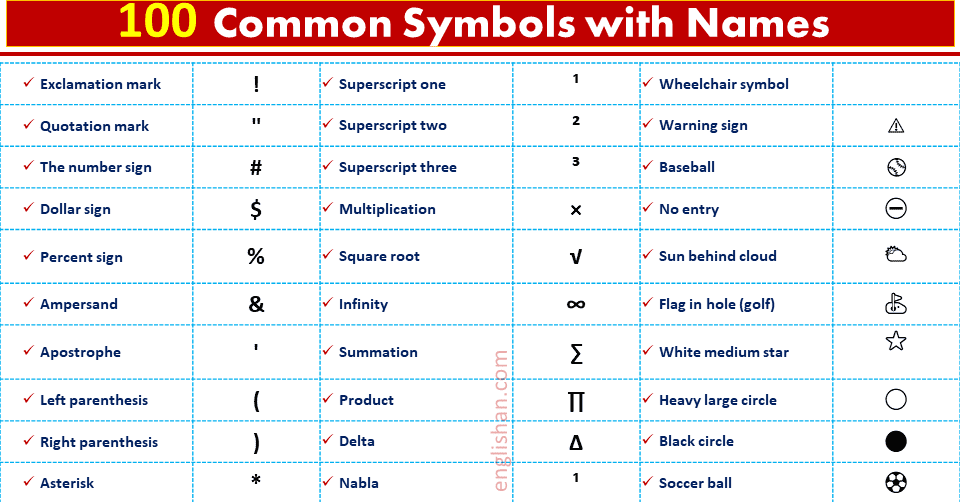
Every symbol you type has a name, and a few of those names quietly change with the setting. Symbols names belong to keyboards, math books, music sheets, and signs we see every day.
Some marks carry more than one name. The # is called hash, pound, or number sign. The & is an ampersand, and the @ is the at sign. Names often shift between writing, coding, math, and music.
Students, writers, teachers, parents helping with homework, and everyday readers can all match each symbol to its right name, recognize the common alternates, and use the version that fits the context with confidence.
Common Symbols Names Quick Reference
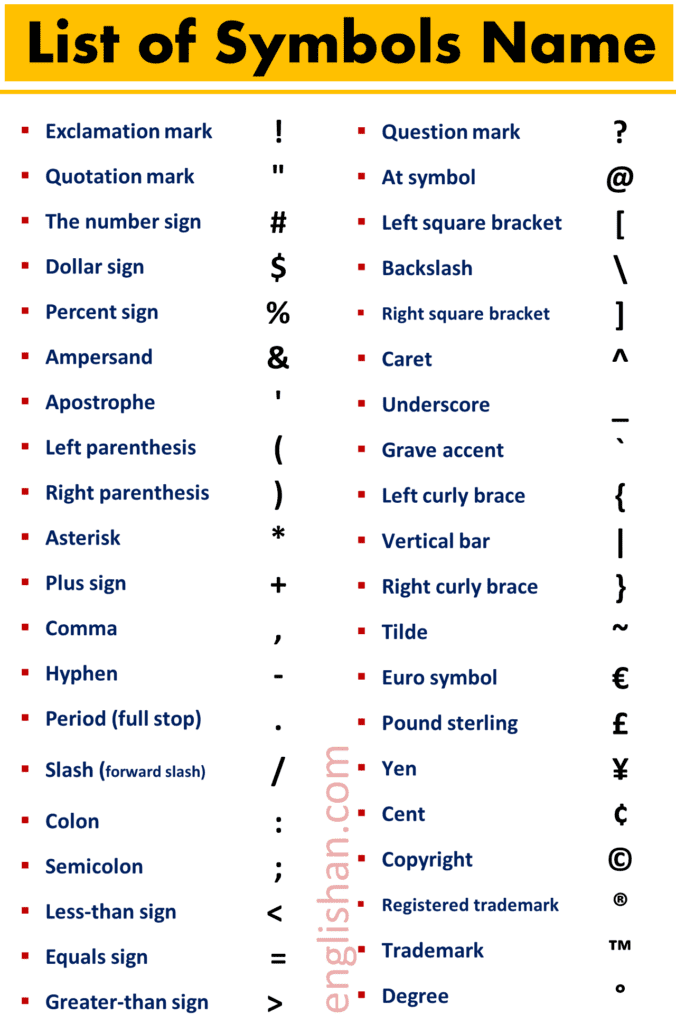
| Symbol Name | Also Called | Used in |
|---|---|---|
| Period (.) | Full stop | Punctuation |
| Comma (,) | Punctuation | |
| Question mark (?) | Questions | |
| Exclamation mark (!) | Exclamation point | Strong feeling, warning, command |
| At sign (@) | At symbol | Email, usernames, handles |
| Hash sign (#) | Number sign, pound sign, octothorpe | Numbers, hashtags, phone keys |
| Ampersand (&) | And sign | Names, titles, labels |
| Asterisk (*) | Star | Notes, required fields, corrections |
| Percent sign (%) | Percent symbol | Percentages |
| Dollar sign ($) | Dollar symbol | Currency |
| Plus sign (+) | Plus symbol | Addition, positive value |
| Minus sign (−) | Minus symbol | Subtraction, negative value |
| Slash (/) | Forward slash, solidus | Dates, URLs, alternatives |
| Backslash () | Reverse slash | Computing, file paths, code |
| Underscore (_) | Low line | Usernames, file names, code |
| Hyphen (-) | Hyphen-minus on keyboards | Compound words, word breaks |
| Equal sign (=) | Equals sign | Equality, assignment in code |
| Parentheses ( ) | Round brackets | Extra information, grouping |
| Square brackets [ ] | Brackets | Inserted notes, technical grouping |
| Braces { } | Curly brackets | Sets, code blocks, structured data |
| Angle brackets < > | Chevrons in some contexts | HTML, placeholders, math notation |
| Colon (:) | None common | Lists, explanations, time |
| Semicolon (;) | None common | Related clauses, complex lists |
| Apostrophe (‘) | Single quote in informal typing | Possession, contractions |
| Quotation marks (“ ”) | Double quotes | Direct speech, quoted text |
Punctuation Symbols Names
Punctuation symbols shape written language by separating ideas, marking tone, framing quotations, and showing how one part of a sentence relates to another.
- Period (.): Also called a full stop, the period closes a statement, marks many abbreviations, and creates a firm pause at the end of a sentence.
- Comma (,): The comma separates items, clauses, introductory phrases, and inserted details, while its placement often changes the rhythm of a sentence.
- Question mark (?): The question mark closes a direct question, whether the sentence asks for a fact, a choice, a reason, or confirmation.
- Exclamation mark (!): Also called an exclamation point, it marks surprise, urgency, strong feeling, warning, or forceful instruction.
- Colon (:): The colon points forward to an explanation, list, quotation, subtitle, time expression, biblical reference, or ratio.
- Semicolon (;): The semicolon joins closely related independent clauses, and it also separates complex list items that contain commas.
- Apostrophe (‘): The apostrophe marks possession, as in Maria’s book, or missing letters, as in don’t and we’re.
- Quotation marks (“ ”): Quotation marks frame exact speech, quoted text, certain titles, and words discussed as words.
- Single quotation marks (‘ ’): Single quotation marks often mark a quote inside another quote in American style, while British style may use them as the main quotation marks.
- Hyphen (-): The hyphen joins compound words, prefixes, suffixes, and word parts, and it is shorter than both the en dash and the em dash.
- En dash (–): The en dash marks ranges, scores, routes, and relationships, as in 2015–2020, pages 10–18, or London–Paris flight.
- Em dash (—): The em dash marks a strong break or interruption in a sentence, although many formal and educational styles use it sparingly.
- Ellipsis (…): The ellipsis marks omitted words, hesitation, unfinished thought, or a trailing pause, depending on the writing context.
- Parentheses ( ): Also called round brackets, parentheses add information that can usually be removed without breaking the main sentence.
- Square brackets [ ]: Square brackets add clarification, correction, or inserted context inside quoted material, and they also appear in technical notation.
- Braces { }: Also called curly brackets, braces group items in mathematics, programming, dictionaries, and structured data.
- Angle brackets < >: Angle brackets appear in HTML tags, placeholder text, mathematical comparisons, and certain editorial or technical references.
- Bullet (•): The bullet marks an item in a vertical list, and it gives each item a visible starting point.
- Section sign (§): The section sign identifies a section in legal writing, contracts, statutes, manuals, and formal document references.
- Pilcrow (¶): The pilcrow marks a paragraph, and it often appears in word processors when formatting marks are turned on.
Keyboard Symbols Names
Keyboard symbols include punctuation marks, mathematical signs, programming characters, and technical marks that appear on standard typing keys or in keyboard shortcuts.
- Tilde (~): The tilde marks approximation in many contexts, and it also appears in computing, language diacritics, and informal digital writing.
- Backtick (`): Also called a grave accent when used as a diacritic, the backtick appears in code, Markdown, command lines, and technical writing.
- Exclamation mark (!): Also called an exclamation point, this keyboard symbol marks emphasis, warning, or command, and in programming it may carry a technical function.
- At sign (@): Also called the at symbol, the at sign appears in email addresses, online usernames, social media handles, and some pricing language.
- Hash sign (#): Also called the number sign, pound sign, or octothorpe, the hash sign marks hashtags, numbers, comments in some code, and phone keypad commands.
- Dollar sign ($): The dollar sign marks currency, and in programming or spreadsheet contexts it may also indicate variables, strings, or fixed references.
- Percent sign (%): The percent sign marks percentages, although technical contexts may also use it as a modulo operator or formatting character.
- Caret (^): The caret marks insertion in editing, exponents in plain-text math, and special operators in programming or command-line contexts.
- Ampersand (&): The ampersand represents and, and it also appears in URLs, code, business names, and compact labels.
- Asterisk (*): Also called a star, the asterisk marks footnotes, required fields, corrections, multiplication in plain text, and wildcard searches.
- Parentheses ( ): Also called round brackets, parentheses group information in writing, mathematics, programming, formulas, and keyboard instructions.
- Underscore (_): Also called a low line, the underscore joins words in usernames, file names, database fields, and code identifiers.
- Plus sign (+): The plus sign marks addition or inclusion, while keyboard shortcuts and phone numbers also use it as a visible connector.
- Equal sign (=): Also called the equals sign, this symbol marks equality, spreadsheet formulas, programming assignments, and form-style pairings.
- Square brackets [ ]: Square brackets group information in technical writing, code, citations, and editorial insertions.
- Braces { }: Also called curly brackets, braces structure code blocks, object notation, mathematical sets, and grouped alternatives.
- Vertical bar (|): Also called a pipe, the vertical bar separates alternatives, table columns, command-line operations, and logical expressions.
- Colon (:): The colon appears in time, ratios, labels, programming syntax, subtitles, and explanatory punctuation.
- Semicolon (;): The semicolon appears in writing, programming statements, data separation, and complex lists.
- Quotation marks (“ ”): Quotation marks frame spoken words, copied text, titles, strings in code, and wording discussed as wording.
- Apostrophe (‘): The apostrophe marks possession or missing letters, and in computing it may also function as a single quote.
- Slash (/): Also called a forward slash, the slash appears in URLs, fractions, dates, alternatives, and command paths.
- Backslash (): The backslash appears mainly in Windows file paths, programming escapes, technical commands, and code syntax.
Math Symbols Names
Math symbols identify operations, relationships, quantities, sets, and logical ideas, and many of them also appear in science, statistics, engineering, and technical writing.
- Plus sign (+): The plus sign marks addition, a positive value, or an added quantity.
- Minus sign (−): The minus sign marks subtraction, negative value, or loss, and it is typographically different from the keyboard hyphen.
- Multiplication sign (×): The multiplication sign marks one value multiplied by another, although an asterisk often replaces it in plain typing.
- Division sign (÷): The division sign marks one value divided by another, especially in elementary arithmetic and general math notation.
- Equal sign (=): Also called the equals sign, it states that both sides of an expression have the same value.
- Not equal sign (≠): The not equal sign states that two values, expressions, or quantities are not the same.
- Greater than sign (>): The greater than sign opens toward the larger value and points toward the smaller one.
- Less than sign (<): The less than sign points toward the smaller value and opens toward the larger one.
- Greater than or equal to sign (≥): This sign marks a value that is either larger than another value or exactly equal to it.
- Less than or equal to sign (≤): This sign marks a value that is either smaller than another value or exactly equal to it.
- Percent sign (%): The percent sign marks a value out of one hundred.
- Per mille sign (‰): The per mille sign marks a value out of one thousand.
- Square root sign (√): Also called the radical sign, it indicates the value that produces a given number when multiplied by itself.
- Pi (π): Pi names the mathematical constant used for the relationship between a circle’s circumference and diameter.
- Infinity symbol (∞): The infinity symbol marks something without limit, especially in mathematics, logic, and abstract notation.
- Approximately equal sign (≈): This sign marks values that are close enough for the context but not exactly identical.
- Plus-minus sign (±): The plus-minus sign marks possible positive and negative variation from a value.
- Delta (Δ): Delta often marks change, difference, or variation, especially in mathematics and science.
- Sigma (Σ): Sigma marks summation, especially when a series of values is being added together.
- Prime symbol (′): The prime symbol marks feet, minutes of arc, or a derivative in calculus.
- Double prime symbol (″): The double prime symbol marks inches, seconds of arc, or a second derivative.
- Integral sign (∫): The integral sign marks integration in calculus.
- Therefore sign (∴): The therefore sign introduces a conclusion in logical or mathematical reasoning.
- Because sign (∵): The because sign introduces a reason or cause in formal reasoning.
- Union symbol (∪): The union symbol joins all elements from two sets.
- Intersection symbol (∩): The intersection symbol marks only the elements shared by two sets.
- Logical and symbol (∧): The logical and symbol connects two statements that must both be true.
- Logical or symbol (∨): The logical or symbol connects alternatives in logic.
- Not sign (¬): The not sign negates a statement in logic.
Related: Mathematical Symbols
Currency Symbols Names
Currency symbols identify money values, although several signs can represent more than one national or regional currency depending on context.
- Dollar sign ($): The dollar sign marks dollar-based currencies, including the U.S. dollar, Canadian dollar, Australian dollar, and many other dollar currencies.
- Euro sign (€): The euro sign marks the euro, which is used across the Eurozone and in several related financial contexts.
- Pound sign (£): Also called the pound sterling sign, it marks the British pound and appears in UK pricing, banking, and financial writing.
- Yen sign (¥): The yen sign marks the Japanese yen, although the same symbol may also represent the Chinese yuan in some contexts.
- Indian rupee sign (₹): The Indian rupee sign marks India’s official currency.
- Rupee sign (₨): The rupee sign appears with currencies such as the Pakistani rupee, Sri Lankan rupee, and Nepalese rupee.
- Won sign (₩): The won sign marks the South Korean won and may also appear in historical Korean currency references.
- Turkish lira sign (₺): The Turkish lira sign marks the currency of Türkiye.
- Peso sign (₱): The peso sign marks the Philippine peso, while other peso currencies often use a dollar-style sign in local contexts.
- Naira sign (₦): The naira sign marks the Nigerian naira.
- Hryvnia sign (₴): The hryvnia sign marks the Ukrainian hryvnia.
- Dong sign (₫): The dong sign marks the Vietnamese đồng.
- Tenge sign (₸): The tenge sign marks the Kazakhstani tenge.
- Cedi sign (₵): The cedi sign marks the Ghanaian cedi.
- Baht sign (฿): The baht sign marks the Thai baht.
- Bitcoin sign (₿): The bitcoin sign marks Bitcoin as a cryptocurrency symbol rather than a national currency sign.
Related: Currencies Symbols
Greek Symbols Names
Greek symbols appear as letters in the Greek alphabet and as technical symbols in mathematics, science, engineering, statistics, finance, and academic notation.
- Alpha (Α, α): Alpha is the first Greek letter, and it often marks angles, significance levels, first versions, or leading values.
- Beta (Β, β): Beta is the second Greek letter, and it appears in testing labels, financial volatility, statistics, and scientific notation.
- Gamma (Γ, γ): Gamma appears in mathematics, physics, finance, radiation terms, and several technical formulas.
- Delta (Δ, δ): Delta often marks change or difference, while lowercase delta can mark a small quantity in technical notation.
- Epsilon (Ε, ε): Epsilon often marks a small quantity, error tolerance, or limiting behavior in mathematical language.
- Zeta (Ζ, ζ): Zeta appears in mathematics, physics, and formal notation.
- Eta (Η, η): Eta often marks efficiency, viscosity, or technical variables in science and engineering.
- Theta (Θ, θ): Theta commonly marks an angle in trigonometry, geometry, and physics.
- Iota (Ι, ι): Iota is a Greek letter used in formal notation, linguistics, and classical references.
- Kappa (Κ, κ): Kappa appears in statistics, physics, geometry, and measurement notation.
- Lambda (Λ, λ): Lambda often marks wavelength, eigenvalues, decay constants, or anonymous functions in programming.
- Mu (Μ, μ): Mu marks the metric prefix micro in many unit symbols, and it also appears as a mean or coefficient symbol.
- Nu (Ν, ν): Nu appears in physics, statistics, and mathematical notation.
- Xi (Ξ, ξ): Xi appears in mathematics, physics, and formal symbolic notation.
- Omicron (Ο, ο): Omicron is a Greek letter, although it is less common as a technical symbol than alpha, beta, theta, or omega.
- Pi (Π, π): Pi marks the circle constant in lowercase form, while uppercase pi can mark a product in mathematics.
- Rho (Ρ, ρ): Rho often marks density, correlation, or rate sensitivity in finance.
- Sigma (Σ, σ): Uppercase sigma marks summation, while lowercase sigma often marks standard deviation.
- Tau (Τ, τ): Tau often marks torque, a time constant, or another technical variable.
- Upsilon (Υ, υ): Upsilon appears in Greek-letter notation and selected scientific contexts.
- Phi (Φ, φ): Phi marks the golden ratio, magnetic flux, or an angle, depending on the field.
- Chi (Χ, χ): Chi appears in statistics, especially in chi-squared notation.
- Psi (Ψ, ψ): Psi commonly marks a wave function in quantum mechanics and appears in mathematical notation.
- Omega (Ω, ω): Uppercase omega marks ohms in electrical measurement, while lowercase omega often marks angular frequency.
Arrow Symbols Names
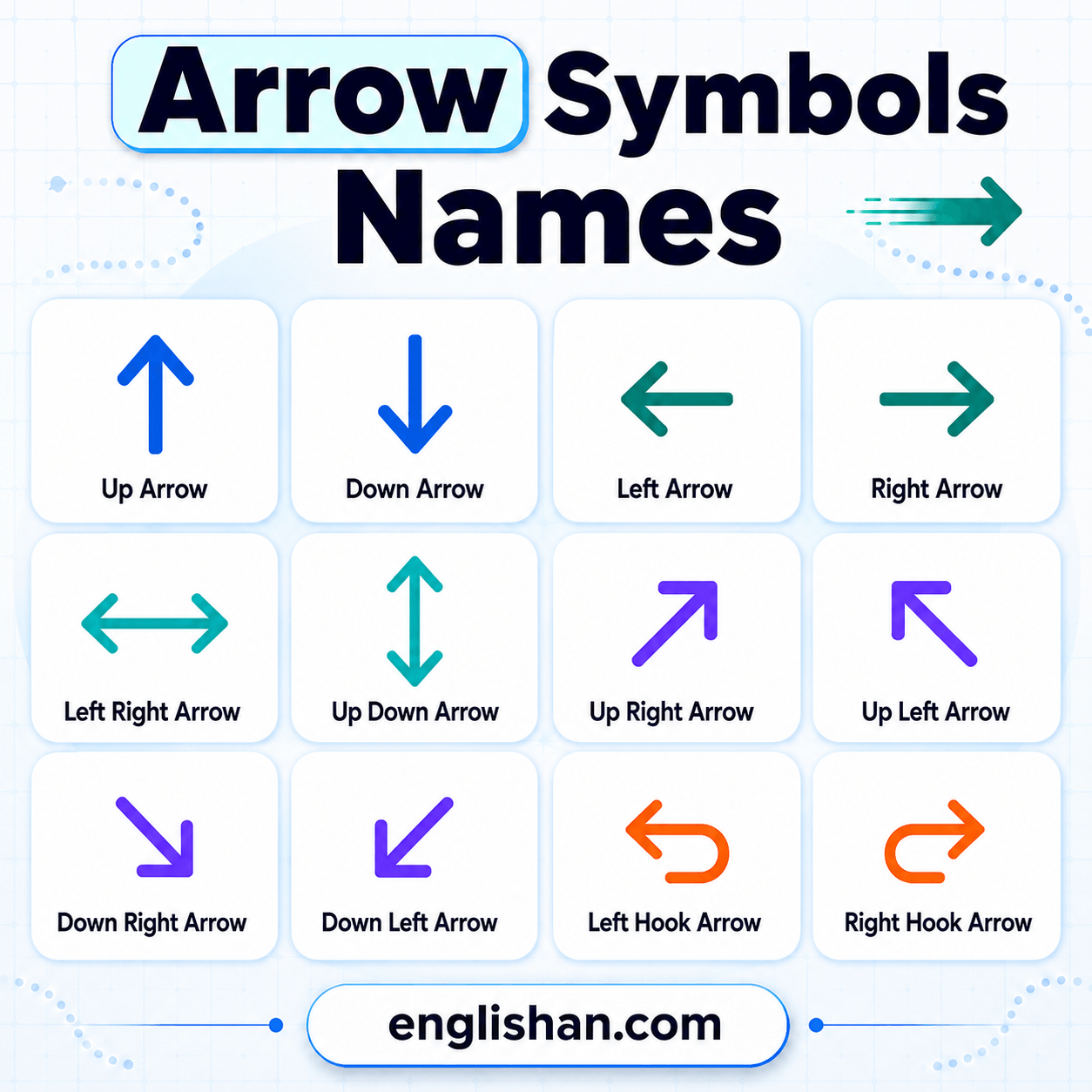
Arrow symbols point toward direction, movement, sequence, return, exchange, implication, or repetition, and their names usually follow the arrow’s visible direction.
- Left arrow (←): The left arrow points backward, leftward, or toward a previous item.
- Right arrow (→): The right arrow points forward, rightward, or toward a result.
- Up arrow (↑): The up arrow marks upward movement, increase, upload direction, or top navigation.
- Down arrow (↓): The down arrow marks downward movement, decrease, download direction, or lower placement.
- Left-right arrow (↔): The left-right arrow marks two-way movement, exchange, balance, or correspondence.
- Up-down arrow (↕): The up-down arrow marks vertical movement in both directions.
- Double right arrow (⇒): The double right arrow often marks implication in logic, mathematics, and formal reasoning.
- Double left-right arrow (⇔): The double left-right arrow often means if and only if in logic and mathematics.
- Return arrow (↵): The return arrow marks the Enter or Return key in keyboard instructions.
- Curved left arrow (↩): The curved left arrow often marks reply, return, undo, or backward movement.
- Curved right arrow (↪): The curved right arrow often marks forward movement, redo, or redirection.
- Clockwise arrow (↻): The clockwise arrow marks refresh, repeat, restart, or clockwise rotation.
- Counterclockwise arrow (↺): The counterclockwise arrow marks undo, reverse rotation, or counterclockwise movement.
- Equilibrium arrow (⇌): The equilibrium arrow marks reversible or balanced movement, especially in chemical reactions.
Science And Measurement Symbols Names
Science and measurement symbols identify units, quantities, scales, electrical values, physical forces, and technical measurements.
- Degree symbol (°): The degree symbol marks angles, geographic coordinates, and temperature scales when paired with a temperature letter.
- Celsius symbol (°C): The Celsius symbol marks temperature on the Celsius scale.
- Fahrenheit symbol (°F): The Fahrenheit symbol marks temperature on the Fahrenheit scale.
- Kelvin symbol (K): Kelvin marks absolute temperature in scientific measurement, and it does not use a degree sign in formal notation.
- Micro symbol (μ): The micro symbol marks one-millionth of a unit, as in micrometre, microsecond, or microgram.
- Ohm symbol (Ω): The ohm symbol marks electrical resistance.
- Volt symbol (V): The volt symbol marks electric potential or voltage.
- Ampere symbol (A): The ampere symbol marks electric current.
- Watt symbol (W): The watt symbol marks power.
- Joule symbol (J): The joule symbol marks energy, work, or heat.
- Newton symbol (N): The newton symbol marks force.
- Gram symbol (g): The gram symbol marks a metric unit of mass.
- Kilogram symbol (kg): The kilogram symbol marks one thousand grams and functions as a base unit in the metric system.
- Metre symbol (m): Also spelled meter in American usage, the metre symbol marks a metric unit of length.
- Kilometre symbol (km): Also spelled kilometer in American usage, the kilometre symbol marks one thousand metres.
- Second symbol (s): The second symbol marks the base unit of time.
- Minute symbol (min): The minute symbol marks sixty seconds in scientific and technical writing.
- Hour symbol (h): The hour symbol marks sixty minutes in technical notation.
- Mole symbol (mol): The mole symbol marks a standard amount of substance in chemistry.
- Litre symbol (L): Also spelled liter in American usage, the litre symbol marks liquid volume.
Technology And Internet Symbols Names
Technology symbols act as visual cues in apps, websites, software, devices, media players, and online accounts.
- Wi-Fi symbol: The Wi-Fi symbol marks wireless internet connection and signal strength.
- Bluetooth symbol: The Bluetooth symbol marks short-range wireless pairing between devices.
- Power symbol (⏻): The power symbol marks on, off, standby, or device power control.
- Search symbol (🔍): Also called the magnifying glass, the search symbol marks a search field, search button, or lookup function.
- Settings gear (⚙): The settings gear marks controls, preferences, configuration, or account options.
- Envelope symbol (✉): The envelope symbol marks email, messages, mail, or contact options.
- Lock symbol (🔒): The lock symbol marks privacy, security, password protection, or restricted access.
- Open lock symbol (🔓): The open lock symbol marks unlocked access, released restriction, or an unsecured state.
- Cloud symbol (☁): The cloud symbol marks cloud storage, online services, sync status, or weather in another context.
- Download symbol (⬇): The download symbol marks receiving, saving, or pulling a file onto a device.
- Upload symbol (⬆): The upload symbol marks sending, submitting, or transferring a file from a device.
- Menu symbol (☰): Also called the hamburger menu, the menu symbol opens navigation options or hidden controls.
- Check mark (✓): The check mark marks correct, approved, selected, completed, or verified status.
- Cross mark (✗): The cross mark marks wrong, rejected, unavailable, cancelled, or removed status.
- Information symbol (ⓘ): The information symbol marks extra details, guidance, notes, or interface explanations.
- Play symbol (▶): The play symbol starts audio, video, animation, or media playback.
- Pause symbol (⏸): The pause symbol temporarily stops playback or activity without ending it.
- Stop symbol (⏹): The stop symbol ends playback, recording, or an active process.
- Record symbol (⏺): The record symbol starts audio, video, or screen recording.
Related: Emoji Symbols and Their Meanings
Safety And Warning Symbols Names
Safety symbols use strong visual marks to signal danger, restriction, caution, emergency equipment, or required attention.
- Warning symbol (⚠): The warning symbol marks caution, risk, or a condition that needs attention.
- Radioactive symbol (☢): The radioactive symbol marks ionising radiation or radioactive material.
- Biohazard symbol (☣): The biohazard symbol marks biological risk, infectious material, contaminated waste, or laboratory hazard.
- Prohibited symbol (🚫): The prohibited symbol marks an action that is not allowed.
- No entry symbol (⛔): The no entry symbol blocks access to a road, area, doorway, or restricted place.
- Stop sign (🛑): The stop sign commands a full stop in traffic, safety, and interface contexts.
- High voltage symbol (⚡): The high voltage symbol warns of electrical danger or shock risk.
- Flammable symbol (🔥): The flammable symbol marks material that catches fire easily, although the same fire symbol can carry informal meanings online.
- Toxic symbol (☠): Also called the skull and crossbones, the toxic symbol marks poison, deadly danger, or hazardous material.
- Recycling symbol (♻): The recycling symbol marks recyclable material, recycling collection, or environmental reuse.
- Age restriction symbol (🔞): The age restriction symbol marks adult-only content, products, or access limits.
- Fire extinguisher symbol (🧯): The fire extinguisher symbol marks fire safety equipment or extinguisher location.
Music Symbols Names
Music symbols identify pitch, rhythm, silence, repetition, and performance direction, and several marks should not be confused with similar-looking keyboard symbols.
- Treble clef (𝄞): The treble clef marks higher-pitched notes, especially for violin, flute, right-hand piano, and many vocal lines.
- Bass clef (𝄢): The bass clef marks lower-pitched notes, especially for bass, cello, trombone, left-hand piano, and low voices.
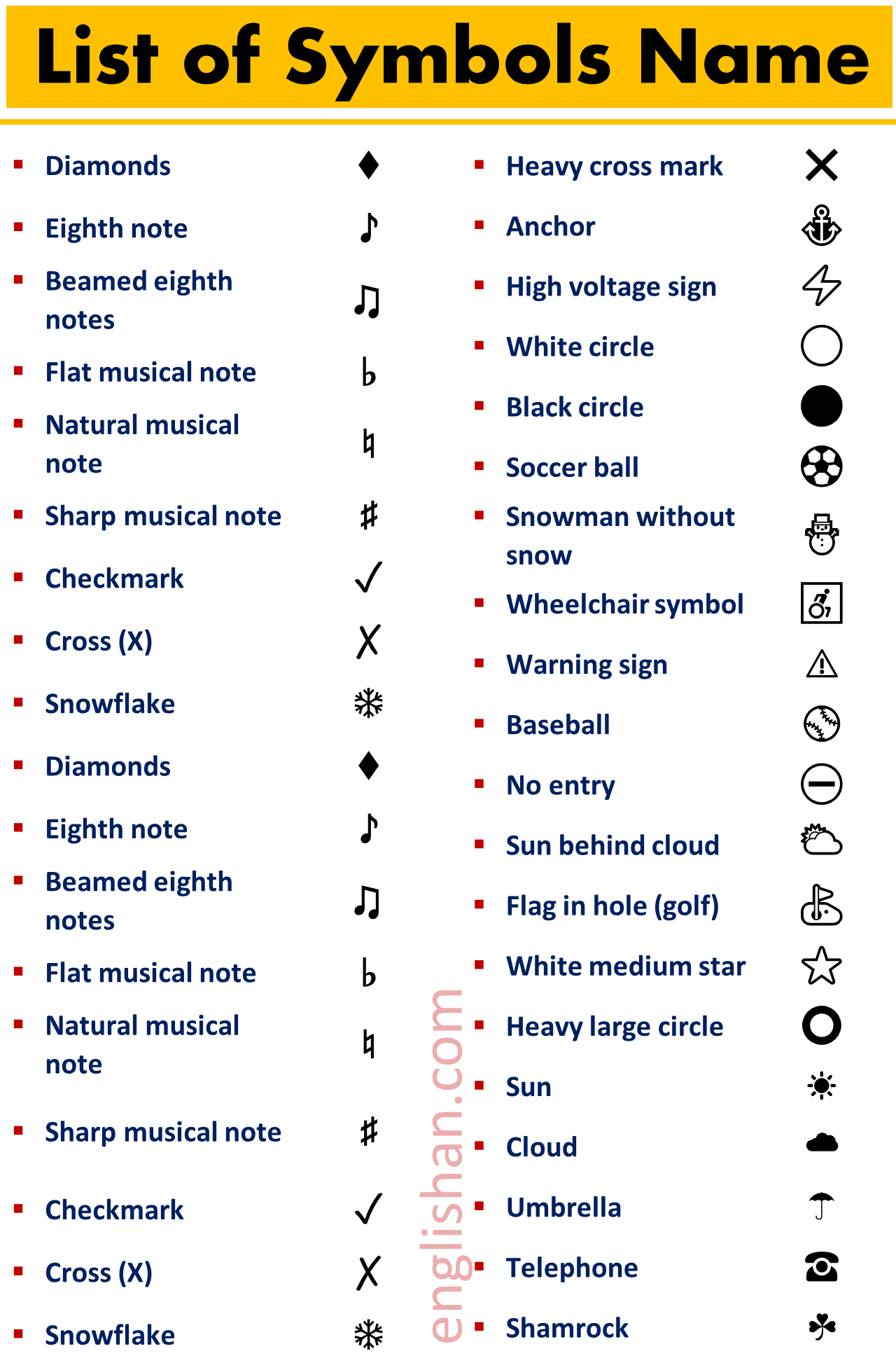
- Sharp sign (♯): The sharp sign raises a musical note by a half step, and it is not the same as the hash sign.
- Flat sign (♭): The flat sign lowers a musical note by a half step.
- Natural sign (♮): The natural sign cancels a sharp or flat and returns the note to its normal pitch.
- Quarter note (♩): The quarter note usually receives one beat in common time.
- Eighth note (♪): The eighth note usually receives half a beat in common time.
- Beamed eighth notes (♫): Beamed eighth notes visually group short notes in a rhythm.
- Rest symbol: A rest marks silence for a measured duration.
- Fermata symbol: A fermata asks the performer to hold a note longer than its written value.
- Repeat signs (𝄆 𝄇): Repeat signs send the performer back to repeat a section of music.
- Dotted note: A dotted note adds half of the note’s original value.
Related: Note of Music Symbols
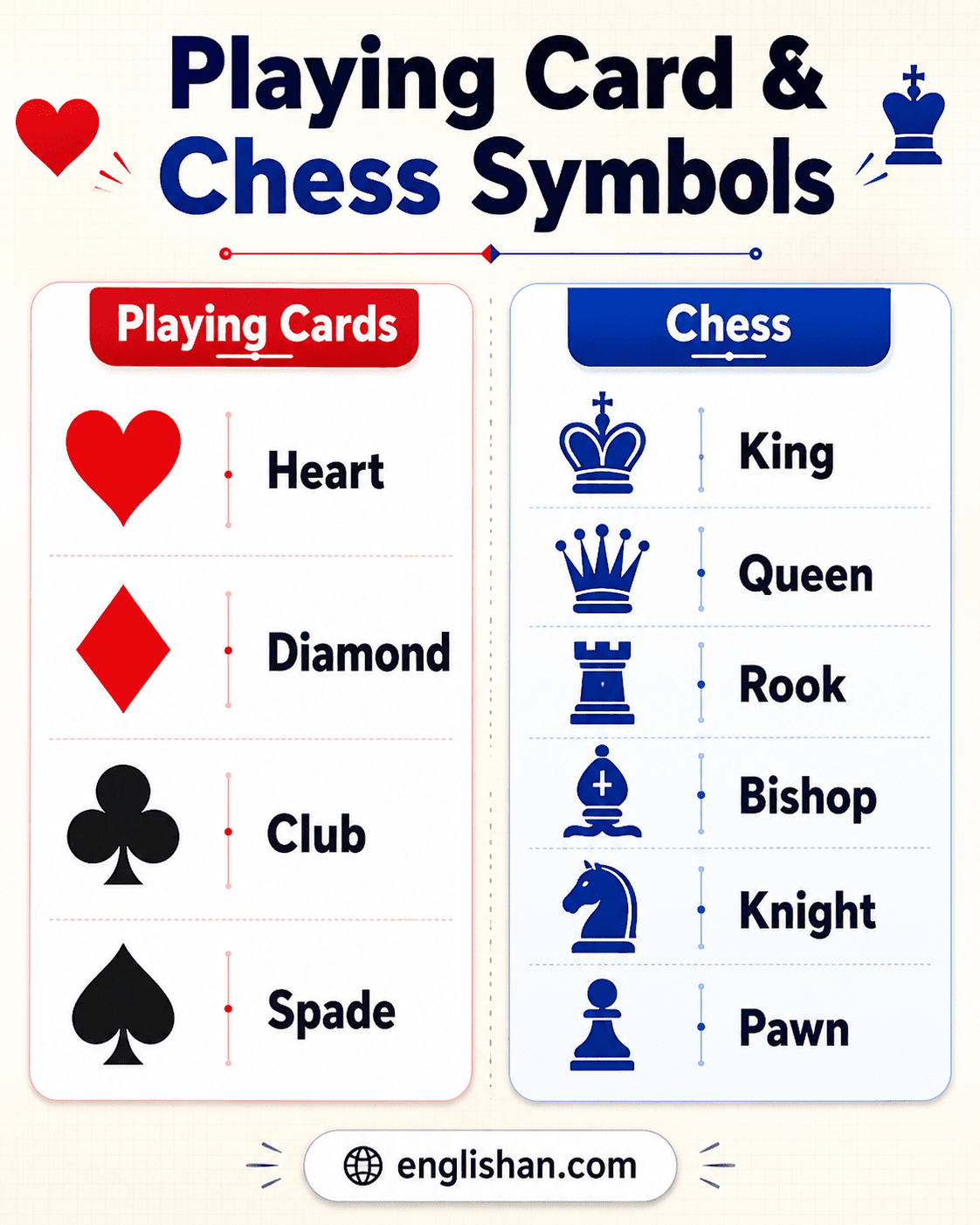
Playing Card And Chess Symbols Names
Playing card and chess symbols identify suits, pieces, and board-game notation, and they often appear in games, diagrams, typography, and digital character sets.
- Spade (♠): The spade is one of the four playing card suits.
- Heart (♥): The heart is a playing card suit and also functions as a common symbol of love, approval, or liking.
- Diamond (♦): The diamond is one of the red playing card suits.
- Club (♣): The club is one of the black playing card suits.
- White king (♔): The white king is the central chess piece whose safety decides the game.
- Black king (♚): The black king is the opposing king symbol in chess notation.
- White queen (♕): The white queen marks the strongest white chess piece by movement range.
- Black queen (♛): The black queen marks the strongest black chess piece by movement range.
- White rook (♖): The white rook moves along ranks and files.
- Black rook (♜): The black rook is the black-side rook symbol.
- White bishop (♗): The white bishop moves diagonally across the board.
- Black bishop (♝): The black bishop is the black-side bishop symbol.
- White knight (♘): The white knight moves in an L-shaped jump.
- Black knight (♞): The black knight is the black-side knight symbol.
- White pawn (♙): The white pawn is the smallest white chess unit.
- Black pawn (♟): The black pawn is the smallest black chess unit.
Weather And Everyday Symbols Names
Weather and everyday symbols appear in forecasts, phone screens, maps, signs, apps, labels, and casual digital communication.
- Sun symbol (☀): The sun symbol marks sunshine, daylight, warmth, brightness, or sunny weather.
- Cloud symbol (☁): The cloud symbol marks cloudy weather, cloud storage, or online service status depending on context.
- Rain cloud symbol (🌧): The rain cloud symbol marks rain, showers, or wet weather.
- Storm cloud symbol (⛈): The storm cloud symbol marks thunder, lightning, stormy weather, or severe conditions.
- Snowflake symbol (❄): The snowflake symbol marks snow, freezing temperature, cold storage, or winter conditions.
- Wind symbol (💨): The wind symbol marks moving air, speed, gusts, or fast movement in informal contexts.
- Fog symbol (🌫): The fog symbol marks fog, mist, haze, or low visibility.
- Rainbow symbol (🌈): The rainbow symbol marks a weather rainbow, while cultural contexts may connect it with hope, diversity, or pride.
- Wave symbol (🌊): The wave symbol marks sea water, surf, coastal weather, or ocean imagery.
- Fire symbol (🔥): The fire symbol marks flame, heat, danger, popularity, excitement, or spicy food depending on context.
- Crescent moon symbol (🌙): The crescent moon symbol marks night, sleep mode, lunar imagery, or evening themes.
- Star symbol (★): The star symbol marks rating, importance, achievement, decoration, or favorite status.
- Leaf symbol (🍃): The leaf symbol marks plants, nature, freshness, eco-related themes, or light movement.
- Globe symbol (🌍): The globe symbol marks Earth, world regions, international settings, language options, or global topics.
Related: Weather Symbols
Commonly Confused Symbols Names
Several symbols look similar but have different names and functions, so the safest reference is to identify the exact mark by its context rather than by shape alone.
- Hyphen (-) and minus sign (−): The hyphen joins word parts, while the minus sign marks subtraction or negative value; the keyboard hyphen often replaces the true minus sign in ordinary typing.
- Hyphen (-), en dash (–), and em dash (—): The hyphen joins words, the en dash marks ranges or relationships, and the em dash marks a strong sentence break.
- Slash (/) and backslash (): The slash leans forward and appears in dates, URLs, fractions, and alternatives, while the backslash leans backward and appears mainly in computing.
- Apostrophe (‘) and prime symbol (′): The apostrophe belongs to words, possession, and contractions, while the prime symbol belongs to feet, minutes of arc, and derivatives.
- Quotation mark (“) and double prime symbol (″): The quotation mark frames speech or quoted text, while the double prime symbol marks inches, seconds of arc, or second derivatives.
- Hash sign (#) and sharp sign (♯): The hash sign marks numbers, hashtags, and phone keys, while the sharp sign raises a musical note by a half step.
- Pound sign (£) and pound sign (#): The £ symbol marks pound sterling, while # is called the pound sign mainly in American telephone-key language.
- Parentheses ( ), square brackets [ ], and braces { }: Parentheses add side information, square brackets insert clarification or technical grouping, and braces group sets, code blocks, or structured data.
- Asterisk (*) and multiplication sign (×): The asterisk can stand for multiplication in plain text or code, while the multiplication sign is the formal arithmetic symbol.
- Letter O (O), zero (0), and degree symbol (°): The capital letter O, numeral zero, and degree symbol differ in size, shape, and function, although they can look similar in some fonts.
How To Read Common Symbols Aloud
Many symbols are read by name when you are explaining them, although prices, emails, URLs, and calculations often require a more natural spoken form.
- At sign (@): Read it as at, as in maria at example dot com.
- Hash sign (#): Read it as hash, number, or pound depending on country, device, and context.
- Ampersand (&): Read it as and, although the symbol name is ampersand.
- Percent sign (%): Read it as percent after the number, as in 50 percent.
- Dollar sign ($): Read it as dollar sign when naming the mark, or as dollars when reading a price.
- Slash (/): Read it as slash in most ordinary contexts, including dates, alternatives, and web addresses.
- Backslash (): Read it as backslash, especially in file paths, code, and technical instructions.
- Plus sign (+): Read it as plus in arithmetic, phone numbers, ratings, and added options.
- Minus sign (−): Read it as minus in arithmetic and negative numbers.
- Equal sign (=): Read it as equals or equal sign, depending on whether you are solving or naming the symbol.
- Parentheses ( ): Read them as parentheses in American English, while British English often calls them brackets in ordinary speech.
- Underscore (_): Read it as underscore, especially in usernames, file names, and email addresses.
- Hyphen (-): Read it as hyphen when spelling names, web addresses, compound words, or file names.
FAQs
The slash (/), also called the forward slash, separates parts of URLs, dates, fractions, and alternatives such as and/or. In typography, it is also known as the solidus.
The tilde (~) marks approximation in math, appears above letters as a diacritic in languages such as Spanish and Portuguese, and represents the home folder on macOS and Linux systems.
The caret (^) marks insertions in editing, represents exponentiation in plain-text math, and functions as bitwise XOR in many programming languages.
The pipe (|), also called the vertical bar, separates alternatives, marks columns in Markdown tables, and connects commands in terminal work.
The hyphen (-) joins words or word parts, while the minus sign (−) belongs to subtraction and negative values. Plain text often uses the keyboard hyphen when the true minus sign is not available.
The hash sign (#) is also called the number sign, pound sign, or octothorpe, depending on country and field. On social media, it forms a hashtag when placed before a word or phrase.
The at sign (@) links a username to a host, platform, or account location in email addresses and social media handles. In older accounting language, it was read as “at the rate of.”
Parentheses ( ) are also called round brackets or curved brackets, and a single mark is called a parenthesis. They enclose side notes, dates, short explanations, optional words, and grouped material.
The dollar sign ($) marks the U.S. dollar and many other dollar-named currencies, including the Canadian, Australian, and New Zealand dollars.
The pound sign (£), also called the pound sterling sign, marks the British pound and a small number of historically linked currencies. The glyph developed from the Latin libra, a word connected with pound weight.
The asterisk (*) flags footnotes, marks required fields, replaces omitted letters in censored words, and functions as a multiplication symbol in many programming languages.
The ampersand (&) represents the word and. It developed from the Latin et, and it remains common in brand names, titles, and short labels.
The underscore (_), also called a low line, connects words in usernames, file names, and code where a regular space would break the system or change the identifier.
The percent sign (%) is read as “percent” and means out of one hundred. It is standard in finance, statistics, sale tags, math, and data reporting.
The backtick (`), also known as the grave accent, appears in code, Markdown formatting, shell commands, and technical writing. As a grave accent, it also marks vowels in languages such as French and Italian.
The ellipsis (…) consists of three dots and marks omission, hesitation, or a trailing thought. In quoted material, it signals removed words without changing the original meaning.
A hyphen (-) joins words or word parts, while a dash separates ideas, ranges, or interruptions. The en dash (–) commonly marks ranges such as 2010–2020, while the em dash (—) creates a stronger break inside a sentence.
The degree sign (°) marks angles, geographic coordinates, and temperature scales. You see it in expressions such as 90° and 25 °C.
You May Also Like