You need an overall synonym because overall has already done its work earlier in the paragraph.
The trouble is that overall is two different words spelled the same way. In front of a noun it means total, as in the overall cost. Standing alone at the front of a sentence it delivers a verdict, as in Overall, the trip went well. A thesaurus prints both sets together and marks neither.
Take a word from the wrong set and the sentence breaks. So the first thing to settle is which overall you are replacing.
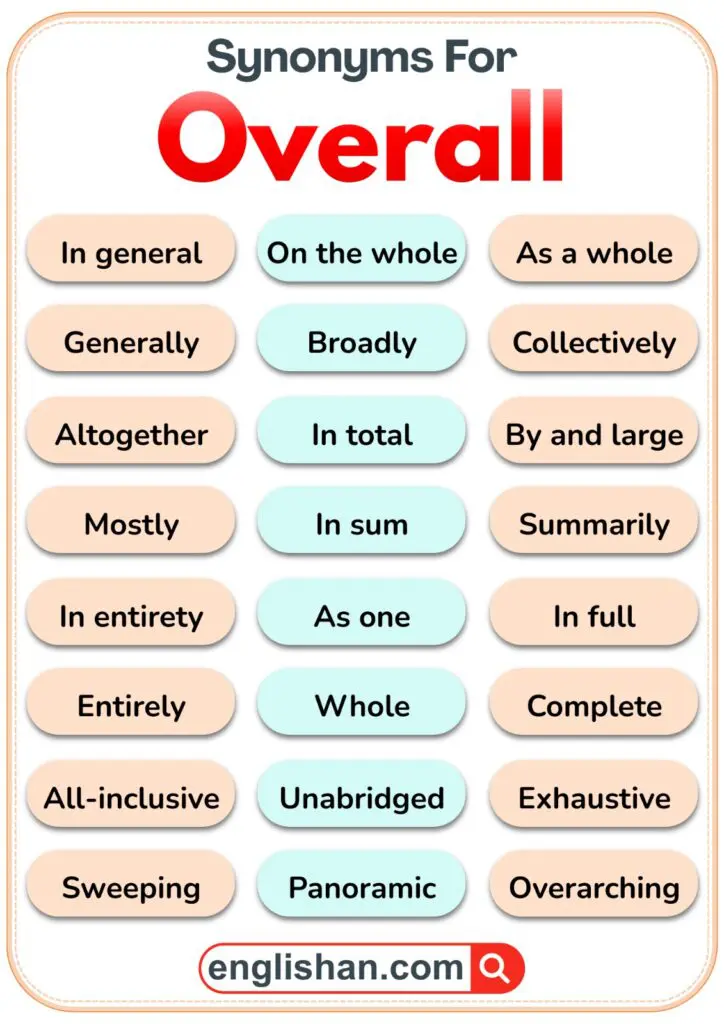
Another Word for Overall
Test it on your own sentence before you choose:
| Your sentence | What overall is doing | What you need |
|---|---|---|
| The overall cost rose 12% | Adjective, counting | Total, aggregate, combined |
| The overall strategy is sound | Adjective, generalising | General, broad, overarching |
| Overall, the launch went well | Adverb, judging | All in all, on the whole |
| Overall, students improved | Adverb, proportioning | Mostly, largely, predominantly |
| She finished third overall | Adverb, totalling | In all, combined, across the field |
| The hull is 12 metres overall | Adverb, measuring | End to end, total length |
Six jobs, six families of overall synonyms.
Overall Synonyms That Mean Considering Everything
This is the verdict overall, the one that opens a sentence after you have weighed the good against the bad. Every one of these overall synonyms can take that position and keep the sentence grammatical.
- All in all: the closest everyday match for a verdict at the front of a sentence. All in all, the week went better than expected.
- On the whole: slightly more measured than all in all, and common in written reviews. On the whole, the service was fast.
- All things considered: signals that you weighed drawbacks against strengths before speaking. All things considered, the price is fair.
- By and large: carries a mild concession, as though exceptions exist. By and large, the staff were patient.
- In general: broad and neutral, safe in speech and writing alike. In general, the software runs without trouble.
- Generally: a one-word version of in general, and lighter on the sentence. Generally, deliveries arrive before noon.
- Generally speaking: softens a claim before you make it. Generally speaking, older houses need more repair.
- Broadly speaking: points at scope rather than frequency. Broadly speaking, both methods reach the same result.
- Broadly: compact and slightly formal. Broadly, the findings match earlier work.
- On balance: weighs two sides and lands on one. On balance, renting suits you better right now.
- In the main: British and a little formal. In the main, the complaints concerned delivery times.
- All told: best where a count sits behind the verdict. All told, forty people attended.
- Taken as a whole: treats the parts as one unit before judging them. Taken as a whole, the collection is worth the entry fee.
- As a whole: the shorter form, and just as safe. As a whole, the team performed above expectation.
- Taking everything into account: long, deliberate, and at home in formal writing. Taking everything into account, the committee approved the plan.
- Considering everything: the shorter, warmer version of that phrase. Considering everything, she coped well.
- When all is said and done: conversational and slightly worn. When all is said and done, the result speaks for itself.
- At the end of the day: very common in speech, and worth avoiding in academic work. At the end of the day, cost decided it.
- In the final analysis: formal, and suited to reports and essays. In the final analysis, the policy failed on cost.
- Ultimately: points to a final outcome rather than a summed judgement. Ultimately, the merger went ahead.
- In essence: reduces something to its central point. In essence, the two proposals are identical.
- Essentially: the one-word form, and more common in speech. Essentially, nothing changed.
- Altogether: doubles as a verdict and as a total, which makes it flexible and occasionally ambiguous. Altogether, it was a good day.
- In the round: British, and used where several angles have been weighed. Viewed in the round, the case looks stronger.
Overall Synonyms That Mean For the Most Part
Here overall is not judging anything. It is saying most, but not all, and the overall synonyms below say the same. Swap in a verdict word and you claim something you did not mean.
- Mostly: the plainest choice, and it fits almost any sentence. Mostly, the feedback was positive.
- Mainly: points to the dominant part rather than the sum. The delay was mainly down to weather.
- Largely: a shade more formal than mainly. The report was largely accurate.
- Chiefly: formal, and common in academic prose. The fund is chiefly supported by donations.
- Predominantly: the strongest of this group, meaning far more than half. The audience was predominantly students.
- Principally: formal, and often paired with a stated reason. She writes principally about migration.
- Primarily: ranks one cause above the rest. The tool is primarily for beginners.
- Substantially: carries a sense of measurable degree. Costs fell substantially after the switch.
- For the most part: three words where one would do, but good for rhythm. For the most part, the rules still apply.
- As a rule: describes a habit rather than a single case. As a rule, we reply within a day.
- Typically: frequency, not proportion, which makes it a near miss. Trains typically run every ten minutes.
- Usually: the everyday version of typically. Usually, the office closes at six.
- Commonly: points at how widespread something is. The name is commonly misspelled.
- Normally: implies a standard that this case might break. Normally, the fee is waived.
- Ordinarily: more formal, and slightly old-fashioned. Ordinarily, applications close in March.
- In most cases: precise and neutral, good in reports. In most cases, treatment lasts six weeks.
- More often than not: informal and a little loose. More often than not, the bus is late.
- To a large extent: hedged, and better in essays than in speech. To a large extent, the theory still stands.
- On average: brings arithmetic into the claim, so use it only where numbers exist. On average, orders ship in two days.
- In large part: formal, and common in analysis. Success was in large part down to timing.
Related:
Overall Synonyms That Mean In Total or Combined
She finished third overall has nothing to do with judgement or proportion. It counts everybody, and these are the overall synonyms sports writing and league tables use most.
- In total: the direct replacement when overall is counting. Ten swimmers qualified in total.
- In all: shorter, and slightly more literary. Twelve in all were selected.
- Combined: works where two or more groups are added. The combined score put her second.
- Collectively: treats a group as a single actor. Collectively, the branches raised nine thousand pounds.
- Inclusively: counts everything inside a boundary, dates included. The offer runs Monday to Friday inclusively.
- In the aggregate: formal, and standard in economics and law. In the aggregate, wages rose.
- Jointly: two or more parties acting as one. They finished jointly in third place.
- Together: plain and wide, and it needs a named group nearby. Together, the pair broke the record.
- All round: British, and common in sport and school reports. A strong performance all round.
- Across the board: every category moved the same way. Prices rose across the board.
- Cumulatively: the total builds over time rather than landing at once. Cumulatively, the delays cost three weeks.
- Totally: an intensifier in speech, but a real total marker in technical writing. The system was totally rebuilt.
- Entirely: leaves nothing out. The cost was entirely covered by the grant.
- Wholly: formal, and now mostly legal or academic. The claim is wholly without merit.
- Fully: emphasises that a limit was reached. Fully half the class passed with distinction.
- In toto: Latin, rare, and only for very formal writing. The proposal was rejected in toto.
Adjective Synonyms for Overall That Mean Total
Put overall in front of a noun and it stops judging. The overall cost is a number. Every one of these overall synonyms goes in that slot, and none can open a sentence the way all in all does.
- Total: the default swap before a noun, and rarely wrong. The total cost came to £4,200.
- Aggregate: the accounting and statistics word for a combined figure. Aggregate demand fell in the second quarter.
- Gross: before deductions, which makes it the opposite of net. Gross profit rose nine percent.
- Combined: two or more figures added into one. Their combined weight exceeded the limit.
- Cumulative: builds across periods rather than standing still. The cumulative effect showed after a year.
- Entire: covers every part with nothing left out. The entire budget went on repairs.
- Whole: warmer and less technical than entire. The whole team was rewarded.
- Full: stresses that nothing was withheld. She received the full amount.
- Complete: nothing missing, and a shade stronger than full. A complete redesign took four months.
- Net: after deductions, which reverses gross. Net income rose despite the costs.
- Grand: almost always paired with total. The grand total reached six figures.
- Collective: belonging to a group rather than a person. The collective effort paid off.
- Consolidated: accounts merged from several sources into one statement. Consolidated revenue topped two billion.
- Composite: built from separate scores or parts. A composite index tracks all four measures.
- Summative: used in education for a final combined mark. Summative assessment happens in June.
- All-in: British, and common in pricing. An all-in price of £950 covers flights and hotel.
- Final: the figure after every adjustment. The final bill arrived in March.
- Accumulated: gathered over time, and frequent in finance. Accumulated interest doubled the debt.
- Integrated: parts joined into one working unit. An integrated system replaced three programs.
- Compound: growth or interest that builds on itself. Compound returns favour long horizons.
- Joint: shared between two named parties. A joint account suits couples.
- Undivided: whole because it was never split. She gave the matter her undivided attention.
- Sum: almost always as sum total. The sum total of his savings was modest.
- Global: British business use for one figure covering everything. A global figure of £2 million was agreed.
Adjective Synonyms for Overall That Mean General
The overall strategy is not a number. Here overall means the wide version, the one without the detail, so the overall synonyms change completely. Swap in total and the sentence turns into arithmetic.
- General: the most-recorded swap, and it fits almost every sentence. The general direction is right.
- Broad: wide rather than deep, and good for strategy. A broad plan leaves room to adjust.
- Blanket: applies to everyone with no exceptions. A blanket ban on phones took effect.
- Sweeping: wide and forceful, often used of change. Sweeping reforms followed the report.
- Across-the-board: hyphenated before a noun, open after it. An across-the-board pay rise was announced.
- Overarching: the level above the detail, and the one that shapes it. The overarching aim is lower emissions.
- Umbrella: one heading covering several smaller ones. An umbrella body speaks for all six charities.
- Big-picture: informal, and common in business talk. A big-picture view helps here.
- Bird’s-eye: viewed from above, so the detail disappears. A bird’s-eye view of the process.
- Wide-ranging: covering many areas rather than one. A wide-ranging inquiry began in May.
- Far-reaching: effects that travel well past the starting point. Far-reaching consequences followed.
- Comprehensive: leaves nothing out, and outranks broad in strength. A comprehensive review of every department.
- Inclusive: brings everything or everyone inside. An inclusive definition covers both cases.
- All-embracing: takes in everything without exception. An all-embracing theory rarely survives testing.
- All-encompassing: the same idea with slightly more weight. An all-encompassing reform package.
- Wholesale: total and often abrupt, used of change. Wholesale changes hit the department.
- Widespread: spread across many places or people. Widespread support met the proposal.
- Universal: true everywhere with no exception. Universal healthcare remains the aim.
- Extensive: large in range or amount. Extensive testing preceded release.
- Panoramic: a wide view taking in everything at once. A panoramic assessment of the market.
- Holistic: treats the parts as one connected system. A holistic approach to student welfare.
- Generic: applying to a class rather than one case. A generic policy covers all branches.
- Prevailing: the version most people hold right now. The prevailing view favours delay.
- Predominant: the strongest presence among several. Cotton was the predominant crop.
Both adjective families turn up behind a stated goal, which is why the overall goal is such a common phrase and such a weak one. The general goal and the total goal mean different things, and picking either forces you to say which you meant.
Related:
Overall Synonyms for End to End Measurement
The yacht is 12 metres overall. This is the measurement sense, and it drives length overall in boating and overall length in engineering and product listings. No general thesaurus covers it, and every one of these overall synonyms is more precise than overall is.
- Total length: the plain replacement in specifications. Total length is 4.6 metres.
- Full length: interchangeable with total length in most listings. Full length including the tow bar.
- End to end: measured from one extremity to the other. Fourteen metres end to end.
- Tip to tail: used of animals, aircraft and boards. Two metres tip to tail.
- Nose to tail: aircraft and road vehicles. Nose to tail, the aircraft measures 37 metres.
- Stem to stern: nautical, and the origin of length overall. Stem to stern she runs 12 metres.
- Bumper to bumper: road vehicles, and also traffic. Bumper to bumper, the van fits the garage.
- Maximum: the largest dimension recorded. Maximum width is 1.8 metres.
- Extreme: technical, meaning the outermost measurement. Extreme beam measures 3.4 metres.
- Outside: measured on the outer surface. Outside diameter is 42 millimetres.
- All over: across the whole surface, as of a pattern. Printed all over with small flowers.
- Throughout: present in every part. The fabric is dyed throughout.
Formal Overall Synonyms for Essays and Reports
Academic writers state the verdict without the chat. Three overall synonyms do that work: in the final analysis, taking everything into account, and on balance. For the adjective, aggregate and cumulative beat overall because they name the arithmetic instead of gesturing at it.
Two to keep out of an essay:
- At the end of the day: fine in a meeting, weak in writing.
- When all is said and done: the same problem, with more words.
And one that trips people constantly: summarily does not mean in summary. It means promptly and without ceremony. He was summarily dismissed means he was fired on the spot. Writing the data was summarily reviewed says the review was rushed and informal, which is the opposite of the claim you meant to make. If you want the summary meaning, write in summary or to summarise.
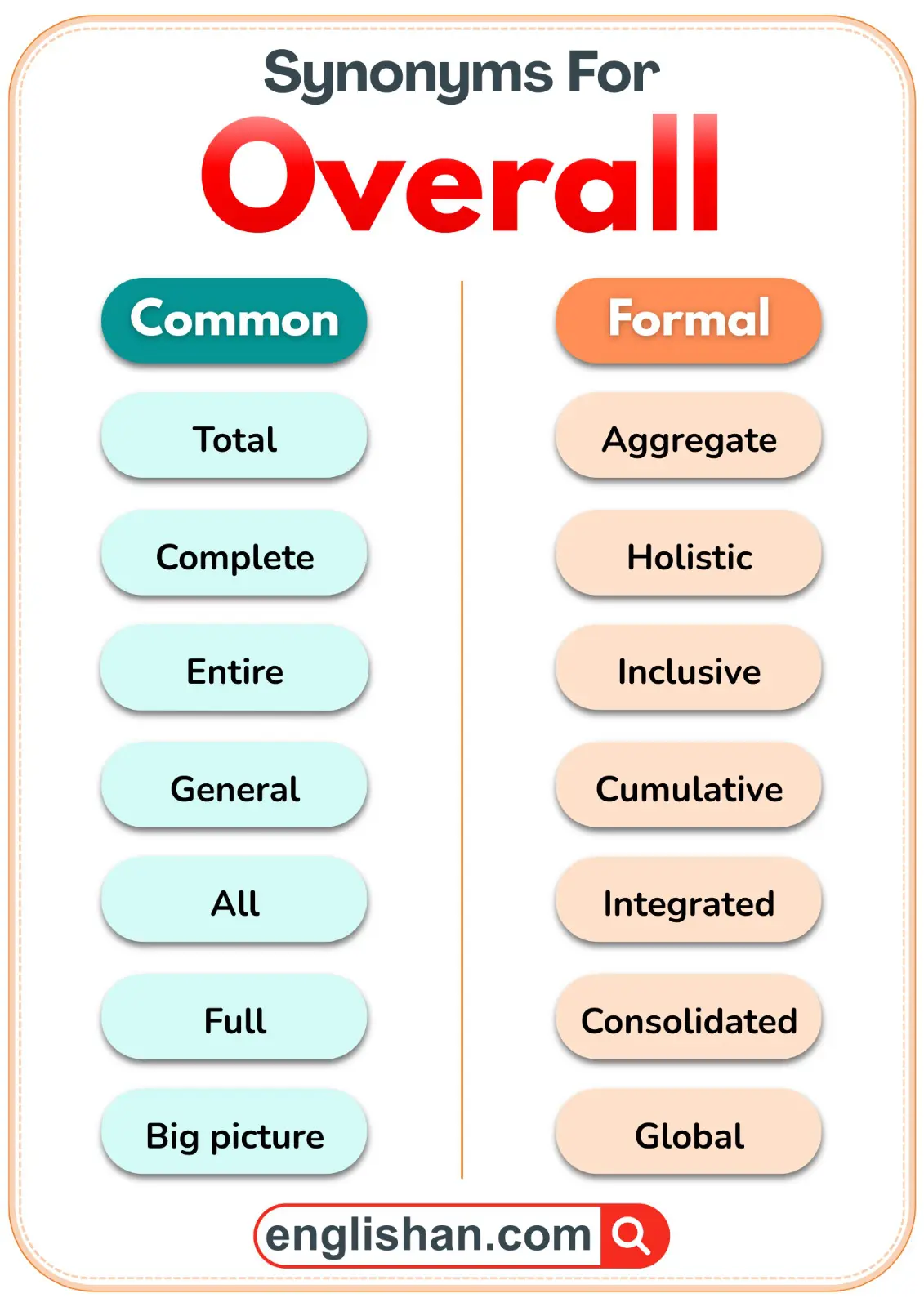
Related:
Professional Overall Synonyms for Reviews and Summaries
Performance reviews use overall harder than almost any document, in the same three places every time: the summary line, the rating, and the closing paragraph. Rotate the overall synonyms across those three or the review reads like a template.
| Instead of | Write | Why |
|---|---|---|
| Overall performance was strong | Sustained strong performance across the year | Names the period |
| Overall, she met expectations | On balance, she met expectations | Signals a weighed judgement |
| Overall rating | Composite rating | Says how the score was built |
| Overall improvement | Cumulative improvement | Shows it built over time |
| Overall contribution | Aggregate contribution | Points at a measurable total |
The same swap works for quality statements. Overall quality improved is vague enough to survive any evidence, while quality improved across all four lines can be checked.
Related:
Casual Ways to Say Overall in Speech
Spoken English drops the adjective almost entirely and keeps the verdict, so the casual overall synonyms are a short set. All in all, at the end of the day, when all is said and done and all round do nearly all the work. British speech adds on balance and in the main; American speech reaches for all in all and when you get right down to it.
Two habits to watch. At the end of the day has been worn thin by overuse, so it reads as filler in writing even though it passes in speech. And altogether shifts meaning by position: altogether, it went well is a verdict, while the cost altogether was £90 is a total.
Words That Are Not Overall Synonyms
Sixteen words circulate as overall synonyms without belonging there. Most of them signal that a paragraph is ending, which is not the same as meaning considering everything.
| Word | What it actually means | Why it fails |
|---|---|---|
| By all means | Certainly, please go ahead | No relation to totality |
| Finally | Last in a sequence | Marks order, not judgement |
| In conclusion | The text is ending | Marks position, not meaning |
| In retrospect | Looking back at the past | Marks time, not scope |
| As it stands | In its present state | Marks the current moment |
| Summarily | Promptly and without formality | Means the opposite of careful |
| In a nutshell | Briefly, in few words | Brevity, not totality |
| In brief | Briefly, in few words | Same problem |
| In sum | In short | Reads as a summary cue, not a verdict |
| As one | In unison, simultaneously | Describes timing |
| En masse | In a body, as a crowd | Describes movement |
| Unabridged | Not shortened, of a text | Wrong subject entirely |
| Overall speaking | Not recorded in any dictionary | Invented; use generally speaking |
| In entirety | Non-standard on its own | The form is in its entirety |
| Looking at everything | A paraphrase, not a word | Nothing to look up |
| Taking it all together | A paraphrase, not a word | Same |
The pattern behind most of these is position. Finally, in conclusion and in brief all turn up at the end of a paragraph, exactly where overall does, and a list built by scraping that position collects them. Meaning never enters into it.
Overall vs Total vs Aggregate vs Cumulative
All four overall synonyms go in front of a noun, and swapping them changes the arithmetic you are claiming.
| Word | Claims | Example |
|---|---|---|
| Overall | Something covering everything, unspecified | The overall figure |
| Total | Everything added once | Total sales of £80,000 |
| Aggregate | Separate amounts merged into one | Aggregate demand |
| Cumulative | A total that built up across periods | Cumulative rainfall for the year |
Overall is the vaguest of the four, which is exactly why editors cut it. Canadian and British style guides both flag it as overused and push writers toward aggregate, average, general or total depending on the sentence. If you can name which of those you meant, use it instead.
Overall vs General vs Broad
These three overlap in the general sense, and the differences are small but real.
- Overall: covers everything and says nothing about depth.
- General: the neutral default, applying to a class rather than a case.
- Broad: implies width, and hints that depth was traded for it.
A general policy applies to everyone. A broad policy covers a lot of ground and leaves gaps. An overall policy means whichever of those the writer had in mind, which is the problem.
Choosing Between Overall and Over All
Written as one word, overall is an adjective (the overall cost) or an adverb (Overall, it worked). Written as two, over all is a prepositional phrase meaning across the whole of something: rain spread over all of Scotland.
Older British and Canadian style kept a third distinction, using over all for the all things considered meaning: Over all, the party was a great success. American usage collapsed that into one word decades ago, and one word is now standard everywhere for the verdict.
Overall, the results were encouraging. ✅
Over all, the results were encouraging. ❌
Snow lay over all the northern counties. ✅
Snow lay overall the northern counties. ❌
Overalls the Garment and Where the Word Came From
Overalls are work trousers with a bib and shoulder straps, called dungarees in British English and bib overalls in American English. The word dates to 1631 and means exactly what it says: the garment goes over all the other clothing.
That is the same logic behind the modern senses. The adverb arrived first, in the thirteenth century, meaning all over or from one end to another. The adjective is much younger, first recorded in 1894. Every current use keeps the original idea of covering the whole thing.
Where Overall Goes in a Sentence
Overall changes job three times depending on where you put it, which is why the same word needs six different replacement families.
- Front, with a comma: the verdict reading. Overall, the results held up.
- Before a noun: the adjective reading. The overall results held up.
- After a noun or number: the totalling or measuring reading. She placed fourth overall. The mast stands 14 metres overall.
Starting a sentence with overall is fully standard, and the comma is not optional in that position. Drop it and the reader parses overall as an adjective for a moment before backtracking.
Related:
Antonyms for Overall
The opposite of overall depends on which sense you started from, and no single word covers all six.
| Sense | Opposites |
|---|---|
| General or blanket | Individual, particular, local, regional, sectional, divisional |
| Broad, not detailed | Specific, detailed, itemised, precise, explicit, particularised |
| Total | Partial, fragmentary, component, constituent, incomplete |
| Considering everything | Narrowly, strictly, individually, separately, in isolation |
| Prevailing | Rare, uncommon, isolated, exceptional |
Partial is the one to watch. It reverses the total sense (a partial refund) but not the general one, so a partial strategy reads as unfinished rather than narrow.
Mistakes to Avoid When Replacing Overall
Five errors account for nearly every broken swap between overall synonyms.
Crossing the two families: the verdict words cannot go in front of a noun, and the adjectives cannot open a sentence.
The all in all cost was £4,200. ❌
The total cost was £4,200. ✅
Stacking two verdicts: Overall, all in all, the day went well says the same thing twice.
Using summarily for in summary: covered above, and the single most damaging error on this word.
Reaching for a long phrase where a short one works: taking everything into consideration and taking everything into account are four words that all in all handles in three, and broadly handles in one.
Keeping the word when the sentence does not need it: delete overall from the overall goal of the project and nothing is lost. That is the most frequent fix an editor makes to this word, and it beats every replacement listed above.
The last one applies to any change you make to a draft. Delete the word first, then read the sentence again. Most overall synonyms are only needed once that test fails, which is what makes deletion the most effective edit on the list.
Related:
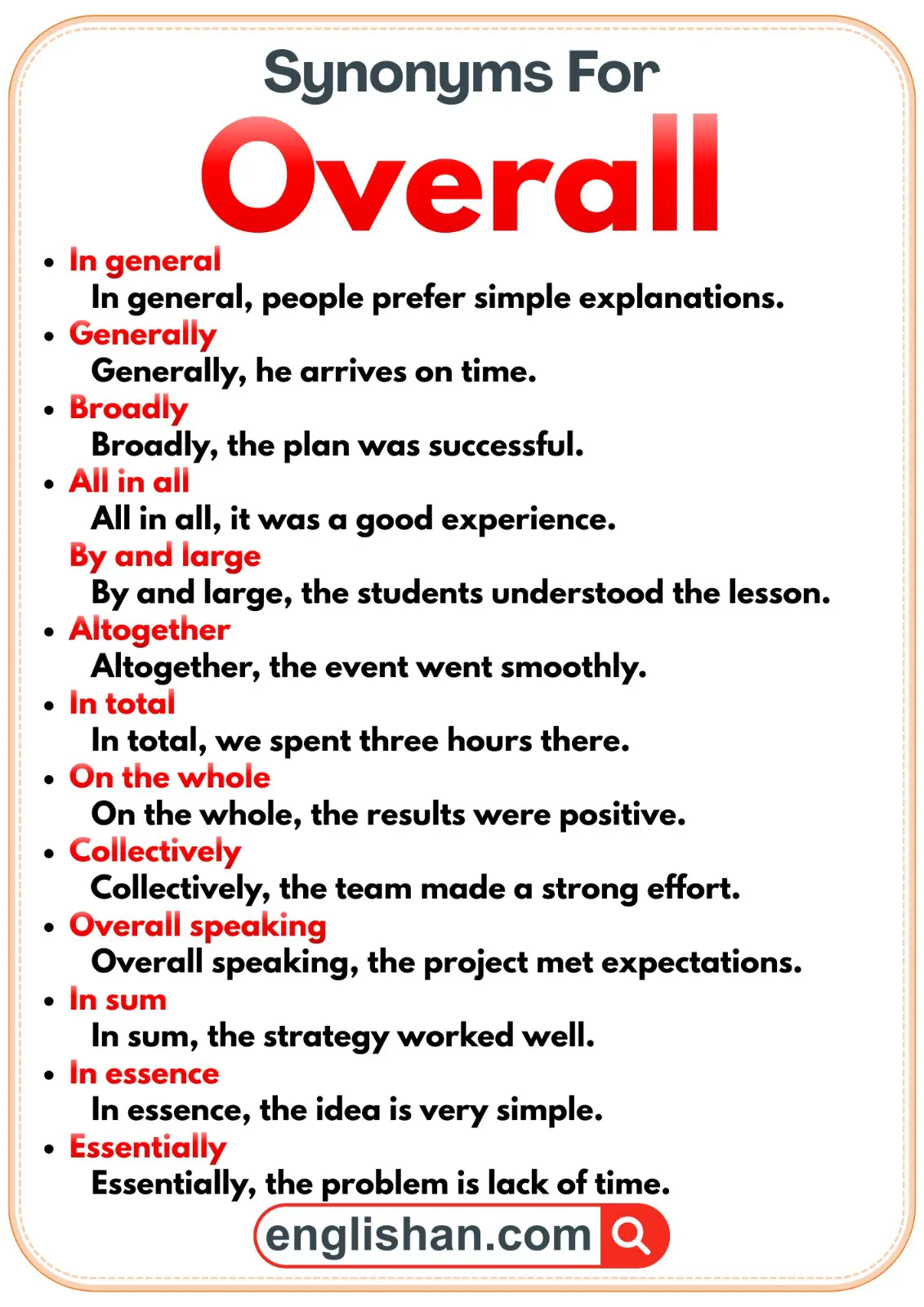
FAQs
Overall has two roles. As an adjective in front of a noun it means total or general, as in the overall cost or the overall strategy. As an adverb it means considering everything, for the most part, counting everyone, or from one end to the other, depending on its position in the sentence.
Match the overall synonym to the job. Before a noun, use total, aggregate, general or broad. At the front of a sentence, use all in all, on the whole, all things considered or by and large. After a number, use in all or combined.
Neutral, and usable in both. The overall synonym you choose sets the formality. In the final analysis and in the aggregate suit academic work, while at the end of the day and all round suit speech.
Yes, and it is fully standard in that position. Follow it with a comma. Overall, the response was positive. Without the comma the reader treats overall as an adjective attached to the next noun.
Total names an exact sum, while overall only gestures at completeness. Total sales is a figure you can check. Overall sales names either the total, the average, or the general trend, so the reader has to guess. That is why editors replace it with the precise word.
One word for the adjective and the adverb: the overall cost, Overall, it worked. Two words when over is a preposition and all is what it governs: rain spread over all of Scotland.
It depends on the sense. Against the general meaning, individual, particular and local. Against the total meaning, partial and component. Against the broad meaning, specific and detailed.
The formal overall synonyms are in the final analysis, taking everything into account and on balance for the verdict. Aggregate and cumulative for the adjective. Avoid summarily, which means promptly and without formality rather than in summary.
You May Also Like