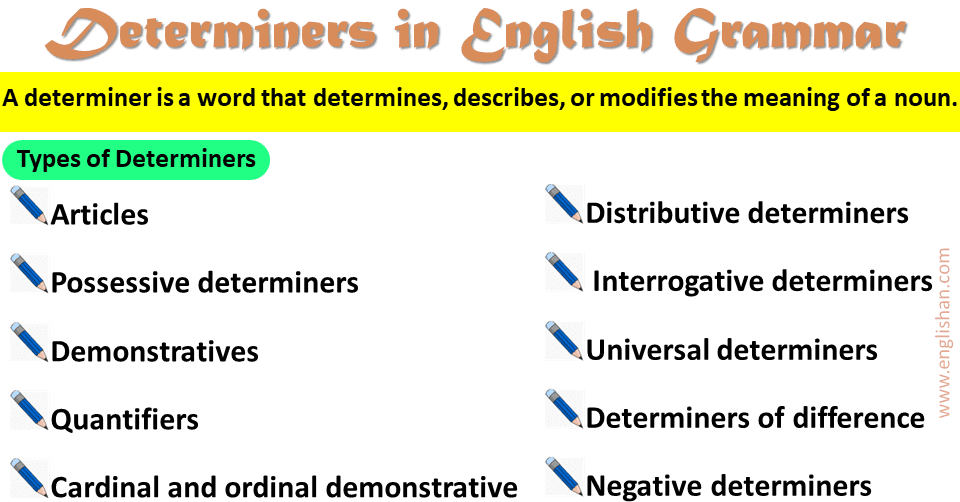
A determiner is a word that determines, describes, or modifies the meaning of a noun. A determiner is always used before a noun or sometimes before an adjective to introduce the noun or give additional information about the noun. Determiners are also called clarifying words because they explain or clarify whether a noun phrase is specific or generic, one or more. For example,
This watch is beautiful.
Here the word this is a determiner that refers to something (watch) that is singular and close to the speaker.
Determiners are essential when the noun is singular, and optional when the noun is plural or uncountable. Some determiners are used only before countable nouns (many, few, some) and some are used before uncountable nouns (much, little) while some are used before both (most, a lot of). We cannot use more than one main determiner with the same noun and sometimes a noun functions without any determiner, this condition is called a zero determiner when a noun is not preceded by a determiner. Some determiners function as pre-determiner (which come before a main determiner such as all, both, or half, etc.) or post-determiner (which come after a main determiner such as many, much, few, or next, etc.) for example,
Do you drink milk? (Zero determiners)
Both my sisters are studying literature. (pre-determiners)
Not all your friends are trustworthy. (pre-determiners)
Punctuation will be explained in the next article. (Post-determiners)
Although determiners and adjectives have the same function. They both modify or describe a noun. But they are slightly different from each other. For instance, Determiners are used only before nouns but adjectives can be used before and after nouns. Determiners only modify nouns but adjectives can modify nouns or pronouns. Determiners are often essential, but an adjective can be removed from a sentence without making a grammatical mistake. And determiners, unlike adjectives, cannot be used as comparatives or superlatives.
Types of determiners
Determiners are divided into different types according to their meaning and usage. For instance,
- Articles (a, an, the)
- Possessive determiners (my, our, your, his, her, its)
- Demonstratives (this, that, these, those)
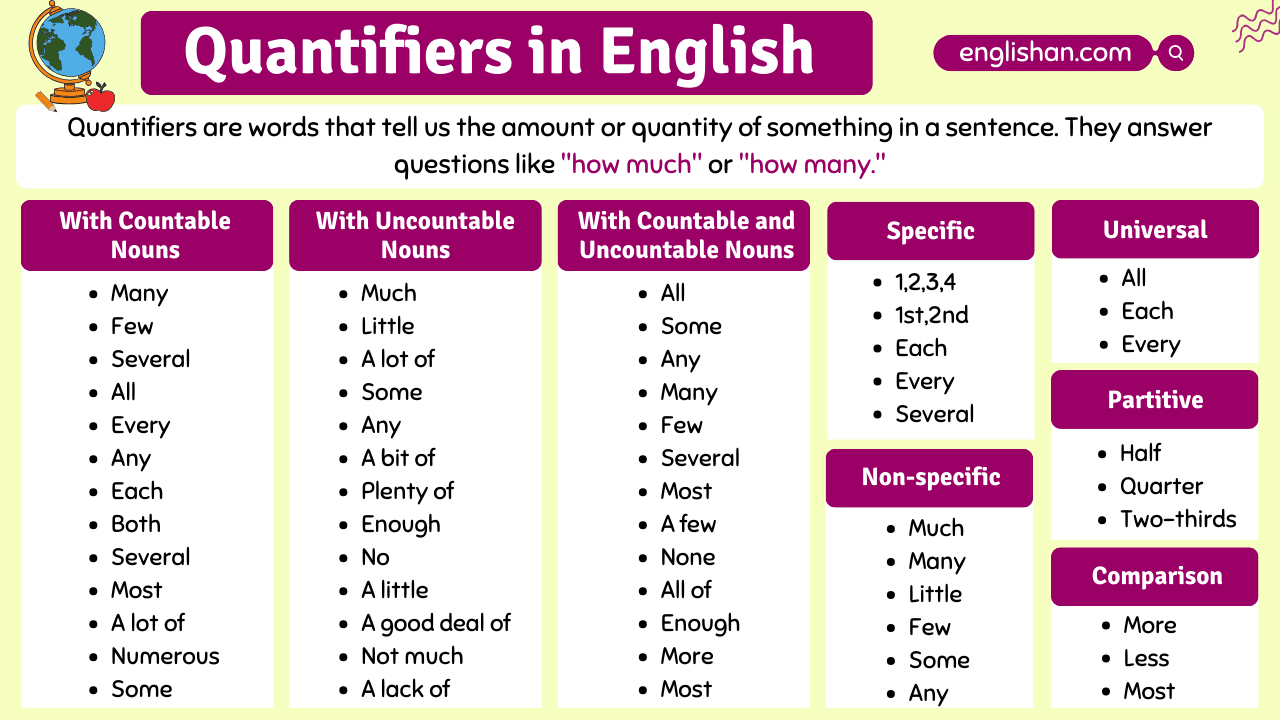
- Quantifiers (some, few, much, many, several, most)
- Cardinal and ordinal demonstrative (zero, one, two, three, first, second, third, next, last)
- Distributive determiners ( each, every, either, neither)
- Interrogative determiners (what, which, whose)
- Universal determiners (all, both)
- Determiners of difference (other, another)
- Negative determiners (no, none, none of)
Articles
(A, An, The)
Articles are very common determiners that determine whether the speaker is referring to a general noun or a specific one. There are two types of articles, the definite article (The) and the indefinite article (A, An).
The definite article (The)
A definite article describes something unique and specific or something that has already been mentioned. The definite article “The” can be used before singular or plural nouns, countable or uncountable nouns. For example,
We will go to the museum.
Here “the” refers to a specific noun (the museum) and both the speaker and the listener have in mind the specific museum they will visit or they have previously mentioned the museum.
The Indefinite articles (a, an)
Indefinite articles A and An are used to modify something general or unspecific or something mentioned for the first time. Indefinite articles are only used before singular nouns. The indefinite article A is used when the noun begins with a consonant sound. And the indefinite article An is used when the noun begins with a vowel sound. For example,
I watched a movie.
Here the speaker is talking about a general movie rather than a specific movie, there are so many movies and he has seen one of them.
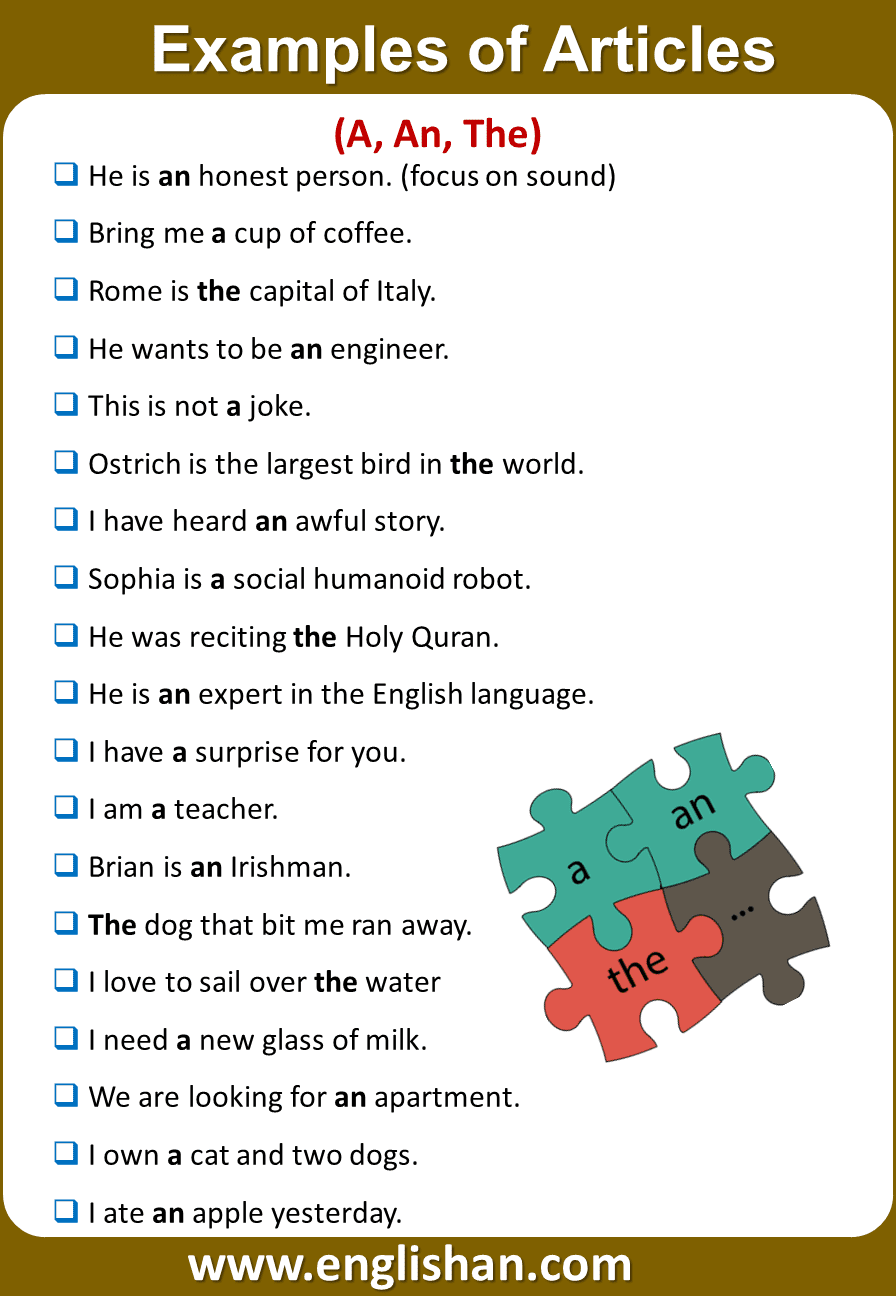
Examples,
- The Pacific Ocean is the largest ocean in the
- He is an honest person. (focus on sound)
- Bring me a cup of coffee.
- Rome is the capital of Italy.
- He wants to be an
- This is not a
- Ostrich is the largest bird in the world.
- I have heard an awful story.
- Sophia is a social humanoid robot.
- He was reciting the Holy Quran.
- He is an expert in the English language.
- I have a surprise for you.
Possessives
(My, Our, Your, His, Her, Its, Their)
Possessive determiners are used to express possession, relationship, or ownership. For example,
This is your stuff.
Here the word “your” refers to the possession or ownership of the stuff.
Possessive determiners ( my, your, his, her, our, its, their) are slightly different from possessive pronouns ( mine, yours, his, hers, ours, theirs) because possessive pronouns can stand alone but possessive determiners are always followed by a noun.
For example
It’s yours or this house is mine. (Possessive pronouns)
He is my best teacher. (Possessive determiner)
There is no apostrophe (’) in determiners so don’t confuse these contractions with possessive determiners,
Your = you’re (you are)
Its = it’s (it is)
Their = they’re (they are) etc.
Examples,
- Jasmine is my favorite flower.
- You are wasting my
- His mother is a teacher.
- Gardening is her
- We love our
- Your brother won the competition.
- Parents always want to see their children happy.
- Its color is slightly darker.
- Her new dress is very beautiful.
- Mind your own business.
- I often go to his
- How was your weekend?
Demonstratives
(This, That, These, Those)
There are four most common demonstrative determiners this, that, these, and those which refer to physical or psychological closeness or distance of something or the location or position of the noun. They are used to demonstrate or indicate the distance or proximity of something (time or space) in relation to the speaker. This and that are used before singular countable or uncountable nouns, and these and those are used before plural countable nouns. “This” and “these” refer to objects that are close to the speaker, and “that” and “those” refer to objects that are comparatively further away from the speaker. For example,
This jacket is mine.
Here “this” is a singular near demonstrative determiner that refers to something (jacket) which is singular and close to the speaker.
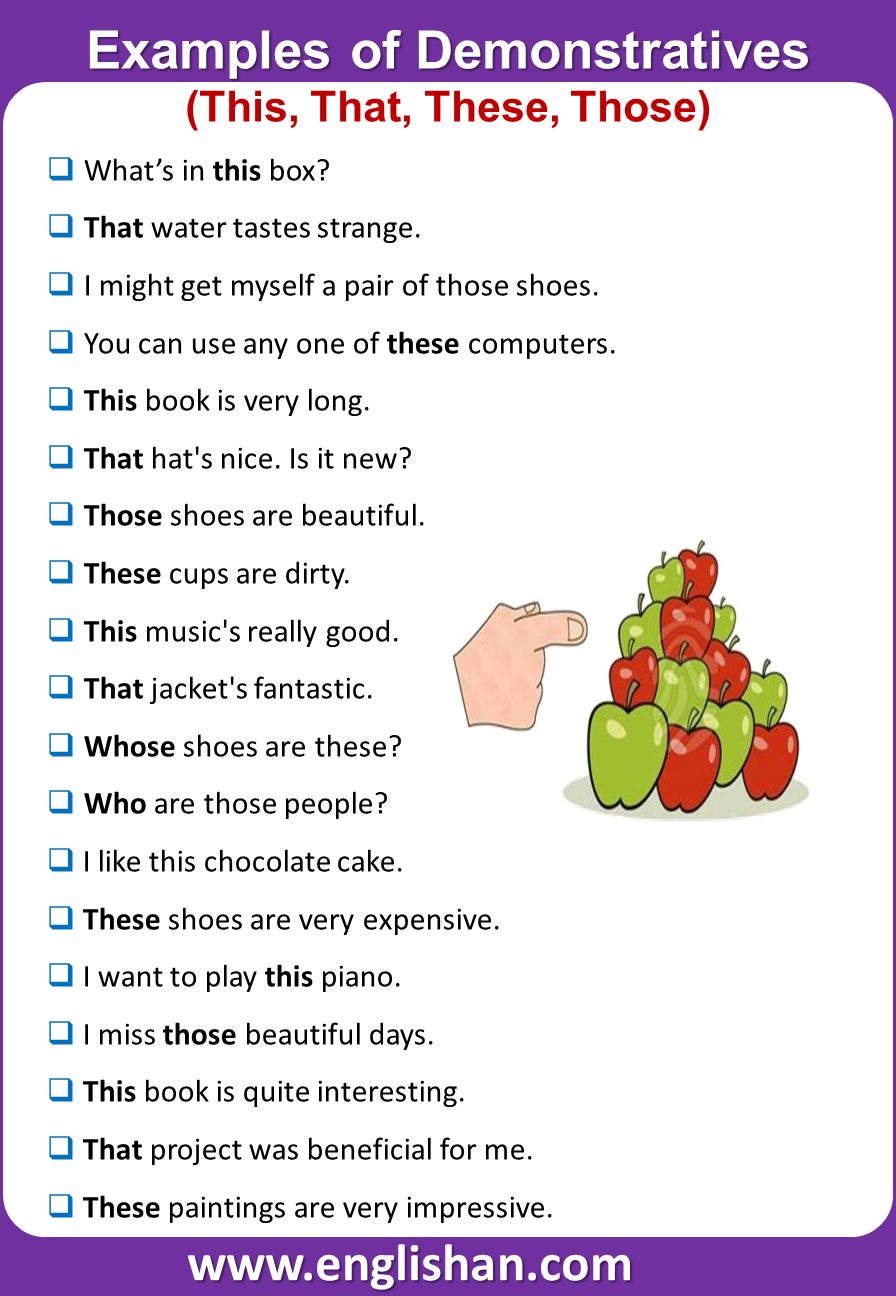
Examples,
- I like this chocolate cake.
- These shoes are very expensive.
- I want to play this
- I miss those beautiful days.
- This book is quite interesting.
- That project was beneficial for me.
- These paintings are very impressive.
- Please wash these
- I will read those books in my spare time.
- Is that your apartment?
Quantifiers
(some, few, much, many, several, most little, any)
Quantifiers are used to express the quantity of a noun by answering the question “how much?” And “how many?” Some quantifiers are only used before countable nouns, for example, many, several, few, and a few, etc. And some quantifiers are only used before uncountable nouns, for example, much, little, a little, and a bit, etc. We can’t use these quantifiers interchangeably. Some quantifiers can be used before both, for example, most, a lot of, some, and any, etc. “Some” is often used for positive statements but “any” is often used for negative statements or questions. Quantifiers few and little mean almost nothing, they express a negative connotation. And A few and A little mean some, and they express a positive connotation. For example, if I say
there were few students in the library.
It means the number of students in the library was less than I expected, equal to nothing, I was expecting around about twenty but there were only two or three. But if I say there were a few students it makes a positive sense means some students were there though not many. So same case with the “little” and “a little”
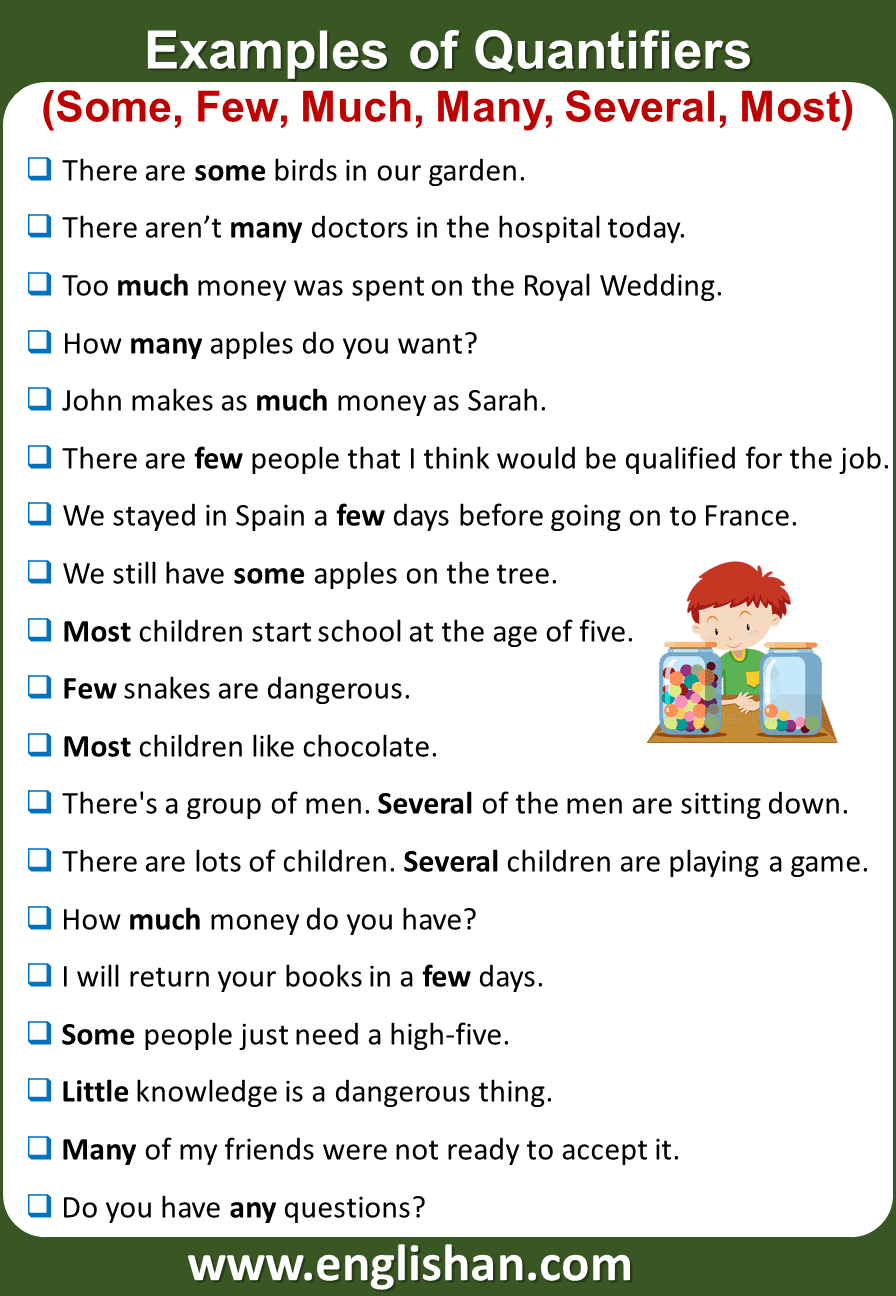
Examples,
- How much money do you have?
- I will return your books in a few
- Some people just need a high-five.
- Little knowledge is a dangerous thing.
- Many of my friends were not ready to accept it.
- Do you have any questions?
- There is a little water in the glass.
- I have few friends in college.
- Most people think he is innocent.
- I want to visit several
Cardinal and Ordinal Demonstratives
(zero, one, two, three, first, second, third, next, last)
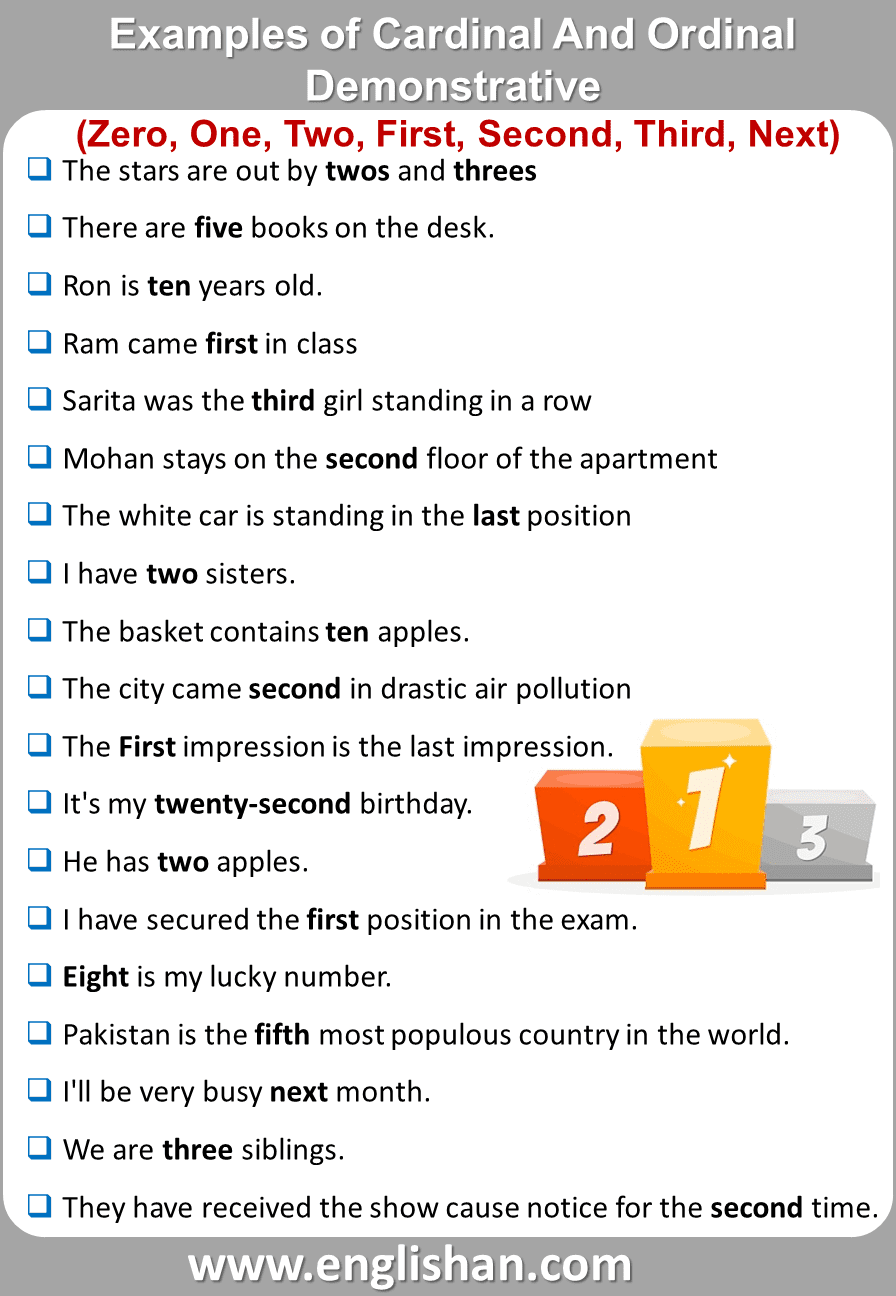
Cardinal and ordinal numbers are often used as determiners. Cardinal numbers which are also known as counting numbers indicate an amount or quantity of something we have; one, two, three, etc. An ordinal number is a number that tells the order or position of something in a series; first, second, third, last, etc.
Example,
- The First impression is the last
- It’s my twenty-second
- He has two
- I have secured the first position in the exam.
- Eight is my lucky number.
- Pakistan is the fifth most populous country in the world.
- I’ll be very busy next
- We are three
- They have received the show cause notice for the second
- Next week they will celebrate their second wedding anniversary.
Distributive Determiners
(each, every, either, neither)
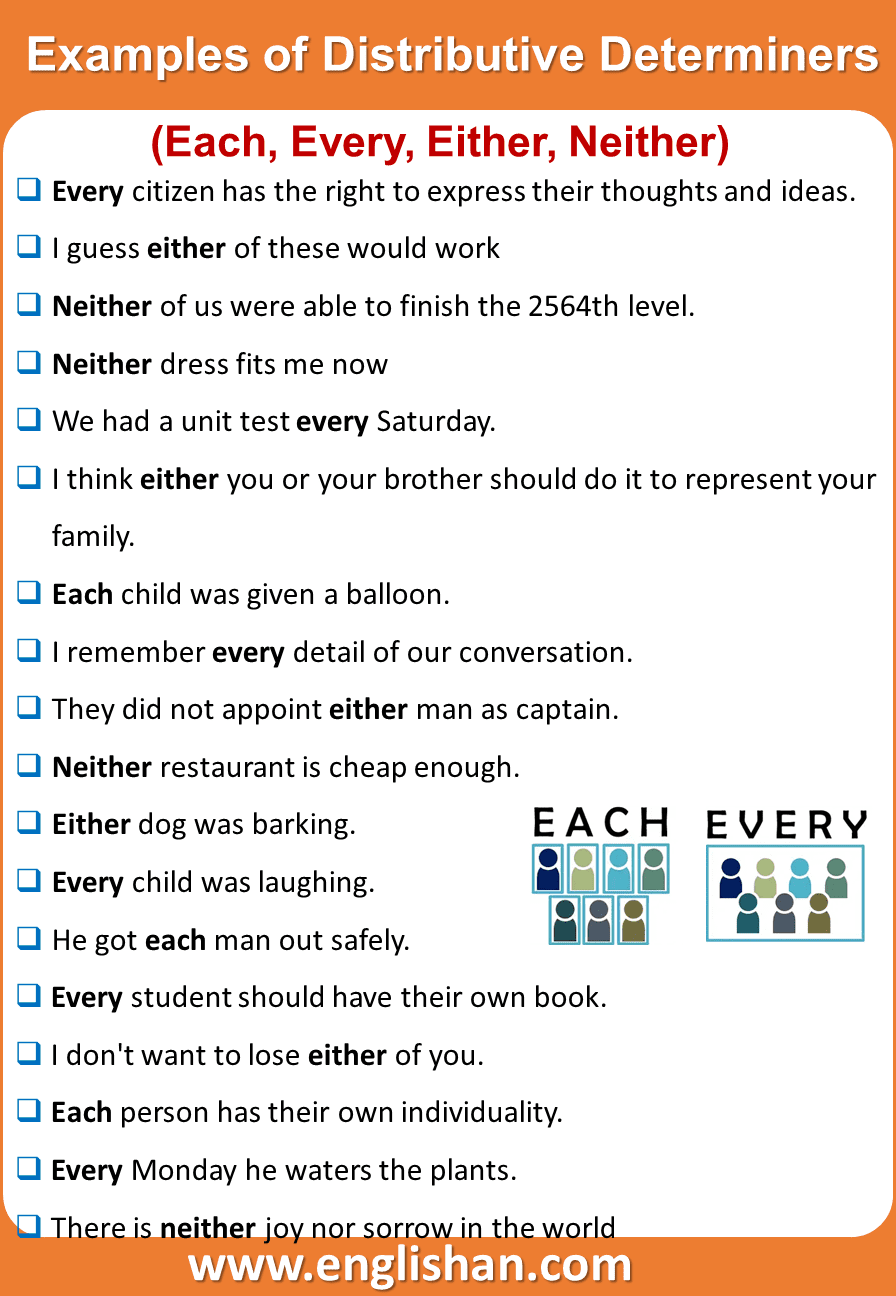
Distributive determiners are used to indicate a group or a specific person or thing among many persons or things. Each is used when the number of persons is limited or less (two or more) but everyone is used for more than two things or persons. Neither means not the (first) one not the (second one) other and neither means one or the other.
Examples,
- Every student should have their own book.
- I don’t want to lose either of you.
- Each person has their own individuality.
- Every Monday he waters the plants.
- There is neither joy nor sorrow in the world
Interrogative Determiners
(what, which, whose)
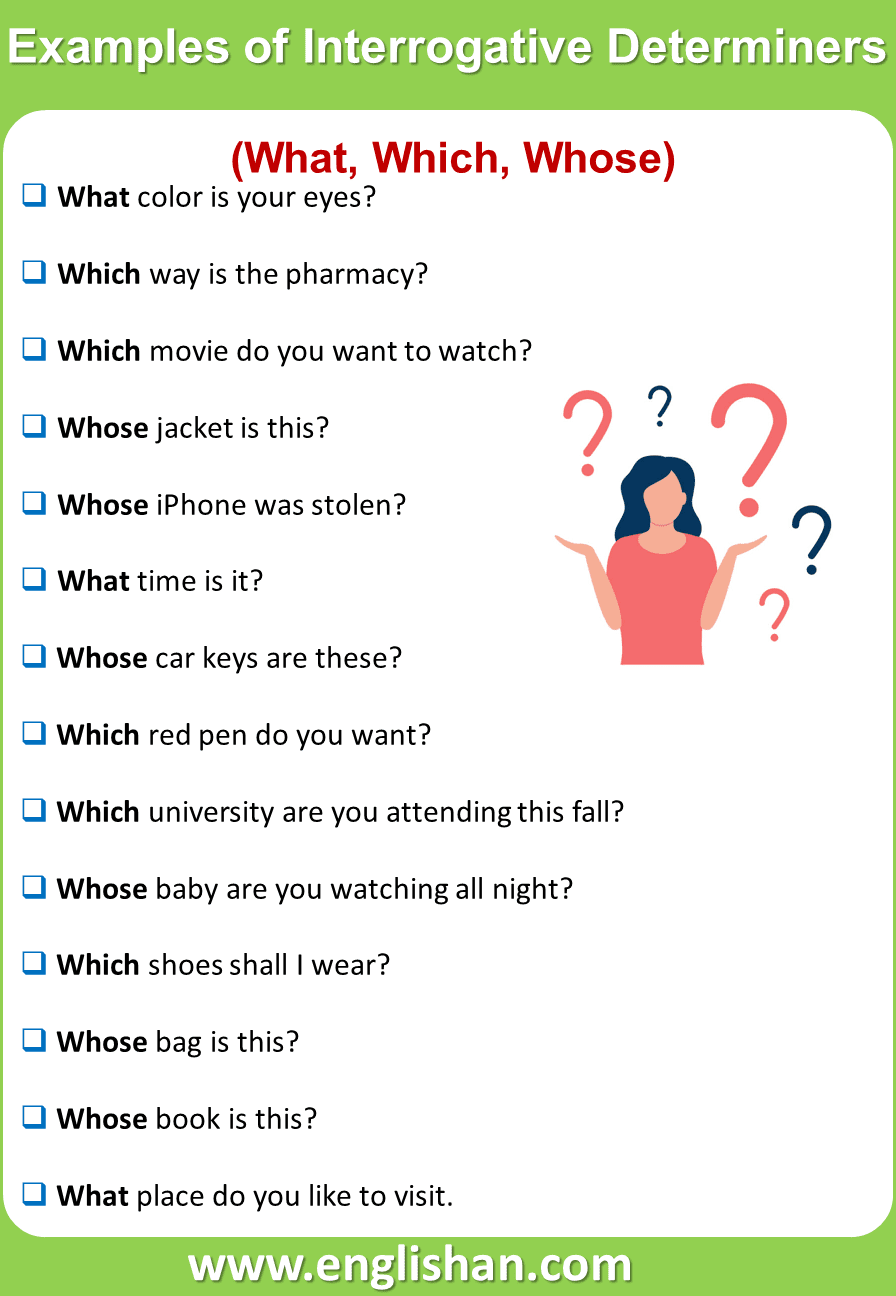
Interrogative determiners are used to ask questions or possession and like other determiners, they are also used at the beginning of a noun.
Examples,
- Whose book is this?
- What place do you like to visit?
- Which color do you like the most?
- What time will you arrive?
Universal Determiners
(all, both)
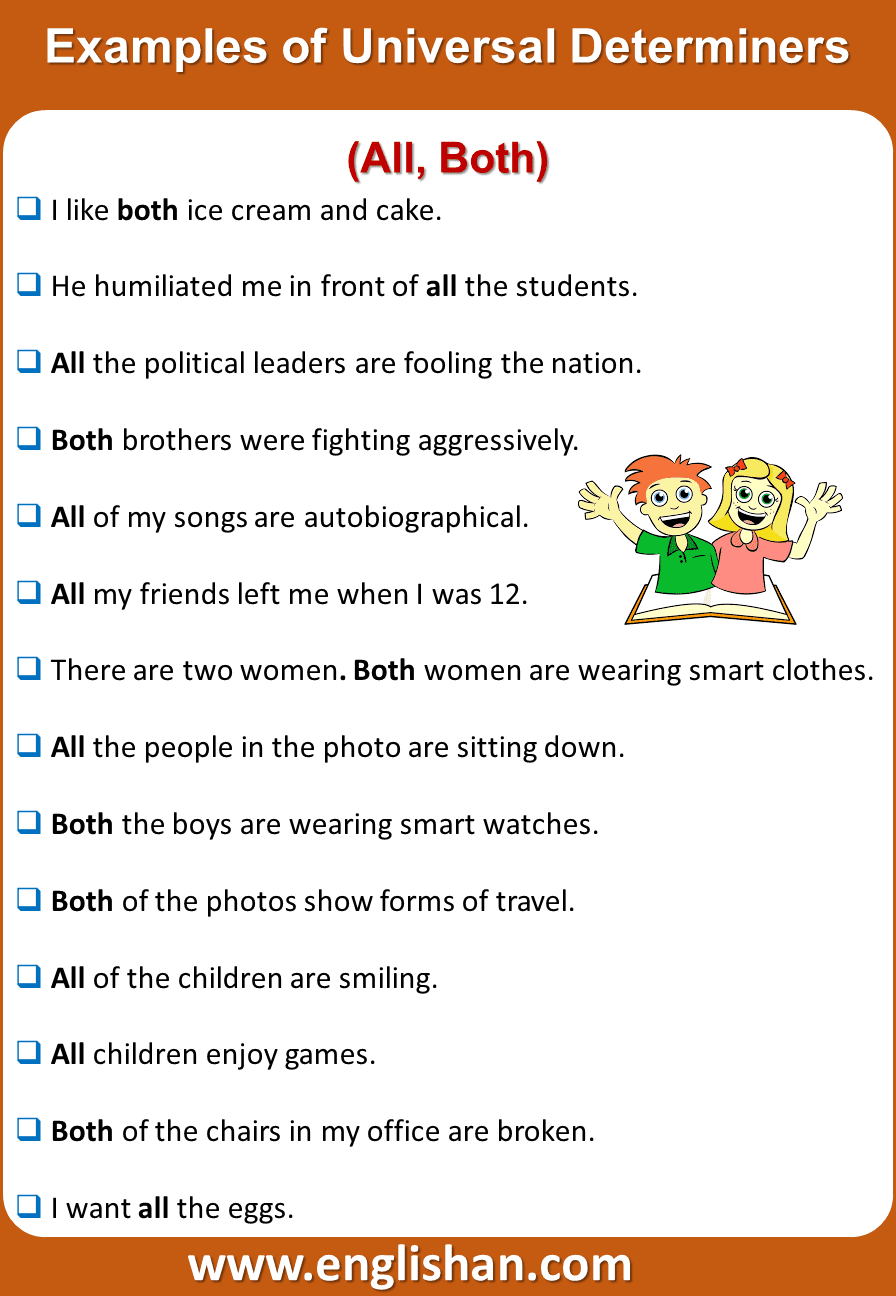
Universal determiners convey universal quantities. It means they declare that there is no subset of an object that lacks the specified property.
Examples,
- I like both ice cream and cake.
- He humiliated me in front of all the students.
- All the political leaders are fooling the nation.
- Both brothers were fighting aggressively.
Determiners of Difference
( other, another)
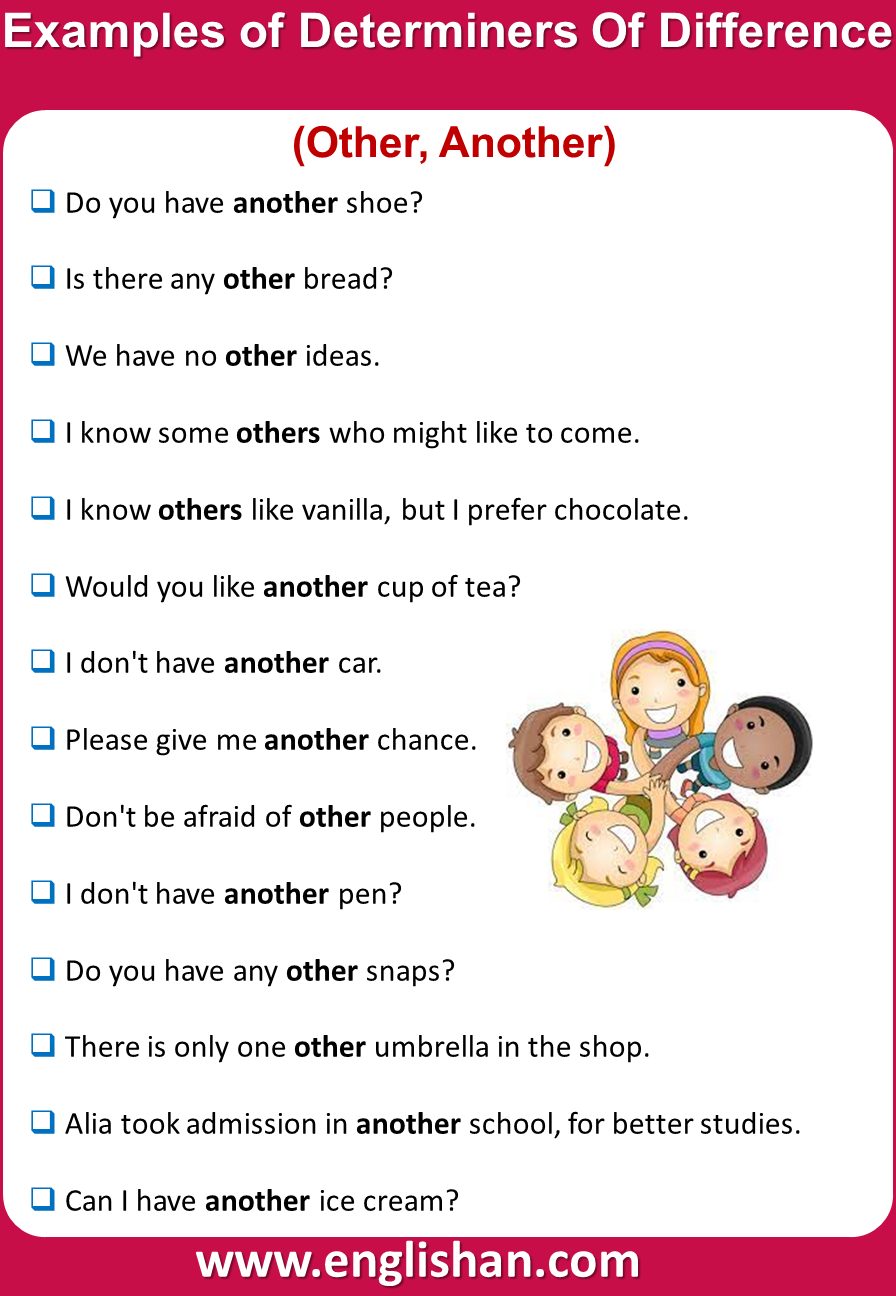
Other and another are determiners of difference, Other means Additional, alternatives and Another means one more or a different one. Determiner other is used before plural countable nouns and all uncountable nouns and another is used before singular countable nouns.
Examples,
- Please give me another
- Don’t be afraid of other
- I don’t have another pen.
- Do you have any other snaps?
Negative Determiners
(no, none of)
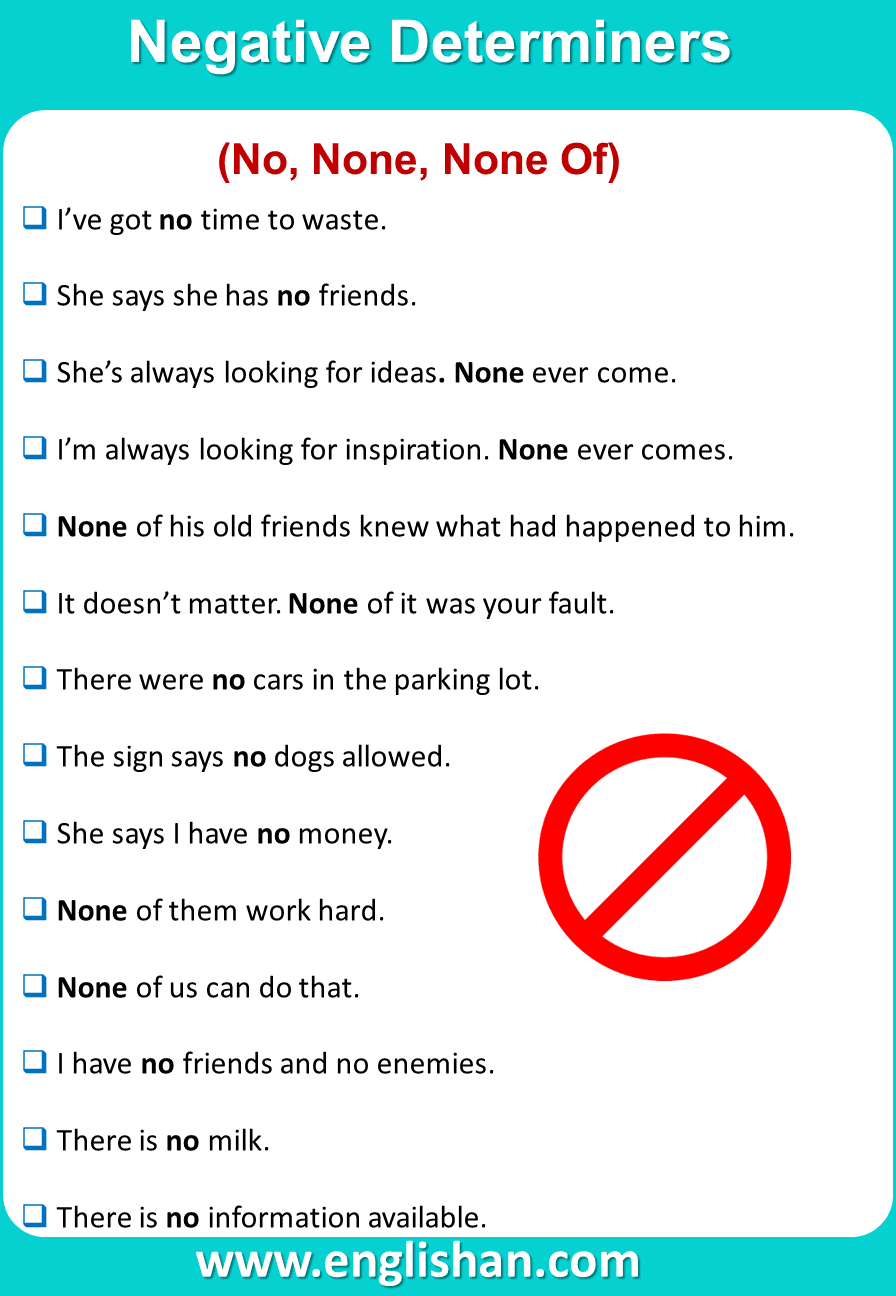
Negative determiners convey a negative meaning, they are often used in a positive sentence to emphasize a negative idea. They can be used with countable and uncountable nouns.
Examples,
- She says I have no
- None of them work hard.
- None of us can do that.
- I have no friends and no
FAQs:
Determiners are words that come before a noun to give more information about it. They help us know which noun we are talking about, how many, or who it belongs to.
Here are 12 common determiners in English:
1. The (definite article)
2. A (indefinite article)
3. An (indefinite article)
4. This (demonstrative)
5. That (demonstrative)
6. These (demonstrative)
7. Those (demonstrative)
8. My (possessive)
9. Your (possessive)
10. His (possessive)
11. Some (quantifier)
12. Any (quantifier)
These determiners help give more information about nouns, such as whether they are specific or general, who owns them, or how many there are!
Types of Determiner Words
1. Articles: a, an, the
Example: The dog is barking.
2. Demonstratives: this, that, these, those
Example: This book is mine.
3. Possessives: my, your, his, her, our, their
Example: My bag is heavy.
4. Quantifiers: some, any, many, few, all, no
Example: Some kids are playing.
5. Numbers: one, two, three
Example: Three apples are on the table.
6. Distributives: each, every, either, neither
Example: Each student got a gift.
7. Interrogatives: what, which, whose
Example: Which color do you like?
Determiners help give details about nouns, like “which one,” “how many,” or “who owns it.”
A determiner is a word that comes before a noun to give more information about it. It helps us understand which noun we are talking about, how many there are, or who owns it.
You May Also Like