

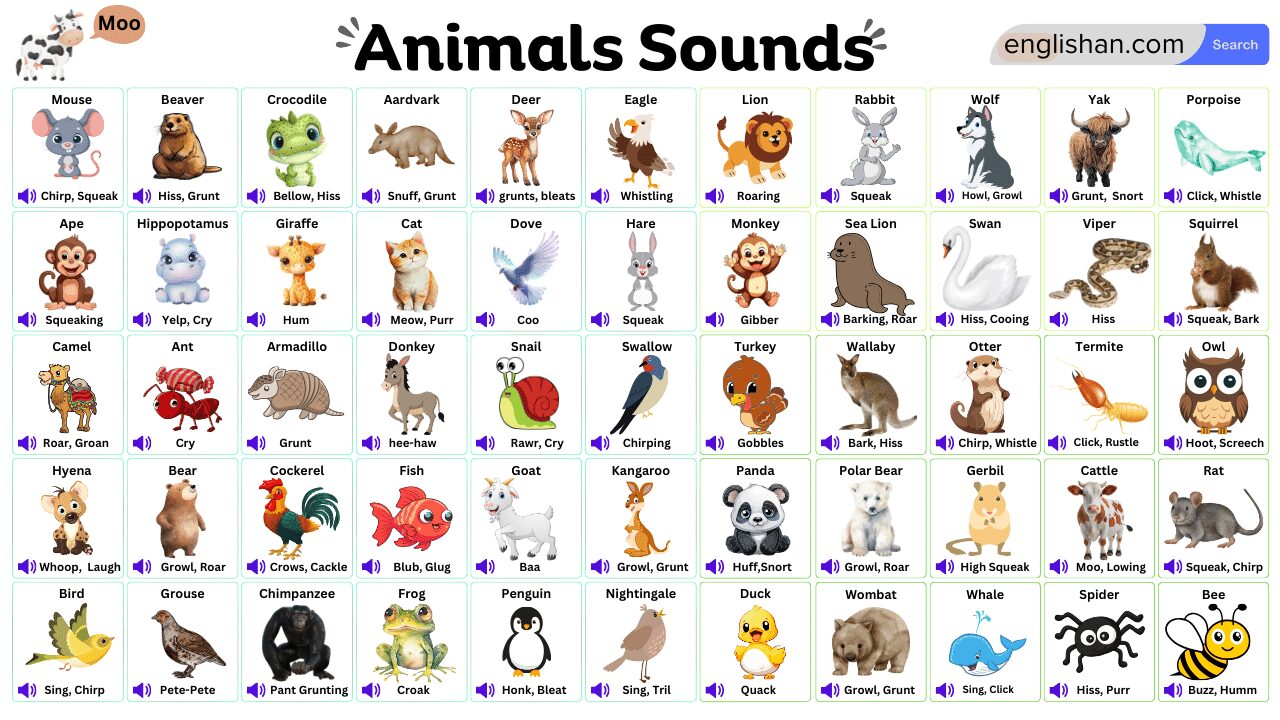
Animals communicate all day long, and English has a word for almost every noise they make. A dog barks to warn you off, a cat purrs when it settles on your lap, a cow moos to call its calf, and a lion roars to claim its ground. These animal sounds copy the noise itself, which is why buzz, hiss, and quack land so close to the real thing. Each one works as both a noun and a verb, so you can mention a loud bark or say that the dog barks. From a sparrow’s chirp to a wolf’s howl, almost every animal has its own term, and the right one turns a vague “it made a noise” into the exact word for what you heard.
Animal Sounds and Onomatopoeia Explained
Most animal sound words copy the noise itself, a pattern English calls onomatopoeia.
Onomatopoeia is a word that imitates the sound it names, like buzz, hiss, or quack.
Each sound word does two jobs at once. It names the sound as a noun, as in a loud bark, and it names the action as a verb, as in the dog barks. That double role is why the cat let out a meow and the cat meowed both read as correct English.
The noise an animal makes stays the same around the world. Only the spelling people give it changes from one language to the next.
| Animal | English | Spanish | Japanese |
|---|---|---|---|
| Dog | Woof | Guau | Wan |
| Cat | Meow | Miau | Nyan |
| Rooster | Cock-a-doodle-doo | Quiquiriquí | Kokekokko |
| Frog | Ribbit | Croac | Kero-kero |
| Duck | Quack | Cuac | Gā-gā |
Animals and Their Sounds: A to Z
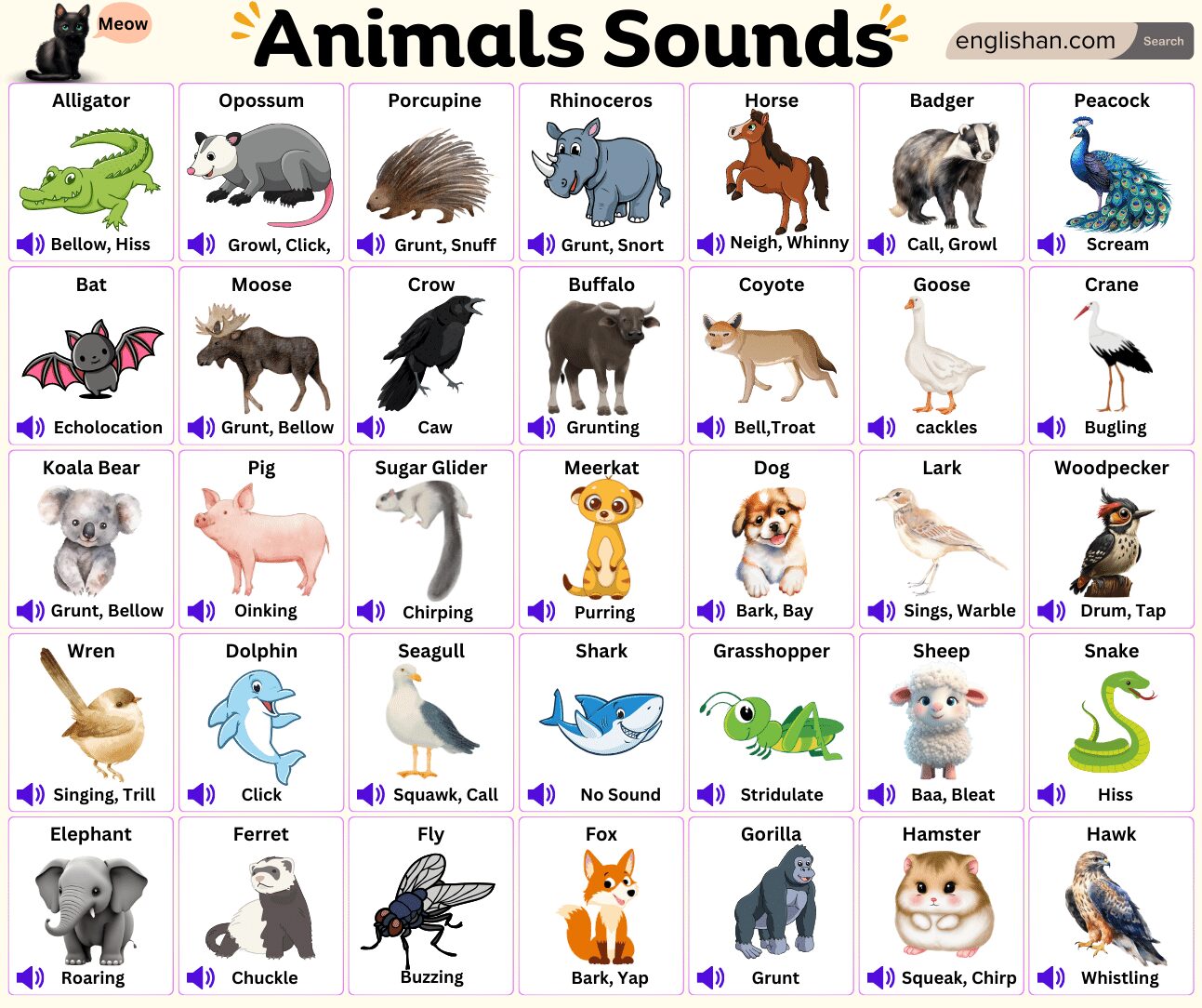
Every common animal with its main sound word and a plain pronunciation cue, ordered alphabetically for fast lookup.
| Animal | Sound | Sounds like |
|---|---|---|
| Alligator | Hiss, bellow | hiss, BEL-oh |
| Ape | Gibber, hoot | JIB-er, hoot |
| Bat | Screech | screech |
| Bear | Growl, roar | growl, ror |
| Bee | Buzz, hum | buzz, hum |
| Bird | Chirp, tweet | churp, tweet |
| Bull | Bellow | BEL-oh |
| Camel | Grunt | grunt |
| Cat | Meow, purr | mee-OW, pur |
| Cheetah | Chirp, purr | churp, pur |
| Chicken | Cluck | kluk |
| Cow | Moo, low | moo, loh |
| Cricket | Chirp | churp |
| Crocodile | Hiss, bellow | hiss, BEL-oh |
| Crow | Caw | kaw |
| Deer | Bleat, grunt | bleet, grunt |
| Dog | Bark, woof, howl | bark, wuf, howl |
| Dolphin | Click, whistle | klik, WIS-ul |
| Donkey | Bray, hee-haw | bray, HEE-haw |
| Dove | Coo | koo |
| Duck | Quack | kwak |
| Eagle | Screech | screech |
| Elephant | Trumpet | TRUM-pet |
| Ferret | Dook | dook |
| Fox | Yelp, scream | yelp, screem |
| Frog | Croak, ribbit | krohk, RIB-it |
| Giraffe | Hum | hum |
| Goat | Bleat | bleet |
| Goose | Honk, hiss | honk, hiss |
| Gorilla | Grunt, hoot | grunt, hoot |
| Grasshopper | Chirp | churp |
| Hamster | Squeak | skweek |
| Hawk | Screech | screech |
| Hen | Cluck, cackle | kluk, KAK-ul |
| Hippopotamus | Grunt, bellow | grunt, BEL-oh |
| Horse | Neigh, whinny, snort | nay, WIN-ee, snort |
| Hyena | Laugh, whoop | laf, woop |
| Iguana | Hiss | hiss |
| Jaguar | Roar, growl | ror, growl |
| Kangaroo | Grunt, chortle | grunt, CHOR-tul |
| Koala | Bellow, grunt | BEL-oh, grunt |
| Lark | Sing, warble | sing, WOR-bul |
| Lion | Roar | ror |
| Meerkat | Bark, purr | bark, pur |
| Monkey | Chatter, screech | CHAT-er, screech |
| Moose | Bellow, grunt | BEL-oh, grunt |
| Mouse | Squeak | skweek |
| Nightingale | Sing, trill | sing, tril |
| Owl | Hoot, screech | hoot, screech |
| Ox | Low, bellow | loh, BEL-oh |
| Parrot | Squawk, talk | skwawk, tawk |
| Peacock | Scream | screem |
| Penguin | Bray, honk | bray, honk |
| Pig | Oink, grunt, squeal | oynk, grunt, skweel |
| Pigeon | Coo | koo |
| Quail | Whistle, call | WIS-ul, kawl |
| Rabbit | Squeak, thump | skweek, thump |
| Raccoon | Chitter, growl | CHIT-er, growl |
| Rooster | Crow | kroh |
| Seal | Bark | bark |
| Sheep | Baa, bleat | bah, bleet |
| Snake | Hiss, rattle | hiss, RAT-ul |
| Sparrow | Chirp, tweet | churp, tweet |
| Squirrel | Chatter, squeak | CHAT-er, skweek |
| Tiger | Roar, growl, snarl | ror, growl, snarl |
| Turkey | Gobble | GOB-ul |
| Vulture | Screech, hiss | screech, hiss |
| Whale | Sing, click | sing, klik |
| Wolf | Howl, growl | howl, growl |
| Wombat | Grunt, growl | grunt, growl |
| Woodpecker | Drum, tap | drum, tap |
| Yak | Grunt, snort | grunt, snort |
| Zebra | Bark, bray | bark, bray |
Animal Sounds by Category
The same words split neatly by where you meet the animal. Each group below leads with the sounds you hear most.
Farm Animal Sounds
The first set most learners pick up, drilled into childhood songs for a reason.
- Cow: moo, low. A deep, drawn-out call across the field.
- Sheep: baa, bleat. The double a shows a long, stretched cry.
- Pig: oink, grunt, squeal. A squeal turns sharp when a pig is startled.
- Horse: neigh, whinny, snort. A whinny is the long, high call; a snort is the short blow through the nose.
- Rooster: crow. The dawn call that names the whole sound, cock-a-doodle-doo.
- Donkey: bray, hee-haw. Loud, harsh, and impossible to sleep through.
- Goat: bleat. Close to a sheep, often higher and more broken.
- Chicken: cluck, cackle. A hen cackles louder right after laying an egg.
Wild Animal Sounds
Out in open country the sounds turn deeper and carry further.
- Lion: roar. Built to travel for miles and warn rivals off.
- Tiger: roar, growl, snarl. A snarl adds bared teeth and real threat.
- Bear: growl, roar. A low growl is the first warning, long before contact.
- Wolf: howl, growl. Wolves howl together to stay linked across distance.
- Elephant: trumpet. A blast of air through the trunk, used in alarm or excitement.
- Hyena: laugh, whoop. The “laugh” is a string of high, broken yelps.
- Monkey: chatter, screech. Fast, sharp, and constant high in the trees.
- Fox: yelp, scream. The night scream is sharp enough to mistake for a person.
Bird Sounds
Birds carry the widest range, from a soft coo to a hard screech.
- Sparrow: chirp, tweet. Short, bright notes repeated through the day.
- Crow: caw. A flat, harsh call you hear before you spot the bird.
- Owl: hoot, screech. The hoot at night; the screech in alarm.
- Duck: quack. Sharp and nasal, mostly from the female.
- Dove: coo. A soft, rolling call used to draw a mate.
- Peacock: scream. A loud, startling cry that carries across a garden.
Water Animal Sounds
Underwater, sound travels further than light, so sea animals lean on it heavily.
- Dolphin: click, whistle. Clicks map the surroundings; whistles name and find each other.
- Whale: sing, click. A humpback song can run for many minutes without a break.
- Seal: bark. Sharp and dog-like, echoing off the rocks.
- Frog: croak, ribbit. Louder in the rain, when many call at once.
Insect Sounds
Tiny bodies, surprising volume, almost all of it made by movement rather than a voice.
- Bee: buzz, hum. The buzz is the beat of fast wings, not a call.
- Cricket: chirp. Made by rubbing the wings together, loudest on warm nights.
- Grasshopper: chirp. The same wing-rubbing trick, a behaviour called stridulation.
- Mosquito: whine. The thin, high note that wakes you in the dark.
Pet Animal Sounds
At home the sounds turn softer, and you learn to read each one by ear.
- Dog: bark, woof, howl. A growl warns; a bark calls; a howl answers a siren.
- Cat: meow, purr, hiss. A purr means content; a hiss means back off.
- Hamster: squeak. Short and high, mostly at night on the wheel.
- Parrot: squawk, talk. A squawk for alarm, and copied words for everything else.
- Rabbit: squeak, thump. A thumped back foot is a silent-style alarm to the warren.
Animal Sounds in Example Sentences
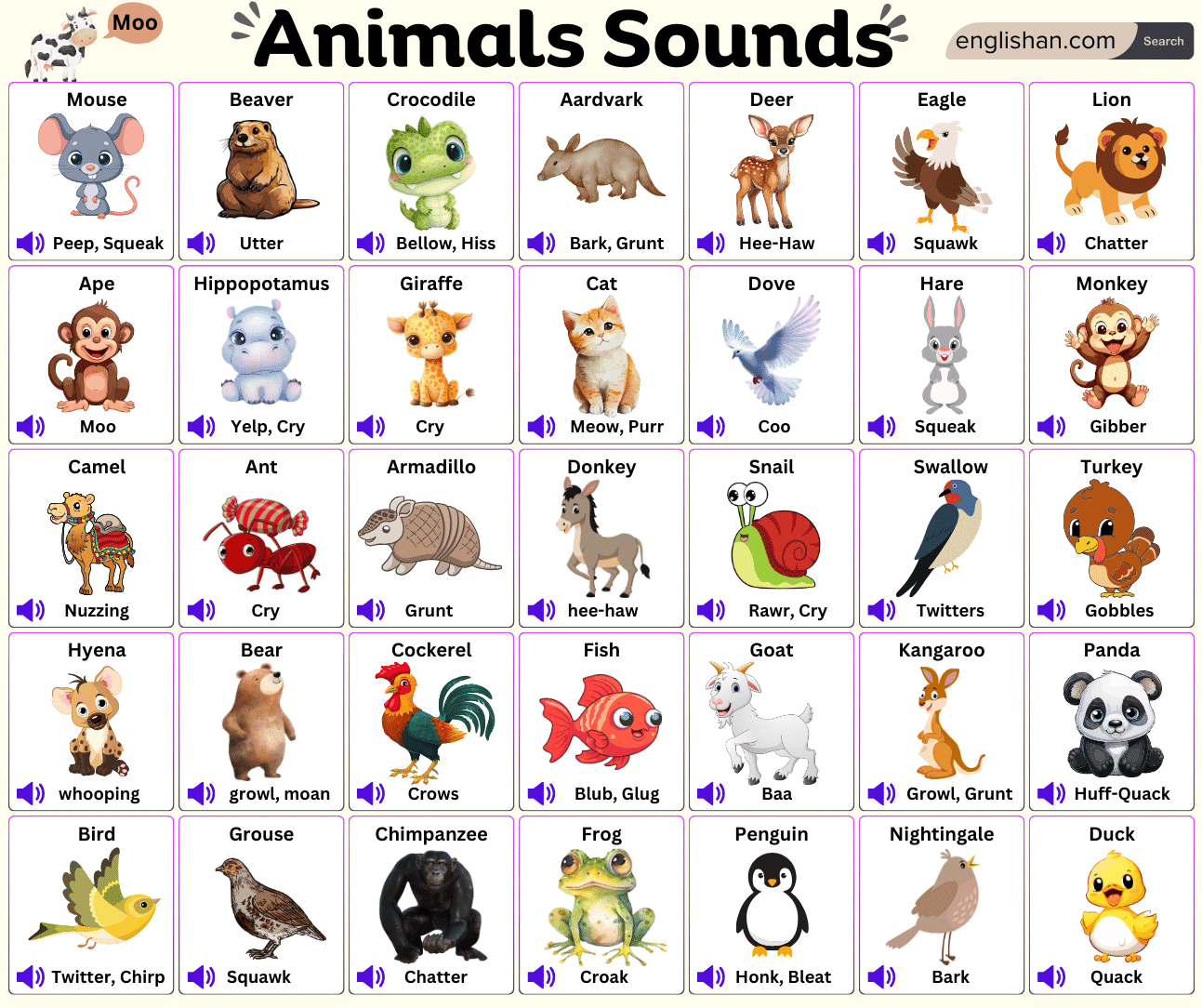
Each sound word slots into a sentence as a verb. Here is how they work in real use, grouped by setting.
On the farm:
- The cow mooed across the field at feeding time.
- The lambs baaed as the farmer crossed the gate.
- A rooster crowed before the sky turned light.
- The hen cackled the moment she left the nest.
In the wild:
- The lion’s roar rolled across the plain.
- The bear growled the second it caught our scent.
- Somewhere past the camp, a hyena whooped.
- The wolves howled to one another after dark.
Among the birds:
- Sparrows chirped along the fence wire all morning.
- A crow cawed from the chimney top.
- An owl hooted twice across the valley.
- The ducks quacked and paddled to the bank.
Near the water:
- The dolphins clicked and whistled as they circled the boat.
- A humpback whale sang for twenty minutes straight.
- Frogs croaked along the pond all evening.
At home:
- The dog barked at every car on the street.
- She purred the second he sat down beside her.
- The parrot squawked and copied the doorbell.
Verb Forms of Animal Sounds
Each sound word is both a noun for the sound and a verb for the action. Here are the present and past forms side by side.
| Animal | Sound (noun) | Verb forms |
|---|---|---|
| Dog | Bark | Barks, barked |
| Cat | Meow | Meows, meowed |
| Cow | Moo | Moos, mooed |
| Sheep | Baa | Baas, baaed |
| Horse | Neigh | Neighs, neighed |
| Lion | Roar | Roars, roared |
| Owl | Hoot | Hoots, hooted |
| Duck | Quack | Quacks, quacked |
| Frog | Croak | Croaks, croaked |
| Snake | Hiss | Hisses, hissed |
| Bee | Buzz | Buzzes, buzzed |
Every one is a regular verb, so the past tense just adds -ed. The only spelling to watch is the words that end in a vowel, like baa to baaed and coo to cooed. The endings -s, -es, and -ed follow the normal rules:
- ✅ The dog barked all night.
- ❌ The dog barkes all night.
What Each Animal Sound Means
Four words look alike on paper but send different messages, and learners mix them up the most.
Quick answer: A roar projects power, a growl warns, a snarl threatens with bared teeth, and a bellow booms from a heavy animal.
- Roar: A long, deep, powerful sound. A lion roars to claim ground and call the pride.
- Growl: A low, rumbling warning. A dog growls before it ever barks or bites.
- Snarl: A growl with bared teeth and open threat behind it. A tiger snarls when it is cornered.
- Bellow: A loud, drawn-out roar from a large animal. A bull bellows, and so does a crocodile.
A few more worth pinning down:
- Hiss: Fear or threat. A cat hisses, a snake hisses, and a goose hisses when you step too close.
- Whistle: A high, clean note. Dolphins whistle to name and find each other.
- Chirp: A short, bright, repeated note. Sparrows chirp to greet the morning and warn the flock.
- Coo: A soft, rolling sound. Doves and pigeons coo to call a mate.
Why Animals Make Sounds
A sound carries a message: a warning, a mating call, a claim on territory, or a cry to the young. A mother hen clucks to gather her chicks, and a cow lows to bring her calf back to her side.
Some sounds come from the body, not the voice. Bees and flies buzz because their wings beat hundreds of times a second, and a cricket chirps by rubbing its wings together rather than calling out.
A few facts worth keeping:
- A lion’s roar travels for miles across open ground and warns rivals off its territory.
- Bats hunt in full dark by sending out high squeaks and reading the echoes, a system called echolocation.
- Elephants rumble below the range of human hearing, and that low sound carries through the ground.
- Wolves howl together to stay in contact when the pack spreads out to hunt.
- A rattlesnake shakes the rings on its tail to warn you off before it strikes.
- Frogs croak louder in the rain, when many of them call at the same time.
Animal Sound Words in Everyday English
Many of these words live a second life outside the animal world, and you will hear them in everyday speech.
- Gobble: To eat very fast. He gobbled his lunch in two minutes.
- Quack: A fake or untrained doctor. That clinic is run by a quack.
- Crow: To boast about a win. She crowed about her score all week.
- Parrot: To repeat words without thinking. He just parrots whatever he reads online.
- Badger: To pester someone again and again. Stop badgering me about the deadline.
- Snort: A short laugh through the nose. She snorted at the joke before she could stop herself.
- Hound: To chase or pressure someone. Reporters hounded him outside the building.
Learn the animal sound first, and the everyday meaning sticks right behind it.
Rare or Unusual Animal Sounds
A few animals make noises that catch people off guard, because the sound does not match the animal you picture.
- Cheetah: A cheetah chirps and purrs like a bird or a house cat, and it cannot roar at all.
- Giraffe: Long thought to be silent, giraffes hum to one another at night.
- Fox: The fox’s night scream is sharp and human enough to startle anyone who hears it.
- Koala: A koala bellows with a deep, growling call far larger than its body suggests.
- Rabbit: A rabbit thumps a back foot on the ground to warn the others, an alarm with almost no sound to it.
Animals That Make Almost No Sound
A few animals stay silent and send their messages another way, because not every animal uses a voice to communicate.
- Snail and worm: Silent. Both rely on movement and chemical traces.
- Jellyfish: No call at all, drifting and pulsing without a sound.
- Most fish: Largely silent, reading each other through movement and body posture.
- Butterfly: Flies in silence; its only signal is the pattern and colour of its wings.
- Octopus: Says everything with colour, flashing its skin to show mood and warning.
Animal Sounds Across Languages
The animal makes one noise, but every language writes it down its own way. A dog in London says woof, a dog in Madrid says guau, and a dog in Tokyo says wan. None of them is wrong. Each spelling is one language’s attempt to catch the same bark on paper, which is why animal sounds shift so much when you cross a border.
Animal Sounds for Young Learners
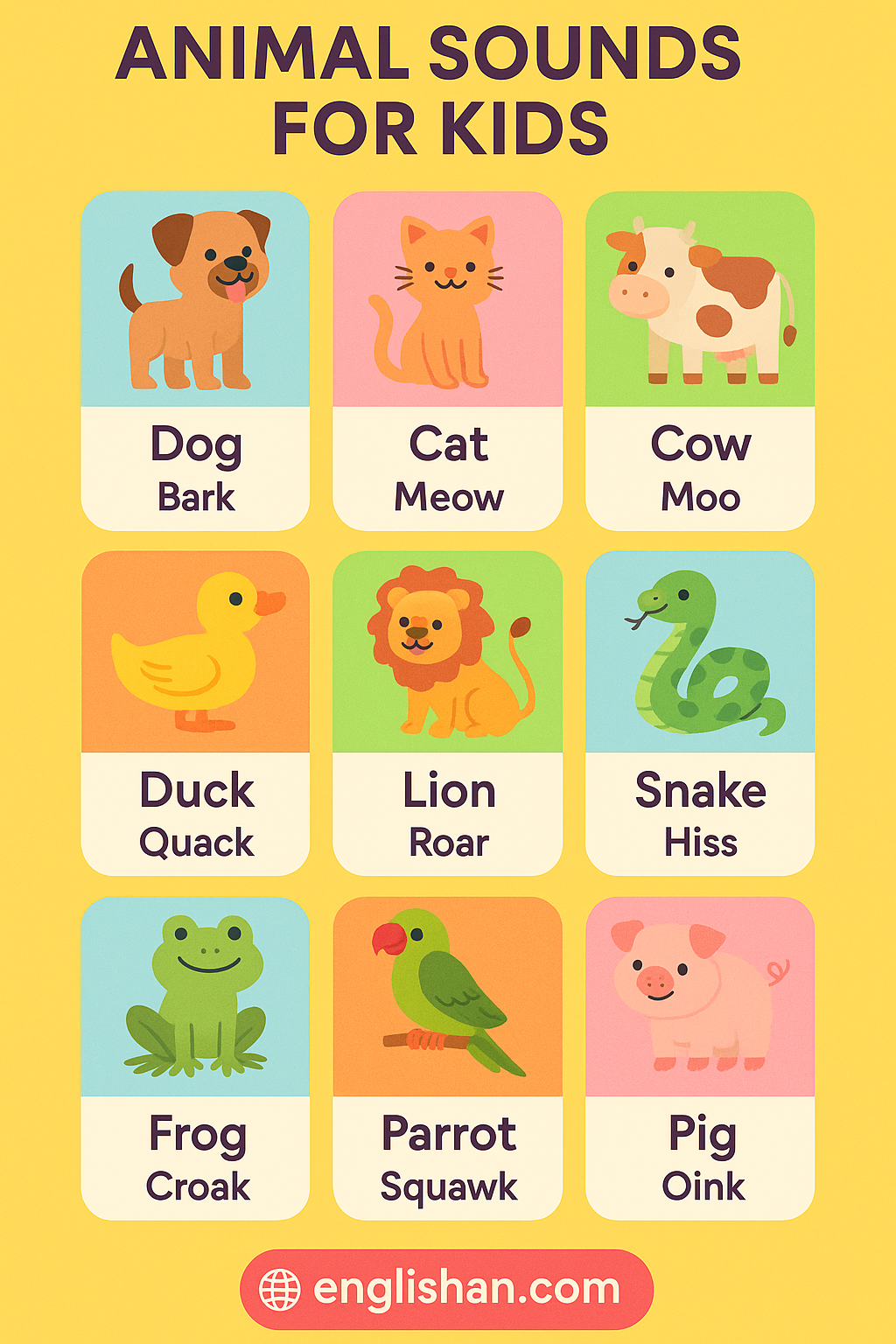
The starter set children learn first, built from the sounds they hear earliest:
- Dog: woof.
- Cat: meow.
- Cow: moo.
- Duck: quack.
- Sheep: baa.
- Pig: oink.
- Horse: neigh.
- Lion: roar.
Songs like Old MacDonald Had a Farm drill these through rhythm and repetition, which is why most children master the farmyard set before any other. To practise, work through an animal sounds worksheet, then move on to baby animal names once the sounds stick.
Practice These Animal Sounds Today
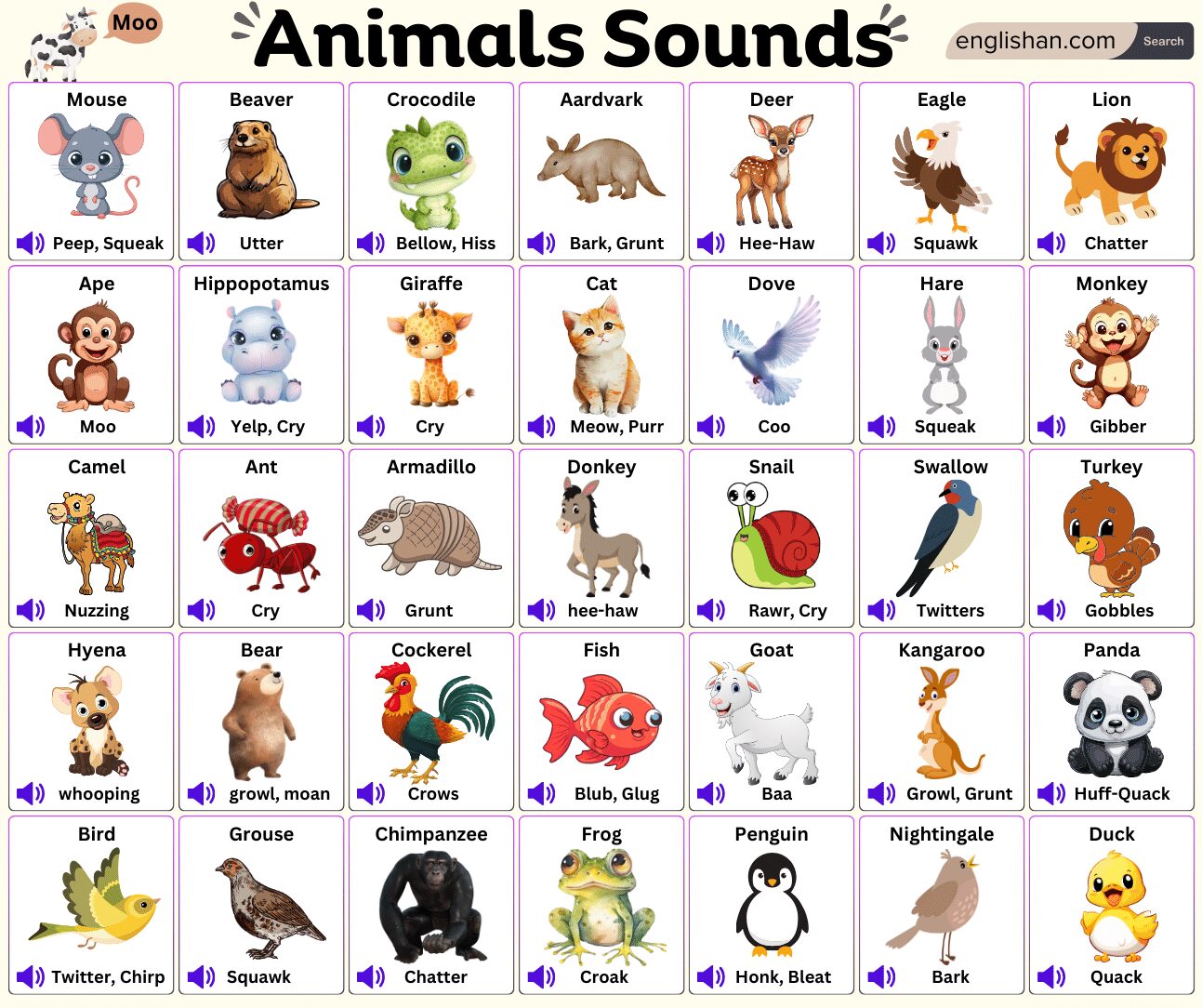
Once these sound words click, you will hear them everywhere: in stories, songs, films, and ordinary speech. Pick five from the A to Z list today, say each one out loud beside the animal, and use one in a sentence before the day is out. Most learners only ever reach for bark and meow. You now have the full set.
FAQs
Animal Sounds FAQs
Here’s a list of animal sounds from A to Z:
A – Antelope: Snort
B – Bear: Growl
C – Cat: Meow
D – Dog: Bark
E – Elephant: Trumpet
F – Frog: Ribbit
G – Goat: Baa
H – Horse: Neigh
I – Iguana: Hiss
J – Jaguar: Growl
K – Kangaroo: Thump
L – Lion: Roar
M – Monkey: Chatter
N – Nightingale: Sing
O – Owl: Hoot
P – Pig: Oink
Q – Quail: Whistle
R – Rabbit: Squeal
S – Snake: Hiss
T – Tiger: Growl
U – Uakari (monkey): Chatter
V – Vulture: Screech
W – Wolf: Howl
X – (No common animal with a sound for X)
Y – Yak: Moo
Z – Zebra: Whinny
The sound a bull makes is called a bellow. It’s a loud, deep noise.
A bull bellows. A bellow is a loud, deep, drawn-out roar that carries across a field.
Onomatopoeia is a word that copies the noise it names. Buzz, hiss, quack, and moo all imitate the real sound, which is why animal sound words show the pattern best.
A roar is long, deep, and powerful, like a lion’s. A growl is lower, shorter, and a warning, like a dog’s. A snarl adds bared teeth and open threat. Roar projects, growl warns, snarl threatens.
Snails, worms, jellyfish, and most fish make no call. They communicate through movement, body posture, scent, or colour instead of a voice.
A cheetah chirps and purrs. It is the only big cat that cannot roar, so its call sounds closer to a bird or a house cat.
English has well over a hundred animal sound words once you count pets, farm animals, wild animals, birds, and insects. Some, like roar and buzz, are used worldwide.
Free PDF Lesson
We also offer a free PDF guide on animals and their sounds. This detailed lesson covers 100 unique animal and their corresponding noises, helping you learn how different animals communicate. Download the PDF to improve your knowledge and enjoy a fun learning experience.
Read More
Animals and Their Sounds Quiz
Animals and Their Sounds
What sound does a donkey make?
The call alternates between a loud in-breath and out-breath.
Bray, neigh and low belong to three different animals.
The donkey brayed across the yard.
Which verb goes with an elephant?
The sound is forced through the trunk, which is why it carries so far.
The verb often describes how the sound is made.
The herd trumpeted as it reached the water.
Complete the sentence.
Owls ___ at night from the wood behind the house.
Not every owl hoots — barn owls screech instead.
The classic hoot belongs mainly to tawny and eagle owls.
A barn owl screeches rather than hooting.
Which animal lows?
Lowing is the deep call of cows, and moo is the everyday word for it.
Low is the literary term; moo is the plain one.
The cattle lowed in the field at dusk.
Which pairing is wrong?
Frogs croak; chirping belongs to crickets and small birds.
Sound verbs are fixed by animal.
The frogs croaked all night by the pond.
Turn on JavaScript for the interactive quiz. The full practice set is shown above.