EnglishanEnglishan
  • Home
  • Grammar
    • Parts of speech
    • Tenses
    • Example Sentences
    • Other Ways to Say
  • Vocabulary
    • Picture Vocabulary
      • Parts of Things
      • Animals
      • Insects
      • Foods
      • Fruits
      • Things
    • Vocabulary for Kids
    • Descriptive Words
    • Synonyms
    • Antonyms
    • Confused Words
    • One Word Substitution
    • Phrasal Verbs
    • Positive Words
    • Verbs List
    • Adjectives List
      • Positive Adjectives
  • Words Lists
    • 5 Letter Words
    • Words Start With
    • Long Words
  • Worksheets
    • Kindergarten Worksheets
  • English Composition
    • Applications
    • Essay Writing
    • Letters
    • Comprehension
  • Wishes and Quotes
  • Contact
Reading: Main Clause in Grammar: Defintion, Rules and Examples
Share
Font ResizerAa
EnglishanEnglishan
Font ResizerAa
Search
  • Home
  • Vocabulary
    • Vocabulary for Kids
    • Internet Slangs
    • Synonyms
    • Antonyms
    • Confused Words
    • Descriptive Words
    • Phrasal Verbs
    • One Word Substitution
    • Adjectives List
    • Positive Adjectives
    • Verbs List
    • Positive Words
  • Picture Vocabulary
    • Parts of Things
    • Animals
    • Foods
    • Fruits
    • Insects
    • Things
  • Words List
    • 5 Letter Words
    • Long Words
    • Words Start With
  • Grammar
    • Parts of speech
    • Tenses
    • Example Sentences
    • Other Ways to Say
  • Worksheets
  • Wishes and Quotes
  • Positive Adjectives
Follow US
  • About
  • Contact
  • Privacy Policy
  • Terms of Service
Copyright © 2026 englishan.com All Rights Reserved.
Home > Grammar > Main Clause in Grammar: Defintion, Rules and Examples
Grammar

Main Clause in Grammar: Defintion, Rules and Examples

Julian Mercer
By
Julian Mercer
Last updated: August 25, 2025
7 Min Read
Main clause in grammar with Examples and Rules
SHARE

In English grammar, a main clause is a group of words with a subject and a verb that expresses a complete thought. A main clause can be a full sentence on its own, which makes it very important in writing. Learning about main clauses helps you understand how sentences work and makes your writing clear.

In This Page
  • What Is a Main Clause?
  • How to Use a Main Clause in a Sentence
  • Difference between a Main Clause and a Subordinate Clause
  • Examples of Main Clauses
  • FAQs

Main clauses are key to writing and speaking because they let us communicate complete ideas. They are the building blocks of sentences, making understanding and sharing thoughts easier. Let’s take a closer look at the main clauses and how they work in English.

What Is a Main Clause?

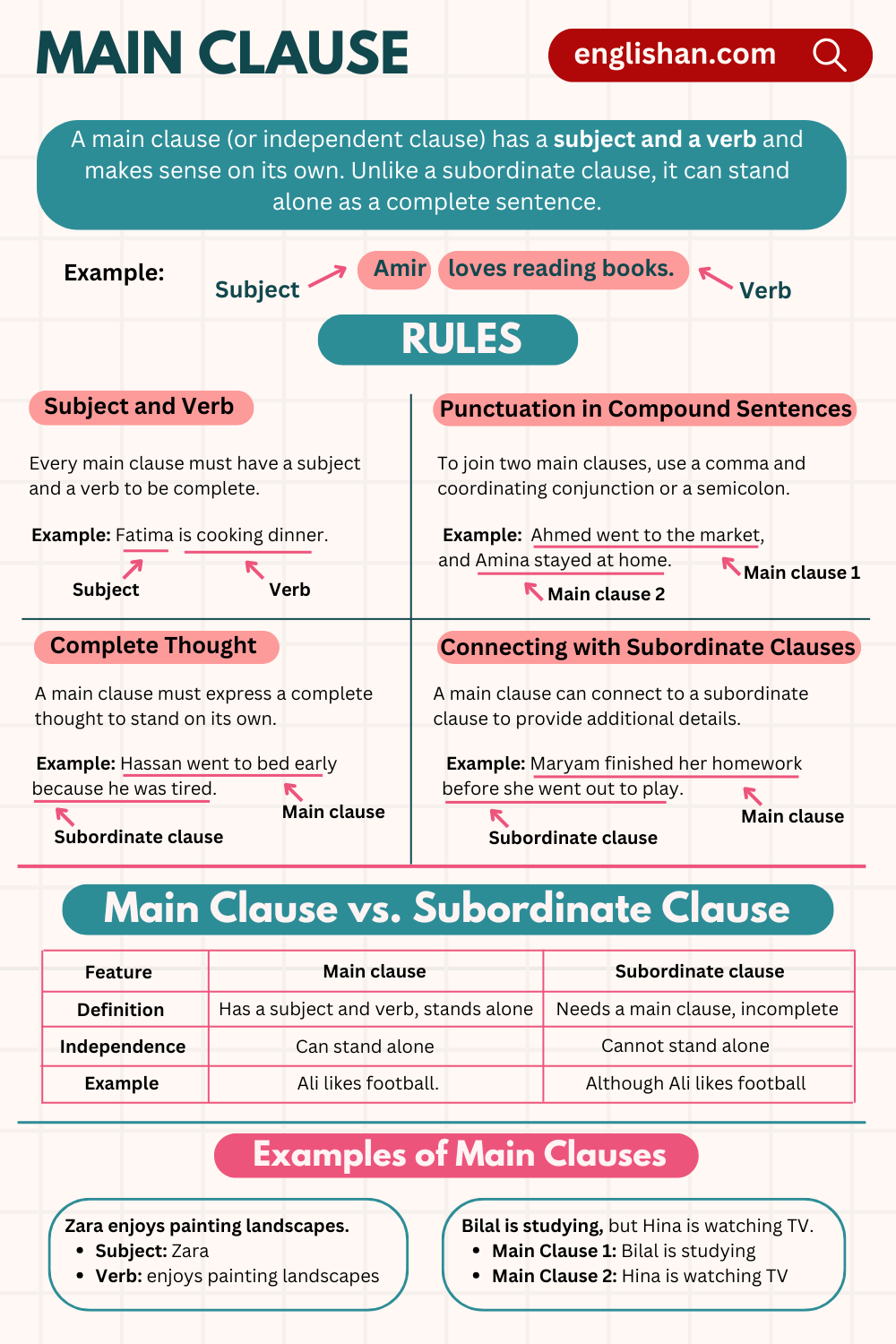
A main clause (also called an independent clause) is a group of words with both a subject and a verb. It expresses a complete idea and makes sense on its own. This is different from a subordinate (or dependent) clause, which needs a main clause to make sense.

For example:

  • Amir loves reading books.

In this sentence, “Amir” is the subject, and “loves reading books” is the verb part. This main clause makes a complete statement and can be a full sentence by itself.

Main clauses make up simple sentences. They can also be combined to form compound or complex sentences.
Main clause with Examples in English Grammar
Advertisement

How to Use a Main Clause in a Sentence

Using main clauses correctly is important for making sure your sentences are complete and make sense. Here are some simple rules to help you use main clauses:

  1. Subject and Verb Requirement: Every main clause must have a subject and a verb. Without these, the clause cannot stand alone.
    • Fatima is cooking dinner.
    In this example, “Fatima” is the subject, and “is cooking” is the verb, making it a complete sentence.
  2. Punctuation in Compound Sentences: When combining two main clauses, use a comma and a coordinating conjunction (for, and, nor, but, or, yet, so) or a semicolon.
    • Ahmed went to the market, and Amina stayed at home.
    Here, two main clauses are joined by a comma and the word and.
  3. Express a Complete Thought: A main clause should always express a complete thought that makes sense by itself. Avoid fragments that are missing important parts.
    • Incorrect: ❌ Because Hassan was tired. (This is not complete)
    • Correct: ✅ Hassan went to bed early because he was tired.
  4. Connecting with Subordinate Clauses: A main clause can be connected to one or more subordinate clauses for extra information, but the main clause should be able to stand alone.
    • Maryam finished her homework before she went out to play.
    Here, “Maryam finished her homework” is the main clause, and it can stand alone, while “before she went out to play” is a subordinate clause.

Difference between a Main Clause and a Subordinate Clause

It is important to understand the difference between main and subordinate clauses to use them correctly.

FeatureMain ClauseSubordinate Clause
DefinitionHas a subject and verb and expresses a complete thought. It can stand alone.Has a subject and verb but does not express a complete thought. It depends on a main clause.
IndependenceCan stand alone as a complete sentence.Cannot stand alone, needs a main clause.
ExampleAli likes football.Although Ali likes football
UsageForms simple, compound, or complex sentences.Adds extra information to a main clause.

To make sense, a subordinate clause must be attached to a main clause:

  • Ali likes football although it’s raining outside.

Here, “Ali likes football” is the main clause, while “although it’s raining outside” is a subordinate clause that adds more information.

Examples of Main Clauses

Here are some examples of main clauses to help you understand better:

  • Zara enjoys painting landscapes.
    Zara is the subject, and “enjoys painting landscapes” is the verb part. This is a complete sentence and stands on its own.
  • Bilal is studying, but Hina is watching TV.
    This sentence has two main clauses joined by the word but. Both “Bilal is studying”” and “”Hina is watching TV” can stand alone as complete sentences.
  • Sarah cooked dinner, and Usman cleaned the dishes.
    In this example, “Sarah cooked dinner” and “Usman cleaned the dishes” are both main clauses joined with “and” to make a compound sentence.

FAQs

1. What is a main clause?

A main clause is a group of words that has a subject and a verb and expresses a complete thought. It can be a sentence by itself, unlike subordinate clauses which need a main clause.

2. How do you identify a main clause?

To find a main clause, look for a subject and a verb that express a complete idea. If it makes sense on its own, it is a main clause.

3. Can a sentence have more than one main clause?

Yes, a sentence can have more than one main clause. These are called compound sentences, and they are joined by words like “and,” “but,” or “so.”

4. What is the difference between a main clause and a subordinate clause?

A main clause can be a complete sentence by itself, but a subordinate clause cannot. Subordinate clauses need to be attached to a main clause for meaning.

5. Can you give an example of a main clause?

Here are some examples of main clause: “Sara loves to play basketball.” This is a main clause because it has a subject (Sara) and a verb (loves) and expresses a complete thought.

You May Also Like

  • Determiners and their Types with Examples
  • Clauses and their Types with Examples
  • Subordinating Conjunctions in English
  • Noun Clauses: Definition, Types, Usage and Examples
  • Dependent Clauses with Examples
Advertisement
Share This Article
Facebook Pinterest Whatsapp Whatsapp LinkedIn Reddit Copy Link
Julian Mercer
ByJulian Mercer
Follow:
Julian Mercer is the founder of Englishan.com and has spent over a decade helping English learners improve through online lessons and practical writing. Having worked with students across many countries, he knows the questions people repeat, the mistakes that slow progress, and the moments that make English click. On Englishan, he writes about vocabulary, picture vocabulary, grammar, and everyday English to help readers speak with ease, read with less strain, and write with more confidence.
270KLike
82KPin
- Advertisement -

You Might Also Like

Types of Prepositions
Grammar

Types of Prepositions with Examples

12 Min Read
Complex Sentence Examples & Definition
Grammar

Complex Sentences uses in English Grammar

7 Min Read
Types of Adjective With Examples and High Quality Printable Document
GrammarParts of speech

Types of Adjectives with Their Examples

11 Min Read
Exclamatory Sentences with Examples in English
Grammar

Exclamatory Sentences with Examples in English

8 Min Read
Englishan-Logo-resized Englishan-Logo-resized

Englishan.com is a blog for better writing, speaking, and study results. We publish grammar and vocabulary posts, plus worksheets, word lists, and example sentences for practice.

Important Pages

  • About
  • Contact
  • Privacy Policy
  • Terms of Service

Get in Touch for Queries

Got any questions - Reach us out at
  • contact@englishan.com
  • +971561449880
  • About
  • Contact
  • Privacy Policy
  • Terms of Service
Welcome Back!

Sign in to your account

Username or Email Address
Password

Lost your password?