Verbs that start with J are English verbs whose base form begins with the letter J. They range from jump and join to juxtapose and jettison.
Every one of them is regular. The past simple and the past participle both take -ed, so jog becomes jogged and justify becomes justified.
Where they differ is in meaning and in how formal they sound. Jest and joke both describe humour, yet one belongs to literature and the other to conversation, and that difference is what makes one of them correct.
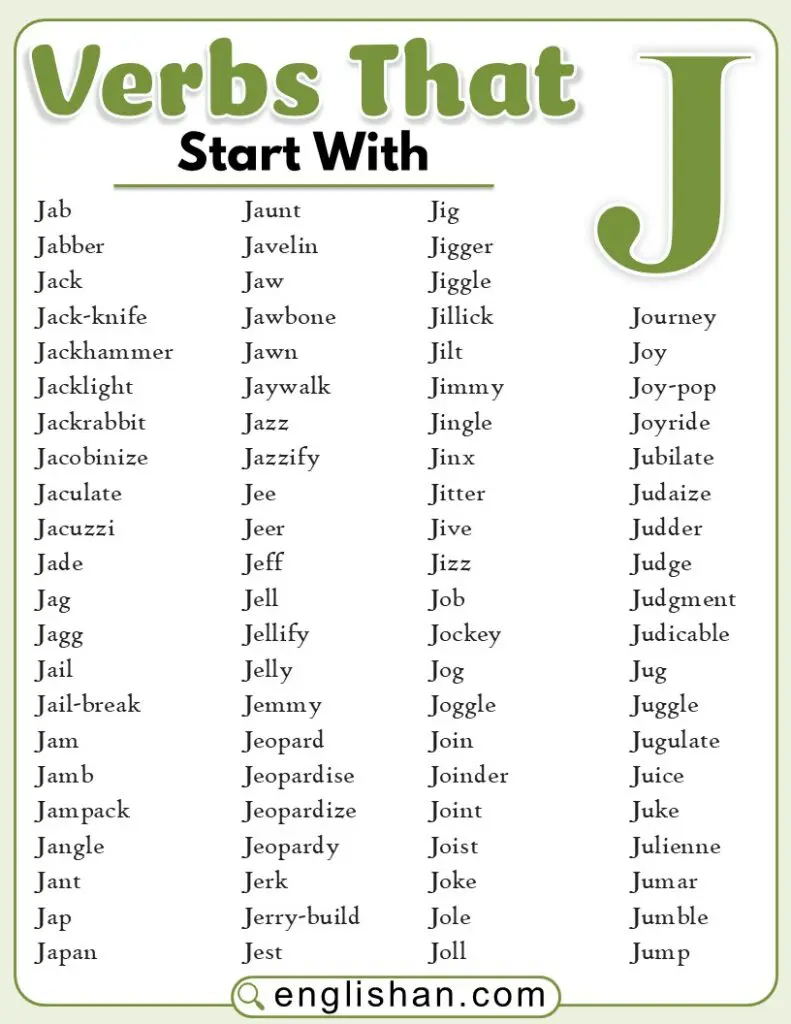
What Are Verbs That Start With J
Verbs that start with J are verbs whose base form opens with the letter J. Most of them name something physical and abrupt, such as jab, jerk, jolt and jostle.
All of them begin with the /dʒ/ sound heard in judge. Jab and jostle take a direct object, while jog and jut stand alone.
Common Verbs That Start With J
Join, jump, judge and justify carry the everyday load in English. Jam, jar and jerk all describe rough physical force, and they are not interchangeable.
| Verb | Meaning | Example sentence |
|---|---|---|
| Join | To become part of a group, or to connect two parts | Three graduates joined the department this term. |
| Jump | To push off the ground with both feet | He jumped the barrier and ran for the platform. |
| Judge | To form an opinion after weighing evidence | Do not judge the proposal before the costings arrive. |
| Joke | To say something meant to amuse | She joked her way through the interview nerves. |
| Jog | To run at a steady, unhurried pace | They jog together every Sunday morning. |
| Jot | To write something down quickly | He jotted the postcode on the back of a receipt. |
| Jam | To force into a tight space, or to block movement | A lorry jammed the junction for forty minutes. |
| Jar | To shake sharply, or to clash unpleasantly | The bass jarred against the vocal line. |
| Jerk | To pull or move with one sudden motion | She jerked the cable free of the socket. |
| Justify | To give reasons that show something is right | He justified the delay with a full breakdown of costs. |
| Juggle | To manage several demands at once | Most parents juggle school runs and deadlines. |
| Journey | To travel from one place to another | They journeyed across three provinces in a week. |
Action Verbs That Start With J

Action verbs that start with J name a physical movement rather than a state. Several take their form from the sound of the movement, among them jangle, jounce and jiggle.
| Verb | The movement it names | Example sentence |
|---|---|---|
| Jab | A short, sharp thrust of the arm or a pointed object | She jabbed a finger at the second clause. |
| Jackknife | A vehicle folding at its own hinge point | The trailer jackknifed across both lanes. |
| Jangle | Metal striking metal to give a harsh ring | Bracelets jangled every time she raised her hand. |
| Jet | Liquid or gas shooting out under pressure | Steam jetted from the loosened valve. |
| Jiggle | Small, rapid side-to-side shaking | He jiggled the handle to release the catch. |
| Jig | Quick, bouncing steps in dance | The crew jigged on deck once the storm passed. |
| Jockey | Manoeuvring into a better position | Cyclists jockeyed for the inside line. |
| Jostle | Pushing roughly against people nearby | Fans jostled at the barrier before the gates opened. |
| Jounce | Rough up-and-down bumping over uneven ground | The jeep jounced across the dry riverbed. |
| Jut | Projecting outward past a surface | A balcony juts over the courtyard below. |
| Jive | Fast swing dancing on the balls of the feet | They jived through the last three songs. |
| Jaywalk | Crossing a road away from a marked crossing | Pedestrians jaywalk here all day long. |
Positive Verbs That Start With J
Positive verbs that start with J describe joy, humour, encouragement or improvement. Jubilate belongs to public celebration, while josh and jest stay personal.
| Verb | What it expresses | Example sentence |
|---|---|---|
| Jubilate | Open celebration after a win or a relief | The town jubilated when the flood warning lifted. |
| Jest | Light humour offered in good spirit | He jested gently about his own accent. |
| Jolly | Encouragement given warmly rather than firmly | She jollied the trainees through their first shift. |
| Jazz | Improvement that adds energy to something plain | The chef jazzed up the menu with seasonal produce. |
| Jell | Separate parts settling into one working whole | The new team jelled within a fortnight. |
| Jape | Playful trickery meant to amuse, never to wound | The prefects japed harmlessly on the last day. |
| Juice | Added power, richness, or strength | A second engineer juiced the release schedule. |
| Josh | Teasing offered between people who are fond of each other | Colleagues joshed him about the promotion. |
| Journey | Movement toward somewhere worth reaching | She journeyed home for the first time in six years. |
| Join | Connection between people, groups, or parts | Hundreds joined the restoration effort. |

Negative Verbs That Start With J
Negative verbs that start with J name loss, risk, mockery or abandonment. Jeopardize puts something valuable in danger, while jettison and junk remove it outright.
| Verb | What it describes | Example sentence |
|---|---|---|
| Jeer | Loud, public mockery aimed at someone | Supporters jeered the referee off the pitch. |
| Jeopardize | Exposure of something valuable to real risk | Missing the filing date jeopardized the licence. |
| Jilt | Sudden abandonment of a romantic partner | She was jilted three weeks before the ceremony. |
| Jinx | Bad luck brought onto a person or a run of success | Do not jinx the streak with predictions. |
| Jettison | Abandonment of something once relied on | Management jettisoned the loyalty scheme overnight. |
| Junk | Disposal of something judged worthless | The firm junked five years of paper records. |
| Jumble | Disorder created where order existed | Someone jumbled the archive during the move. |
| Jib | Refusal to go forward with what was agreed | Two investors jibbed at the revised terms. |
| Jade | Exhaustion caused by too much of one thing | Constant travel had jaded the sales staff. |
| Jar | A shock or clash that unsettles | The ending jarred against the rest of the film. |
Verbs That Start With J To Describe A Person
Several verbs that start with J describe a habit rather than a single act. Written in the present simple, they suit a character sketch, a reference or a performance review.
| Verb | The behaviour it names | Example sentence |
|---|---|---|
| Jabber | Rapid talking that outruns sense | He jabbers whenever he is nervous. |
| Jaw | Long, relaxed talking with no hurry | The two of them jaw for hours over coffee. |
| Josh | Affectionate teasing among friends | She joshes her brother about his driving. |
| Jive | Teasing talk that carries a little edge | He jives the new recruits every Monday. |
| Jitter | Visible nervousness under pressure | She jitters before every presentation. |
| Jeer | Open contempt shown in front of others | He jeers at anyone who disagrees with him. |
| Jest | A habit of turning serious moments light | She jests when the room gets tense. |
| Jolly | A habit of lifting other people along | He jollies the whole office through audit week. |
| Jinx | A reputation for bringing bad luck | They swear he jinxes every away match. |
| Jilt | A habit of leaving partners abruptly | He jilted two fiancees before turning thirty. |
Phrasal Verbs That Start With J
Phrasal verbs that start with J pair a J verb with a particle that rewrites the meaning. Jump at means eager acceptance, and jump on means sharp criticism. Jack in and jog on belong to British English.
| Phrasal verb | Meaning | Example sentence |
|---|---|---|
| Jack up | To raise a price, a level, or a vehicle | Suppliers jacked up the rate without warning. |
| Jack in | To give something up, used in British English | He jacked in the job after one winter. |
| Jazz up | To make something livelier or more attractive | They jazzed up the storefront for the holidays. |
| Jot down | To write something quickly before it is forgotten | Jot down the flight number while you have it. |
| Jump in | To enter a conversation or task suddenly | She jumped in halfway through the argument. |
| Jump at | To accept an offer without hesitation | He jumped at the transfer to Manchester. |
| Jump on | To criticise someone quickly and sharply | The board jumped on the missing figure. |
| Jump out | To stand out and catch attention | One name jumped out of the shortlist. |
| Jump to | To decide something before the evidence arrives | Do not jump to blame before the report lands. |
| Jump around | To move restlessly, or to switch between subjects | The lecture jumped around too much to follow. |
| Join in | To take part in what others are doing | The youngest child refused to join in. |
| Join up | To enlist, or to connect two separate parts | He joined up at eighteen and served four years. |
| Juice up | To add power, speed, or energy to something | The mechanic juiced up the engine before the rally. |
| Jumble up | To mix so that order is lost | The courier jumbled up the numbered crates. |
| Joke around | To behave playfully rather than seriously | They joked around until the supervisor arrived. |
| Jog along | To continue steadily without dramatic change | The project jogs along at its own pace. |
| Jog on | To leave, used in British English | He told the hecklers to jog on. |
| Jam up | To block a passage or a process | Requests jammed up the approval queue. |
| Jam on | To apply something forcefully, most of all brakes | She jammed on the brakes at the crossing. |
| Jib at | To refuse to accept a condition | The union jibbed at the overtime clause. |
Regular Verbs That Start With J
Every verb that starts with J is regular. The past simple and the past participle are identical, and four spelling rules cover the whole group.
| Base form | Past simple | Past participle | Spelling change |
|---|---|---|---|
| Join | Joined | Joined | Add -ed to the base form |
| Jeer | Jeered | Jeered | Add -ed to the base form |
| Jump | Jumped | Jumped | Add -ed to the base form |
| Jolt | Jolted | Jolted | Add -ed to the base form |
| Jab | Jabbed | Jabbed | Double the final consonant, then add -ed |
| Jog | Jogged | Jogged | Double the final consonant, then add -ed |
| Jot | Jotted | Jotted | Double the final consonant, then add -ed |
| Jam | Jammed | Jammed | Double the final consonant, then add -ed |
| Jet | Jetted | Jetted | Double the final consonant, then add -ed |
| Jut | Jutted | Jutted | Double the final consonant, then add -ed |
| Judge | Judged | Judged | Drop the silent e, then add -ed |
| Juggle | Juggled | Juggled | Drop the silent e, then add -ed |
| Juxtapose | Juxtaposed | Juxtaposed | Drop the silent e, then add -ed |
| Jive | Jived | Jived | Drop the silent e, then add -ed |
| Justify | Justified | Justified | Change y to i, then add -ed |
| Jimmy | Jimmied | Jimmied | Change y to i, then add -ed |
| Jolly | Jollied | Jollied | Change y to i, then add -ed |
The doubling rule applies where a single vowel sits before a single final consonant in a stressed syllable. Jog meets that condition and becomes jogged, while join has two vowels and stays joined.
Irregular Verbs That Start With J
No irregular verb in standard modern English begins with J. Spelling is the one place these verbs go wrong, and the doubling rule accounts for most of it.
| Verb | Incorrect form | Correct past form |
|---|---|---|
| Jog | Joged | Jogged |
| Jab | Jabed | Jabbed |
| Jot | Joted | Jotted |
| Jam | Jamed | Jammed |
| Jut | Juted | Jutted |
| Jet | Jeted | Jetted |
| Jar | Jared | Jarred |
| Jig | Jiged | Jigged |
| Justify | Justifyed | Justified |
| Jimmy | Jimmyed | Jimmied |
Formal Verbs That Start With J
Formal verbs that start with J belong to law, engineering, aviation and academic writing. Judder, jink and jackknife each name one precise movement and lose their force when used loosely.
| Verb | Meaning | Field or setting |
|---|---|---|
| Juxtapose | To set two objects side by side so the contrast shows | Art criticism, literary analysis, design |
| Justify | To support a decision with stated reasons | Accounting, law, academic argument |
| Jeopardize | To place something valuable at risk | Law, medicine, risk reporting |
| Jettison | To discard something once carried or relied on | Aviation, shipping, strategy documents |
| Judge | To decide a case or assess against a standard | Law, competition, formal review |
| Jubilate | To celebrate openly and publicly | Liturgy, poetry, historical writing |
| Judder | To vibrate violently under load | Engineering, automotive testing |
| Jink | To change course with a sharp turn | Aviation, military reporting |
| Joust | To contend with a rival in public | Political commentary, debate coverage |
| Jackknife | To fold at the coupling between cab and trailer | Haulage, road safety, accident reports |
Verbs That Start With J For Kids
These verbs that start with J name an action a child performs or watches. Each one works in a short sentence with no extra grammar.
| Verb | Meaning | Example sentence |
|---|---|---|
| Jump | To push off the ground with both feet | Jump over the puddle. |
| Jog | To run slowly and steadily | We jog around the field on Fridays. |
| Join | To come together with others | Join the circle for story time. |
| Joke | To say something funny | Dad jokes at the dinner table. |
| Jot | To write something down fast | Jot your name at the top. |
| Jam | To push something into a tight space | Do not jam the door shut. |
| Jingle | To make a light ringing sound | The bells jingle on the sleigh. |
| Jiggle | To shake with small quick moves | Jiggle the box and listen. |
| Juggle | To keep balls moving in the air | The clown can juggle five balls. |
| Jab | To poke quickly | He jabbed the balloon with a pin. |
| Jazz | To make something brighter and livelier | Let us jazz up the classroom door. |
| Journey | To travel somewhere | We journey to the coast each August. |
Verbs That Start With J and Vowels
Verbs that start with J are set out by opening pair, so any one of them can be found quickly.
Verbs That Start With JA
| Verb | Meaning | Example sentence |
|---|---|---|
| Jab | To poke or strike with a short, sharp movement | The boxer jabbed twice before stepping back. |
| Jabber | To talk rapidly without making much sense | The twins jabbered through the whole car ride. |
| Jack | To lift something with a mechanical device | He jacked the car and changed the flat tyre. |
| Jackknife | To fold at the middle, said of a lorry and its trailer | The lorry jackknifed on the icy slip road. |
| Jade | To wear out through overwork or excess | Twelve-hour shifts had jaded the whole nursing team. |
| Jam | To force something into a tight space, or to block it | She jammed the last folder into the drawer. |
| Jangle | To make a harsh ringing noise | His keys jangled with every step down the corridor. |
| Jape | To joke or play a trick on someone | The students japed about the exam until the results arrived. |
| Jar | To shake with a sudden jolt, or to clash unpleasantly | The pothole jarred the suspension badly. |
| Jaunt | To take a short trip for pleasure | They jaunted along the coast for the weekend. |
| Jaw | To talk at length in a relaxed way | The neighbours jawed over the fence for an hour. |
| Jaywalk | To cross a road illegally, away from a crossing | Tourists jaywalk across the boulevard despite the fines. |
| Jazz | To make something livelier, used with “up” | The designer jazzed up the layout with a brighter palette. |
Verbs That Start With JE
| Verb | Meaning | Example sentence |
|---|---|---|
| Jeer | To mock someone loudly | The crowd jeered when the penalty was awarded. |
| Jell | To set into a firm form, or for a group to work well together | The defence jelled after three matches together. |
| Jeopardize | To put something at risk of harm or loss | One careless email jeopardized the entire merger. |
| Jerk | To move with a sudden sharp pull | He jerked the handle and the drawer flew open. |
| Jest | To joke in a light, playful way | She jested about her cooking before serving the meal. |
| Jet | To travel by aircraft, or to shoot out in a stream | Water jetted from the cracked pipe. |
| Jettison | To throw something overboard, or to abandon a plan | The board jettisoned the pricing model in March. |
Verbs That Start With JI
| Verb | Meaning | Example sentence |
|---|---|---|
| Jib | To refuse to move forward | The horse jibbed at the third fence. |
| Jibe | To make a mocking remark, or to agree with something | His account jibed with the security footage. |
| Jig | To dance with quick, bouncing steps | The children jigged to the fiddle music. |
| Jiggle | To move with small, rapid shakes | She jiggled the key until the lock turned. |
| Jilt | To end a romantic relationship abruptly | He was jilted a fortnight before the wedding. |
| Jimmy | To force a lock or window open with a tool | Someone jimmied the back window during the night. |
| Jingle | To make a light ringing sound | Coins jingled in his coat pocket. |
| Jink | To change direction with a quick turn | The pilot jinked to avoid the incoming missile. |
| Jinx | To bring bad luck to someone or something | Do not jinx the run by talking about it. |
| Jitter | To move or behave nervously | The candidate jittered through the opening question. |
| Jive | To dance to swing music, or to talk in a teasing way | They jived until the band packed up. |
Verbs That Start With JO
| Verb | Meaning | Example sentence |
|---|---|---|
| Jockey | To manoeuvre for advantage | Three suppliers jockeyed for the contract. |
| Jog | To run at a steady, gentle pace | She jogs four miles before work. |
| Joggle | To shake something slightly | He joggled the wire until the signal returned. |
| Join | To connect two parts, or to become a member | She joined the finance team in April. |
| Joke | To say something intended to amuse | He joked about the traffic to break the silence. |
| Jolly | To encourage someone in a cheerful way | The captain jollied the squad through extra time. |
| Jolt | To shake with a sudden violent movement | The train jolted and the coffee spilled. |
| Josh | To tease someone good-naturedly | They joshed him about the haircut all week. |
| Jostle | To push roughly against others in a crowd | Commuters jostled towards the closing doors. |
| Jot | To write something down quickly | Jot the address before you forget it. |
| Jounce | To move up and down with rough bumps | The cart jounced along the rutted track. |
| Journey | To travel from one place to another | They journeyed north for the summer. |
| Joust | To compete or argue with a rival | The two economists jousted throughout the panel. |
Verbs That Start With JU
| Verb | Meaning | Example sentence |
|---|---|---|
| Jubilate | To express great joy | The village jubilated when the bridge reopened. |
| Judder | To shake violently while moving | The engine juddered before it cut out. |
| Judge | To form an opinion, or to decide a case | The panel judged the designs on originality. |
| Juggle | To keep objects in the air, or to manage competing demands | She juggles two jobs and a night course. |
| Juice | To extract liquid from fruit, or to add power | He juiced six oranges for breakfast. |
| Jumble | To mix without order | The removal firm jumbled the labelled boxes. |
| Jump | To push off the ground with both feet | The cat jumped onto the windowsill. |
| Junk | To discard something as worthless | They junked the server after the migration. |
| Justify | To give reasons that show something is right | The auditor justified every line of the claim. |
| Jut | To stick out beyond a surface | A rock juts from the cliff face. |
| Juxtapose | To place two objects side by side for contrast | The exhibition juxtaposes early sketches with finished canvases. |
FAQs
The most common are join, jump, judge, joke, jog, jot, jam and justify. Each one belongs to ordinary speech and to written English without sounding unusual. Join and jump rank highest across general use.
No irregular verb in standard modern English begins with J. Every verb that starts with J forms the past simple and the past participle with -ed. Jump becomes jumped, join becomes joined and jettison becomes jettisoned.
Action verbs that start with J include jab, jump, jog, jostle, jiggle, jerk and jut. Each names a movement the body or an object makes. Jackknife and jounce name movements specific to vehicles.
Positive verbs that start with J include jubilate, jest, jolly, jazz, jell and jape. They describe joy, humour, encouragement or improvement. Jubilate carries the strongest sense of celebration and belongs to formal writing.
Verbs that describe a person include jabber, jaw, josh, jeer, jest, jitter and jive. They name habits of speech and behaviour rather than single acts. Jabber and jaw both point to heavy talking, though jaw is the friendlier of the two.
Jump, jog, join, jot, jam, jingle, jiggle and juggle suit young learners. Each names an action a child recognises and performs. Jump and jog work well for classroom movement activities.
Seventy-five verbs that start with J hold up as standard modern English, made up of fifty-five single-word verbs and twenty phrasal verbs. Longer counts elsewhere reach 120 or more by including adjectives such as jovial and nouns such as jigsaw. Dialect and obsolete forms account for the rest.
Word Lists For The Same Letter:
- Positive words that start with J
- Adjectives that start with J
- Descriptive words that start with J
- Positive adjectives that start with J
- Words starting with the letter J
- Preschool words that start with J
Related: