Adjectives ending in a suffix take their meaning from that ending. The adjective “careful” ends in “-ful” and “careless” ends in “-less”, and each ending marks a different meaning.
Some endings are added to a noun (“-y” in “rainy”), some to a verb (“-able” in “readable”), and some to another adjective (“-ish” in “reddish”). The common adjective endings are covered first, with the meaning each one adds.
Common Adjective Endings
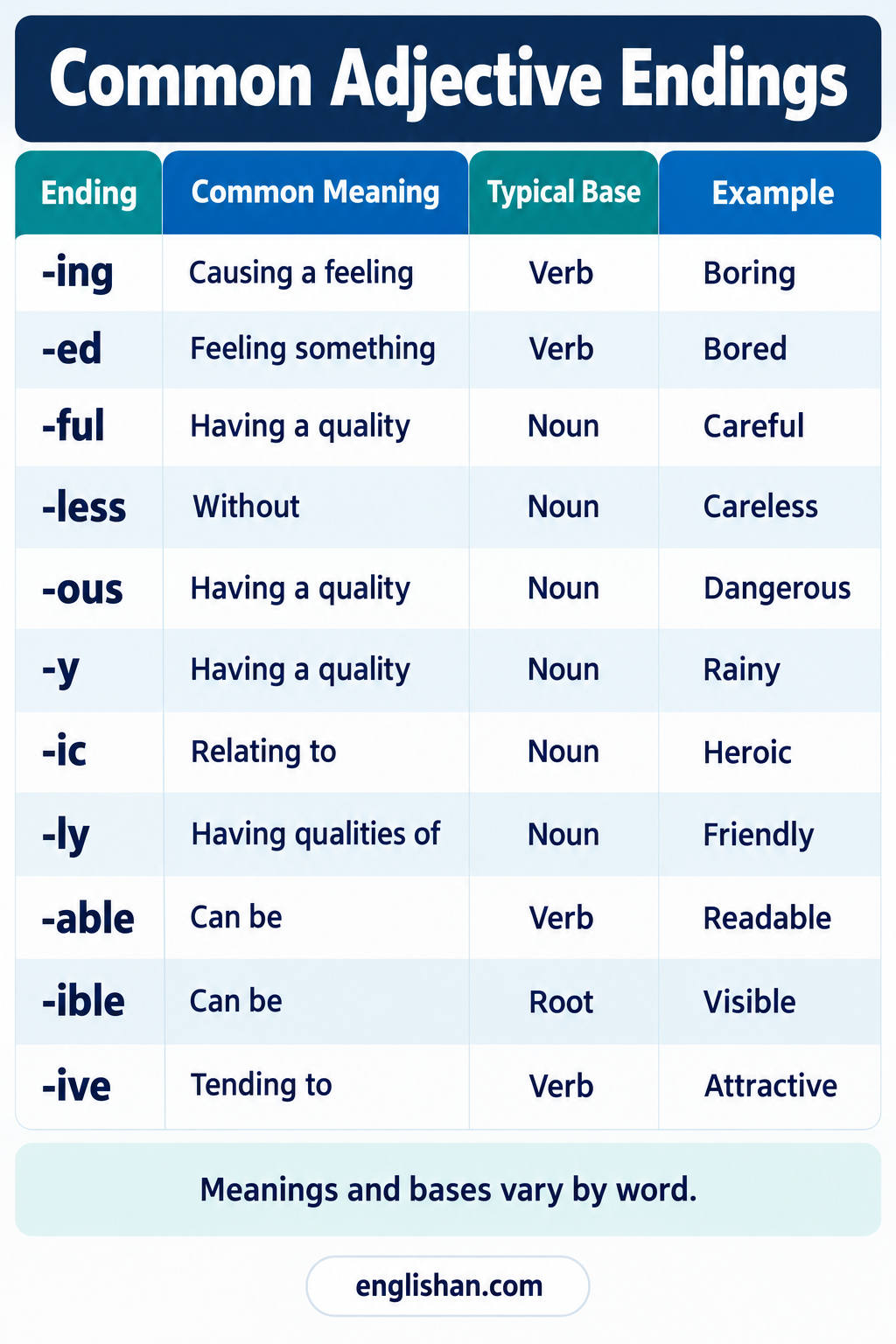
Adjectives ending in a suffix take one meaning from that suffix, and the base word is a noun, a verb, or an adjective.
| Ending | Adjective | Meaning of ending | Added to |
|---|---|---|---|
| Ing | Boring | Describes what causes a feeling | Verb |
| Ed | Bored | Describes who has a feeling | Verb |
| Ful | Careful | Full of a quality | Noun |
| Less | Careless | Without a quality | Noun |
| Able | Readable | Able to be done | Verb |
| Ible | Visible | Able to be done | Latin root |
| Ous | Dangerous | Full of a quality | Noun |
| Y | Rainy | Having a quality | Noun |
| Ic | Heroic | Relating to | Noun |
| Ly | Friendly | Having the quality of | Noun |
| Er | Taller | More of a quality | Adjective |
| Est | Tallest | Most of a quality | Adjective |
| Al | Seasonal | Relating to | Noun |
| Ish | Reddish | Close to a quality | Noun or adjective |
| Like | Childlike | Resembling | Noun |
| En | Wooden | Made of | Noun |
| Ary | Customary | Relating to | Noun or Latin root |
| Ate | Passionate | Having a quality | Noun or Latin root |
| Ive | Attractive | Tending to | Verb |
| Ent | Different | Performing or showing | Verb or Latin root |
| Ant | Resistant | Performing or showing | Verb or Latin root |
Adjectives Ending In Ing And Ed
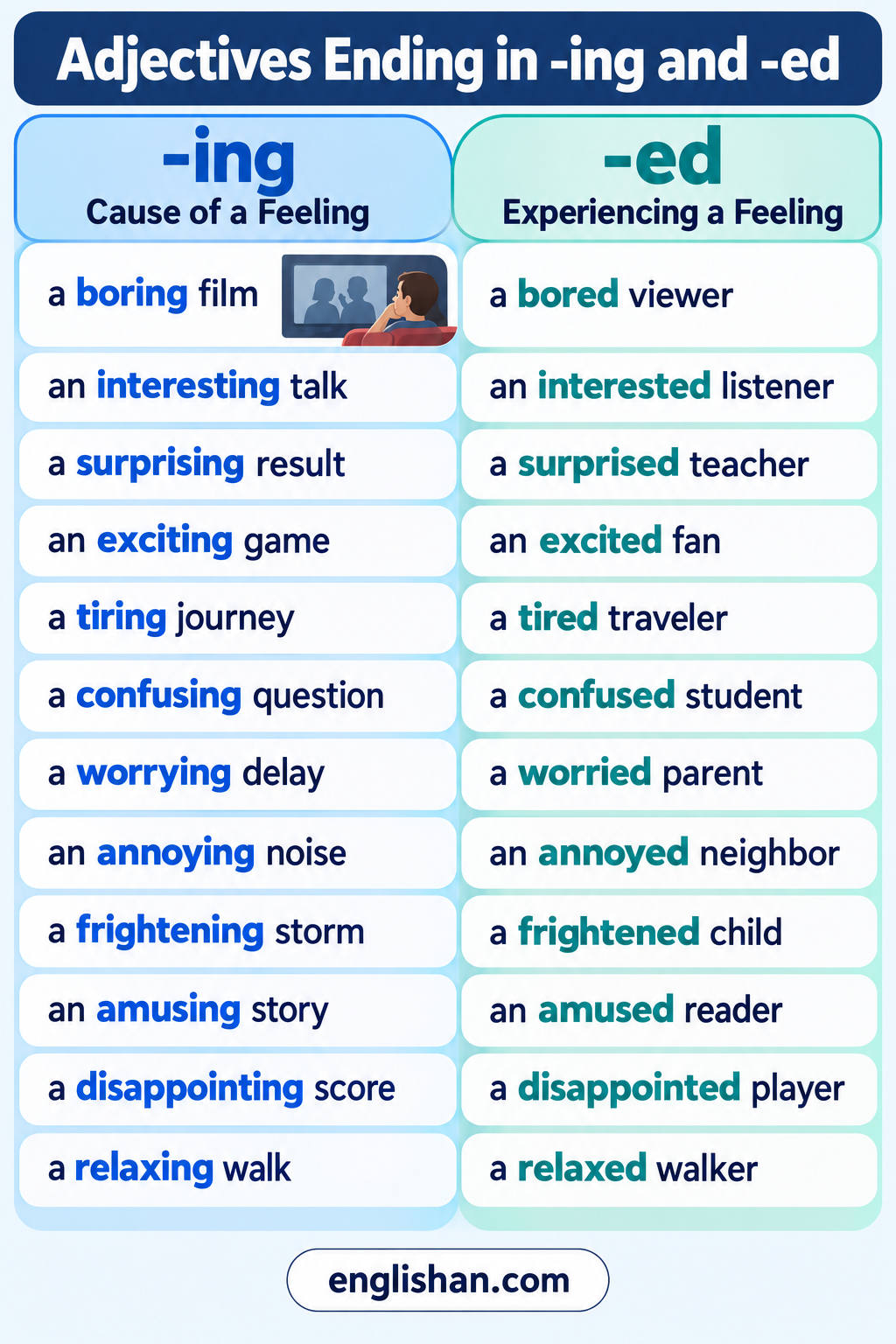
Adjectives ending in “-ing” and “-ed” are participle adjectives, formed from verbs. An “-ing” adjective is used for the cause of a feeling, and an “-ed” adjective is used for the person who has it.
| Ing adjective | Ed adjective | Sentence | Base verb |
|---|---|---|---|
| Boring | Bored | The lecture was boring, and the students were bored. | Bore |
| Interesting | Interested | The book is interesting, and I am interested in it. | Interest |
| Exciting | Excited | The match was exciting, so the fans were excited. | Excite |
| Tiring | Tired | The climb was tiring, and the hikers felt tired. | Tire |
| Surprising | Surprised | The result was surprising, and she looked surprised. | Surprise |
| Confusing | Confused | The map was confusing, so we were confused. | Confuse |
| Annoying | Annoyed | The noise was annoying, and the neighbors were annoyed. | Annoy |
| Amazing | Amazed | The view was amazing, and the visitors were amazed. | Amaze |
| Disappointing | Disappointed | The ending was disappointing, and the fans were disappointed. | Disappoint |
| Frightening | Frightened | The storm was frightening, and the children were frightened. | Frighten |
| Worrying | Worried | The news was worrying, and her parents were worried. | Worry |
| Satisfying | Satisfied | The meal was satisfying, and the guests were satisfied. | Satisfy |
| Embarrassing | Embarrassed | The mistake was embarrassing, and he felt embarrassed. | Embarrass |
| Shocking | Shocked | The photo was shocking, and the crowd looked shocked. | Shock |
| Relaxing | Relaxed | The spa was relaxing, and the guests were relaxed. | Relax |
| Discouraging | Discouraged | The test was discouraging, and the pupils felt discouraged. | Discourage |
| Fascinating | Fascinated | The film was fascinating, and we were fascinated. | Fascinate |
| Inspiring | Inspired | The speech was inspiring, and the team felt inspired. | Inspire |
| Thrilling | Thrilled | The ride was thrilling, and the riders were thrilled. | Thrill |
| Terrifying | Terrified | The scene was terrifying, and the audience was terrified. | Terrify |
| Disgusting | Disgusted | The smell was disgusting, and the cook was disgusted. | Disgust |
| Exhausting | Exhausted | The shift was exhausting, and the nurses were exhausted. | Exhaust |
| Puzzling | Puzzled | The riddle was puzzling, and the pupils were puzzled. | Puzzle |
| Touching | Touched | The letter was touching, and she was touched. | Touch |
Adjectives With The Suffix Ful And Less
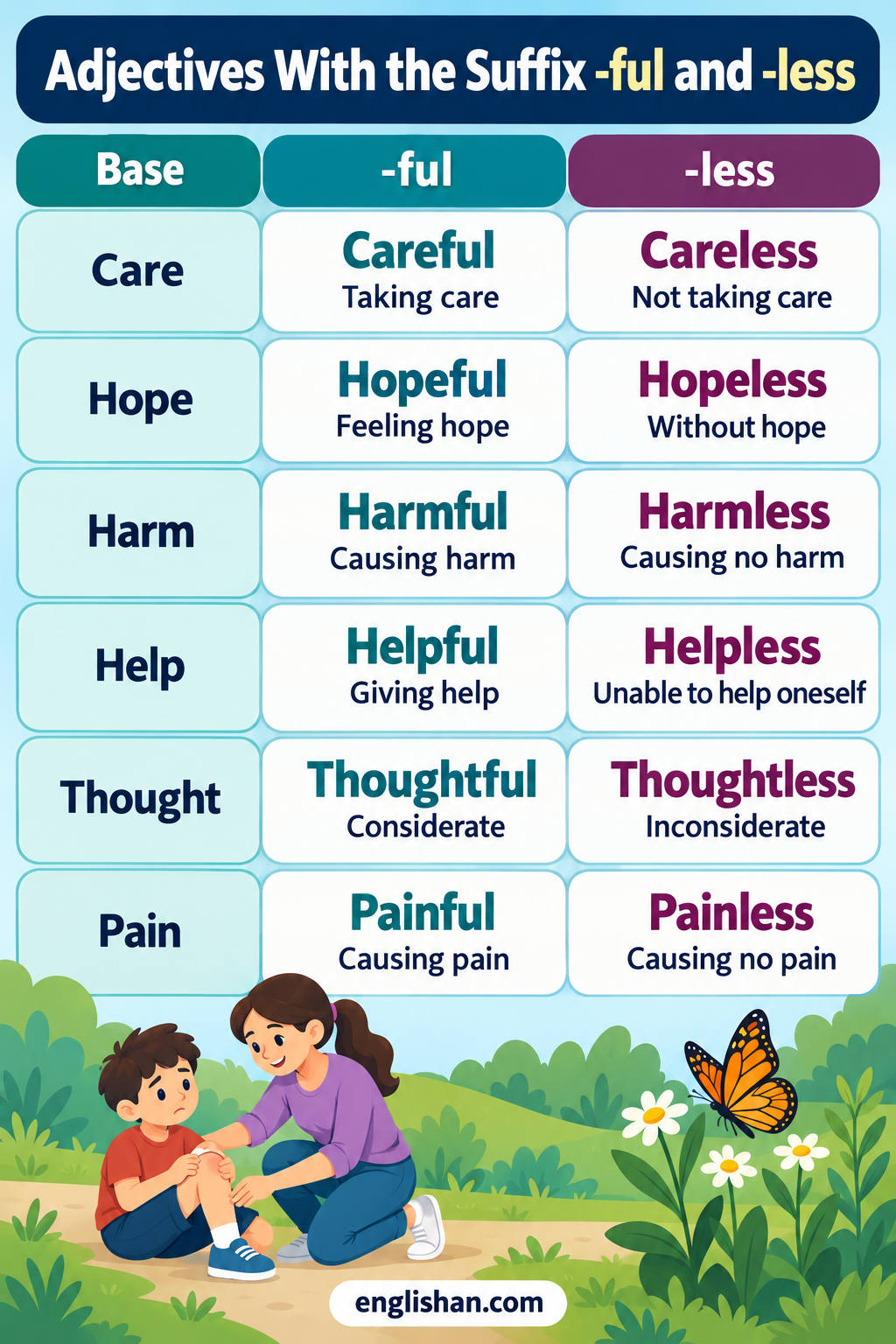
Adjectives ending in “-ful” mean ‘full of’ and those ending in “-less” mean ‘without’. Both endings are added to nouns, as in “careful” and “careless”.
Ful adjectives:
| Adjective | Sentence | Base noun |
|---|---|---|
| Careful | The nurse was careful with the glass. | Care |
| Hopeful | The team is hopeful about the final. | Hope |
| Beautiful | A beautiful garden surrounds the hotel. | Beauty |
| Colorful | The market sold colorful scarves. | Color |
| Graceful | The dancer made a graceful turn. | Grace |
| Joyful | A joyful crowd filled the square. | Joy |
| Peaceful | The lake is peaceful at dawn. | Peace |
| Powerful | A powerful engine drives the boat. | Power |
| Thankful | We are thankful for your support. | Thank |
| Wonderful | They had a wonderful holiday in Italy. | Wonder |
| Playful | The puppy is playful in the garden. | Play |
| Painful | The injury was painful for weeks. | Pain |
Less adjectives:
| Adjective | Sentence | Base noun |
|---|---|---|
| Careless | A careless error cost us the match. | Care |
| Hopeless | The repair seemed hopeless. | Hope |
| Homeless | The charity feeds homeless families. | Home |
| Fearless | The fearless climber reached the summit. | Fear |
| Endless | The road felt endless. | End |
| Countless | Countless stars filled the sky. | Count |
| Harmless | The snake is harmless. | Harm |
| Sleepless | She spent a sleepless night at the hospital. | Sleep |
| Priceless | The vase is priceless. | Price |
| Speechless | The news left him speechless. | Speech |
| Thoughtless | It was thoughtless to leave early. | Thought |
| Wireless | We bought a wireless speaker. | Wire |
Adjectives Ending In Able And Ible
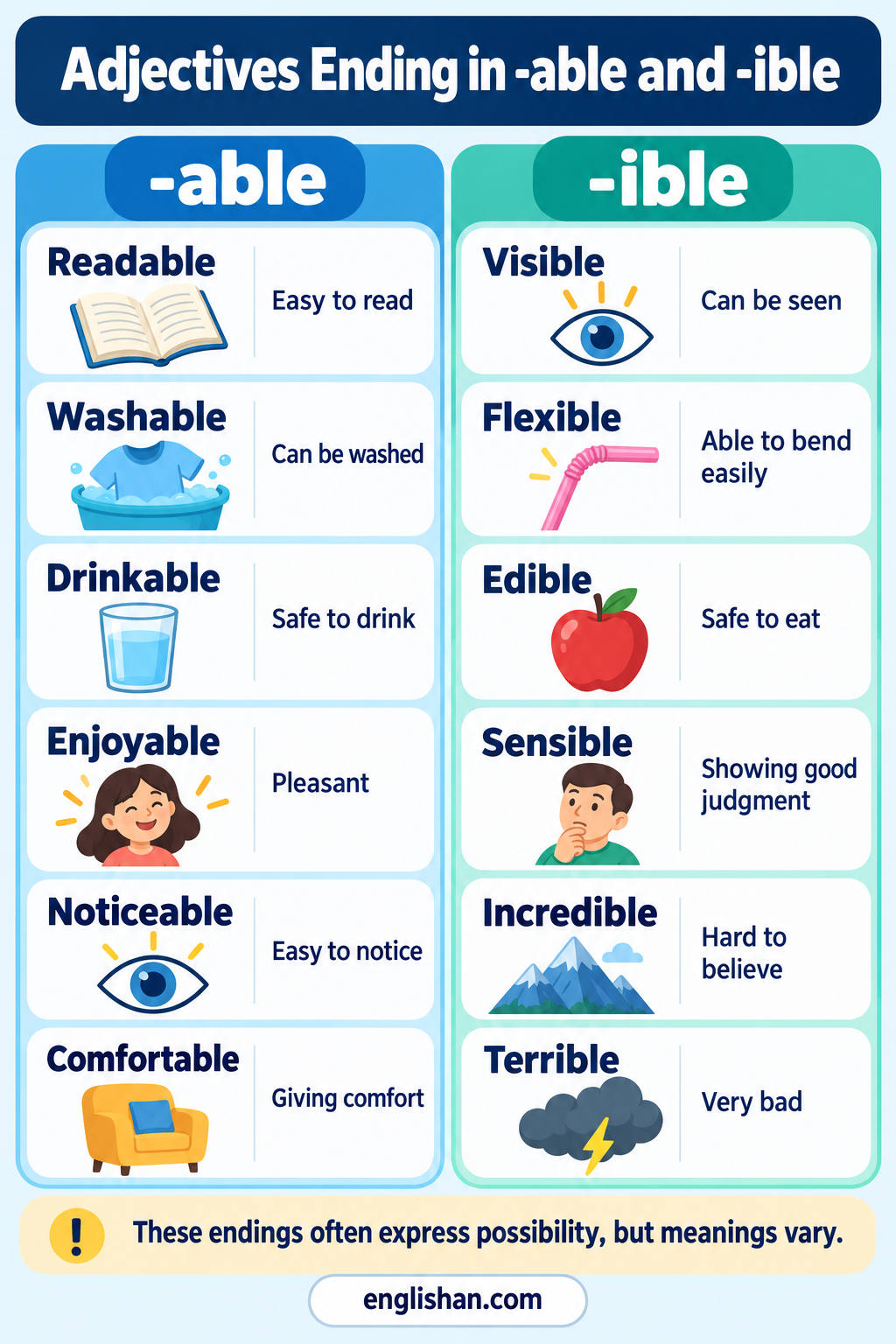
Both endings mean ‘able to be’. The ending “-able” is added to verbs, and “-ible” is found in words borrowed from Latin.
Able adjectives:
| Adjective | Sentence | Base verb |
|---|---|---|
| Readable | The report is readable on a phone. | Read |
| Enjoyable | The concert was an enjoyable evening. | Enjoy |
| Drinkable | The well water is drinkable. | Drink |
| Washable | Each washable cover goes in the machine. | Wash |
| Removable | The seat has a removable cushion. | Remove |
| Noticeable | A noticeable crack ran across the wall. | Notice |
| Reasonable | She made a reasonable offer. | Reason |
| Comfortable | The sofa is comfortable. | Comfort |
| Adorable | An adorable kitten slept on the chair. | Adore |
| Fashionable | She wore a fashionable coat. | Fashion |
Ible adjectives:
| Adjective | Meaning | Sentence |
|---|---|---|
| Visible | Able to be seen | The summit is visible from the village. |
| Flexible | Able to bend or change | The schedule is flexible. |
| Edible | Safe to eat | These berries are edible. |
| Sensible | Showing good judgment | She chose sensible shoes for the hike. |
| Incredible | Too great to believe | The team made an incredible comeback. |
| Terrible | Very bad | A terrible storm hit the coast. |
| Responsible | Accountable for a duty | A responsible driver slows down in the rain. |
| Convertible | Able to be changed to another form | The convertible sofa becomes a bed. |
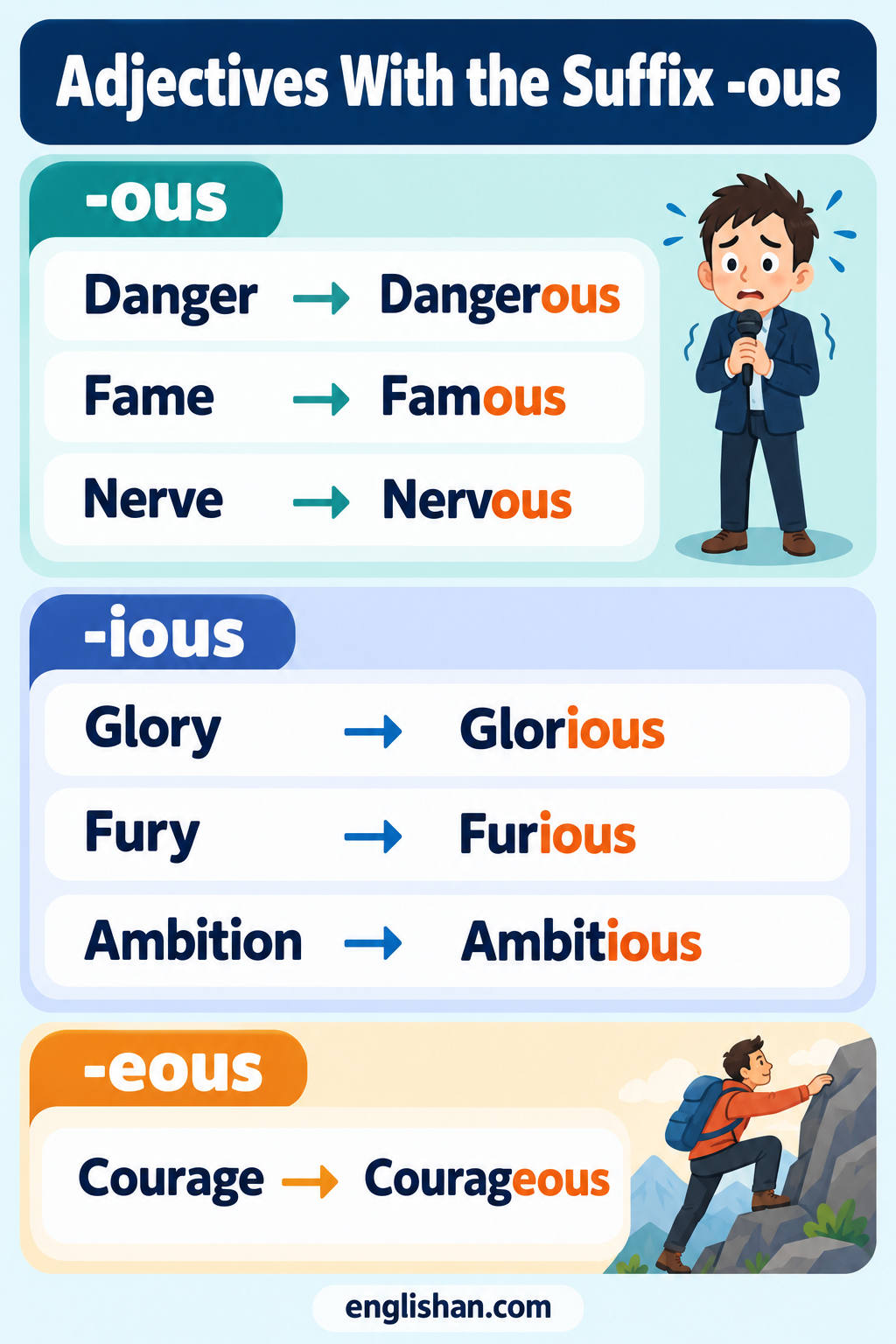
Adjectives With The Suffix Ous
The ending “-ous” means ‘full of’ and is added to nouns. The vowel before it varies in “-eous” and “-ious” words such as “courageous” and “furious”.
| Adjective | Sentence | Base noun |
|---|---|---|
| Dangerous | The icy road is dangerous. | Danger |
| Famous | A famous chef opened the café. | Fame |
| Nervous | She felt nervous before the interview. | Nerve |
| Poisonous | Poisonous mushrooms grow in the wood. | Poison |
| Mountainous | The mountainous region has few roads. | Mountain |
| Humorous | He gave a humorous speech. | Humor |
| Glorious | The team won a glorious victory. | Glory |
| Furious | The manager was furious about the delay. | Fury |
| Courageous | The courageous firefighter entered the building. | Courage |
| Ambitious | An ambitious student applied to three universities. | Ambition |
| Adventurous | We took an adventurous trip through the jungle. | Adventure |
| Mysterious | A mysterious light flickered in the field. | Mystery |
Adjectives Ending In Y
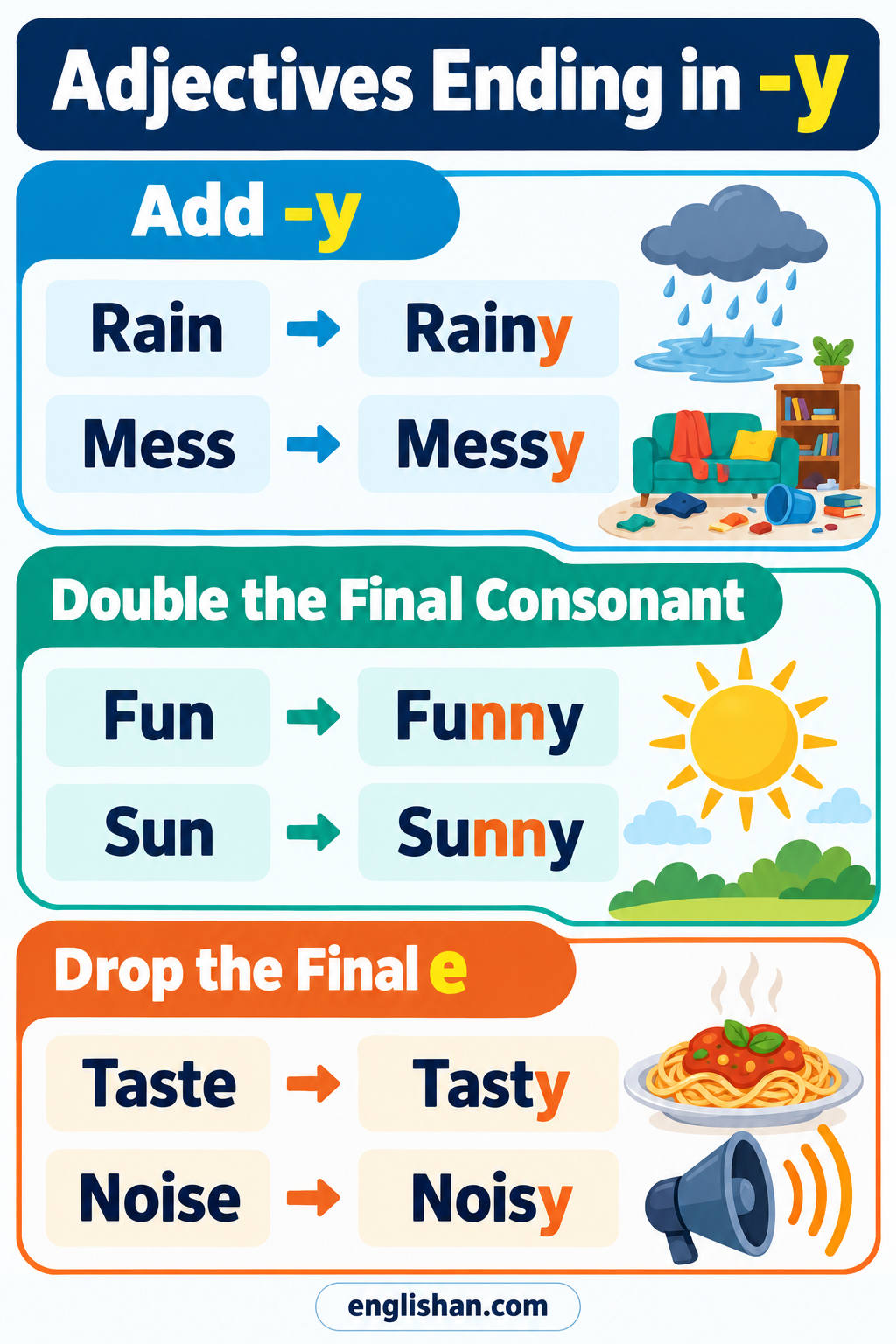
The ending “-y” means ‘having a quality’ and is added to nouns. The final consonant is doubled in “sunny” (from “sun”). The final “e” is dropped in “tasty” (from “taste”).
| Adjective | Sentence | Base noun |
|---|---|---|
| Rainy | Some rainy days keep us indoors. | Rain |
| Windy | The coast is windy in March. | Wind |
| Cloudy | A cloudy sky hid the moon. | Cloud |
| Hungry | The hungry children ate quickly. | Hunger |
| Angry | He was angry about the noise. | Anger |
| Funny | She told a funny story. | Fun |
| Messy | The messy desk was covered in papers. | Mess |
| Noisy | A noisy crowd filled the street. | Noise |
| Healthy | Fresh fruit is a healthy snack. | Health |
| Lucky | She is lucky to have a seat. | Luck |
| Tasty | The soup was tasty. | Taste |
| Creamy | A creamy sauce covered the pasta. | Cream |
Adjectives With The Suffix Ic
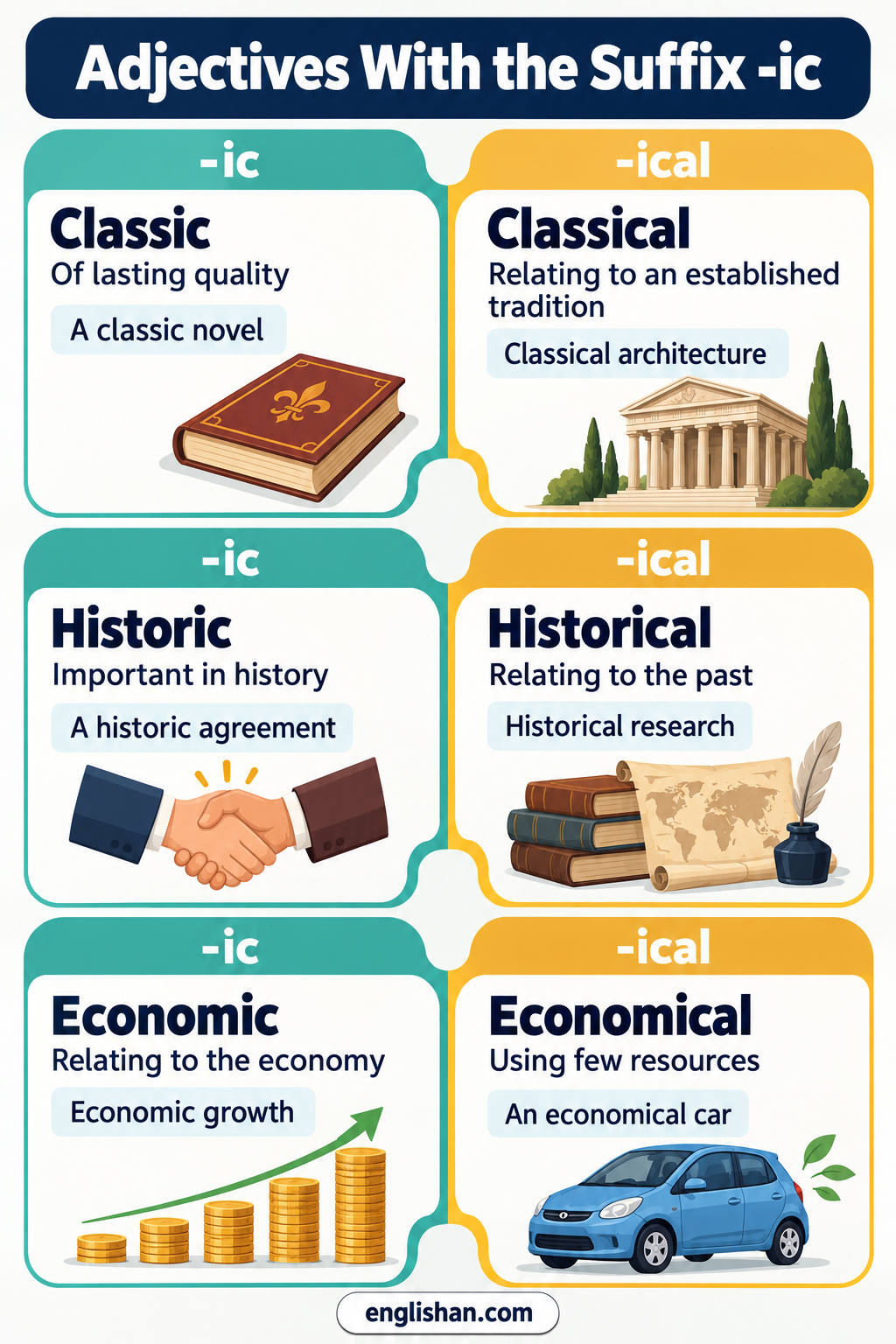
The ending “-ic” means ‘relating to’ and is added to nouns. Some adjectives with “-ic” are paired with an “-ical” form of different meaning.
Ic adjectives:
| Adjective | Meaning | Sentence | Base noun |
|---|---|---|---|
| Heroic | Showing great courage | The heroic rescue saved three hikers. | Hero |
| Artistic | Having skill in art or design | She is an artistic child with a steady hand. | Art |
| Athletic | Strong and skilled at sport | He has an athletic build. | Athlete |
| Energetic | Full of energy | The energetic puppy raced across the lawn. | Energy |
| Fantastic | Extraordinarily good | We had a fantastic view from the roof. | Fantasy |
| Historic | Famous in history | The historic treaty was signed here. | History |
| Magnetic | Having the force of a magnet | A magnetic strip holds the door shut. | Magnet |
| Poetic | Written in or like poetry | The letter had a poetic tone. | Poet |
| Romantic | Related to love | They had a romantic dinner by the river. | Romance |
| Scientific | Based on science | The team ran a scientific study. | Science |
| Tragic | Causing great sadness | A tragic accident closed the road. | Tragedy |
| Atomic | Relating to atoms | The lab studies atomic structure. | Atom |
Ic and ical pairs:
| Ic form | Meaning | Ical form | Meaning |
|---|---|---|---|
| Classic | Of lasting quality | Classical | Relating to ancient Greece and Rome |
| Historic | Famous in history | Historical | Relating to the past |
| Economic | Relating to the economy | Economical | Saving money |
| Electric | Powered by electricity | Electrical | Relating to electricity |
Adjectives Ending In Ly
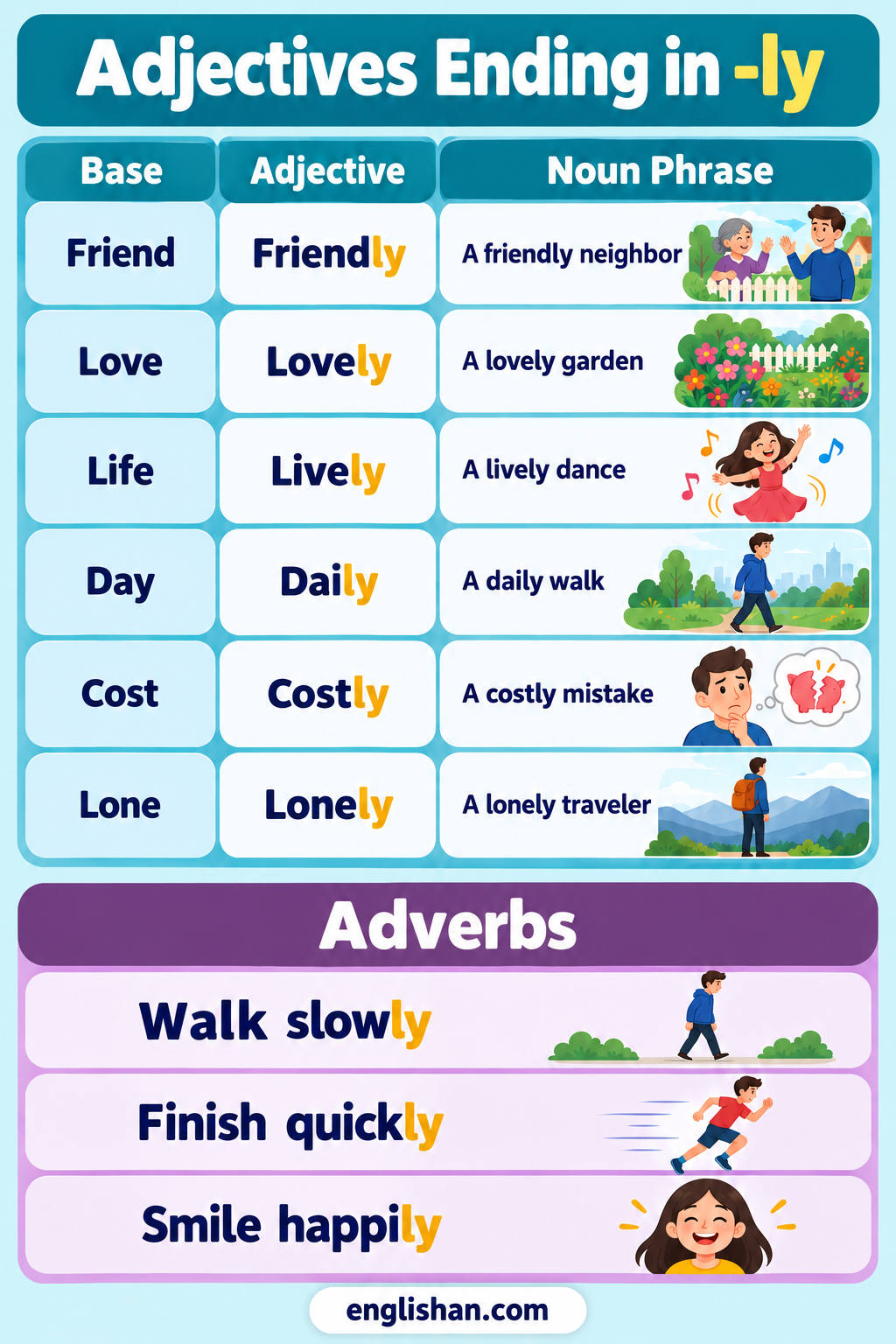
The ending “-ly” forms adjectives from nouns (“friend” and “friendly”) and adverbs from adjectives (“slow” and “slowly”). Each word in this group is an adjective.
| Adjective | Sentence | Base word |
|---|---|---|
| Friendly | A friendly neighbor waved from the gate. | Friend |
| Lovely | They stayed in a lovely cottage. | Love |
| Lonely | The lonely traveler sat by the fire. | Lone |
| Lively | A lively band played in the square. | Life |
| Costly | A costly mistake ended the project. | Cost |
| Deadly | The cobra is a deadly snake. | Death |
| Daily | Her daily walk lasts an hour. | Day |
| Elderly | An elderly man sat on the bench. | Elder |
| Cowardly | It was cowardly to run away. | Coward |
| Timely | She sent a timely reminder. | Time |
Comparative And Superlative Adjective Endings
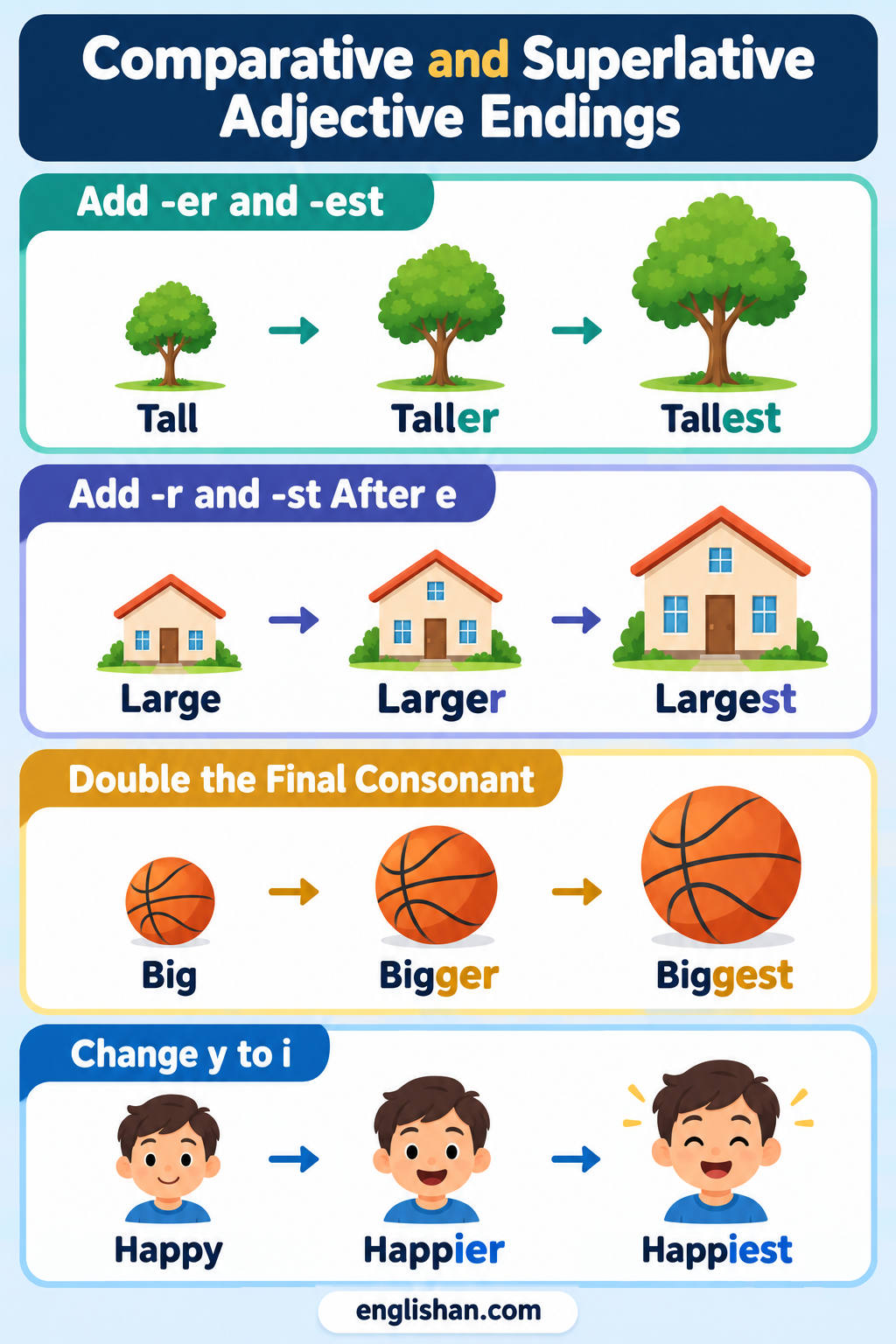
The endings “-er” and “-est” are added to short adjectives to form the comparative and the superlative. Longer adjectives take “more” and “most” instead.
Adjectives Ending In Er
The ending “-er” forms the comparative and is followed by “than”.
| Adjective | Comparative | Change | Sentence |
|---|---|---|---|
| Tall | Taller | Adds er | The new tower is taller than the old one. |
| Small | Smaller | Adds er | My room is smaller than yours. |
| Large | Larger | Adds r | The second hall is larger than the first. |
| Wide | Wider | Adds r | The river is wider here than at the bridge. |
| Big | Bigger | Doubles g, adds er | This box is bigger than that one. |
| Thin | Thinner | Doubles n, adds er | The new phone is thinner than the old model. |
| Happy | Happier | Changes y to i, adds er | She is happier in the city. |
| Busy | Busier | Changes y to i, adds er | Friday is busier than Monday. |
Adjectives Ending In Est
The ending “-est” forms the superlative and is preceded by “the”.
| Adjective | Superlative | Change | Sentence |
|---|---|---|---|
| Tall | Tallest | Adds est | It is the tallest tower in the city. |
| Small | Smallest | Adds est | This is the smallest room in the house. |
| Large | Largest | Adds st | That is the largest hall in town. |
| Wide | Widest | Adds st | This is the widest road in the county. |
| Big | Biggest | Doubles g, adds est | It is the biggest box on the shelf. |
| Thin | Thinnest | Doubles n, adds est | It is the thinnest phone on sale. |
| Happy | Happiest | Changes y to i, adds est | She is the happiest person I know. |
| Busy | Busiest | Changes y to i, adds est | Friday is the busiest day of the week. |
Adjectives Formed From Nouns
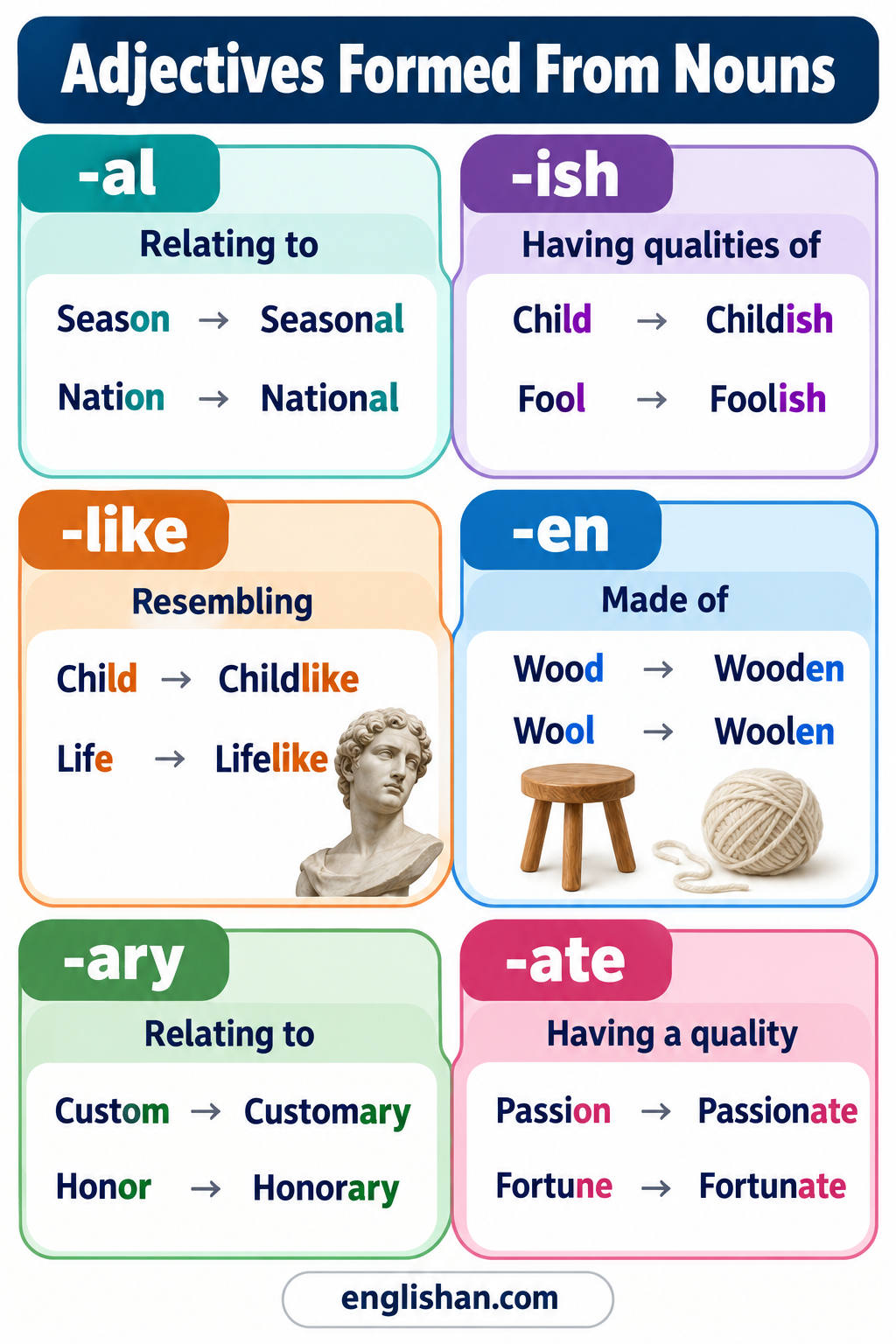
Words with these suffixes are formed from nouns and mean ‘relating to’, ‘like’, or ‘made of’.
Adjectives Ending In Al
The ending “-al” means ‘relating to’ and is added to nouns.
| Adjective | Sentence | Base noun |
|---|---|---|
| Seasonal | The shop sells seasonal fruit. | Season |
| National | The national anthem was played at noon. | Nation |
| Musical | She plays a musical instrument. | Music |
| Medical | He needs medical care. | Medicine |
| Natural | The cave is a natural wonder. | Nature |
| Cultural | The city hosts a cultural festival. | Culture |
| Central | The hotel has a central location. | Center |
| Personal | Please keep your personal items with you. | Person |
Adjectives Ending In Ish
The ending “-ish” means ‘close to’ or ‘like’, and it is added to nouns and to adjectives.
| Adjective | Sentence | Base word |
|---|---|---|
| Reddish | The sky turned a reddish orange. | Red |
| Childish | His childish joke made nobody laugh. | Child |
| Foolish | It was foolish to ignore the warning. | Fool |
| Selfish | A selfish driver blocked the lane. | Self |
| Stylish | She wore a stylish hat. | Style |
| Bluish | The ice had a bluish tint. | Blue |
Adjectives Ending In Like
The ending “-like” means ‘resembling’ and is added to nouns.
| Adjective | Sentence | Base noun |
|---|---|---|
| Childlike | He had a childlike curiosity. | Child |
| Lifelike | The museum has a lifelike statue. | Life |
| Catlike | The thief made a catlike leap. | Cat |
| Businesslike | She gave a businesslike reply. | Business |
| Dreamlike | The mist gave the valley a dreamlike look. | Dream |
Adjectives Ending In En
The ending “-en” means ‘made of’ and is added to the name of a material.
| Adjective | Meaning | Sentence | Base noun |
|---|---|---|---|
| Wooden | Made of wood | A wooden bridge crosses the stream. | Wood |
| Golden | Made of gold or colored like gold | The golden crown shone in the light. | Gold |
| Woolen | Made of wool | He wore a woolen scarf. | Wool |
| Silken | Soft and smooth like silk | Her silken hair fell to her shoulders. | Silk |
| Earthen | Made of earth or clay | They drank from an earthen jug. | Earth |
| Leaden | Dull gray like lead | A leaden sky hung over the harbor. | Lead |
Adjectives Ending In Ary
The ending “-ary” means ‘relating to’.
| Adjective | Meaning | Sentence |
|---|---|---|
| Customary | Based on custom | It is customary to bring a gift. |
| Imaginary | Existing only in the mind | The child has an imaginary friend. |
| Ordinary | Of the normal type | It was an ordinary day at work. |
| Revolutionary | Bringing great change | The revolutionary design changed the industry. |
| Voluntary | Done by choice | She does voluntary work on weekends. |
| Temporary | Lasting a short time | We live in a temporary shelter. |
Adjectives Ending In Ate
The ending “-ate” means ‘having a quality’ and forms adjectives from nouns and Latin roots.
| Adjective | Meaning | Sentence | Base word |
|---|---|---|---|
| Passionate | Showing strong feeling | He gave a passionate speech. | Passion |
| Fortunate | Having good luck | We were fortunate to find a room. | Fortune |
| Affectionate | Showing fondness | The dog is affectionate with children. | Affection |
| Considerate | Thoughtful toward others | A considerate neighbor shared the news. | Consider |
| Accurate | Correct in every detail | The map is accurate. | Accuracy |
| Delicate | Fine and fragile | She holds a delicate cup. | Delicacy |
Adjectives Formed From Verbs
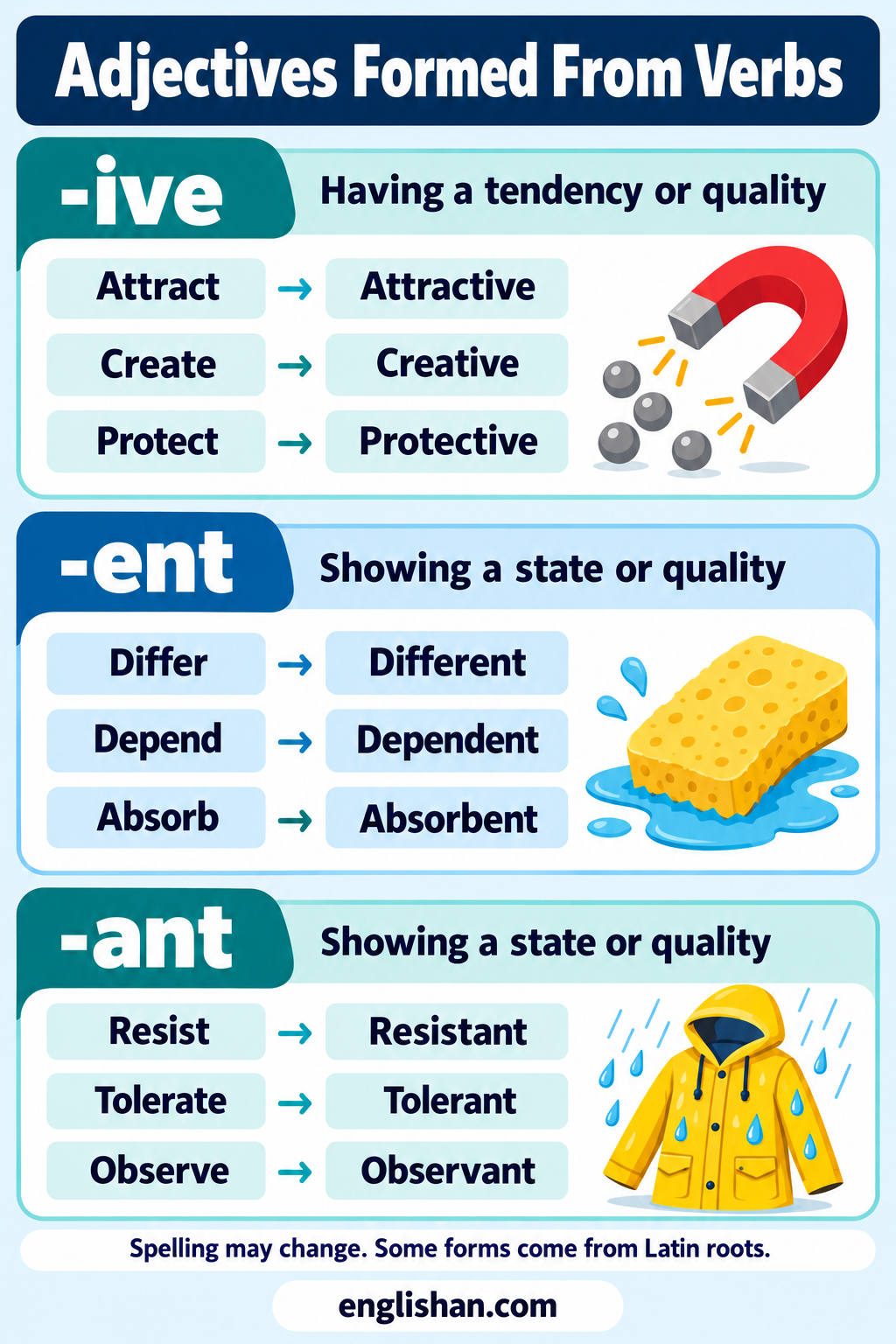
Words with these suffixes are formed from verbs and Latin roots.
Adjectives Ending In Ive
The ending “-ive” means ‘tending to’ and is added to verbs.
| Adjective | Sentence | Base verb |
|---|---|---|
| Attractive | The café has an attractive entrance. | Attract |
| Creative | She is a creative designer. | Create |
| Competitive | The competitive team trained daily. | Compete |
| Protective | He wore protective gloves. | Protect |
| Talkative | A talkative guide led the tour. | Talk |
| Supportive | Her friends were supportive throughout. | Support |
| Impressive | The pianist gave an impressive performance. | Impress |
| Destructive | A destructive fire swept the hill. | Destroy |
Adjectives Ending In Ent
The ending “-ent” forms adjectives from verbs and Latin roots, as in “different” from “differ”.
| Adjective | Meaning | Sentence | Base noun |
|---|---|---|---|
| Different | Not the same | She chose a different route. | Differ |
| Dependent | Relying on someone or something | The village is dependent on tourism. | Depend |
| Persistent | Continuing without stopping | A persistent cough kept him awake. | Persist |
| Obedient | Doing what one is told | The obedient dog waited at the door. | Obey |
| Excellent | Of outstanding quality | They serve excellent coffee. | Excel |
| Apparent | Plain to see | The reason for the delay was apparent. | Appear |
Adjectives Ending In Ant
The ending “-ant” forms adjectives from verbs and Latin roots, as in “resistant” from “resist”.
| Adjective | Meaning | Sentence | Base verb |
|---|---|---|---|
| Resistant | Not harmed by something | The jacket is resistant to water. | Resist |
| Defiant | Openly refusing to obey | The defiant child shook his head. | Defy |
| Tolerant | Accepting different views | A tolerant teacher welcomed every opinion. | Tolerate |
| Hesitant | Slow to act from doubt | He was hesitant about signing. | Hesitate |
| Observant | Quick to notice | An observant guard spotted the error. | Observe |
| Reliant | Depending on something | The town is reliant on one factory. | Rely |
Adjectives Ending In Every Letter

Common adjectives end in every letter except ‘j’, ‘q’, and ‘v’.
| Final letter | Adjectives |
|---|---|
| A | Extra, ultra, mega |
| B | Dumb, numb, glib |
| C | Public, specific, chic |
| D | Grand, bland, loud |
| E | Large, white, wide |
| F | Deaf, brief, stiff |
| G | Long, strong, big |
| H | High, rich, tough |
| I | Iraqi, Israeli, Pakistani |
| J | None in common use |
| K | Dark, weak, thick |
| L | Cool, small, special |
| M | Warm, calm, slim |
| N | Green, brown, open |
| O | Retro, solo, pro |
| P | Cheap, deep, sharp |
| Q | None in common use |
| R | Poor, sour, tender |
| S | Serious, jealous, various |
| T | Sweet, quiet, short |
| U | Impromptu, ecru |
| V | None in common use |
| W | New, low, narrow |
| X | Complex, convex, lax |
| Y | Happy, heavy, early |
| Z | Ersatz |
FAQs
Q1. Are adjectives that end in ing and ed participles?
Yes, adjectives ending in “-ing” and “-ed” are participle adjectives formed from verbs. An “-ing” adjective is used for what causes a feeling (“boring”), and an “-ed” adjective is used for the person who has the feeling (“bored”).
Q2. Is every word ending in ly an adverb?
No, many adjectives formed from nouns end in “-ly”, as in “friendly” and “lovely”. A word such as “slowly” is an adverb because it is formed from the adjective “slow”.
Q3. What is the difference between able and ible?
The difference is the origin of the word. The ending “-able” is added to verbs, as in “readable”, and “-ible” is found in words borrowed from Latin, as in “visible”. Both mean ‘able to be’, and new adjectives are formed with “-able” only.
Q4. Do suffixes form adjectives from both nouns and verbs?
Yes. Nouns are the base words for “-ful”, “-less”, and “-ous”. For “-able”, “-ible”, and “-ive”, the base word is a verb.
Q5. Are adjectives ending in y formed from nouns?
Yes, most adjectives ending in “-y” are formed from nouns, as in “rainy” from “rain” and “windy” from “wind”.
You May Also Like
- List of Adjectives
- Types Of Adjectives
- Degrees Of Comparison
- One Syllable Adjectives
- Order Of Adjectives