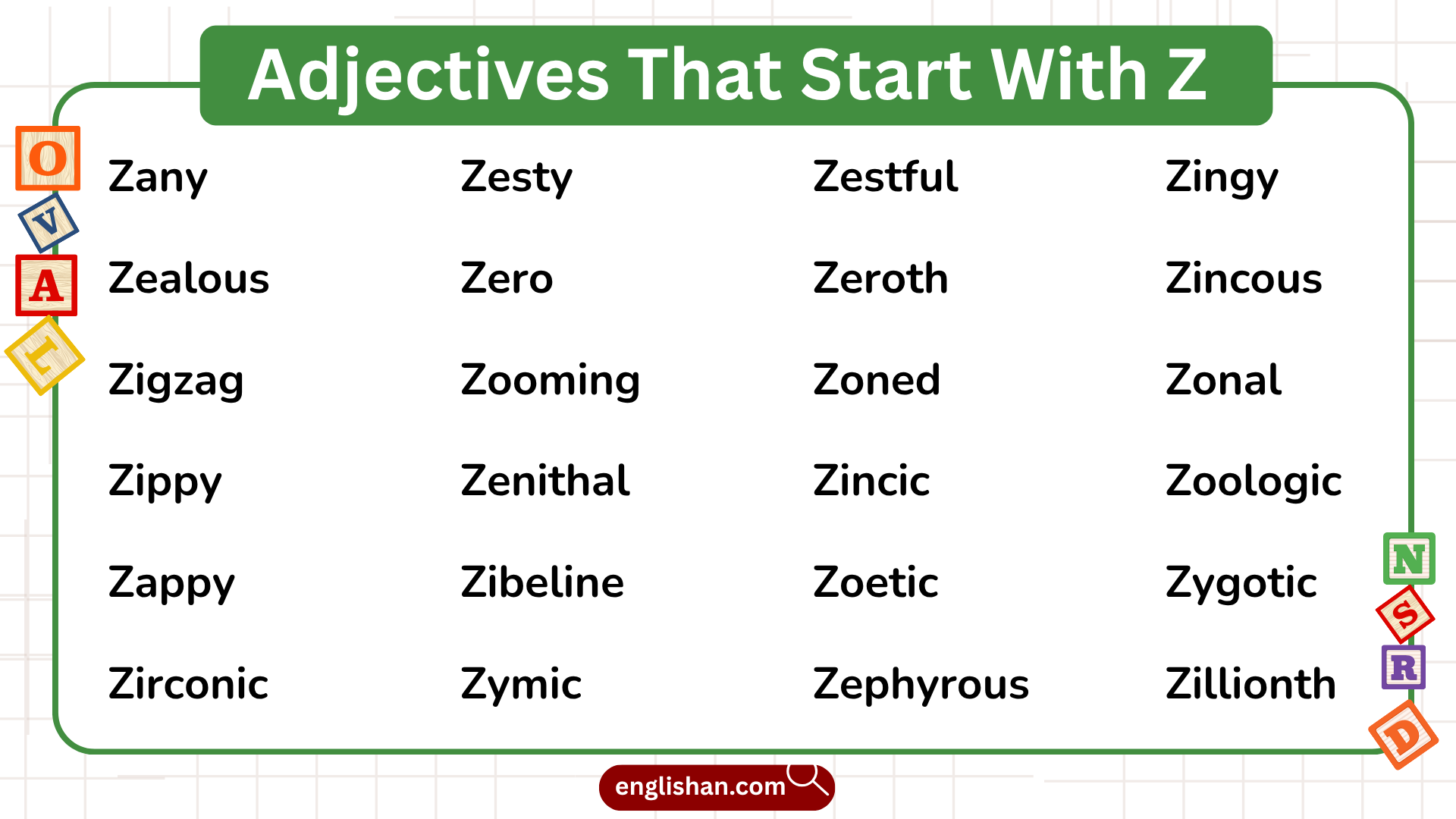
Adjectives to describe a house are words that modify the noun “house”. They denote what the house is like: its size, its age, or its condition. You replace a vague “nice house” with a specific one by choosing a precise adjective, such as a “spacious” hall or a “weathered” barn.
Positive adjectives come first, since listings and compliments use them most. Words for design, age, and surroundings follow, each with its meaning and a sentence.
The best adjectives for a house denote one quality exactly. Size is denoted by “spacious” or “compact”, age by “historic” or “ancient”, and style by “modern” or “rustic”. Choose the word for the quality you mean: a “secluded” cottage is remote, and a “gloomy” cottage is dark.
Positive Adjectives To Describe A House
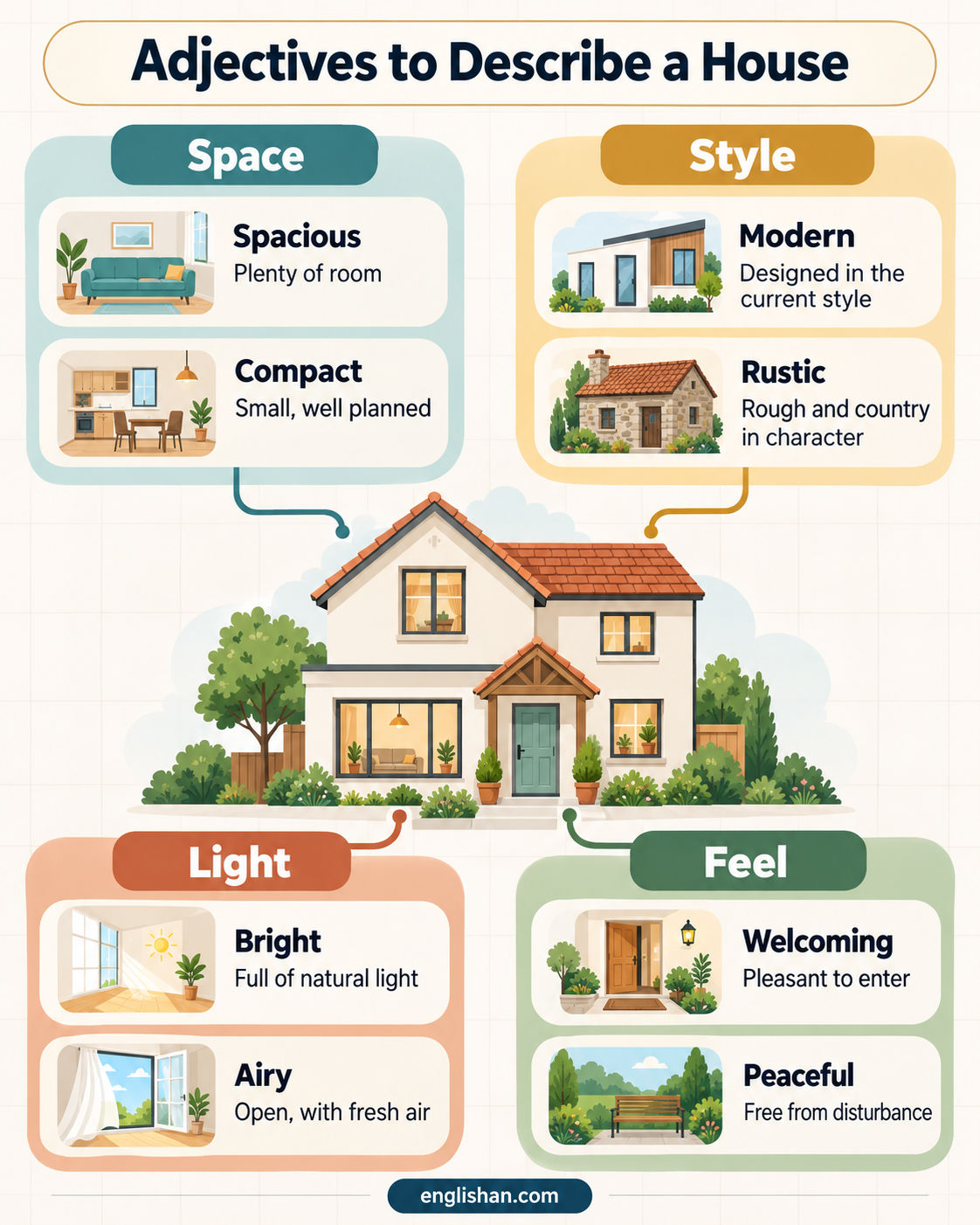
Positive adjectives denote the qualities that make a house attractive, such as space or comfort. See also types of adjectives.
| Adjective | Meaning | Sentence |
|---|---|---|
| Spacious | Offering plenty of room | The spacious hall holds a piano and a long table. |
| Charming | Pleasing in a quaint or graceful way | We rented a charming cottage near the harbor. |
| Cozy | Warm, small, and comfortable | The cozy living room had a wood stove and two armchairs. |
| Comfortable | Giving physical ease | Their comfortable house had deep sofas and thick rugs. |
| Luxurious | Rich in costly fittings | A luxurious house with marble floors stood on the hill. |
| Elegant | Refined and graceful in design | The elegant staircase curves up to the first floor. |
| Bright | Full of natural light | Every room in the bright house faces south. |
| Airy | Open, with height and fresh air | The airy loft has windows on three sides. |
| Welcoming | Pleasant to enter | A welcoming porch led to the front door. |
| Inviting | Attractive enough to draw visitors in | The lamp in the window made the house look inviting. |
| Stylish | Fashionable and well designed | She furnished the stylish townhouse in gray and white. |
| Immaculate | Perfectly kept and tidy | Buyers praised the immaculate kitchen. |
| Sunlit | Lit by direct sunshine | The sunlit conservatory is warm by noon. |
| Tranquil | Calm and free of noise | The tranquil garden is hidden from the road. |
| Impressive | Striking in size or quality | The impressive facade has six tall columns. |
| Graceful | Pleasing in line and proportion | A graceful archway joins the two wings. |
| Homely | Comfortable and domestic (UK); plain (US) | Her homely kitchen smelled of fresh bread. |
| Well-appointed | Fitted with quality furnishings | The well-appointed kitchen includes a gas range and a pantry. |
| Picturesque | Visually pleasing in a scenic way | A picturesque farmhouse stands beside the river. |
| Enchanting | Delightful and memorable | The enchanting cottage has a crooked chimney. |
| Adjective | Typical nouns |
|---|---|
| Spacious | Hall, kitchen, garden |
| Sunlit | Conservatory, bedroom |
| Well-appointed | Kitchen, bathroom |
| Picturesque | Village, farmhouse |
Architectural Adjectives For A House
These words to describe a house denote how it is built through its dimensions, its design, and its building materials.
Spatial Adjectives
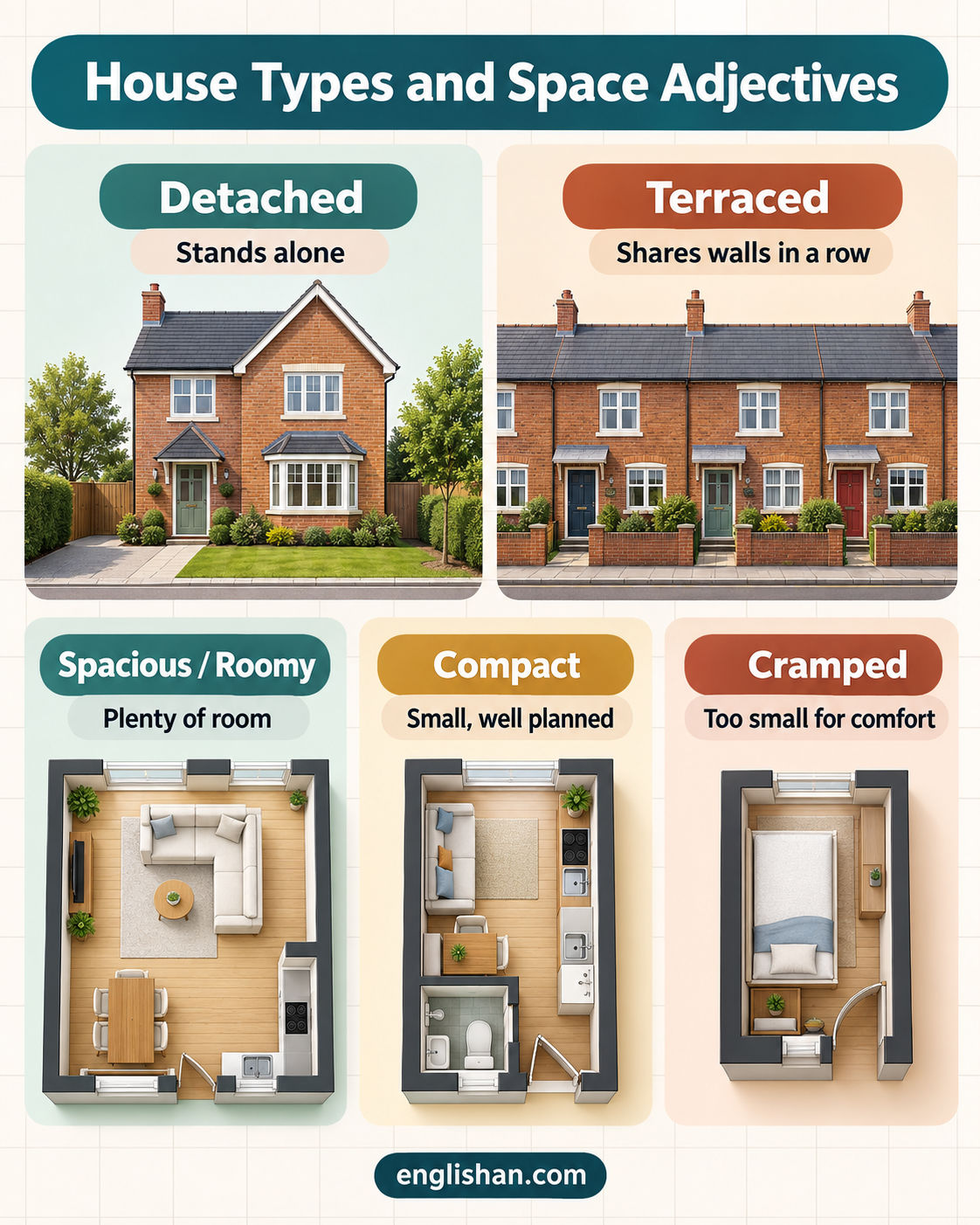
Spatial adjectives to describe a house denote its size and layout. For the full range of house types, see types of houses.
| Adjective | Meaning | Sentence |
|---|---|---|
| Grand | Large and impressive | The grand entrance hall has a double staircase. |
| Compact | Small and well planned | A compact house suits a single buyer. |
| Sprawling | Spread over wide ground | The sprawling ranch house covers two acres. |
| Cramped | Too small for comfort | The cramped kitchen has room for one cook. |
| Roomy | Having plenty of space inside | We chose the roomy farmhouse for the reunion. |
| Tiny | Very small | Her tiny house has a loft bedroom. |
| Vast | Extremely large | The vast mansion has forty rooms. |
| Modest | Small and plain in size | They live in a modest house on a quiet street. |
| Detached | Standing alone, with no shared wall | A detached house has a garden on all four sides. |
| Terraced | Joined to neighbors in a row | Each terraced house shares walls with its neighbors. |
Style Adjectives
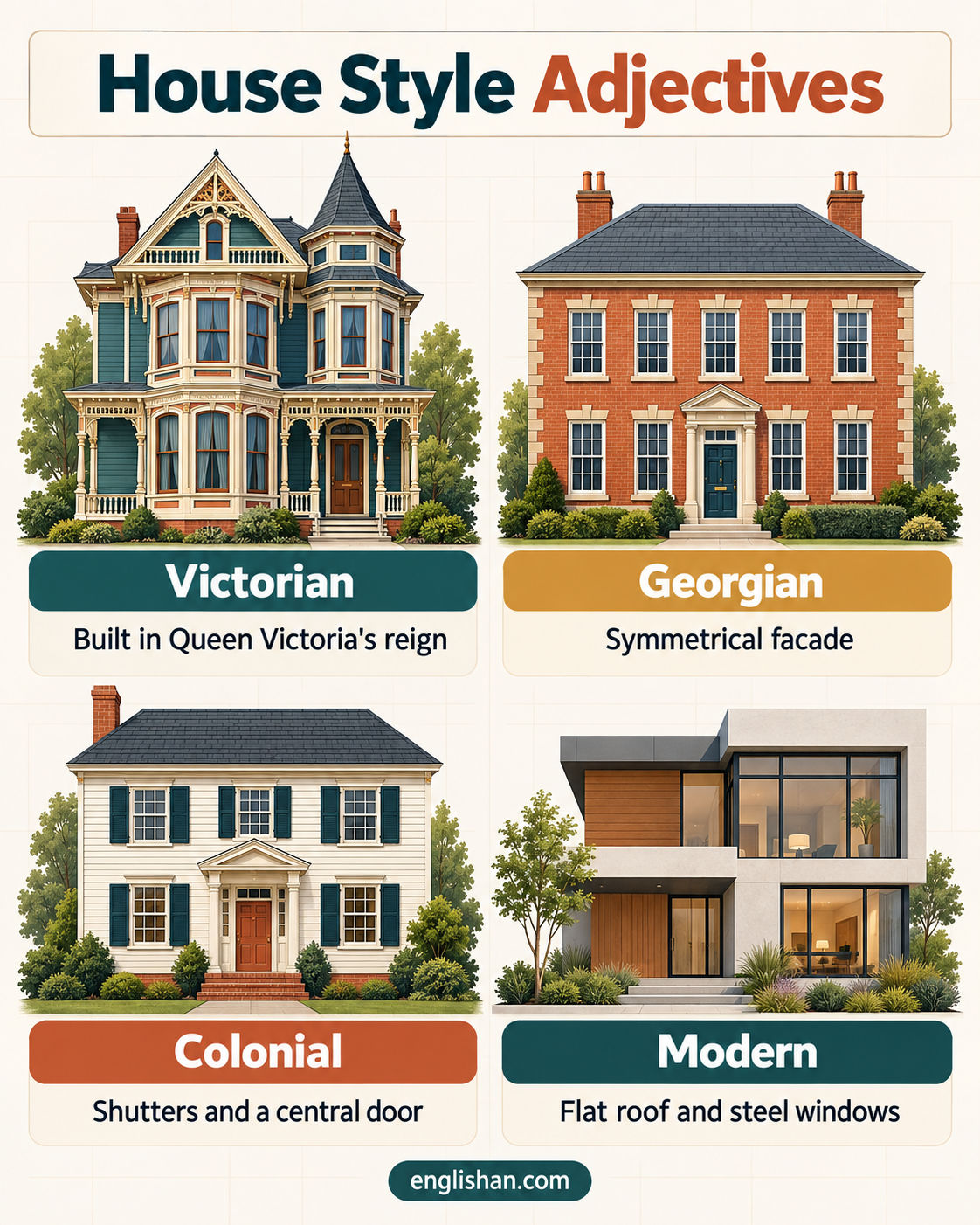
Style adjectives to describe a house denote its design period or manner. “Victorian” and “Georgian” are proper adjectives, formed from the proper nouns “Victoria” and “George”, so they keep a capital letter wherever they appear.
| Adjective | Meaning | Sentence |
|---|---|---|
| Modern | Designed in the current style | The modern house has a flat roof and steel windows. |
| Minimalist | Plain, with little decoration | A minimalist living room holds one sofa and one lamp. |
| Rustic | Rough and country in character | The rustic cabin has exposed beams. |
| Victorian | Built in the reign of Queen Victoria | We toured a Victorian terrace in Leeds. |
| Georgian | Built in the style of the 1700s and early 1800s | The Georgian facade is perfectly symmetrical. |
| Colonial | In the style of early settler houses | The colonial farmhouse has shutters and a central door. |
| Traditional | Based on established design | The traditional kitchen has a farmhouse sink. |
| Contemporary | Designed in the present day | The contemporary extension is made of glass. |
| Quaint | Charming in an old-fashioned way | A quaint cottage stands at the end of the lane. |
| Ornate | Richly decorated | The ornate ceiling is covered in plaster roses. |
Material Adjectives
Material adjectives to describe a house denote what it is built from. A word such as “brick” in “a brick house” is a noun adjunct, not an adjective, because it is also a noun on its own (“a brick”). “Tiled” and “thatched” are participle adjectives.
| Adjective | Meaning | Sentence |
|---|---|---|
| Wooden | Made of wood | A wooden porch wraps around the cabin. |
| Thatched | Roofed with straw or reed | The thatched cottage is cool in summer. |
| Tiled | Covered with tiles | A tiled roof lasts for generations. |
| Glazed | Fitted with glass | The glazed porch catches the morning sun. |
| Whitewashed | Painted with lime wash | The whitewashed walls reflect the afternoon heat. |
| Timbered | Framed with wooden beams | The timbered barn was moved board by board. |
| Brick-built | Constructed of brick | A brick-built garage stands behind the house. |
| Half-timbered | With exposed beams and plaster between them | The half-timbered inn dates from the 1500s. |
Adjectives To Describe An Old House
Adjectives for a house of great age denote age together with historical value or wear. “Historic” denotes a house linked to a notable event, and “historical” means relating to history.
| Adjective | Meaning | Sentence |
|---|---|---|
| Ancient | Extremely old, from the distant past | The ancient farmhouse predates the village church. |
| Aged | Showing the effect of many years | The aged door sticks in wet weather. |
| Venerable | Respected for great age | A venerable manor house stands at the center of the village. |
| Historic | Linked to a notable event or person | The historic house was once the mayor’s residence. |
| Period | Built in an earlier historical era (UK) | We bought a period house with original fireplaces. |
| Antique | Of great age and value, said of objects | The antique clock in the hall dates from 1840. |
| Vintage | From a past era and valued for its style | The vintage kitchen has its original 1950s tiles. |
| Old-fashioned | In a style no longer current | The old-fashioned kitchen has a pull-chain light. |
| Weathered | Worn by sun, wind, and rain | The weathered shutters need repainting. |
| Creaky | Making sounds from worn parts | The creaky stairs made every late arrival audible. |
| Time-worn | Damaged by years of use | The time-worn steps dip in the middle. |
| Centuries-old | Many hundreds of years old | A centuries-old barn leans against the hill. |
Adjectives To Describe An Abandoned House
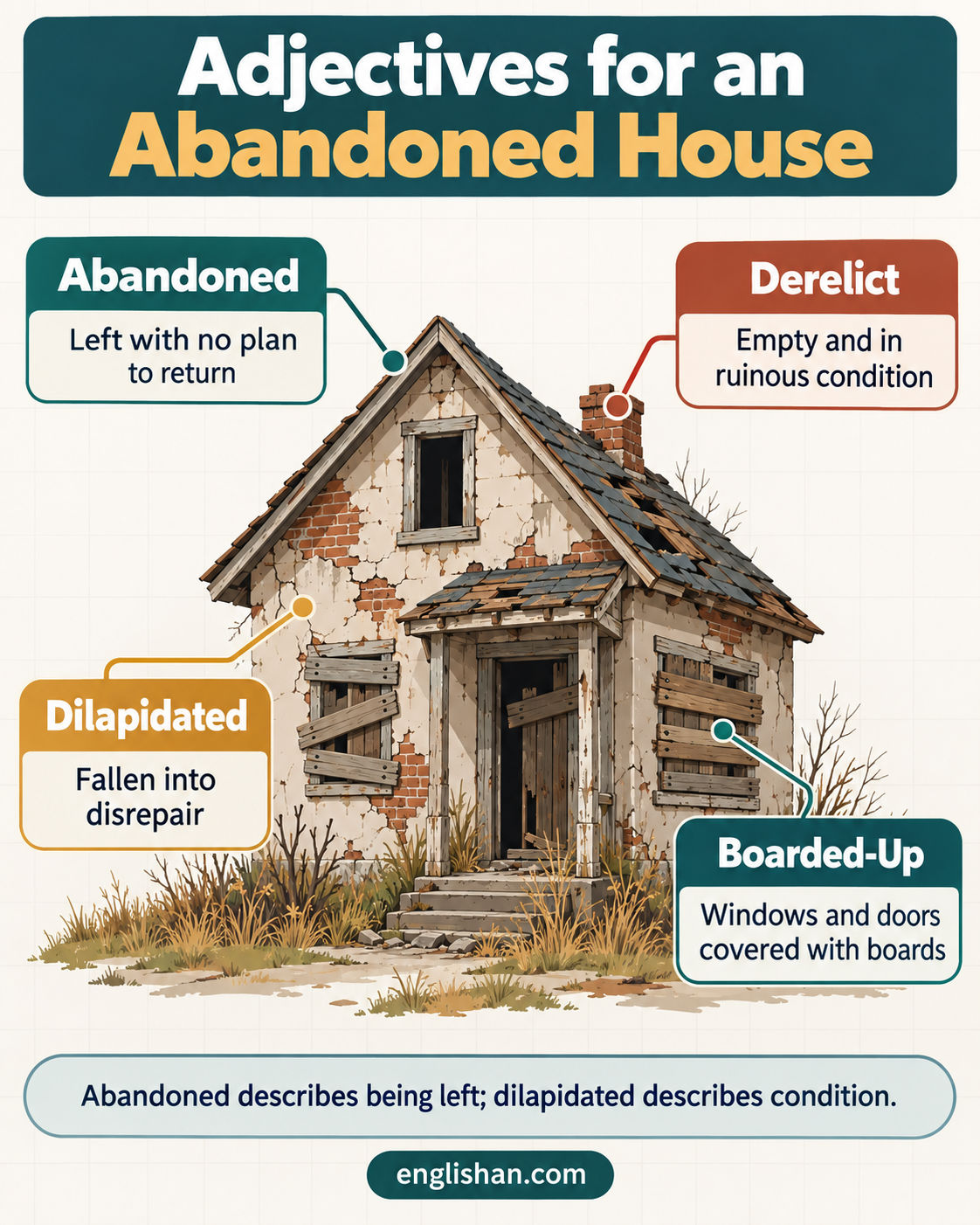
These words denote emptiness, neglect, or decay. Each one names a different cause of the condition.
| Adjective | Meaning | Sentence |
|---|---|---|
| Abandoned | Left by its owner with no plan to return | The abandoned farmhouse has stood empty since 1970. |
| Deserted | Empty of people at present | The deserted house echoed with every step. |
| Vacant | Available for a new occupant | The vacant house on Elm Street is for rent. |
| Derelict | Empty and in ruinous condition | A derelict mill borders the property. |
| Dilapidated | Fallen into disrepair | The dilapidated porch is unsafe to cross. |
| Crumbling | Breaking apart in small pieces | The crumbling chimney drops bricks into the yard. |
| Run-down | In poor condition from lack of care | We viewed a run-down cottage with a leaking roof. |
| Neglected | Left without maintenance | The neglected garden is knee-high in weeds. |
| Decaying | Slowly rotting or breaking down | The decaying floorboards give way underfoot. |
| Boarded-up | With windows and doors covered by boards | The boarded-up windows kept out the weather. |
| Overgrown | Covered by uncontrolled plant growth | The overgrown path leads to a sealed door. |
| Haunted | Said to be visited by ghosts | The haunted manor is closed after dark. |
Setting Adjectives For A House
These adjectives denote the location of a house and its surroundings.
| Adjective | Meaning | Sentence |
|---|---|---|
| Suburban | Located in a residential district at the edge of a city | They moved to a suburban house with a double garage. |
| Rural | Located in the countryside | The rural cottage has no street lighting. |
| Urban | Located in a city | An urban townhouse costs more per square foot. |
| Coastal | Located on or near the sea | A coastal house needs salt-resistant paint. |
| Remote | Far from towns and roads | The remote lodge is a day’s drive from the airport. |
| Secluded | Private and screened from view | A secluded cottage sits behind a line of pines. |
| Isolated | Cut off from other buildings | The isolated farmhouse loses power in every storm. |
| Central | Near the middle of a town | Their central flat is five minutes from the station. |
| Outlying | Far from the center of a town | The outlying house is served by one bus a day. |
| Neighboring | Next to the house in question | The neighboring house has a taller fence. |
Atmosphere Adjectives For A House
These words denote what it is like to be inside or near a home.
| Adjective | Meaning | Sentence |
|---|---|---|
| Peaceful | Free from disturbance | The peaceful house backs onto a meadow. |
| Cheerful | Bright and good-humored in tone | A cheerful yellow hallway greets every visitor. |
| Gloomy | Dark and depressing | The gloomy hallway had no windows. |
| Eerie | Strange and frightening | An eerie silence filled the empty house. |
| Serene | Calm and untroubled | The serene courtyard is shaded by a fig tree. |
| Lively | Full of activity | The lively house hosts a party every Friday. |
| Quiet | Making little noise | A quiet house suits a writer. |
| Dreary | Dull and sad | The dreary rooms smelled of damp. |
| Calm | Still and relaxed | The calm study overlooks the garden. |
| Stately | Dignified and impressive | A stately home stands at the end of the drive. |
| Somber | Serious and dark in tone | The somber dining room was hung with portraits. |
| Sinister | Suggesting danger or evil | A sinister shadow crossed the attic window. |
Compound Adjectives For A House
Compound adjectives are two or more words joined to modify one noun, as in “a well-kept lawn”.
| Adjective | Meaning | Sentence |
|---|---|---|
| Three-bedroom | With three bedrooms | We bought a three-bedroom house near the park. |
| Well-kept | Maintained with care | The well-kept lawn is cut every week. |
| Open-plan | With few interior walls | The open-plan kitchen joins the living room. |
| South-facing | Facing south | A south-facing garden catches the afternoon sun. |
| Split-level | With floors at staggered heights | The split-level house has a sunken lounge. |
| High-ceilinged | With tall ceilings | Each high-ceilinged room feels larger than it is. |
| Two-story | With two floors | Their two-story house has a basement. |
| Family-owned | Owned by one family | The family-owned estate has been sold only twice. |
FAQs
Q1. What are good adjectives to describe a house?
Good adjectives to describe a house denote one exact quality: “spacious” denotes room, “sunlit” denotes light, and “period” denotes age. Choose the adjective for the quality you want to describe. A wider set of words is given in adjectives with meanings.
Q2. What is the difference between a house and a home?
The difference is that “house” denotes a building, and “home” denotes a person’s own residence and sense of belonging. “Detached” and “spacious” are used with “house”, and “welcoming” and “happy” are used with “home”.
Q3. Which real estate adjectives are used for a desirable house?
Real estate listings contain adjectives that denote verifiable facts about the house. “Spacious” and “sunlit” denote room and light, “south-facing” denotes orientation, and “period” denotes age. “Charming” and “stylish” express the seller’s judgment on those facts.
Q4. Is “house” an adjective?
No, “house” is a noun. It is used as a noun adjunct in “house cat”, “house music”, and “house rules”, where it is placed before another noun and stays singular. It is not a true adjective, because it cannot take “very” or follow a linking verb.
You May Also Like
- Order Of Adjectives
- Attributive Adjectives In English
- Predicate Adjectives In English
- Degrees Of Comparison Of Adjectives