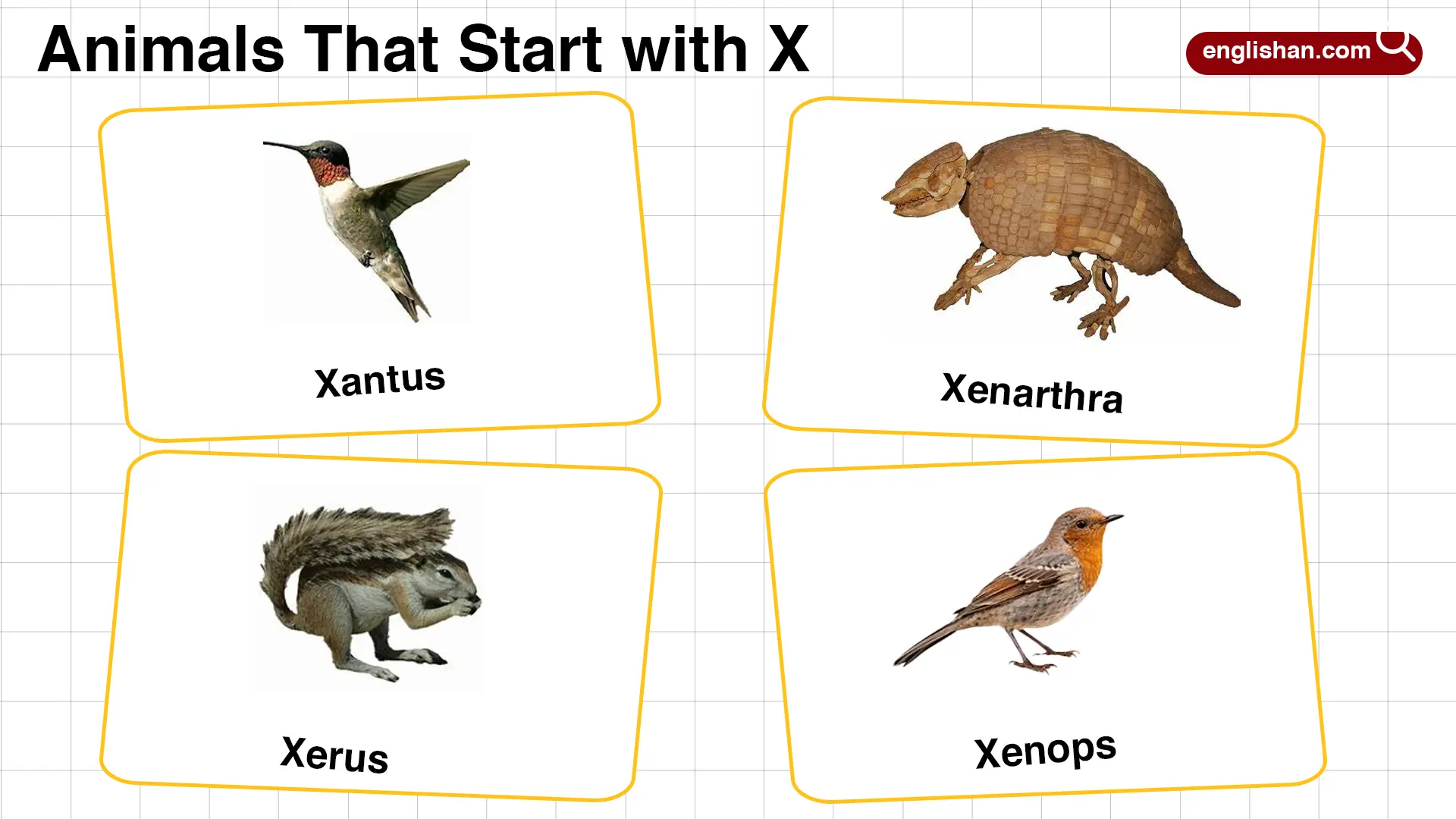
Finding animals that start with X is a challenge due to the rarity of the letter in biological naming. This guide provides a precise list of these species, including the forest-dwelling xenops, the transparent X-ray tetra, and the desert Xantus’s hummingbird.
The list is categorized by habitat and species type. Each entry includes the animal’s formal name alongside a description of its physical traits and geographic location.
Use this reference to identify rare species and clarify their roles in different ecosystems. By the end, you will be able to name several X-starting animals and explain the specific traits that define them.
List of Animals That Start with X
- Xantus’s Hummingbird
- Xantus’ Leaf-Toed Gecko
- Xanthippe’s Shrew
- X-ray Tetra
- Xeme
- Xenops
- Xerus
- Xestus Sabretooth Blenny
- Xingu River Ray
- Xoloitzcuintli
- Xiaosaurus
- Xiaotingia
- Xiongguanlong
- Xiphactinus
- Xenoceratops
- Xenoposeidon
- Xenotarsosaurus
- Xenacanthus
Mammals
Xantus’s Hummingbird Bat
Despite its name, Xantus’s hummingbird bat is not a separate scientific species and is often used informally for a small nectar-feeding bat found in Mexico. It refers to a tiny bat with a slender body and a long tongue adapted for feeding on flower nectar. These bats are active at night and also consume insects. They play a role in pollination within desert and semi-arid habitats.
Xanthippe’s Shrew
Known from parts of East Africa, Xanthippe’s shrew is a small insect-eating mammal with a pointed snout and dense fur. It inhabits dry savannas and scrublands. Like other shrews, it has a high metabolic rate and must feed frequently on insects and other small invertebrates. Its movements are quick and close to the ground as it searches for prey.
Xerus
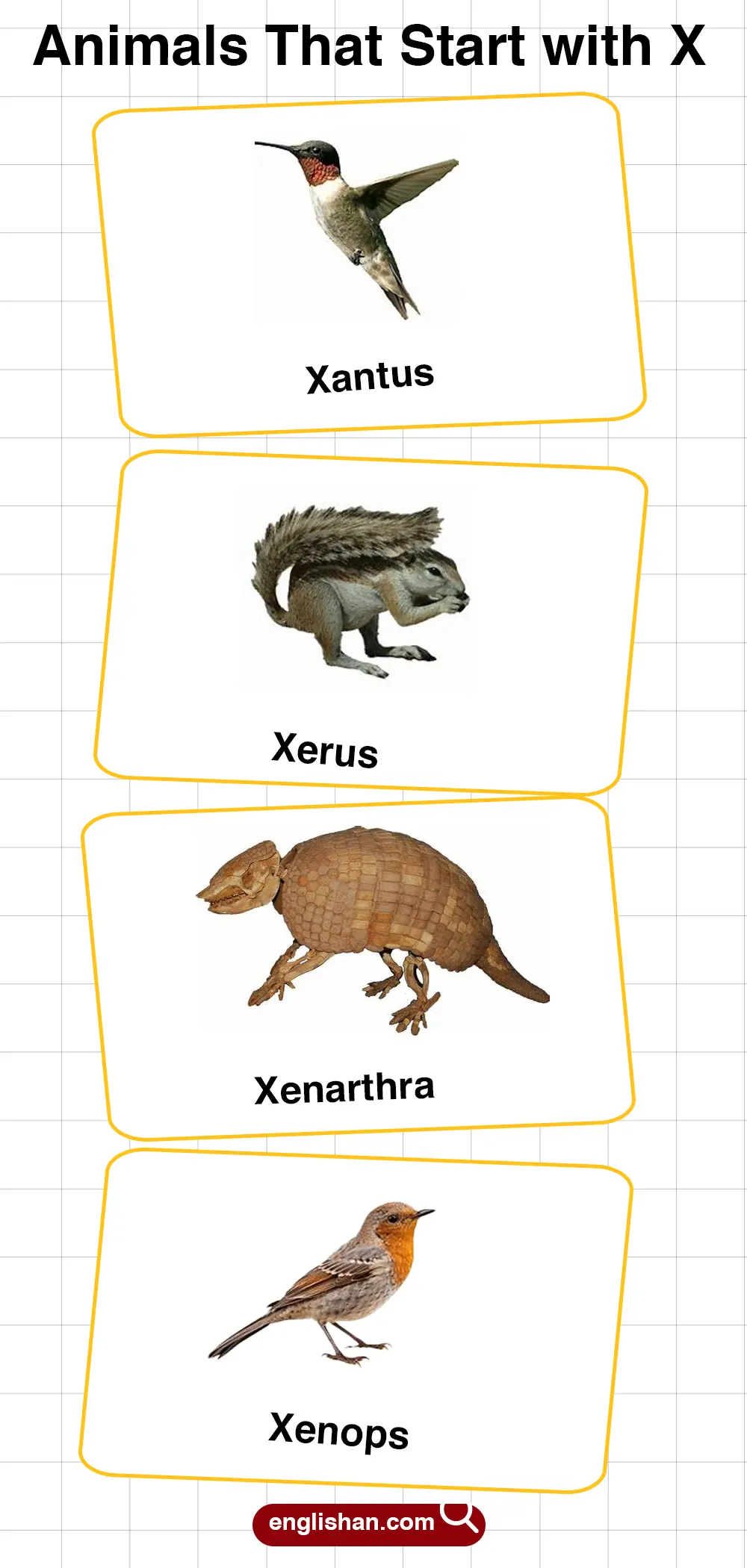
Used as both a common and genus name, Xerus refers to African ground squirrels that live in open grasslands and deserts. These rodents have slender bodies, bushy tails, and strong claws for digging burrows. They are active during the day and feed on seeds, roots, and insects. Social behavior varies by species, with some living in groups.
Xoloitzcuintli
Originating in Mexico, the Xoloitzcuintli is a domestic dog breed known for its hairless body and smooth skin. Some individuals have a short coat, but the hairless variety is most recognized. It has a lean build, large upright ears, and an alert expression. This breed has ancient roots in Mesoamerican cultures and is recognized as a distinct dog breed today.
Birds
Xantus’s Hummingbird
Native to Baja California, Xantus’s hummingbird is a medium-sized hummingbird known for its green upperparts and distinct white stripe behind the eye. A rufous tail and reddish bill add contrast to its appearance. It feeds on nectar from flowering plants and also consumes small insects for protein. This species often inhabits dry forests, gardens, and shrublands within its limited geographic range.
Xeme
Also known as Sabine’s gull, Xeme is a small seabird that breeds in Arctic regions and migrates over open oceans. It has a gray back, white body, and a distinctive forked tail. During flight, its wings display bold black, white, and gray patterns. It feeds on insects during the breeding season and shifts to marine prey while at sea.
Xenops
Belonging to the ovenbird family, Xenops refers to a group of small tropical birds found in Central and South America. These birds have short tails and slightly curved bills adapted for probing bark. Their brown plumage blends with tree trunks, aiding concealment. They feed mainly on insects and often move methodically along branches while foraging.
Reptiles
Xantus’ Leaf-Toed Gecko
The Xantus’ leaf-toed gecko is a small nocturnal reptile native to Baja California, Mexico. It lives in arid habitats such as deserts, rocky slopes, and coastal scrublands. Its broad, leaf-shaped toe pads provide traction on rough surfaces, while large eyes improve vision in low light. The body is usually pale brown or gray, which aids camouflage against sand and stone. It feeds mainly on insects and other small invertebrates and shelters in crevices during the day.
Fish And Sea Animals
X-ray Tetra
Gliding through clear freshwater streams, the X-ray tetra is a small tropical fish native to South America. Its body appears almost transparent, allowing parts of the backbone and internal organs to be seen through the skin. A forked tail marked with black and yellow bands adds contrast to its glasslike look. It typically swims in groups and feeds on tiny invertebrates and plant matter.
Xingu River Ray
Flowing waters of Brazil’s Xingu River are home to the Xingu River ray, a freshwater stingray with a round, flattened body. Its dark upper surface is often patterned with pale spots, while the underside remains lighter. Like other river rays, it has a long tail equipped with a defensive spine. It feeds on small fish and invertebrates along the riverbed.
Xestus Sabretooth Blenny
Coral reefs in the Indo-Pacific region shelter the Xestus sabretooth blenny, a small but agile marine fish. It belongs to a group known for sharp, fanglike teeth that can nip at other fish. Slender in shape, it moves quickly among reef crevices and often mimics cleaner fish in behavior. Its diet includes small crustaceans and bits of tissue from other fish.
Extinct Animals
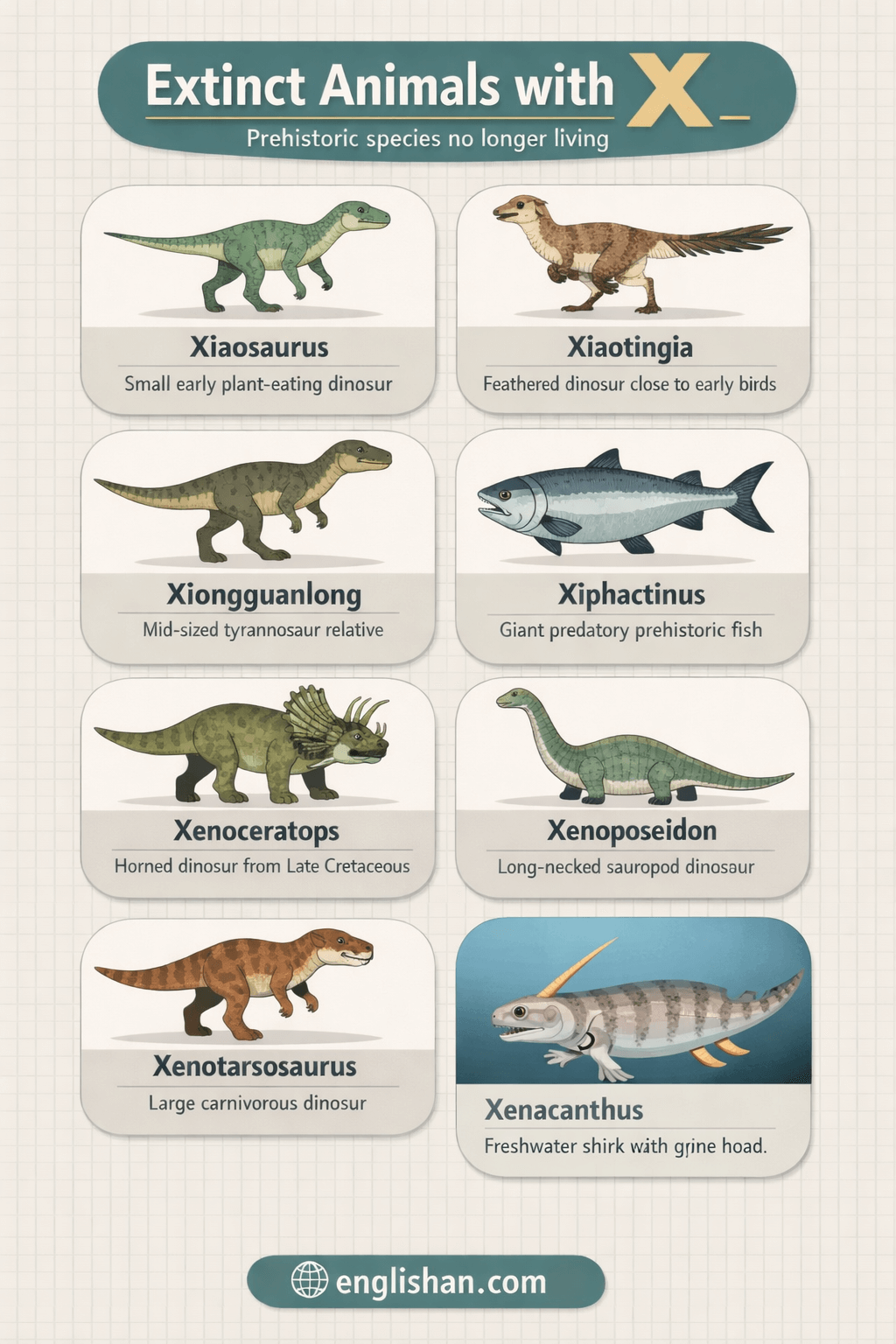
Xiaosaurus
Living during the Middle Jurassic period, Xiaosaurus was a small plant-eating dinosaur discovered in China. It belonged to an early group of ornithischians and likely moved on two legs. Its light frame and simple teeth suggest a diet of low-growing vegetation. Fossils are limited, so much about its full size and appearance remains based on partial skeletal remains.
Xiaotingia
Feather impressions preserved in stone reveal that Xiaotingia was a small, bird-like dinosaur from the Late Jurassic of China. It shared traits with early birds and small theropods, including a lightweight skeleton and long arms. These features place it close to the evolutionary line that connects non-avian dinosaurs with the first true birds.
Xiongguanlong
From the Early Cretaceous of China, Xiongguanlong represents an early relative of later giant tyrannosaurs. It was medium-sized, with a long skull and sharp teeth suited for hunting. Fossil evidence shows a mix of primitive and advanced traits, helping scientists trace how tyrannosaurs evolved into larger predators like Tyrannosaurus.
Xiphactinus
Ancient inland seas once held Xiphactinus, a massive predatory fish from the Late Cretaceous. Reaching over four meters in length, it had a streamlined body and powerful jaws lined with sharp teeth. Some fossils even contain remains of other fish inside its ribcage, showing that it swallowed large prey whole.
Xenoceratops
Discovered in Canada and dating to the Late Cretaceous, Xenoceratops was an early horned dinosaur. It belonged to the ceratopsian group, known for facial horns and broad bony frills. Though fossils are incomplete, the preserved skull pieces suggest a large head decorated with prominent horn structures.
Xenoposeidon
Known from a single unusual vertebra found in England, Xenoposeidon was a long-necked sauropod from the Early Cretaceous. Its bone structure differs from other sauropods, hinting at a distinct branch within that group. Even with limited material, the fossil shows it was part of the massive, four-legged plant-eating dinosaurs.
Xenotarsosaurus
Fossils from Argentina reveal that Xenotarsosaurus was a carnivorous theropod living in the Late Cretaceous. It walked on two legs and likely hunted smaller animals. The preserved limb bones and vertebrae indicate a strong build typical of medium-sized predatory dinosaurs of its time.
Xenacanthus
Long before the age of dinosaurs ended, freshwater systems were home to Xenacanthus, an extinct shark that lived from the Devonian to the Triassic period. It had an eel-like body and a distinctive spine projecting from the back of its head. Fossils found in ancient river and lake deposits confirm it thrived in freshwater rather than ocean environments.
Interesting Facts About Animals with ‘X’
Learning with facts adds interest and boosts recall. These details help make picture vocabulary lessons more engaging.
- The X-Ray Tetra has a body that looks almost clear, like an X-ray picture.
- Xoloitzcuintli is an old dog breed from Mexico and is mostly hairless.
- Xenarthra animals, such as armadillos and sloths, have strong backbones and live in the Americas.
- The Xiphias, or swordfish, has a long, sharp nose that looks like a sword.
- Xantus’s Hummingbird is very small and moves quickly to drink nectar from flowers.
FAQs
Yes, but they are rare. Animals that start with X include X-ray tetra, Xerus, xeme, Xenops, and Xoloitzcuintli, which come from different parts of the world.
The Xoloitzcuintli is one of the best-known animals that start with X. It is a hairless dog from Mexico and has been around for thousands of years.
Yes, the X-ray tetra is a small freshwater fish. It is named for its see-through body, where parts of its bones are visible.
Xerus is a mammal that starts with X. It is a type of ground squirrel found in Africa and often lives in dry, open areas.
Yes, the xeme is a bird that starts with X. It is a small gull that lives near cold coastal regions and wetlands.
Yes, animals that start with X include Xenopus, a type of African frog, and Xantus’ leaf-toed gecko, a small desert-dwelling reptile.
Animals that start with X are uncommon because few animal names in English begin with this letter, and many come from scientific or regional names.
Conclusion
Animals that start with the letter X are rare, yet they span a wide range of groups, from birds and reptiles to fish and extinct dinosaurs. Some, such as the X-ray tetra and Xerus, are living species found in specific regions, while others like Xiphactinus and Xenoceratops are known only from fossils. Together, these names show how scientific discovery and regional naming traditions shape the way animals are classified and recorded.
You May Also Like