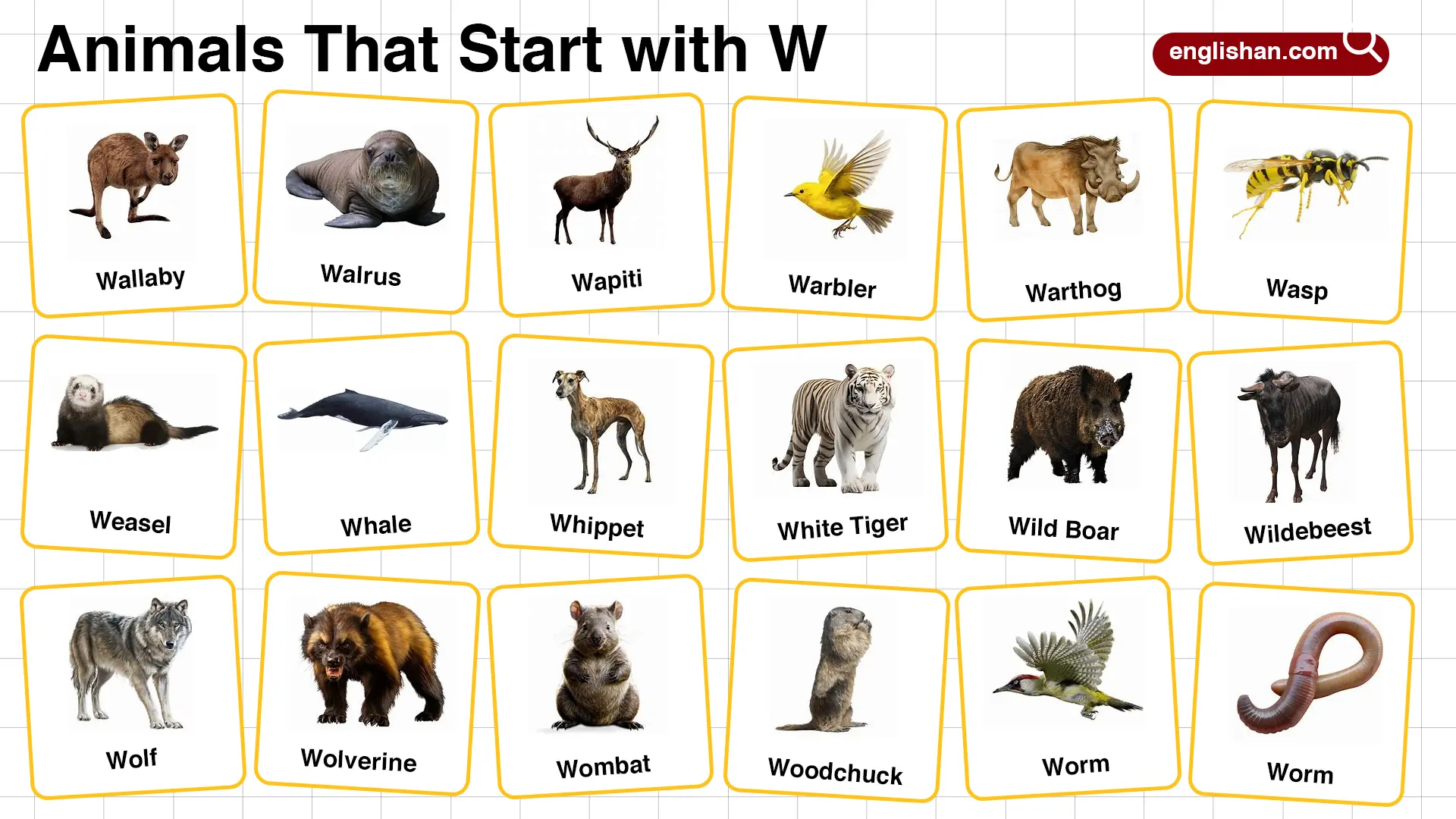
The Arctic walrus and the forest-dwelling wolf show how diverse animals that start with W can be. These species use unique physical traits, like ivory tusks or thick fur, to thrive in harsh environments.
Picture a woodpecker drilling into a tree or a wombat digging deep tunnels in the Australian soil. From giant ocean whales to tiny weasels, these creatures live in very different habitats.
This guide organizes animals starting with W by their type and home. By the end, you will recognize these species on sight and understand the behaviors that help them survive.
List of Animals Starting with W
Below is a categorized list of animals that start with the letter W.
- Wallaby
- Walrus
- Wapiti
- Warbler
- Warthog
- Wasp
- Weasel
- Whale
- Whippet
- White Tiger
- Wild Boar
- Wildebeest
- Wolf
- Wolverine
- Wombat
- Woodchuck
- Woodpecker
- Worm
- Wrasse
- Wren
Mammals That Start with W
Mammals are animals that have fur or hair. They breathe air and usually have babies.
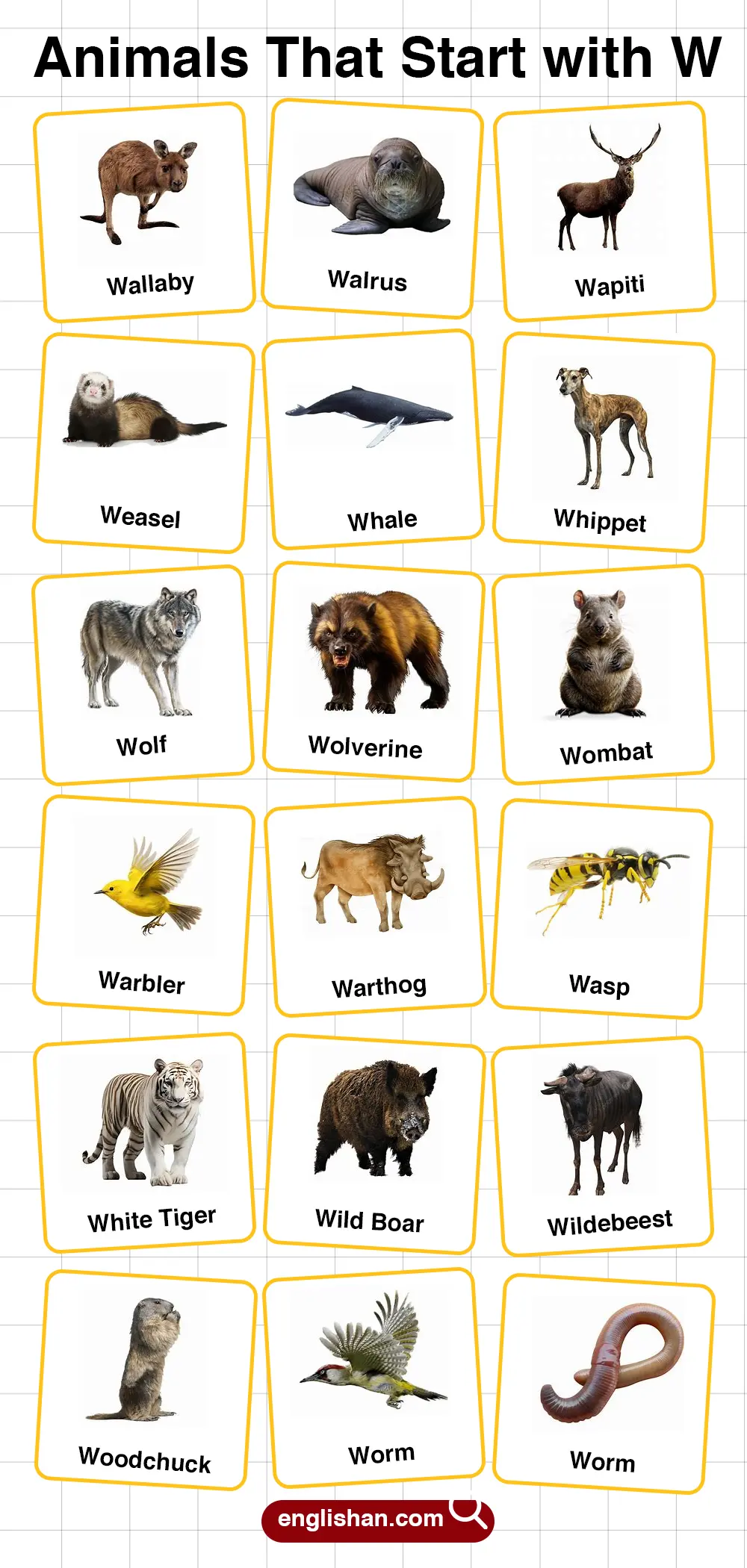
Wallaby
A wallaby is a medium-sized marsupial related to kangaroos and native to Australia and nearby islands. It has strong hind legs built for hopping and a thick tail that keeps its balance steady while moving. Different species live in forests, rocky hills, or open grasslands. Most feed on grasses, leaves, and shrubs.
Walrus
The walrus is a large Arctic marine mammal recognized by its long tusks and heavy folds of skin. Those tusks are elongated canine teeth and can grow over one meter in males. It uses them to pull its body onto sea ice and to establish dominance. Thick whiskers help it detect clams and other shellfish on the ocean floor.
Wapiti
Wapiti, often called elk in North America, are among the largest deer species. Males grow massive branching antlers that are shed and regrown each year. They inhabit forests and mountain regions and migrate seasonally. Their diet shifts from grasses in summer to bark and woody plants in winter.
Warthog
The warthog is a wild member of the pig family found across African savannas. It has curved tusks and facial swellings that appear like warts. When threatened, it can run quickly despite its stocky build. It feeds mainly on grasses but also digs for roots using its snout.
Weasel
Small, slender, and highly active, the weasel is a carnivorous mammal known for hunting rodents. Its long body allows it to enter burrows with ease. Fur color may change with the seasons in colder regions. Sharp teeth and quick reflexes make it an efficient predator.
Whale
Whales are fully aquatic mammals that range from moderate to immense in size, with the blue whale being the largest animal known to have lived. They breathe air through blowholes and give birth to live young. Some species filter tiny krill from seawater, while others hunt fish and squid. Long migrations are common in many whale species.
Whippet
The whippet is a lean domestic dog breed developed for speed. Its deep chest and long legs allow rapid acceleration over short distances. Although capable of sprinting at high speeds, it is usually calm and quiet indoors. The breed is often kept as a companion animal.
White Tiger
A white tiger is not a separate species but a color variant of the Bengal tiger caused by a genetic trait. It retains black or dark brown stripes over pale fur. The body structure, strength, and behavior are the same as other Bengal tigers. This variation is rare in the wild.
Wild Boar
Wild boar are sturdy, adaptable mammals that inhabit forests and grasslands across Europe, Asia, and parts of Africa. Coarse hair covers their bodies, and sharp tusks grow from the lower jaw. They forage for roots, fruits, insects, and small animals. Domestic pigs descend from this species.
Wildebeest
Wildebeest, also known as gnu, are large African antelopes recognized by their heavy heads and curved horns. They form massive herds and take part in long seasonal migrations. Grass makes up most of their diet. Predators such as lions often follow these migrating groups.
Wolf
Wolves are social carnivores that live and hunt in organized packs. Communication includes howling, scent marking, and body posture. They prey mainly on large hoofed animals such as deer and elk. Populations occur across parts of North America, Europe, and Asia.
Wolverine
The wolverine is a powerful member of the weasel family adapted to cold northern climates. Thick fur protects it from harsh winters. Despite its moderate size, it is capable of defending carcasses from larger predators. It feeds on small mammals and carrion.
Wombat
Wombats are burrowing marsupials native to Australia. They have compact bodies, strong claws, and continuously growing teeth suited to grazing. Their tunnel systems can be extensive. A backward-facing pouch protects the young while the mother digs.
Woodchuck
Also called a groundhog, the woodchuck is a rodent that spends much of its time in underground burrows. It inhabits fields, forest edges, and rural areas in North America. The animal feeds mainly on grasses and other vegetation and enters a deep hibernation during winter.
Birds That Start with W
Birds have feathers and wings. They can usually fly.
Warbler
Warblers are small songbirds known for active movement and varied vocal patterns. Many species migrate long distances between breeding and wintering grounds. They usually feed on insects, often picking them from leaves and branches. Plumage ranges from dull olive to bright yellow depending on the species.
Woodpecker
Woodpeckers are birds adapted for climbing tree trunks and drilling into wood. A strong chisel-like beak allows them to peck bark in search of insects. Their stiff tail feathers provide support against vertical surfaces. Many species also create nesting cavities inside trees.
Wren
Wrens are tiny, energetic birds with short wings and upright tails. Despite their small size, they produce loud and complex songs. Most species live in dense shrubs, forests, or gardens. Their diet mainly consists of insects and spiders.
Insects and Small Creatures That Start with W
These are small animals, some can fly, and some crawl on the ground.
Wasp
Wasps are flying insects with slender bodies and narrow waists. Most species have a smooth stinger used for defense or hunting. They feed on nectar, insects, or both, depending on the species. Some live alone, while others form organized colonies with a queen and workers.
Worm
Worms are soft-bodied, legless invertebrates that live in soil, water, or inside other organisms. Earthworms, the most familiar type, move by contracting body segments. As they burrow, they loosen soil and break down organic matter. This process improves soil structure and nutrient cycling.
Fish and Marine Animals That Start with W
These animals live in water. They swim and breathe underwater or come up for air.
Wrasse
Wrasses are marine fish found mainly in tropical and temperate oceans. Many species display bright colors and changing patterns as they mature. They inhabit coral reefs and rocky shores, where they feed on small invertebrates such as crustaceans and mollusks. Some wrasses are known for cleaning parasites from larger fish.
Whale
Whales are large marine mammals that live entirely in the ocean and breathe air through blowholes. The blue whale is the largest animal known to exist. Whales give birth to live young and nurse them with milk. Their diets vary, with some filtering plankton and others hunting fish or squid.
Interesting Facts About Animals That Start with W
Learning with facts adds interest and boosts recall. These details help make picture vocabulary lessons more engaging.
- The walrus uses its big tusks to pull itself out of the water.
- Wolves live and hunt together in groups called packs.
- Woodpeckers can peck trees very fast—up to 20 times every second.
- The white tiger is rare and has white fur with black stripes.
- Wombats dig tunnels underground to live in.
FAQs
You’ll often hear names like wolf, whale, walrus, wombat, warthog, weasel, and woodpecker. These animals live in very different places, from oceans and forests to grasslands and deserts.
Common land animals include wolf, wombat, warthog, wildebeest, weasel, and wallaby. Some are predators, while others are plant eaters found in open plains or wooded areas.
Yes, there are many. Woodpecker, wren, and whooping crane are familiar bird names, and each one has its own style of movement, calls, and nesting habits.
Walrus and whale shark are popular examples. The walrus lives in cold regions near ice, while the whale shark is the largest fish in the sea and feeds on tiny sea life.
Yes. Wasp and wolf spider are common examples. Wasps are flying insects that build nests, while wolf spiders live on the ground and hunt without webs.
Wombat and wallaby are closely linked to Australia. Both are marsupials, meaning they carry their young in a pouch during early growth.
Conclusion
These W-starting animals include birds, insects, fish, mammals, and invertebrates. Some, like the whale and warthog, are large and powerful, while others such as the wren and worm are small yet biologically significant. They occupy oceans, forests, grasslands, and soil ecosystems. Their feeding habits range from nectar and insects to large marine prey. Together, they reflect the wide range of body forms, behaviors, and habitats found across the animal kingdom.
You May Also Like