

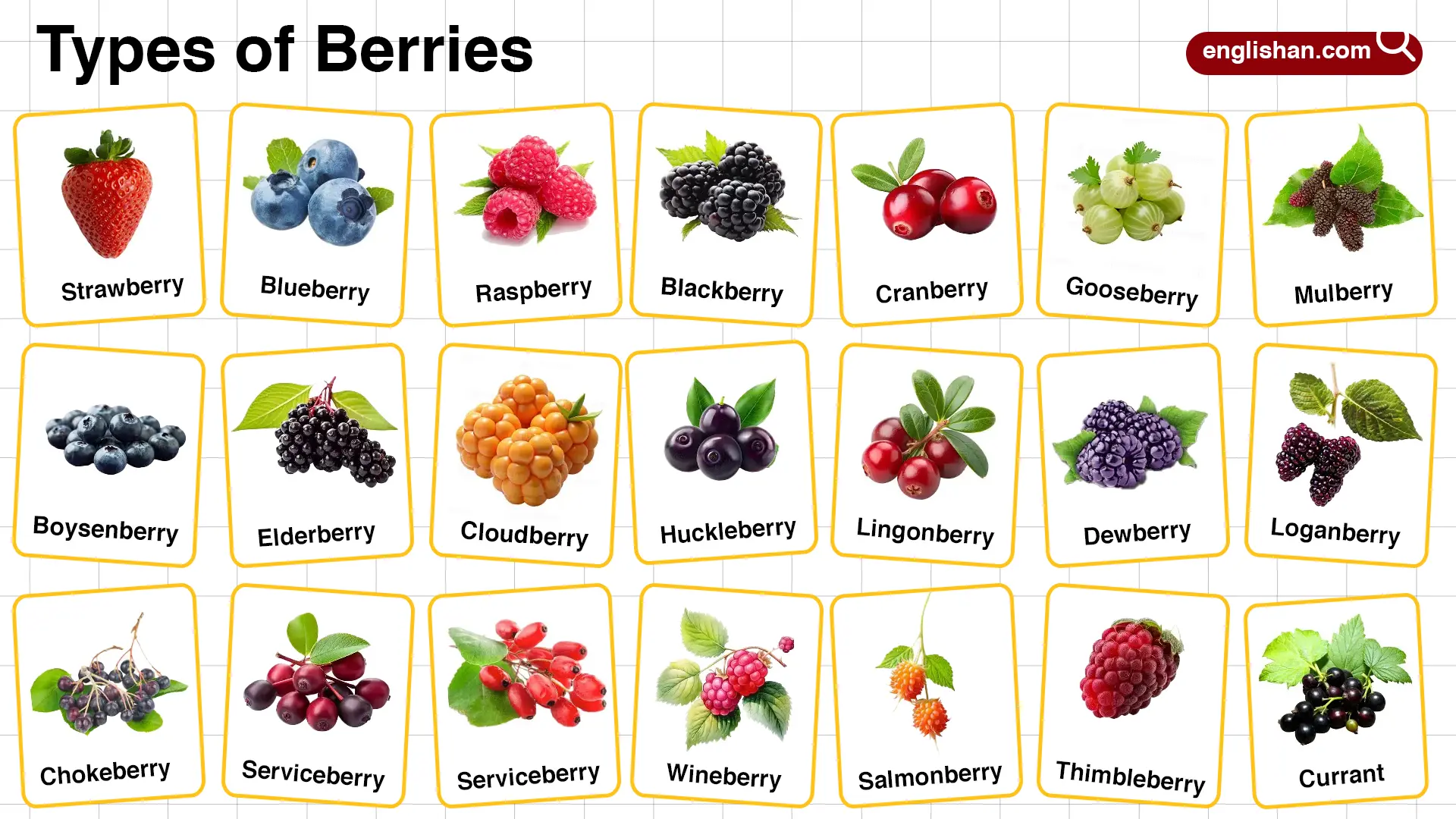
More than 400 berry species grow worldwide, though a supermarket shelf carries six or seven of them. The familiar types of berries start with strawberry and blueberry, while wild salmonberry and tropical jabuticaba belong at the far end of that range. Color, plant type, and season separate one from the next, and those three traits do most of the identifying work.
Types of Berries With Pictures
This list of berries runs alphabetically from acai to youngberry, which finds a single name faster than any arrangement by color or plant would.
- Acai
- Acerola
- Aronia
- Baobab
- Barberry
- Bearberry
- Bilberry
- Blackberry
- Black raspberry
- Blackcurrant
- Blueberry
- Boysenberry
- Buffaloberry
- Bunchberry
- Camu camu
- Cape gooseberry
- Ceylon gooseberry
- Chilean guava
- Chokecherry
- Cloudberry
- Cranberry
- Crowberry
- Dewberry
- Elderberry
- Goji
- Golden raspberry
- Gooseberry
- Goumi
- Hackberry
- Hawthorn berry
- Honeyberry
- Huckleberry
- Indian gooseberry
- Jabuticaba
- Jostaberry
- Juniper berry
- Kiwi berry
- Lingonberry
- Loganberry
- Maqui
- Marionberry
- Marula
- Miracle berry
- Mulberry
- Nannyberry
- Nanking cherry
- Olallieberry
- Oregon grape
- Pin cherry
- Pineberry
- Raspberry
- Red currant
- Red huckleberry
- Rose hip
- Rowan berry
- Salal berry
- Salmonberry
- Sea buckthorn
- Serviceberry
- Sloe
- Snowberry
- Strawberry
- Strawberry tree fruit
- Tayberry
- Thimbleberry
- White currant
- White mulberry
- Wineberry
- Wintergreen berry
- Youngberry
What Is a Berry
A berry is a fleshy fruit that develops from the single ovary of one flower, with its seeds embedded in the pulp. That definition governs botany, and it splits the kitchen sense of the word almost in half. All types of berries fall on one side of the line or the other.
Two other fruit forms wear the name without qualifying. An aggregate fruit develops from several ovaries inside one flower, which is why a raspberry looks like a cluster of tiny beads. Each of those beads is its own drupelet, with its own seed inside. A multiple fruit develops from a whole cluster of separate flowers that fuse together as they ripen, and the mulberry grows that way.
Neither form counts as a true berry, though both taste and cook like one. That mismatch between the everyday word and the botanical word is worth knowing when you name fruit in English. For younger learners meeting these words for the first time, the broader fruit names reference teaches the same ground at an easier level.
List of Botanical True Berries
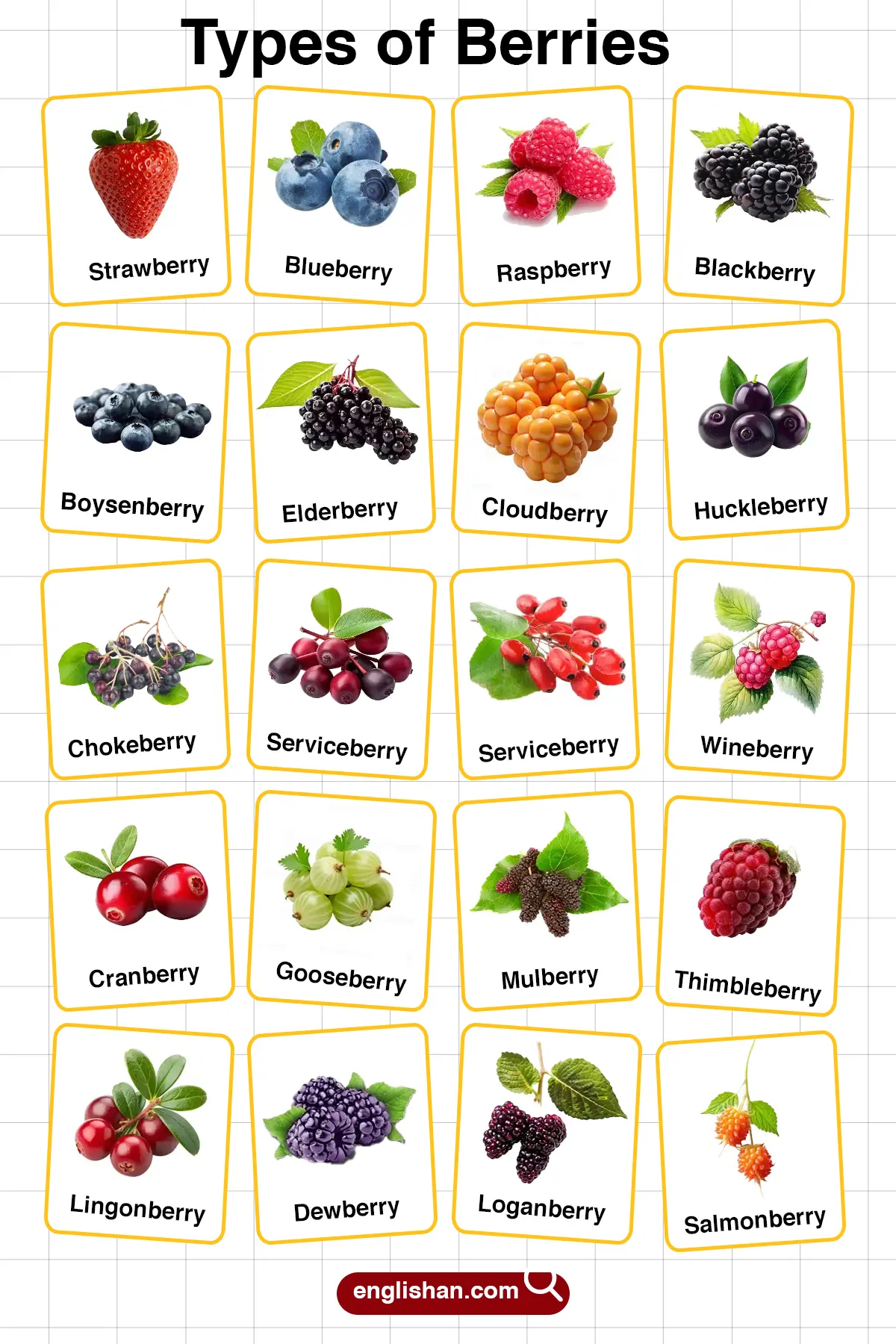
These fruits satisfy the strict definition. Several of them surprise people who expect a berry to be small, round, and sweet.
- Blueberry
- Cranberry
- Currant (red, black, white)
- Gooseberry
- Grape
- Banana
- Tomato
- Avocado
- Eggplant
- Bell pepper and chili
- Kiwi
- Papaya
- Passionfruit
- Guava
- Persimmon
Strawberry, raspberry, blackberry, and mulberry all fail the test, which reverses what most people guess when they first meet the rule.
Berry Types by Color
Color tells you more about a berry than its size or its shape does, and it predicts the taste well. Dark skin comes from anthocyanins, the pigments that also make a berry sour. Pale fruit forms almost none of them, so it tastes sweeter. Putting berries of one color together also places the lookalike pairs side by side, which is where most naming mistakes happen.
Red Berries
Strawberry and raspberry outsell every other berry in the world, and both of them are red. So are rowan and hawthorn, wild fruits that birds strip and people leave alone. Red skin means sourness more than sweetness, which is why so many red types of berries cook into jelly and jam instead of reaching a bowl.
Strawberry
The strawberry grows on a low, spreading ground plant rather than a bush, and it ripens bright scarlet from the tip upward. Its seeds stud the outside of the fruit instead of sitting within the flesh, which is what disqualifies it as a true berry. Cultivated fruit measures roughly one to two inches across, while wild strawberries stay smaller than a fingernail and taste far stronger.
Peak season runs from late spring into early summer. The fruit softens within a day of picking and bruises where it touches, so it travels badly and tastes best bought locally. Eight medium strawberries deliver a full day’s vitamin C for an adult, at around 60 milligrams.
Raspberry
Each raspberry forms as a cluster of soft drupelets clustered around a hollow core. That hollow is the identifying feature: pull a raspberry from its plant and the white central plug stays behind on the cane, which never happens with a blackberry. Red raspberries lead every common berry in dietary fiber, at 8 grams per cup.
Canes fruit in summer, and some varieties produce a second, lighter crop in autumn. Buy raspberries the day you plan to eat them, since they crush and mold faster than any other fruit on this list.
Cranberry
Cranberries grow on trailing vines in acid bogs, and growers flood those bogs at harvest so the fruit floats to the surface. Ripe cranberries turn deep red and stay firm rather than softening, which is unusual for a berry. Squeeze one and it bounces.
The taste runs sharply sour raw, so almost all of the crop cooks down into sauce, juice, or sweetened dried fruit. Harvest falls in autumn, which is why cranberry appears on North American and British winter tables. Whole fresh cranberries keep for weeks in a refrigerator and freeze without any preparation at all.
Red currant
Translucent strings of red currant hang along the stem, each fruit about the size of a pea with its seeds visible through the skin. Bushes fruit in early summer, and a single mature plant yields several pounds.
Sharp acidity and high natural pectin make the red currant the standard fruit for jelly, and it sets without any added pectin. Cooks also brush the strained juice over tarts as a glaze. Raw fruit tastes sharply sour, closer to a sour cherry than to a strawberry.
Goji
Goji is the fruit of a thorny Asian shrub in the nightshade family, sold almost entirely dried rather than fresh. The dried fruit turns leathery and slightly chewy, roughly the length of a raisin, and tastes mildly sweet with a faint tomato flavor behind it.
An ounce of dried goji supplies half an adult’s daily vitamin A. Chinese cooking drops the fruit into soups, teas, and rice porridge, while Western shops shelve it beside supplements. Other dried fruits follow the same route from field to packet.
Lingonberry
Across northern Europe, Russia, and Canada, lingonberry grows on a low evergreen shrub and ripens to a firm scarlet in late summer. Each fruit measures under a quarter inch and stays hard rather than juicy.
Scandinavian kitchens cook it into a tart preserve served beside meatballs, reindeer, and pork rather than as dessert. Wild picking supplies most of the crop, since the plant resists commercial growing.
Barberry
Barberry fruits ripen as small oval red berries on a spiny ornamental shrub, hanging in loose bunches through autumn. The taste runs sour and slightly bitter, closer to a dried cranberry than a sweet berry.
Persian cooking scatters the dried fruit through rice for its acidity. One caution attaches to the species: common barberry produces edible fruit, while several ornamental varieties do not, so identification matters before picking.
Hawthorn berry
The hawthorn berry, called a haw, ripens deep red in dense clusters on thorny hedgerow trees across Europe and North America. Each fruit measures around half an inch and encloses one to five stony seeds.
The flesh turns dry and mealy, with too little flavor to eat raw. Cooked, the fruit strains into a jelly served with cold meat, and herbal preparations use it widely.
Rowan berry
Rowan berries ripen orange-red in heavy drooping bunches on the mountain ash, a slender tree common across northern Europe. Each berry reaches pea size and dries the mouth when eaten raw.
Cooking breaks that tannin down and turns the fruit into the sharp jelly traditionally served with venison and game birds. Birds strip the tree quickly once the fruit ripens in early autumn.
Thimbleberry
Shaped like the thimble it takes its name from, thimbleberry fruit slips off its core in one piece and flattens in the hand. Large maple-shaped leaves and thornless stems identify the plant.
It grows wild across western North America, from California up into Alaska. The fruit collapses within hours of picking, so it never reaches a shop and stays a foraging find.
Wineberry
Wineberry is an East Asian raspberry relative, identified by red hairy stems that glow when backlit. The fruit ripens bright orange-red inside a sticky calyx that peels back as it matures.
Flavor runs sweet and lightly tart, comparable to a raspberry with more acidity. The plant spreads aggressively through thickets in the eastern United States, where it counts as invasive, which makes picking it doubly welcome.
Acerola
Acerola, also called the Barbados cherry, ripens bright red on a shrub across the Caribbean and tropical South America. The fruit ranks among the richest natural sources of vitamin C measured anywhere, at levels many times those of an orange.
Ripe fruit spoils within days, so acerola reaches most markets as juice, powder, or supplement.
Bearberry
Bearberry spreads as a low evergreen mat across northern heaths and dunes, producing small red fruit with dry, mealy flesh. Raw berries taste bland, and cooking draws out what sweetness they carry.
The plant doubles as ground cover in cold gardens, where its leaves turn red through winter.
Buffaloberry
Buffaloberry ripens as tart red or amber fruit on a silver-leaved shrub of the northern plains. Indigenous cooking whipped the fruit into a foam, since it froths when beaten.
The shrub fixes nitrogen and tolerates poor, dry soil, which explains its presence on windbreaks.
Bunchberry
Bunchberry spreads as a ground-covering dogwood no taller than a hand, and its red fruit clusters at the center of four white bracts. The flavor stays mild and faintly sweet, with a mealy texture.
It grows across northern forests and eats better cooked into a preserve than raw.
Nanking cherry
Nanking cherry produces sweet scarlet fruit around half an inch across, on a shrub that blossoms white in early spring. The taste balances sweetness against a light tartness, closer to a sour cherry than a berry.
The shrub tolerates drought and cold, which makes it a common hedge across the prairies.
Pin cherry
Pin cherry fruits ripen as tiny sour red drupes on a fast-growing tree that spreads across burned and cleared ground. Each fruit measures a quarter inch and surrounds a single stone.
Sharpness rules out raw eating for most people, so the fruit goes into jelly and syrup.
Red huckleberry
Red huckleberry grows on bright green-stemmed shrubs in Pacific Northwest forests, favoring rotting stumps and shaded slopes. The fruit ripens translucent red and tastes sharply tart with a light sweetness underneath.
Foragers pick it from midsummer, and it works in pies where a sour note is wanted.
Wintergreen berry
Wintergreen produces a bright red fruit carrying the same minty flavor as its leaves, on a creeping plant a few inches tall. The berries persist through winter under snow, which is where the plant takes its name.
Texture stays mealy, so the fruit flavors tea and sweets more than it satisfies as fresh eating.
Chilean guava
Chilean guava, sold in Australia and New Zealand as ugni, produces small dark red fruit on a compact evergreen shrub. Flavor combines strawberry and passion fruit, sweet with a light perfume to it.
Victorian gardeners grew it in Britain, and the shrub takes a hedge or a container comfortably.
Miracle berry
The miracle berry carries miraculin, a protein that binds to the tongue and rewrites sour flavors as sweet for up to an hour. The fruit itself, a small red West African berry, tastes of very little.
Chefs use it for tasting events where lemons and vinegar turn sweet on the palate.
Blue and Purple Berries
Anthocyanin reaches its highest levels in blue and purple types of berries, and that pigment is what most berry health research studies. This color also creates the hardest naming problems. Blueberry, huckleberry, and bilberry look almost identical in a bowl, and all three grow on low shrubs in the same acid soil.
Blueberry
Blueberries grow in clusters on shrubs ranging from ankle-high lowbush plants to bushes taller than a person. Highbush varieties dominate commercial sales at around half an inch across, while lowbush fruit stays smaller and tastes noticeably more intense.
A pale waxy bloom on the skin marks fresh fruit, and rubbing it away shortens shelf life. Season runs through midsummer in most of the northern hemisphere. Cut a blueberry open and the flesh stays pale green, which separates it from every dark-fleshed lookalike.
Huckleberry
Huckleberries resemble blueberries closely enough that shoppers mix them up on sight. The difference shows inside: huckleberry flesh encloses ten hard seeds you notice while chewing, where a blueberry’s seeds go unnoticed entirely.
Wild mountain harvest supplies the whole crop, since the plant resists cultivation, and that keeps prices high across Montana, Idaho, and the Pacific Northwest. Flavor runs richer and more acidic than blueberry, which suits it to pie and syrup.
Bilberry
Europe’s native blueberry relative, bilberry grows singly along the stem rather than in clusters. Plants stay low, rarely above knee height, on moorland and in open woodland.
Cutting one open settles the identification immediately, because bilberry flesh runs purple all the way through while blueberry flesh stays pale. The fruit stains fingers and tongue deep purple, and its flavor carries more intensity than a cultivated blueberry.
Honeyberry
Honeyberry, also called haskap, ripens as an elongated blue fruit shaped more like a small plum than a round berry. Harvest arrives weeks ahead of every other berry, in late spring.
Flavor lands between blueberry and raspberry with a tart finish. The fruit delivers four times the vitamin C of a blueberry, and the plant survives temperatures that kill most fruit bushes.
Serviceberry
The serviceberry, known regionally as juneberry or saskatoon, ripens purple on a small tree that flowers white in early spring. Fruit reaches around a third of an inch and tastes of sweet blueberry with a distinct almond finish from the seeds.
Botanically it forms a pome, the same fruit structure as an apple, rather than a berry at all. Canadian prairie baking treats saskatoon as its default pie fruit.
Sloe
Sloe ripens on the blackthorn, a fiercely spined hedgerow shrub, as a blue-black plum barely larger than a marble. A dusty bloom coats the skin, and a single stone fills the center.
Raw fruit dries the mouth on contact and tastes harsh enough to spit out. Frost breaks that harshness down, which is why gin makers traditionally wait until after the first cold snap in October before picking.
Juniper berry
Juniper berries form as fleshy seed cones rather than true fruit, ripening from green to blue-black across two full years on the same shrub. Both colors appear on one plant at once, which identifies it reliably.
Its sharp piney flavor defines gin and seasons game, cabbage, and cured meat. A few species turn too bitter for cooking, so only common juniper belongs in a kitchen.
Acai
Acai grows in heavy bunches on a slender palm across the Amazon basin, each fruit about the size of a blueberry with a large seed filling most of it. Only a thin layer of purple pulp surrounds that seed.
The taste runs earthy and unsweetened, closer to dark berry with a cocoa finish than to anything sugary. Pulp spoils within a day of harvest, so it travels frozen or as powder.
Maqui
Maqui ripens as a small purple-black fruit on a Chilean evergreen tree, roughly a quarter inch across. Readings place it among the highest antioxidant fruits ever tested.
Mapuche communities ferment it into a traditional drink, and it reaches export markets as powder.
Oregon grape
Oregon grape produces waxy blue-black fruit in tight clusters on a holly-leaved evergreen shrub native to western North America. Despite the name, it shares no relation with grapes.
Tartness rules out raw eating for most palates, so the fruit heads into jelly, where its color survives cooking.
Nannyberry
Flat-topped clusters of nannyberry ripen blue-black on a viburnum shrub that reaches small-tree height. Ripe fruit tastes sweet with a note of vanilla and spice, and its texture turns soft, almost like a date.
Overripe fruit shrivels on the branch and turns bitter, so timing the pick matters.
Hackberry
Hackberry fruit ripens purple on tall shade trees across North America, each berry surrounding a crunchy seed under a thin layer of flesh. That flesh tastes intensely of dates.
Fruit persists on bare branches through winter, which makes the tree a reliable food source for birds.
Black Berries
Most black types of berries come from the bramble family. Breeders have crossed raspberry with blackberry so many times that a dozen named hybrids now exist, each one bred in a different country. The black fruits outside that family, elderberry and aronia among them, taste too sharp to eat raw and need sugar or cooking first.
Blackberry
The blackberry forms as an aggregate of drupelets on a thorny arching cane, and unlike a raspberry it keeps its white core when picked. That single difference identifies it every time.
Ripe fruit turns fully matte black and yields to light pressure. Anything still glossy stays sour, whatever its color. Season peaks in late summer, and wild hedgerow fruit tastes sharper and stronger than the cultivated kind. A cup delivers close to 8 grams of fiber.
Blackcurrant
Blackcurrants grow in strings on a shrub whose leaves smell as strongly as the fruit does when crushed. Each berry measures around a third of an inch across, matte black with a small dried flower remnant at the tip.
The taste runs sharp, musky, and unmistakable. By weight the fruit delivers several times the vitamin C of an orange, which is why wartime Britain planted it heavily. Bushes fruit in midsummer, and almost all of the crop cooks into cordial, jam, or liqueur.
Elderberry
Elderberries ripen as tiny black fruit in flat, heavy heads on a large shrub that flowers cream-white in early summer. Individual berries measure only a few millimeters, and hundreds hang in one head.
Raw fruit and seeds cause nausea and stomach upset, so cooking is not optional here. Once cooked, the fruit becomes syrup, cordial, and country wine. Harvest falls in early autumn, and the whole head cuts off at once with scissors.
Mulberry
Mulberries grow on a tree and stretch long rather than round, forming from a fused cluster of separate flowers. That makes it a multiple fruit, a different category from both true berries and aggregates.
Ripe fruit drops at a touch and stains skin, clothing, and pavement a deep purple. Sweetness peaks when the fruit turns almost black and yields softly. Trees fruit through midsummer, and the easiest harvest spreads a sheet underneath and shakes the branches.
Boysenberry
Four parents meet in the boysenberry: blackberry, raspberry, loganberry, and dewberry, crossed into one maroon-black fruit around an inch long. It came out of a California breeding program roughly a century ago and reached fame through Knott’s Berry Farm.
Flavor runs deep and winey, sweeter than blackberry with more aroma. Fruit crushes easily, so most of the crop goes to jam and pie rather than fresh sale.
Black raspberry
Black raspberries hollow out when picked exactly as red ones do, which separates them from the blackberry they otherwise resemble. Canes carry a distinctive blue-white waxy coating.
Anthocyanin content runs higher than in either red raspberry or blackberry. Flavor turns drier and more floral, and Oregon grows most of the American crop.
Aronia
Aronia, sold as chokeberry, dries the mouth on contact, and that is where the name comes from. Fruit ripens glossy black in clusters on a hardy shrub.
Blending it into juice or cooking it into jam softens that dryness. The shrub survives extreme cold and produces heavily with almost no attention.
Marionberry
Bred in Oregon in the 1950s, marionberry produces firm, glossy fruit that growers rate above any other blackberry for flavor. Fruit grows longer and narrower at the tip than a common blackberry.
Nearly all of the crop grows within a few counties of Oregon, and most of it freezes for baking rather than selling fresh.
Dewberry
Dewberry trails along the ground rather than arching upward, and that habit is the quickest way to tell it from blackberry in the field. Canes carry fine prickles instead of hooked thorns.
Fruit ripens two to three weeks ahead of blackberry and tastes sweeter, with fewer and larger drupelets.
Loganberry
Blackberry crossed with red raspberry gives the loganberry its long dark red fruit and thornless canes. It appeared by accident in a California garden in the 1880s.
The taste stays tart even when fully ripe, which suits it to cooking and to wine more than to fresh eating.
Tayberry
Tayberry comes from the same two parents as loganberry, though the result differs sharply. Fruit grows longer, sweeter, and far less acidic.
Scottish breeders released it in 1979, naming it after the River Tay. Ripe fruit does not detach cleanly, so hand-picking is the only practical harvest.
Jostaberry
Blackcurrant crossed with gooseberry produced the jostaberry, thornless of cane and dark of fruit, tasting midway between its parents. German breeding produced it after decades of attempts.
Fruit ripens larger than a blackcurrant and milder, and the bush resists the mildew that troubles gooseberries.
Olallieberry
Olallieberry comes from loganberry crossed with a blackberry cultivar, and its fruit grows large, glossy, and juicy. Growers along the central California coast supply most of it.
Flavor runs sweeter than blackberry with a lingering tartness, and pie is its most common destination.
Youngberry
Youngberry ripens dark red to black on thorny canes, tasting sweet without the tartness its blackberry parent carries. It crosses dewberry with a blackberry-raspberry hybrid.
Ripening arrives early in the bramble season, and the fruit softens quickly once picked.
Crowberry
Crowberry grows on a needle-leaved arctic ground shrub that forms dense mats across tundra and northern bogs. Fruit ripens matte black, juicy but mild to the point of blandness.
Drying concentrates the flavor before the fruit goes into preserves, and Inuit and Sámi cooking has relied on it for centuries.
Chokecherry
Long strings of chokecherry ripen dark purple to black on small trees across North America. Each fruit surrounds a single stone, which marks it as a drupe rather than a berry.
That harshness drops away once cooked, and the fruit turns into jelly, syrup, and wine.
Jabuticaba
Jabuticaba fruits directly on the trunk and branches of its Brazilian tree, so the bark disappears under a coat of black, grape-like fruit. The skin tastes bitter, and the pulp inside tastes sweet and lightly perfumed.
Fruit ferments within days of picking, which is why it barely leaves Brazil.
Salal berry
Salal produces dark blue-black fruit on a broad-leaved evergreen shrub across the Pacific Northwest. Flavor runs sweet with a faint pine note, and the texture turns mealy.
Coastal First Nations dried the fruit into cakes as a staple food, and florists now grow the shrub mainly for its foliage.
White and Yellow Berries
Pale types of berries taste sweeter and less sour than dark ones, because almost no anthocyanin forms in them. Few of them reach a shop, and most are grown at home or picked wild. One belongs here for the opposite reason: snowberry looks harmless and poisons anyone who eats it.
Gooseberry
The gooseberry grows singly on a spiny bush, striped, translucent, and roughly the size of a grape. Color runs green, gold, or deep red depending on the variety and how ripe the fruit is.
Green fruit picks early in summer for cooking, where its acidity does the work in fools and crumbles. Left another month, the fruit sweetens enough to eat raw. High natural pectin makes it a reliable jam fruit without additives, and British gardens have grown it for four centuries.
White currant
White currant carries no pigment at all, which leaves it milder and noticeably sweeter than the red form. Fruit hangs in the same translucent strings, pale gold rather than pure white.
Sweetness makes it the one currant worth eating straight off the bush. Yields run lighter than red currant, so it stays a garden fruit rather than a commercial one.
White mulberry
Native to China, white mulberry ripens pale and honey-sweet, with almost none of the tartness its black relative carries. Fruit grows shorter and rounder.
Silk production drove its spread worldwide, since silkworms feed on its leaves alone. The fruit dries well, and most of what reaches shops arrives dried.
Pineberry
The pineberry ripens white with red seeds, the reverse coloring of a strawberry, and it comes from crossing two wild strawberry species. Fruit stays smaller than a cultivated strawberry.
The flavor genuinely carries pineapple, which is what the name records. Yields run low, so it appears as a novelty crop rather than a staple.
Golden raspberry
Golden raspberries share the exact structure of red ones, hollow core and all, with a milder and sweeter flavor. Fruit ripens apricot-gold, and some cultivars pale almost to white.
Softness rules out shipping, which keeps the fruit at farm stands and in gardens.
Indian gooseberry
Indian gooseberry, called amla, ripens pale green and translucent on a tree across South Asia, with faint vertical ridges dividing the fruit into segments. It tastes so sour that few people finish one raw.
Vitamin C content ranks among the highest of any fruit. Indian cooking pickles it, juices it, and preserves it in sugar, and Ayurvedic preparations rely on it heavily.
Kiwi berry
Kiwi berries ripen to grape size with smooth, edible green skin, climbing a hardy woody vine rather than growing on a bush. Cut it open and the flesh looks exactly like a miniature kiwi, black seeds and all.
Flavor runs sweeter than a full-sized kiwi with no acidity at the skin. The vine survives hard winters, which extends its range well north of kiwi country.
Snowberry
Snowberry produces round, waxy white fruit in clusters on a bare-stemmed honeysuckle relative, persisting long after the leaves drop. That fruit poisons anyone who eats it, causing vomiting and dizziness.
The shrub earns its place in gardens on winter appearance alone.
Ceylon gooseberry
Native to Sri Lanka, Ceylon gooseberry ripens purple-skinned with pale, juicy flesh inside, on a thorny tree. Sourness sharp enough to pucker the mouth rules out raw eating.
Almost the entire crop cooks into jam, where sugar brings the flavor into balance.
Marula
Marula ripens yellow and plum-sized on a large southern African tree, dropping to the ground before it fully softens. The flesh tastes tart and strongly scented, and elephants seek it out.
Fermented marula becomes the cream liqueur that carries its name, and the kernel presses into a valued oil.
Baobab
Baobab fruit dries on the tree inside a hard, velvety shell rather than ripening soft. Cracking the shell reveals a powdery white pulp around large seeds.
That pulp tastes sour and citrus-like, rich in vitamin C and fiber, and it reaches export markets ground into powder.
Orange Berries
Orange types of berries are almost all wild fruit. Only two reach shops in any quantity, sea buckthorn as juice and cape gooseberry inside its papery husk. Cloudberry and salmonberry ripen in places where picking them means walking to them.
Cloudberry
Amber-orange and low to the ground, cloudberry looks like a pale raspberry made of fewer, larger drupelets. Fruit softens to the texture of jam on the plant itself.
The plant takes up to seven years from planting to fruit, which rules out commercial growing almost entirely. Scandinavian kitchens treat it as a delicacy, serving it warm over cheese, and it carries more protein than any other berry.
Sea buckthorn
Sea buckthorn coats its thorny branches in dense orange fruit along northern coastlines and riverbanks. Berries cluster so tightly against the stem that harvesting means cutting whole branches.
The taste runs sharply acidic, closer to lemon than to any berry. Vitamin C concentration ranks among the highest of any plant source, and the fruit turns into juice, oil, and supplements.
Cape gooseberry
The cape gooseberry ripens inside a papery husk that dries to brown and splits open, revealing a golden fruit the size of a marble. Shops also label it physalis or golden berry.
Flavor runs sweet-tart and tropical, closer to mango and pineapple than to gooseberry despite the name. The husk keeps the fruit fresh for weeks, which is unusual for anything this soft.
Salmonberry
Salmonberry ripens from gold through orange to red on tall canes beside Pacific Northwest streams, and both colors appear on one plant. Fruit shapes like a large, loose raspberry.
Taste runs mild and lightly sweet, watery compared with a raspberry. It ripens earlier than any other bramble in its range, from late spring.
Rose hip
Once a rose flower drops its petals, the hip behind it swells and ripens orange-red through autumn. Shape varies by species, from round on rugosa roses to slim on dog roses.
Vitamin C content runs very high, and the fruit turns into syrup, tea, and jelly. Removing the irritant hairs surrounding the seeds is the step that makes it usable, and skipping it causes real discomfort.
Goumi
Goumi ripens speckled orange-red on a nitrogen-fixing shrub from East Asia, each fruit hanging on a long thin stalk. Flavor runs tart with a note of rhubarb, sweetening as the fruit darkens.
The shrub feeds nitrogen back into the soil around it, which earns it a place in low-input planting.
Strawberry tree fruit
Round, warty fruit ripens from yellow to deep red on the strawberry tree, an evergreen of the Mediterranean. Flowers and ripe fruit appear together, since the fruit takes a year to mature.
Texture turns grainy and the flavor stays mild, so the fruit works better in jam and liqueur than fresh.
Camu camu
Camu camu grows on a shrub in Amazon forest that floods every year, ripening to a red-orange fruit about an inch across. Harvesters reach the plants by canoe when the water rises.
Its vitamin C reading is one of the highest recorded in any fruit, and sourness that strong sends nearly all of it to market as powder.
Types of Edible Berries
Edible types of berries share three traits: soft flesh, no toxic compounds in the ripe fruit, and a flavor that works raw or cooked. Every berry named here reaches shops or markets somewhere in the world.
- Supermarket staples: strawberry, raspberry, blueberry, blackberry, cranberry, gooseberry
- Brambles and hybrids: black raspberry, boysenberry, loganberry, tayberry, marionberry, olallieberry, youngberry, jostaberry, dewberry
- Currant family: red currant, blackcurrant, white currant
- Northern and wild-picked: huckleberry, bilberry, lingonberry, honeyberry, cloudberry, serviceberry, aronia
- Sold dried or frozen: goji, acai, maqui, acerola, camu camu, jabuticaba, sea buckthorn
- Husked and unusual: cape gooseberry, Indian gooseberry, kiwi berry, pineberry, golden raspberry, mulberry, elderberry
Elderberry carries one condition worth repeating: cook the ripe fruit before eating it.
List of Wild Berries
Wild types of berries grow without cultivation, ripen on their own schedule, and rarely survive the trip to a shop. Foragers harvest most of them by hand inside a window of two or three weeks.
- Pacific Northwest: salmonberry, thimbleberry, salal berry, red huckleberry
- Northern and arctic: cloudberry, crowberry, bearberry, bilberry, lingonberry
- Woodland and mountain: huckleberry, bunchberry, buffaloberry, chokecherry
- Hedgerow and roadside: sloe, rowan berry, hawthorn berry, wineberry, dewberry
Wild forms of blackberry and raspberry grow across the same hedgerows and clearings, and both taste sharper than the cultivated fruit.
Tropical and Exotic Berries
Tropical types of berries ripen in warm climates and reach northern markets frozen, dried, or powdered, because most of them spoil within a day or two of harvest.
- South America: acai, camu camu, jabuticaba, acerola, maqui, Chilean guava
- Asia: goji, Indian gooseberry, Ceylon gooseberry
- Africa: marula, baobab, miracle berry
- Andes and beyond: cape gooseberry
Types of Berries That Grow on Trees
The types of berries that grow on trees ripen above head height on woody trunks rather than on canes or low shrubs. That changes how the fruit is harvested, and it changes how many years the plant needs before it produces.
- Mulberry: a spreading tree that drops ripe fruit at a touch
- White mulberry: the pale Asian species grown for silkworm leaves
- Serviceberry: a small tree flowering white in early spring
- Elderberry: a tall shrub reaching tree height with age
- Hackberry: a large shade tree whose fruit persists through winter
- Hawthorn berry: a thorny hedgerow tree carrying dense clusters
- Rowan berry: the mountain ash, orange-red in autumn
- Chokecherry: a small tree across North America
- Marula: a southern African tree with yellow fruit
- Baobab: the African tree whose fruit dries on the branch
- Strawberry tree fruit: an evergreen Mediterranean tree
- Jabuticaba: a Brazilian tree fruiting directly on its trunk
- Acai: a palm fruiting in heavy bunches
- Nanking cherry and pin cherry: small cherry trees producing berry-sized fruit
Types of Berries That Grow on Bushes
The types of berries that grow on bushes account for almost everything sold fresh, since a shrub reaches picking height and produces within two or three years of planting.
- Blueberry: highbush varieties reach chest height, lowbush stays near the ground
- Raspberry and blackberry: biennial canes fruiting in their second year
- Currants and gooseberry: clustered fruit on open shrubs of the same genus
- Boysenberry, loganberry, tayberry, marionberry, olallieberry, youngberry: hybrid brambles trained along wires
- Aronia, honeyberry, jostaberry: hardy shrubs grown for cold tolerance
- Sea buckthorn, buffaloberry, goumi: thorny shrubs that fix nitrogen in poor soil
- Lingonberry, bearberry, crowberry: low evergreen mats
- Cranberry: a trailing vine on bog ground rather than an upright bush
- Dewberry: a bramble trailing along the soil instead of arching
- Kiwi berry: a woody climbing vine trained on a trellis
Poisonous Berries to Avoid
Several ornamental and hedgerow types of berries look edible and are not. Learning six of them removes almost all the risk of foraging in Europe and North America.
Yew
The red fleshy aril tastes sweet, and every seed and every other part of the plant is highly toxic. Flat needle-like leaves on a dark evergreen identify it, and the fruit opens at one end like a cup rather than closing over.
Winterberry
Winterberry is a holly that drops its leaves, leaving bright red fruit on completely bare winter branches. Birds strip it through the cold months, and people who eat it fall badly ill.
Holly
Glossy spined evergreen leaves grow beside firm red berries that cause vomiting in small quantities. The combination of prickly leaf and red fruit is distinctive enough to learn once.
Pokeweed
Dark purple fruit hangs in grape-like strings on a thick magenta stem that reaches head height. Every part of the plant poisons raw, and the stem color is the fastest identifier.
Deadly nightshade
Shiny black fruit emerges from a green star-shaped collar on a plant with dull purple bell flowers. A handful kills an adult, and children have died from far less.
Snowberry
Round waxy white berries cluster on bare stems through autumn and winter. Eating them causes vomiting and dizziness.
On unfamiliar ground, identify a berry positively rather than by ruling out the ones you know to be toxic.
Wild blackberry, picked from an arching thorny cane with matte black aggregate fruit. ✅
Pokeweed, picked from a smooth magenta stem with fruit hanging in a single string. ❌
Berry Season by Month
Fresh supply of most types of berries follows a tight calendar in the northern hemisphere, and knowing it explains why a punnet costs three times more in January than in July.
| Season | Berries at peak |
|---|---|
| Late spring | Strawberry, honeyberry, serviceberry, salmonberry |
| Early summer | Raspberry, gooseberry, currants, cherry-type berries |
| Midsummer | Blueberry, blackberry, mulberry, huckleberry, boysenberry |
| Late summer | Dewberry, marionberry, thimbleberry, wineberry, cloudberry |
| Autumn | Cranberry, elderberry, aronia, sea buckthorn, rose hip, sloe |
| Winter | Imported and frozen fruit, with rowan and hawthorn still on the branch |
Frozen berries retain most of their anthocyanin content, so out-of-season baking loses very little.
Health Benefits of Berries
Different kinds of berries earn their reputation on three counts. They deliver fiber at a low calorie cost, and raspberries and blackberries lead every common fruit at 8 grams per cup. They supply vitamin C in quantities that rival citrus, and blackcurrant, acerola, sea buckthorn, and camu camu exceed it several times over.
Their pigments do the third piece of work. Anthocyanins produce the red through black coloring, and research links them to cardiovascular and cognitive outcomes. Darker fruit correlates with higher anthocyanin content, which puts blackcurrant, aronia, bilberry, and maqui at the top of that scale.
Tartness tracks the same line. The berries richest in these compounds are the ones that need cooking or sweetening before most people enjoy them, which is why the healthiest fruit on this page rarely arrives fresh in a bowl.
FAQs
More than 400 berry species grow worldwide, counting both the fruits that qualify botanically and the ones the kitchen calls berries. Fewer than a dozen reach commercial scale, and the rest stay wild, regional, or ornamental. The 70 named on this list of berries run to the fruit a reader in the United States, Britain, Canada, or Australia realistically encounters.
Seven is the number of simple fleshy fruit types in plant classification: berry, drupe, pome, pepo, hesperidium, balausta, and amphisarca. Grape is a true berry, cherry a drupe, apple a pome, watermelon a pepo, orange a hesperidium, pomegranate a balausta, and wood apple an amphisarca. Three of those seven count as berries in the strict sense, because pepo and hesperidium are both modified berries with a hardened or leathery rind.
Mulberry, serviceberry, hackberry, hawthorn, rowan, chokecherry, marula, baobab, jabuticaba, and the strawberry tree all produce their fruit on trees. Elderberry grows on a shrub tall enough to count as one, and acai fruits on a palm. Everything else on this list grows on bushes, canes, vines, or ground plants.
A true berry develops from a single ovary, and a strawberry flower carries many. Each of those ovaries becomes one of the small seed-like structures on the outside of the fruit, while the red flesh is the swollen flower base holding them together. That makes the strawberry an aggregate fruit.
Yes, both qualify as true berries in botany. Each develops from a single flower with one ovary and encloses its seeds in fleshy pulp, which settles the whole test. Grapes, avocados, peppers, and kiwis pass it as well.
Yew, winterberry, holly, pokeweed, deadly nightshade, and snowberry are the six mistaken most for edible fruit. All six cause serious illness, and deadly nightshade kills. Never eat a wild berry on the reasoning that it resembles a safe one, since several toxic species mimic edible fruit closely.
You May Also Like