

Half of the fruit that start with Y are yellow versions of fruit you already know: yellow plums in July, seedless yellow grapes all year, a canary-fleshed watermelon beside the red ones. The other half carry Y names of their own. Most of those grow in one region and stay there, in Hokkaido greenhouses, the hills of Zhejiang, or the rainforest edges of Luzon.
Season, growing region and kitchen use separate every fruit with Y from the next. Yuzu reaches the table as peel rather than flesh, and yangmei lasts about three weeks before it bruises on the drive to market. Yacon grows underground as a root and eats like a crisp apple.
Anyone asked to name a fruit from Y says yuzu first, and the names thin out fast after that. Yangmei, ya pear and yellow passion fruit follow. Yaca, yantok and yellowhorn stay unknown outside the countries that grow them.
Fruits That Start With Y
Thirty fruit names begin with Y, and they split into two kinds. Sixteen begin with Y in their own right, from yuzu to yacon. The rest begin with Y because the word yellow precedes a fruit you already know. Both kinds belong under the letter, provided nobody dresses a yellow plum up as an exotic discovery.
| Name | What it is |
|---|---|
| Ya pear | Chinese white pear, crisp and very juicy |
| York Imperial apple | Lopsided Pennsylvania apple bred for processing |
| Yellow Transparent apple | Pale Russian apple, first to ripen each year |
| Yellow watermelon | Canary-fleshed watermelon with no lycopene |
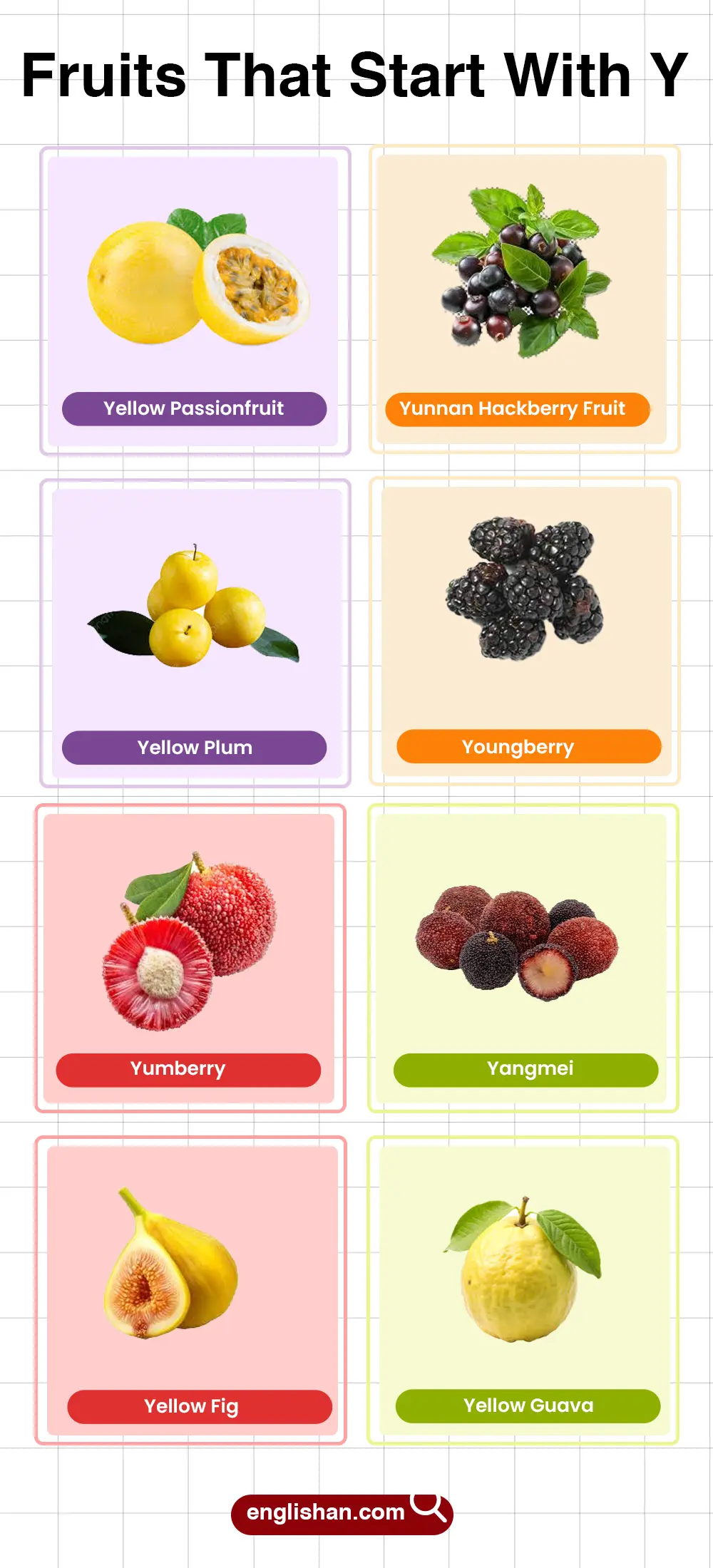
| Yellow guava | Common guava ripened to a yellow skin |
| Yuzu | Japanese citrus grown for peel and juice |
| Yemenite citron | Pulpless ritual citron, almost all pith |
| Yen Ben lemon | Thin-skinned Lisbon lemon, New Zealand’s main crop |
| Yangmei | Chinese bayberry, sold as juice under the name yumberry |
| Yubari King melon | Hokkaido gift melon sold at auction |
| Yangtao | The original Chinese name for kiwifruit |
| Yambo | Wax apple, bell-shaped and mostly water |
| Yellowhorn | Northern Chinese capsule grown for its seeds |
| Yellow plum | Mirabelle and Shiro, golden and honey-sweet |
| Yellow cherries | Royal Ann and Yellow Drogan, pale gold |
| Yellow grapes | Sultana and Niagara, chartreuse to greenish-white |
| Yellow strawberry | Yellow Wonder alpine and the white pineberry |
| Yellow passion fruit | The tropical form that dominates juice |
| Yellow dragon fruit | Spiny yellow pitaya from the Andes |
| Yellow sapote | Canistel, with the texture of hard-boiled egg yolk |
| Yellow mangosteen | Sharply acidic Garcinia, unrelated to true mangosteen |
| Yellow mombin | Hog plum, the cajá of Brazilian juice bars |
| Yellow granadilla | Water lemon, a passionflower with poisonous leaves |
| Yaca | The Spanish name for jackfruit |
| Youngberry | Louisiana blackberry cross, parent of the boysenberry |
| Yellow Himalayan raspberry | Golden raspberry, invasive in Hawaii |
| Yew berry | Red aril around a lethal seed. Do not eat |
| Yucca fruit | Banana yucca capsule, roasted by Apache and Navajo cooks |
| Yacon | Andean root eaten raw like fruit |
| Yantok | Philippine rattan fruit, used to sour soup |
Common Fruit That Start With Y
Five of these turn up in ordinary shops. Everything past these five takes more looking.
Ya Pear
Pyrus × bretschneideri ‘Yali’
Ya pear and Yali pear name the same fruit, whatever a shop label suggests. The Chinese 鸭梨 means duck pear, after the tilted stem end, and ya is only the first syllable of yali. Northern China grows it, and Hebei grows the most. China alone produced 18.9 million tonnes of pears in 2021, which comes to roughly 73 percent of the world’s crop.
You can spot one by its shape: a broad base tapers to a narrow neck, and the whole fruit tilts to one side. Thin skin turns from pale green to yellow with light russeting and dark pores. Inside, the cream flesh stays crisp instead of softening the way a European pear does. The juice runs high, and the sugar stays gentle. Chinese kitchens stew it with rock sugar for coughs. Harvest falls in late summer, and good fruit keeps through winter.
York Imperial Apple
Malus domestica ‘York Imperial’
York Imperial is an old American apple, found near York, Pennsylvania around 1820 on the farm of a man named Johnson. It became famous for how long it keeps: children used to dig sound apples out of leaf piles the next spring. The nurseryman Jonathan Jessop spread it, and a pomologist named Downing renamed it in the 1850s after calling it the Imperial of Keepers.
Every York Imperial tilts to one side, which makes it the easiest apple in the barrel to identify. The greenish-yellow ground disappears under a light red flush with carmine stripes and russet dots. The yellow flesh is coarse and firm, so it holds its shape through cooking. That one quality made it Pennsylvania’s leading apple and a favourite for applesauce, slices and cider. Flavour sweetens for five or six months after picking, so a York eaten in March beats a York eaten in October.
Yellow Transparent Apple
Malus domestica ‘Yellow Transparent’
Yellow Transparent is a pale Russian apple that reached the United States in 1870. It ripens earlier than almost any other apple, and the skin turns so pale it looks translucent, closer to white than yellow, waxy and speckled with small dots.
The white flesh bruises at a touch and turns mealy within days of ripeness, so it never ships and never stores. Cooks grow it anyway, because it breaks down to a smooth sauce faster than any other apple and needs little added sugar. Pick it in July and use it the same week.
Yellow Watermelon
Citrullus lanatus
Yellow watermelon is an ordinary watermelon with canary-yellow flesh instead of red. The outside looks the same, green stripes and all, so the colour only shows once you cut it. The flavour runs sweeter and more honeyed than red, without the mineral, green edge.
One correction worth making, since the food web repeats the opposite: yellow watermelon carries no lycopene at all. Lycopene makes watermelon red, and in canary flesh a functional enzyme converts it onward into beta-carotene and other yellow pigments instead. That happens through a natural mutation, not engineering. Per 100 g the flesh gives 30 calories and 4.1 mg of vitamin C at 91 percent water. Peak season falls in mid to late summer.
Yellow Guava
Psidium guajava
Yellow guava means ordinary guava ripened until the skin turns yellow, not a separate species. Peru grew it by 2500 BC, and it now spreads across Mexico, Central America, the Caribbean and northern South America.
Size varies from 4 to 12 cm. The flesh is soft and slightly grainy around a core of hard seeds. White guavas stay off-white inside, while red guavas turn deep pink. It tastes musky and sweet with a sour edge, and it smells close to lemon rind, only softer. High pectin makes it the standard fruit for guava paste and jelly. One nutrition figure outranks nearly every common fruit: 228.3 mg of vitamin C per 100 g, more than three times an orange.
Citrus Fruit Thats Start With Y
Three citrus fruits begin with Y, and not one of them gets eaten the way you would eat an orange.
Yuzu
Citrus junos
Yuzu is a sour Japanese citrus grown for its peel and juice rather than its flesh. It started in the upper Yangtze basin and reached Japan through Korea about 1,300 years ago. One fruit weighs 120 to 130 g and fits in a palm, under a thick, bumpy rind that ripens from green to yellow.
Cut one open and you find barely any pulp, plenty of seeds, and juice too sharp to drink. The aroma comes from the peel instead, somewhere between grapefruit, mandarin and lime, and Japanese cooking builds everything on that. The peel goes into ponzu sauce, yuzu kosho and marmalade, and cooks grate a little rind over grilled fish. Even the vitamin C follows the peel: 150 mg per 100 g in the rind against 40 mg in the juice. Shipments peak from November to January, and on the winter solstice whole fruit goes into the bath rather than the pot.
Yemenite Citron
Citrus medica
The Yemenite citron is a citrus grown for religious use rather than for eating. Growers in Yemen have kept the strain unbroken for centuries, and Yemenite tradition traces it back to Temple times. Both the tree and the fruit grow larger than other citrons.
Unlike every other citrus, it has no juice at all. The segments never develop juice sacs, so a thick white pith takes up nearly all the weight and the inside stays solid. Buyers want it as one of the Four Species at Sukkot, which requires an unblemished fruit from an ungrafted tree, and a flawless specimen sells for well over a hundred dollars. Blemished fruit goes to the kitchen instead, candied or preserved. The rind gives off a violet note from beta-ionone. Growers time the harvest to Sukkot in September or October.
Yen Ben Lemon
Citrus limon ‘Yen Ben’
Yen Ben is a thin-skinned lemon of the Lisbon type. It appeared as a chance sport at Benyenda near Burrum Heads in Queensland in the late 1930s. New Zealand growers took it up from 1978, and it now supplies the country’s main commercial lemon crop and an export line into Japan.
One fruit averages 120 to 130 g, a little smaller than a Eureka. The skin runs thinner than either Eureka or Lisbon, and finer in texture too. The pale greenish-yellow flesh gives plenty of juice, keeps that juice through storage, and carries only about two seeds per fruit. Acid runs high and sharp. Several crops appear each year, with the main one through winter into early spring.
Asian Fruit That Start With Y
Yangmei
Myrica rubra
Yangmei and yumberry name one fruit. Yumberry names the brand behind the juice, not a second species, so counting both names doubles the same fruit. Southern China has grown it for at least 2,000 years, with Zhejiang, Fujian and Guangdong at the centre.
Each berry is a small sphere of 1.5 to 2.5 cm with a pebbled, knobby surface. A single seed fills the centre and takes up half the width. Most yangmei ripen crimson red, though white and purple forms exist. It tastes sweet and very tart at the same time, and the deep red colour comes from cyanidin-3-O-glucoside, a natural plant pigment. Fruit arrives in May and June and lasts about three weeks, and it bruises so readily that fresh yangmei almost never leaves China. Most of the crop moves dried, canned, juiced, jammed or fermented into yangmei jiu.
Yubari King Melon
Cucumis melo ‘Yubari King’
Yubari King is a premium Japanese melon, grown only in greenhouses around Yūbari in Hokkaido. It came from a cross of Earl’s Favourite and Burpee’s Spicy Cantaloupe. Every melon gets graded before sale: it must be perfectly round, with a smooth rind, fine grey-green netting and high sugar, and even the stem gets trimmed into a neat T with scissors.
Inside, the flesh is deep orange and very soft, with plenty of sugar and almost no acid. The high price comes from gift culture rather than taste alone: Japanese buyers give these melons as summer Chūgen presents, and the ceremonial first auction each May sets the market. In May 2026 a pair sold for ¥5.8 million, beating the ¥5 million record from 2019.
Yangtao
Actinidia chinensis
Yangtao is what China called kiwifruit before the world renamed it. Seed reached New Zealand in 1904 and growers there sold it as Chinese gooseberry, which turned unsellable into Cold War America. An earlier attempt at “melonette” failed too, since melons and berries both carried heavy US import tariffs.
The fix came on 15 June 1959, when Jack Turner proposed “kiwifruit” at a Turners and Growers meeting in Auckland and the industry adopted it. One caution on the name: yangtao also refers to carambola in Chinese, so it never mapped to one fruit alone.
Yambo
Syzygium samarangense
Yambo is the Tagalog name for what English calls the wax apple or Java apple, native to the Greater Sunda Islands, the Malay Peninsula and the Andamans. Wild fruit measures 4 to 6 cm and takes a distinct bell shape, wider at the base than the stem.
Colour ranges from white through green to crimson and near-black under thin, waxy skin. The white flesh feels spongy and holds a surprising amount of water, closer to watermelon than to apple. The taste is mildly sweet and faintly sour, with very little aroma. Core it and eat it fresh, slice it into salads, sauté it briefly or pickle it.
Yellowhorn
Xanthoceras sorbifolium
Yellowhorn is a northern Chinese shrub grown for its edible seeds, since there is no pulp inside at all. The green capsule reaches about 6 cm and resembles a buckeye until it splits. Pea-sized purplish-brown seeds fill it, and they taste sweet as chestnut when raw and closer to macadamia once roasted, which earned the plant the name popcorn shrub.
Northern China has pressed those seeds for cooking oil and lamp oil for centuries. Agronomists now treat yellowhorn as a serious oil crop for poor ground, because the shrub withstands heat, drought and salty soil. Kernels run 55 to 70 percent oil, about 94 percent of it unsaturated.
Yellow Fruit That Start With Y
Four familiar fruits turn up in gold, and each one earns its place on real cultivars rather than on a colour adjective.
Yellow Plum
Prunus domestica subsp. syriaca and Prunus salicina
Two real plums answer to the name yellow plum: the French Mirabelle and the American Shiro.
Mirabelle is the one worth seeking. The wild parent came out of Anatolia, but Lorraine in France became its true home. The region now grows about 15,000 tonnes a year, roughly 80 percent of the world’s commercial crop, and the name has been protected since 1996. The fruit itself is small and oval, dark yellow flecked with red, with golden flesh and a honeyed sweetness. Growers shake the trees from July to mid-September. Most of the harvest never leaves the region as fresh fruit, since 70 percent goes into jam and another 20 percent into eau de vie. Mirabelle de Nancy eats best fresh, Mirabelle de Metz cooks better.
Shiro takes the American side. Released in 1899 from a cross of four plums, it reaches about 2.5 cm with golden skin, occasionally blushed pink, over semi-translucent flesh that turns soft and very juicy. Sugar dominates, acidity barely registers, and only the skin tastes tart.
One disambiguation, since the term shifts meaning across regions: across tropical Latin America and West Africa, yellow plum means yellow mombin, which comes from a different family entirely.
Yellow Cherries
Prunus avium
Two old cultivars answer to the name yellow cherries, and a third gets mistaken for them.
Royal Ann, also sold as Napoleon or Queen Anne, runs yellow to light pink and reddens only where the sun strikes it. Henderson Lewelling carried 700 trees to Oregon in 1847, and Seth Lewelling renamed it in 1850. Almost every maraschino cherry starts here.
Yellow Drogan came out of Germany and now grows across Eastern Europe and Central Asia. Each cherry reaches 2.2 to 2.5 cm and weighs 6 to 7 g. The colour runs from pale to rich gold. Sugar runs high and acid stays low, with a slight tang behind the sweetness. The season falls between late June and early August, and the skin is too thin to ship, so it sells close to where it grows.
Rainier falls into a different bracket. Harold Fogle bred it at Washington State University in 1952 from Bing and Van, and it carries a red blush over a yellow ground with thick creamy-yellow flesh beneath.
Yellow Grapes
Vitis vinifera and Vitis labrusca
Three real varieties answer to the name yellow grapes, all closer to green-gold than true yellow.
Sultana, sold in the United States as Thompson Seedless, came from Asia Minor and reached California through the viticulturist William Thompson. The skin runs chartreuse rather than true yellow. It works as a table grape, a raisin grape and a wine grape at once. In 2000 it accounted for about 97 percent of California’s raisins and roughly a third of the state’s entire grape acreage.
Niagara crossed Concord with white Cassady in Niagara County, New York in 1868 and went commercial in 1882. The grapes ripen pale greenish-white. The flavour is the foxy labrusca kind, with candied lemon rind and jasmine behind it. It leads the United States among green grapes and supplies most white grape juice.
Golden Muscat came later, bred by R. D. Anthony at Cornell in Geneva, New York in 1915 from Muscat of Hamburg and Moore’s Diamond, and it serves as a table grape, a white wine grape and an ornamental.
Yellow Strawberry
Fragaria vesca and Fragaria × ananassa
Two real berries answer to the name yellow strawberry: the Yellow Wonder alpine and the white pineberry.
Yellow Wonder is an alpine strawberry with small cream to pale-yellow fruit and an aroma stronger than its size suggests. It fruits continuously through the season and comes true from seed rather than from runners, which is unusual among strawberries. Gardeners plant it partly on the belief that birds ignore yellow fruit, though that reputation comes from gardening lore rather than from research.
Pineberry inverts the normal arrangement: white flesh studded with red achenes. Growers identified it in South America around 2002, cultivated it in Belgium and exported it from the Netherlands, reaching Britain in 2010 and the United States in 2012. At 15 to 23 mm it stays smaller than a standard strawberry, and the flavour turns distinctly toward pineapple.
Tropical Fruit That Start With Y
Seven tropical fruits begin with Y, and six of them begin with the word yellow.
Yellow Passion Fruit
Passiflora edulis f. flavicarpa
Yellow passion fruit is the yellow-skinned tropical form of the common passion fruit. It took over the lowland tropics because it grows more vigorously and resists disease better than the purple form. Brazil grows the most, with Colombia, Ecuador, Peru, Australia and Hawaii behind it. Growers also use it as the rootstock for the purple form.
At 6 to 8 cm it runs larger than purple passion fruit, under a hard, smooth yellow rind that wrinkles as it ripens. Wrinkled skin means ready, not spoiled. Inside, orange gelatinous arils wrap around crunchy black seeds you eat along with the pulp. Acidity dominates and perfume stays faint, so the yellow form goes to juice factories while the purple goes to fruit bowls. USDA figures for passion fruit, measured on the purple form, give 97 calories and 30 mg of vitamin C per 100 g. The fibre figure is the one worth remembering, at 10.4 g per 100 g, and nearly all of it comes from the seeds. Two flushes a year in the tropics keep supply close to year-round.
Yellow Dragon Fruit
Selenicereus megalanthus
Yellow dragon fruit, also called yellow pitaya, is a cactus fruit from Colombia, Ecuador and Peru, and Israel and Vietnam now grow it too. It runs smaller than red dragon fruit and, alone among the dragon fruits, grows spines, which get brushed off before sale.
The flesh is translucent white and dotted with small black seeds. It tastes softly and mildly sweet, measured at roughly 12 to 15 degrees Brix. Sellers call it the sweetest of the dragon fruits, though no published comparison against the red form confirms that. Halve it and spoon it out chilled. The seeds and fibre give it a well-known laxative effect, so moderation applies. Flowers open between June and October and stretch 32 to 38 cm, among the largest of any cactus.
Yellow Sapote
Pouteria campechiana
Yellow sapote, also called canistel or eggfruit, is a tropical fruit with flesh like the yolk of a hard-boiled egg. The texture runs dense, dry and pasty, though the better cultivars soften it into a mousse. The flavour comes close to egg custard or sweet potato, and unripe fruit turns astringent.
It grew first in southern Mexico, Belize, Guatemala and El Salvador. Farms in Florida, Brazil, India, the Philippines, Vietnam and Australia raise it now. The fruit grows oval to spindle-shaped and reaches about 7 cm, and the best selections pass 400 g. Glossy orange-yellow skin wraps the flesh, which surrounds one to six large brown seeds. It ripens off the tree to deep yellow. Blend it into shakes, freeze it into ice cream, fold it into custards and pancakes, or dry and mill it into flour.
Yellow Mangosteen
Garcinia dulcis
Yellow mangosteen is a sharply sour tropical fruit, and despite the name it tastes nothing like the purple mangosteen. The name applies to more than one plant as well: Garcinia dulcis from Indonesia and the Philippines, Garcinia xanthochymus from India and Myanmar, and the unrelated Australian Atractocarpus fitzalanii sold under the same label.
The Garcinia fruits run round, 5 to 8 cm, under velvety golden-yellow skin, with soft orange-yellow segmented flesh around several large seeds. Sharp acidity dominates, subacid at best, which sends nearly all of it into jams, syrups, curries and preserves rather than onto a plate.
Yellow Mombin
Spondias mombin
Yellow mombin is a small, tart tropical fruit, better known in Brazil as cajá and in Amazonia as taperebá. It grows from Mexico to Brazil, plus West Africa and the Caribbean, and northeastern Brazil farms it as a commercial juice crop.
Each fruit is a small oval drupe of about 4 cm with thin, bright yellow skin. A shallow layer of flesh clings to a large fibrous stone, and the taste runs sharp, tart-sweet and slightly resinous. Eat it fresh once it softens, or take it the way Brazil does: suco de cajá, batida de cajá, ice cream and jelly. Its other names, hog plum and jobo, explain why yellow plum means something different south of the equator.
Yellow Granadilla
Passiflora laurifolia
Yellow granadilla forms a different species from yellow passion fruit, and the two get confused constantly. This one grows across eastern Brazil, Peru, Venezuela, the Guyanas and the Caribbean under the names water lemon, Jamaican honeysuckle and golden bell apple.
The oblong fruit measures about 8 by 4 cm and ripens yellow to orange over fragrant, juicy, agreeably subacid pulp rich in vitamin C. Most people pierce one end and suck out the pulp and seeds rather than cutting it. Growers also use the vine as a disease-resistant rootstock. One warning: the leaves carry poison, so only the fruit goes anywhere near food.
Yaca
Artocarpus heterophyllus
Yaca is Spanish for jackfruit, jaca in Portuguese, and the English word travelled from Portuguese out of the Malayalam chakka. It originated in the Western Ghats of India and now grows across the tropics.
No tree bears a larger fruit: a single yaca reaches up to 55 kg, 90 cm long and 50 cm across. A thick green to yellow-brown rind covered in blunt spikes hides the golden bulbs inside. Each bulb wraps a large seed and pulls free of the fibrous strands around it. Ripe flesh turns soft and slippery and tastes of pineapple and banana at once. Unripe flesh stays firm and stringy, which lets it work as a meat substitute in curries and stews. The seeds get boiled, roasted or curried. Fruit matures in the rainy season, roughly July and August in the Indian subcontinent.
Berries That Start With Y
Youngberry
Rubus hybrid
Youngberry is an American berry, created in Louisiana in the early 1900s by a grower named B.M. Young. He crossed a blackberry hybrid with a dewberry, and his berry later became a parent of the boysenberry. Today it grows across the southern and western United States, and small farms in Australia, New Zealand and South Africa raise it too.
A youngberry looks much like a long blackberry. It ripens from deep wine-purple to nearly black, with soft, glossy skin, and people mix it up with loganberries and boysenberries all the time. It tastes sweeter than a loganberry, with a winey blackberry depth behind it. The season starts in early summer, ahead of most blackberries. Eat them fresh, or cook them into juice, jam and pies.
Yellow Himalayan Raspberry
Rubus ellipticus
Yellow Himalayan raspberry is a golden wild raspberry from the Himalayas and subtropical Asia, growing from India and Nepal through Sri Lanka, China and Southeast Asia. The berries ripen in golden-yellow clusters of small drupelets. The berries taste juicy, sweet and mildly tart, and unmistakably like a raspberry. Fruit arrives in spring and early summer, and Asian traditional medicine uses the leaves and roots.
In Hawaii, though, it has become a serious pest. The variety obcordatus invades Hawaiian rainforest and Hawai’i Volcanoes National Park, throwing up impenetrable thorny thickets that shade out the native understorey. On the Hawaii Invasive Species Council target list it stays a live problem, and biological-control research continues.
Yew Berry
Taxus baccata
Yew berry is the small red fruit of the yew tree, and it earns a warning here rather than a recommendation. The soft cup around the seed tastes sweet and jelly-like, and English country names called it snotty gogs. Birds strip it every autumn. That single edible layer explains why yew turns up under Y at all, and it earns a warning rather than a recipe.
Yews grow slowly enough that the word ancient starts at 900 years, and ten British yews predate the tenth century.
Exotic Fruit That Start With Y
Three fruits here rarely leave the regions that grow them.
Yucca Fruit
Yucca baccata
Yucca fruit comes from the banana yucca, a desert plant of the southwestern United States and northern Mexico. Most yuccas produce dry, hard capsules nobody eats, but this one grows a fleshy fruit that the US Forest Service describes as looking like short fat green bananas, which explains the name.
Apache and Navajo cooks worked out the method long ago. Roast or bake the fruit, strip the seeds, pound the flesh to a pulp, then press it into flat cakes and dry them in the sun. Picked slightly under-ripe and ripened off the plant, the fruit beats the wildlife to the harvest. Roasted, it turns sweet, somewhere near sweet potato or date. One distinction worth holding: yucca fruit and yuca, the cassava root, come from unrelated plants.
Yacon
Smallanthus sonchifolius
Yacon grows as a storage root and eats like a fruit, raw and crisp and sweet, which puts it beside the fruit in Andean markets rather than the vegetables. It comes from the daisy family and grows from Colombia down to northern Argentina, with New Zealand, Japan, Brazil and the United States now producing it too.
One root reaches up to 25 cm long and 10 cm wide, and weighs anywhere from 0.2 to 2 kg. The thin tan skin peels away before eating. Inside, the flesh runs white to amber and almost translucent, and it snaps like jicama or water chestnut. The taste comes close to apple crossed with watermelon, with a faint violet note behind it. Harvest follows the first frosts, which sweeten it markedly. Fructooligosaccharides account for 40 to 70 percent of dry matter, and because those pass undigested to the colon, yacon tastes sweet while delivering little usable energy.
Yantok
Calamus manillensis
Yantok is Tagalog, littuko is Ilocano, and both name the fruit of a Philippine rattan palm. Clusters of small fruits, 1 to 2.5 cm, press tight against the stem under overlapping scales in vertical rows. Each one resembles a miniature pinecone, or a small snake fruit, in shades of orange, yellow, brown and white.
Cream-coloured watery pulp surrounds one to three dark seeds, and the taste turns aggressively sour with an earthy, woody edge. Filipino cooks peel and eat it raw, though most of the crop goes into sinigang and dinuguan, souring them the way tamarind does elsewhere. Outside the Cordillera and its neighbouring provinces almost nobody has tried it.
Y Fruit Names For Kids
Eight of these names stay short enough to say and familiar enough to picture, which makes them the ones worth starting with:
- Yellow watermelon: looks exactly like a normal watermelon until you cut it open
- Yellow apple: the Yellow Transparent turns so pale it looks almost white
- Yellow grapes: the pale green grapes in most lunchboxes
- Yellow plum: small, golden and sweeter than a purple plum
- Yuzu: a bumpy Japanese lemon that smells stronger than it tastes
- Yangmei: a knobbly red Chinese berry the size of a marble
- Ya pear: a Chinese pear that stays crunchy instead of going soft
- Youngberry: a dark berry that looks like a long blackberry
For the other end of the alphabet, the fruits that start with Z run even shorter, and the fruits that start with A run far longer.
Fruit And Vegetables That Start With Y
Botany and cooking disagree here. Three yellow foods beginning with Y qualify as fruit under a botanist’s definition and get cooked as vegetables everywhere else:
- Yellow squash: a fruit botanically, sliced and fried like a vegetable, in season through summer
- Yellow pear tomato: a small golden tomato, sweeter and lower in acid than a red one
- Yellow bell pepper: a ripened green pepper, sweeter and crunchier once the colour turns
Yacon crosses the line from the other direction. It grows as a root, which puts it among vegetables, and it eats raw and sweet, which puts it among fruit.
Health Benefits Of Y Fruits
Three of these fruits carry figures worth knowing.
Yellow guava reaches 228.3 mg of vitamin C per 100 g, more than three times an orange and among the highest of any common fruit.
Passion fruit delivers 10.4 g of dietary fibre per 100 g on USDA figures for the purple form, an unusually high number driven by the crunchy black seeds people eat along with the pulp.
Yuzu concentrates its vitamin C in the peel at 150 mg per 100 g against 40 mg in the juice, which rewards zesting over squeezing.
Beyond those, yangmei owes its crimson colour to cyanidin-3-O-glucoside, an anthocyanin under active pharmacological study, and yacon stores its sweetness as fructooligosaccharides that reach the colon undigested and act as prebiotics.
Fruit Wrongly Listed Under Y
Few real fruits begin with Y, and thin letters attract invention. Several names circulate widely across Y fruit lists without a botanical source behind any of them.
| Name in circulation | What is actually true |
|---|---|
| Yunnan lemon | No such taxon or cultivar. No citrus registry lists one |
| Yunnan fig | No Ficus carries this English name |
| Yunnan mulberry | No accepted Morus with this name. The real plant is Chinese mulberry, Maclura tricuspidata |
| Yaffa apple | A confusion with the Jaffa orange. No apple registry lists a Yaffa cultivar |
| Yunnan hackberry | Celtis yunnanensis is not an accepted name at Kew, only a synonym of Celtis tetrandra. A wild forage drupe, not a named fruit |
| Yunnan walnut | Juglans sigillata is real and its English name is iron walnut. A walnut is a nut |
| Yunnan cherry | Prunus yunnanensis is real and ornamental, planted as a street tree in Kunming, with no documented food use |
| Yellow elderberry | Elderberries ripen black or red. The golden elderberries in nurseries carry golden leaves and ordinary dark berries |
| Yumberry as a second fruit | Yumberry and yangmei are one species, Myrica rubra. Yumberry is the juice brand |
| Yali pear as a second fruit | Yali is the cultivar name for the ya pear. 鸭梨 means duck pear, and ya is the first syllable of yali |
Two more corrections worth making, since both appear on food sites regularly. Yellow watermelon holds no lycopene, since lycopene makes watermelon red. And yerba mate grows as a leaf brewed for tea, not a fruit, whatever the alphabet pages say.
FAQs
Yuzu is the answer most people give first, since Japanese cooking has carried it worldwide. Yangmei, ya pear, yellow watermelon and yellow passion fruit follow it, and all five sell commercially outside the countries that grow them.
Thirty fruit names begin with Y once fabricated names and duplicates come out. Sixteen begin with Y in their own right, and the rest begin with the word yellow in front of a fruit already familiar under another colour.
Yuzu is a fruit, and specifically a citrus fruit, Citrus junos. Nobody eats it out of hand because the flesh holds little juice and plenty of seeds, so kitchens work with the aromatic peel and a small amount of sharp juice instead.
Yubari King melon takes it, bred and graded specifically for sugar content, with Mirabelle plum and yellow watermelon close behind. Yellow dragon fruit measures around 12 to 15 degrees Brix and gets marketed as the sweetest of the dragon fruits, though no published study confirms that against the red form.
Yumberry is a trade name for yangmei, the Chinese bayberry, Myrica rubra. A juice company commercialised the fruit under that label, so a list counting yumberry and yangmei as two separate fruits has counted the same species twice.
Three qualify. Yuzu is the best known, the Yemenite citron serves ritual rather than culinary purposes at Sukkot, and the Yen Ben is a thin-skinned Lisbon lemon that supplies most of New Zealand’s commercial crop.
Yellow squash, yellow pear tomato and yellow bell pepper qualify as fruit botanically and get cooked as vegetables. Yacon works the other way round: an Andean root eaten raw and sweet like fruit. Yam counts as a vegetable outright.
No. Only the soft red aril lacks toxins, and it surrounds a seed that carries taxine alkaloids strong enough to stop the heart, as do the needles, bark and wood. Chewing the seed releases them, no antidote exists, and anyone who has swallowed any part of a yew needs urgent medical care.
You May Also Like
Fruits That Start With Y Quiz
Fruits That Start With Y
Two of these fruits begin with Y. Which one does not?
Feijoa begins with F, so it is the one that does not belong.
Check each first letter before reading further.
Feijoa is the odd one out.
Which of these fruits begins with the letter Y?
Grown for its rind and juice rather than its flesh, and central to Japanese cooking.
Read the first letter before anything else.
Yuzu begins with Y.
Name a fruit beginning with this letter.
A fruit whose name begins with Y is ___.
Accepted here: Yellow passion fruit, Yuzu.
More than one answer is right; any fruit starting with the letter counts.
Yellow passion fruit begins with Y.
Which fruit does this describe? Larger and more acidic than the purple form, and more common in the tropics.
Larger and more acidic than the purple form, and more common in the tropics.
Match the description to the fruit rather than to the letter.
Larger and more acidic than the purple form, and more common in the tropics.
Which of these is a citrus fruit?
Yuzu is a citrus fruit. Grown for its rind and juice rather than its flesh, and central to Japanese cooking.
Group by what the thing actually is, not by where it turns up.
Yuzu is a citrus fruit.
Turn on JavaScript for the interactive quiz. The full practice set is shown above.