

The parts of a shirt are the pieces cut from woven cloth and joined at seams around the neck, shoulders, and arms. The collar is sewn to the collar stand, a narrow band at the neckline. At the front, the button placket is folded and topstitched down the center. Together they close the neckline and the front of a dress shirt. Every other part is stitched at a fixed position on the front, the back, or the sleeve.
Parts of a Shirt Labeled Front and Back
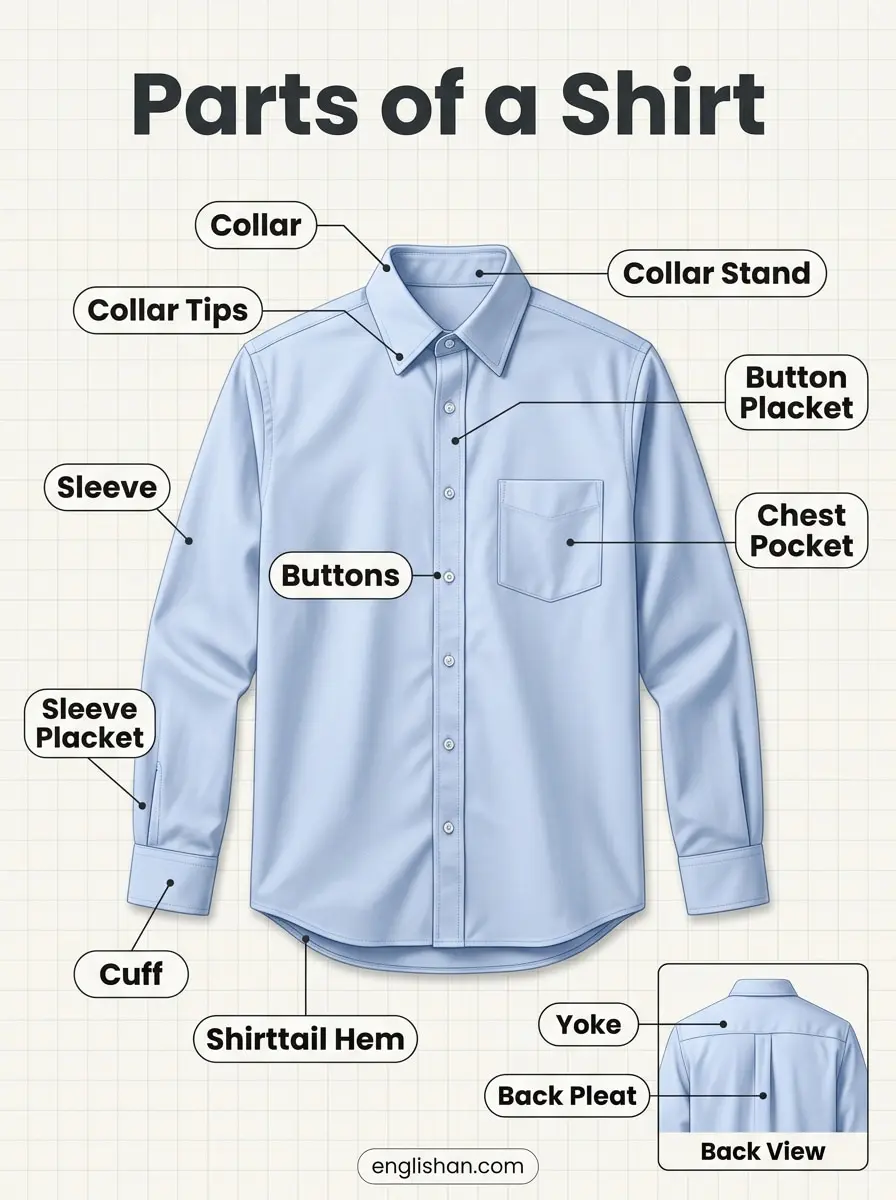
A button-up dress shirt is cut from two front panels, a back panel, a yoke, two sleeves, a collar, and two cuffs. The collar is sewn to the neckline. A placket, the reinforced strip where a garment opens, is folded and topstitched down the front. Each sleeve is set into an armhole and finished with a cuff. These are the parts of a shirt on a standard dress shirt. Each shirt part name is the one used in pattern making and tailoring.
| Part | Where you find it |
|---|---|
| 1. Collar | Folded band around the neck |
| 2. Collar tips | Two pointed ends at the front of the collar |
| 3. Collar stand | Narrow band under the folded collar |
| 4. Button placket | Vertical strip down the center front |
| 5. Buttons | Discs fixed along the placket |
| 6. Chest pocket | Patch pocket on the left front |
| 7. Yoke | Double panel across the upper back |
| 8. Back pleat | Fold of fabric under the yoke |
| 9. Dart | Tapered fold sewn into the back panel |
| 10. Armhole | Curved opening where the sleeve joins |
| 11. Sleeve | Fabric tube over the arm |
| 12. Sleeve placket | Short slit with a strip near the cuff |
| 13. Cuff | Band at the end of a long sleeve |
| 14. Side seam | Seam from the underarm to the hem |
| 15. Gusset | Small triangle at the hem end of the side seam |
| 16. Hem | Folded lower edge of the shirt |
| 17. Shirttail | Curved lower front and back panels |
Main Parts of a Shirt
The main parts of a shirt are joined at the neckline, the shoulders, and the armholes. The collar is sewn to a narrow stand, and the button placket is folded and topstitched down the center front. The yoke joins the back panel to the front panels at the shoulder seams.
Each sleeve is set into an armhole and ends in a cuff, with a short placket ahead of it. Dress shirts are cut from tightly woven cotton poplin, twill, or oxford cloth. A shirt cuff extends about half an inch past the sleeve of a coat.
Shirt Collar Parts
The collar is the most visible of the parts of a shirt, and its cut separates a business shirt from a casual one.
Collar
The collar is a folded band of fabric sewn to the collar stand around the neckline, fastened at the center front by one button. Pointed collars are the standard business style, and spread collars angle the tips wider apart. A cutaway collar angles them wider still, and button-down collars fasten each tip to the shirt with a small button. Neck sizes are measured in half-inch steps from 14 to 18 inches.
Collar Tips
At the front of the collar, the two pointed ends are the collar tips. They measure 2.5 to 3.5 inches on a business shirt. The space between them is the spread, and a wider spread suits a thicker necktie knot.
Collar Stand
Under the folded collar, a narrow band of fabric forms the collar stand, also called the neckband. It raises the collar leaf to neck height and has the top button and buttonhole. A stand of 1 to 1.5 inches is standard.
Collar Stays
Thin strips of plastic, brass, or stainless steel, collar stays slide into small pockets on the underside of each collar tip. They keep the tips flat and sharp. A stay measures 1.5 to 2.5 inches and is removed before washing.
Shirt Front Parts
The front is two chest panels joined by the placket, and these parts of a shirt fasten the garment at the center front.
Button Placket
The button placket is a strip of fabric folded twice and topstitched down the center front, also called the button stand. Interfacing, a stiff fusible layer, reinforces the strip and keeps it flat. It measures 1 to 1.5 inches wide and extends the full length of the front. A fly-front placket conceals the buttons behind a second fold of fabric, leaving a plain front.
Buttons and Buttonholes
Buttons are small discs of plastic, shell, or corozo nut that fasten the front. A dress shirt has six to eight down the placket, spaced about 3.5 to 4 inches apart. Buttonholes are cut as stitched slits, vertical on the placket and horizontal on the collar stand and cuffs.
Chest Pocket
A chest pocket is a patch pocket stitched to the left front panel, about 4 to 5 inches wide and 5 inches deep. Its bottom edge is cut square, pointed, or rounded. Formal shirts leave it off, and work shirts add a flap or a second pocket on the right.
Shirt Back and Shoulder Parts
The back is one wide panel. The yoke, the pleat, and the darts are the parts of a shirt that shape it.
Yoke
Across the upper back, a yoke is a double layer of fabric from shoulder seam to shoulder seam. The back panel is gathered or pleated into its lower edge, leaving the shoulder blades room to move. A split yoke is cut in two pieces joined at a center seam.
Back Pleat
Stitched into the yoke seam near the neck, a back pleat is a fold of fabric. A box pleat is one wide fold at the center, and side pleats are two smaller folds near each shoulder. Both styles add ease across the shoulder blades.
Darts
Darts are tapered folds of fabric sewn into the back panel of a fitted shirt. A pair is sewn from the waistline toward the shoulder blades, and each takes in about an inch of fabric. The shirt then follows the waistline closely.
Shirt Sleeve and Cuff Parts
The sleeve is the longest of the parts of a shirt, and it ends in the cuff at the wrist.
Sleeve
The sleeve is a tube of fabric that covers the arm, attached at the armhole. Long sleeves measure 32 to 37 inches from the center back neck to the cuff edge. Short sleeves end midway down the upper arm with a hemmed opening.
Armhole
On each side of the body, the armhole is the curved opening where the sleeve is stitched in. The armhole seam curves from the shoulder point to the underarm. A deeper armhole frees the arm to move, and a higher one fits closer to the body.
Sleeve Placket
A sleeve placket is a short vertical slit ahead of the cuff, finished with a narrow strip of fabric. It lets the sleeve open wide enough for the hand to pass the cuff. A small button, called a gauntlet button, closes the placket on many shirts.
Cuff
A cuff is a stiffened band of fabric at the end of each long sleeve, 2.5 to 3 inches wide. A barrel cuff closes with one or two buttons. A French cuff folds back on itself and closes with a cufflink through four buttonholes.
Shirt Hem and Side Parts
The lower body finishes the shirt, and these parts of a shirt set whether it is worn tucked in or out.
Side Seam
A side seam is the stitched line that joins the front and back panels from the underarm to the hem. Tailors narrow a shirt by taking in this seam. A flat-felled seam folds both edges under so no raw edge shows.
Gusset
At the hem end of the side seam, a gusset is a small triangular patch stitched in beside the short vent. It reinforces that vent and stops the seam tearing as the shirt moves.
Hem and Shirttail
A hem is the folded and stitched lower edge of the shirt. A shirttail hem curves from long front and back panels to shorter sides and is made to be tucked in. A straight hem is cut level and worn untucked.
Parts of a Polo Shirt and T-Shirt
The parts of a shirt change when the fabric is knit instead of woven. Both of these shirts drop the cuffs and the sleeve placket.
Polo Shirt
A polo shirt is a knit shirt with a flat folded collar and a short placket of two or three buttons at the neck. The sleeves are short and end in ribbed bands. The hem is straight with small side vents. A zip polo replaces the buttons with a zipper.
T-Shirt
A T-shirt has no collar stand, placket, or cuffs. A ribbed crew neckband finishes the neckline, and shoulder seams join the front and back panels. Short sleeves end in a hemmed opening, and a straight hem finishes the bottom edge.
Related:
FAQs
FAQs
The parts of a shirt are the collar, collar stand, button placket, buttons, front panels, yoke, back pleat, sleeves, cuffs, and hem. A dress shirt adds a chest pocket, sleeve plackets, side seams, and gussets. In all, a dress shirt has 17 named parts, from the collar to the shirttail. The shirt part names are the same for men’s and women’s button-up shirts.
The collar is the part of a shirt around the neck. The narrow band sewn under it is the collar stand, or neckband, and the two pointed ends at the front are the collar tips.
A dress shirt collar has two collar tips, a folded collar leaf, a collar stand, and collar stays in small pockets under the tips. The stand has the top buttonhole, and the leaf folds down over it. A button-down collar adds a small button at each tip.
The arm parts of a shirt are the sleeve, the armhole where it joins the body, the sleeve placket, and the cuff. Short sleeves end in a hemmed opening with no placket or cuff.
A polo shirt has a knit collar, a short button placket, short sleeves with ribbed bands, side vents, and a straight hem. The placket closes with two or three buttons.
A T-shirt has a ribbed neckband, shoulder seams, two short sleeves, side seams, and a hem. It has no collar stand, placket, or cuffs.
A tailor shortens the sleeves at the cuff, narrows the body through the side seams, adds darts to the back, and raises the hem. The collar and yoke are rebuilt only with difficulty, so choose those to fit first.
