

A boot is a shoe whose shaft rises past the ankle. The parts of a boot are named from the pull strap at the top of the shaft to the outsole at the base.
Between them are the vamp, the toe box, the counter, and the heel. A welt joins the upper to the sole, and each part is stitched in a fixed position.
Parts of a Boot Labeled in Side View
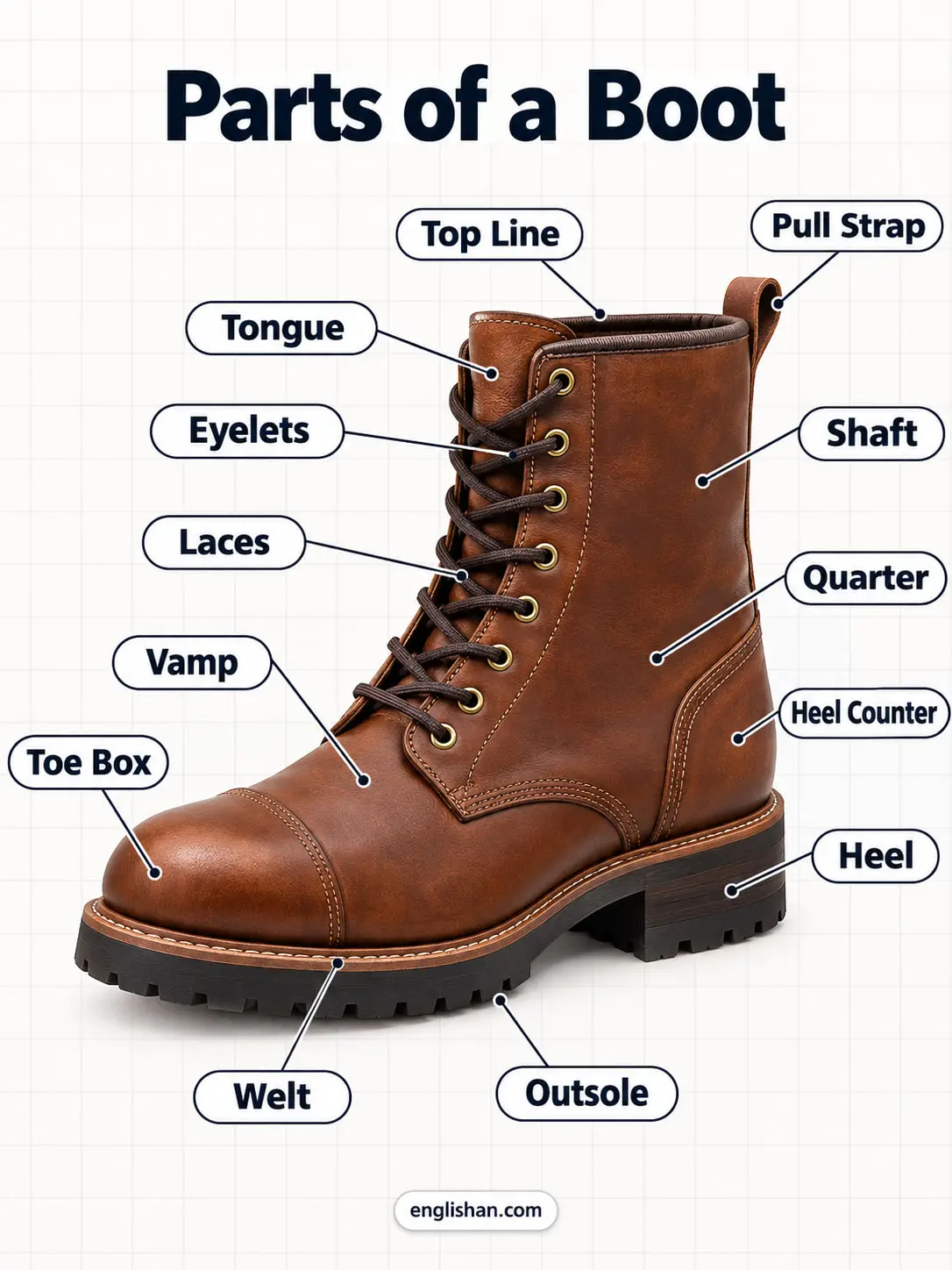
In side view, the shaft rises from the quarter to the top line. The vamp spans the instep, and the toe box rounds the front. The heel counter shapes the back, and the heel is built up in layers under it. The welt runs along the edge where the upper meets the outsole. These are the parts of a boot, or the boot parts names, as bootmakers use them. Terms shared with other footwear are on the shoe parts page.
| Part | Where you find it |
|---|---|
| 1. Pull strap | Loop at the top of the shaft on both sides |
| 2. Scallop | U-shaped dip at the top center of the shaft |
| 3. Top line | Upper edge of the shaft around the leg |
| 4. Piping | Vertical seam down each side of the shaft |
| 5. Shaft | Tall tube that rises from the ankle to the calf |
| 6. Mule tabs | Extra-long pull straps |
| 7. Inlay and overlay | Contrasting leather cut into or sewn onto the shaft |
| 8. Crown | Upper middle panel of the shaft |
| 9. Tongue | Flap under the laces on a lace-up boot |
| 10. Eyelets | Reinforced holes along the lacing edge |
| 11. Lace hooks | Metal hooks past the eyelets |
| 12. D-rings | Lacing loops on the quarters |
| 13. Buckles | Straps and clasps that close some boots |
| 14. Laces | Cords that tighten the boot over the instep |
| 15. Padded collar | Cushioned rim around the ankle opening |
| 16. Lining | Inner layer of leather or fabric |
| 17. Instep | Curved panel over the arch of the foot |
| 18. Vamp | Front panel from the toe to the shaft |
| 19. Toe box | Rounded front end that holds the toes |
| 20. Round toe | Wide rounded front |
| 21. Square toe | Squared-off front |
| 22. Snip toe | Narrow angled-off point |
| 23. Pointed toe | Front tapered to a sharp point |
| 24. Almond toe | Slightly pointed oval front |
| 25. Club toe | Square-ish front with rounded edges |
| 26. Toe cap | Reinforced cap over the toe box |
| 27. Quarter | Side panel behind the vamp |
| 28. Backstay | Leather strip joining the two halves at the back |
| 29. Throat | Narrow neck where the shaft meets the upper |
| 30. Gemming | Fabric strip glued into the waist of the upper |
| 31. Heel counter | Rigid cup at the lower back of the boot |
| 32. Heel foxing | Panel on the lower back side |
| 33. Spur ridge | Small horizontal ridge on the back, over the heel |
| 34. Heel | Raised block under the back of the foot |
| 35. Block heel | Flat-pitched stacked heel |
| 36. Logger heel | Tall concave heel that grips slopes |
| 37. Dogger heel | Short heel that tapers toward the ground |
| 38. Cuban heel | Heel that tapers on the back and sides |
| 39. Walking heel | Taller heel with less taper |
| 40. Fowler heel | Straight heel slightly taller than a roper heel |
| 41. Heel rand | Strip between the heel counter and the sole |
| 42. Stacked heel | Heel built from layers of leather |
| 43. Top lift | Bottom layer of the heel that touches the ground |
| 44. Insole | Inner layer the foot rests on |
| 45. Footbed | Removable comfort layer under the foot |
| 46. Shank | Thin plate between the insole and outsole |
| 47. Midsole | Cushioning layer between the insole and outsole |
| 48. Outsole | Ground-contacting base of the boot |
| 49. Lugs | Raised tread blocks on a rubber outsole |
| 50. Welt | Strip stitched around the edge of the upper |
| 51. Goodyear welt | Welt stitched to the upper, the insole, and the outsole |
| 52. Storm welt | Goodyear welt with an extra leather flange |
| 53. Last | Foot-shaped mold the boot is built around |
| 54. Rand | Rubber band around the base of the upper |
| 55. Elastic gusset | Stretch panel on the side of a Chelsea boot |
| 56. Side zipper | Zipper along the inner edge of the shaft |
Boot Shaft and Top Parts
The shaft is the defining part of a boot. These parts of a boot enclose the ankle and the lower leg.
Shaft
The shaft is the tall tube of the boot, rising from the ankle toward the calf. Western shafts measure 10 to 14 inches and reach at least mid-calf. Stitching keeps the shaft of a cowboy boot from folding over. The shaft of a fashion boot is called the bootleg.
Top Line and Padded Collar
The top line is the upper edge of the shaft, cut around the leg. On a hiking or work boot, a padded collar lines it. A scree collar is a higher padded rim that protects the Achilles tendon and the ankle from chafing.
Pull Straps and Scallop
Pull straps are loops sewn at the top of the shaft on both sides, and they help pull the boot on. They are the loops at the back of the boot that many buyers ask about. Some boots have pull holes cut into the shaft instead. The scallop is the U-shaped dip at the top center, between the two straps.
Piping and Crown
Piping is a seam that runs down each side of the shaft from the top to the ankle. The crown is the upper middle panel of the shaft, slightly curved and decorated with stitching on a cowboy boot.
Shaft Height Classes
Among the parts of a boot, shaft height sorts boots into classes. An ankle boot measures about 6 to 8 inches, and a mid-calf boot measures about 10 to 12 inches. A knee-high boot measures about 16 to 20 inches.
Mule Tabs
Mule tabs are extra-long pull straps that give a firm grip for pulling on a tall shaft.
Inlay and Overlay
An inlay is a contrasting piece of leather cut into the shaft, and an overlay is a piece sewn on top of it. Both decorate a cowboy boot.
Decorative Stitching
Decorative stitching runs over the shaft and the toe. Medallion and toe bug are two common motifs on cowboy boots.
Side Zipper and Elastic Gusset
A side zipper runs along the inner edge of the shaft and opens the boot wide enough to slide the foot in. The zipper page names the tape and the slider. A Chelsea boot has an elastic gusset, a stretch panel on each side that replaces the zipper.
Boot Lacing Parts
A lace-up boot has a closure on the front of the shaft. The parts of a boot at the lacing edge hold the foot.
Eyelets and Lace Hooks
Eyelets are reinforced holes along the lacing edge, and the laces pass through them. Lace hooks are metal hooks fixed past the eyelets at the top of the boot. The laces lock into them for a quick, tight fit.
Laces
Laces are cords that run through the eyelets and the hooks. Work boots are lace-ups, which tighten the boot around the ankle and the instep.
D-Rings and Speed Hooks
Among the lacing parts of a boot, D-rings are metal loops on the quarters that direct the laces on work and hiking boots. Speed hooks are another name for lace hooks, so the laces slide into them without being threaded.
Buckles and Pull-On Boots
Buckles are straps and clasps that close some boots at the ankle or the shaft. A pull-on boot has no laces and no zipper, and the foot slides in with the help of the pull straps.
Tongue
The tongue is a flap of leather or fabric under the laces. It keeps water, dirt, and debris out of a hiking boot, and a single-piece design avoids the gaps at the sides.
Boot Upper Parts
The upper is everything of the boot over the sole, and the parts of a boot in this group enclose the foot.
Vamp and Instep
The vamp is the large front panel that spans the top of the foot from the toe to the shaft. It is the most visible part when trousers hang over the boots. The instep is the curved panel where the shaft meets the front of the foot, over the arch.
Toe Box and Toe Cap
The toe box is the rigid, rounded front end that holds the toes. A toe cap is a reinforced cap over it. Work boots have steel toecaps, and safety toe caps are fitted inside the toe box.
Quarter
The quarter is the side panel that joins the vamp to the back of the boot. Together the quarters form the sides of the foot opening.
Backstay and Throat
Among the upper parts of a boot, the backstay is the leather strip at the back that joins the two halves of the upper. The throat is the narrow neck where the shaft meets the upper at the ankle.
Gemming
Among the interior parts of a boot, gemming is a strip of fabric glued into the waist of the upper. It stabilizes the leather, so the upper does not stretch out of shape.
Heel Counter and Heel Foxing
The heel counter is the firm, rigid cup at the lower back of the boot. It holds the heel in place and stops the foot from sliding. Heel foxing is a panel on the lower back side. A new boot slips about 1/4 to 1/2 inch at the heel, which is necessary for a proper fit.
Spur Ridge
The spur ridge is a small horizontal ridge on the back of the boot over the heel. It holds the strap of a spur fastened by a rider. The saddle page names the riding gear the spur belongs to.
Lining
The lining is the inner layer of leather or fabric. A padded lining adds comfort, and an insulated lining is built into boots for cold weather.
Boot Heel Parts
The heel is a raised block under the back of the foot, and the parts of a boot heel are built in layers.
Heel
The heel of most boots is clearly separate from the sole. Traditional western heels are compressed leather and measure 1.5 inches or more. A roper heel is lower, at about 1 inch, and riding heels measure 2 inches or more.
Block and Logger Heels
Among the heel parts of a boot, the block heel is a flat-pitched stacked heel, the most versatile type. A logger heel, also called a woodsman heel, is taller and concave and grips on slopes.
Dogger and Cuban Heels
A dogger heel is a short bulldogger heel that tapers toward the ground and suits riding and walking. A cuban heel tapers on the back and the sides.
Walking and Fowler Heels
A walking heel is taller than a cowboy heel, with less taper. A fowler heel is a straight heel about a quarter inch taller than a roper heel, and a pitched fowler has a slight taper.
Heel Rand
The heel rand is a strip between the heel counter and the sole, and it is decorative on many boots.
Stacked Heel and Top Lift
A stacked heel is built from layers of leather glued and nailed together. The top lift, or heel cap, is the bottom layer that touches the ground, and it is replaced when it wears down.
Boot Sole Parts
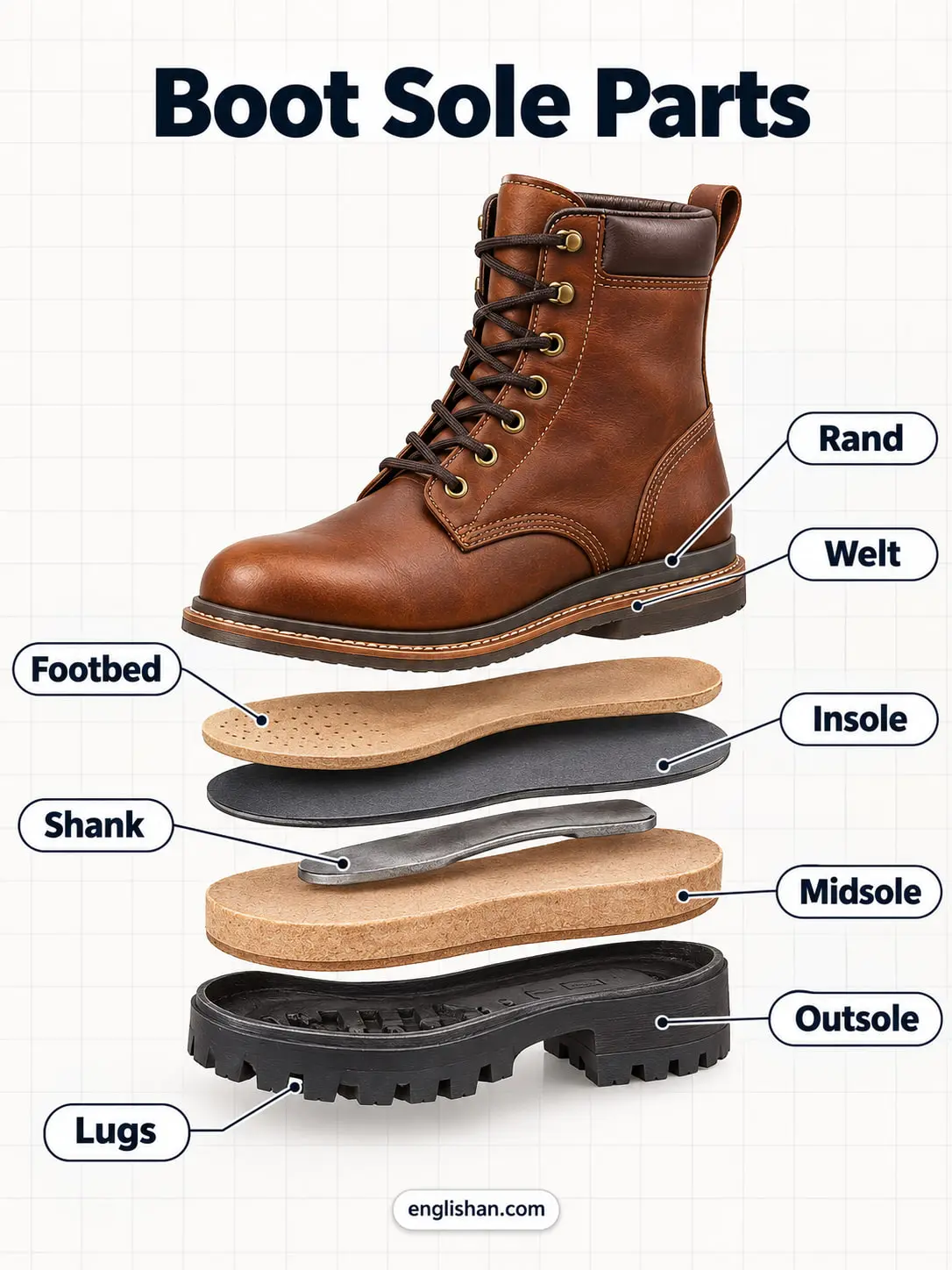
The sole system is a stack of layers, and the parts of a boot at the base decide how it grips and supports.
Insole
The insole is the inner layer the foot rests on, set over the midsole. It is either attached to the boot or removable.
Footbed
The footbed is a removable comfort layer under the foot. Padding and arch support in the footbed cushion each step and support the arch.
Shank
The shank is a thin plate of metal or composite between the insole and the outsole. It supports the arch and stiffens the boot. Shanks come in full, three-quarter, and half lengths, and a longer shank makes the boot stiffer.
Midsole
The midsole is a layer of foam or rubber between the insole and the outsole. It cushions the foot and absorbs shock from each step.
Outsole and Lugs
The outsole is the ground-contacting base of the boot. Leather outsoles are traditional and dressier, and rubber outsoles are more durable with better traction. Lugs are the deep, raised blocks of tread on a rubber outsole, and they grip loose ground. A crampon connection on a mountaineering boot holds crampons for ice.
Welt and Rand
The welt is a strip stitched around the edge of the upper, where it bonds the vamp to the outsole. A full welt runs around the whole perimeter including the heel, and a three-quarter welt runs from the front to the arch. A rand is a band of rubber or coated leather around the base of the upper. It protects the places that take the most wear.
Boot Toe Shapes
The toe box takes several shapes, and these parts of a boot decide the outline of the front.
Round and Square Toes
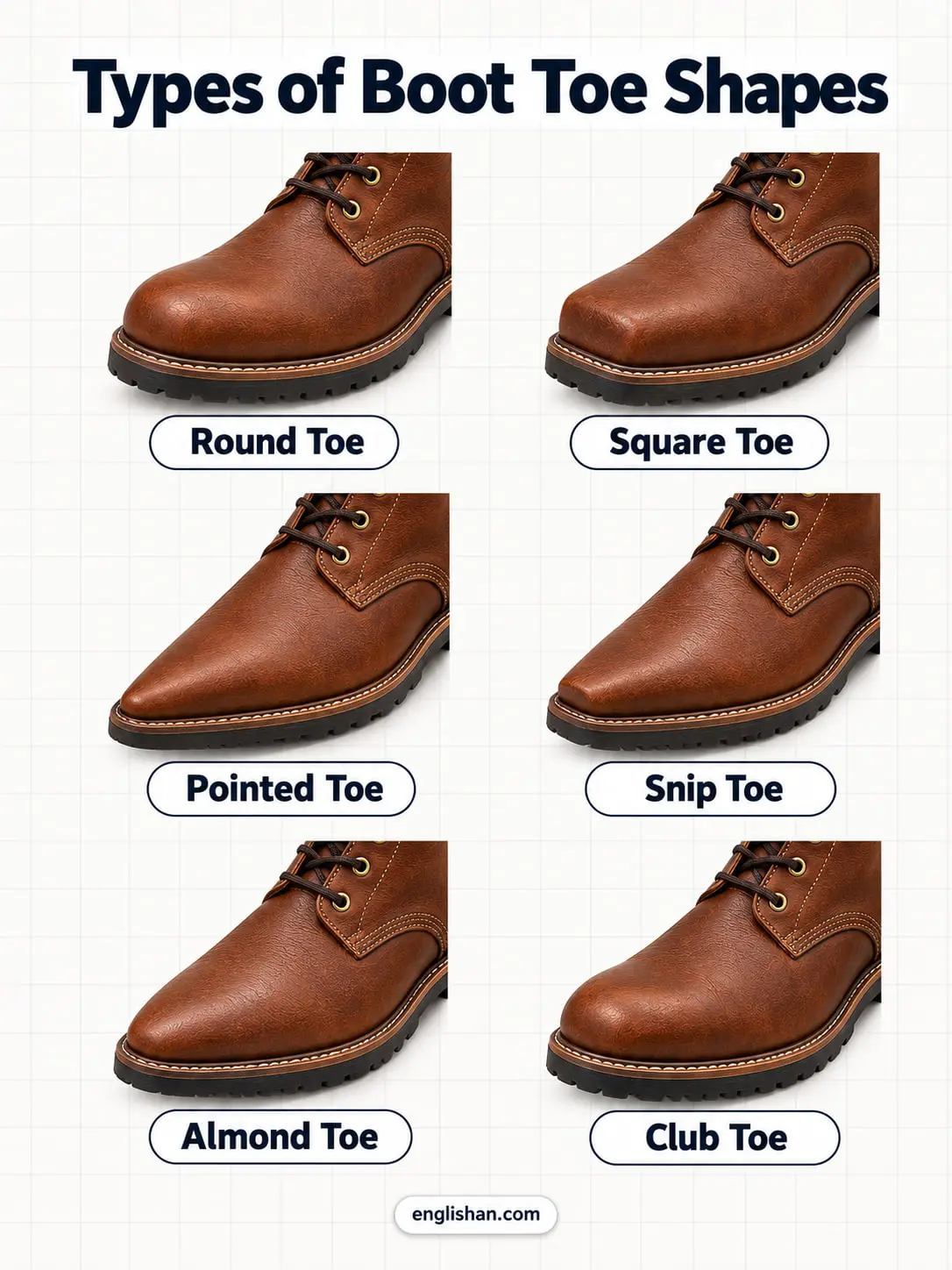
Among the toe parts of a boot, a round toe is a wide rounded front. A square toe is squared off at the front and gives the toes more room.
Snip Toe and Pointed Toe
A snip toe is a narrow, angled-off point popular on cowboy boots. A pointed toe tapers to a sharp front, and an almond toe is a slightly pointed oval.
Club Toe
A club toe is square-ish with rounded edges, and it is used on work boots.
Carbon Toe and Celastic Toe
A carbon toe is a lighter safety toe that does not conduct electricity. A celastic toe is a stiffener that keeps the toe from collapsing, and it is not a safety toe.
Boot Construction Parts
Construction is the method that joins the upper to the sole, and these parts of a boot decide whether the boot is resoled.
Last and Lasting
Among the construction parts of a boot, the last is the foot-shaped mold a boot is built around. It sets the fit and the shape. Lasting is the step where the leather is stretched over the last and the upper is attached.
Goodyear Welt
A Goodyear welt is stitched to the upper and the insole, and then stitched to the outsole. It resists water and lets a cobbler resole the boot. A storm welt adds an extra leather flange for weather resistance.
Blake Stitch
A Blake stitch sews the insole straight to the outsole with no welt. It makes a slimmer boot, common on dress boots.
Cemented and Injected Soles
A cemented sole is glued to the upper, which makes it cheap and light but impossible to resole. A direct-injection sole is liquid rubber molded onto the upper.
Board Lasted
A board-lasted boot has its upper fixed to a board in the midsole, which makes a very structured boot.
Boot Types and Their Added Parts
The parts of a boot change with the type, because the shaft height and the closure alter the upper.
Cowboy Boot
A cowboy boot has a tall decorated shaft, pull straps, a scallop, a pointed or rounded toe box, and a stacked heel. It has no laces and no tongue.
Work Boot
A work boot has a lace-up front, a steel toe cap, a thick rubber outsole, and a lower heel. Some add a met-guard, a hardened flap that protects the metatarsal bones. Older work boots were reinforced with hobnails and heel plates.
Hiking Boot
A hiking boot has a padded collar, a tongue sewn to the sides, a stiff shank, a rand, and a lug outsole. The upper repels water but still lets the foot breathe.
Ankle Boot
An ankle boot has a shaft that ends at or just over the ankle bone. It keeps the vamp, the heel, and the sole of a taller boot, and it closes with laces, a zipper, or an elastic gusset.
Related:
FAQs
FAQs
The parts of a boot are the shaft, pull strap, top line, vamp, toe box, heel counter, heel, insole, shank, outsole, and welt. A lace-up boot adds a tongue, eyelets, and laces. A Chelsea boot adds an elastic gusset instead.
A cowboy boot has a shaft, pull straps, a scallop, a crown, and piping. It also has a vamp, a toe box, a stacked heel, a welt, and an outsole. The shaft is 10 to 14 inches tall and has decorative stitching.
The upper is the shaft, the vamp, the toe box, the quarter, the heel counter, and the lining. Laced boots add the tongue and the eyelets. Everything under the welt belongs to the sole system.
The bottom of a boot has an insole, a shank, a midsole, an outsole, a welt, and a heel. A rubber outsole has lugs, and the heel ends in a top lift.
The loops are pull straps. They are sewn at the top of the shaft, so the boot is pulled on by hand without folding the shaft.
A boot heel has a stacked body of leather layers and a top lift at the bottom. A heel counter shapes the back over it, and a spur ridge is cut over the heel on riding boots.
An ankle boot has a short shaft, a top line, a vamp, and a toe box. It also has a heel counter, a heel, an insole, and an outsole. It closes with laces, a side zipper, or an elastic gusset.
