

The parts of a backpack are built around a fabric sack and two shoulder straps that transfer its weight to the back. A padded back panel lines the body side, and zippers close the compartments at the front and the top.
Larger packs add a hip belt, which takes most of the load, and a sternum strap across the chest. Each part is stitched or buckled to the sack at a fixed position.
Parts of a Backpack Labeled in Front and Back View
Backpack compartments organize electronics, clothing, accessories, and travel essentials.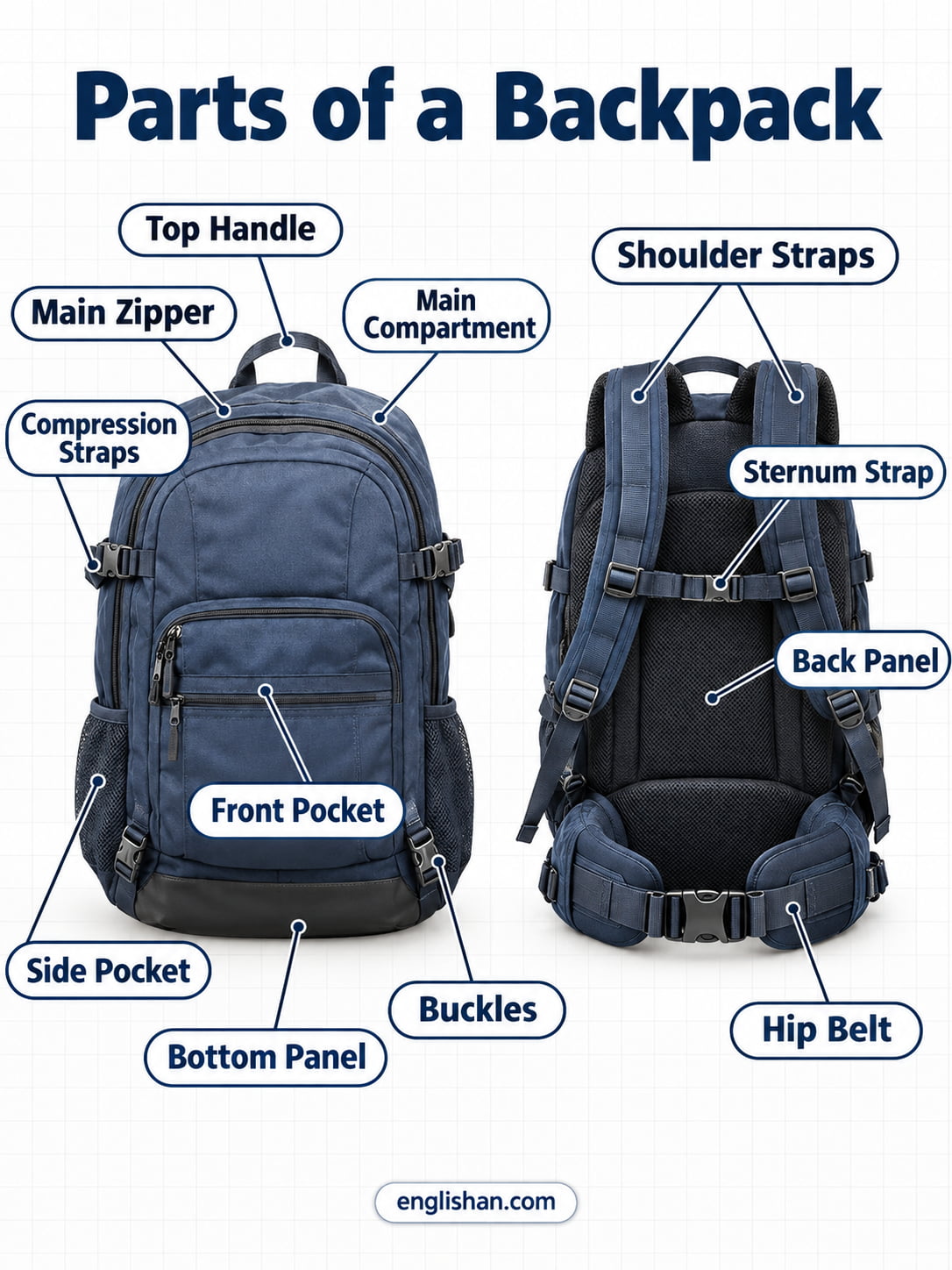
In front view, the main zipper closes the largest compartment, and a front pocket is stitched over it. A top handle is sewn at the crown. In back view, the shoulder straps hang from the top of the back panel, and a hip belt wraps the base. These are the parts of a backpack, or the parts of a school bag, as pack makers name them.
| Part | Where you find it |
|---|---|
| 1. Top handle | Webbing loop stitched at the crown of the pack |
| 2. Lid | Flap, also called the brain, that closes the top of a hiking pack |
| 3. Main zipper | Zipper that opens the largest compartment |
| 4. Zipper pull | Tab on the slider of each zipper |
| 5. Drawstring | Cord that gathers the opening of the main compartment |
| 6. Cord lock | Spring clip that holds the drawstring tight |
| 7. Grommets | Metal rings that reinforce the drawstring holes |
| 8. Rolltop opening | Fabric collar that rolls down and buckles shut |
| 9. Panel opening | Zippered front panel that opens the whole pack |
| 10. Clamshell opening | Zipper that opens the pack flat like a book |
| 11. Main compartment | Large inner space for the main load |
| 12. Laptop sleeve | Padded pocket against the back panel |
| 13. Hydration sleeve | Pocket for a water bladder, with a hose port |
| 14. Organizer pocket | Small inner pockets for pens and cards |
| 15. Cell phone sleeve | Small padded pouch inside the front |
| 16. Hidden pocket | Concealed pocket against the back panel or strap |
| 17. Shoe compartment | Separate vented pocket at the base |
| 18. Front pocket | Zippered pocket stitched to the front panel |
| 19. Kangaroo pocket | Open stretch pocket on the front of a hiking pack |
| 20. Side pocket | Stretch pocket on the side for a water bottle |
| 21. Hip belt pockets | Small zippered pockets on the hip belt |
| 22. USB port | Cable port that joins an inner power bank to a plug |
| 23. Headphone port | Small opening that routes a headphone cable |
| 24. Compression straps | Straps with buckles that cinch the pack |
| 25. Buckles | Plastic clips that fasten the straps |
| 26. Webbing | Flat woven strap used for loops and straps |
| 27. Rivets | Metal fasteners that anchor webbing at stress points |
| 28. Velcro | Hook-and-loop tape on flaps and pockets |
| 29. Elastic band | Stretch cord or band that holds small items |
| 30. Daisy chain | Row of webbing loops sewn along the front |
| 31. Lash points | Webbing loops that tie on gear |
| 32. Gear loops | Small fabric loops for hooks and carabiners |
| 33. Bungee cord | Elastic cord laced across the front |
| 34. Trekking pole holder | Loop and elastic that hold a pole against the pack |
| 35. Belt keeper | Elastic loop that holds the tail of a strap |
| 36. Piping | Cord trim sewn into the seams |
| 37. Reflective panel | Strip of reflective fabric on the front |
| 38. Rain cover | Waterproof sheet stored in the base pocket |
| 39. Back panel | Padded surface against the back |
| 40. Ventilation channel | Gap or mesh that lets air pass behind the panel |
| 41. Frame | Aluminum or plastic support inside or outside the pack |
| 42. Framesheet | Stiff plastic sheet behind the back panel |
| 43. Shoulder straps | Two padded straps over the shoulders |
| 44. Load lifters | Small straps from the strap top to the pack |
| 45. Stabilizer straps | Straps from the hip belt to the pack sides |
| 46. Rear loading straps | Straps that pull the base of a rear-loading pack |
| 47. Sternum strap | Strap and buckle across the chest |
| 48. Hip belt | Padded belt that wraps the hips |
| 49. Waist strap | Thin strap on a daypack, closed by a buckle |
| 50. Bottom panel | Reinforced fabric under the pack |
| 51. Wheels | Wheels at the base of a rolling backpack |
| 52. Telescoping handle | Extending handle on a rolling backpack |
Backpack Strap and Belt Parts
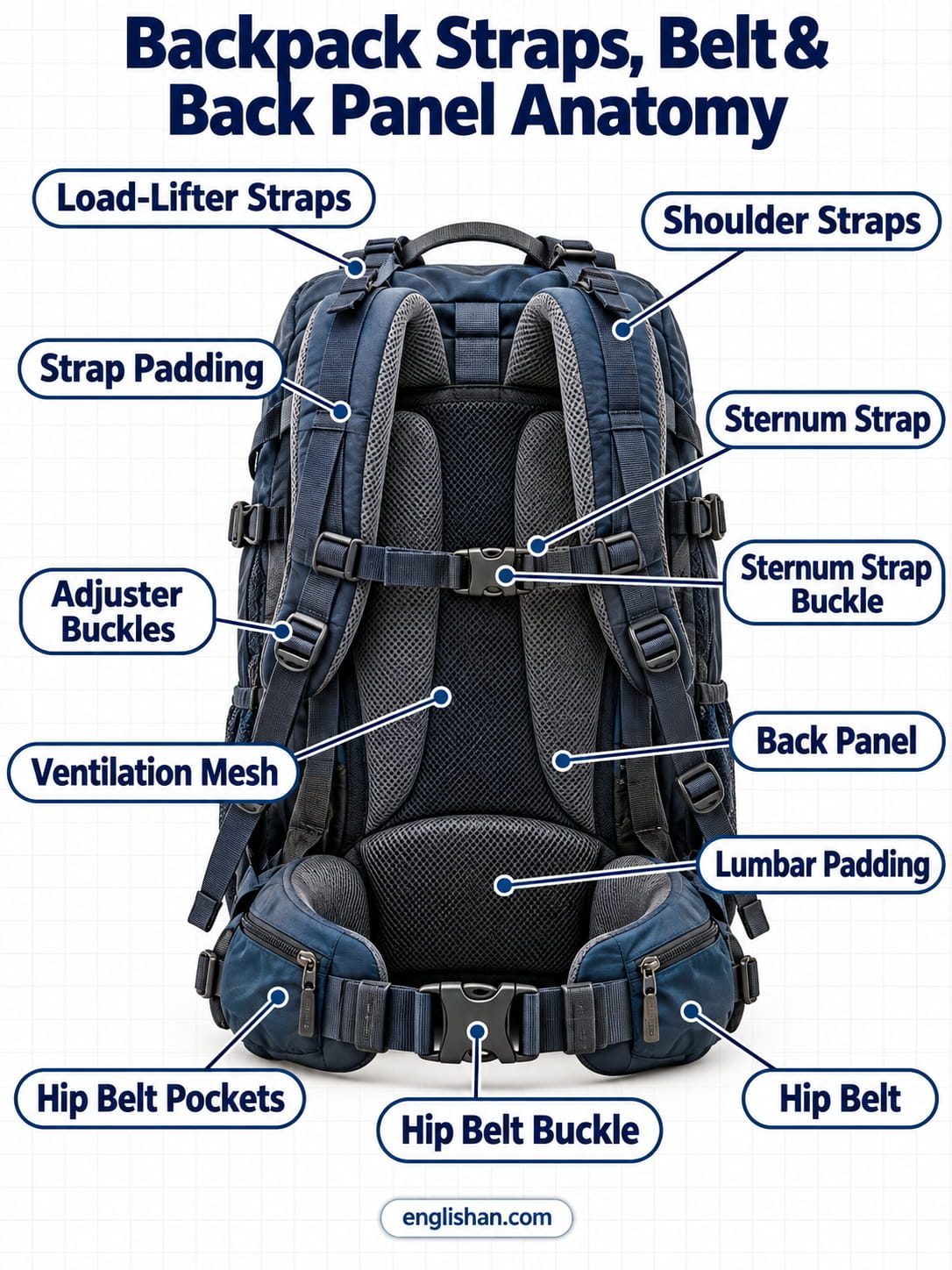
The straps and the belt are the parts of a backpack that bear the weight. They decide how the load rests on the body.
Shoulder Straps
Shoulder straps are two padded bands that hang from the top of the back panel and loop over the shoulders. On large packs they stabilize the load, since the hip belt takes most of the weight. Each strap has an adjuster at the bottom, a webbing tail that is pulled to tighten it. Straight straps hang flat, and S-shaped and J-shaped straps curve to follow the chest. Mesh-faced straps ventilate the shoulders, and the shape of the strap changes how the pack rests.
Sternum Strap
The sternum strap, or chest strap, is a short strap with a buckle that joins the two shoulder straps across the chest. It keeps the shoulder straps from sliding outward. Greg Lowe is credited with the first modern design.
Load Lifters
Load lifters are small straps that run from the top of each shoulder strap to the upper frame of the pack. Tightening them draws the top of the load toward the body, so the pack does not lean away.
Hip Belt and Waist Strap
The hip belt is a padded belt that wraps the hips. It takes up to about 90% of the load on large packs over 22 pounds. A waist strap is a thinner, unpadded strap on a daypack that steadies the pack. Both close with a buckle at the front.
Stabilizer Straps and Rear Loading Straps
Stabilizer straps run from the sides of the hip belt to the pack. They pull the load in against the hips. Rear loading straps are straps at the base of a pack that opens at the back, and they pull the opening snug.
Compression Straps
Compression straps are straps with buckles that cinch the pack against its contents. Side compression straps tighten the pack along the sides, and straps across the top of a hydration pack hold the load.
Backpack Back and Frame Parts
The back is the side of the pack against the body, and these parts of a backpack set the fit and the comfort.
Back Panel
The back panel is the padded surface against the back. Advanced and school packs have a padded back panel, with foam in a molded pattern on many models. The back of a backpack is the surface behind this panel.
Ventilation Channel
A ventilation channel is a gap or a strip of mesh behind the back panel. It lets air pass between the pack and the back, so the body stays drier on a long walk.
Frame and Framesheet
An external frame is a rigid frame of aluminum, other light metal, or reinforced plastic. It holds the sack off the back and is built for loads over 44 pounds. An internal frame uses strips of aluminum, titanium, or plastic sewn inside the pack and fits closer to the body. A framesheet is a stiff plastic sheet behind the back panel of a pack with a light frame.
Backpack Compartment Parts
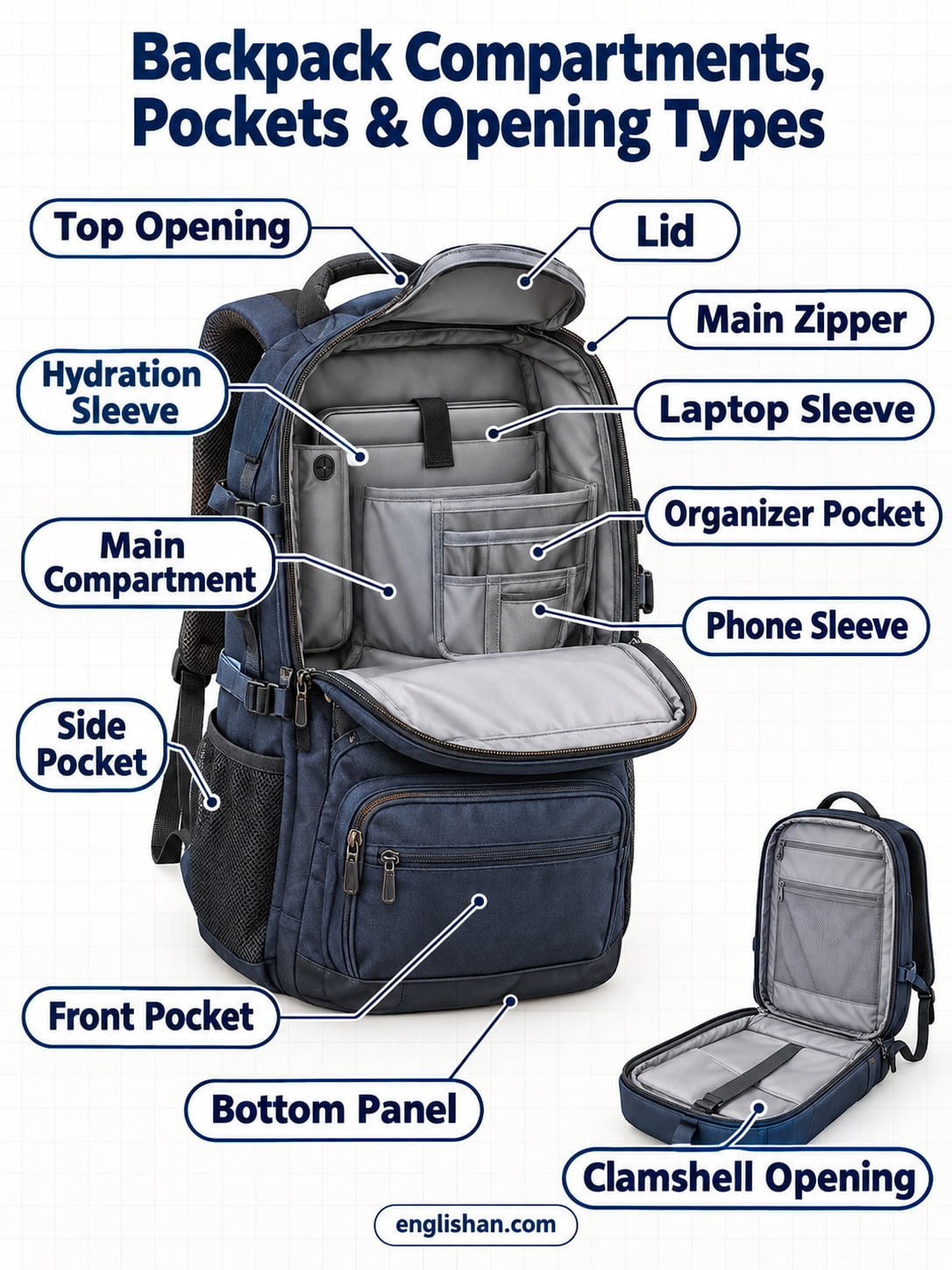
The compartments hold the contents, and the parts of a backpack inside the sack are arranged by size and use.
Main Compartment
The main compartment is the largest inner space, closed by a zipper, a drawstring, or a lid. The smallest packs have one main pocket. Internal-frame packs have a large main compartment that is loaded from the top or the front.
Laptop Sleeve
The laptop sleeve is a padded pocket against the back panel, cut to the size of a laptop. A padded computer compartment with flaps for accessories is the defining part of a laptop pack.
Hydration Sleeve
The hydration sleeve is a pocket for a water bladder, with a port at the top for the hose. Hydration packs hold a reservoir of water, and the hose runs over the shoulder strap to a bite valve.
Organizer Pocket
An organizer pocket is a small inner pocket, or a panel of pockets, for pens, cards, and a phone. It stops small items from sinking to the base of the main compartment.
Lid and Drawstring
A lid is a flap that closes the top of a hiking pack, with a pocket on its top face. A drawstring is a cord through the top hem that gathers the opening, and a cord lock holds it tight.
Backpack Pocket and Outer Parts
The outer parts of a backpack are the pockets and loops on the outside of the sack, and they hold gear within reach.
Front Pocket
The front pocket is a zippered pocket stitched to the front panel of the sack. School packs have a few front pockets, and advanced packs have more.
Side Pocket
The side pocket is a stretch pocket on the side of the pack. It holds a water bottle or an umbrella, and it is open at the top.
Kangaroo Pocket and Hip Belt Pockets
Among the outer parts of a backpack, the kangaroo pocket is an open stretch pocket on the front of a hiking pack. It is sized for a wet jacket or a map. Hip belt pockets are small zippered pockets on the hip belt, within reach of the hand while walking.
Phone Sleeve and Hidden Pocket
A cell phone sleeve is a small padded pouch inside the front of the pack. A hidden pocket is a concealed pocket against the back panel or inside a shoulder strap. These pockets are among the smaller parts of a backpack. A shoe compartment is a separate vented pocket at the base, and a shove-it pocket is an open front pocket for a jacket.
USB Port and Headphone Port
Among the newer parts of a backpack, a USB port is a cable opening. It joins a power bank inside the pack to a plug on the outside. A headphone port is a small opening in the pack wall that routes a headphone cable out of the compartment.
Daisy Chain and Lash Points
The daisy chain is a row of webbing loops sewn along the front of the pack. Lash points are webbing loops that tie on a sleeping bag or other gear. MOLLE and ILBE packs use rows of webbing loops for pouches.
Gear Loops and Trekking Pole Holder
Gear loops are small fabric loops for hooks and carabiners, and lash tabs are the short webbing tabs used the same way. A bungee cord is an elastic cord laced across the front to hold a layer. A trekking pole holder is a loop at the hip belt and an elastic at the top that hold a pole against the pack.
Reflective Panel and Rain Cover
A reflective panel is a strip of reflective fabric on the front, common on school packs. A rain cover is a waterproof sheet stored in a pocket in the base. It is pulled over the sack in a storm.
Grommets and Piping
Grommets are the metal rings of a backpack that reinforce the holes of a drawstring. Piping is a cord trim sewn into the seams, and it strengthens the edges.
Top Handle
The top handle is a loop of webbing or fabric stitched at the crown of the pack. It lifts the pack by hand, without using the shoulder straps.
Backpack Opening Parts
The opening is where the pack is loaded, and the parts of a backpack differ by opening type. Top loading and panel loading are the two main designs.
Top Opening and Lid
A top opening is a single opening at the crown of the pack. It closes with a lid, a drawstring, or a rolltop. The lid, also called the brain, is a flap that buckles over the opening and holds a pocket on its top face.
Rolltop Opening
A rolltop opening is a fabric collar that is rolled down several turns and buckled shut. It keeps water out of the main compartment.
Panel and Clamshell Opening
A panel opening is a zippered front panel that gives access to the whole pack. A clamshell opening runs a zipper around the pack, so it opens flat like a book. Side access and bottom access openings reach the load from the side or the base.
Backpack Closure Parts
Closures keep the sack shut, and the parts of a backpack that fasten it are zippers, buckles, and webbing.
Zippers
Zippers close the main compartment and the pockets. Each zipper has two rows of teeth, a slider, and a pull tab. The zipper page names the tape and the stops.
Buckles and Webbing
Buckles are plastic clips that fasten the straps, such as the sternum strap and the hip belt. Webbing is the flat woven strap that forms the loops and the straps. Dry-bag closures roll shut and fasten with a buckle. Rivets anchor the webbing at stress points, so the parts of a backpack under load do not tear free. Velcro closes flaps and pockets, and an elastic band holds small items. A belt keeper is an elastic loop that holds the loose tail of a strap, and magnetic buckles close some flaps.
Backpack Base and Wheel Parts
The base is the underside of the pack, and these parts of a backpack take the contact with the ground.
Bottom Panel
The bottom panel is a piece of reinforced fabric stitched under the pack. It resists scuffs when the pack is set down, and many packs have a thicker coated base.
Wheels and Telescoping Handle
A rolling backpack has wheels at the base and a telescoping handle that extends from the back. It is built for air and rail travel, where the pack is pulled instead of lifted.
Backpack Types and Their Added Parts
The parts of a backpack change with the type, because the volume and the use alter the straps and the frame.
School Backpack
A school backpack has a plain design with a main compartment, a few front pockets, padded shoulder straps, a padded back, and reflective panels. Many add a laptop sleeve.
Daypack
A daypack averages 10 to 30 liters and has shoulder straps, a waist strap, a main compartment, and a front pocket. It has no frame and no hip belt.
Hiking Backpack
A hiking pack measures 35 to 65 liters or more. It has an internal frame, a padded hip belt, load lifters, and a lid. Compression straps cinch it, and it is built to bear the weight of a multi-day load.
Hydration Pack
A hydration pack has a sleeve for a water bladder and a hose that runs to the shoulder strap. Running packs are under 6 liters, and cycling packs measure 6 to 10 liters and ride high on the back.
Related:
FAQs
The parts of a backpack are the shoulder straps, back panel, main compartment, pockets, zippers, buckles, and compression straps. Larger packs add a sternum strap, a hip belt, load lifters, and a frame.
A backpack strap has a padded band, an adjuster with a webbing tail, and a buckle on straps that open. The shoulder straps attach at the top of the back panel and at the base of the pack. A sternum strap joins them across the chest.
A hiking backpack has an internal or external frame, a padded back panel, shoulder straps, a hip belt, load lifters, and a sternum strap. It also has a lid, a main compartment, side pockets, compression straps, and lash points.
A school backpack has a main compartment, a few front pockets, padded shoulder straps, a padded back, and zippers. Many add a laptop sleeve, a side bottle pocket, a top handle, and reflective panels.
The loops are webbing loops, such as a daisy chain, lash points, lash tabs, and gear loops. They tie on gear and hold hooks, and the top handle is a loop that lifts the pack by hand.
The back of a backpack is the back panel. It is the padded surface against the body, and it has foam padding and ventilation channels on many packs.
No, a backpack sprayer is a garden tool with a tank, a pump, and a spray wand. It is carried on the shoulders, but its parts are not those of a bag. The knapsack sprayer page names them.