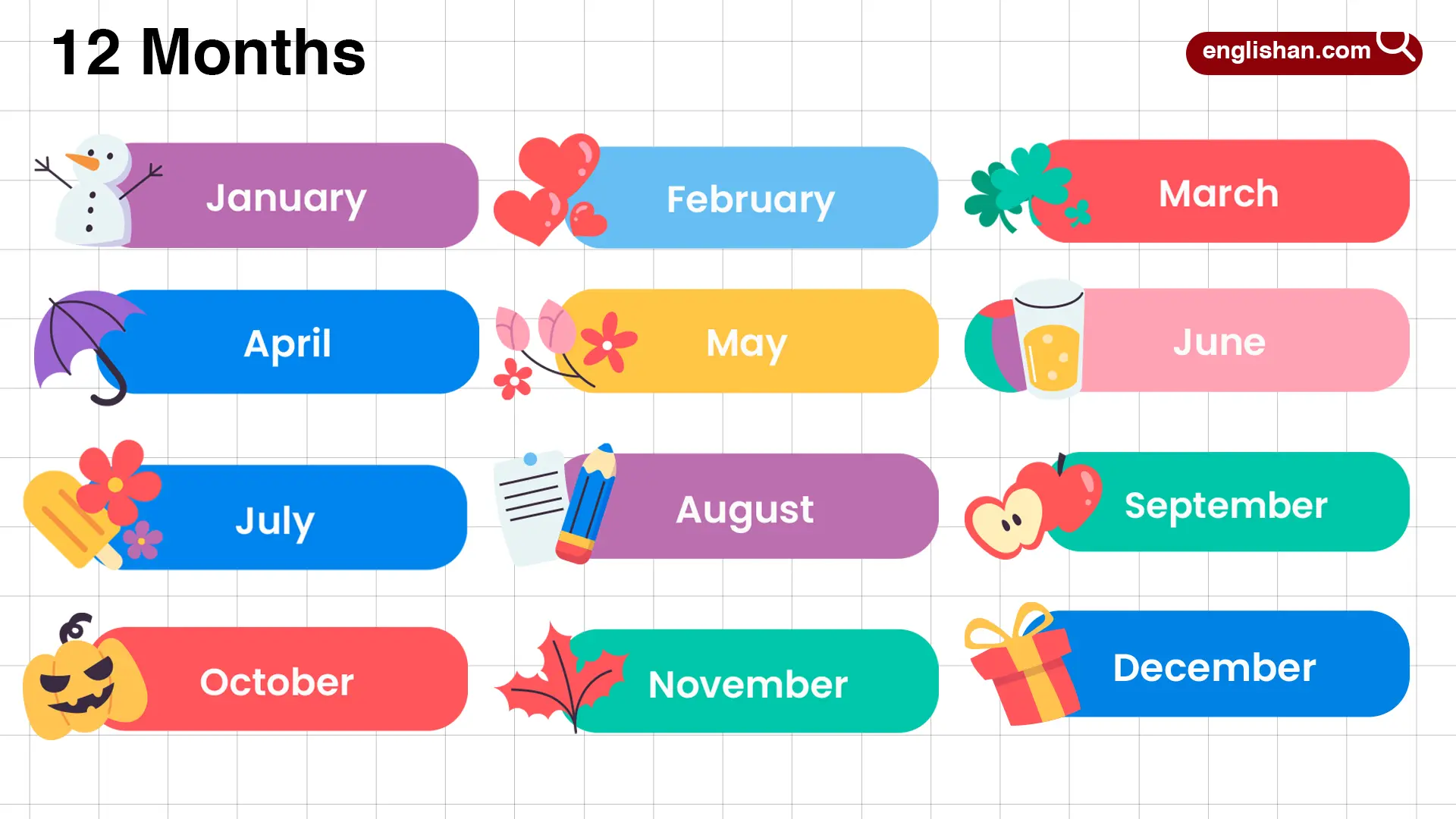
A month name in English is a proper noun, so it always begins with a capital letter: January, not january. The Gregorian calendar divides the year into 12 months, each with a fixed position, a set number of days, and a short form used on calendars and exam forms. All twelve appear below in order, with the spelling traps that cost marks in dictation and the sentence patterns that show each name in use.
12 Month Names in English (January to December)
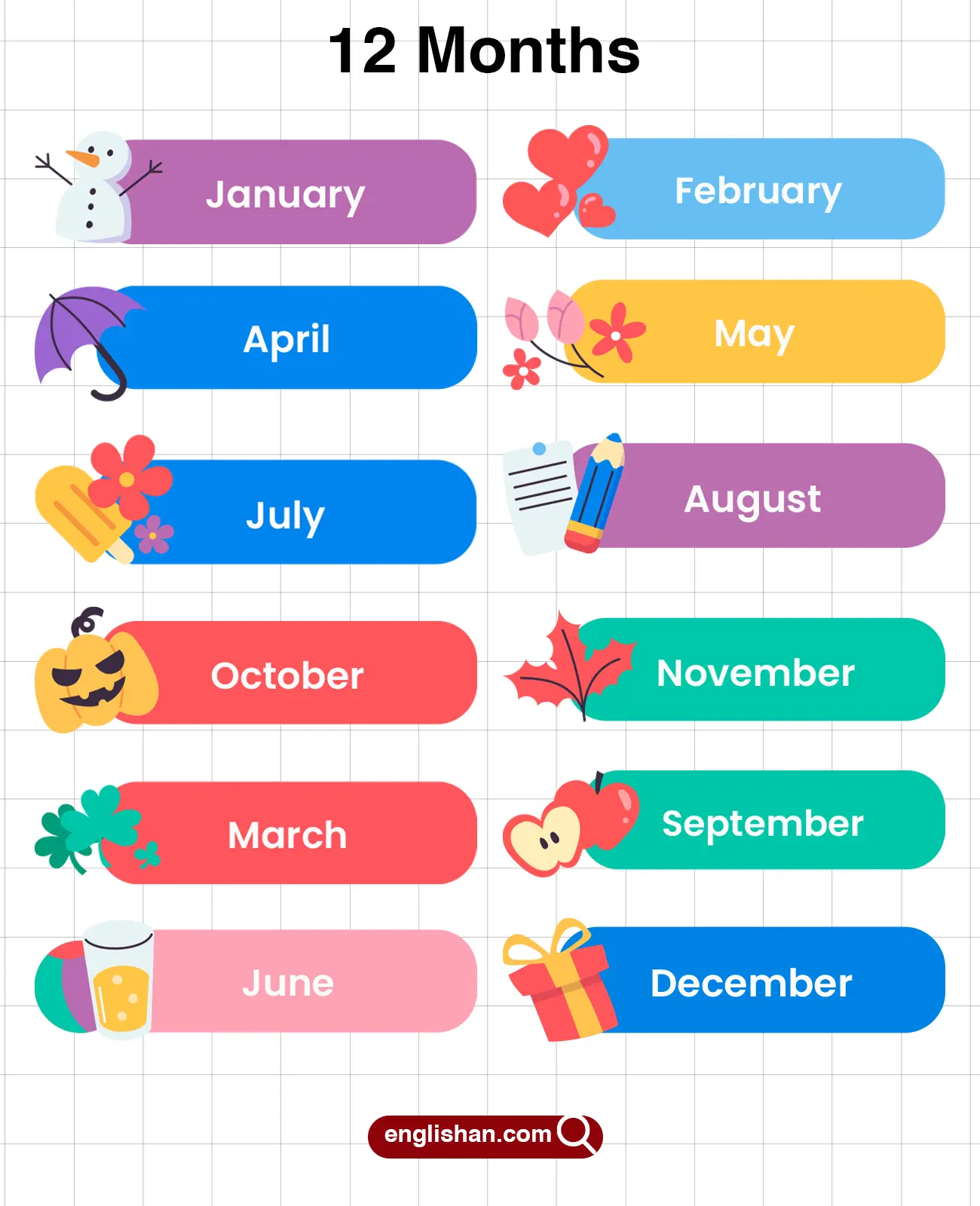
The twelve months in correct sequence:
- January
- February
- March
- April
- May
- June
- July
- August
- September
- October
- November
- December
Students in Classes 1 to 4 are usually asked to write these from memory, so the sequence matters as much as the spelling.
Order of the 12 Months With Short Forms
| Number | Month | Short form |
|---|---|---|
| 1 | January | Jan |
| 2 | February | Feb |
| 3 | March | Mar |
| 4 | April | Apr |
| 5 | May | May |
| 6 | June | Jun |
| 7 | July | Jul |
| 8 | August | Aug |
| 9 | September | Sep |
| 10 | October | Oct |
| 11 | November | Nov |
| 12 | December | Dec |
Cover the middle column and name each month from its number. That single exercise fixes both the order and the spelling faster than reading the list again.
School diaries, railway tickets, bank forms and calendar apps all use the three-letter versions. American style adds a full stop after the abbreviation (Jan.), British style leaves it out (Jan). Either way the capital letter stays. May, June and July are short enough that most writing keeps them in full.
How Many Days in Each Month
| Month | Days |
|---|---|
| January | 31 |
| February | 28, or 29 in a leap year |
| March | 31 |
| April | 30 |
| May | 31 |
| June | 30 |
| July | 31 |
| August | 31 |
| September | 30 |
| October | 31 |
| November | 30 |
| December | 31 |
Seven months have 31 days, four have 30, and February stands alone on 28. A leap year arrives once every four years and gives February a 29th day, which keeps the calendar matched to the Earth’s orbit around the sun.
The old rhyme runs: Thirty days hath September, April, June and November. All the rest have thirty-one, except February alone. The knuckle trick is quicker still. Count across the knuckles and dips of one fist, starting with January on the first knuckle: every knuckle is a 31-day month, every dip between them is a 30-day month, and February lands on the first dip.
Month Names Spelling and Common Mistakes
Marks go missing in dictation more often on spelling than on order. Five months account for almost every error.
- February ✅ Febuary ❌ The first r disappears because nobody sounds it. Say Feb-ru-a-ry slowly while writing.
- September ✅ Septmber ❌ The e after Sept gets swallowed in speech.
- August ✅ Agust ❌ Two vowels open the word: Au-gust.
- November ✅ Novemeber ❌ One m, one b, no extra e.
- December ✅ Decemeber ❌ Same trap as November, same fix.
Writing a difficult month three times aloud beats reading it ten times in silence.
Meaning and Origin of Each Month
Almost every month name in English traces back to Latin and the Roman calendar. Knowing the source makes the spelling easier to remember.
- January: Janus, Roman god of doorways and beginnings, shown with two faces looking backward and forward.
- February: Februa, a Roman purification festival held in mid-month.
- March: Mars, Roman god of war. The Roman year originally started here.
- April: the Latin aperire, meaning to open, for the season when buds open.
- May: Maia, a Roman goddess linked with growth and spring.
- June: Juno, Roman goddess of marriage and queen of the gods.
- July: Julius Caesar, the first real person to give a month his name.
- August: Augustus, the first Roman emperor.
- September: septem, Latin for seven, its position in the old ten-month calendar.
- October: octo, Latin for eight.
- November: novem, Latin for nine.
- December: decem, Latin for ten.
The last four names sit two places out of step with their numbers because January and February joined the calendar later and pushed everything back.
Using Month Names in Sentences
The preposition changes with what follows it. Use in before a month on its own, and on before a full date.
- My birthday is in March.
- The new session starts in June.
- The exam is on 15 March.
- She joined the school on 3 September 2025.
- We travel in December every year. ✅
- We travel on December every year. ❌
Capitalization applies in every position, including mid-sentence: The results came out in April, never in april. The same rule governs the days of the week in English, which are proper nouns for exactly the same reason.
Months by Season
| Season | Months |
|---|---|
| Spring | March, April, May |
| Summer | June, July, August |
| Autumn (Fall) | September, October, November |
| Winter | December, January, February |
These groupings follow the Northern Hemisphere. South of the equator the pattern reverses, so December falls in summer across Australia and much of South America. Some regions divide the year more finely, which is where the six seasons model comes from, and the four-season vocabulary is set out under seasons names in English.
Month Names in Hindi
| English | Hindi |
|---|---|
| January | जनवरी |
| February | फ़रवरी |
| March | मार्च |
| April | अप्रैल |
| May | मई |
| June | जून |
| July | जुलाई |
| August | अगस्त |
| September | सितंबर |
| October | अक्टूबर |
| November | नवंबर |
| December | दिसंबर |
These are the standard calendar months as written in Hindi, not the traditional lunar months such as Chaitra or Vaishakh, which follow a separate system.
Festivals and Holidays by Month
| Month | Occasion |
|---|---|
| January | New Year’s Day, 1 January |
| February | Valentine’s Day, 14 February |
| March | St Patrick’s Day, 17 March |
| April | Earth Day, 22 April |
| May | May Day, International Workers’ Day, 1 May |
| June | Father’s Day, third Sunday |
| July | Independence Day in the USA, 4 July |
| August | Friendship Day, first Sunday in India and several other countries |
| September | Labor Day in the USA, first Monday |
| October | Halloween, 31 October |
| November | Thanksgiving in the USA, fourth Thursday |
| December | Christmas, 25 December |
May Day and the American Labor Day both honour workers, but they fall in different months and are not the same holiday.
Month Names Practice Questions
Fill in the blanks
- ______ comes after March.
- There are ______ months in a year.
- ______ is the last month of the year.
- February has ______ days in a normal year.
Put these in correct order
- June, April, May
- December, October, November
- February, January, March
Correct the spelling
- Febuary
- Agust
- Novemeber
- Septmber
Choose in or on
- The wedding is ______ November.
- The test is ______ 12 October.
FAQs
January, February, March, April, May, June, July, August, September, October, November and December. All twelve are proper nouns and take a capital letter wherever they appear in a sentence.
The twelve-month calendar comes from the Roman system, which aligned months with lunar cycles while keeping the year matched to the Earth’s orbit around the sun. A thirteen-month year would drift out of step with the seasons.
February has 28 days in a normal year and 29 in a leap year. Every other month has either 30 or 31.
F-e-b-r-u-a-r-y. The first r is the one students drop, because it is barely sounded in speech.
Month names are proper nouns, so each one names a single specific thing rather than a general class. That is why April takes a capital letter while spring does not.
Use in with a month by itself, as in School reopens in July. Use on when a full date follows, as in School reopens on 8 July.
Thirty days: April, June, September, November. Thirty-one days: January, March, May, July, August, October, December. February has 28 or 29.
Jan, Feb, Mar, Apr, May, Jun, Jul, Aug, Sep, Oct, Nov and Dec. Each keeps its capital letter, and May is written the same in full and in short.
Once every month name in English is fixed in sequence, with the right spelling and the right preposition, writing dates stops being guesswork in exams and in everyday English alike.
You May Also Like