

A saree is one unstitched length of cloth, five to nine yards long and about 44 inches wide. The parts of a saree are the zones woven and draped along that length.
The pallu forms the decorated end, the body fills the middle, and a border edges each long side. A blouse and a petticoat complete the outfit.
Parts of a Saree Labeled on a Draped Saree
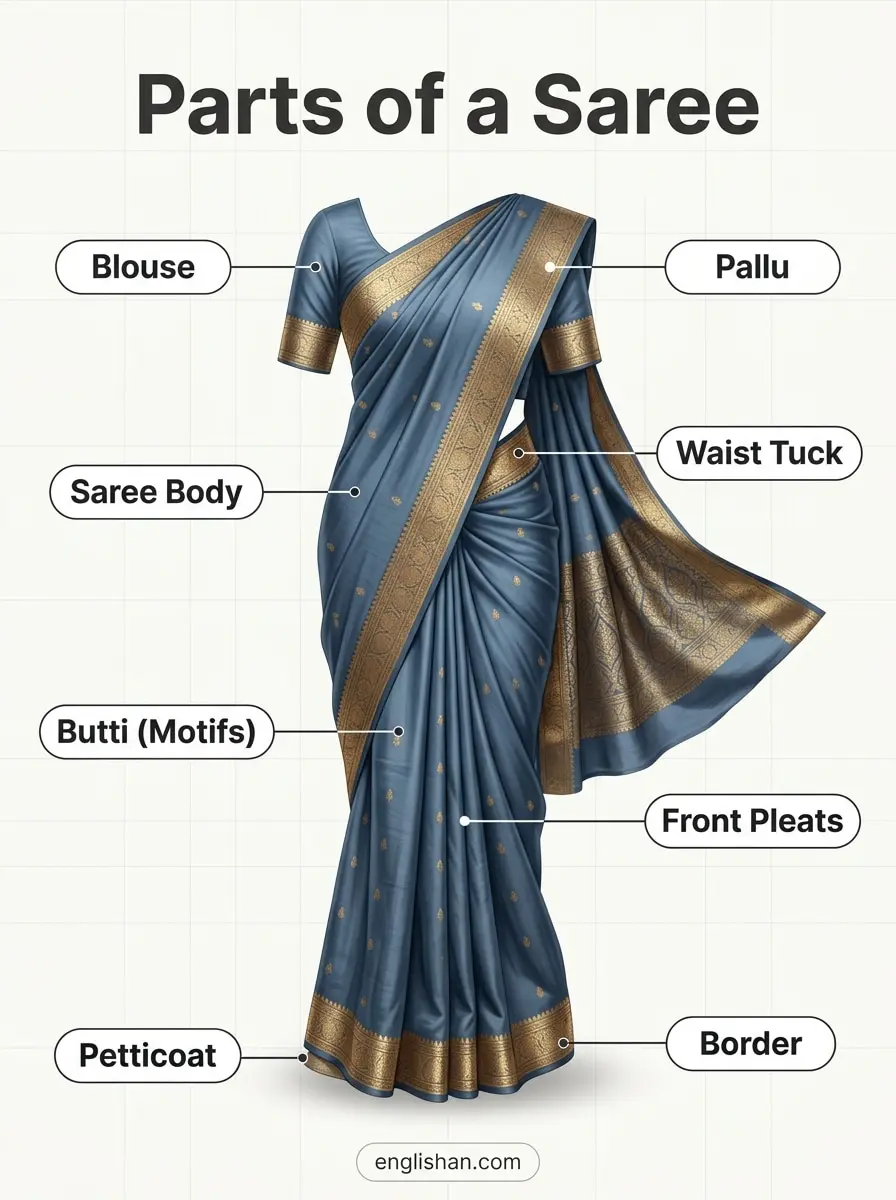
On a draped saree, the pallu falls from the left shoulder, and the body covers the lower half of the figure in front. The pleats are tucked at the navel, and the lower border follows the hem. The blouse covers the upper body, and the petticoat is worn beneath the drape. These are the parts of a saree in English, and the saree parts names in Hindi and regional use are given beside each one. The spelling sari is the older form of the same word. Stitched garments such as a dress are cut and sewn, while the parts of a saree are woven or draped.
| Part | Where you find it |
|---|---|
| 1. Pallu | Decorated end of the cloth that falls over the shoulder |
| 2. Pallu border | Woven band across the outer end of the pallu |
| 3. Pallu panel | Densely patterned field between the pallu border and the body |
| 4. Tassels | Knotted thread fringe at the free edge of the pallu |
| 5. Pallu pleats | Folds set into the pallu before it is pinned to the shoulder |
| 6. Body | Main field of the cloth between the two long borders |
| 7. Butti | Small motif repeated across the body |
| 8. Border | Woven or applied band along each long edge |
| 9. Upper border | Border along the top edge, tucked at the waist |
| 10. Lower border | Border along the hem edge of the draped cloth |
| 11. Selvedge | Self-finished woven edge on each long side |
| 12. Pin-holes | Small holes along the selvedge of handloom cloth |
| 13. Zari | Gold or silver thread woven into borders and pallu |
| 14. Korvai join | Interlocked weave that joins the border to the body |
| 15. Petni join | Weave that joins the body to a separately woven pallu |
| 16. Inner end | Plain end of the cloth opposite the pallu |
| 17. Fall | Lining strip stitched to the wrong side of the hem edge |
| 18. Pico | Folded and stitched finish along the edges |
| 19. Edging | Stitched finish on the loose ends of the cloth |
| 20. Pleats | Even folds at the front center of the draped cloth |
| 21. Tuck line | Waistline where the pleats and the upper border are tucked |
| 22. Shoulder drape | Cloth crossed over the left shoulder from the waist |
| 23. Saree pin | Pin that fixes the pallu to the blouse at the shoulder |
| 24. Waist belt | Belt fastened over the drape to secure the pleats |
| 25. Blouse | Fitted short top worn under the pallu, also called choli |
| 26. Blouse neckline | Front and back opening cut around the neck |
| 27. Blouse sleeves | Sleeve length from sleeveless to elbow |
| 28. Blouse darts | Tapered folds stitched at the bust and the waist |
| 29. Blouse closure | Hooks, zipper, or ties at the front or the back |
| 30. Petticoat | Fitted underskirt that anchors the tuck, also called inskirt |
| 31. Petticoat drawstring | Cord threaded through the waistband |
| 32. Petticoat waistband | Stitched band at the top of the underskirt |
| 33. Petticoat panels | Shaped pieces joined to flare the underskirt |
| 34. Petticoat hem | Lower edge of the underskirt |
| 35. Langa | Long skirt of a half saree |
| 36. Voni | Short drape worn over the shoulder with a half saree |
| 37. Mekhela | Wrapped skirt of the Assamese two-piece set |
| 38. Chador | Shoulder cloth that completes the Assamese set |
Saree Pallu Parts
The pallu is the finishing end of the saree, and its parts are the border, the panel, the tassels, and the pleats. Among the parts of a saree, it has the heaviest weave.
Pallu
Among the parts of a saree, the pallu is the decorated end, also called aanchal, anchal, pallav, or seragu depending on region. It is woven with denser motifs and more zari than the body. In the nivi drape, the pallu is laid over the left shoulder and falls down the back.
Pallu Border and Pallu Panel
The pallu border is a woven band across the outer end of the pallu. The pallu panel is the patterned field between that band and the body. The panel is the most densely woven field of the saree, and the border closes it at the outer end.
Tassels
Tassels are knotted thread fringes at the free edge of the pallu. They are called kuchu in some regions, and they are knotted in bundles to keep the loose warp ends from fraying.
Pallu Types
An open pallu falls loose from the shoulder, and a pleated pallu is folded into even pleats before it is pinned. A seedha pallu is brought over the right shoulder to the front. An ulta pallu reverses that direction, with the pleats taken from the lower skirt.
Saree Body and Border Parts
The body and the borders are the woven structure of the saree, and these parts of a saree are fixed at the loom. The parts of a saree in this group are fixed at the loom, and they set the pattern of the whole cloth.
Body
The body is the main field of the cloth, between the two long borders and the pallu. Some sarees have a plain body, and others have an all-over pattern. A handloom body is woven in one piece with the borders.
Butti
A butti is a small motif repeated across the body, such as a dot, a flower, or a paisley. The word is also spelled buti or butta. Buttis are woven in with a supplementary weft thread, or they are printed or embroidered on.
Border
The border is a decorative band along each long edge of the saree. It is woven in, printed, embroidered, or stitched on as lace. The simplest border is a single contrasting line, about one inch wide.
Upper Border and Lower Border
The lower border follows the hem of the draped saree and is the border seen most. The upper border is the matching band along the opposite edge, and it is tucked into the petticoat at the waist. Only the lower border is visible in most drapes.
Selvedge and Pin-Holes
The selvedge is the self-finished woven edge on each long side of the cloth. Handloom sarees show small pin-holes along it, left by the wooden pegs that hold the cloth taut on the loom.
Zari
Zari is thread of silver plated with gold, or a metallic imitation, woven into the borders and the pallu. Heavy zari adds weight to a silk saree, and it is concentrated in the border and the pallu.
Korvai and Petni Joins
A korvai join is the interlocked weave that joins a separately woven border to the body in Kanchipuram silk. It leaves a slight ridge at the seam. A petni join does the same between the body and the pallu, and it forms one permanent structure.
Inner End
The inner end is the plain end of the cloth opposite the pallu. It is tucked into the petticoat at the start of the drape. The inner end is the first length of cloth fixed at the waist when the saree is draped.
Saree Hem and Edge Finishing Parts
The hem and edge finishes are stitched after weaving, and the parts of a saree in this group protect the cloth. These parts of a saree protect the cloth from fraying, and one of them adds weight to the fall of the hem.
Fall
The fall is a strip of lining stitched to the wrong side of the hem edge. It is invisible from the outside. It adds weight near the hem, which keeps the pleats straight and shields the cloth from the floor.
Pico
Pico is a folded and stitched finish along the edges of the saree, also called pico edging. The stitch holds the threads in place and protects the border from wear against the ground.
Edging
Edging is the stitched finish on the loose ends of the cloth, where cut threads would otherwise pull out. The pallu end and the inner end are finished this way. Tassels are the alternative finish at the pallu end, and they complete the pallu among the parts of a saree.
Draped Saree Parts at the Waist and Shoulder
A draped saree forms new parts when the cloth is folded and fixed, and these parts of a saree exist only on the body. The parts of a saree in this group are the pleats, the tuck line, the shoulder drape, the pin, and the belt.
Pleats
Pleats are the even folds at the front center of the draped saree. A standard drape has five to seven pleats, each about five inches wide. They are tucked into the petticoat waistband, and the folds face the left.
Tuck Line
The tuck line is the waistline where the pleats and the upper border are tucked into the petticoat. It is set at navel level, directly under the drawstring of the petticoat.
Shoulder Drape
The shoulder drape is the stretch of cloth that crosses the body from the waist to the left shoulder, ending in the pallu. The nivi drape uses a six-yard saree, and the nine-yard drape adds length for the legs.
Saree Pin
A saree pin is a safety pin or a decorative brooch that fixes the pallu to the blouse at the shoulder. Pins also fix the pleats at the waist. Pinning through the blouse protects thin silk from snags.
Waist Belt
A waist belt is a chain or fabric belt fastened over the drape at the waist. It secures the pleats and holds the tuck line in place on slippery cloth. The belt is worn on the outside of the drape.
Saree Blouse Parts
The blouse is a fitted short top worn under the pallu, called choli in Hindi. Among the parts of a saree blouse are the neckline, the sleeves, the darts, and the closure.
Blouse Neckline
The blouse neckline is the opening cut around the neck at the front and the back. Shapes are round, square, V-shaped, boat, and halter, and the back neckline is cut separately from the front.
Blouse Sleeves
Blouse sleeves are cut sleeveless, cap, short, elbow, or three-quarter length. The armhole is stitched with a curved seam, as on a shirt.
Blouse Darts
Blouse darts are tapered folds stitched at the bust and the waist to shape the fitted cloth. A princess seam replaces the bust dart on some designs. These are the same tapered folds used in a suit jacket, and they give the saree blouse its close fit.
Blouse Closure
The blouse closure is a row of hooks, a zipper, or ties at the front or the back. A back zipper keeps the front panel unbroken, while front hooks leave the back neckline open.
Saree Petticoat Parts
The petticoat is the fitted underskirt worn beneath the saree, and it is also called an inskirt. The parts of a saree petticoat are the drawstring, the waistband, the panels, and the hem.
Petticoat Drawstring and Waistband
The waistband is a stitched band at the top of the petticoat, and the drawstring is a cord threaded through it. The drawstring is tied tightly at the navel. The saree pleats are tucked beneath that cord.
Petticoat Panels and Hem
The panels are shaped pieces stitched together to flare the underskirt. An eight-piece petticoat has eight panels and gives a wider flare than a straight cut. The hem is the lower edge, and it ends just short of the floor.
Parts of a Saree by Type
The parts of a saree change with the type. A pre-stitched saree, a half saree, and a mekhela chador each alter the cloth or the way it is joined.
Pre-Stitched Saree and Saree Gown
A pre-stitched saree has its pleats sewn in place and a skirt panel attached, so only the pallu is draped and pinned. A saree gown is a two-part design with a stitched skirt and a pallu panel. Both are sold as two-piece sarees.
Half Saree
A half saree has three parts: the langa, the blouse, and the voni. The langa is a long flared skirt. The voni, also called davani, is a short drape worn from the waist to the opposite shoulder. South Indian girls wear it as a formal outfit.
Mekhela Chador
A mekhela chador is the Assamese two-piece outfit. The mekhela is a wrapped skirt, pleated at the waist. The chador is a shoulder cloth tucked into the mekhela at the waist and worn over a blouse.
Nine-Yard Saree
A nine-yard saree is the Maharashtrian paithani drape. It has the same pallu, body, and border as a six-yard saree. The extra length forms the kachcha drape between the legs.
FAQs
FAQs
The parts of a saree are the pallu, body, border, selvedge, and pleats. The blouse and the petticoat are worn with it. The pallu is the decorated end, and the border is the band along the long edge.
The parts of a saree blouse are the neckline, the sleeves, the darts, and the closure. The back neckline and the armhole complete the cut. The blouse is called choli in Hindi, and these four make up the parts of a saree blouse.
The decorated end of a saree is the pallu, also known as aanchal or pallav. The plain end opposite it is the inner end. The pallu is draped over the left shoulder in the nivi drape.
The border of a saree is the decorative band along each long edge. The border at the hem is the lower border, and the one tucked at the waist is the upper border. Border types include woven, printed, lace, and embroidered.
The parts of a half saree are the langa, the blouse, and the voni. The langa is a long skirt, and the voni is a short drape worn over the shoulder.
A fall is a lining strip stitched to the wrong side of the hem edge. Pico is a folded and stitched finish along the edges. The fall adds weight to the hem, and pico protects the border from fraying.
The pallu goes over the left shoulder in the nivi drape, and the seedha pallu goes over the right shoulder to the front. In both drapes the pallu is the decorated end of the saree.
