

The parts of a dress are the bodice and the skirt, joined at a waist seam. The bodice fits the chest and back, and the skirt hangs from the waistline to the hem.
Darts shape the bodice, and a zipper closes it at the back or the side. The neckline and the sleeves finish the top, and each part is stitched at a fixed position.
Parts of a Dress Labeled on a Front and Back View
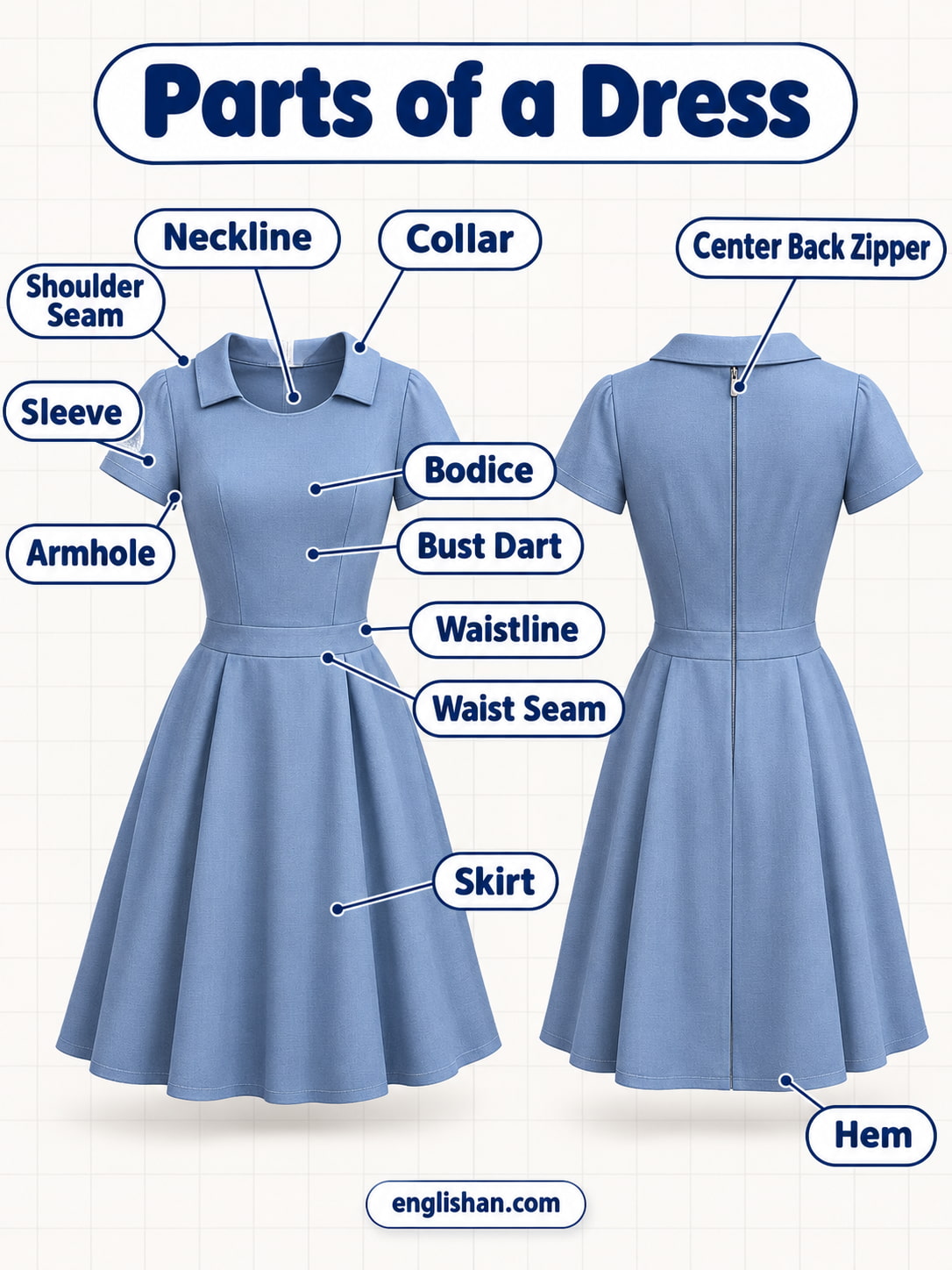
On an everyday dress, the neckline is cut around the collarbone, and the straps or sleeves join the shoulder seams. The bodice ends at the waistline, and the skirt is stitched to it at the waist seam. The skirt ends at the hem, and a zipper closes the center back. These are the parts of a dress, or the dress parts names, as dressmakers use them. Formal and bridal terms are on the gown page.
| Part | Where you find it |
|---|---|
| 1. Neckline | Opening cut around the neck and chest |
| 2. Neckline facing | Inner band that finishes the neckline edge |
| 3. Sweetheart neckline | Two soft curves meeting at a center point |
| 4. Off-the-shoulder neckline | Neckline cut lower than the shoulder line |
| 5. Collar | Folded band sewn to the neckline |
| 6. Straps | Narrow bands that join the bodice to the shoulders |
| 7. Strapless bodice | Bodice with no straps or sleeves |
| 8. Shoulder seam | Seam across the top of the shoulder |
| 9. Armhole | Curved opening where the sleeve is set in |
| 10. Sleeve | Fabric tube from the armhole to the wrist or upper arm |
| 11. Sleeve cap | Curved top of the sleeve at the shoulder |
| 12. Raglan sleeve | Sleeve cut in one piece up to the collar |
| 13. Bishop sleeve | Full sleeve gathered into a cuff at the wrist |
| 14. Cuff | Band or hem at the end of the sleeve |
| 15. Bodice | Upper body of the dress, from shoulders to waist |
| 16. Bust dart | Tapered fold sewn from the side seam toward the bust |
| 17. Waist dart | Tapered fold sewn at the waistline of the bodice |
| 18. Boning | Thin stiff strips sewn into the bodice seams |
| 19. Built-in cups | Padded cups sewn into the bodice lining |
| 20. Princess seam | Curved seam running from the shoulder over the bust |
| 21. Side seam | Seam from the underarm to the hem |
| 22. Underarm gusset | Small fabric insert that adds room at the underarm |
| 23. Seam allowance | Extra fabric beyond the stitch line |
| 24. Center back seam | Vertical seam down the middle of the back |
| 25. Lining | Inner layer of fabric sewn inside the bodice |
| 26. Zipper | Closure sewn into the center back or the side |
| 27. Hook and eye | Small metal fastener at the top of the zipper |
| 28. Buttons | Discs fixed along a placket at the front |
| 29. Placket | Reinforced strip where the dress opens |
| 30. Waistline | Line where the bodice meets the skirt |
| 31. Waist seam | Seam that joins the bodice to the skirt |
| 32. Belt | Strap fastened around the waistline |
| 33. Sash | Wide fabric band tied at the waist |
| 34. Skirt | Lower part of the dress that hangs from the waist |
| 35. Gathers | Small folds of fabric pulled into the waist seam |
| 36. Pleats | Sharp folds pressed into the skirt |
| 37. Pencil skirt | Skirt cut close to the body from waist to hem |
| 38. Circle skirt | Skirt cut as a full circle |
| 39. Skirt panels | Shaped pieces stitched along vertical seams |
| 40. Slit | Opening cut into the skirt hem |
| 41. Pockets | Pouches sewn into the side seams |
| 42. Underskirt | Separate skirt layer inside the dress |
| 43. Crinoline | Stiff underlayer that adds fullness |
| 44. Ruffle | Gathered strip of fabric stitched to an edge |
| 45. Lace | Openwork fabric stitched along an edge |
| 46. Beading | Beads and sequins sewn onto the fabric |
| 47. Embroidery | Decorative stitching in colored thread |
| 48. Fringe | Loose strands along a skirt or sleeve edge |
| 49. Cording | Narrow cord that outlines an edge |
| 50. Appliqué | Cut-out motif stitched onto the fabric |
| 51. Hem | Folded and stitched lower edge of the skirt |
| 52. Hem allowance | Extra fabric folded up inside the hem |
| 53. Hemline | Level where the hem ends on the body |
| 54. Tea-length hem | Hem ending between the knee and the ankle |
| 55. High-low hem | Hem shorter in front and longer in back |
Dress Neckline and Strap Parts
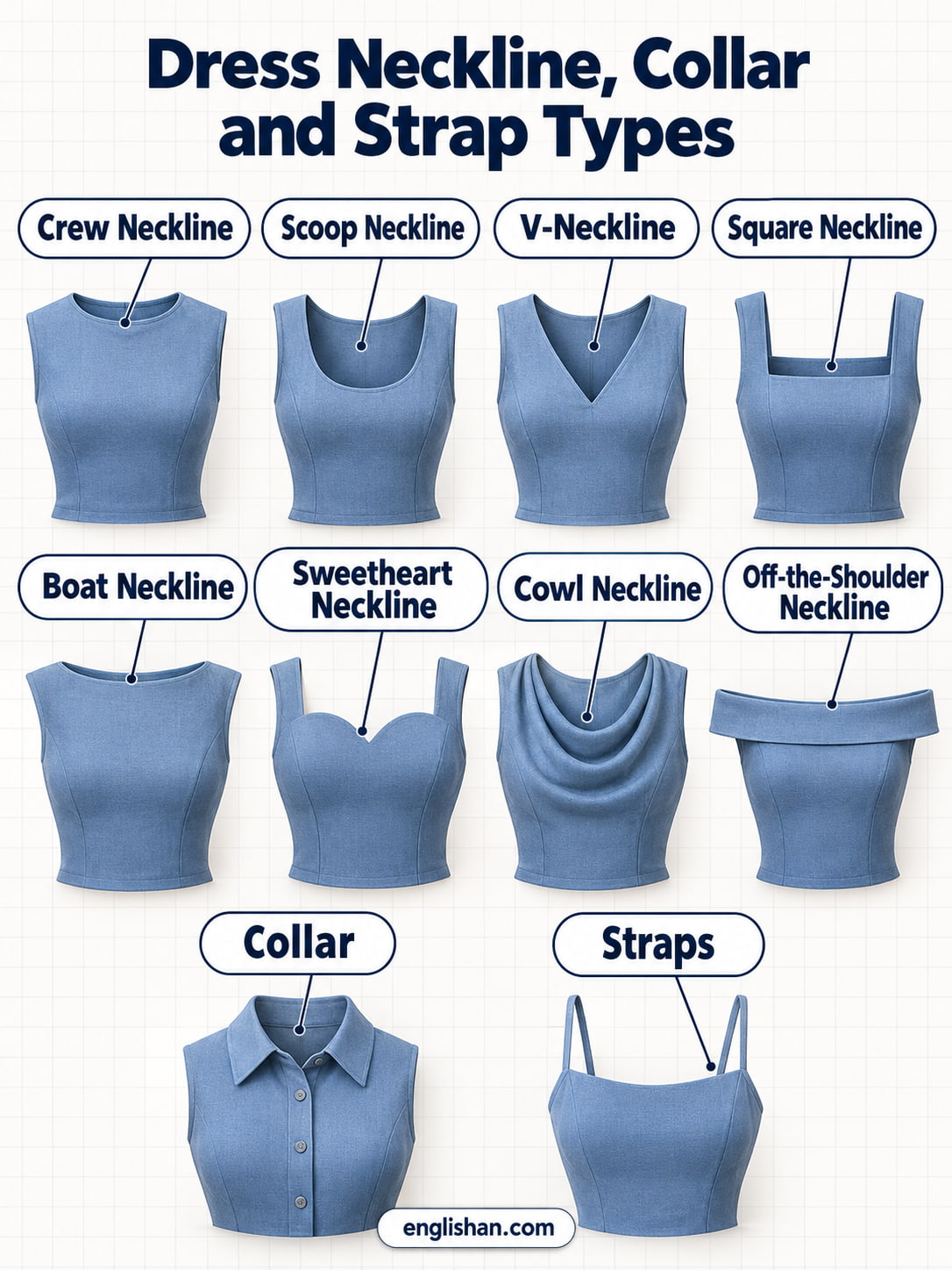
The top edge of the dress is made of the neckline, the collar, and the straps. These parts of a dress surround the face and shoulders.
Neckline
The neckline is the opening cut around the neck and chest. Its shape names the style. A crew neckline is a round cut close to the base of the neck, and a scoop neckline is a deeper curve. A V-neck is two straight edges meeting at a point. A square neckline has four corners, and a boat neckline is a wide, shallow curve across the collarbones. A halter neckline is held by a strap behind the neck.
Sweetheart and Cowl Necklines
Among the neckline parts of a dress, the sweetheart neckline is two soft curves. They meet at a center point, like the top of a heart. A cowl neckline is a drape of soft folds that falls in a loose curve at the front. A one-shoulder neckline has a strap or sleeve over one shoulder only.
Off-the-Shoulder and Strapless Necklines
An off-the-shoulder neckline is cut lower than the shoulder line and exposes the collarbone. A strapless bodice has no straps or sleeves, so a snug fit and boning hold it up. A jewel neckline is the high, round cut also called a crew neckline. A bateau neckline is another name for the boat neckline.
Neckline Facing
The facing is a shaped strip of fabric, cut to match the neckline and stitched to its inner edge. The facing is turned inside and pressed flat. It finishes the edge and stops it from stretching.
Collar
A collar is a band of fabric sewn around the neckline. A shirtdress has the same folded collar and collar stand as a shirt. A Peter Pan collar is flat and rounded, and a mandarin collar is a narrow upright band with a gap at the front.
Straps and Shoulder Seams
Straps are narrow bands of fabric that join the bodice to the shoulders. Spaghetti straps are thin cords, and wide straps are cut as part of the bodice. A shoulder seam joins the front and back bodice pieces across the top of the shoulder.
Dress Bodice Parts
The bodice is the upper body of the dress, from the shoulders to the waistline. It is the most fitted of the parts of a dress.
Bodice
The bodice is cut in a front piece and a back piece, joined at the side seams and the shoulder seams. A fitted bodice follows the chest and waist closely, and a loose bodice hangs straight.
Bust Darts
A bust dart is a tapered fold sewn from the side seam toward the fullest point of the chest. It takes in extra fabric, so the bodice fits the curve instead of hanging in loose folds.
Waist Darts and Princess Seams
A waist dart is a tapered fold sewn at the waistline, in the front or the back. A princess seam is a long, curved seam that runs from the shoulder over the bust to the hem and replaces both darts.
Side Seams and Center Back Seam
The side seams join the front and the back from the underarm to the hem. The center back seam is a vertical seam down the middle of the back, and it holds the zipper on many dresses. A standard seam allowance is 5/8 inch.
Lining
The lining is an inner layer of fabric sewn into the bodice or the whole dress. It covers the seam allowances and keeps a sheer fabric from showing the body. Lined dresses are cut in a smooth lining fabric such as satin.
Dress Sleeve Parts

The sleeve fits the arm, and the parts of a dress at the arm are the armhole, the sleeve cap, and the cuff.
Armhole and Sleeve Cap
The armhole is the curved opening in the bodice where the sleeve is stitched in. The sleeve cap is the rounded top of the sleeve that fits into it, and the cap is eased in with small gathers.
Sleeve
The sleeve is a fabric tube from the armhole to the arm. A cap sleeve is a short curve over the shoulder, and a short sleeve ends over the upper arm. A three-quarter sleeve ends between the elbow and the wrist, and a long sleeve reaches the wrist. A puff sleeve is gathered at the cap or the cuff, and a bell sleeve flares out toward the end.
Sleeveless and Raglan Sleeves
A sleeveless dress has only an armhole and a neckline, with no sleeve at all. Among the sleeve parts of a dress, a raglan sleeve is cut in one piece that runs up to the collar. The dress has no set-in shoulder seam.
Bishop and Bracelet Sleeves
A bishop sleeve is full and loose, gathered into a fitted cuff at the wrist. A bracelet sleeve ends between the elbow and the wrist.
Cuff
A cuff is a band or a folded hem at the end of the sleeve. A button cuff has a narrow band and one button, and a bell sleeve ends in a plain hem.
Dress Waist Parts
Dress hem styles influence skirt shape, length, and overall silhouette.The waist is where the two main halves meet, and these parts of a dress set the proportions of the whole dress.
Waistline
The waistline is the line where the bodice meets the skirt. An empire waistline is high, just under the bust, and a natural waistline is at the narrowest part of the torso. A drop waistline is lower than the natural waist, near the hip.
Waist Seam
The waist seam is the stitched line that joins the bodice to the skirt. The skirt is gathered or pleated into it, and the zipper ends there on many dresses.
Belt and Sash
A belt is a strap fastened around the waistline with a buckle. A sash is a wide fabric band tied at the waist or the back. A belt loop is a small fabric strip stitched to the side seam to hold the belt.
Dress Skirt Parts
The skirt hangs from the waist seam to the hem, and it is the longest of the parts of a dress.
Skirt
The skirt is the lower part of the dress. It is cut as a single tube, in several panels, or as a circle. The shape of the skirt names the silhouette of the dress.
Gathers and Pleats
Gathers are small folds of fabric pulled into the waist seam with a long stitch. Pleats are sharp, pressed folds. A knife pleat folds in one direction, and a box pleat folds out in two.
Skirt Panels
Skirt panels are shaped pieces of fabric stitched along vertical seams. Each seam narrows the panel at the waist and widens it at the hem, which gives the skirt its flare.
Pencil Skirt and Circle Skirt
Among the skirt parts of a dress, a pencil skirt is cut close to the body from the waist to the hem. It ends at the knee on most styles. A circle skirt is cut as a full circle of fabric, so the hem flares wide and swings as the body moves. A wrap skirt overlaps in front and ties at the waist.
Slit and Pockets
A slit is an opening cut into the hem or the side of the skirt, so the legs move freely. Pockets are pouches sewn into the side seams, with the opening along the seam.
Underskirt and Ruffle
An underskirt, or petticoat, is a separate skirt layer inside the dress that adds volume. A ruffle is a gathered strip of fabric stitched to the hem, the neckline, or the sleeve.
Dress Construction Parts
Construction parts are hidden inside the dress, and these parts of a dress give the bodice its shape and support.
Boning and Built-In Cups
Boning is a set of thin, stiff strips sewn into the seams of the bodice to hold its shape. Built-in cups are padded or underwire cups sewn into the lining, and they replace a separate bra on a strapless dress.
Underarm Gusset
Among the hidden parts of a dress, a gusset is a small insert of fabric stitched into the underarm seam. It adds room for the arm to move, so the seam does not tear.
Seam Allowance
The seam allowance is the extra fabric beyond the stitch line. It is left inside the dress so a tailor lets the seam out or takes it in. A standard seam allowance is 5/8 inch.
Crinoline
A crinoline is a stiff underlayer of net or horsehair braid that adds fullness to a skirt. It is fitted inside the dress, under the underskirt.
Dress Closure Parts
A closure lets the dress open wide enough to be pulled on. These parts of a dress are fitted at the back, the side, or the front.
Zipper
A zipper is a closure of two rows of interlocking teeth with a slider. It is sewn into the center back seam or the side seam. It ends at the waist seam or the top of the neckline. A hidden zipper has its teeth turned inside. The zipper page names the tape, slider, and pull.
Hook and Eye
A hook and eye is a small metal fastener at the top of the zipper. The hook catches the loop of the eye, and it holds the neckline closed.
Buttons and Placket
Buttons are discs fixed down the front of a shirtdress or the back of a fitted dress. A placket is the reinforced strip of fabric where the dress opens, and it holds the buttonholes.
Dress Hem Parts
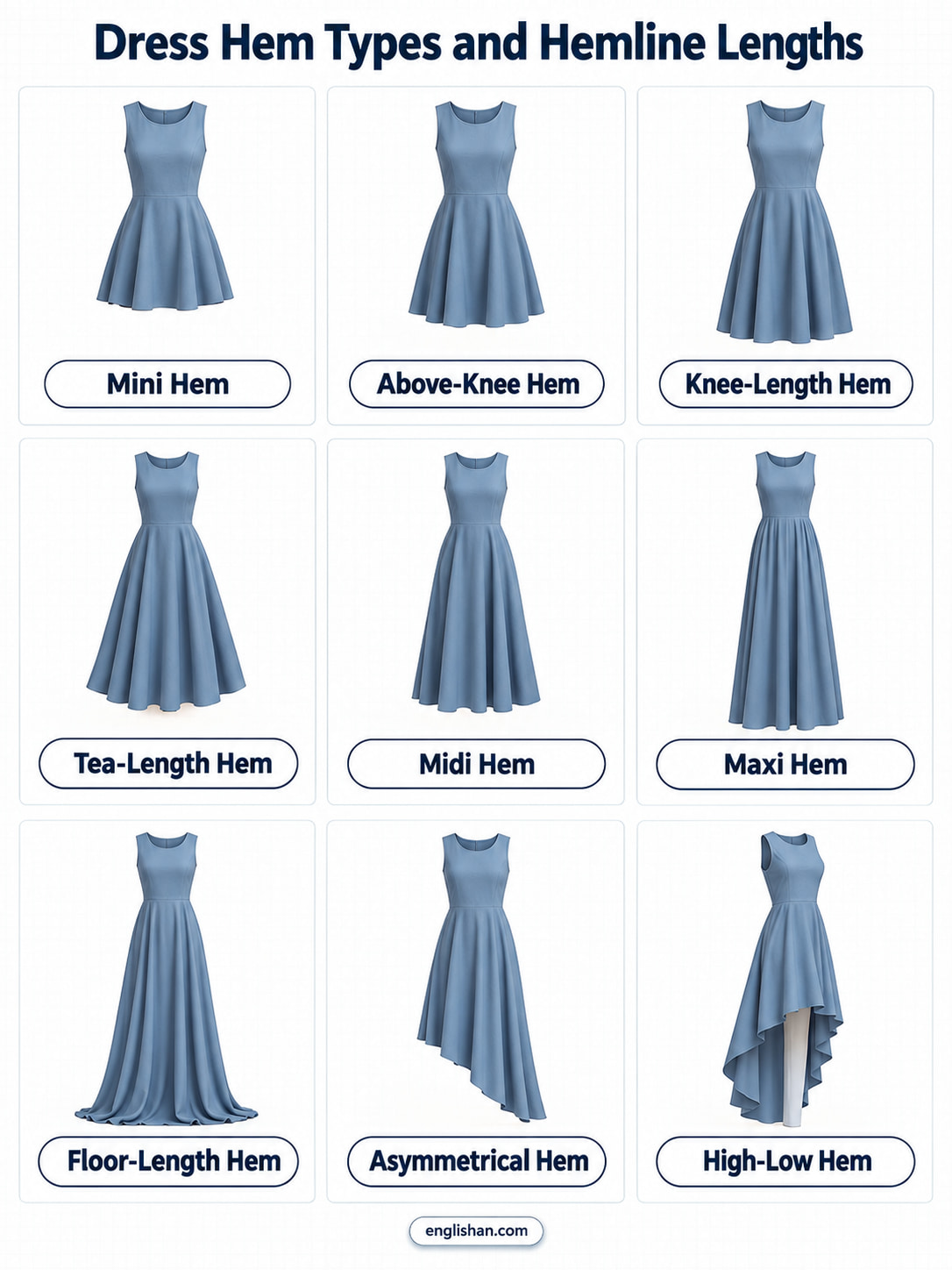
The hem is the bottom edge of the skirt. The parts of a dress at the hem decide how long and how heavy the skirt hangs.
Hem
The hem is the folded and stitched lower edge of the skirt. A blind hem keeps the stitches inside, and a rolled hem is a very narrow fold used on thin fabrics. A raw hem is left unfolded, and a finished hem is folded and stitched.
Hem Allowance
The hem allowance is the extra fabric folded up inside the hem. It lets a tailor lengthen or shorten the dress.
Hemline
The hemline is the level where the hem ends on the body. A mini dress ends over the thigh, and a knee-length dress ends at knee height. A tea-length dress ends between the knee and the ankle, a little shorter than a midi. A midi dress ends at mid-calf, halfway between the knee and the ankle. A maxi dress falls to the ankle or the floor, and a gown has a floor-length skirt. A high-low hem is shorter in front and longer in back. A handkerchief hem is uneven, with pointed panels of different lengths.
Dress Trim and Embellishment Parts
Trim is added to the finished edges, and these parts of a dress decorate the neckline, the sleeves, and the hem.
Lace and Piping
Among the trim parts of a dress, lace is an openwork fabric sewn along an edge or laid over the bodice. Piping is a narrow strip in a contrasting color on many dresses, sewn into a seam to outline it.
Beading and Sequins
Beading is a pattern of small beads sewn onto the fabric. Sequins are flat shiny discs sewn in rows, and both are common on evening dresses.
Embroidery and Appliqué
Embroidery is decorative stitching in colored thread, and appliqué is a cut-out motif of fabric stitched onto the dress.
Fringe and Cording
Fringe is a set of loose strands along a skirt or sleeve edge that move as the body moves. Cording and braid are narrow cords that outline a neckline, a sleeve, or a hem.
Ribbons and Bows
Ribbons are narrow bands of fabric tied at the waist or on the shoulder. A bow is a ribbon tied in a knot with two loops.
Dress Silhouettes and Their Added Parts
The parts of a dress are the same on every style, but the cut of the skirt and the bodice changes the silhouette.
A-Line and Fit-and-Flare
An A-line dress narrows at the waist and widens in a straight line to the hem. A fit-and-flare dress has a fitted bodice, a waist seam, and a skirt that flares from the waist.
Sheath and Shift
A sheath dress follows the body closely from the shoulders to the knee, and it uses darts to fit. A shift dress hangs straight from the shoulders with no waist seam.
Empire Dress
Among the dress silhouettes, an empire dress has a seam just under the bust, and the fabric flows loose from there to the hem. It is built on the empire waistline.
Bodycon Dress
A bodycon dress is cut close to the body from the top to the hem in a stretch fabric.
Wrap Dress
A wrap dress crosses the front panels over the chest and ties at the waist with a sash. It has no zipper or buttons.
Related:
FAQs
The parts of a dress are the neckline, bodice, sleeves, waistline, skirt, and hem. Darts, seams, a lining, and a zipper shape and close it. Straps, a collar, a belt, and pockets are added on some styles.
The different parts of a dress are the top, the waist, and the skirt. The top has the neckline, straps or sleeves, and bodice. The waist has the waistline, the waist seam, and a belt. The skirt ends at the hem.
The bodice is the part of a dress from the shoulders to the waist. It holds the neckline, the armholes, the bust darts, and the zipper on many styles.
The skirt is the part of a dress from the waist down. It hangs from the waist seam to the hem, and it has gathers, pleats, panels, a slit, or pockets on many styles.
A wedding dress has the same bodice, waistline, skirt, and hem as an everyday dress. Formal terms such as the train and the corset are on the gown page.
The neckline is the part of a dress around the neck. A collar is a band of fabric sewn to the neckline, and the straps join the bodice at the shoulders.
The end of a dress is the hem, the folded and stitched lower edge of the skirt. The hemline is the level where the hem ends on the body, such as mini, knee length, tea length, midi, maxi, or floor length.