

Matching cloth joins the jacket and the trousers of a tailored suit into one outfit. The parts of a suit are named along the jacket from the collar to the vents. They are named along the trousers from the waistband to the hem.
A waistcoat joins them in a three-piece suit. Each part is cut and stitched at a fixed position on the body.
Parts of a Suit Labeled on the Jacket and Trousers
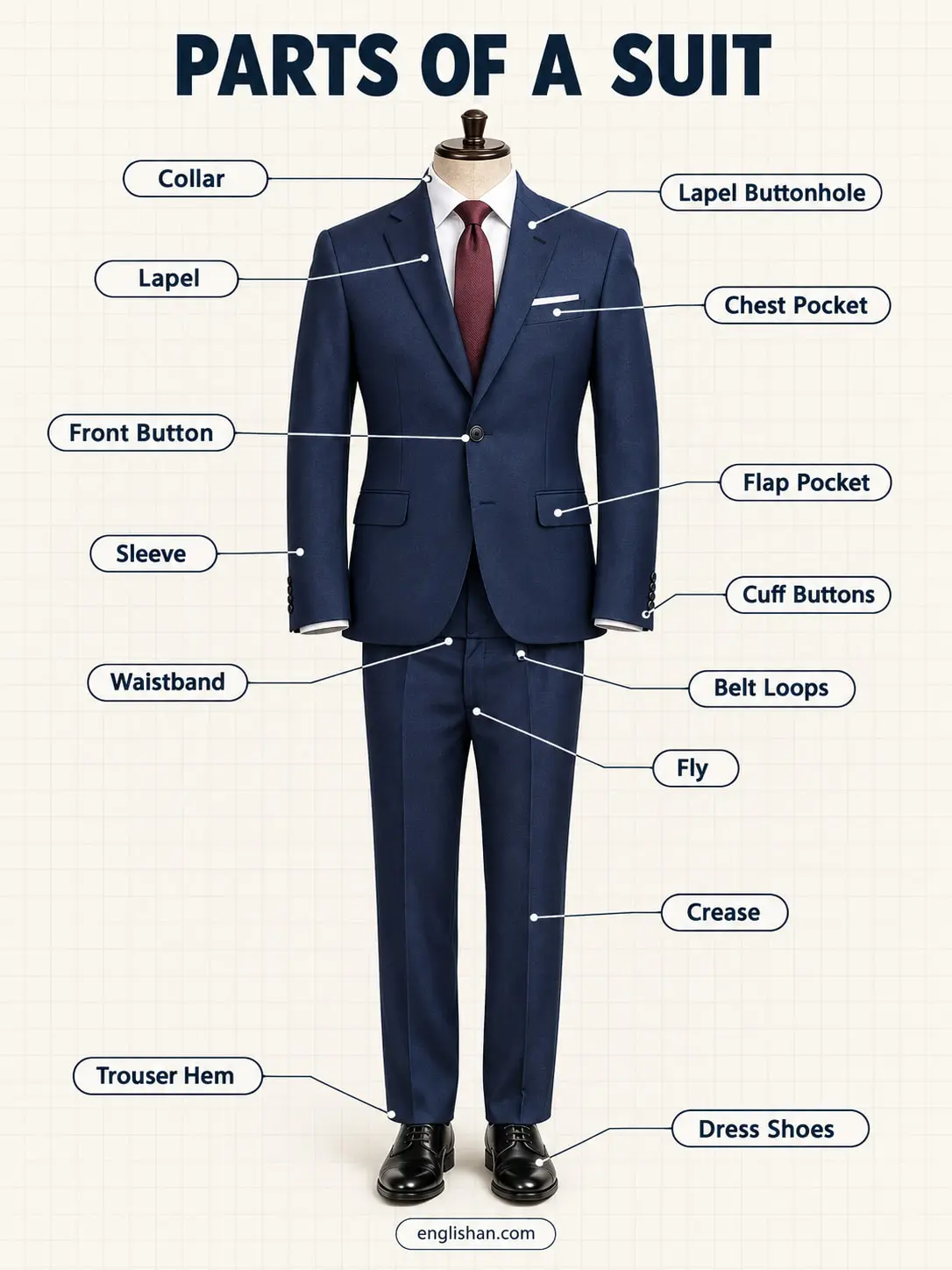
On a single-breasted jacket, the notch lapels fold back from the collar, and two or three front buttons close the center. Flap pockets are set at the hips, and one vent opens the back hem. The trousers match the jacket cloth, with belt loops at the waistband and a crease down each leg. These are the parts of a suit, or the parts of a suit jacket and trousers, as tailors name them.
| Part | Where you find it |
|---|---|
| 1. Collar | Band of cloth around the back of the neck |
| 2. Lapel | Folded front edge that turns back from the collar |
| 3. Gorge | Seam where the collar meets the lapel |
| 4. Lapel buttonhole | Slit on the left lapel for a flower |
| 5. Front buttons | Row of buttons down the center front |
| 6. Breast pocket | Narrow welt pocket on the left chest |
| 7. Pocket square | Folded handkerchief in the breast pocket |
| 8. Patch pocket | Pocket sewn onto the outside of the jacket |
| 9. Flap pockets | Two pockets with covers at the hips |
| 10. Ticket pocket | Small pocket over the right hip pocket |
| 11. Front dart | Tapered fold sewn into the front panel |
| 12. Shoulder | Seam and padding across the top of the arm |
| 13. Shoulder pad | Shaped wadding inside the shoulder |
| 14. Structured shoulder | Padded shoulder with a sharp line |
| 15. Natural shoulder | Soft shoulder with little or no padding |
| 16. Armhole | Curved opening where the sleeve is set in |
| 17. Sleeve head | Padded cap at the top of the sleeve |
| 18. Sleeve | Fabric tube from the shoulder to the wrist |
| 19. Sleeve buttons | Three or four buttons at the cuff edge |
| 20. Kissing cuff | Cuff buttons whose edges touch without overlapping |
| 21. Back panel | Two panels joined at the center back seam |
| 22. Center back seam | Vertical seam down the middle of the back |
| 23. Vent | Slit in the back hem of the jacket |
| 24. Canvas | Interfacing layer between the cloth and the lining |
| 25. Full canvas | Hand-sewn canvas from the shoulder to the hem |
| 26. Half canvas | Canvas only in the chest and lapels |
| 27. Fused interlining | Glued synthetic layer in place of canvas |
| 28. Lining | Inner layer of smooth fabric |
| 29. Underarm shields | Linings that protect the cloth under the arms |
| 30. Inside pocket | Welt pocket in the lining at the chest |
| 31. Jacket hem | Lower edge of the jacket |
| 32. Waistcoat | Sleeveless vest in the same cloth |
| 33. Waistcoat buttons | Row of small buttons down the front |
| 34. Waistcoat front tips | Lower front tips that reach the trouser waistband |
| 35. Back strap | Adjusting strap at the back of the waistcoat |
| 36. Waistband | Band at the top of the trousers |
| 37. Belt loops | Short cloth loops around the waistband |
| 38. Side adjusters | Buckle or button tabs on the hips |
| 39. Fly | Front opening closed by a zipper |
| 40. Pleats | Folds stitched under the waistband |
| 41. Pleat types | Single, double, forward, or reverse folds |
| 42. Front pockets | Slanted pockets cut into the side seams |
| 43. Vertical seam pockets | Pockets set into the side seam |
| 44. Jetted back pockets | Slit pockets at the back |
| 45. Back pocket | Welt pocket on the right back |
| 46. Crease | Pressed line down the front of each leg |
| 47. Rise | Distance from the crotch seam to the waistband |
| 48. Seat | Seam and panel across the back of the hips |
| 49. Trouser leg | Tube of cloth from the hip to the hem |
| 50. Cuffs | Folded-up hem, also called turn-ups |
| 51. Trouser hem | Lower edge of each leg |
| 52. Braces buttons | Buttons inside the waistband for braces |
Suit Jacket Collar and Lapel Parts
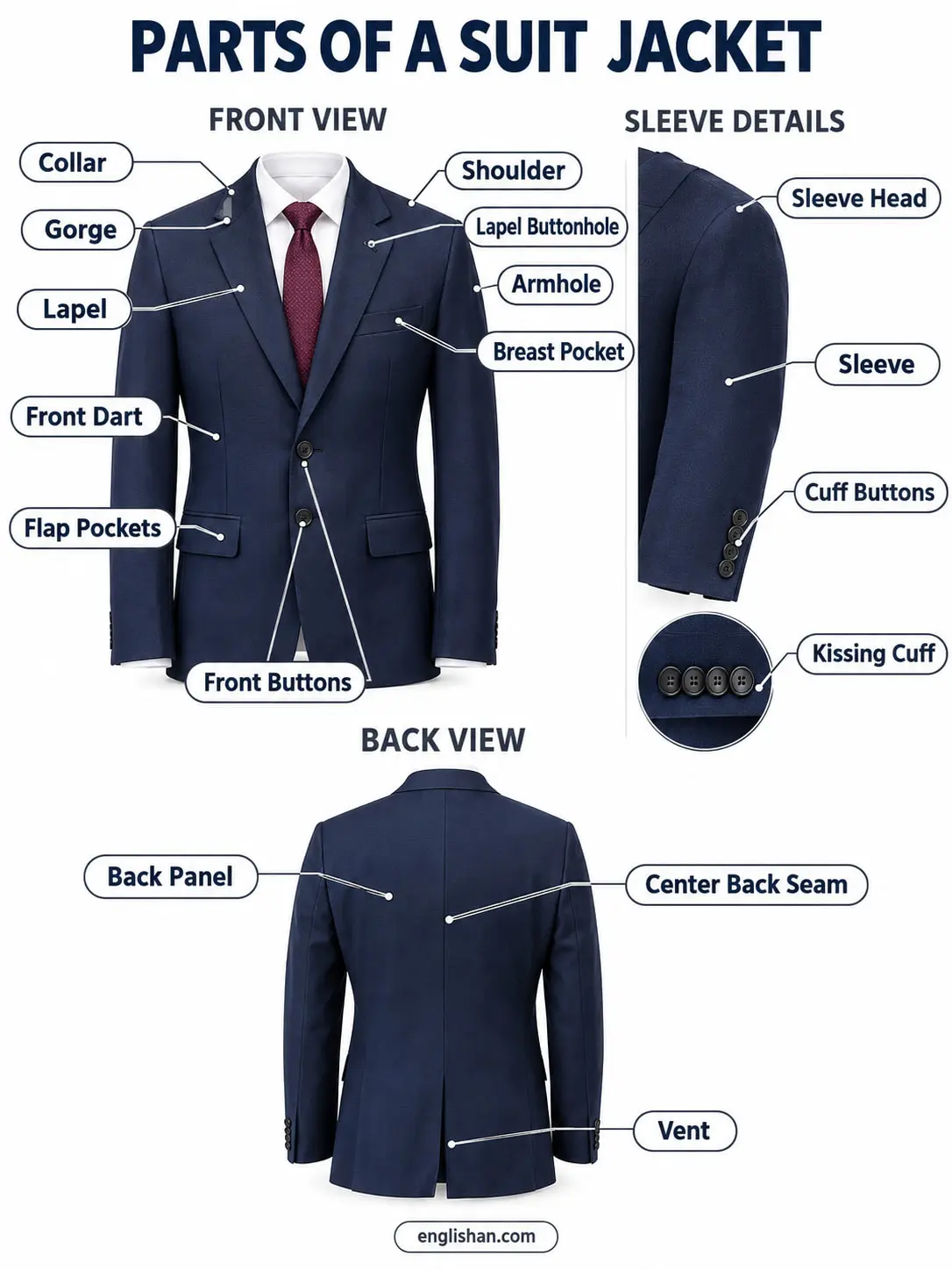
The collar and the lapels surround the shirt collar and the tie. These parts of a suit decide how formal the jacket looks.
Collar
The collar is a band of cloth sewn around the back of the neck, with an under collar of felt beneath it. It meets the shirt collar at the nape. The shirt page names the collar stand that rises under it.
Lapel and Gorge
The lapel is the folded front edge of the jacket that turns back from the collar. The gorge is the seam where the lapel meets the collar. A notch lapel has a 75 to 90 degree notch at the gorge. It is the most common style on single-breasted jackets. A peak lapel has tips angled up toward the shoulders and suits double-breasted jackets. A shawl lapel is a rounded, continuous curve with no notch, and it is cut for tuxedos and dinner suits.
Lapel Buttonhole and Boutonnière
The lapel buttonhole is a slit on the left lapel that holds a boutonnière, a small flower. A single-breasted jacket has one buttonhole on the left. A double-breasted jacket has one on each lapel, with the flower on the left.
Suit Jacket Front Parts
The front of the jacket holds the buttons, the pockets, and the darts, and these parts of a suit close and shape the chest.
Front Buttons
A single-breasted jacket has two or three front buttons, and four or more is unusual. Dinner jackets have one, and the bottom button is left open. A double-breasted jacket has six buttons in pairs, and only two of them fasten. An anchor button, hidden inside the front, holds the overlap in place.
Pockets
The breast pocket is a narrow welt pocket on the left chest. Hip pockets are jetted, flapped, or patched. A jetted pocket is a slit finished with a narrow strip of cloth, and it is the most formal. A flap pocket has a cover that tucks in or hangs out. A ticket pocket is a small pocket over the right hip pocket, about half as wide. Hacking pockets are slanted, a style that began on riding jackets.
Button Stance
Among the front parts of a suit, the button stance is the position of the top front button on the jacket. A high stance lengthens the lapel line, and a low stance opens the chest. It sets the proportions of the whole jacket.
Patch Pocket and Pocket Square
Among the pocket parts of a suit, a patch pocket is sewn onto the outside of the jacket. It is the most casual pocket style. A pocket square is a folded handkerchief placed in the breast pocket for color and finish.
Front Darts
Front darts are tapered folds sewn into the front panels from the hip pocket line toward the waist. They draw the cloth in at the waist, so the jacket follows the torso instead of hanging straight.
Suit Jacket Sleeve and Back Parts
The sleeves and the back are cut from several panels. The parts of a suit at the shoulder decide how sharp the outline looks.
Shoulder and Shoulder Pad
The shoulder is the seam across the top of the arm, built over a shoulder pad of wadding. The pad squares the shoulder line and keeps the cloth smooth. Softer jackets use a thin pad or none.
Structured and Natural Shoulders
Among the shoulder parts of a suit, a structured shoulder is padded. It gives a sharp, square line across the top of the arm. A natural shoulder has little or no padding and follows the body, so the jacket looks relaxed.
Sleeve and Sleeve Buttons
The sleeve is a tube of cloth set into the armhole, with a seam along the underarm. Sleeve buttons are three or four buttons at the cuff edge, and they are decorative on most suits. A surgeon’s cuff has working buttonholes, a mark of a high-end or bespoke jacket.
Sleeve Head and Armscye
Among the sleeve parts of a suit, the sleeve head is the padded cotton cap at the top of the sleeve. It meets the shoulder. The armscye is another name for the armhole, the curved opening in the body of the jacket. A set-in sleeve is sewn into the armscye, and a raglan sleeve runs from the collar to the underarm.
Kissing Cuff
A kissing cuff is a pair of cuff buttons whose edges meet without overlapping. It is a mark of precise tailoring.
Back and Vents
The back is cut as two panels joined by a center back seam. A vent is a slit in the back hem that lets the jacket open when the body bends. A single vent is at the center, double vents are at each side, and a ventless jacket has none. A hook vent is a style linked to American Ivy suits. Dinner jackets traditionally have no vent.
Suit Jacket Inner Parts
The inner parts of a suit give the jacket its shape and its comfort, and they are hidden under the cloth.
Canvas
The canvas is a layer of interfacing between the cloth and the lining. A floating canvas is stitched by hand, and it molds to the body over time. A fused canvas is glued in place, which is the method for cheaper jackets.
Lining
The lining is the inner layer of smooth fabric, such as viscose, silk, or polyester. It lets the jacket slide over the shirt and covers the seams and the canvas.
Inside Pocket
An inside pocket is a welt pocket sewn into the lining at the chest. Most jackets have one on the left and a smaller one on the right. Some jackets add a pen pocket over the first.
Suit Construction Parts
Construction decides how a jacket holds its shape, and these parts of a suit are hidden inside the cloth.
Full Canvas
A full canvas jacket has a hand-sewn canvas layer from the shoulder to the hem. It is the highest standard of construction, and it molds to the body over years of use.
Half Canvas
A half canvas jacket has canvas only in the chest and the lapels, with a lighter lower body. It costs less than a full canvas jacket and keeps the shape of the front.
Fused Construction
A fused jacket has its cloth glued to a synthetic interlining. It is the least costly method, and the glue bubbles or stiffens with time.
Interlining
The interlining is the hidden layer, such as haircloth or fusible interfacing, that shapes the drape of the cloth. Canvas and fused interlining are the two main types.
Underarm Shields
Underarm shields are linings sewn under the arms to protect the cloth from perspiration. A tailor replaces them when the fabric wears thin.
Stitching
Among the construction parts of a suit, single stitching uses one thread and wears faster. Double stitching uses two threads and holds longer, and hand stitching is the top standard of craft.
Suit Waistcoat Parts
The waistcoat is the sleeveless vest of a three-piece suit, and it adds its own parts to the suit.
Waistcoat
The waistcoat is cut in the same cloth as the jacket and trousers. It has a V-shaped front opening, and the back is lining fabric. Some waistcoats have lapels. A pocket watch chain passes through a middle buttonhole.
Waistcoat Buttons and Back Strap
The waistcoat buttons run down the front in a single row, and the bottom button is left open. A back strap is an adjustable strap with a buckle at the back that tightens the waistcoat to the waist.
Waistcoat Styles and Back Styles
Among the waistcoat parts of a suit, a single-breasted waistcoat has one column of buttons. A double-breasted waistcoat has overlapping panels and two columns, and it is more formal. The back is a full back in suit cloth, a belt back with a cinch strap, or an adjustable back. The front tips are the lower corners of the waistcoat, and they reach the trouser waistband. The neckline is cut in a V or a U.
Suit Trousers Parts
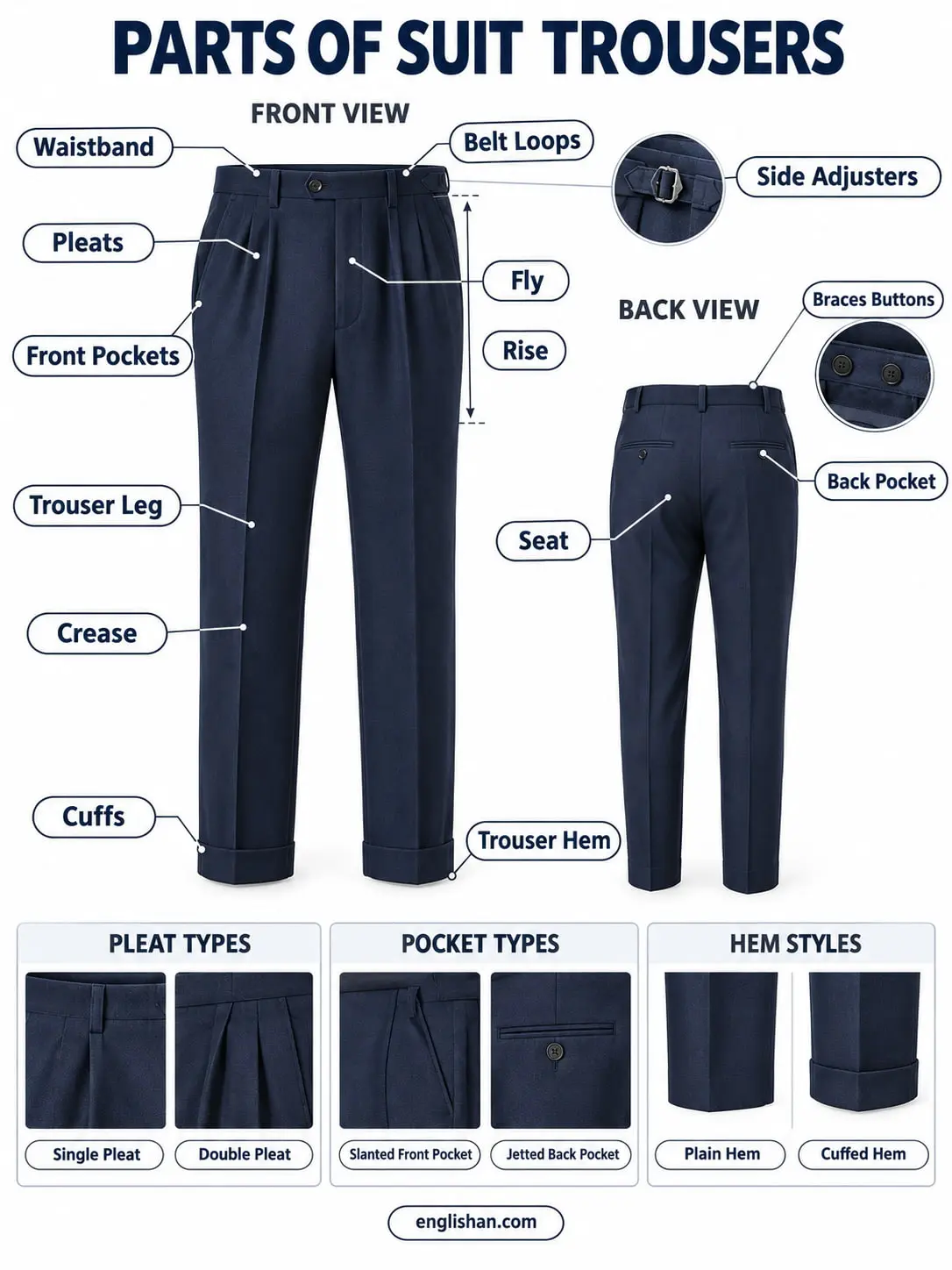
The trousers hang from the waistband to the hem. The parts of a suit from the waist down are cut from the same cloth as the jacket. The trousers page names the parts of jeans and casual pants.
Waistband and Belt Loops
The waistband is a stiffened band at the top of the trousers, closed by a hook and a button. Belt loops are short loops of cloth sewn around it to hold a belt. Trousers cut for braces have extra height at the back and a fishtail split in the waistband.
Side Adjusters
Among the trouser parts of a suit, side adjusters are buckle or button tabs on the hips of the waistband. They tighten the waist without a belt, and they replace belt loops on some trousers.
Fly
The fly is the front opening of the trousers, closed by a zipper with a button and hook at its top. The zipper page names the tape and the slider.
Pleats and Crease
Pleats are folds stitched into the front under the waistband. Most classic trousers have two forward pleats, and flat-front trousers have none. The crease is a pressed line down the front of each leg.
Pockets
Front pockets are slanted openings cut into the side seams. The back pocket is a welt pocket on the right, closed by a button.
Pleat Types and Seam Pockets
Pleats are single or double. They face forward or reverse. Forward pleats open toward the pockets, and reverse pleats open toward the fly. Vertical seam pockets are set into the side seam, and jetted back pockets are slits at the back.
Rise and Seat
The rise is the distance from the crotch seam to the top of the waistband. A high rise ends at the natural waist, and a low rise rests on the hips. The seat is the panel across the back of the hips.
Cuffs and Hem
The hem is the lower edge of each leg. A cuff, or turn-up, is a hem folded up and stitched outside the leg. The style became popular in the 1890s and is informal. The break is the fold that forms where the hem meets the shoe. European tailoring favors a short hem with little or no break, and American tailoring favors a slight break.
Braces Buttons
Braces buttons are buttons sewn inside the waistband, and they hold the clips of a pair of braces. They are placed on the inside of the waistband on modern trousers.
Suit Styles and Their Added Parts
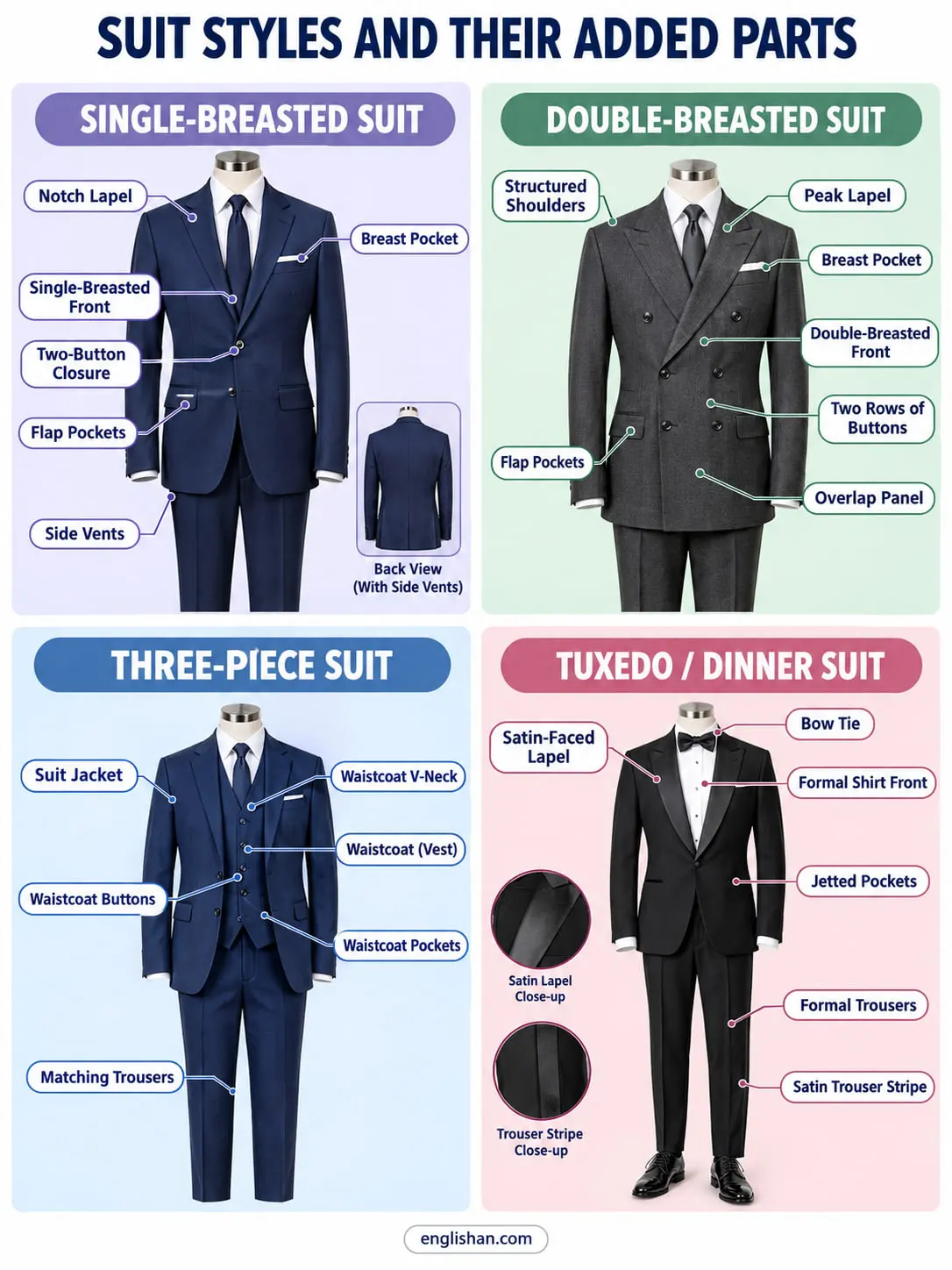
The parts of a suit change with the style, because the cut of the front, the lapel, and the vest alter the jacket.
Single-Breasted Suit
A single-breasted suit has one row of buttons, a notch lapel, and an overlap of one button width. It is the most common style.
Double-Breasted Suit
A double-breasted suit has two rows of buttons, a deep overlap, and peak lapels. Its front panels cross over the chest and fasten with the buttons on the inner row.
Two-Piece Suit
A two-piece suit is a jacket and trousers in the same cloth. It is the base style, and every other style adds to it.
Three-Piece Suit
A three-piece suit adds a waistcoat to the jacket and trousers, all in one cloth. The jacket is cut with a shorter front opening so the waistcoat shows.
Tuxedo
A tuxedo, or dinner suit, has a shawl lapel, one front button, and no vent. The other tuxedo parts of a suit match a business suit. A satin facing covers the lapels, and a stripe runs down each trouser leg. A black tie goes with it, and the necktie page names the knot and blade.
Related:
FAQs
FAQs
The parts of a suit are the jacket, the trousers, and in a three-piece suit the waistcoat. The jacket has a collar, lapels, front buttons, pockets, sleeves, vents, canvas, and lining. The trousers have a waistband, belt loops, a fly, pleats, pockets, and a hem.
A suit jacket has a collar, lapels, a gorge, front buttons, a breast pocket, and hip pockets. It also has sleeves with cuff buttons and a back with one or two vents. Inside are the canvas, the lining, and inside pockets, and a shoulder pad shapes the shoulder.
A tailor shortens the sleeves at the cuff, takes in the waist through the side seams, and shortens or lengthens the trouser hem. The trouser waistband is let out or taken in at the center back seam. The shoulders and the collar are rebuilt only with difficulty.
A three-piece suit has a jacket, a waistcoat, and trousers, all in the same cloth. The waistcoat adds a V-front, a row of buttons, and a back strap to the jacket and trousers.
A double-breasted suit has the same parts as a single-breasted suit, with two rows of buttons, a deep overlap, and peak lapels. Six buttons is typical, and two of them fasten.
A tuxedo has a shawl lapel, a single front button, no vent, and satin facings on the lapels. The trousers have a satin stripe down each leg. The rest of the jacket and trousers match a business suit.
The three types of lapels are notch, peak, and shawl. A notch lapel has a notch at the gorge and fits single-breasted jackets. A peak lapel angles its tips upward, and a shawl lapel is a rounded curve used on tuxedos.
