

Trousers have a front and a back, and the parts of trousers differ from one side to the other. The fly, the front pockets, and the front rise are cut into the front.
The yoke, the back pockets, and the back rise are cut into the back. The waistband joins both sides at the top, the inseam and outseam join the legs, and the hem finishes the bottom.
Parts of Trousers Labeled on the Front and Back
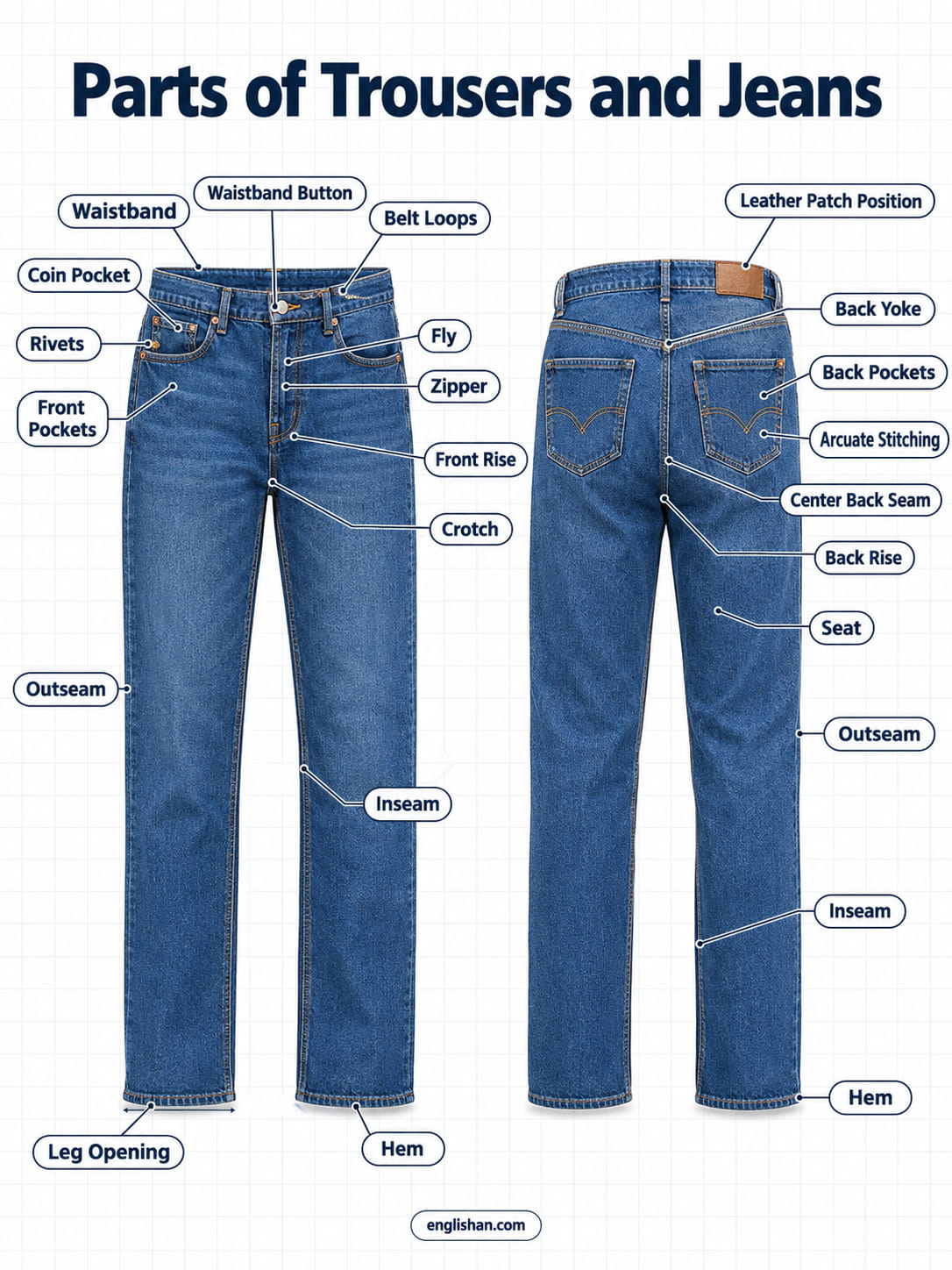
The waistband and belt loops are at the top of the trousers, and the fly is cut into the center front under them. The front pockets are set into the side seams, and the back pockets are stitched to the back panels. Two legs extend from the crotch to the hem. These are the parts of trousers, and the pant parts names in English match them one to one. In the United States, the same garment is called pants, while trousers names a tailored pair with a creased leg.
| Part | Where you find it |
|---|---|
| 1. Waistband | Strip of fabric sewn around the top edge |
| 2. Waistband lining | Inner facing of the waistband against the skin |
| 3. Belt loops | Fabric loops stitched at intervals around the waistband |
| 4. Waistband button | Round fastener at the end of the waistband |
| 5. Hook and bar | Flat metal closure inside the waistband end |
| 6. Drawstring | Cord threaded through the waistband on casual pants |
| 7. Elastic waistband | Stretch band sewn into pull-on pants |
| 8. Fly | Front opening cut into the center front |
| 9. Zipper | Toothed closure sewn into the fly |
| 10. Button fly | Row of buttons that closes the fly |
| 11. Fly shield | Fabric layer behind the fly that covers the zipper |
| 12. Placket | Folded strip that finishes the edge of the fly |
| 13. French fly | Inner tab that fastens the fly on tailored trousers |
| 14. Front rise | Distance from the crotch seam to the top of the front waistband |
| 15. Back rise | Distance from the crotch seam to the top of the back waistband |
| 16. Crotch | Point where the leg seams meet |
| 17. Crotch seam | Curved seam joining the two legs |
| 18. Gusset | Fabric insert that adds room at the crotch |
| 19. Seat | Part of the back panel that covers the hips |
| 20. Front pocket | Opening cut into the side seam or the front panel |
| 21. Pocket lining | Fabric bag stitched behind each pocket opening |
| 22. Coin pocket | Small pocket set inside the right front pocket |
| 23. Back pocket | Pocket stitched to or set into the back panel |
| 24. Welt pocket | Pocket with a narrow strip on each side of the opening |
| 25. Patch pocket | Pocket stitched flat onto the outside of the panel |
| 26. Cargo pocket | Large pocket with a flap on the side of the leg |
| 27. Rivets | Metal studs at the corners of jeans pockets |
| 28. Arcuate | Curved double stitching on jeans back pockets |
| 29. Back yoke | Shaped panel across the top of the back |
| 30. Darts | Tapered folds sewn at the back waist |
| 31. Pleats | Folds sewn into the front under the waistband |
| 32. Crease | Pressed vertical line down the center of each leg |
| 33. Inseam | Seam on the inside of the leg |
| 34. Outseam | Seam on the outside of the leg |
| 35. Side seam | Seam joining the front and back panels at the hip |
| 36. Flat-felled seam | Double-folded seam with two parallel lines of stitching |
| 37. Topstitching | Visible line of stitching beside a seam or an edge |
| 38. Bartack | Short dense stitch at pocket corners and the fly end |
| 39. Thigh | Length of leg between the crotch and the knee |
| 40. Knee | Length of leg at the midpoint of the inseam |
| 41. Knee lining | Partial lining of the front leg on tailored trousers |
| 42. Leg opening | Width of the leg at the bottom edge |
| 43. Hem | Folded and stitched bottom edge of each leg |
| 44. Cuff | Folded band at the hem, called a turn-up in the UK |
| 45. Main label | Brand label at the back of the waistband |
| 46. Care label | Sewn tag inside the waistband with fiber and wash codes |
Trouser Waistband Parts and Closures
The waistband is the top edge, and the belt loops, the button, and the hook and bar are attached to it. Among the parts of trousers, these fix the garment at the waist.
Waistband
The waistband is a strip of fabric sewn around the top edge of the trousers. A tailored waistband is cut straight or curved to follow the waist, and a jeans waistband is a double layer of denim. A waistband lining is stitched inside, against the skin.
Belt Loops
Among the parts of trousers, belt loops are short fabric loops stitched at intervals around the waistband to keep a belt in place. Jeans have five belt loops on most pairs, and the count ranges from five to seven. A loop is secured with a bartack at the top and the bottom.
Waistband Button and Hook and Bar
The waistband button is the round fastener at the end of the waistband, and the buttonhole is cut in the opposite end. Tailored trousers add a hook and bar inside the waistband to take the strain off the button. Jeans use a metal button in place of the hook and bar.
Drawstring and Elastic Waistband
A drawstring is a cord threaded through a channel in the waistband, and an elastic waistband is a stretch band sewn into it. Joggers, sweatpants, and pull-on pants use these in place of a fly and a button. The waistband is then cut straight with no belt loops.
Waistband Labels
The main label is the brand label at the back of the waistband, one of the smallest parts of trousers. A care label is sewn inside the waistband with the fiber and wash codes. A leather or faux leather patch is stitched to the back waistband on jeans.
Parts of a Pant Fly
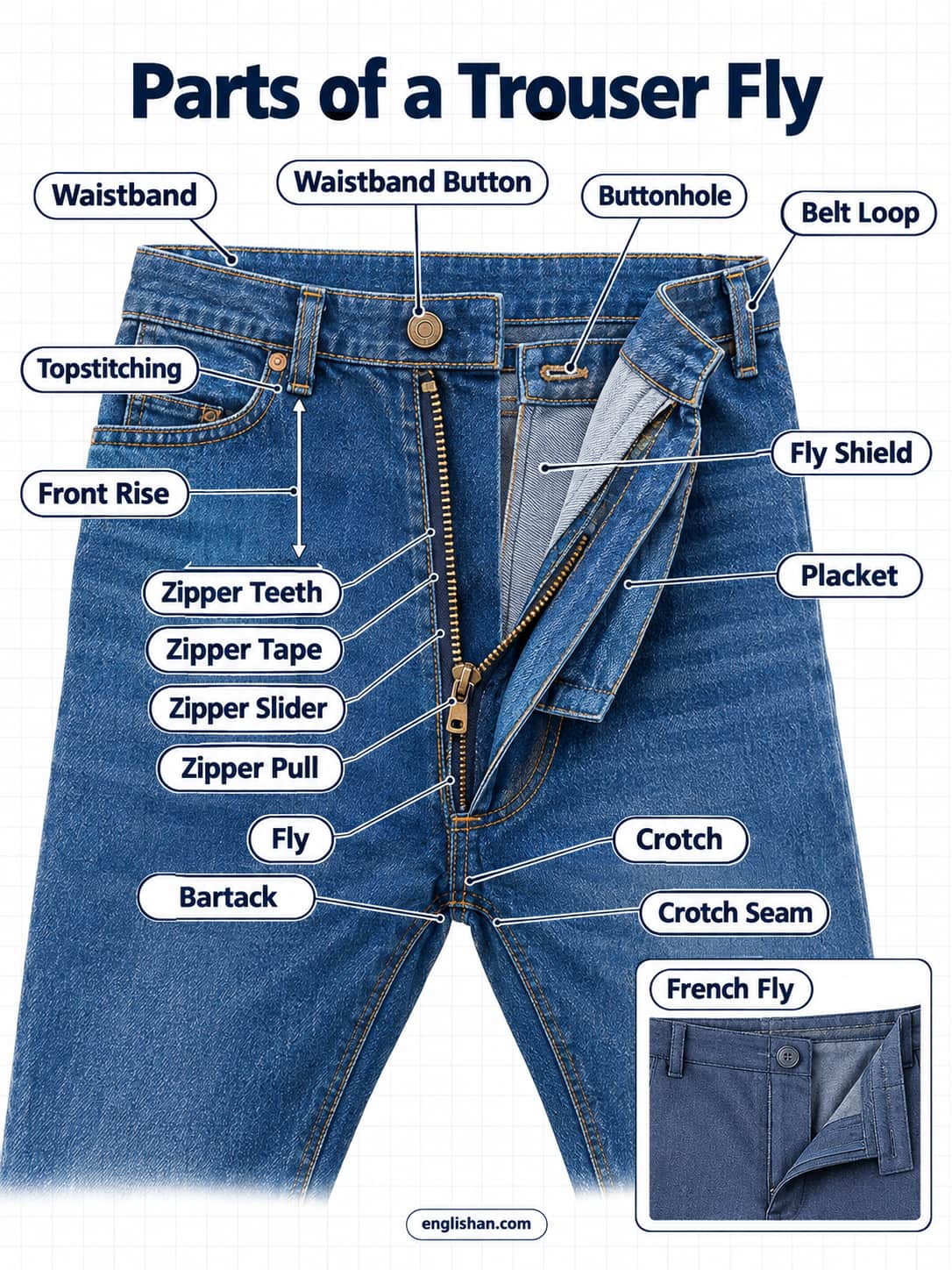
The fly is the front opening, and its parts are the zipper or buttons, the fly shield, and the placket. These parts of trousers are stitched in a fixed order.
The fly is the front opening cut into the center front, from the waistband down toward the crotch. It is the most recognizable of the parts of trousers. A J-shaped line of topstitching marks the edge of the fly on most pairs. The fly ends in a bartack, which closes the opening at the base.
Zipper and Button Fly
A zipper fly closes with a zipper sewn between two folded edges, and a button fly closes with a row of buttons and buttonholes. Jeans are made with either type, and the button fly is the older one. The zipper page names the tape, teeth, slider, and pull.
Fly Shield
The fly shield is a layer of fabric stitched behind the fly opening that covers the zipper. It keeps the teeth from touching the skin. A double fly shield is two layers of fabric.
Placket and French Fly
The placket is a folded strip of fabric that finishes the edge of the fly. A French fly is an inner tab, found on tailored trousers, that fastens at the waistband. It is the same piece as the extension on a suit trouser.
Rise and Crotch Parts of Trousers
The rise and the crotch form the center of the garment, where the front panels and the back panels meet. These parts of trousers set how high the waistband is worn.
Rise
The rise is the distance from the crotch seam to the top of the waistband. The front rise is measured on the front panel and the back rise on the back panel. A back rise is cut longer than a front rise. Low, mid, and high rise name the three lengths.
Crotch and Crotch Seam
The crotch is the point where the leg seams meet, and the crotch seam is the curved seam that joins the two legs. Four seams meet at the crotch, which makes it the point of highest strain. On jeans, the crotch seam is flat-felled.
Gusset
A gusset is a small diamond or triangle of fabric inserted at the crotch to add room and reinforce the join. It is added to work pants and activewear to give room at the crotch.
Seat
The seat is the part of the back panel that covers the hips. It extends from the back rise down to the bottom of the crotch seam. The seat fit depends on the back rise and the yoke.
Pocket Parts of Trousers and Jeans
Pockets are cut into the front and back, and each type has its own opening and lining. Among the parts of trousers, the pockets range from the front pocket to the cargo pocket.
Front Pockets
The front pockets are cut into the side seam or the front panel, one at each hip. A slant pocket opens on a diagonal line, and an on-seam pocket opens along the side seam. Jeans front pockets are cut in a curve, called a scoop.
Pocket Lining
The pocket lining, or pocket bag, is the fabric pouch stitched behind the pocket opening. It is cut from a lighter cotton or poly-cotton than the outer fabric. The lining is sewn to the facing and to the waistband.
Coin Pocket
The coin pocket is a small pocket set inside the right front pocket, near the opening. It is also called the watch pocket or the fifth pocket on jeans. A five-pocket pair has two front pockets, two back pockets, and this one.
Back Pockets
The back pockets are stitched to or set into the back panels. Jeans have two patch pockets, each topstitched and bartacked at the corners. Tailored trousers have one or two welt pockets with a button or a flap.
Welt Patch and Cargo Pockets
A welt pocket has a narrow strip of fabric on each side of the opening, and it is also called a jetted pocket. A patch pocket is stitched flat onto the outside of the panel. A cargo pocket is a large patch pocket with a flap on the side of the leg.
Seam and Stitching Parts on Pants
The seams join the panels, and stitching finishes the edges and reinforces the stress spots. The parts of trousers in this group are the inseam, the outseam, the yoke, and the stitch types.
Inseam
The inseam is the seam on the inside of the leg, from the crotch to the hem. Of all the parts of trousers, it is the one that sets leg length. On jeans it is flat-felled to resist strain.
Outseam and Side Seam
The outseam is the seam on the outside of the leg, from the waistband to the hem. The side seam is the upper part of it at the hip, where the front pocket is cut in. The outseam is longer than the inseam by the length of the rise.
Back Yoke
The back yoke is the shaped panel across the top of the back, under the waistband. It is cut straight, in a V, or in a sweetheart shape, and it shapes the waist into the seat. Tailored trousers use darts in their place.
Flat-Felled Seam and Topstitching
A flat-felled seam is folded over twice and stitched with two parallel lines, so no raw edge is exposed. Topstitching is the visible line of stitching beside a seam or an edge.
Bartack
A bartack is a short, dense zigzag stitch at pocket corners and at the end of the fly. It reinforces the stress spots, and jeans have several. The belt loops are also secured with a bartack at the top and the bottom.
Pleat and Dart Parts of Trousers
Folds on trousers are sewn in as pleats and darts or pressed in as a crease. Among the parts of trousers, these shape the garment from the waist to the hem.
Pleats
Pleats are folds sewn into the front under the waistband, facing either the pocket or the fly. They add volume and room for movement at the hip. Flat-front trousers have darts and no pleats.
Darts
Darts are tapered folds sewn at the back waist to shape the fabric to the hips. They remove the extra width between the waist and the hip. Tailored trousers use darts where jeans use a yoke.
Crease
The crease is a pressed vertical line down the center of each trouser leg. It is set with heat and moisture, or stitched in permanently. It is also called the traveler’s crease, and a trouser press sets it.
Trouser Leg and Hem Parts
The leg is the lower half of the trousers, and its parts are the thigh, the knee, the leg opening, and the hem. Among the parts of trousers, these set the silhouette from slim to wide.
Thigh and Knee
The thigh is the length of leg between the crotch and the knee. The knee is the length at the midpoint of the inseam. Both are measured around the leg, and they set the cut of the leg: slim, straight, tapered, or relaxed.
Knee Lining
A knee lining is a partial lining of the front leg, stitched inside from the waistband to the knee. It is found on tailored wool trousers, where it reduces friction against the skin.
Leg Opening and Hem
The leg opening is the width of the leg at the bottom edge, and the hem is the folded and stitched edge of it. Bootcut, straight, and wide-leg trousers differ in leg opening. A plain hem is turned up once, and a chainstitch hem gives premium denim its rope effect.
Cuff
A cuff is a band of fabric folded up at the hem of each leg. It is one of the dressier parts of trousers. It is called a turn-up in the UK. A cuff adds weight to the leg and is stitched to the hem at the inseam and the outseam.
Parts of Jeans
Jeans are trousers in denim with riveted stress spots. The parts of jeans add rivets, an arcuate, and a patch to the parts of trousers. The five-pocket pattern, the yoke, and the topstitching define the type.
Rivets
Rivets are metal studs set at the pocket corners and the base of the fly to reinforce stress spots. They were added to work pants in 1873.
Arcuate and Orange Thread
The arcuate is the curved double stitching on the back pockets of jeans. It is stitched with heavy cotton-poly thread, in orange on many pairs, to match the brass rivets. Each brand has its own arcuate shape, and the stitching is bartacked at the corners.
Metal Button and Leather Patch
The metal button closes the waistband of jeans, and a second set of metal buttons closes a button fly. The leather patch is stitched to the back waistband and shows the brand and the waist and length sizes. Most patches are now faux leather.
Pant Types and Their Parts
The parts of trousers change with the type of garment. Cargo pants, joggers, and pleated trousers each add or remove a few parts.
Cargo Pants
Cargo pants add two large flapped patch pockets on the sides of the legs. The pockets are secured with snaps, hook-and-loop tape, or buttons.
Joggers and Sweatpants
Joggers have an elastic waistband, a drawstring, and elastic cuffs at the hem. They have no fly, no belt loops, and no back yoke.
Pleated and Flat-Front Trousers
Pleated trousers have one or two pleats under each side of the waistband. Flat-front trousers have none and fit closer through the hip.
Related:
FAQs
The parts of trousers are the waistband, belt loops, fly, pockets, rise, crotch, inseam, outseam, and hem. Jeans add rivets, a yoke, and a coin pocket. A tailored pair adds a crease, pleats, and a French fly.
The parts of jeans are the waistband, belt loops, button, fly, front pockets, coin pocket, back pockets, rivets, yoke, inseam, and hem. The curved stitching on the back pockets is the arcuate. Bartacks reinforce the stress spots.
The bottom of the trousers is the hem, the folded and stitched edge of each leg. The width of the opening is the leg opening. A folded band at the hem is a cuff, or a turn-up in the UK.
The inseam is the seam on the inside of the leg, measured from the crotch to the hem. The outseam is the seam on the outside of the leg, measured from the waistband to the hem. The outseam is the longer of the two.
The rise is the distance from the crotch seam to the top of the waistband. Front rise and back rise are measured separately. Low, mid, and high rise name the three lengths.
Among the parts of trousers, the folds sewn into the front under the waistband are pleats. Tapered folds at the back waist are darts. A pressed line down the leg is a crease.
Trousers is the term for a tailored pair with a fly, a waistband, and a creased leg. Pants is the broader and more common word in the United States for the same garment and for casual types.