

Migration animals names include some of nature’s most powerful survival strategies. Every year a small Arctic tern weighing barely four ounces flies from the Arctic to Antarctica and back again. That round trip covers nearly 70,000 kilometers, the equivalent of circling the Earth almost twice.
Migration animals names represent some of the greatest travelers alive. Wildebeest thundering across the Serengeti. Monarch butterflies drifting from Canada to Mexico. Humpback whales crossing ocean basins. Salmon fighting their way upstream to the rivers where they were born.
This article gives you the complete list of migration animals names across every category, the science of how they navigate, the world’s most famous migrations, and the threats these journeys now face
What Is Animal Migration?
Animal migration is the seasonal, large-scale movement of animals from one region to another and back again. Unlike simple wandering, true migration is directional (toward a specific destination), seasonal (at predictable times of year), and cyclical (animals make a return journey).
The fundamental drivers are food, breeding, and survival. When resources disappear in one location, animals move to where conditions are better. When the season reverses, they return.
Explore more animals that start with different letters:
A | B | C | D | E | F | G | H | I | J | K | L | M | N | O | P | Q | R | S | T | U | V | W | X | Y | Z
Migration vs Related Behaviors
| Behavior | Definition | Example |
|---|---|---|
| Seasonal Migration | Regular movement between seasonal ranges | Arctic tern, wildebeest |
| Nomadism | Irregular movement following unpredictable resources | Desert locust |
| Dispersal | One-way movement away from birthplace | Young mammals leaving home range |
| Natal Homing | Returning to birthplace to reproduce | Salmon, sea turtles |
| Hibernation | Staying put, entering dormancy | Bears, groundhogs |
Types of Animal Migration
Seasonal (Latitudinal) Migration – Animals move toward the poles in summer following food abundance and return toward the equator in winter. Most migratory birds follow this pattern.
Altitudinal Migration – Animals move up mountains in summer and down to valleys in winter. Elk, mountain goats, and various bird species follow altitudinal routes.
Transoceanic Migration – Animals cross entire ocean basins. The Arctic tern crosses the Atlantic; humpback whales traverse the Pacific; leatherback turtles cross from Asia to North America.
Natal Homing – Animals return to the exact location where they were born to reproduce, sometimes after years and thousands of miles away. Salmon navigate back to the precise stream where they hatched. Loggerhead turtles return to their birth beach decades later.
Irruptive Migration – Irregular migration driven by food failure rather than season. When food sources collapse, species like snowy owls and crossbills move southward in large numbers unpredictably.
Reproductive Migration – Movement specifically to reach better breeding grounds. Many whales migrate from cold feeding waters to warm tropical seas for calving.
Complete List of Migration Animals Names by Category
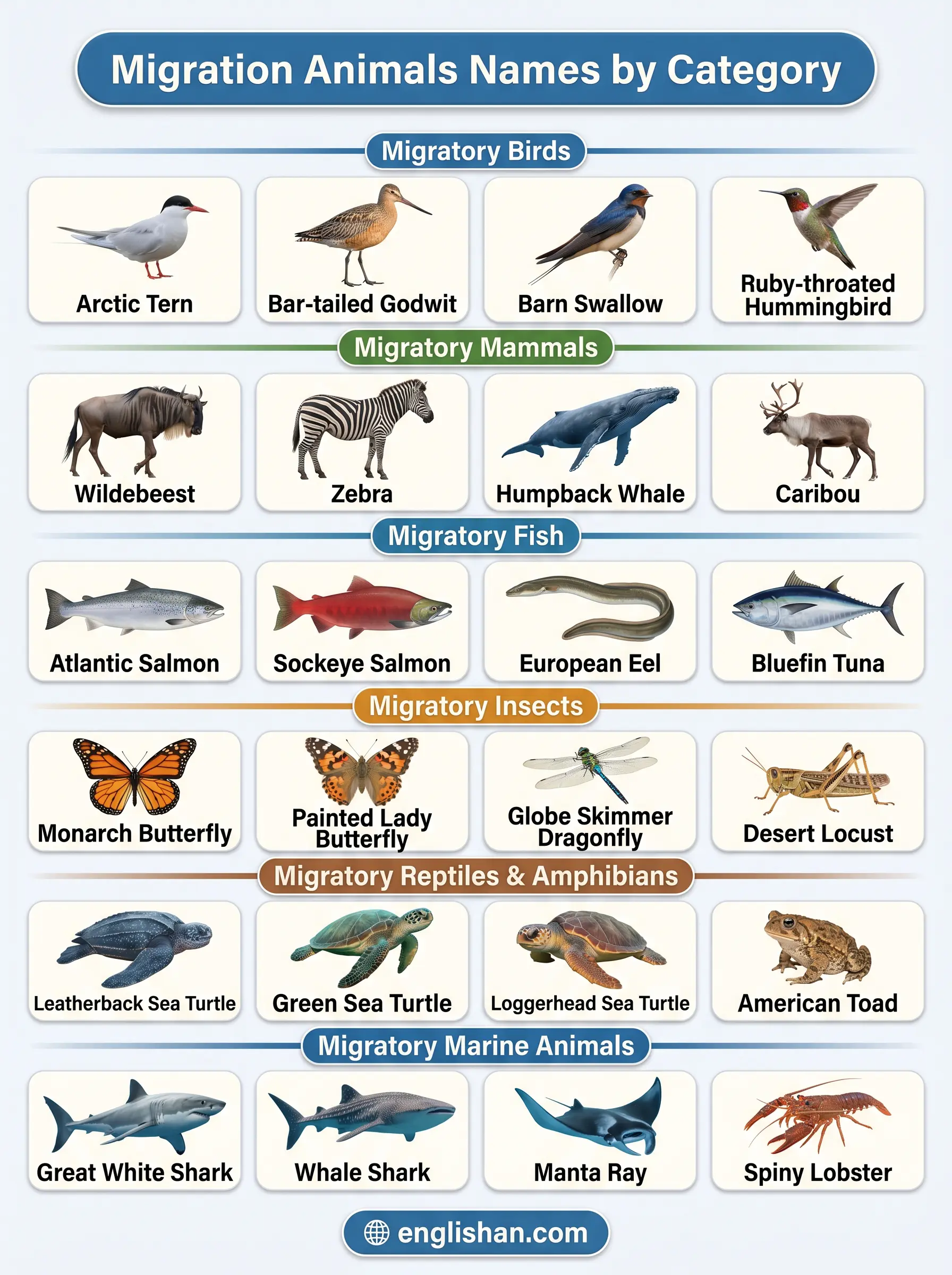
Animal migration is a natural seasonal movement where animals travel long or long-distance areas to find food, suitable climate, or breeding places. It is a key survival behavior seen across many species, including birds, mammals, fish, and insects.
Migratory Birds Names
- Arctic Tern – Migrates from Arctic to Antarctic each year, covering approximately 70,000 km round trip, the longest migration of any animal on Earth.
- Bar-tailed Godwit – Holds the record for the longest non-stop flight. One individual flew 13,560 km from Alaska to Tasmania in 11 days without landing or eating.
- Barn Swallow – Breeds across the Northern Hemisphere and winters in South America, Africa, and South Asia. One of the world’s most widely distributed migratory birds.
- Ruby-throated Hummingbird – Weighs just 3 grams but crosses the Gulf of Mexico non-stop each spring, covering 900 km over open water.
- Whooping Crane – One of the rarest birds on Earth, migrating between Canada and Texas. Conservation efforts have brought it back from just 21 wild individuals in the 1940s.
- Snow Goose – Migrates in flocks of hundreds of thousands between Arctic breeding grounds and Gulf Coast marshes.
- Canada Goose – Famous for V-formation flights across North America between northern breeding grounds and southern wintering areas.
- Mallard Duck – The world’s most common duck, migrating seasonally across the Northern Hemisphere along ancient flyways.
- Peregrine Falcon – The fastest animal on Earth also migrates impressively, with some Arctic-breeding birds traveling 25,000 km round trip to South America.
- Osprey – A fish hunter that migrates from the Northern Hemisphere to tropical regions, with some birds crossing the Sahara non-stop.
- Blackpoll Warbler – A tiny songbird that flies up to 2,770 km non-stop from New England to South America in just 3 days over open ocean.
- Common Swift – Can remain airborne for up to 10 months, eating, sleeping, and mating on the wing. Lands only to nest.
- White Stork – Migrates from Europe to sub-Saharan Africa following two major routes: via Gibraltar in the west or the Bosphorus in the east.
- Sandhill Crane – One of the most ancient living bird species, using the same North American flyways for approximately 2.5 million years.
- Common Cuckoo – Migrates from Europe to sub-Saharan Africa. Satellite tracking revealed some birds cross via the Congo rainforest, others via the Nile Valley.
- Sooty Shearwater – Completes a figure-eight migration around the Pacific Ocean, traveling up to 65,000 km annually.
- Amur Falcon – A tiny raptor that crosses the Arabian Sea non-stop from India to East Africa, approximately 3,000 km over open water.
- Northern Pintail – Migrates from Arctic breeding grounds to wintering areas in the southern US, Mexico, and Asia. Among the first ducks to move north in spring.
- European Roller – A jewel-colored bird migrating from Europe and Central Asia to eastern and southern Africa each autumn.
- Bald Eagle – Northern populations migrate south in winter following food sources, particularly open water for fish.
Mammals That Migrate
- Wildebeest – 1.5 million wildebeest move in a clockwise circuit through Tanzania and Kenya each year following seasonal rains, the largest land migration on Earth.
- Zebra – Migrates alongside wildebeest in East Africa. Botswana’s zebra migration, from the Okavango Delta to the Makgadikgadi salt pans, is the longest documented land migration in Africa at 500 km.
- Humpback Whale – Migrates up to 8,500 km from polar feeding grounds to tropical breeding waters. Famous for its complex songs sung on breeding grounds.
- Gray Whale – Travels up to 20,000 km round trip between Arctic feeding grounds and Mexican calving lagoons, one of the longest mammal migrations.
- Blue Whale – The largest animal on Earth moves from cold polar feeding grounds to warmer tropical seas for breeding. Migration routes are still being mapped.
- Caribou (Reindeer) – Undertakes the longest land mammal migration in the world, up to 5,000 km round trip across Arctic tundra between summer calving grounds and winter forest ranges.
- African Elephant – Travels hundreds of kilometers along ancient routes passed down through matriarchal memory over generations. Many of these routes are now fragmented by human development.
- Straw-coloured Fruit Bat – Up to 10 million gather at Kasanka National Park in Zambia each autumn, the largest mammal migration on Earth by number.
- Pronghorn Antelope – Undertakes North America’s longest land mammal migration, up to 500 km between summer and winter ranges in Wyoming and Idaho.
- Moose – Northern populations undertake seasonal altitudinal migrations between mountain summer ranges and lowland winter ranges.
Fish That Migrate
- Atlantic Salmon – Born in freshwater, migrates to the ocean, then returns to the exact stream where it hatched to spawn, navigating by the unique chemical signature of its birth river.
- Sockeye Salmon – Migrates from the Pacific Ocean into North American rivers, swimming hundreds of kilometers upstream without eating, turning bright red on entering freshwater.
- Chinook Salmon – The largest Pacific salmon, traveling over 1,400 km upriver to reach spawning grounds using smell alone.
- European Eel – Lives in freshwater rivers then migrates 6,000 km to the Sargasso Sea to breed. No adult eel has ever been observed spawning there. One of science’s enduring mysteries.
- American Eel – Makes the same journey to the Sargasso Sea. Larvae drift back on ocean currents to North American rivers where they live for decades before returning.
- Bluefin Tuna – Crosses the Atlantic between North American feeding grounds and Mediterranean breeding areas, capable of making the crossing in as little as 60 days.
- Striped Bass – Migrates along the US Atlantic coast between New England summers and southern wintering waters. One of the most popular sport fish in North America.
- Shad – Anadromous fish that once ran in enormous numbers up East Coast rivers in spring. Dams have severely reduced these migrations.
- Steelhead Trout – A migratory form of rainbow trout. Like salmon, steelhead migrate to the ocean and return to rivers to spawn, but some survive to return to the ocean again.
- Atlantic Cod – Migrates seasonally between feeding and spawning grounds across the North Atlantic. Overfishing has dramatically altered these historical patterns.
Insects That Migrate
- Monarch Butterfly – Migrates up to 4,500 km from Canada to central Mexican fir forests. No individual makes the full round trip; the journey takes three to four generations northward in spring, yet the autumn generation finds forests it has never visited.
- Painted Lady Butterfly – The world’s most widespread butterfly completes a multi-generational migration of up to 15,000 km from West Africa to northern Europe and back, only recently discovered through genetic analysis.
- Globe Skimmer Dragonfly – Holds the record for the longest insect migration, traveling up to 18,000 km from India across the Indian Ocean to East Africa and back, following monsoon rains.
- Desert Locust – An irruptive migrant that does not follow predictable routes. Swarms covering hundreds of square kilometers with billions of individuals devastate agriculture across Africa and Asia.
- Bogong Moth – Migrates from Queensland and New South Wales to the Australian Alps each summer to shelter in mountain caves. A traditional food source for indigenous Australians for thousands of years.
Reptiles and Amphibians That Migrate
- Leatherback Sea Turtle – The world’s largest reptile, tracked crossing the entire Pacific Ocean from Indonesia to California, approximately 20,000 km round trip, navigating by the Earth’s magnetic field.
- Green Sea Turtle – One population feeds off Brazil and migrates 2,200 km to Ascension Island in the middle of the Atlantic to nest, finding an island 90 km wide in open ocean with extraordinary precision.
- Loggerhead Sea Turtle – Imprints on the magnetic field of its birth beach and returns to nest there decades later. Young loggerheads complete a circular migration across the entire North Atlantic before returning as adults.
- American Toad – Migrates in mass movements to breeding ponds each spring, often crossing roads en masse. Organized “toad patrols” help them cross safely.
- European Common Frog – Returns to the same traditional breeding ponds each spring, sometimes traveling hundreds of meters across terrain to reach them.
Marine Animals That Migrate
- Great White Shark – Tagged individuals have crossed the Pacific from California to Hawaii and back. Spends winter in warm open ocean and summer in coastal feeding areas.
- Whale Shark – The world’s largest fish follows plankton blooms and spawning events across thousands of kilometers in the Indian and Pacific Oceans.
- Manta Ray – Undertakes seasonal migrations of over 1,000 km following plankton blooms between feeding and breeding sites.
- Spiny Lobster – Forms single-file lines of up to 50 individuals and walks across the sea floor each autumn to reach deeper water, one of the most unusual migration behaviors in the ocean.
- Christmas Island Red Crab – 50 million red crabs flood roads and beaches as they march from forest to coast to spawn each year. Special bridges and tunnels have been built to protect them.
The World’s Most Famous Animal Migrations Names
❶ The Great Wildebeest Migration
Where: Tanzania and Kenya
Animals: 1.5 million wildebeest plus zebras and gazelles
When: Year-round circular route
The largest movement of land animals on Earth. Wildebeest follow a clockwise circuit across the Serengeti-Masai Mara ecosystem tracking seasonal rains and fresh grass. The Mara River crossings, where thousands plunge into crocodile-filled water at once, are among the most dramatic wildlife scenes on the planet.
❷ The Monarch Butterfly Migration
Where: North America to central Mexico
Animals: Hundreds of millions of monarchs
When: Autumn migration September to November, spring return March to June
Monarchs gather in Mexican fir forests in numbers so dense their combined weight bends tree branches. The spring and autumn movements through the US are celebrated by communities along the route. The mystery of how the autumn generation finds forests it has never visited remains one of biology’s most compelling questions.
❸ The Salmon Run
Where: Pacific coast rivers of North America
Animals: Chinook, sockeye, coho, chum, and pink salmon
When: Late summer and autumn
Millions of fish fight upstream, jumping waterfalls, battling currents, eating nothing. Bears, eagles, otters, and wolves gather along the banks. When the salmon die after spawning, their bodies carry marine nutrients deep into forest ecosystems.
❹ The Arctic Tern’s Pole-to-Pole Journey
Where: Arctic to Antarctic and back
Animal: Arctic tern
When: Continuous, following polar summers
One bird. Two polar summers. 70,000 km per year. The Arctic tern sees more daylight than any other creature on Earth and, over a 30-year lifetime, travels the equivalent of three round trips to the Moon.
❺ The Christmas Island Red Crab March
Where: Christmas Island, Indian Ocean 333333
Animals: 50 million red crabs
When: October to December
Roads close as millions of crimson crabs move from forest to coast. Dedicated crab bridges and road tunnels have been constructed to protect them. It is one of the greatest wildlife spectacles on Earth.
❻ The Fruit Bat Migration in Kasanka
Where: Kasanka National Park, Zambia
Animals: Up to 10 million straw-coloured fruit bats
When: October to December
The evening emergence of millions of bats from their roost trees darkens the sky. By number, this is the world’s largest mammal migration, with the bats consuming thousands of tons of wild fruit over their stay.
❼ The Caribou Migration
Where: Alaska, Canada, and Russia
Animals: Barren-ground caribou herds
When: Spring northward, autumn southward
Caribou herds of thousands move across Arctic tundra in a river of antlers, following routes used for thousands of years. Climate change is now altering the timing and locations of these journeys.
❽ The Sardine Run
Where: Eastern coast of South Africa
Animals: Billions of sardines
When: May to July
Billions of sardines migrate northward along the South African coast, triggering the greatest marine feeding frenzy on Earth. Dolphins, sharks, whales, seabirds, and humans all converge. Called the Greatest Shoal on Earth.
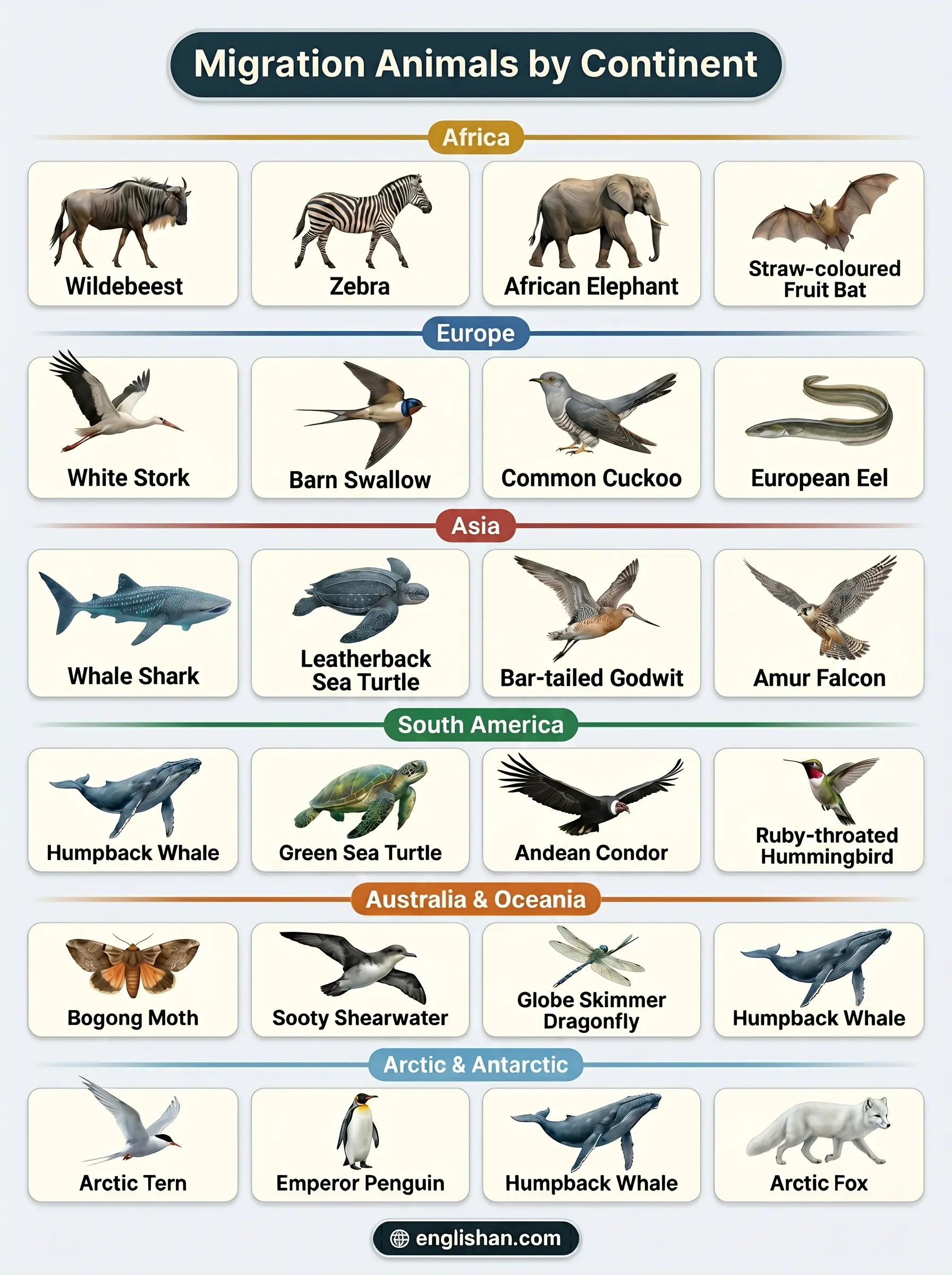
Migration Animals Names by Continent
Migratory Animals of Africa
- Wildebeest – 1.5 million circle through Tanzania and Kenya each year following the rains
- Zebra – Travels with wildebeest in East Africa; Botswana population makes Africa’s longest land migration
- African Elephant – Follows ancient corridors of hundreds of kilometers passed down through family memory
- Straw-coloured Fruit Bat – 10 million gather in Zambia, the largest mammal migration by number on Earth
- Flamingo – Moves between shallow soda lakes in East Africa following rainfall and algae blooms
- White Stork – Uses the continent as its wintering ground after breeding in Europe
- Christmas Island Red Crab – 50 million crabs march to the coast of Christmas Island to spawn
Migratory Animals of North America
- Monarch Butterfly – 4,500 km from Canada to Mexican forests, the most famous insect migration
- Caribou – Up to 5,000 km across the Arctic, the longest land mammal migration on Earth
- Gray Whale – 20,000 km round trip between Alaska and Baja California
- Salmon – Returns to birth rivers from the Pacific Ocean to spawn
- Arctic Tern – Passes through on its pole-to-pole journey of 70,000 km per year
- Sandhill Crane – Half a million stop at Nebraska’s Platte River each spring
- Peregrine Falcon – Some Arctic-breeding birds fly 25,000 km round trip to South America
- Pronghorn Antelope – 500 km between summer and winter ranges through Wyoming
Migratory Animals of Europe
- White Stork – Breeds in Europe, winters in sub-Saharan Africa via Gibraltar or the Bosphorus
- Barn Swallow – One of the most familiar summer visitors to Europe, wintering in Africa
- Common Cuckoo – Migrates from European woodlands to sub-Saharan Africa each autumn
- Atlantic Salmon – Runs up rivers in Scotland, Norway, and Iceland to spawn
- European Eel – Makes the mysterious 6,000 km journey to the Sargasso Sea to breed
- Common Frog – Returns to traditional breeding ponds each spring across the continent
Migratory Animals of Asia
- Bar-tailed Godwit – Departs Alaska and arrives in New Zealand and Australia without landing
- Amur Falcon – Crosses the Arabian Sea non-stop from northeastern India to East Africa
- Whale Shark – Gathers at seasonal aggregation sites in the Indian Ocean following plankton
- Leatherback Sea Turtle – Nests in Indonesia and crosses the Pacific to feeding grounds off California
- Snow Leopard – Undertakes altitudinal migrations between high summer pastures and lower winter ranges in the Himalayas
Migratory Animals of South America
- Humpback Whale – Calves in warm Brazilian coastal waters after feeding in Antarctic seas
- Green Sea Turtle – Migrates 2,200 km between Brazilian feeding grounds and Ascension Island nesting beaches
- Andean Condor – Rides thermals across vast distances following large animal carcasses
- Ruby-throated Hummingbird – Winters in Central America before crossing the Gulf of Mexico each spring
Migratory Animals of Australia and Oceania
- Humpback Whale – Migrates along Australia’s eastern and western coasts between Antarctic feeding grounds and tropical calving waters
- Bogong Moth – Moves from lowland breeding areas to high mountain caves of the Australian Alps to shelter through summer
- Sooty Shearwater – Completes a transoceanic figure-eight around the Pacific, covering 65,000 km per year
- Globe Skimmer Dragonfly – Passes through on its 18,000 km route between India and East Africa
Migratory Animals of the Arctic and Antarctic
- Arctic Tern – Breeds in the Arctic in summer, winters in the Antarctic, seeing perpetual daylight for most of its life
- Emperor Penguin – Marches up to 120 km across Antarctic ice to reach inland breeding colonies
- Humpback Whale – Feeds in rich polar waters before migrating to tropical breeding grounds
- Arctic Fox – Tracked individuals have traveled over 3,500 km in search of food, following sea ice and lemming cycles
How Animals Navigate During Migration
- Magnetoreception – Many animals including birds, sea turtles, and salmon detect the Earth’s magnetic field and use it as a compass. Sea turtles imprint on the unique magnetic signature of their birth beach and navigate back decades later.
- Star Navigation – Many nocturnal migrating birds navigate using the rotation pattern of the night sky, identifying the celestial pole as a fixed reference for their southward journey.
- Sun Compass – Daytime migrants use the position of the sun, compensating for its movement with an internal clock. Monarch butterflies use a sun compass in their antennae adjusted by their circadian rhythm to maintain a southwest heading each autumn.
- Smell – Salmon navigate back to their birth streams using olfactory memory, detecting the unique chemical signature of their home river from hundreds of miles away in the open ocean.
- Infrasound – Some birds and whales use infrasound, extremely low-frequency sound below human hearing, to navigate. Mountain ranges, coastlines, and ocean swells produce characteristic signatures.
- Learned Routes – Some migrants learn routes from experienced individuals. Elephants follow corridors passed down through matriarchal knowledge. Whooping cranes raised in captivity had to be taught their migration route by ultralight aircraft.
- Landmark Recognition – Many migrants use coastlines, river valleys, and mountain ranges as visual guides, particularly when approaching their destination.
Threats to Migratory Animals
Habitat Destruction Along Flyways – Migratory animals need stopover sites to rest and refuel mid-journey. The loss of wetlands along North American bird flyways is linked to dramatic shorebird declines. Roads and fences across elephant and caribou corridors fragment ancient routes.
Climate Change – Changing seasons are decoupling migrants from the resources they rely on. Birds arrive at breeding grounds after the insect peak has passed. Salmon rivers warm beyond the fish’s tolerance. Sea turtle nesting beaches now produce skewed sex ratios in hatchlings.
Light Pollution – Billions of migrating birds are drawn off course by artificial light at night. Disoriented birds circle lit buildings, collide with glass, and exhaust themselves flying in confused loops. Estimates suggest up to one billion birds die from building collisions in North America each year.
Overfishing – The collapse of fish populations removes prey from whales, seabirds, and other marine migrants. The loss of Atlantic cod has restructured the ecology of the North Atlantic.
Physical Barriers – Dams have eliminated salmon from thousands of kilometers of river. Fencing in the American West disrupts pronghorn and elk migrations. Border infrastructure threatens the last migration corridors for jaguars and ocelots.
Hunting Along Migration Routes – Predictable migration routes concentrate animals and make them vulnerable. Songbird trapping in Mediterranean countries, raptor shooting in parts of Asia, and hunting at traditional gathering sites all take significant tolls.
Migration Animals Names for Kids
Migration is when animals travel a really long way to find food or have babies. They go because the weather in one place gets too cold or too dry, so they move somewhere better. When the seasons change, they come back. It is like going somewhere better for the winter, then coming home in spring.
Top 10 Migration Animals Names Kids Love
- Arctic Tern – Flies from the Arctic to Antarctica every year, nearly the distance to the Moon
- Monarch Butterfly – Smaller than your hand but flies 4,500 km from Canada all the way to Mexico
- Wildebeest – 1.5 million of them run together across Africa in the biggest animal traffic jam on Earth
- Salmon – Swims from the ocean back to the exact river where it was born, jumping up waterfalls to get there
- Humpback Whale – One of the biggest migrants in the sea, singing songs across thousands of miles of ocean
- Caribou – Walks 5,000 km across the Arctic, like walking from London to New York and back
- Barn Swallow – A tiny bird that lives near your home in summer then flies all the way to Africa for winter
- Sea Turtle – Remembers the exact beach where it was born and swims back there to lay eggs 30 years later
- Christmas Island Red Crab – 50 million bright red crabs march to the beach together and the roads have to close
- Bar-tailed Godwit – Flies 13,000 km for 11 days straight without eating, drinking, or sleeping
Conclusion
The migration animals names in this guide represent some of the greatest feats of endurance and navigation in the living world. An Arctic tern crossing two polar regions every year. A bar-tailed godwit flying 13,000 km without landing. Fifty million Christmas Island crabs flooding roads to reach the sea. A million and a half wildebeest thundering across the Serengeti in perfect seasonal timing.
These journeys are not just remarkable. They are essential. The salmon carry ocean nutrients into inland forests. The wildebeest shape the savanna. The butterflies carry pollen across continents. When migrations fail, entire ecosystems feel the effects.
FAQs About Migration Animals Names
Well-known migration animals names include the Arctic tern, bar-tailed godwit, wildebeest, monarch butterfly, Atlantic salmon, humpback whale, caribou, leatherback sea turtle, barn swallow, globe skimmer dragonfly, gray whale, and Christmas Island red crab. The complete list includes thousands of species across birds, mammals, fish, insects, reptiles, and marine animals.
The Arctic tern migrates the farthest of any animal, completing a round trip of approximately 70,000 km per year between its Arctic breeding grounds and Antarctic wintering grounds. Over a 30-year lifetime, a single Arctic tern may travel three times the distance from Earth to the Moon.
The Great Wildebeest Migration animals names in the Serengeti-Masai Mara is the most famous land migration, involving 1.5 million wildebeest. The monarch butterfly migration is the most famous insect migration. The Arctic tern’s pole-to-pole journey is the most remarkable by distance.
No. Approximately 40% of the world’s bird species are migratory. Birds that eat insects or nectar are most likely to migrate since these food sources disappear in winter. Seed-eating and generalist birds are more likely to be year-round residents.
Migration and hibernation are opposite strategies for surviving winter. Migration means physically moving to a better environment. Hibernation means staying put but drastically reducing the body’s energy requirements. The Arctic ground squirrel hibernates. The Arctic tern migrates. Both face the same Arctic winter and each uses a completely different solution.
Notable migratory fish include Atlantic and Pacific salmon (born in rivers, migrate to sea, return to spawn), European and American eels (born in the sea, migrate to rivers, return to the ocean to breed), bluefin tuna, striped bass, shad, steelhead trout, and Atlantic cod.
Migratory insects include the monarch butterfly (4,500 km, North America to Mexico), the painted lady butterfly (up to 15,000 km, West Africa to Europe), the globe skimmer dragonfly (up to 18,000 km, the longest insect migration), desert locusts (irruptive swarms), and bogong moths (Australia).
Animals migrate rather than hibernate when moving to follow food is more efficient than sleeping through scarcity. Birds with high metabolisms and diets requiring insects cannot store enough fat to hibernate for months. Large animals like whales and wildebeest cannot fast for that long either. Animals that can slow their metabolism enough, such as bears, groundhogs, and dormice, can afford to stay put.
The caribou undertakes the longest land mammal migration at up to 5,000 km round trip across the Arctic tundra. The Botswana zebra migration is the longest documented land migration in Africa at approximately 500 km.
You May Also Like
- 65+ Cat Breeds with Pictures and Traits from Around
- 50+ Nocturnal Animals Names with Pictures
- 50+ Carnivorous Animals Names with Pictures
Migrating Animals Quiz
Migrating Animals
Which bird makes the longest migration of any animal?
It travels between the Arctic and Antarctic each year, seeing two summers.
The tern's route is close to the maximum possible on this planet.
An Arctic tern may fly over two million kilometres in a lifetime.
How do migrating birds navigate?
No single cue is reliable enough, so several are combined.
Redundant cues make the system robust.
A young cuckoo migrates alone to a place it has never been.
Name the insect.
The ___ butterfly migrates thousands of kilometres to Mexico across several generations.
No individual completes the round trip, so the route is not learned by any single butterfly.
The journey is inherited rather than remembered.
Great-grandchildren return to trees their ancestors left.
Why do salmon return to the stream where they hatched?
The scent is imprinted as a juvenile and recalled years later.
Smell is the homing sense for salmon.
Each stream carries its own detectable chemistry.
Why do wildebeest migrate across the Serengeti?
The herd tracks rainfall, so the route shifts with the weather rather than being fixed.
Grazing migration follows food, not a fixed map.
A dry year changes the whole route.
Turn on JavaScript for the interactive quiz. The full practice set is shown above.