English narrative uses four past tenses, and each one expresses a different relation in time. The narrative tenses are the past simple, the past continuous, the past perfect, and the past perfect continuous. Choose the wrong one and the sentence stays grammatical, but the order of events stops being recoverable.
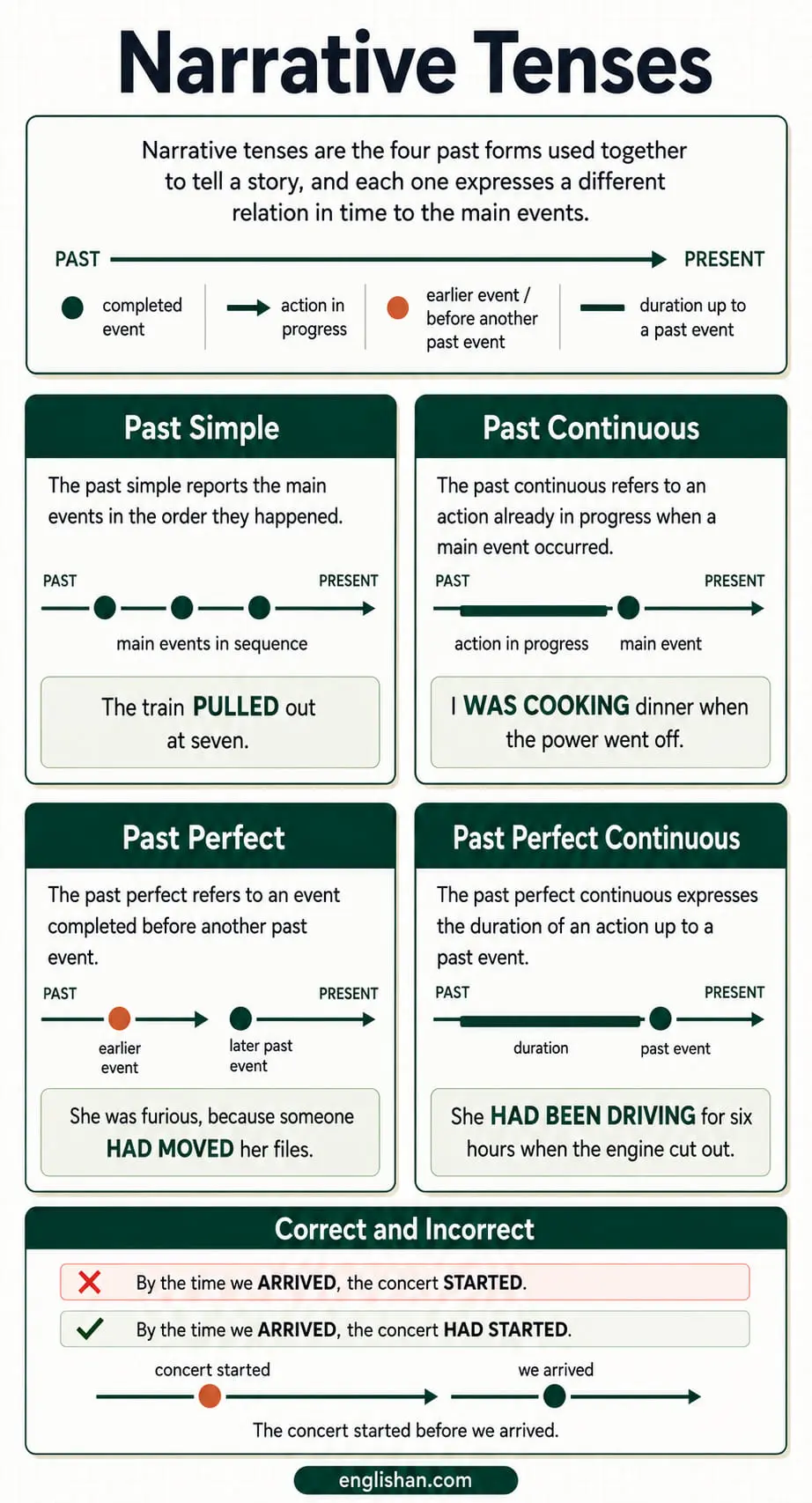
The Four Narrative Tenses
The past simple reports the events in the order they happened, and each of the other three tenses expresses a different relation to one of those events.
The narrative tenses are the four past forms used together to tell a story. The past continuous refers to an action already in progress around a main event. The past perfect refers to an action completed before a main event. The past perfect continuous expresses the duration of an action up to a main event.
- The train pulled out at seven.
- Rain was falling when the train pulled out.
- The guard had checked every door before the train pulled out.
- Passengers had been waiting on the platform for an hour.
Those four sentences describe one moment through four time relations, and only the verb changes.
The two tenses used for events and background: the next three rules are the past simple, the past continuous, and the conjunctions that join them.
Past Simple For The Main Events
The past simple reports a finished event, a past state, or a repeated past habit.
A narrative reports more than a series of actions, since it also reports the states that were true at the time and the habits that preceded them.
- She opened the letter and read it twice.
- The office closed at six that Friday.
- We lived in Bristol for three years.
- He knew the answer before the question ended.
- Every winter the lake froze solid.
- The nurse called my name, and I stood up.
- Nobody spoke for a full minute.
- The flight landed late, so the driver left without us.
“Lived” and “knew” report states rather than actions, and they still take the past simple. A past state has duration, and duration alone does not require a continuous form.
Past Continuous For The Background
The past continuous refers to an action already in progress when a main event occurred, so it identifies the background action rather than the event itself.
The past continuous occurs in three environments. It sets the scene at the start of a passage, it refers to a longer action that a shorter one interrupts, and it presents two actions as simultaneous.
- The sun was setting over the harbour.
- I was cooking dinner when the power went off.
- She was reading on the balcony while her brother was painting the wall.
- Traffic was building on the ring road, so we took the back lanes.
- They were arguing about the bill when the waiter arrived.
- Snow was falling as the coach pulled into the village.
- He was not listening, which is why the instruction had to be repeated.
- Were you waiting long before the doctor called you in?
In the second example, “was cooking” started before the power cut and continued after it, so the cooking is the setting and the power cut is the event.
When And While In Past Narration
“I was walking home when it started to rain” and “It started to rain while I was walking home” report the same event, and the tense rather than the conjunction is what identifies the background action.
The past continuous is used for the longer action, and the past simple for the shorter one that interrupts it. “When” and “while” both accept either tense, so the conjunction alone never identifies the background action.
- I was walking home when it started to rain.
- It started to rain while I was walking home.
- While the kettle was boiling, she checked her messages.
- The alarm went off while we were sleeping.
- When the results arrived, everyone was working late.
- She was crossing the road when a cyclist shouted at her.
Two mistakes follow from reading the conjunction instead of the tense.
- While I arrived, they were eating. ❌
- When I arrived, they were eating. ✅
“While” requires an action with duration in its clause, and an arrival is instantaneous.
- I was walking home when it was starting to rain. ❌
- I was walking home when it started to rain. ✅
The two tenses that refer to earlier time: the next three rules are the past perfect, the conditions under which it is optional, and the continuous form built on it.
Past Perfect For Earlier Events
The past perfect refers to an event completed before another past event, and it is formed with “had” plus the past participle.
The past perfect is required whenever the narration departs from chronological order, because it identifies the sentence as reporting an earlier time rather than the next event.
- By the time we reached the theatre, the play had started.
- She was furious, because someone had moved her files.
- He had never flown before that morning.
- The house was quiet: the children had gone to bed.
- I recognised the address, since I had lived there as a student.
- They apologised for the delay, but the parcel had already left the depot.
- When I called, she had finished her shift.
- The pitch was unplayable, because it had rained all week.
In the last example, “had rained” happened first and “was unplayable” happened second, even though the unplayable pitch is mentioned first. Reversing the order of mention is exactly what the past perfect permits.
When The Past Perfect Is Optional
The past perfect is not required every time one event precedes another. It is required only when nothing else in the sentence makes the order explicit.
“Before”, “after”, “as soon as”, “first”, “then”, and a stated date all establish the order on their own, and the past simple is enough once one of them is present.
- After she finished the report, she went home.
- After she had finished the report, she went home.
- Before the guests arrived, we cleared the table.
- As soon as the bell rang, the class emptied.
- In 2019 the firm moved offices, and the rent doubled the year after.
- She paid the deposit, then signed the lease.
The first two sentences are both correct and state the same order of events, since “after” has already established it. Apply this test to your own sentence: replace the past perfect with the past simple. If the order of events is still obvious, the past simple is correct and the past perfect is a choice rather than a requirement.
Past Perfect Continuous For Duration
The past perfect continuous expresses the duration of an action up to a past event, and it is formed with “had been” plus the -ing form.
The past perfect states that something finished; the past perfect continuous states how long it lasted. Use the continuous form whenever the length of time is what the sentence reports. Use it also when the result of that time is still visible at the moment of the story.
- She had been driving for six hours when the engine cut out.
- His hands were filthy, because he had been repairing the bike.
- We had been waiting since eight, and nobody had told us why.
- They had been arguing all evening before the neighbours knocked.
- The pavement was wet: it had been raining.
- I had been studying Portuguese for two years before I moved to Lisbon.
- Had you been working there long when the takeover happened?
Stative Verbs And The Continuous Forms
“I had been knowing her for years” is impossible, and the correction is the simple form rather than a different tense.
A stative verb describes a state rather than an activity, and the group includes know, believe, own, belong, understand, seem, want, need, and prefer. A dynamic verb describes an activity: run, write, wait, build, cook. Stative verbs do not occur in either continuous form, so duration with a stative verb is expressed by the past perfect simple.
- I had been knowing her for years. ❌
- I had known her for years. ✅
- We had been owning the flat since 2015. ❌
- We had owned the flat since 2015. ✅
- She was wanting a coffee when I called. ❌
- She wanted a coffee when I called. ✅
The same verb can be stative in one meaning and dynamic in another, which is why “I was having lunch” is correct while “I was having a car” is not. “Have” as an activity takes the continuous form, and “have” as possession does not.
Used To And Would For Past Habits
“Used to” expresses both past habits and past states, and “would” expresses habits alone.
Both forms occur in a past narrative, and both are alternatives to the past simple rather than members of the four-tense set. Use them when the story is establishing what life was like before the events start.
- We used to spend every August at my grandmother’s.
- We would spend every August at my grandmother’s.
- She used to live in Cardiff.
- She would live in Cardiff. ❌
- The mill used to employ four hundred people.
- Every Sunday he would walk to the market and back.
- I used to hate long meetings, and now I run them.
- They would leave the back door unlocked all summer.
The fourth sentence fails because “live” describes a state. “Would” requires a repeated action, so a state takes “used to” or the past simple.
The forms around the four tenses: the next rule sets out the time expressions associated with each tense, before the four occur together in one passage.
Time Expressions For Each Tense
Take “by the time the ambulance arrived”. That expression alone determines the tense, because “by the time” introduces a past perfect in the clause that follows.
Each tense takes its own set of time expressions. Recognising one of them identifies the tense before the meaning has been considered.
| Tense | Expressions associated with it |
|---|---|
| Past simple | Yesterday, last week, in 2019, then, at six o’clock, ago |
| Past continuous | While, as, all morning, at that moment, at the time |
| Past perfect | By the time, already, just, never before, until then, by 2019 |
| Past perfect continuous | For two hours, since eight, all day, before that |
- By the time the ambulance arrived, the driver had walked away.
- While the results were being counted, the hall was emptying.
- The shop had already closed when we got there.
- She had been coughing since Monday.
- We left the office at six and caught the last train.
- He had never seen snow before that winter.
Narrative Tenses Working Together
Take a single paragraph, and read the four tenses in one place.
Marta arrived at the station just after nine. Rain was drumming on the roof, and the departure board was showing delays on every line. She had been travelling since dawn, and she had not eaten since Leeds. When the announcement finally came, she picked up her bag and walked to platform four.
Each verb answers a different question about time.
- “Arrived”, “came”, “picked”, and “walked” are the main events, in order.
- “Was drumming” and “was showing” set the scene around the arrival.
- “Had been travelling” gives the length of the journey up to that point.
- “Had not eaten” reports something finished before she arrived.
A passage written in the past simple alone would still be grammatical, and it would leave every one of those distinctions unexpressed. A graded story task is assessed on exactly those distinctions.
Reported Speech Inside A Narrative
Which tense does a character’s speech take when the narration is already in the past?
Speech reported inside a past narrative shifts back one tense, and that change is called backshift. The present simple becomes the past simple, the past simple becomes the past perfect, and “will” becomes “would”. A past perfect stays a past perfect, since no form refers to a time before it.
- “I am exhausted.” → She said she was exhausted.
- “We missed the connection.” → They explained that they had missed the connection.
- “I will call the office.” → He said he would call the office.
- “I had already paid.” → She insisted she had already paid.
- “The bus leaves at eight.” → The driver told us the bus left at eight.
Common Mistakes In Past Narration
Each error below is a correct rule applied in the wrong environment, so the correction depends on identifying the environment rather than on restating the rule.
- She was knowing the answer. ❌
- She knew the answer. ✅
Stative verbs take the simple forms, however long the state lasted.
- After the film had ended, we had gone for pizza. ❌
- After the film ended, we went for pizza. ✅
- I have been to Rome last summer. ❌
- I went to Rome last summer. ✅
- While the phone rang, I was in the shower. ❌
- While the phone was ringing, I was in the shower. ✅
- He would be very shy as a child. ❌
- He used to be very shy as a child. ✅
- By the time we arrived, the concert started. ❌
- By the time we arrived, the concert had started. ✅
Narrative Tenses Chart
| Tense | Form | What it expresses | Example |
|---|---|---|---|
| Past simple | Verb + -ed, or the irregular past form | A finished event, a past state, a past habit | The train pulled out at seven. |
| Past continuous | Was or were + -ing | An action in progress around a main event | Rain was falling on the platform. |
| Past perfect | Had + past participle | An action finished before a main event | The guard had checked every door. |
| Past perfect continuous | Had been + -ing | The duration of an action up to a main event | Passengers had been waiting for an hour. |
| Used to | Used to + base form | A past habit or a past state, now finished | We used to spend August there. |
| Would | Would + base form | A repeated past action, never a past state | He would walk to the market. |
Identify the main events first, then determine which of the other tenses each surrounding sentence requires, since every one of them is defined against a main event.
Related: Past Tenses: Rules, Formulas, and Examples for All 4 Types
FAQs
Q1. Can a story be told in the present tense?
Yes, and the present simple used for past events is called the historic present. Novels, film summaries, jokes, and spoken anecdotes all use it, and it makes past events feel immediate. Mixing it with past tenses inside one passage is what causes trouble, so one or the other is used throughout.
Q2. What is the difference between the past perfect and the past perfect continuous?
The past perfect states that an earlier action finished. The past perfect continuous states how long that action lasted. “She had written three emails” counts finished emails, while “She had been writing emails all morning” measures the time it took. Choose the continuous form when the duration or its visible result is what the sentence reports.
Q3. What is the difference between “used to” and “be used to”?
“Used to” plus a base form describes a finished past habit, as in “I used to cycle to work”. “Be used to” plus a noun or an -ing form describes being familiar with something, as in “I am used to cycling to work”. The first is about the past, and the second is about how normal something feels now.
Q4. Why do narrative tenses matter in a story?
They make the order of events recoverable without dates. In “The pitch was unplayable, because it had rained all week”, the verb form alone establishes that the rain came first. Written in the past simple alone, the same two facts are stated with no order between them.
Q5. Which linking words are used with narrative tenses?
Sequence linkers order the events of a past narrative: then, after that, next, later, eventually, and in the end. Contrast and interruption linkers indicate a break in the sequence: suddenly, all at once, meanwhile, and just as. These join the events; the narrative tenses express how those events relate in time, so a passage needs both.
Narrative Tenses Quiz
Narrative Tenses
Choose the verb form.
The sun ___ as they walked home.
The ongoing background of a scene takes the past continuous.
past continuous sets the scene
The sun was setting as they walked home.
Choose the verb form.
She ___ the letter and gasped.
A main, finished event takes the past simple.
past simple carries the main events
She opened the letter and gasped.
Choose the verb form.
He was exhausted; he ___ for hours.
A span of activity before a past point takes the past perfect continuous.
past perfect continuous for a span before a past point
He had been walking for hours.
Choose the verb form.
When she arrived, the party ___ already ___ .
An event before another past event takes the past perfect.
past perfect for an earlier past event
When she arrived, the party had already started.
Which tense carries the main events?
Choose the storyline tense.
The past simple moves the story through its finished events.
past simple drives the storyline
She ran, opened the gate, and left.
Which tense sets the scene?
Choose the background tense.
The past continuous paints the ongoing background.
past continuous sets the scene
Rain was falling and wind was howling.
Which tense reaches back to an earlier moment?
Choose the flashback tense.
The past perfect reaches back to an event before the story's present.
past perfect for the earlier event
She realized she had met him before.
Which tense stresses a span before a past point?
Choose the duration tense.
The past perfect continuous stresses a span leading to a past point.
past perfect continuous for a prior span
He was tired; he had been driving all night.
Type the correct form of the verb in brackets.
Rain ___ (fall) as the train pulled in.
An ongoing background action takes the past continuous: was falling.
past continuous for the background
Rain was falling as the train pulled in.
Choose the verb form.
They ___ dinner before the guests arrived.
An event completed before another past event takes the past perfect.
past perfect for the earlier event
They had finished dinner before the guests arrived.
Choose the verb form.
She recognized the street; she ___ there as a child.
An earlier past state in a flashback takes the past perfect.
past perfect for the flashback
She had lived there as a child.
Choose the verb forms.
He ___ the door, ___ into the car, and ___ off.
A chain of finished actions stays in the past simple.
past simple for a chain of events
He locked the door, got into the car, and drove off.
Choose the verb form.
The ground was wet because it ___ all night.
A span of activity that left a result takes the past perfect continuous.
past perfect continuous behind a past result
The ground was wet because it had been raining all night.
True or false?
The past continuous sets the background in a narrative.
The past continuous paints the ongoing scene behind the events.
past continuous for the background
The birds were singing as we set off.
True or false?
The past perfect moves a story forward event by event.
The past simple moves the story forward; the past perfect reaches back to earlier events.
past simple drives the story; past perfect reaches back
She arrived after they had left.
Choose the verb form.
While they ___ , a storm broke.
The ongoing action interrupted by an event takes the past continuous.
past continuous for the interrupted action
While they were driving, a storm broke.
Type the correct form of the verb in brackets.
By the time we arrived, everyone ___ (leave).
An action completed before another past event takes the past perfect: had left.
past perfect for the earlier event
By the time we arrived, everyone had left.
Choose the verb form.
He looked worn out because he ___ all night.
A span of activity before a past point takes the past perfect continuous.
past perfect continuous for a prior span
He had been studying all night.
Choose the verb form.
A branch ___ and everyone froze.
A sudden, finished event takes the past simple.
past simple for a sudden event
A branch cracked and everyone froze.
Choose the verb form.
The children ___ outside when it started to snow.
The ongoing action interrupted by an event takes the past continuous.
past continuous for the interrupted action
The children were playing outside when it started to snow.
Turn on JavaScript for the interactive quiz. The full practice set is shown above.