“I am meeting Sara on Thursday” describes something that has not happened yet, and the verb is a present form. The present continuous refers to the future whenever the arrangement for the event already exists. What the tense expresses is the arrangement rather than the event. No extra future word is needed, since the timing is already clear from the arrangement itself.
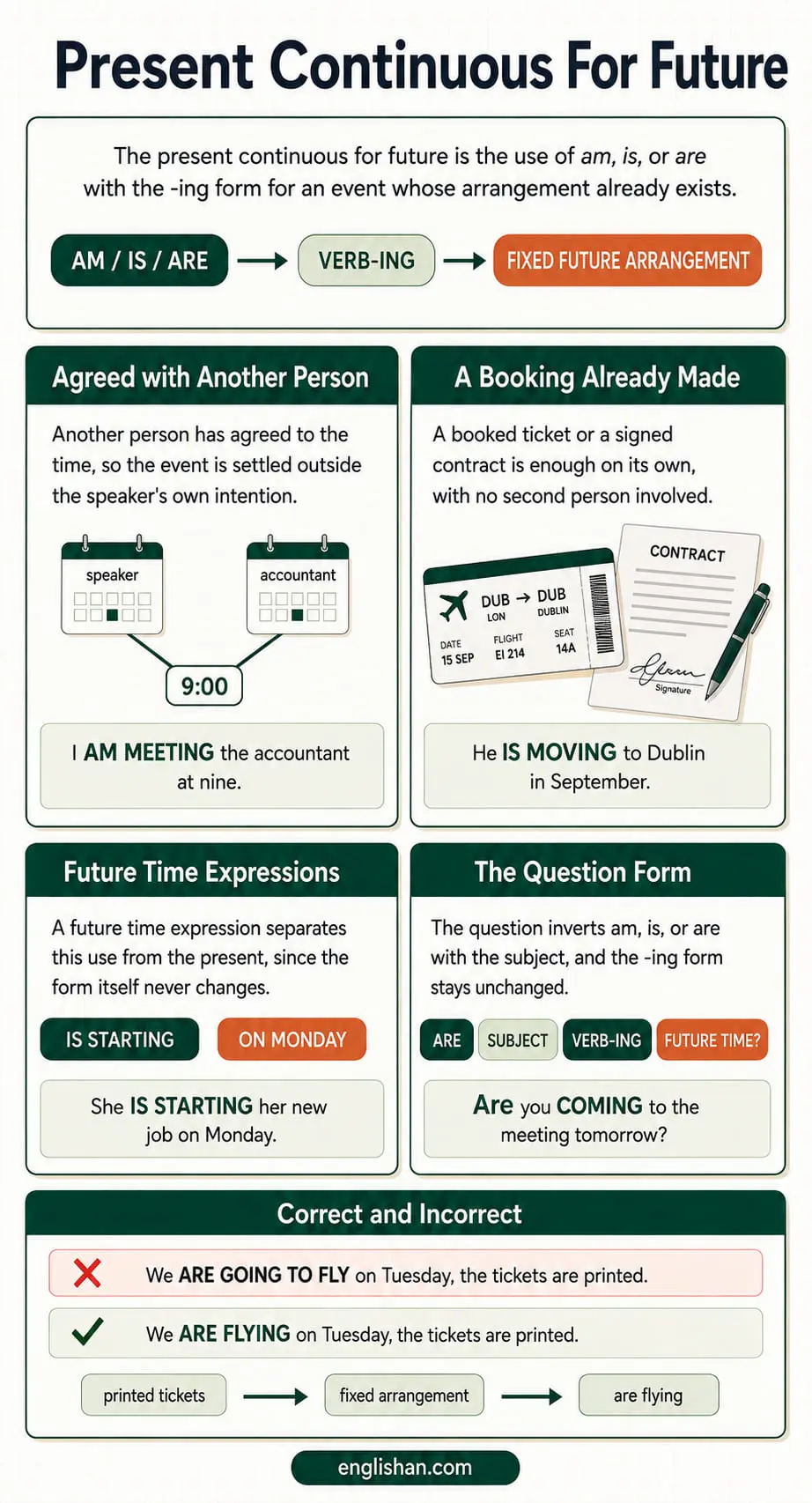
Present Continuous For Future Arrangements
The present continuous refers to a future event when the arrangement for it already exists, so the form expresses a decision made before the moment of speaking.
An arrangement is something fixed: a time agreed with another person, a booking made, an appointment written in a diary. The event happens in the future, and the arranging happened before now.
- I am seeing the dentist at four.
- We are flying to Porto on Saturday.
- She is starting her new job on Monday.
- Are you coming to the meeting tomorrow?
- They are not staying for dinner.
“Am seeing” reports an appointment that was made days ago, so one sentence refers to two times: the arranging, which is finished, and the event, which is not.
The form and its conditions: the next three rules are the structure of the tense, the condition that licenses it, and the time expressions it takes.
How The Present Continuous Is Formed
The present continuous takes a form of “be” plus the -ing form of the main verb, and the future use takes exactly the same form as the present use.
| Subject | Be | Verb + ing | Example |
|---|---|---|---|
| I | am | working | I am working late on Friday. |
| You, we, they | are | leaving | We are leaving at dawn. |
| He, she, it | is | arriving | She is arriving on the 8.15. |
Speech nearly always takes the contracted forms: “I’m”, “you’re”, “he’s”, “she’s”, “we’re”, “they’re”.
- I’m having lunch with Daniel tomorrow.
- We’re moving house at the end of the month.
- He’s giving a talk at the conference.
- They’re driving down on Friday evening.
- She’s taking the children to the dentist after school.
- It’s closing for refurbishment in June.
- You’re presenting first, right after the break.
- I’m not working next Tuesday.
What Counts As An Arrangement
Which future events take this form, and which do not?
An event qualifies when something about it is already fixed. Three conditions make it fixed: another person has agreed to it, a booking or a ticket exists, or a time and a place are already set. An intention alone does not qualify, and neither does a guess about what will happen.
- I am meeting the accountant at nine. (a time agreed with someone)
- We are taking the overnight ferry. (tickets booked)
- The band is playing two nights in Glasgow. (dates announced)
- She is having an operation next week. (a date in the hospital system)
- He is moving to Dublin in September. (the flat is signed)
- My parents are visiting at Easter. (agreed on the phone)
- The team is presenting the results on Thursday. (in the calendar)
- I am picking you up at six.
- We are not renewing the contract.
- Is she staying the whole weekend?
The bracketed note is what licenses each sentence. Remove the fixing and the sentence takes a different future form instead.
Time Expressions With Future Arrangements
A future time expression goes at the end of the sentence, and it can also open the sentence for emphasis.
| Position | Expressions | Example |
|---|---|---|
| End of the sentence | Tomorrow, on Friday, next week, at four, this evening, in June | I am flying out on Friday. |
| Start of the sentence | Tomorrow, next month, on Saturday | On Saturday we are driving to Kent. |
No time expression is required. The surrounding conversation already places the event in the future, which is why “I’m meeting the accountant” answers “What are you doing?” without any adverbial at all.
- We are having dinner at eight.
- Next Thursday I am working from home.
- The results are coming out in April.
- I am catching the 7.40, so I need to leave now.
- On the 12th they are closing the road.
- She is finishing her course in June.
- “What are you doing later?” “I am seeing Priya.”
- Are they arriving before or after lunch?
The verbs inside an arrangement: the next three rules are the negative and question forms, the verbs that recur in arrangements, and the verbs that do not occur in this use.
Negatives And Questions About Arrangements
The negative and the question take the same forms as the present-time use: “not” after “be” for the negative, and “be” before the subject for the question.
Cancelling an arrangement is exactly what the negative is for.
- I am not working on Monday.
- We are not going to the reception after all.
- She isn’t coming to the rehearsal.
- They aren’t taking the early train.
- Am I presenting before Yusuf?
- Are you staying for the whole conference?
- Is he flying back on Sunday?
- When are we meeting the supplier?
- Where are you having the party?
- Who is driving tomorrow?
- What time is the inspector arriving?
- Why aren’t they joining us for lunch?
“Aren’t taking” and “isn’t coming” both report cancelled arrangements, so the negative here reports that an existing arrangement has been cancelled rather than that it was never made.
Common Verbs In Future Arrangements
Take “I’m seeing”, “I’m meeting”, and “I’m flying”. A small set of verbs recurs in this use, because a small set of situations is what gets arranged.
| Area of life | Verbs |
|---|---|
| People | Meet, see, visit, have lunch with, catch up with |
| Travel | Fly, drive, take, catch, leave, arrive, stay |
| Work | Work, present, start, finish, interview, train |
| Health and admin | See, have, collect, sign, move |
| Social | Play, watch, celebrate, host, come, go |
- I am seeing my supervisor on Wednesday.
- We are visiting her parents at the weekend.
- He is interviewing two candidates on Thursday.
- They are catching the 6.05 from Reading.
- She is collecting the keys on Friday morning.
- I am having a scan on the 20th.
- We are hosting the quiz this month.
- The neighbours are moving out in April.
- Is anyone coming to the exhibition?
- I am starting Portuguese classes in September.
- She is finishing at four so we can leave early.
- They are playing at the Barrowland in November.
Stative Verbs And Future Arrangements
“I am knowing the answer tomorrow” is impossible, and the reason is what the verb means rather than the verb itself.
A stative verb describes a state rather than an activity: know, believe, own, belong, seem, need, prefer. A state is not something anybody arranges, so it cannot take the arrangement reading. The constraint applies to meaning, so the same verb is acceptable as soon as it describes an activity: “I’m having dinner with Ana” and “I’m seeing the dentist” are both standard, because “have” and “see” are activities there.
- I am knowing the results on Friday. ❌
- I will know the results on Friday. ✅
- We are owning the flat from June. ❌
- We own the flat from June. ✅
- I am having dinner with Ana on Friday. ✅
- I am seeing the dentist at four. ✅
The last two sentences use verbs from the same list and are correct, so the test is not the verb but the meaning. Ask whether the event could be entered in a diary. If they could, the arrangement reading is available.
Choosing between the future forms: the next four rules place the present continuous beside the three forms it competes with.
Present Continuous Or Be Going To
The present continuous expresses an arrangement, and “be going to” expresses an intention, meaning a decision that has been made without anything being fixed.
Both refer to the future, and both relate to a decision already made. The difference is whether anything beyond the speaker’s own intention has been fixed.
- I am seeing the doctor on Tuesday. (the appointment exists)
- I am going to see the doctor about my knee. (decided, nothing booked)
- We are moving in September. (contracts signed)
- We are going to move somewhere quieter. (an intention)
- She is starting the course on the 4th. (enrolled)
- She is going to start learning Greek. (a plan in her head)
- They are flying to Lisbon on Friday. (tickets bought)
- They are going to travel more next year. (a resolution)
- Are you taking the 9.10? (a booked seat)
- Are you going to take the train or drive? (still deciding)
Where an arrangement genuinely exists, either form is grammatical, and the present continuous is the form a native speaker uses. “Be going to” with a settled arrangement suggests that nothing has yet been agreed with anyone else.
Present Simple For Timetables And Schedules
The present simple is used for future events set by a timetable, meaning a published schedule that nobody involved in the conversation controls.
Trains, flights, cinema screenings, term dates, and opening hours all take the present simple. Your own appointment inside one of those schedules still takes the present continuous.
- The train leaves at 7.40.
- I am catching the 7.40.
- The museum opens at ten on Sundays.
- We are meeting outside the museum at ten.
- Term starts on 8 September.
- She is starting her course on 8 September.
- The film begins at 8.15.
- We are watching the 8.15 showing.
- The conference runs from Monday to Wednesday.
- I am speaking on the Tuesday.
Each pair puts the same time on two different subjects. The timetable takes the present simple, and the person inside it takes the present continuous.
Present Continuous Or Will
The present continuous reports an arrangement already made, and “will” reports a decision made at the moment of speaking or a prediction about what is going to happen.
“Will” is not wrong for a future arrangement so much as misleading, because it presents the decision as being made now. An arrangement was decided earlier, so “will” contradicts the timing the sentence reports.
- I am meeting the client at two. (arranged)
- I will meet the client, if nobody else can. (deciding now)
- We are eating at Nino’s tonight. (booked)
- “There’s nothing in the fridge.” “I will order something.” (deciding now)
- She is taking the late flight. (booked)
- It will rain before the weekend. (a prediction)
- They are announcing the results on Friday. (scheduled)
- The results will disappoint a lot of people. (a prediction)
- I am picking Amal up at six. (agreed with Amal)
- Will you pick Amal up? (a request)
Which Future Form To Use
Take one future event and ask a single question about it: what has already happened?
| What has already happened | Form | Example |
|---|---|---|
| A time, a booking, or an agreement is fixed | Present continuous | I am flying on Tuesday. |
| A decision exists but nothing is fixed | Be going to | I am going to fly rather than drive. |
| A published schedule sets the time | Present simple | The flight leaves at 6.20. |
| Nothing yet, and the decision is happening now | Will | I will fly if the trains are cancelled. |
| Nothing yet, and this is a guess about the future | Will, or be going to with evidence | It will be busy. Look at those clouds, it is going to pour. |
Read the left column from the top and take the first row that matches. The order is deliberate, since a settled arrangement is chosen over an intention, and an intention over a prediction.
Related: Present Tenses With Examples, Rules, Usage
Arrangements In Reported Speech
Which form does an arrangement take when somebody reports it afterwards?
Reported after a past verb, the present continuous shifts to the past continuous, which is called backshift. The arrangement itself does not change; only the form does.
- “I am leaving on Friday.” → He said he was leaving on Friday.
- “We are meeting at noon.” → They told me they were meeting at noon.
- “She is not coming.” → He mentioned that she was not coming.
- “Are you staying overnight?” → She asked whether I was staying overnight.
- “The band is playing twice.” → The email said the band was playing twice.
Common Mistakes With Future Arrangements
Each error below is a correct rule applied in the wrong environment, so the correction depends on identifying the environment rather than on restating the rule.
- I will meet Sara tomorrow at ten, we agreed last week. ❌
- I am meeting Sara tomorrow at ten, we agreed last week. ✅
The agreement already exists, so a form expressing a decision made now contradicts the rest of the sentence.
- The train is leaving at 7.40 every morning. ❌
- The train leaves at 7.40 every morning. ✅
- I am knowing my results next week. ❌
- I will know my results next week. ✅
- We are going to fly on Tuesday, the tickets are printed. ❌
- We are flying on Tuesday, the tickets are printed. ✅
- You are come to the party? ❌
- Are you coming to the party? ✅
- She is meet us at the station. ❌
- She is meeting us at the station. ✅
- It is raining tomorrow, look at the forecast. ❌
- It is going to rain tomorrow, look at the forecast. ✅
- I am go to the gym on Thursday. ❌
- I am going to the gym on Thursday. ✅
FAQs
Q1. How do you tell a present meaning from a future meaning?
The time expression identifies it in most sentences: “I am working” with “now” is present, and “I am working” with “on Friday” is future. Where no adverbial is present, the context identifies it instead, since “What are you doing?” asks about now and “What are you doing at the weekend?” asks about the future. The form itself never changes.
Q2. Does an arrangement need another person?
No, an arrangement only needs something outside your own intention to be fixed. A booked ticket, a paid deposit, or a hospital appointment all count, so “I am flying to Rome on Tuesday” is correct even if you are travelling alone. What fails is an intention with nothing fixed behind it.
Q3. Can the present continuous be used for predictions?
No, a prediction takes “will” or “be going to”, since nobody arranges the weather or an election result. “It is raining tomorrow” fails for that reason, while “It is going to rain” is correct. The one overlap is a scheduled natural event, as in “The sun is setting at 8.04 tomorrow”, where a published time exists.
Q4. Is the present continuous for the future acceptable in formal writing?
Yes, and it is standard in business English wherever a calendar is involved. “The board is meeting on 14 May” and “The auditors are visiting next quarter” are both formal. What is informal is the contraction rather than the tense, so write “I am attending” rather than “I’m attending” in a formal letter.
Q5. How do you cancel or change an arrangement?
Use the negative form for the cancellation, then a new positive sentence for the replacement. “I am not coming on Thursday. I am coming on Friday instead.” “No longer” makes the change explicit, as in “We are no longer meeting at ten.” The past continuous reports what was arranged before, as in “I was meeting them at ten, but it moved.”
Q6. Can the present continuous for the future be used with modal verbs?
No, a modal verb takes a base form after it, so “will am meeting” and “must is coming” are both impossible. Where a modal meaning is needed, the modal replaces the whole present continuous, as in “I might meet them on Friday”. A modal plus “be” plus the -ing form builds the future continuous instead, as in “I will be meeting them on Friday”, which reports something different again.