“I have lived here since 2019” and “I have lived here for six years” describe the same stretch of time, and the two words are not interchangeable. “Since” names the moment something started, and “for” names how long it has lasted.
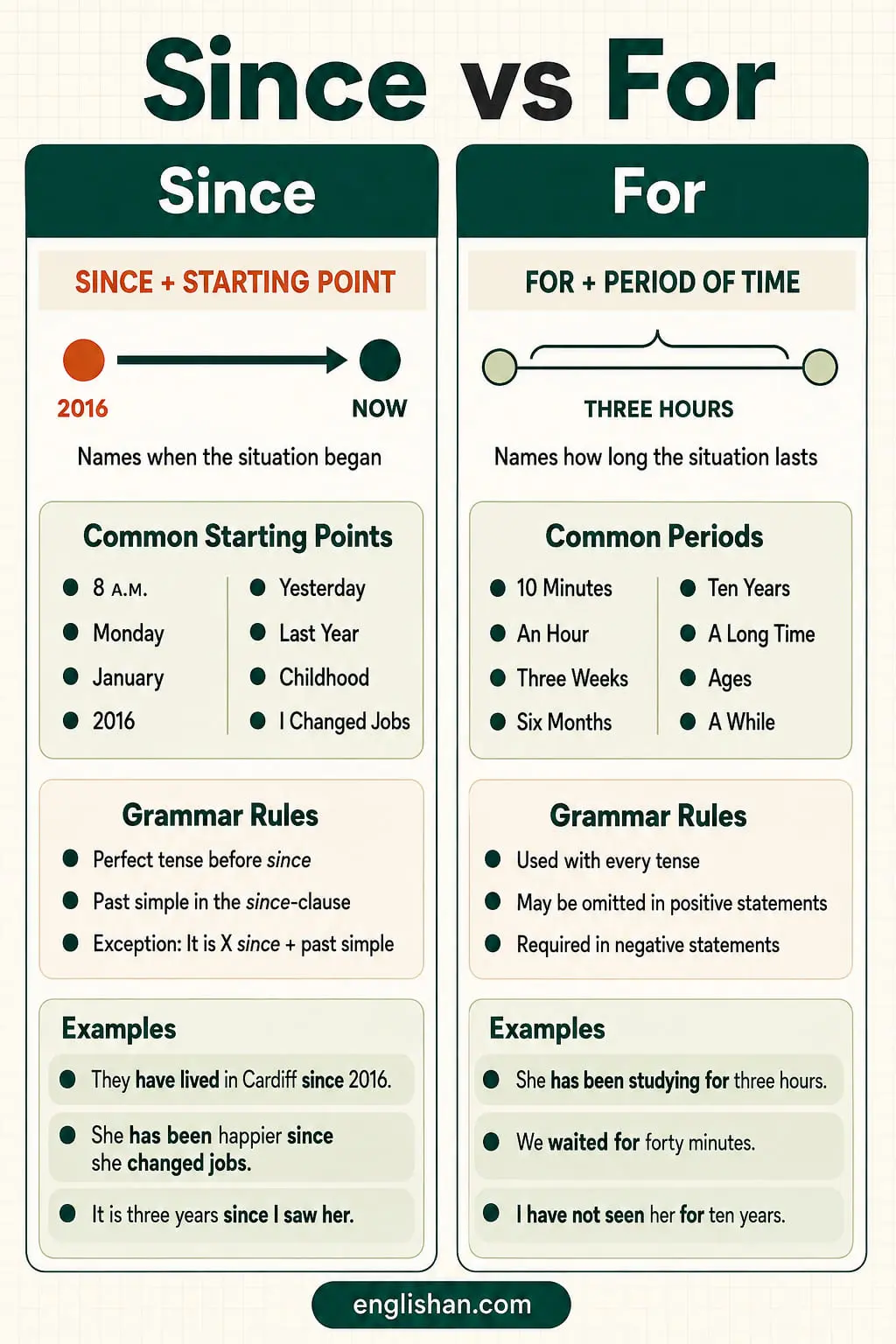
The Difference Between Since And For
“Since” is followed by a point in time, and “for” is followed by a quantity of time.
A starting point is a moment on the calendar or the clock: Monday, 2019, six o’clock, my birthday, the accident. A duration is a stretch of time with no fixed moment attached: three days, ten minutes, ages, a long time.
- She has worked here since March.
- She has worked here for eight months.
- We have known each other since university.
- We have known each other for twenty years.
- I have not eaten since breakfast.
- I have not eaten for nine hours.
The two words in each pair report the same stretch of time, one by its starting point and one by its length, so the test is not the meaning but the words that follow. A date takes “since”, and a length takes “for”.
The two words and the tenses: the next three rules are each word on its own, then the tenses that take them.
Since With A Starting Point
“Since” is followed by the moment a situation began, and the situation continues to the present.
Four kinds of expression follow it: a clock time, a date, an event, and a stated age or stage of life.
- The shop has been closed since Tuesday.
- He has been unwell since the weekend.
- I have not spoken to her since the wedding.
- They have lived in Cardiff since 2016.
- She has played the cello since she was seven.
- The road has been flooded since Thursday morning.
- Nothing has changed since my last visit.
- We have been friends since primary school.
- Prices have risen since January.
- I have felt better since the operation.
“Since primary school” and “since the operation” name events rather than dates, and both are correct because an event fixes a moment as precisely as a date does.
For With A Length Of Time
“For” is followed by a length of time, and it answers the question “How long?”
Numbers, vague quantities, and fixed expressions all follow it: two hours, three weeks, ten years, a moment, ages, a while, a long time.
- We waited for forty minutes.
- She has been studying for three hours.
- The contract runs for two years.
- I have not seen him for ages.
- They stayed for a week.
- He talked for what felt like an hour.
- The library closes for the whole of August.
- We have been discussing this for far too long.
- She lived in Osaka for a decade.
- The pain lasted for a few seconds.
Which Tenses Take Since And For
“Since” and “for” attach to different sets of tenses, and only one of the two is restricted.
“For” measures a length of time in any tense, past, present, or future. “Since” requires a situation continuing from a past point up to a later reference point, so it occurs with the perfect tenses and with one fixed past-simple structure.
| Tense | Since | For | Example |
|---|---|---|---|
| Present perfect | Yes | Yes | I have worked here since 2020 / for five years. |
| Present perfect continuous | Yes | Yes | She has been waiting since noon / for two hours. |
| Past perfect | Yes | Yes | They had lived there since 1998 / for twenty years. |
| Past simple | Only in “It is X since” | Yes | We stayed for a week. It is a year since I saw her. |
| Future perfect | Yes | Yes | By June he will have taught there for a decade. |
| Present simple | No | Yes, for a habitual length | I work for eight hours a day. |
The choice between the present perfect and the present perfect continuous is decided by the verb, not by “since” or “for”. A stative verb, meaning one that describes a state rather than an activity, takes the simple form: “I have known her for years”, never “I have been knowing her”.
- We have been married for thirty-one years.
- The kettle has been boiling since you left the room.
- She had been ill since the previous winter.
- I have owned this bike for longer than I care to admit.
- For three days nobody answered the phone.
- It is nearly a month since the last inspection.
- He will have been in post for a year by Christmas.
- They have been arguing since breakfast.
The last two are worth reading together. “Will have been in post for a year” measures a duration ahead of now, and it is the one use of “for” that has no equivalent with “since”.
Three structures to get right: the next three rules are the clause after “since”, the sentences where “for” is omitted, and the negative.
The Tense Inside A Since Clause
“I have felt better since I have stopped drinking coffee” is wrong, and the correction is in the second clause.
When “since” introduces a clause rather than a noun, that clause takes the past simple, because it names the moment the situation began. The main clause keeps the present perfect, because the situation continues.
- I have felt better since I stopped drinking coffee.
- She has been happier since she changed jobs.
- We have not heard from him since he moved to Berlin.
- The team has improved since Marta joined.
- Prices have doubled since the factory closed.
- He has barely slept since the baby arrived.
- Nothing has been the same since they sold the farm.
Two tenses in one sentence is exactly right here. The present perfect measures the stretch of time, and the past simple names the point at which it began.
When For Can Be Left Out
“For” can be omitted in a positive statement about a length of time, and it cannot be omitted in any other environment.
- I have lived here for ten years.
- I have lived here ten years.
- We waited for an hour.
- We waited an hour.
- I have not seen her for ten years.
- I have not seen her ten years. ❌
The last pair shows the limit. Once the sentence is negative, “for” is obligatory, and the same rule governs questions. “Have you been waiting long?” is correct without it because “long” is not a stated length, while “Have you been waiting for two hours?” keeps it.
Since And For In Negative Sentences
A negative sentence with “for” measures how long it is since something last happened, and a negative with “since” names the moment that stretch of time began.
- I have not been to the cinema for months.
- I have not been to the cinema since February.
- She has not called for three weeks.
- She has not called since the argument.
- We have not had rain for forty days.
- We have not had rain since the spring.
- He has not played for a whole season.
- Nobody has used this room since the refit.
British English writes “for months” and “for years” in these sentences. American English writes “in months” and “in years” instead, so “I have not seen her in years” is standard in the United States and unusual in Britain.
Since and for beyond time: the next three rules are the second meaning of each word, and the fixed expressions built on “since”.
Since Meaning Because
Can “since” mean something other than time?
Yes. As a subordinating conjunction, meaning a word that attaches one clause to another, “since” also introduces a reason, exactly as “because” and “as” do. This use has nothing to do with duration at all.
- Since the trains were cancelled, we drove.
- We drove, since the trains were cancelled.
- Since you are here, you may as well stay for dinner.
- Since nobody objected, the motion passed.
- She left early, since the last bus goes at eleven.
- Since the file is confidential, please do not forward it.
- Since it was raining, the match was moved indoors.
The substitution test identifies the use. Replace “since” with “because”: if the sentence still means what it meant, the use is causal, and if it stops making sense, the use is temporal. Word order is a weaker second clue, because a causal clause opens the sentence more readily than a time clause does, so an opening “since” clause is worth testing for a reason first.
For Meaning Purpose Or Benefit
Take “This parcel is for you”. No length of time is named anywhere in the sentence.
Beyond duration, “for” identifies who or what something is intended to benefit, and it expresses the purpose of an action.
- This parcel is for you.
- She bought a card for her mother.
- The room is for storage.
- I use this app for tracking expenses.
- We stopped for petrol.
- He is studying for the entrance exam.
- Thank you for everything.
Only the duration use competes with “since”, so the purpose use never creates a choice between the two words. It is stated here because both senses of “for” occur in sentences about time, and the two have to be told apart.
Since Then And Ever Since
“Since” also occurs in two fixed expressions with no following noun at all.
“Since then” refers back to a starting point already named. “Ever since” adds emphasis, meaning continuously from that moment onwards.
- She moved to Leeds in 2021 and has been happy since then.
- The factory closed in March. Unemployment has risen since then.
- He broke his wrist skiing and has avoided the slopes ever since.
- We met at a conference and have worked together ever since.
- They fell out over money and have not spoken since then.
- I tried oysters once and have refused them ever since.
Since Or From
“From” also names a starting point, and the difference is what happens after that point.
“Since” measures from a past moment up to now, so it requires a perfect tense. “From” names a starting point in any time, and it takes “to” or “until” to mark the end.
- I have worked here since 2020.
- I worked here from 2020 to 2023.
- The road is closed from Monday.
- The road has been closed since Monday.
- The shop is open from nine until six.
- She has been unwell since Tuesday.
The first pair is the one to remember. “Since 2020” reports that the employment continues, and “from 2020 to 2023” reports that it finished.
For During Or In
“For” answers “How long?”, “during” answers “When?”, and “in” answers “How long did it take?”
| Word | Question it answers | Follows with | Example |
|---|---|---|---|
| For | How long? | A length of time | We talked for two hours. |
| During | When? | A named period or event | We talked during the interval. |
| In | How long did it take? | A length of time | We finished the job in two hours. |
- She was ill for a week.
- She was ill during the exams.
- He built the shed in two days.
- Nobody spoke during the film.
- The alarm rang for twenty minutes.
- I can be there in ten minutes.
- Sales fall during August.
- We queued for an hour.
Common Mistakes With Since And For
Each error below is a correct rule applied in the wrong environment, so the correction depends on identifying the environment rather than on restating the rule.
- I have lived here since six years. ❌
- I have lived here for six years. ✅
“Six years” is a length of time, and only “for” takes a length.
- I live here since 2019. ❌
- I have lived here since 2019. ✅
- I am working here for three years. ❌
- I have been working here for three years. ✅
- I have felt better since I have stopped smoking. ❌
- I have felt better since I stopped smoking. ✅
- She has been knowing him for years. ❌
- She has known him for years. ✅
- I did not see him since Monday. ❌
- I have not seen him since Monday. ✅
- We waited during two hours. ❌
- We waited for two hours. ✅
- It is three years that I saw her. ❌
- It is three years since I saw her. ✅
Duration And Starting Point Chart
| Question | Word | What follows it | Example |
|---|---|---|---|
| When did it start? | Since | A time, a date, an event, or a past-simple clause | Since Friday, since 2016, since she left |
| How long has it lasted? | For | A length of time | For three days, for ten years, for ages |
| Why? | Since | A clause giving a reason | Since it was raining, we stayed in |
| Who is it intended for? | For | A person, a thing, or a purpose | This is for you |
| From when to when? | From | A starting point, with “to” or “until” to close it | From nine to five |
| At what point inside a period? | During | A named period or event | During the meeting |
| How long did it take? | In | A length of time | In twenty minutes |
Start from the question in the left column rather than from the word, since the question is what you already know when you are writing the sentence.
FAQs
Q1. Are “since” and “for” prepositions?
Both are prepositions when a noun follows them, as in “since Monday” and “for three days”. “Since” is also a subordinating conjunction when a clause follows it, as in “since she left” and “since it was raining”. “For” is a coordinating conjunction in formal or literary writing, as in “He said nothing, for there was nothing to say”, though that use is rare in modern English.
Q2. Can “since” start a sentence?
Yes, and it is common in both meanings. A causal clause opens a sentence freely, as in “Since the trains were cancelled, we drove”. A time clause can open one too, as in “Since moving to Bristol, she has cycled everywhere”. A comma separates the opening clause from the main clause in both.
Q3. Is “since” formal?
Temporal “since” is neutral, and it is used at every register. Causal “since” is slightly more formal than “because” and slightly less formal than “as”, which makes it a safe choice in reports and emails. “Because” remains the safest option in speech, since it cannot be misread as a time expression.
Q4. How do “since”, “for”, and “ago” differ?
“Since” names a starting point, “for” names a length of time, and “ago” counts a length of time backwards from now. “Ago” takes the past simple, as in “She left two hours ago”, while “since” and “for” with a continuing situation take the present perfect. The three answer different questions: when it started, how long it lasted, and how far back it was.
Q5. Can you use “since” and “ago” together?
Yes, in the phrase “since … ago”, where “ago” turns a length of time into a point. “I have not seen her since two years ago” is correct, because “two years ago” names a moment. “Since two years” is wrong, because “two years” is a length rather than a moment.
Q6. How are “since” and “for” used with “already” and “yet”?
They combine freely, because they measure different properties of the same situation. “Already” and “yet” mark whether something has happened, while “since” and “for” measure the stretch of time involved. “I have already been waiting for an hour” and “Nobody has arrived yet, and it is twenty minutes since the doors opened” are both natural.
Q7. How do you answer a “How long…?” question with “since” or “for”?
Both answers are correct, and they differ in what they state. “How long have you lived here?” takes “Since 2019” if you want to give the date, and “For six years” if you want to give the length. Short answers omit the verb entirely, so “Since March” and “For about a month” are complete replies in speech.