Two clauses in one sentence mean two verbs, and the tense of the second verb is not chosen freely. The sequence of tenses is the rule that determines which tense the subordinate verb takes once the main verb is settled. Almost all of it applies to one environment, in which a past main verb requires a past form in the subordinate clause. The rest of the rule names the clauses that keep their own tense whatever the main verb does.
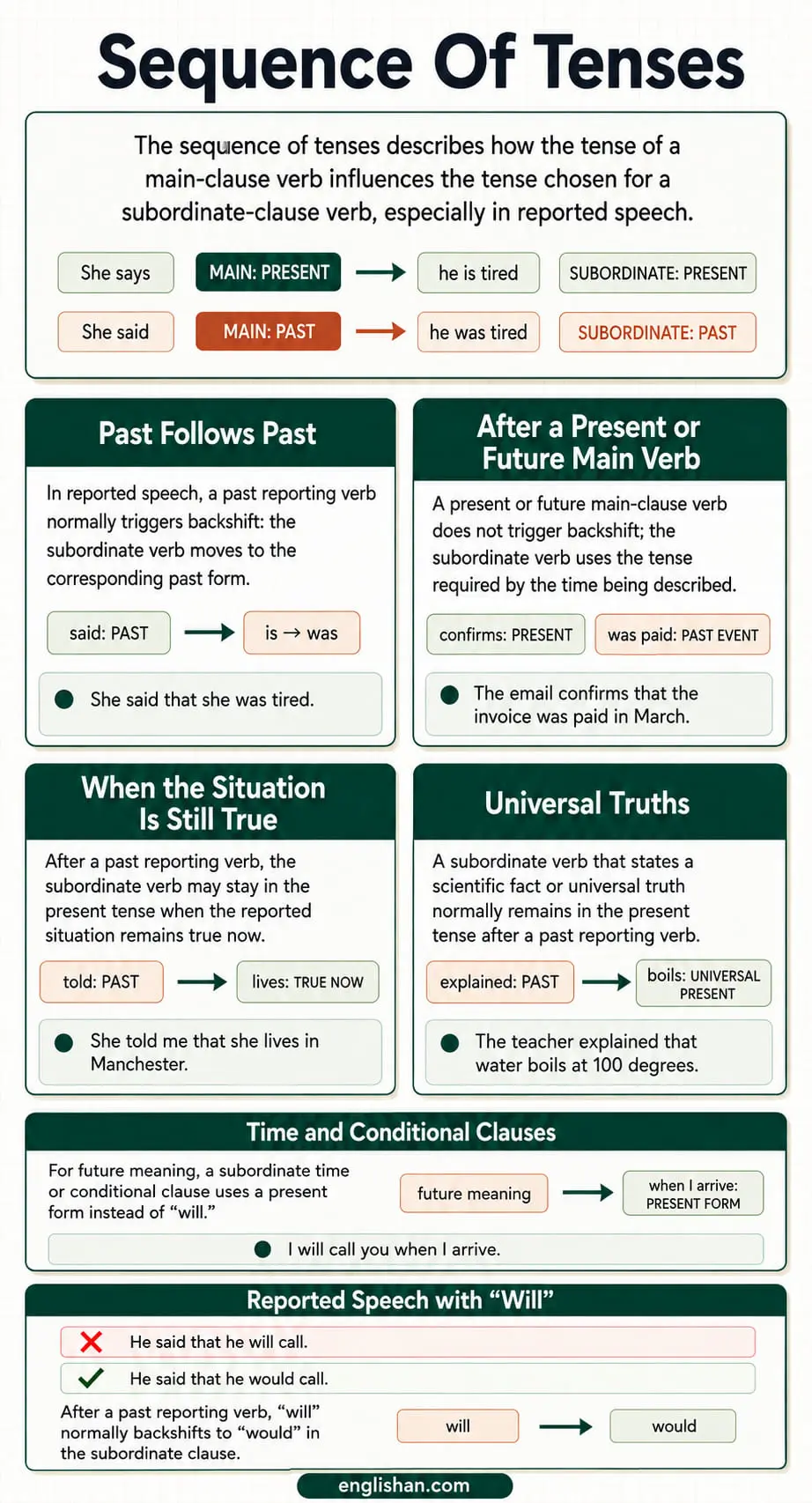
The Sequence Of Tenses Rule
The main verb sets the tense of the subordinate verb, and the only main verb that changes it is a past one.
The main clause is the half that is grammatical as a complete sentence on its own. The subordinate clause is the half attached to it by a word such as “that”, “when”, “if”, “so that”, or “because”. The first half is also named the principal clause, and the two names denote the same clause. When the main verb is past, the verb in the subordinate clause shifts back one tense, and that change is called backshift.
- She says that she is tired.
- She said that she was tired.
- He knows that you live in Leeds.
- He knew that you lived in Leeds.
In the second pair, only the main verb was changed, and the subordinate verb followed automatically. Backshift is the whole rule.
After a past main verb: the next three rules state whether the shift happens, whether it is required, and where it stops.
Past Follows Past In A Subordinate Clause
A past main verb backshifts the subordinate verb by one tense.
Each tense is replaced by its past counterpart. The present perfect and the past simple both become the past perfect, and “will” becomes “would”.
- The manager announced that the office closed early on Fridays.
- Priya told me she was staying with her cousin.
- We realised that the train had already left.
- The nurse explained that she had worked there for ten years.
- I thought you would call before eight.
- The guide warned us that the path got steeper after the bridge.
- She wrote that the parcel had arrived on Tuesday.
- Nobody noticed that the printer was running out of paper.
In the third example, “had already left” reports an event that happened before “realised”, so the past simple of the original words becomes the past perfect.
When Backshift Is Not Required
Backshift is the default after a past main verb, and two conditions cancel it.
The first condition is a situation still true at the moment of speaking. The second is a universal truth, meaning a fact that does not depend on when it is stated. In both, the backshifted form and the unshifted form are correct, and the unshifted form keeps the situation live for the listener.
- She told me that she lives in Manchester.
- She told me that she lived in Manchester.
- The teacher explained that water boils at 100 degrees.
- The teacher explained that water boiled at 100 degrees.
- My brother said the shop opens at seven.
- The report confirmed that the building is structurally sound.
- Our doctor mentioned that exercise lowers blood pressure.
- He admitted that he still owes me money.
The first two sentences report the same words and differ only in what the speaker marks. “Lives” places the situation in the present, and “lived” leaves the time unstated.
Ask whether the situation is still true at the moment of speaking, and if it is, either tense is correct.
Past Perfect Does Not Shift Further
The past perfect is the last form in the shift. No verb form refers to a time before it, so a past perfect stays a past perfect when it is reported.
- “I had already eaten.” → He said he had already eaten.
- “I ate at six.” → He said he had eaten at six.
- She claimed that the parcel had gone missing before the weekend.
- The auditor noted that the figures had been checked twice.
- We found out that the flat had been empty for a year.
Those two reports begin from different tenses and end in the same form. One past perfect can therefore report either original tense, so the exact wording cannot always be recovered from a report.
Clauses that set their own tense: in the next three rules the clause type determines the tense, and the main verb has no effect on it.
Any Tense After Present Or Future
A present or future main verb leaves the subordinate verb free, so the tense follows the meaning alone.
- She says she finished the report yesterday.
- She says she is finishing the report now.
- She says she will finish the report tonight.
- The email confirms that the invoice was paid in March.
- Our tutor will explain why the experiment failed.
- Everyone knows that the museum has been closed since June.
- The letter states that the tenancy ends in April.
Present Tense In Time And Conditional Clauses
“I will phone you when I will get home” is impossible, and the reason is the clause type rather than the tense.
An adverbial clause modifies the main clause and answers when, if, or under what condition. An adverbial clause of time or condition takes a present form for future time, whatever tense the main clause takes. “When”, “as soon as”, “once”, “until”, “before”, “after”, and “if” all introduce one.
- I will call you when I arrive.
- We will start as soon as the projector works.
- She will pay the deposit once the contract is ready.
- If it rains, the match will move indoors.
- Wait here until the doctor calls your name.
- Tell me when the results will be published.
- Nobody knows whether the flight will leave on time.
The last two sentences take “will”, and the reason is that “when” and “whether” introduce a noun clause there rather than an adverbial one. A noun clause functions as the object, so it takes any tense that fits the meaning, including “will”.
Apply this test to the clause. Replace it with “then”: if the sentence is still grammatical, the clause is adverbial and takes a present form. Replace it with “something”: if that version is grammatical instead, the clause is a noun clause and “will” is correct.
Sequence Of Tenses In Purpose Clauses
Take “She left early so that she could catch the last bus”.
A purpose clause states why the action in the main clause happened, and it takes a modal verb rather than a plain tense. “Can” and “may” follow a present main verb. “Could” and “would” follow a past one.
- She left early so that she could catch the last bus.
- He works two jobs so that his daughter can stay in college.
- We write everything down so that the team can refer to it later.
- The nurse spoke slowly so that the patient would follow her.
- They book early so that they can choose their seats.
“Might” is also grammatical after a past main verb, and “could” and “would” are what current writing and speech use.
Reporting verbs and fixed expressions: the next three rules are the past reporting verb, the modal verbs it backshifts, and the expressions that take a past form in every environment.
Sequence Of Tenses In Reported Speech
Which tense does a reported clause take when the reporting verb is past?
The reported clause backshifts, and each form has its own past equivalent. Reported speech is where the sequence of tenses applies most, because the reporting verb there is nearly always past.
| Direct speech | After a past reporting verb |
|---|---|
| Present simple | Past simple |
| Present continuous | Past continuous |
| Present perfect | Past perfect |
| Past simple | Past perfect |
| Past continuous | Past perfect continuous |
| Will | Would |
| Am, is, are going to | Was, were going to |
- “I work nights.” → She said she worked nights.
- “We are moving house.” → They said they were moving house.
- “I have finished.” → He said he had finished.
- “The bus left at six.” → She said the bus had left at six.
- “I will email you.” → He said he would email me.
- “We are going to appeal.” → They said they were going to appeal.
- “I was waiting outside.” → She said she had been waiting outside.
- “You can collect it tomorrow.” → He said I could collect it the next day.
Backshift Of Modal Verbs
“Will” becomes “would”, and four modal verbs are unchanged.
| Modal in direct speech | After a past reporting verb |
|---|---|
| Will | Would |
| Can | Could |
| May | Might |
| Shall | Should |
| Must, meaning obligation | Had to |
| Must, meaning a deduction | Must |
| Would, could, might, should, ought to | Unchanged |
- “I can drive.” → She said she could drive.
- “We may be late.” → They said they might be late.
- “You must book in advance.” → The clerk said I had to book in advance.
- “She must be exhausted.” → He said she must be exhausted.
- “I would rather wait.” → He said he would rather wait.
- “You should rest.” → The doctor said I should rest.
- “They might cancel.” → She said they might cancel.
The two meanings of “must” backshift differently. Obligation becomes “had to”, and a deduction stays as “must”, because no past form of that meaning exists.
Past Tense After Wish And As If
“I wish I knew you earlier” is wrong, and the correction is a different past form rather than a different tense.
“Wish”, “as if”, “as though”, “if only”, “it is time”, and “would rather” all take a past form for something unreal in the present, and a past perfect for something unreal in the past. This is the unreal past, also named the past subjunctive. It is separate from backshift, because no reporting verb is involved and the past form marks unreality rather than past time.
- I wish I knew the answer.
- I wish I had known you earlier.
- She talks as if she owned the place.
- He looked as though he had slept badly.
- If only the flat were a little bigger.
- It is time we left.
- I would rather you paid in cash.
“What if” is not used with these expressions. “What if he comes back?” takes a present form for a real possibility, and the past form is used only when the situation is unreal.
Tense Sequence With Infinitives And Participles
Take “I am glad to meet you” beside “I am glad to have met your parents last week”.
The sequence of tenses applies to non-finite forms as well. A present infinitive refers to time at or after the main verb, and a perfect infinitive, meaning “to have” plus the past participle, refers to time before it. The present participle and the perfect participle express the same contrast.
- I am glad to meet you.
- I am glad to have met your parents last week.
- She seems to enjoy the course.
- She seems to have enjoyed the course.
- Waiting on the platform, he checked his phone.
- Having waited an hour, he took a taxi.
The two participle sentences describe different orders of events. “Waiting” refers to an action simultaneous with the checking, and “Having waited” refers to one completed before it.
Common Backshift Mistakes
Each error below is a correct rule applied in the wrong environment, so the correction depends on identifying the environment rather than on restating the rule.
- He said that he will call. ❌
- He said that he would call. ✅
The reporting verb is past, so “will” becomes “would” whatever the timing of the call.
- I will phone you when I will get home. ❌
- I will phone you when I get home. ✅
- The clerk said I must pay a deposit. ❌
- The clerk said I had to pay a deposit. ✅
- I wish I knew about the meeting yesterday. ❌
- I wish I had known about the meeting yesterday. ✅
- She told me the parcel has arrived on Monday. ❌
- She told me the parcel had arrived on Monday. ✅
- He said he would phone when he would arrive. ❌
- He said he would phone when he arrived. ✅
Sequence Of Tenses Chart
| Main clause | Subordinate clause takes | Example |
|---|---|---|
| Present or future | Any tense that fits the meaning | She says she left early. |
| Past reporting verb | The backshifted form | She said she had left early. |
| Past, situation still true | The backshifted form or the unshifted form | She said she lives here. |
| Past, universal truth | The backshifted form or the unshifted form | He explained that ice melts at zero. |
| Time or conditional clause, future meaning | A present form | I will wait until she calls. |
| Purpose clause | Can or may after a present verb; could or would after a past one | He saves so that he can travel. |
| Wish, as if, if only, it is time | Past for present unreality; past perfect for past unreality | I wish I had known. |
Identify the main clause first, then read the subordinate clause, since the subordinate clause follows from it and never the reverse.
Related: All Tenses Chart with Formulas and Example Sentences
FAQs
Q1. What is the difference between the sequence of tenses and tense consistency?
The sequence of tenses governs two verbs inside one sentence, where the main verb determines what the subordinate verb takes. Tense consistency governs a whole passage, where a narrative that opens in the past remains in the past unless the time reference genuinely changes. The first is a rule of clause structure, and the second is a convention of writing.
Q2. Does the sequence of tenses apply to conditional sentences?
Yes, and conditional sentences follow their own fixed forms on top of it. A first conditional takes a present form in the if-clause and “will” in the main clause. A second conditional takes a past form for present unreality, and a third conditional takes a past perfect for past unreality. Those past forms are the unreal past rather than backshift.
Q3. Does the sequence of tenses apply to direct speech?
No, direct speech reproduces the original words inside quotation marks, so nothing shifts. “She said, ‘I am tired'” keeps “am” whatever tense the reporting verb takes. The shift applies only when the quotation marks are removed and the words become a subordinate clause.
Q4. Which tenses form the primary sequence and which form the secondary sequence?
The primary sequence applies where the main verb is in the present, the present perfect, or the future, and it leaves the subordinate verb free. The secondary sequence applies where the main verb is in the past or the past perfect, and it triggers backshift. Both names are borrowed from Latin grammar, and exam papers still use them.
Q5. Can the sequence of tenses change the meaning of a sentence?
Yes, and the clearest instance is a report of something still true. “He said his wife is a doctor” reports that she still is, while “He said his wife was a doctor” leaves that unstated and can suggest she no longer is. Both are grammatical, so the choice is a decision about meaning rather than about correctness.
Q6. How do you check whether a sentence has the correct sequence of tenses?
Find the main verb first and label it present, future, or past. If it is present or future, the subordinate verb is free and the check is over. If it is past, ask three questions. Check whether the subordinate clause is adverbial, whether the situation is still true, and whether the verb is already a past perfect, since each of those cancels or blocks the shift.
Q7. Is the sequence of tenses the same in other languages?
No, and a direct translation fails here. English backshifts after a past reporting verb, while Russian, Arabic, and Japanese keep the original tense of the reported words. Latin and Ancient Greek apply a stricter version of the rule than English does.
Sequence of Tenses Quiz
Sequence of Tenses
Report the sentence.
'I am tired,' she said. -> She said she ___ tired.
After a past reporting verb, present 'am' backshifts to 'was'.
present simple -> past simple after 'said'
She said she was tired.
Report the sentence.
'I work here,' he said. -> He said he ___ there.
Present 'work' backshifts to past 'worked' after 'said'.
present simple -> past simple
He said he worked there.
Report the sentence.
'I have finished,' she said. -> She said she ___ finished.
Present perfect 'have finished' backshifts to past perfect 'had finished'.
present perfect -> past perfect
She said she had finished.
Report the sentence.
'I will call,' he said. -> He said he ___ call.
'Will' backshifts to 'would' after a past reporting verb.
will -> would
He said he would call.
Report the sentence.
'I can swim,' she said. -> She said she ___ swim.
'Can' backshifts to 'could' after 'said'.
can -> could
She said she could swim.
Report the sentence.
'I saw it,' he said. -> He said he ___ it.
Past simple 'saw' backshifts to past perfect 'had seen'.
past simple -> past perfect
He said he had seen it.
Report the sentence.
'I am reading,' she said. -> She said she ___ reading.
Present continuous 'am reading' backshifts to past continuous 'was reading'.
present continuous -> past continuous
She said she was reading.
Report the sentence.
'I may come,' he said. -> He said he ___ come.
'May' backshifts to 'might' after 'said'.
may -> might
He said he might come.
Report the sentence.
'I must go,' she said. -> She said she ___ go.
'Must' backshifts to 'had to' after a past reporting verb.
must -> had to
She said she had to go.
Report the time word.
'I'll do it tomorrow.' -> He said he'd do it ___ .
In reported speech, 'tomorrow' shifts to 'the next day'.
tomorrow -> the next day
He said he'd do it the next day.
Report the time word.
'I'm busy now.' -> She said she was busy ___ .
In reported speech, 'now' shifts to 'then'.
now -> then
She said she was busy then.
True or false?
After a past reporting verb, the present simple backshifts to the past simple.
A present simple steps back to a past simple after 'said' or 'told'.
present simple -> past simple
He said he lived nearby.
True or false?
'Will' stays 'will' after a past reporting verb.
'Will' backshifts to 'would' after a past reporting verb.
will -> would
She said she would help.
Report the verb.
'I live in Paris,' she said. -> She said she ___ in Paris.
Present 'live' backshifts to past 'lived' after 'said'.
present simple -> past simple
She said she lived in Paris.
Report the sentence.
'I don't know,' she said. -> She said she ___ know.
Present 'don't' backshifts to past 'didn't' after 'said'.
don't -> didn't
She said she didn't know.
Report the sentence.
'I have been waiting,' he said. -> He said he ___ waiting.
Present perfect continuous backshifts to past perfect continuous.
present perfect continuous -> past perfect continuous
He said he had been waiting.
Report the time word.
'I saw her today.' -> He said he'd seen her ___ .
In reported speech, 'today' shifts to 'that day'.
today -> that day
He said he'd seen her that day.
Report the sentence.
'I can't help,' she said. -> She said she ___ help.
'Can't' backshifts to 'couldn't' after 'said'.
can't -> couldn't
She said she couldn't help.
Report the verb.
'We are leaving,' they said. -> They said they ___ leaving.
Present continuous 'are leaving' backshifts to past continuous 'were leaving'.
present continuous -> past continuous
They said they were leaving.
Report the place word.
'Come here,' he said. -> He told me to go ___ .
In reported speech, 'here' shifts to 'there'.
here -> there
He told me to go there.
Turn on JavaScript for the interactive quiz. The full practice set is shown above.