Australian Animals Names attract millions of people interested in wildlife, nature, and biodiversity. Australia is one of the most biologically rich countries on Earth, with around 80% of its animal species found nowhere else in the world. Isolated for millions of years, the continent followed a unique evolutionary path, producing remarkable marsupials, egg-laying mammals, highly venomous snakes, and some of the world’s most colorful birds.
Whether you are a student, wildlife enthusiast, or planning a trip to Australia, this article explores Australian animals names, pictures, facts, habitats, and conservation status across the country’s major wildlife groups.
Why Australian Wildlife Is So Unique
Australia has been geographically separated from other continents for roughly 35 million years. This isolation gave native species the freedom to evolve independently, filling ecological roles that placental mammals occupy elsewhere in the world. The result is a continent where:
- Over 80% of mammals, reptiles, and frogs are found nowhere else
- Two of the world’s five monotreme (egg-laying mammal) species live here
- More than 100 venomous snake species call it home
- Australia ranks among the world’s 17 megadiverse nations
- Over 800 bird species have been recorded
Explore more animals that start with different letters
A | B | C | D | E | F | G | H | I | J | K | L | M | N | O | P | Q | R | S | T | U | V | W | X | Y | Z
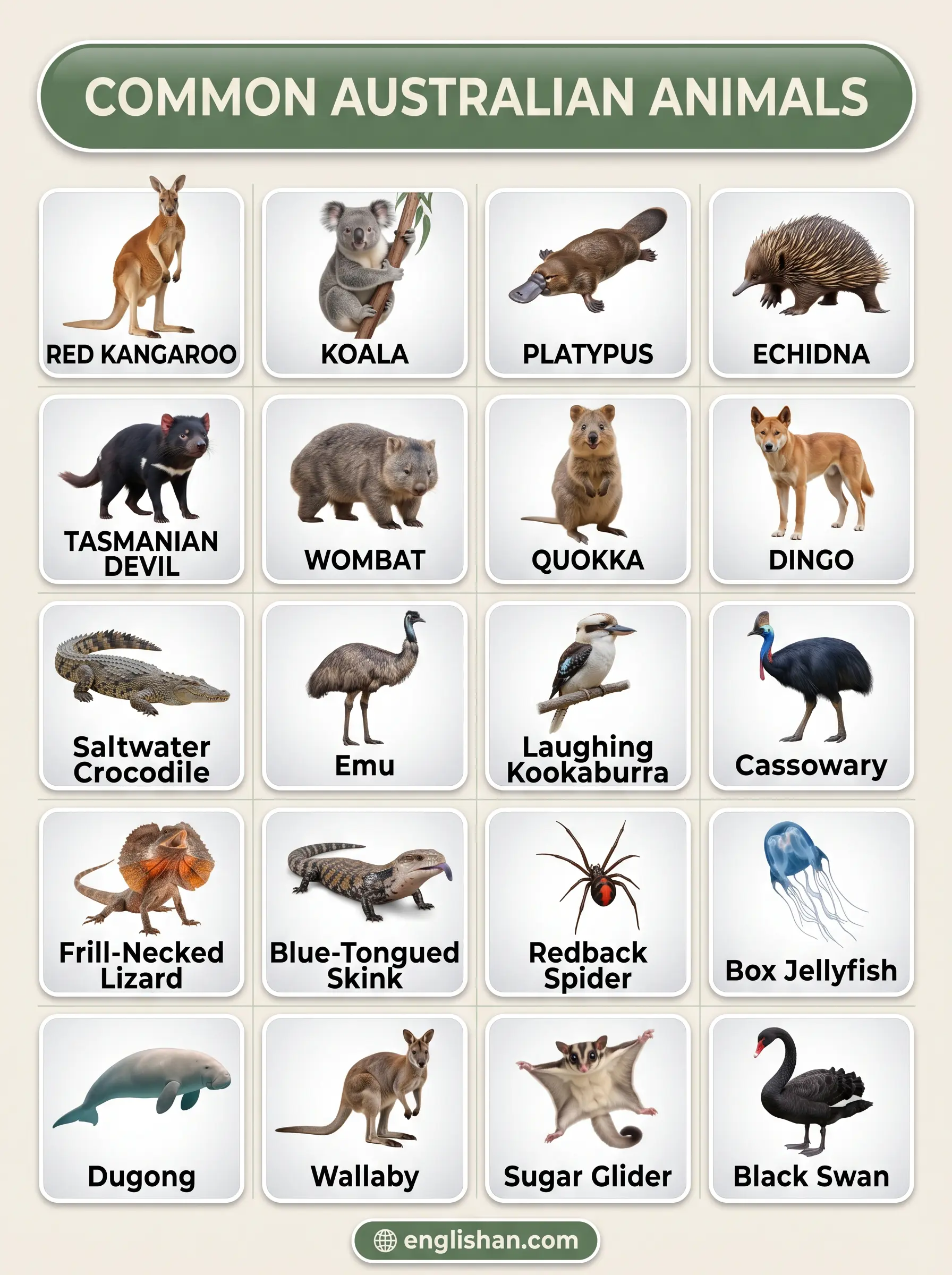
Most Common Australian Animals with Pictures
These are the australian animals names you are most likely to encounter, read about, or search for when exploring Australian wildlife. Each includes its common name, key identification features, habitat, diet, and one standout fact.
❶ Red Kangaroo
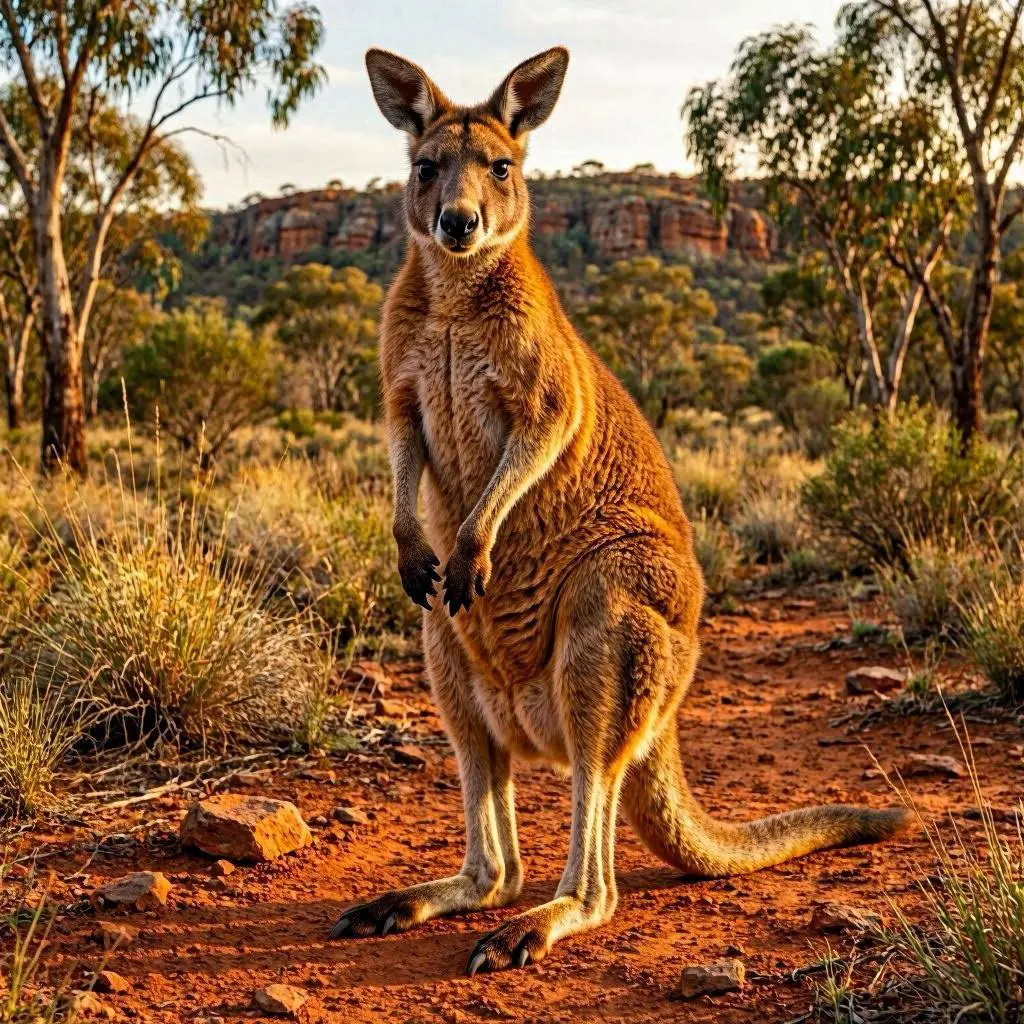
The red kangaroo is Australia’s largest land animal and its national symbol. Males are brick-red while females are blue-grey. Found across the dry interior, it grazes on grasses and low shrubs. It cannot walk backwards, one of the reasons it appears on the Australian Coat of Arms alongside the emu. Joeys are born the size of a jellybean and spend six to eight months developing in the pouch.
❷ Koala
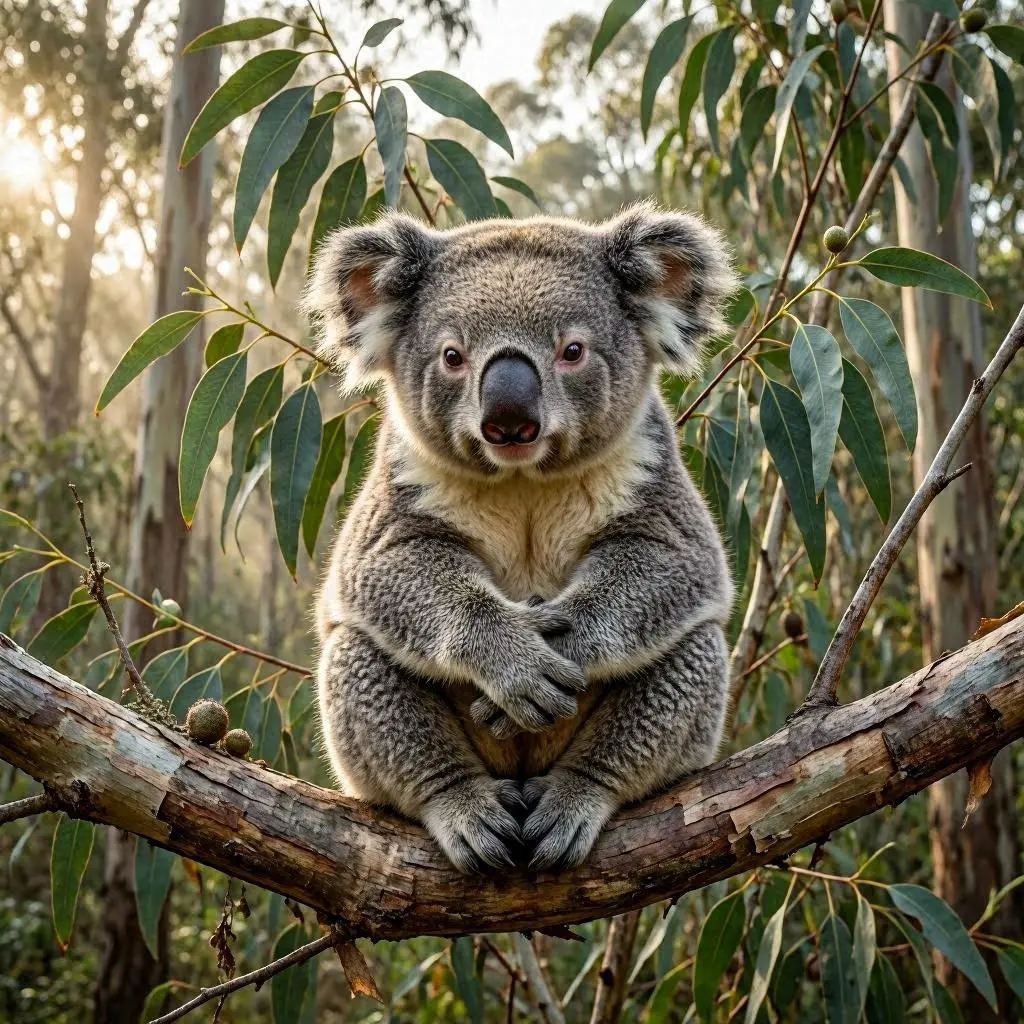
The koala is Australia’s most globally recognized animal. It lives almost exclusively in eucalyptus trees and feeds on leaves that are toxic to virtually every other mammal. Koalas have a uniquely ridged fingerprint nearly indistinguishable from a human fingerprint. They sleep up to 22 hours a day. Currently listed as endangered in Queensland, New South Wales, and the Australian Capital Territory.
❸ Platypus
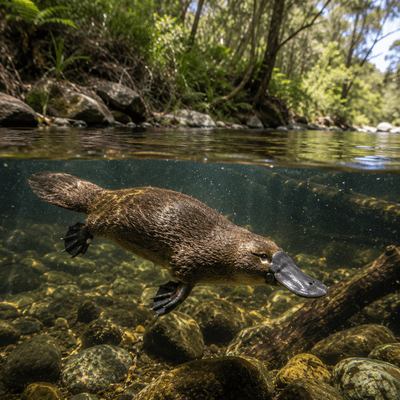
The platypus is one of the most scientifically remarkable animals alive. It is a mammal that lays eggs, has a bill lined with electroreceptors to detect prey underwater, and the male carries venom in ankle spurs. For years after its discovery, European scientists believed specimens sent back to England were a taxidermy hoax. Found in rivers and streams of eastern Australia and Tasmania.
❹ Echidna
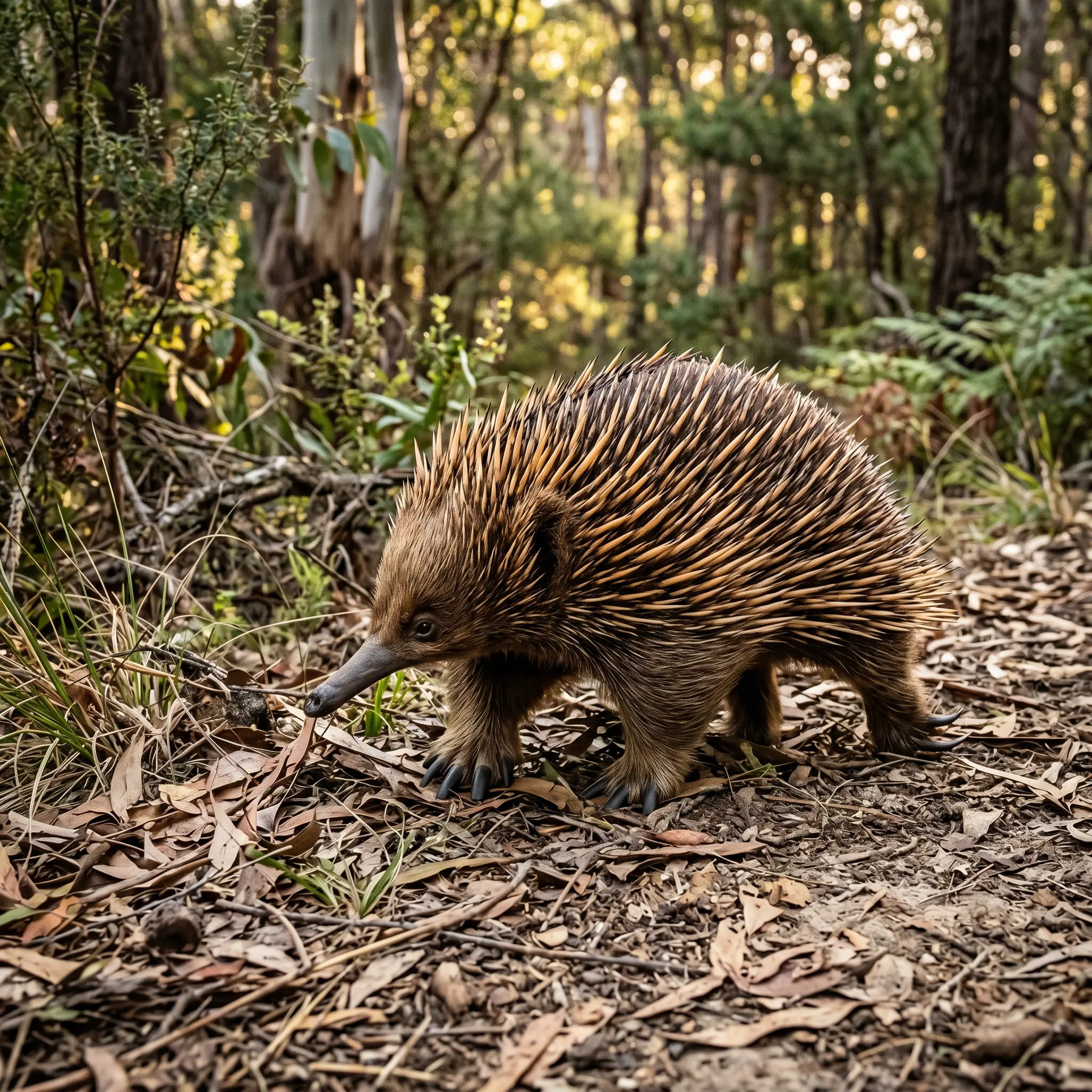
The short-beaked echidna is one of only two egg-laying mammals in Australia. It is covered in sharp spines and has no teeth, instead using a long, rapid-flicking tongue to catch ants and termites. When threatened, it rolls into a tight ball or buries itself rapidly using its powerful claws. Found across virtually the entire continent, from coastal forest to alpine zones and outback desert.
❺ Tasmanian Devil
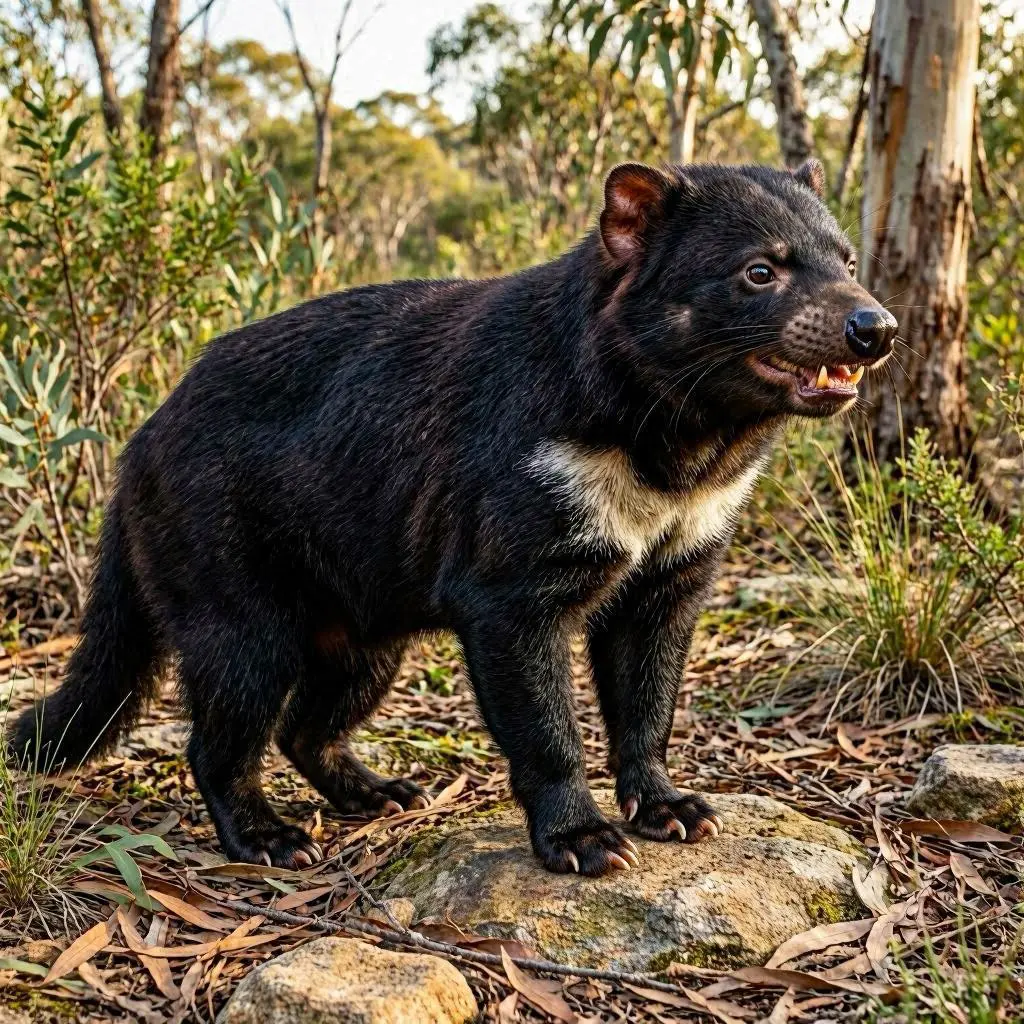
The Tasmanian devil is the world’s largest carnivorous marsupial and is found only in Tasmania. It is about the size of a small dog but has an exceptionally powerful bite capable of crushing bone. It feeds primarily on carrion and plays a vital role as a scavenger in Tasmania’s ecosystem. Currently threatened by devil facial tumor disease, an infectious contagious cancer that has wiped out significant portions of the wild population.
❻ Wombat
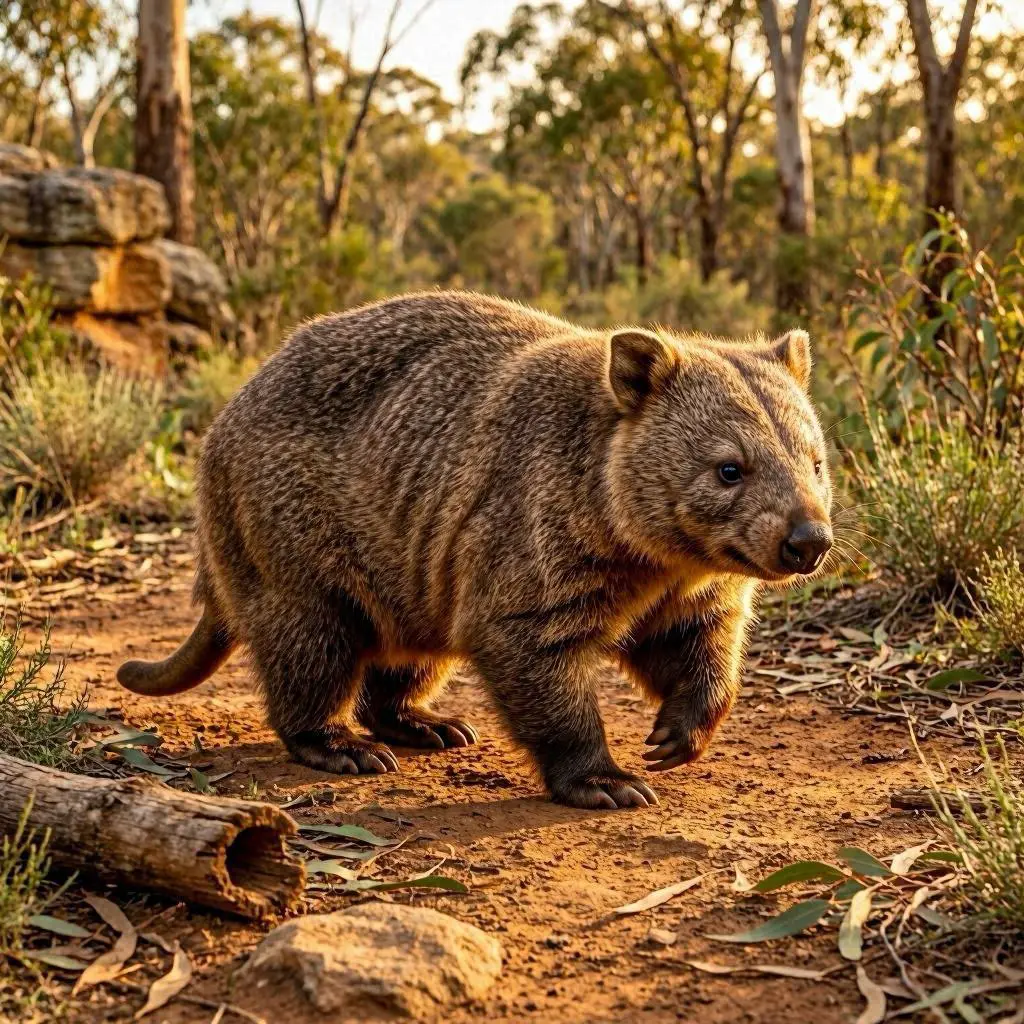
The wombat is a heavy, burrowing marsupial with backwards-facing pouches that keep dirt away from developing joeys. Its tunnel systems can stretch over 30 meters underground. Wombats are the only known animal to produce cube-shaped droppings, which they use to mark territory on rocks and logs. Despite their bulky build, they can sprint at 25 mph when threatened.
❼ Quokka
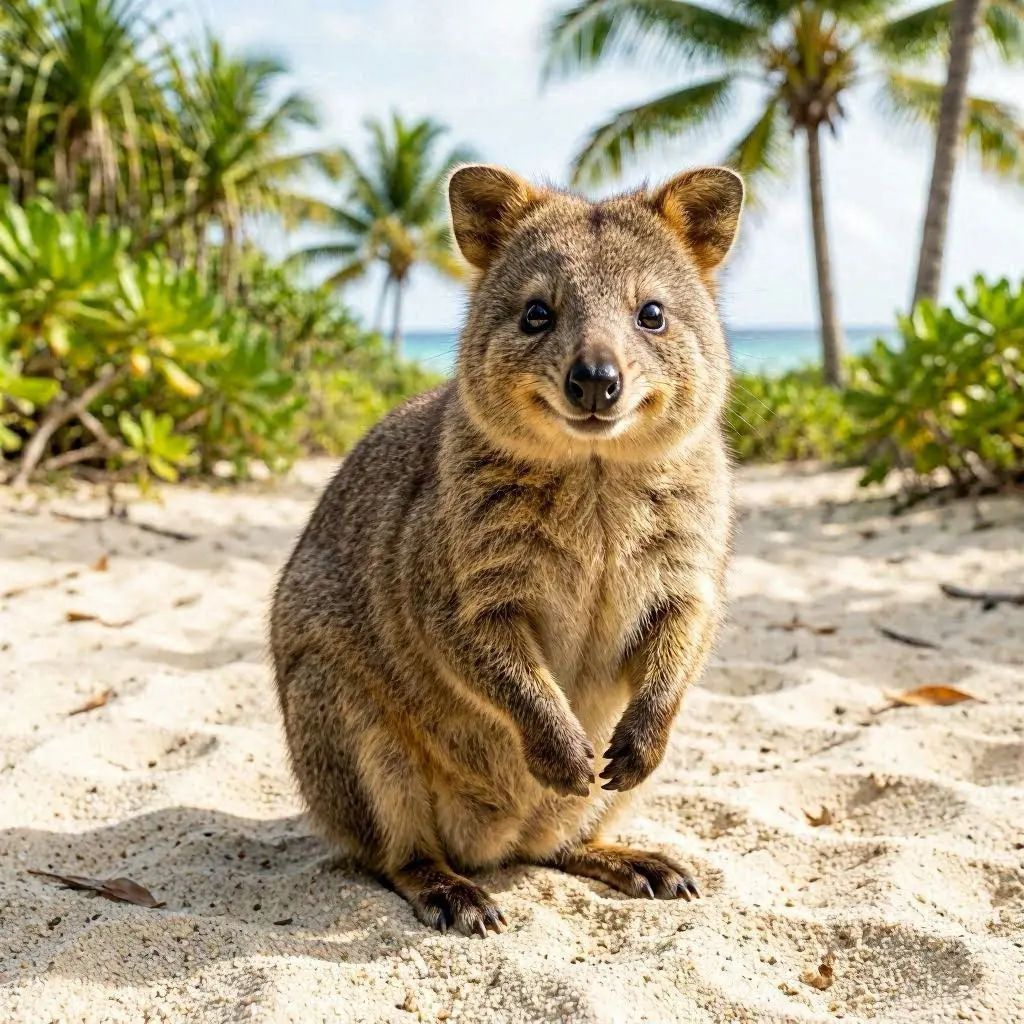
The quokka is a small marsupial native primarily to Rottnest Island near Perth and has become one of the most photographed animals in the world due to its naturally upturned mouth that resembles a smile. It carries joeys in its pouch, is mostly nocturnal, and feeds on grasses, leaves, and stems. The Dutch explorer Willem de Vlamingh mistook quokkas for large rats when he arrived in 1696, naming the island Rottnest, meaning “rat’s nest.”
❽ Dingo
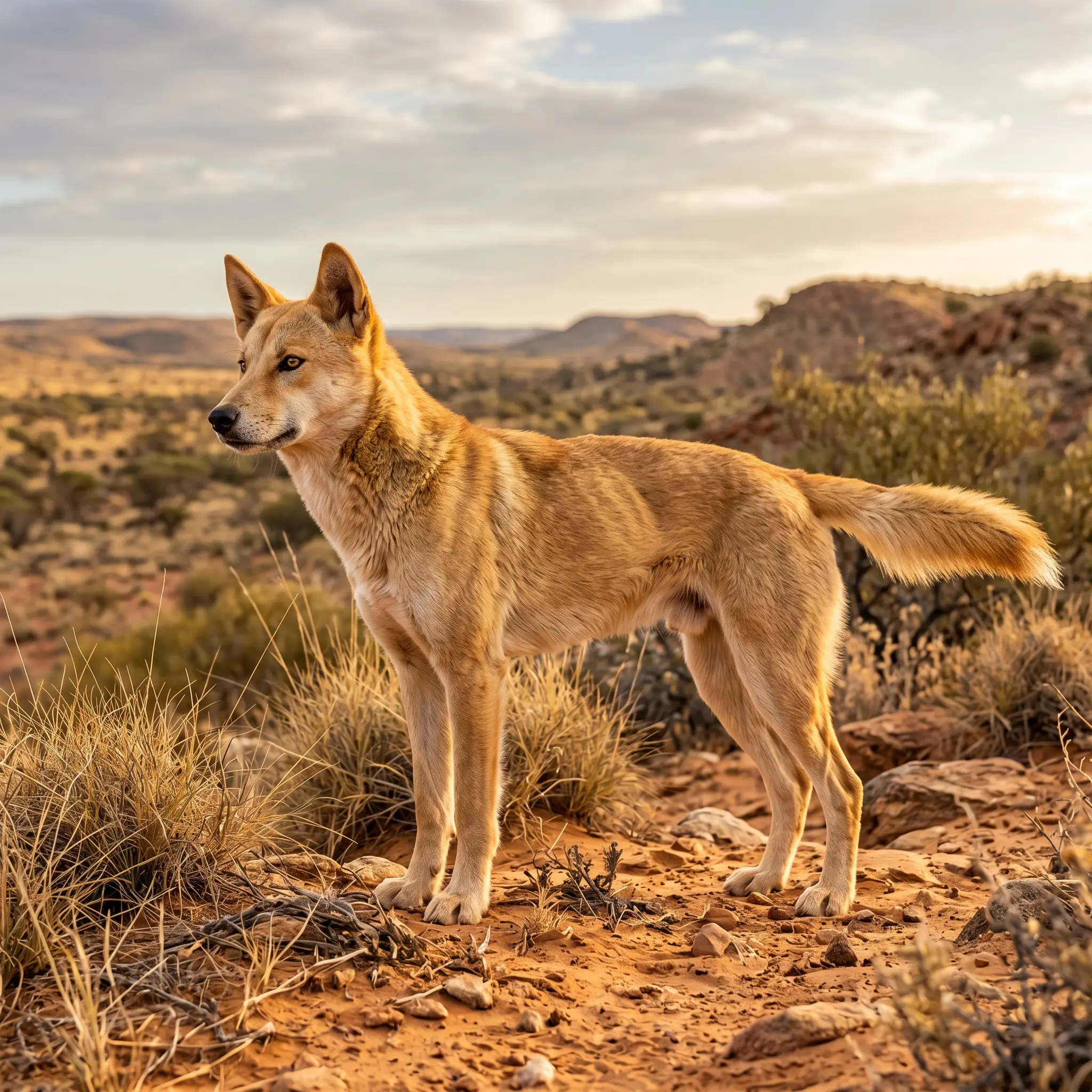
The dingo is Australia’s largest land predator and its only native dog. It arrived in Australia roughly 4,000 years ago from Southeast Asia and has since become fully wild. It is slimmer than domestic dogs with a longer muzzle and larger canine teeth. Dingoes communicate through howling rather than barking. Found across all of mainland Australia, it is both a apex predator and a critical part of ecosystem balance.
❾ Saltwater Crocodile
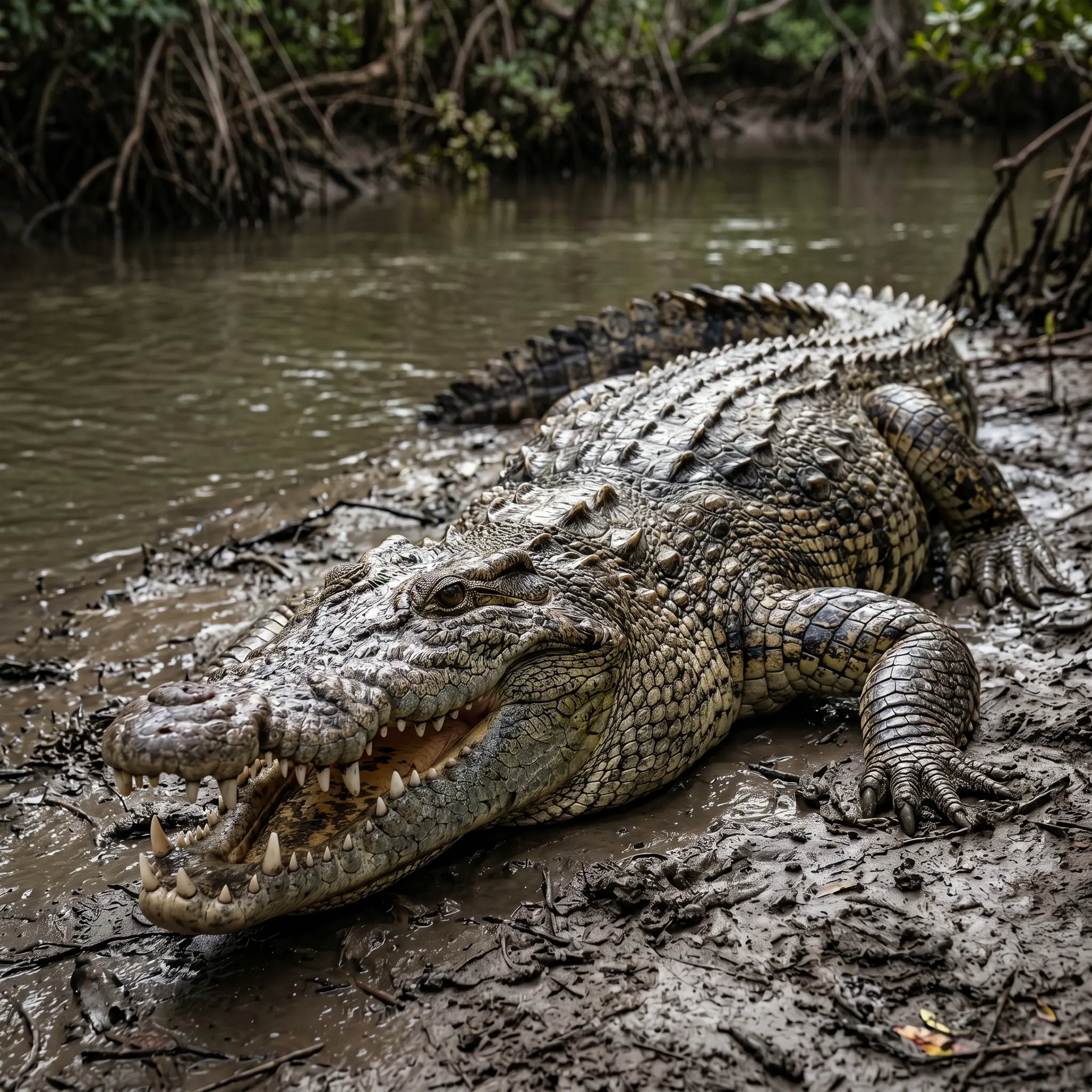
The saltwater crocodile, known locally as a “saltie,” is the world’s largest living reptile and one of its most dangerous. It can remain motionless for hours before launching an explosive ambush from the water. It is found across northern Australia’s rivers, estuaries, and coastal zones. The Northern Territory alone has an estimated 100,000 individuals. Despite its name, it regularly inhabits freshwater systems far inland.
❿ Emu
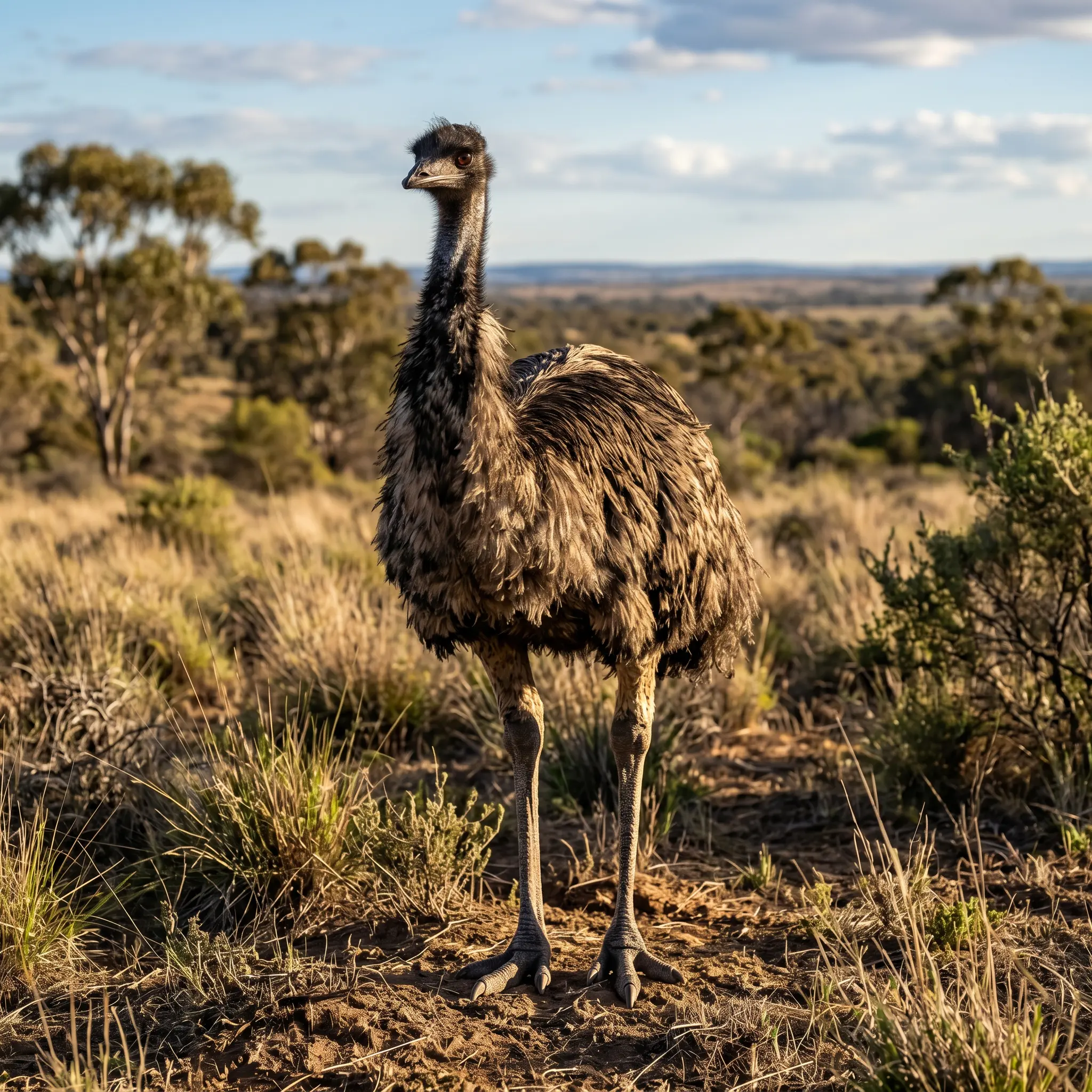
The emu is Australia’s tallest bird and the world’s third-tallest. It cannot fly but can run at up to 30 mph and is an excellent swimmer. Males are the sole incubators of eggs and primary caregivers to chicks for the first 18 months. The emu appears on the Australian Coat of Arms and is also the subject of the famous Great Emu War of 1932, in which the Australian military was deployed to cull a population of emus and ultimately withdrew after failing to control them.
⓫ Kookaburra
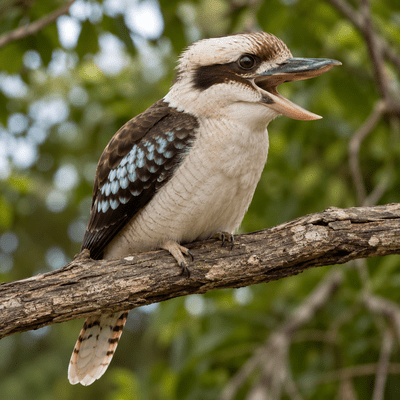
The laughing kookaburra is the world’s largest kingfisher and produces one of Australia’s most iconic sounds, a loud, echoing call that sounds like human laughter. It is a carnivore that hunts lizards, snakes, insects, and small rodents, often smashing prey against a branch before swallowing it. The kookaburra is territorial and monogamous, and family groups cooperate to raise young together each season.
⓬ Cassowary
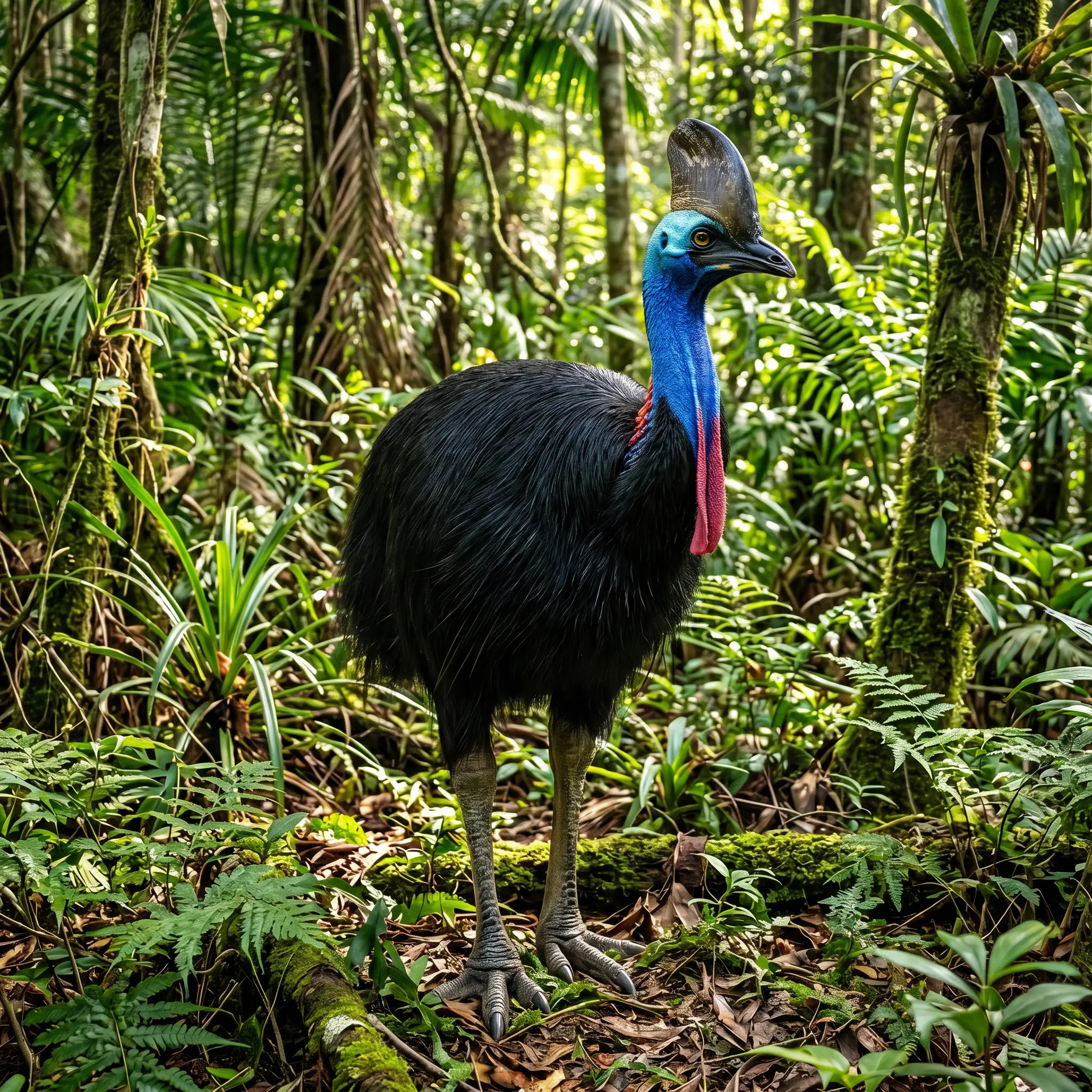
The southern cassowary is the world’s second-heaviest bird and is found only in the rainforests of northeastern Queensland in Australia. Its bony casque on top of its head amplifies low-frequency calls and may help it navigate dense forest. Its inner claw can reach 12 cm in length and deliver a powerful, potentially fatal kick. Despite its fearsome reputation, it is shy and rarely encountered by people.
⓭ Frill-Necked Lizard
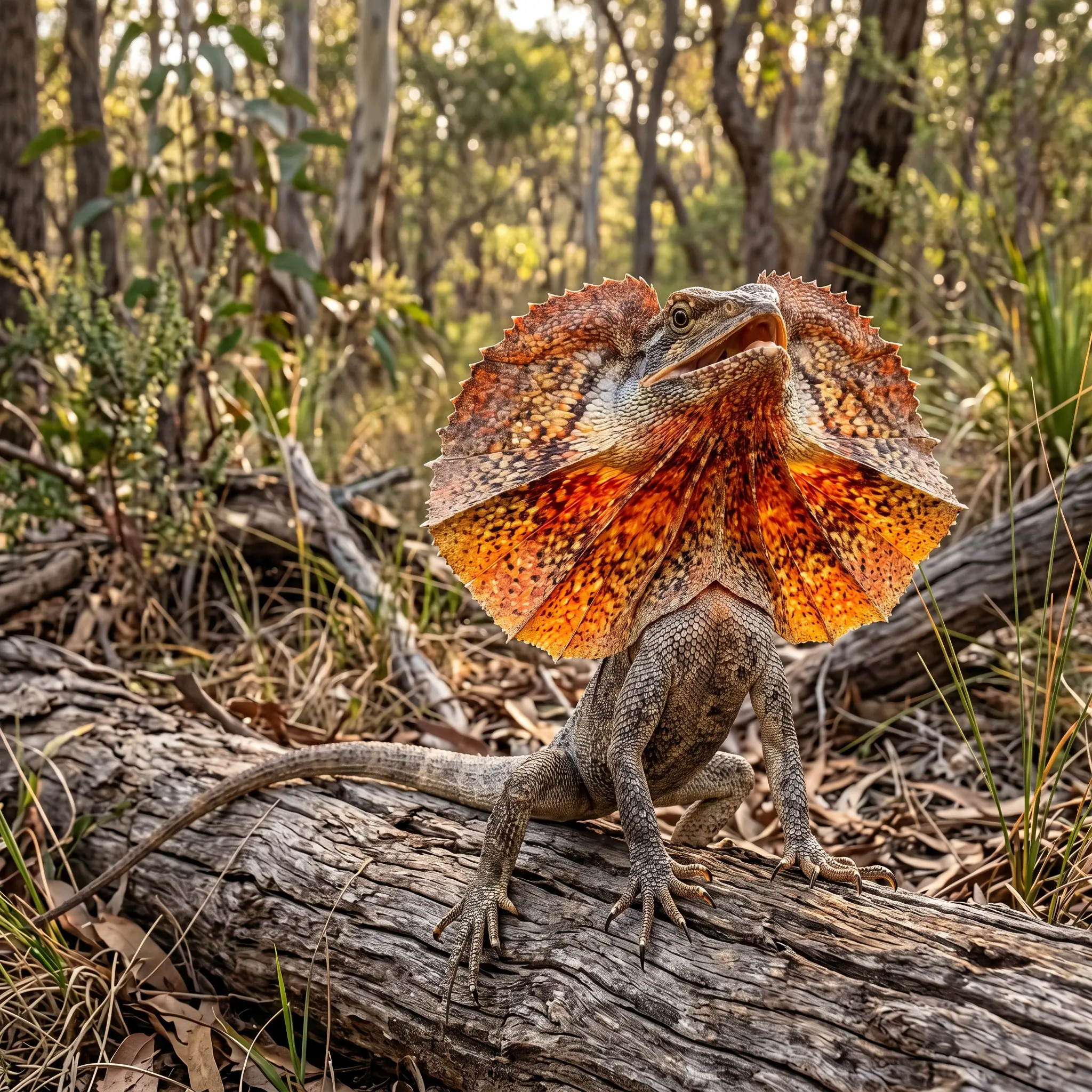
The frill-necked lizard is one of Australia’s most visually dramatic reptiles. When threatened, it opens a large frill of brightly colored skin around its neck, hisses, and runs bipedally on its hind legs to escape. Spends most of its time motionless in the tree canopy, perfectly camouflaged. Found across the tropical and subtropical forests and woodlands of northern Australia.
⓮ Blue-Tongued Skink
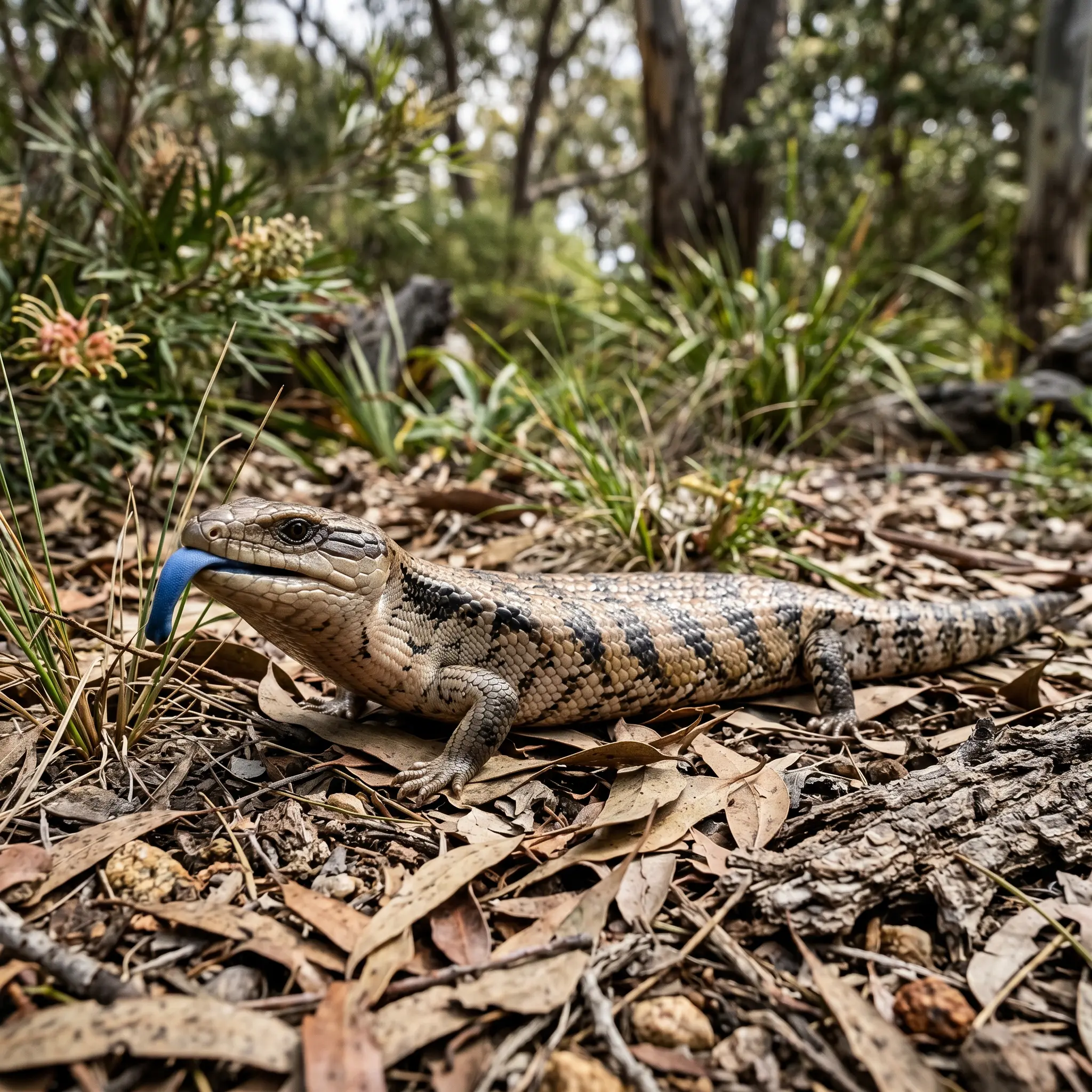
The blue-tongued skink is a slow-moving lizard instantly identifiable by its vivid cobalt-blue tongue, which it flashes at predators to mimic the warning coloration of venomous animals. It is one of the most commonly encountered lizards in Australian gardens and suburban parks. Omnivorous, feeding on snails, insects, fruits, and flowers. One of the most popular pet reptiles in Australia due to its docile temperament.
⓯ Redback Spider
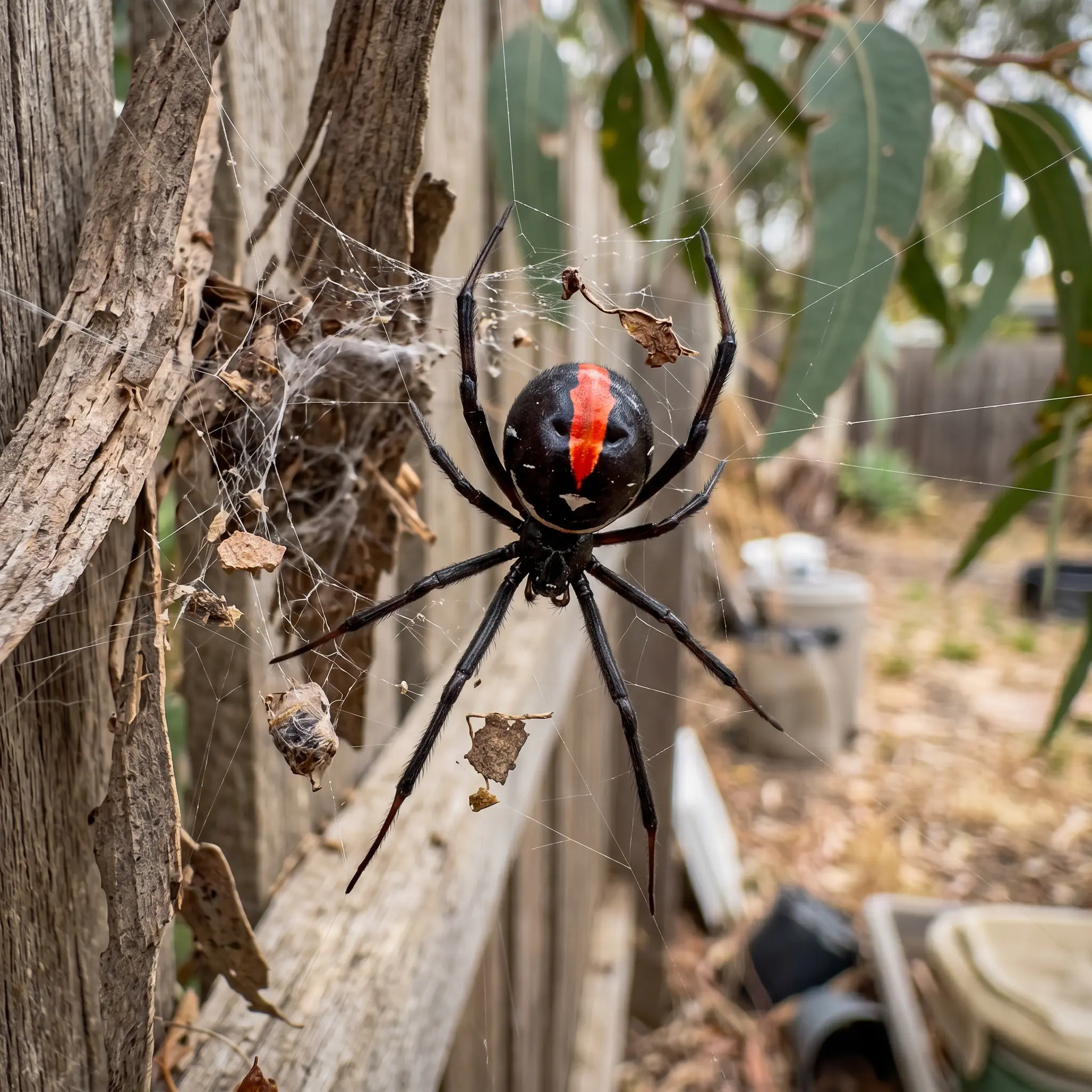
The redback spider is one of Australia’s most feared spiders and one of the world’s most venomous. The female is identified by its jet-black body and a distinctive red or orange stripe on the upper abdomen. Found across all of Australia in dry, sheltered spots near human habitation, including garden sheds, outdoor furniture, and letterboxes. Males are tiny and harmless. An antivenom introduced in 1956 has made fatalities extremely rare.
⓰ Box Jellyfish
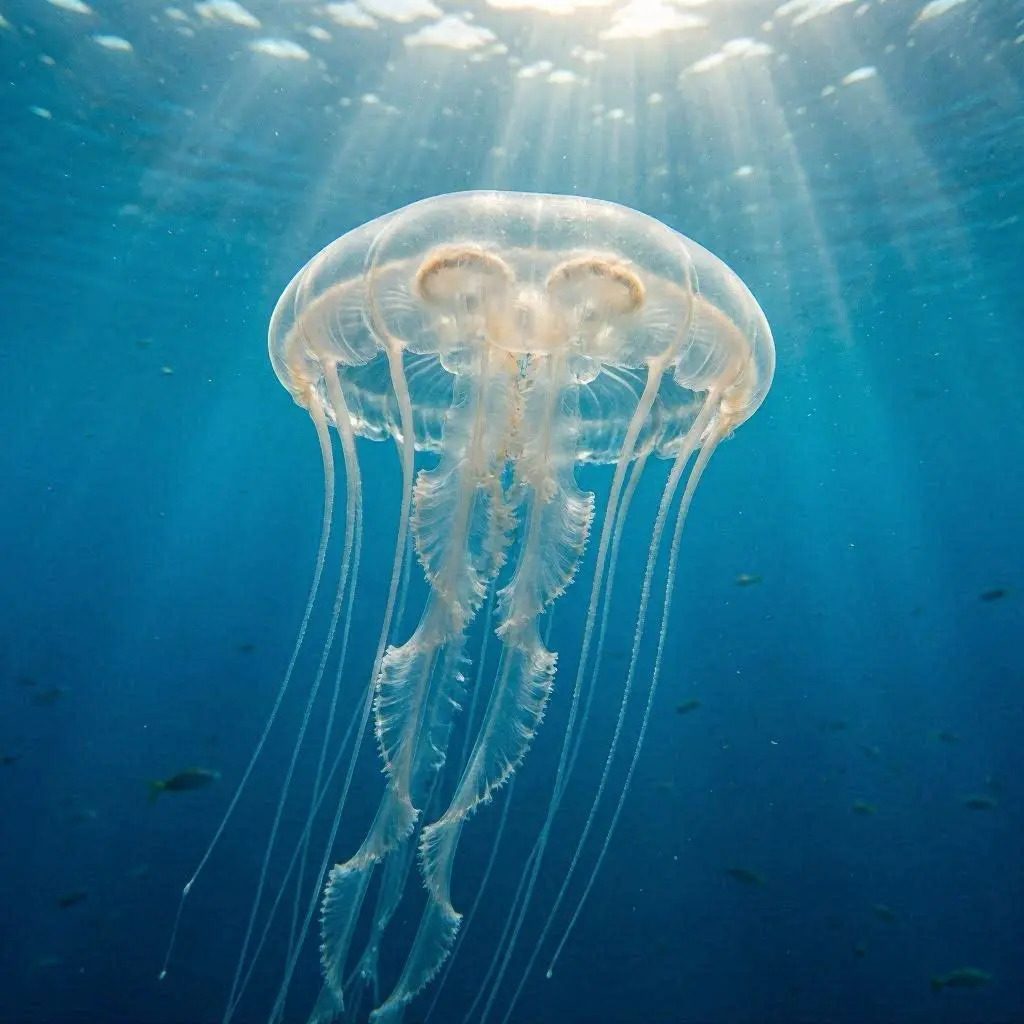
The box jellyfish is widely considered the most venomous animal on Earth. Its transparent, cube-shaped bell and trailing tentacles are almost invisible in the water, making it extraordinarily dangerous. Each tentacle contains thousands of stinging cells that inject venom fast enough to cause cardiac arrest in under four minutes. Found in northern Australian tropical waters from October to May. Stinger nets protect popular beaches during peak season.
⓱ Dugong
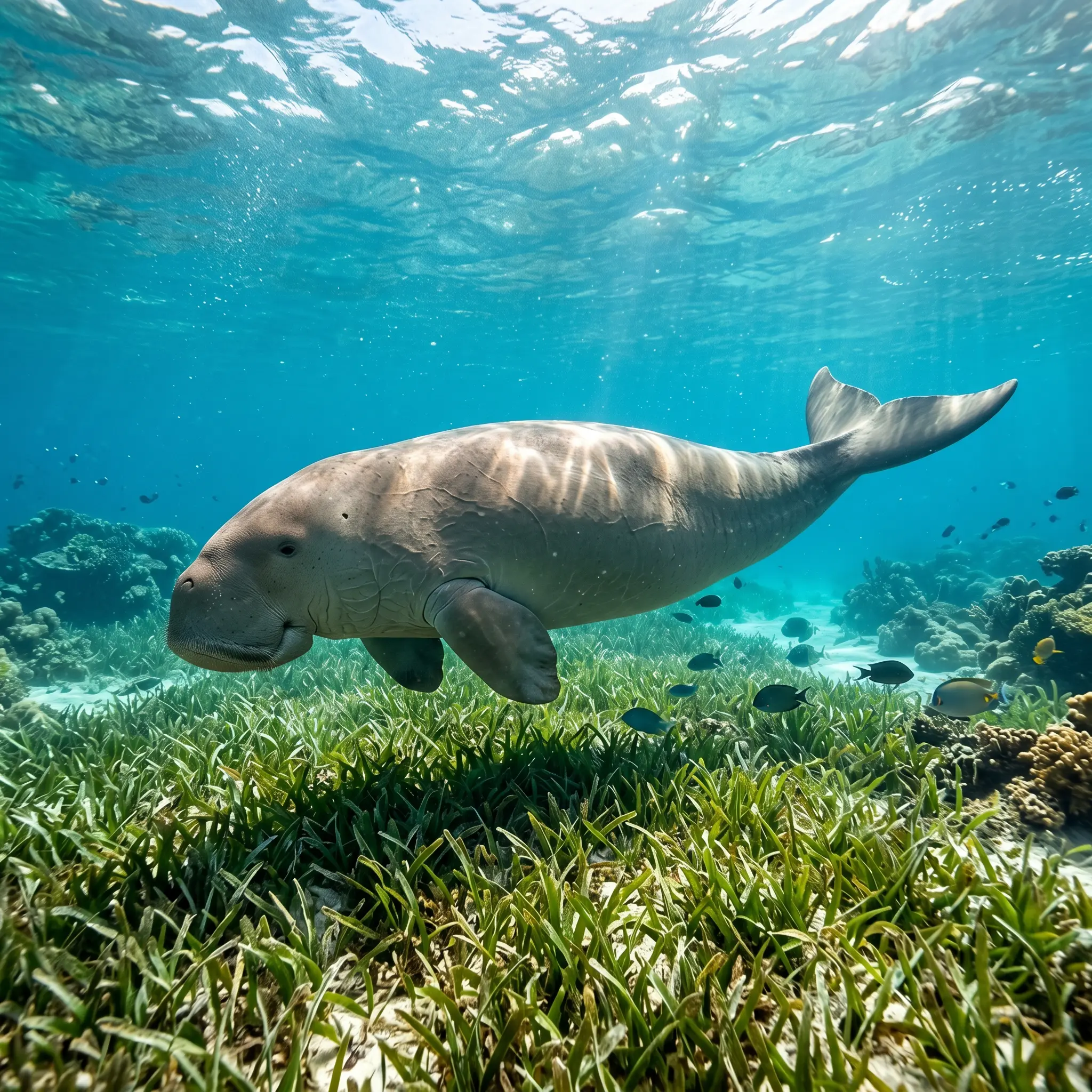
The dugong is a large, slow-moving marine mammal that feeds exclusively on seagrass, consuming up to 40 kg per day. It is the only strictly herbivorous marine mammal. Australia holds the world’s largest dugong population, with major concentrations in Shark Bay and the waters of the Northern Territory. The dugong is believed to have inspired ancient sailor myths of mermaids. It is classified as vulnerable to extinction globally.
⓲ Wallaby
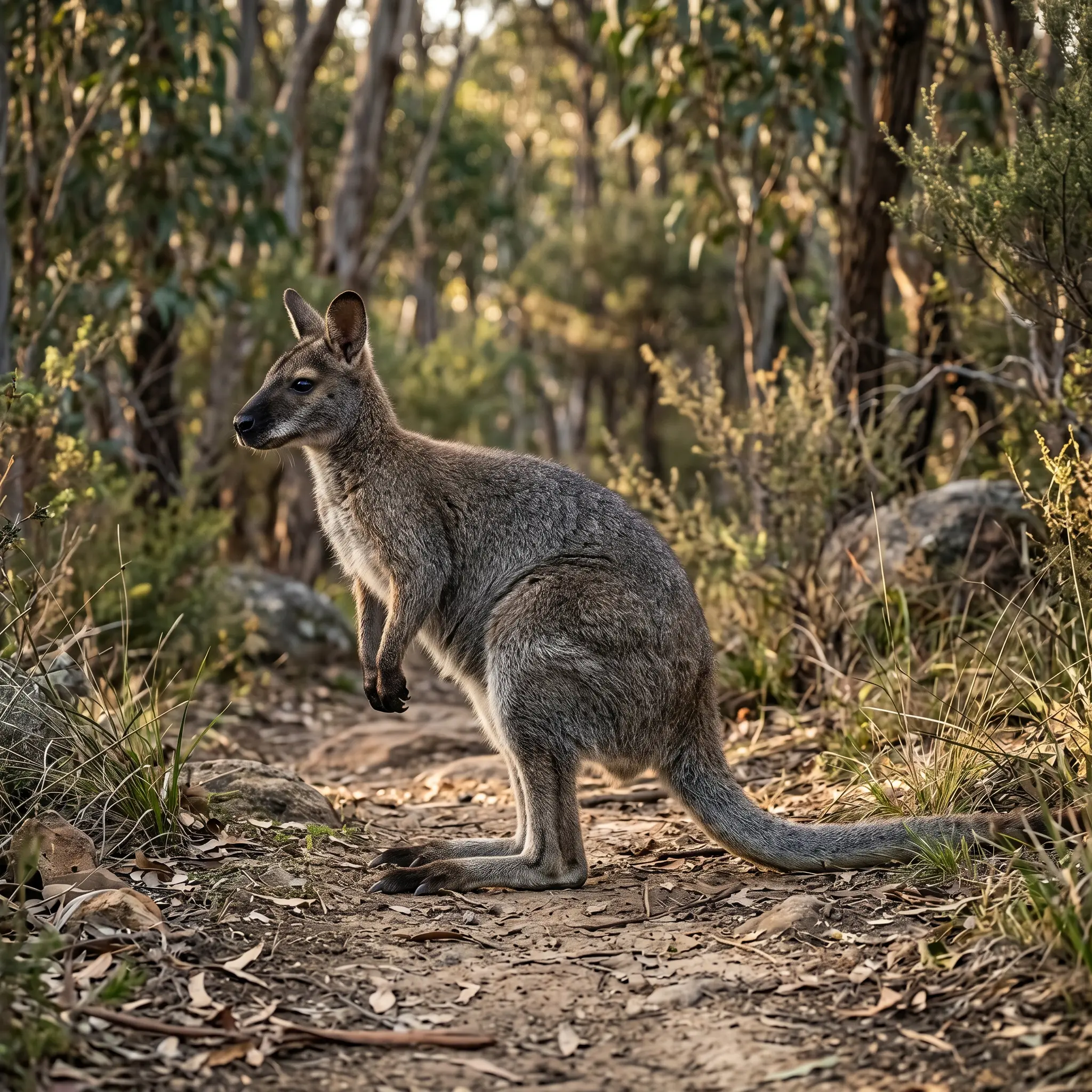
Wallabies are essentially smaller kangaroos, and over 30 species exist across Australia. They occupy an enormous range of habitats from dense rainforest to rocky cliff faces and coastal scrubland. Rock wallabies have specialized, textured foot pads for gripping steep cliff surfaces. Agile wallabies are the most commonly encountered species in tropical northern Australia. Like kangaroos, females carry joeys in a forward-opening pouch.
⓳ Sugar Glider
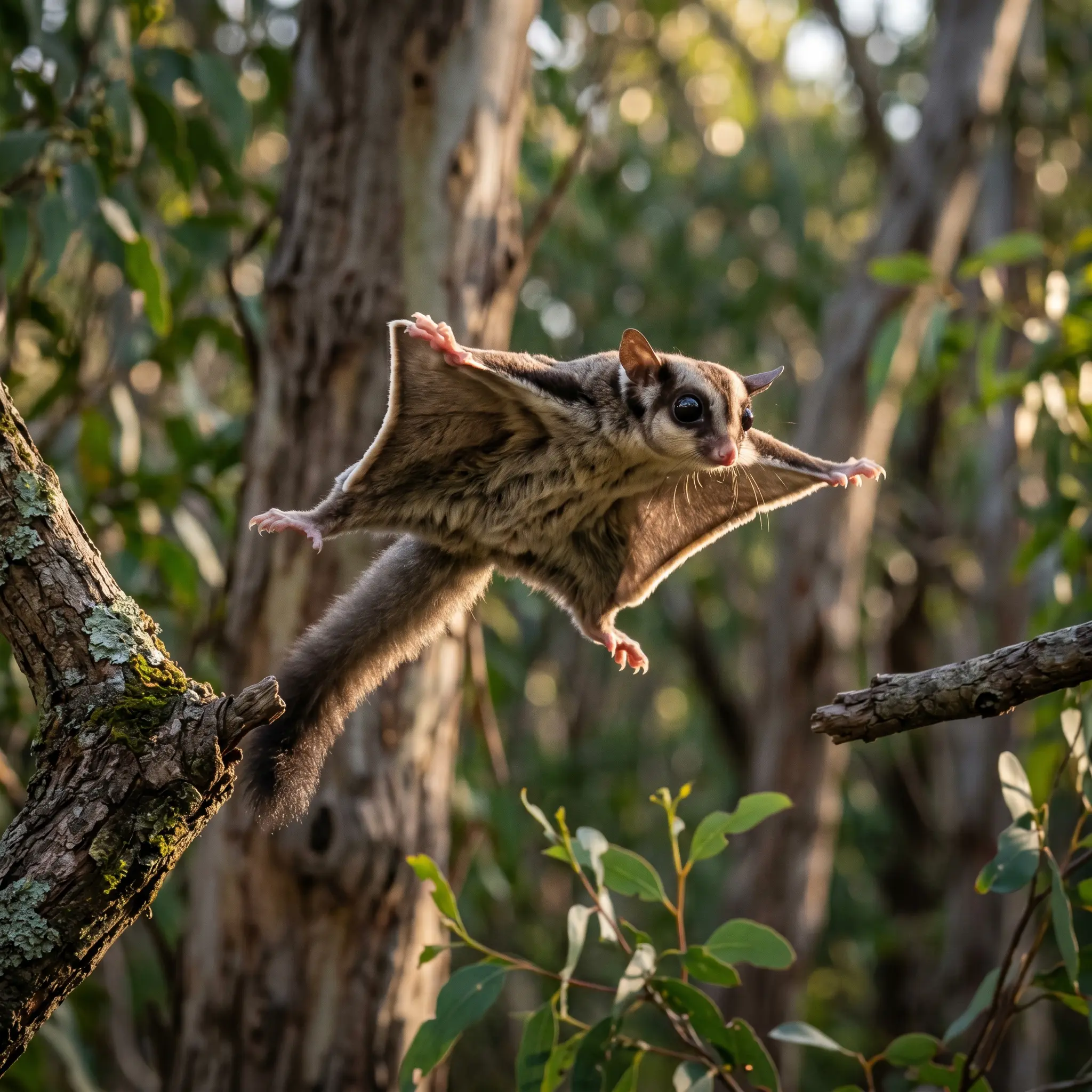
The sugar glider is a small possum-like marsupial with a membrane of thin skin stretching between its wrists and ankles that allows it to glide up to 50 meters between trees. Active at night, it feeds on nectar, tree sap, pollen, and insects. Found in forests across northern and eastern Australia and parts of New Guinea. Highly social and lives in family groups of up to 15 individuals that huddle together for warmth.
⓴ Black Swan
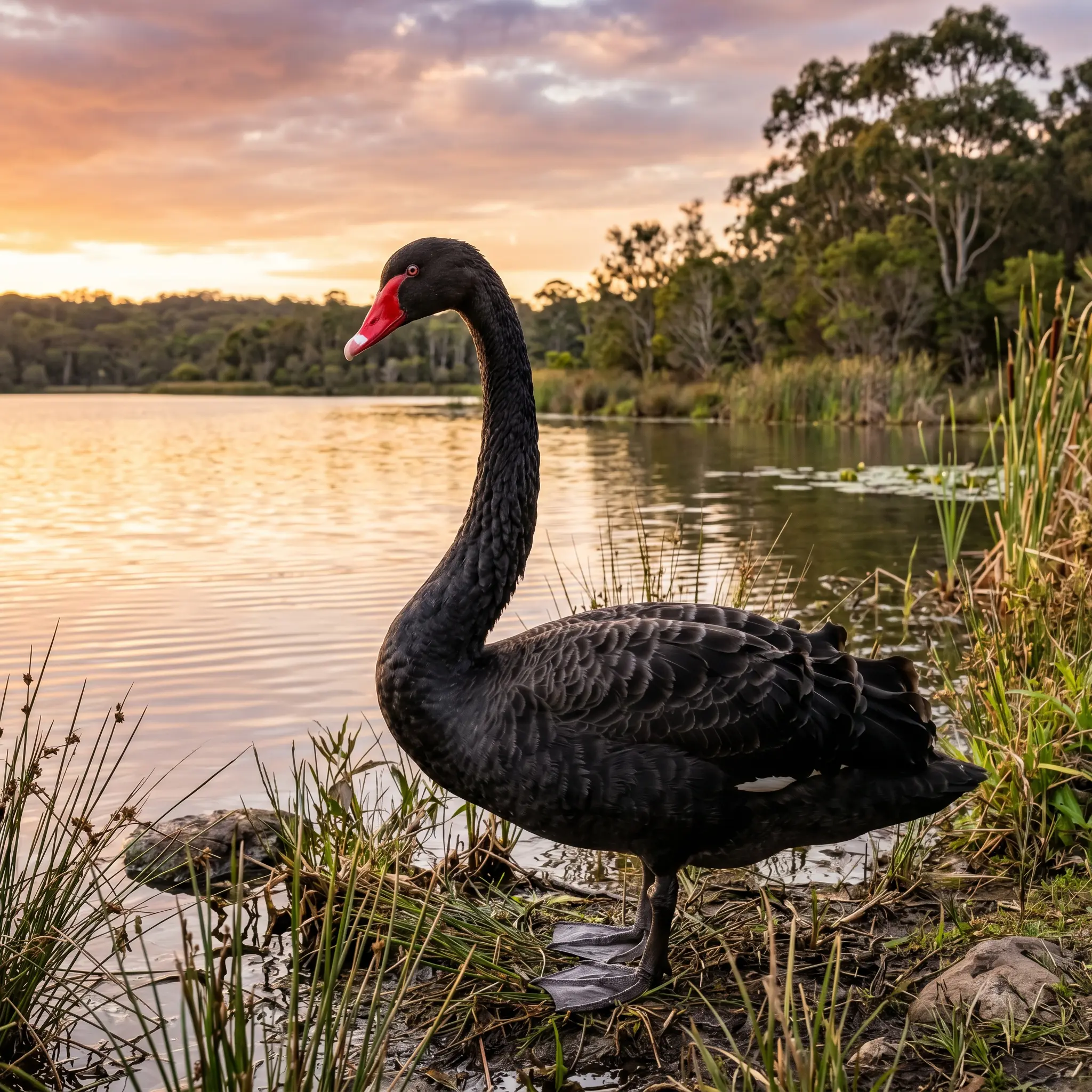
The black swan is a large, elegant waterbird found in wetlands, lakes, and rivers across Australia. It is entirely black with a bright red bill and white flight feathers visible only in flight. The official bird emblem of Western Australia. Primarily herbivorous, feeding on aquatic plants and algae. The term “black swan event,” now used in economics and risk theory, originated from the historical European belief that all swans were white, until black swans were discovered in Australia in 1697.
Types of Australian Animals Names(By Category)
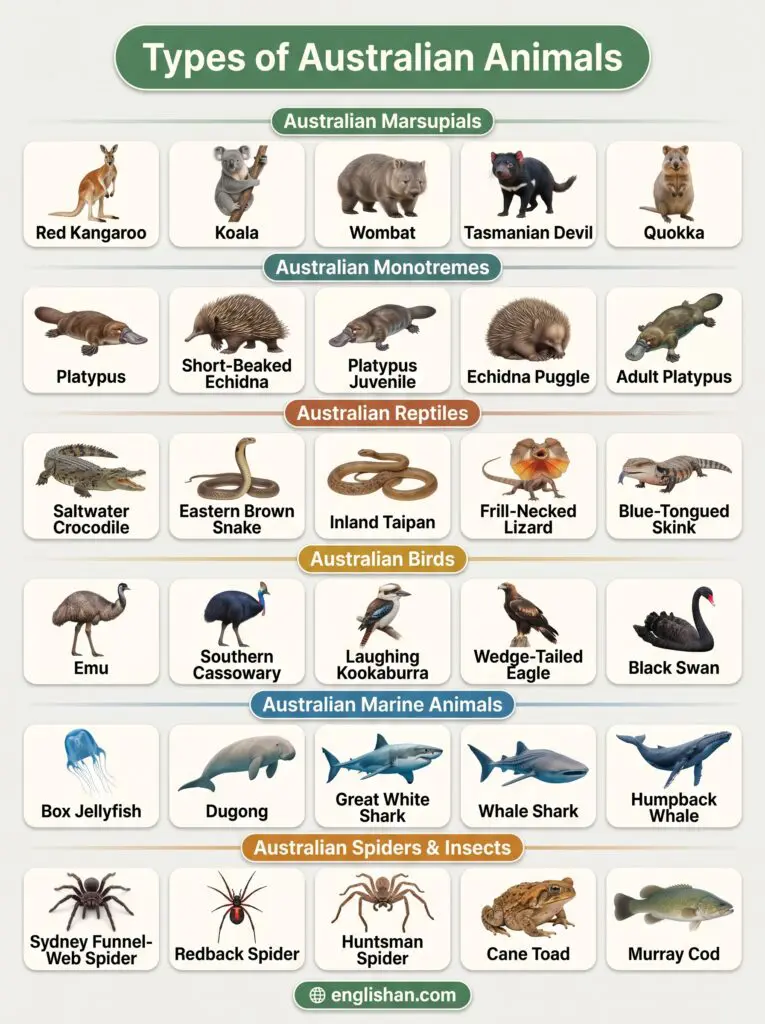
Australian wildlife falls into several major groups. Each is explored in detail below.
Australian Marsupials
Marsupials are pouched mammals that give birth to tiny, undeveloped young and carry them in a pouch until fully developed. Around 70% of the world’s marsupial species live in Australia. They dominate the mammal fauna and range from the massive red kangaroo to creatures smaller than a mouse.
- Red Kangaroo – The largest marsupial on Earth and Australia’s national animal. Males can reach 6 feet tall and 200 pounds, with powerful hind legs built for speed and a muscular tail used as a fifth limb. Found across the arid and semi-arid interior. Surprisingly strong swimmers that take to water to escape predators.
- Eastern Grey Kangaroo – Slightly smaller than the red kangaroo, this species is the most commonly encountered kangaroo in eastern Australia. Prefers forests and grasslands along the eastern coast. Lives in groups called mobs and is most active at dusk and dawn.
- Koala – One of Australia’s most globally recognized animals, the koala feeds almost entirely on eucalyptus leaves, which are toxic to most animals. Koalas have specialized gut bacteria to detoxify the leaves and sleep up to 22 hours daily to conserve energy. Found in eucalyptus forests of Queensland, New South Wales, Victoria, and South Australia. Currently listed as endangered.
- Wombat – A stocky, barrel-bodied burrowing marsupial with one of the most impressive digging capabilities in the animal kingdom. Wombats produce cube-shaped droppings, the only known animal to do so. Their backward-facing pouch prevents dirt from entering while burrowing. Can run at up to 25 mph in short bursts despite their heavy appearance.
- Tasmanian Devil – The world’s largest carnivorous marsupial, found only in Tasmania. Has one of the strongest bites relative to body size of any land mammal, capable of consuming bones, fur, and all. Known for its piercing screeches and aggressive feeding behavior. Currently threatened by devil facial tumor disease (DFTD), a contagious cancer unique to the species.
- Quokka – A small, cat-sized marsupial native to Rottnest Island near Perth. Known worldwide for its natural smile-like expression. Most active at night but frequently spotted during the day on Rottnest Island due to the absence of predators. The most-searched Australian animal online.
- Wallaby – Not a separate species but a collective name for smaller kangaroo family members. Over 30 wallaby species exist in Australia, ranging from rock wallabies adapted to cliff faces to the agile wallaby of tropical grasslands. Groups are called courts, mobs, or troupes.
- Wallaroo – Sits between a wallaby and a kangaroo in size. Stockier and more robustly built than both. Found across rocky hillsides and ranges in mainland Australia. More solitary than kangaroos and active mainly at night.
- Numbat – A small, striped marsupial that feeds almost entirely on termites, consuming up to 20,000 per day. It is the only diurnal (daytime-active) marsupial in existence, because its food source is only available when the sun warms the soil. Found in isolated remnant patches of southwestern Australia. Classified as endangered, with fewer than 1,000 individuals remaining.
- Bilby – A nocturnal, burrowing marsupial with long rabbit-like ears, giving it the nickname “rabbit-eared bandicoot.” Uses a long pointed tongue to forage for insects, seeds, and plant bulbs underground. Its rear-facing pouch prevents soil from entering while it digs. A nationally important conservation symbol, often used in Australian Easter campaigns in place of the Easter Bunny.
- Sugar Glider – A small, possum-like marsupial with a thin membrane called a patagium stretched between its wrists and ankles, allowing it to glide up to 50 meters between trees. Found in forests of northern and eastern Australia. Highly social and lives in groups of 10 to 15 individuals.
- Quoll – Australia’s native cat. Four quoll species exist across Australia, all carnivorous marsupials that hunt insects, small mammals, and birds. Spotted coats and a fierce hunting instinct make them one of Australia’s most impressive small predators. Several species are now endangered due to fox and cat predation.
- Bandicoot – A group of around 20 species of small, rat-like omnivorous marsupials found across Australia. Have long, tapered snouts used to sniff out insects and earthworms underground, which they dig up with strong forepaws. Range in size from a large rat to a small rabbit.
- Possum – Not to be confused with the North American opossum, Australian possums are arboreal marsupials found across forests, woodlands, and even suburban gardens. The common brushtail possum is one of the most frequently encountered marsupials near human settlements. Ring-tailed possums build globe-shaped nests called dreys.
- Pygmy Possum – One of the smallest marsupials in the world. The eastern pygmy possum weighs as little as 15 grams. Despite its tiny size, it is capable of entering torpor (a hibernation-like state) to survive cold winters. Feeds on nectar, pollen, and insects.
Australian Monotremes (Egg-Laying Mammals)
Monotremes are among the most ancient mammal lineages on Earth. Only five species exist worldwide, and two of them live in Australia. They share characteristics with both reptiles and mammals, laying eggs while also nursing young with milk.
- Platypus – One of the most unusual animals on Earth. Has a duck-like bill, beaver-like tail, and webbed feet. Males carry venomous spurs on their hind legs capable of causing intense pain in humans. Hunts entirely underwater using electroreceptors in its bill to detect the electrical fields of prey. Found in rivers and creeks of eastern Australia and Tasmania.
- Short-Beaked Echidna – The more common of Australia’s two echidna species, found across virtually the entire continent from deserts to alpine zones. Covered in sharp spines, it rolls into a ball when threatened or buries itself rapidly. Feeds exclusively on ants and termites using a long, sticky tongue. Baby echidnas, called puggles, hatch from a single leathery egg deposited directly into the mother’s pouch.
Australian Reptiles
Australia is home to some of the world’s most dangerous reptiles, including the top three most venomous snakes on Earth. It also hosts a fascinating range of lizards unique to the continent.
- Saltwater Crocodile – The world’s largest living reptile, reaching over 23 feet in length and 2,200 pounds. Found in coastal waters, estuaries, rivers, and freshwater swamps of northern Australia. An apex ambush predator that can remain motionless for hours before striking. The Northern Territory alone is home to an estimated 100,000 individuals. Known locally as “salties.”
- Freshwater Crocodile – Smaller and less aggressive than its saltwater relative, reaching up to 9 feet. Found in rivers, lakes, and swamps of northern Australia. Its bite is painful but rarely fatal to humans unless provoked. Distinguished by a narrower snout compared to the saltwater crocodile.
- Eastern Brown Snake – The world’s second-most venomous land snake and responsible for more snakebite deaths in Australia than any other species. Fast-moving and highly responsive to movement, it is found across eastern and central Australia in a wide variety of habitats including farmlands and suburbs.
- Inland Taipan – Holds the record for the most toxic venom of any land snake in the world. A single bite contains enough venom to kill 100 adult humans. Despite this, it is shy and reclusive, living in remote black-soil plains of central Australia, and human encounters are extremely rare.
- Frill-Necked Lizard – A large arboreal lizard found in northern Australian forests and woodlands. When threatened, it opens a dramatic frill of brightly colored skin around its neck to startle predators. Can run on its hind legs at impressive speed. Grows up to 85 cm in total length.
- Thorny Devil – A small, spiny desert lizard that collects drinking water through microscopic channels between its scales, channeling moisture directly to its mouth. Feeds exclusively on small black ants. Found across the sandy deserts of central Australia. Moves with a distinctive rocking gait.
- Blue-Tongued Skink – A slow-moving, heavy-bodied lizard with a vivid blue tongue it flashes to bluff predators by mimicking the coloration of venomous animals. Omnivorous and highly adaptable, found in gardens, grasslands, and forests across most of Australia. One of the most popular pet reptiles in the country.
- Goanna (Monitor Lizard) – Australia has 25 species of monitor lizard, known locally as goannas. The largest, the perentie, can reach 2.5 meters. They are powerful, intelligent predators that forage over large territories. Their forked tongue samples the air for scent. Found across most Australian habitats.
- Leatherback Turtle – The world’s largest turtle, found in Australian coastal waters. Unlike other turtles, it has a flexible, leathery shell rather than a hard carapace. Can migrate up to 16,000 km between nesting and feeding grounds. Feeds primarily on jellyfish, including the dangerous box jellyfish.
- Green Sea Turtle – Named for the color of its fat rather than its shell. Feeds on seagrasses in tropical and subtropical Australian waters. The Great Barrier Reef hosts one of the world’s largest green turtle populations. Long-distance migrators that return to the exact beach where they were born to nest.
Australian Birds
Australia has over 800 recorded bird species, including one of the world’s richest parrot faunas and some of the most distinctive flightless birds alive. Around one-third of Australian bird species are endemic.
- Emu – Australia’s tallest bird and the world’s third-tallest bird, standing up to 6.5 feet. Featured on the Australian Coat of Arms. Flightless but capable of running at 30 mph. Males incubate the eggs and raise the chicks alone. Famous for the “Great Emu War” of 1932, in which the Australian military attempted but failed to cull a population of emus.
- Southern Cassowary – The world’s second-heaviest bird, found only in the rainforests of northeastern Queensland in Australia. Has a bony casque on its head, a vivid blue and red neck, and razor-sharp claws capable of disemboweling large animals. Considered the world’s most dangerous bird when cornered.
- Kookaburra (Laughing Kookaburra) – The world’s largest kingfisher, famous for its loud, echoing call that resembles human laughter. Carnivorous and feeds on lizards, snakes, insects, and rodents. Often heard at dawn and dusk across eastern and southwestern Australia. A beloved symbol of the Australian bush.
- Wedge-Tailed Eagle – Australia’s largest bird of prey, with a wingspan up to 7.5 feet. Easily recognized by its distinctive diamond-shaped tail. Feeds on rabbits, wallabies, and carrion. Soars on thermal air currents to great heights and has exceptional eyesight. Found across all of Australia including Tasmania.
- Rainbow Lorikeet – One of the most colorful birds in the world, with a vivid combination of red, orange, yellow, green, and blue plumage. Feeds on nectar and pollen using a brush-tipped tongue. Highly social and noisy, often found in large flocks in coastal and woodland areas of eastern and northern Australia.
- Sulphur-Crested Cockatoo – A large, white cockatoo with a striking bright yellow crest. Highly intelligent, long-lived (up to 70 years), and extraordinarily loud. One of the most commonly seen large parrots across northern and eastern Australia. Known for learning and tool use in captivity.
- Galah – Known as the pink cockatoo, the galah has a soft pink body with a grey back and wings. Highly gregarious and often seen in flocks of hundreds. Found across most of mainland Australia in open country. One of the most adaptable and widespread cockatoo species.
- Black Swan – A large waterbird exclusive to Australia, with striking all-black plumage, a long curved neck, and a bright red bill. The emblem of Western Australia, appearing on the state’s flag and coat of arms. Primarily herbivorous, feeding on aquatic plants. The phrase “black swan event” derives from the historical belief that black swans did not exist.
- Australian Magpie – One of the most recognized birds in Australia, known for its rich, complex warbling song considered one of the finest bird calls in the world. Notorious for swooping and dive-bombing humans near its nest during breeding season. Found across most of mainland Australia and Tasmania.
- Brolga – Australia’s only native crane and one of its most graceful birds. Famous for its elaborate courtship dance, in which pairs leap, bow, and call in synchronized display. Found in tropical and subtropical grasslands and wetlands, particularly in Queensland and the Northern Territory.
Australian Marine Animals
Australia’s coastline stretches over 35,000 kilometers and borders both the Indian and Pacific Oceans. Its waters contain extraordinary biodiversity, from the Great Barrier Reef to the temperate southern coast.
- Box Jellyfish – Widely regarded as the most venomous animal on Earth. Its tentacles carry thousands of nematocysts that deliver venom capable of killing a human in under four minutes. Nearly transparent and difficult to spot in the water. Found in northern Australian tropical waters, primarily between October and May.
- Blue-Ringed Octopus – One of the world’s most deadly marine animals despite being no larger than a golf ball. The blue rings on its body glow electric blue as a warning when threatened. Its venom contains tetrodotoxin, a toxin with no known antidote. Found in tide pools and coral reefs across Australian coastal waters.
- Reef Stonefish – The world’s most venomous fish. Perfectly camouflaged to resemble a rock or coral, it ambushes prey with lightning-fast strikes. Dorsal spines inject venom causing excruciating pain, tissue death, and in rare cases, death in humans. Found on the Great Barrier Reef and in shallow coastal waters.
- Dugong – A large, slow-moving marine mammal closely related to the manatee. Feeds exclusively on seagrass and can consume up to 40 kg per day. Australia has the world’s largest dugong population, concentrated along the northern and western coasts. An important animal in Indigenous Australian culture and a vulnerable species globally.
- Great White Shark – The ocean’s apex predator, reaching up to 20 feet in length. Present in temperate and subtropical waters around southern Australia. Despite its fearsome reputation, great white shark attacks on humans are rare. The species is listed as vulnerable due to overfishing and bycatch.
- Whale Shark – The world’s largest fish, reaching up to 40 feet in length. A filter feeder that poses no danger to humans. Ningaloo Reef in Western Australia is one of the world’s premier locations for swimming with whale sharks, with a predictable annual aggregation between March and August.
- Humpback Whale – Migrates annually along Australia’s eastern and western coasts between May and November, traveling between Antarctic feeding grounds and tropical breeding waters. Known for spectacular breaching behaviors and complex whale songs. Australia is one of the world’s best locations for humpback whale watching.
Australian Spiders and Insects
- Sydney Funnel-Web Spider – One of the world’s most dangerous spiders. Found within a 100 km radius of Sydney, it is aggressive when threatened and delivers venom that attacks the human nervous system. Males are more dangerous than females during mating season when they wander in search of mates. An antivenom developed in 1981 has since eliminated funnel-web fatalities.
- Redback Spider – Related to the black widow, the female redback has a distinctive red stripe and a bite that can be fatal if untreated. Found across Australia in dry, sheltered spots near human habitation such as garden sheds, letterboxes, and outdoor furniture. Females practice cannibalism after mating.
- Huntsman Spider – Large, fast-moving spiders with a leg span up to 15 cm. Often found inside homes and cars. Despite their alarming size, they are not medically dangerous to humans and are beneficial predators of insects and small lizards. Found across most of Australia in a wide range of habitats.
- Cane Toad – Not native to Australia but introduced in 1935 in a failed attempt to control sugar cane beetles. Now a devastating invasive pest across northern Australia. Produces a potent toxin in its parotid glands that is lethal to most native predators, including quolls, goannas, and even crocodiles that attempt to eat them.
Australian Freshwater Animals
- Platypus (see Monotremes above) – Australia’s most iconic freshwater animal.
- Murray Cod – Australia’s largest freshwater fish, reaching up to 180 cm and 113 kg. Found in the Murray-Darling river system. An important food source for Indigenous Australians for thousands of years. Classified as vulnerable due to overfishing and habitat change.
- Fitzroy River Turtle – Famous for its unique ability to breathe through its backside, absorbing oxygen from water through cloacal bursae. Can remain submerged for up to 21 days. Found only in the Fitzroy Basin of southeastern Queensland and listed as vulnerable.
Dangerous Australian Animals
Australia has a well-earned reputation for dangerous wildlife. Here are the animals that pose the greatest risk to humans:
| Animal | Type of Danger | Where Found |
|---|---|---|
| Box Jellyfish | Lethal venom | Northern coastal waters |
| Inland Taipan | Most venomous snake on Earth | Remote central Australia |
| Eastern Brown Snake | Most bites/deaths | Eastern and central Australia |
| Saltwater Crocodile | Ambush predator | Northern rivers and coasts |
| Blue-Ringed Octopus | Lethal venom, no antidote | Coastal tide pools |
| Reef Stonefish | Most venomous fish | Shallow reefs, coastal waters |
| Sydney Funnel-Web Spider | Aggressive, neurotoxic venom | Sydney region |
| Redback Spider | Painful, potentially fatal bite | Across all of Australia |
Despite this list, fatalities from wildlife in Australia are relatively rare. Bee stings cause more deaths annually than snake bites.
Endemic vs. Introduced Australian Animals
Endemic (Native Only to Australia)
- Red Kangaroo, Koala, Platypus, Echidna, Tasmanian Devil, Quokka, Numbat, Wombat, Emu, Kookaburra, Blue-Ringed Octopus
Native but Shared With Other Regions
- Saltwater Crocodile (also Southeast Asia), Dugong (Indo-Pacific), Green Sea Turtle (global tropical)
Introduced and Now Feral
- Dingo (arrived approximately 4,000 years ago via Asia)
- Feral Camel (approximately 300,000 individuals across the outback)
- Cane Toad (introduced 1935 from South America)
- European Red Fox (introduced 1855 for sport hunting)
- Feral Cat (descended from domestic cats brought in 1788)
Introduced species have been responsible for over two-thirds of Australia’s mammal extinctions since European settlement.
Australian Animals by Habitat
Outback and Desert
- Red Kangaroo
- Thorny Devil
- Dingo
- Bilby
- Fat-Tailed Dunnart
- Perentie (Goanna)
- Inland Taipan
Tropical Rainforest (Queensland)
- Southern Cassowary
- Tree Kangaroo
- Green Tree Python
- Boyd’s Forest Dragon
- Spotted-Tail Quoll
Coastal and Marine
- Saltwater Crocodile
- Dugong
- Humpback Whale
- Green Turtle
- Box Jellyfish
- Great White Shark
- Whale Shark
Eastern Forests and Woodlands
- Koala
- Platypus
- Wombat
- Kookaburra
- Lyrebird
- Eastern Brown Snake
- Sugar Glider
- Possum
Tasmania (Unique Species)
- Tasmanian Devil
- Spotted-Tail Quoll
- Tasmanian Pademelon
- Eastern Barred Bandicoot
Great Barrier Reef
- Reef Stonefish
- Blue-Ringed Octopus
- Clownfish
- Humphead Parrotfish
- Manta Ray
- Six of the World’s Seven Sea Turtle Species
Where to See Australian Wildlife
- Kangaroo Island, South Australia – Kangaroos, koalas, echidnas, sea lions, platypuses, and fur seals in one compact location. One of the best wildlife destinations in the world.
- Kakadu National Park, Northern Territory – Saltwater crocodiles, over 280 bird species, wallabies, and rock art from one of the world’s oldest living cultures.
- Daintree Rainforest, Queensland – Southern cassowary, tree kangaroos, Boyd’s forest dragon, and some of the world’s oldest rainforest.
- Rottnest Island, Western Australia – The only reliable place in the world to see quokkas in large numbers in their natural habitat.
- Ningaloo Reef, Western Australia – Whale sharks from March to August, manta rays, dugongs, and humpback whales.
- Great Barrier Reef, Queensland – The world’s largest coral reef system, home to 1,625 fish species, six sea turtle species, and thousands of marine invertebrates.
- Cradle Mountain, Tasmania – Tasmanian devils, wombats, echidnas, and pademelons in a stunning alpine wilderness setting.
- Murray-Darling Basin – Platypus, Murray cod, freshwater turtles, and over 100 waterbird species.
Australian Animals and Indigenous Culture
For Aboriginal and Torres Strait Islander peoples, animals are not simply wildlife. They are totems, guides, food sources, and living connections to the Dreamtime. The kangaroo and emu appear on the Australian Coat of Arms precisely because they symbolize forward motion, as neither animal can walk backwards. Many species names in Australia derive from Aboriginal languages: the quokka from the Nyungar word “gwaga,” the bilby from the Yuwaalaraay word “bilba,” and the wombat from the Darug word “wambad.”
Indigenous ranger programs across northern Australia now combine traditional ecological knowledge with modern conservation science, and some of the most successful wildlife management programs on the continent are led by First Nations communities.
Australia’s Extinction Crisis
Australia has one of the worst mammal extinction records in the world. Since European settlement in 1788:
- At least 27 mammal species have gone extinct
- 23 bird species have been lost
- 4 frog species have disappeared
- Cats and European foxes have driven at least two-thirds of terrestrial mammal extinctions
The IUCN currently lists 86 Australian species as critically endangered, including:
- Swift Parrot
- Kangaroo Island Dunnart
- Northern Hairy-Nosed Wombat (fewer than 300 individuals remaining)
- Gilbert’s Potoroo (fewer than 100 in the wild)
- Christmas Island Pipistrelle (possibly extinct)
Australia’s Strategy for Nature 2024 to 2030 aims to halt and reverse biodiversity loss within the decade through habitat restoration, invasive predator control, and Indigenous-led conservation programs.
Extinct Australian Animals
- Thylacine (Tasmanian Tiger) – A striped, wolf-sized carnivorous marsupial hunted to extinction by the 1930s. The last known individual died in captivity on September 7, 1936. Ongoing research into de-extinction using preserved DNA continues.
- Tasmanian Tiger – See above.
- Paradise Parrot – Last reliably sighted in 1927. One of only two parrot species to go extinct in modern times.
- Pig-Footed Bandicoot – A small bandicoot with horse-like hooves. Last seen in the 1950s, likely driven to extinction by foxes and habitat changes.
- Giant Wombat (Diprotodon) – The largest marsupial to ever live, reaching the size of a rhinoceros. Went extinct approximately 46,000 years ago.
Conclusion
Australia’s wildlife is not just a collection of unusual species. It is the result of millions of years of isolated evolution that produced creatures found nowhere else on Earth. From the eucalyptus forests of the east coast to the scorching red deserts of the outback and the coral gardens of the Great Barrier Reef, every habitat shelters animals perfectly shaped by the environment around them.
The kangaroo, the koala, the platypus, and the Tasmanian devil are more than icons. They are living proof of how extraordinary life becomes when given enough time and space to develop on its own terms. Yet today, many of these species face threats they did not evolve to handle: habitat clearing, invasive predators, disease, and climate change.
Protecting Australian wildlife is not just a national responsibility. It is a global one. When a species exists only in Australia, its extinction is permanent and universal. Learning their names, understanding their lives, and caring about their survival is where conservation begins.
FAQs
The box jellyfish is widely considered the most lethal, capable of killing a human in under four minutes. The inland taipan has the most toxic venom of any land snake, and the saltwater crocodile is the most dangerous large animal in terms of human attacks.
Yes. Around 80% of Australian land animals are endemic, including kangaroos, koalas, platypuses, echidnas, wombats, and the Tasmanian devil.
The kangaroo is Australia’s national animal and the most internationally recognized. The koala is the most globally beloved.
Gilbert’s potoroo, a small marsupial, is considered Australia’s most endangered mammal with fewer than 100 individuals surviving in the wild near Albany, Western Australia.
Over 30 vertebrate species have gone extinct since European settlement, including the thylacine (Tasmanian tiger), paradise parrot, and pig-footed bandicoot.
Yes. The vast majority of Australian wildlife presents no danger to humans when observed from a respectful distance. Parks and wildlife rangers provide guidance, and snakebite fatalities average fewer than five per year nationally.
You May Also Like
- African Animals Names
- 75+ Arctic Animals Names with Pictures
- 30+ Beautiful Horse Breeds with Pictures
Australian Animals Quiz
Australian Animals
Why are most Australian mammals marsupials?
Marsupials then radiated into the roles placentals took elsewhere.
Isolation, then radiation.
Bats and rodents arrived later under their own power.
Which Australian mammal lays eggs?
It also detects prey electrically and the male carries a venomous spur.
Monotremes are found only in Australia and New Guinea.
The echidna is the other egg-laying mammal.
Name the animal.
The marsupial carnivore of Tasmania, known for a very loud call, is the Tasmanian ___.
It has one of the strongest bites relative to size of any mammal.
The name came from settlers who heard it before they saw it.
A transmissible facial tumour has cut numbers sharply.
What is embryonic diapause, seen in kangaroos?
A female can hold a fertilised embryo until the previous joey leaves the pouch.
Reproduction is held ready rather than restarted.
A drought can delay a birth by months.
Why have introduced species done so much damage in Australia?
Cats, foxes and rabbits arrived into a fauna that had never encountered them.
Isolation that created the fauna also left it defenceless.
Australia has lost more mammal species than any other country.
Turn on JavaScript for the interactive quiz. The full practice set is shown above.