The Laws of Cricket cap a bat at 38 inches in length. The parts of a cricket bat divide into a cane handle and a willow blade, joined at a V-shaped splice.
Every other part is shaped on the blade or fitted to the handle. In a front and back profile, every part of the blade has a fixed position.
Parts of a Cricket Bat Labeled in Profile
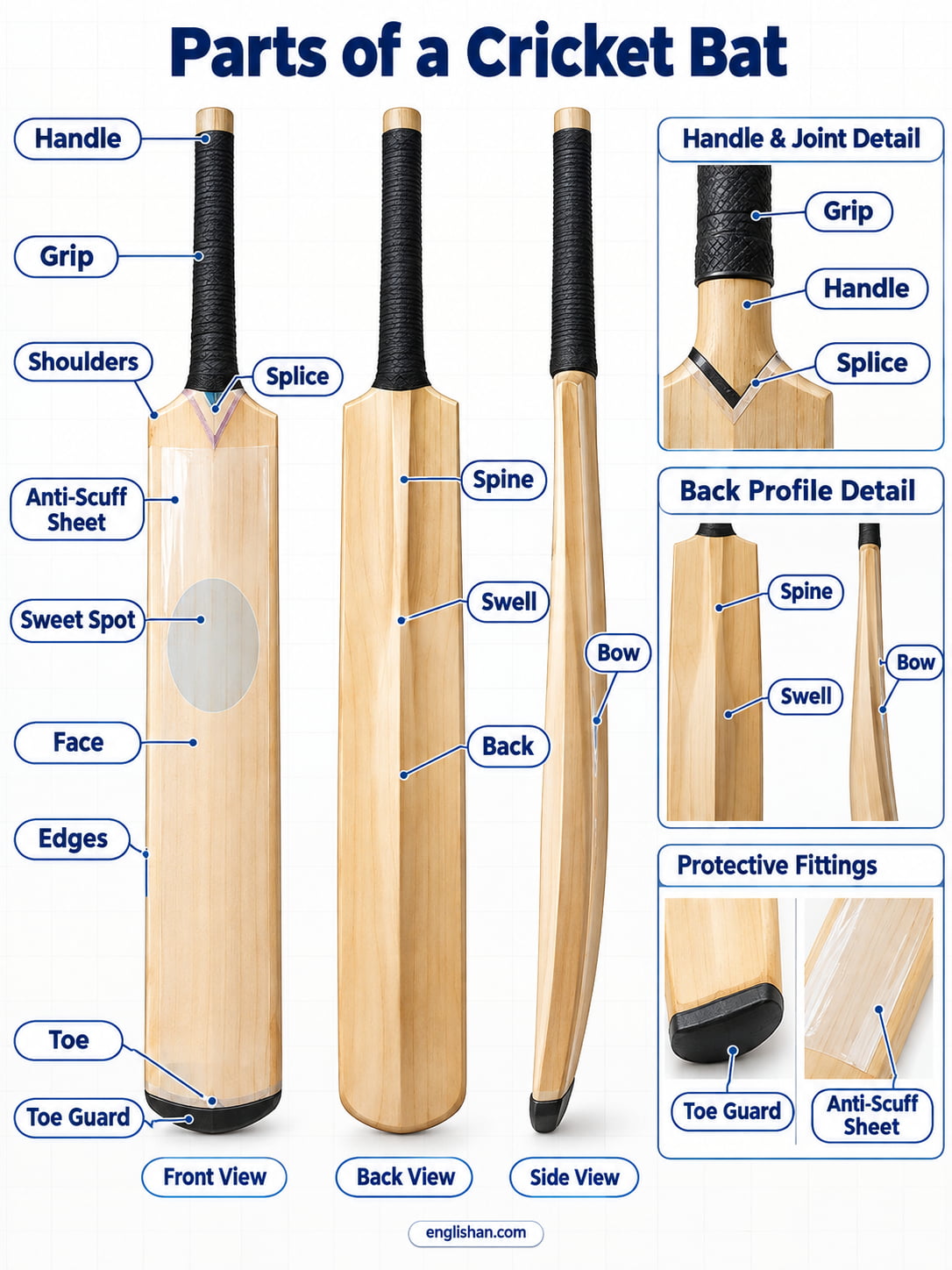
In profile, the rubber grip is wound over the top of the handle, and the splice marks the joint with the blade. The blade widens at the shoulders and ends in a rounded toe. Its front is flat, and its back is ridged along the spine. These are the parts of a cricket bat as bat makers name them.
| Part | Where you find it |
|---|---|
| 1. Handle | Cane shaft at the top of the bat |
| 2. Grip | Rubber sleeve wound over the handle |
| 3. Splice | V-shaped joint between handle and blade |
| 4. Shoulders | Sloping edges where the blade widens from the splice |
| 5. Blade | Flat willow body of the bat |
| 6. Face | Flat front surface that meets the ball |
| 7. Sweet spot | Hitting zone near the middle of the face |
| 8. Toe | Rounded bottom end of the blade |
| 9. Back | Ridged rear surface of the blade |
| 10. Spine | Central ridge down the back |
| 11. Swell | Thickest mass of willow on the back |
| 12. Bow | Curve of the back from the splice to the toe |
| 13. Edges | Two narrow sides of the blade |
| 14. Toe guard | Rubber or plastic cap on the toe |
| 15. Anti-scuff sheet | Thin film bonded over the face |
Cricket Bat Handle Parts
The handle is the top of the bat, and these parts of a cricket bat are the ones the batter holds.
Handle
The handle is a round shaft of cane, built from layered strips of cane and rubber. The rubber layers absorb shock from the ball. The shape resembles the handle of a mid-century tennis racket.
Grip
The grip is a rubber sleeve rolled over the handle, ridged so a gloved hand does not slip. Grips come in many colors, and a batting glove closes around it during play.
Splice
The splice is the V-shaped joint where the lower end of the handle is glued into the top of the blade. The tapered, interlocked cut spreads shock across both pieces. Charles Richardson devised the design in the 1880s to stop bats breaking at the joint.
Cricket Bat Blade Parts
The blade is the willow body past the splice. These parts of a cricket bat meet the ball.
Blade
The blade is the flat body of the bat, cut from English willow, a light wood that resists shock. Raw linseed oil protects the surface, and the Laws of Cricket cap blade width at 4.25 inches.
Shoulders
The shoulders are the two sloping edges where the blade widens from the splice. They form the transition from the round handle to the full width of the blade.
Face
The face is the flat front of the blade, the side that meets the ball. The grain count is the number of grain lines across it, and a count of 6 to 12 marks seasoned willow.
Sweet Spot
The sweet spot is the zone near the middle of the face where the ball leaves the bat fastest. Shock through the handle is lowest there, and its height varies from bat to bat.
Toe
The toe is the rounded bottom end of the blade. It takes more damage than any other part, so a toe guard is fitted. A duckbill toe is rounded and lighter, while a square toe is heavier.
Cricket Bat Back and Edge Parts
The back of the blade is where the willow is thickest. These parts of a cricket bat decide its weight and balance.
Back
The back is the rear surface of the blade, raised in a ridge where the wood is thickest. Its profile is the shape seen from the side of the bat.
Spine
The spine is the central ridge down the back of the blade. A high spine measures 0.9 inch or more, which adds willow behind the face. A low spine measures about 0.7 to 0.8 inch.
Swell
The swell is the thickest mass of willow on the back, positioned in the middle or the lower blade. Its position determines the weight behind the sweet spot.
Bow
The bow is the curve of the back from the splice to the toe. Seen from the side, it forms the profile of the bat.
Edges
The edges are the two narrow sides of the blade. The inside edge faces the batter’s body, and the outside edge faces away from it. The Laws of Cricket cap edge thickness at 1.56 inches.
Cricket Bat Fittings
Fittings are added to the finished blade, and these parts of a cricket bat protect the wood from damage.
Toe Guard
A toe guard is a rubber or plastic cap glued onto the toe of the blade. It protects the thinnest wood on the bat from splitting.
Anti-Scuff Sheet
An anti-scuff sheet is a thin transparent or colored film bonded over the face and edges. It protects the willow from cracks and from marks left by the ball seam.
Related:
FAQs
The parts of a cricket bat are the handle, grip, splice, shoulders, blade, face, back, spine, edges, and toe. The sweet spot is the hitting zone on the face. A toe guard and an anti-scuff sheet are fitted to the finished blade.
The two parts of a cricket bat are the handle and the blade. The handle is cane, and the blade is willow, joined at the splice.
The splice is the V-shaped joint between the handle and the blade. The lower end of the handle is glued into the top of the blade at this joint.
The sweet spot hits the ball farthest. It is the zone near the middle of the face, where the ball leaves the bat fastest with the least shock in the handle.
A cricket bat is made of English willow for the blade and layered cane and rubber for the handle. The grip is rubber, and the toe guard is rubber or plastic.
A cricket bat is made in two pieces because the blade and the handle need different materials. Willow is light and resists shock for striking, and layered cane and rubber absorb shock in the hands. The splice joins the two pieces without a weak point.
A cricket bat is 38 inches long at most under the Laws of Cricket. The blade is up to 4.25 inches wide and 2.64 inches deep. The edges are up to 1.56 inches thick.