The parts of a microwave oven fit inside a rectangular steel case, with a hinged door and a control panel on the front. A glass tray turns inside a metal-walled cavity, and the electronics fill the space beside and behind it.
The door is the only part on the front that opens, and everything else stays sealed inside the case.
Parts of a Microwave Oven Diagram
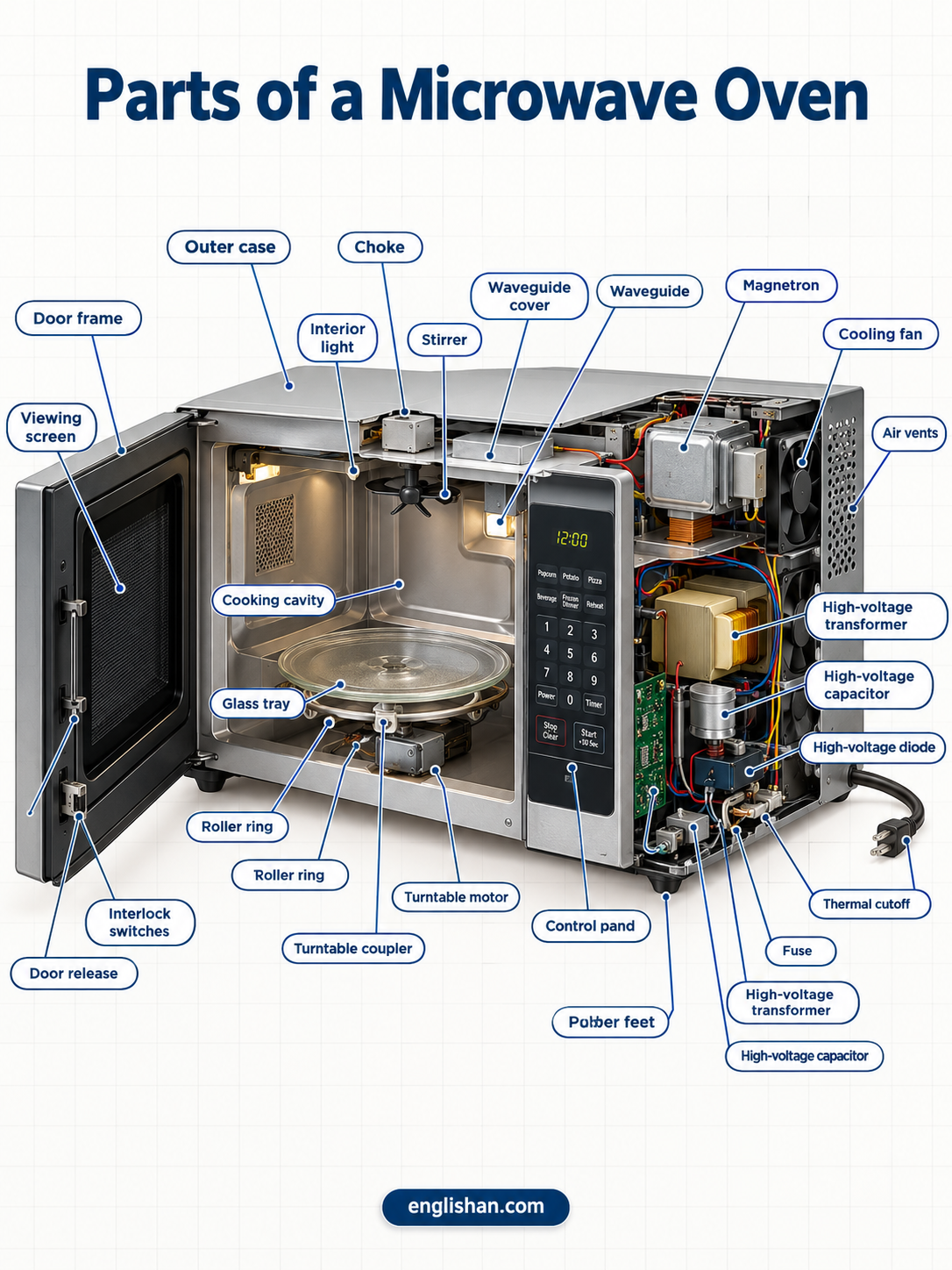
On the front, a hinged door closes the cooking cavity, and a control panel with a keypad runs beside it. Inside the cavity, a glass tray rests on a roller ring over the turntable motor. The waveguide, magnetron, transformer, capacitor, and diode are mounted in the space beside and behind the cavity, with a cooling fan at the back.
| Part | Where you find it |
|---|---|
| 1. Door frame | Hinged plastic and metal frame on the front |
| 2. Viewing screen | Window in the door, layered with a punched metal sheet |
| 3. Choke | Metal-lined groove around the inside edge of the door |
| 4. Latch hooks | Plastic hooks on the door edge |
| 5. Interlock switches | Small switches behind the latch slots in the front frame |
| 6. Door release | Push button or pull handle beside the door |
| 7. Outer case | Painted or stainless steel cover over the top and sides |
| 8. Power cord | Three-prong cable at the back |
| 9. Rubber feet | Pads under the four bottom corners |
| 10. Cooking cavity | Metal-walled box behind the door |
| 11. Waveguide cover | Tan or brown sheet on one cavity wall |
| 12. Stirrer | Angled metal blades near the waveguide opening |
| 13. Interior light | Small bulb behind a lens in the cavity wall |
| 14. Glass tray | Round tempered glass plate on the cavity floor |
| 15. Roller ring | Plastic ring of wheels under the tray |
| 16. Turntable coupler | Three-pointed hub in the center of the floor |
| 17. Turntable motor | Small motor under the cavity floor |
| 18. Control panel | Keypad and display beside the door |
| 19. Control board | Circuit board behind the control panel |
| 20. Cooling fan | Small fan at the back beside the magnetron |
| 21. Air vents | Slots on the back and sides of the case |
| 22. Magnetron | Finned metal cylinder beside the cavity |
| 23. Waveguide | Rectangular metal channel joining magnetron and cavity |
| 24. High-voltage transformer | Heavy iron block beside the magnetron |
| 25. High-voltage capacitor | Metal case with two terminals near the transformer |
| 26. High-voltage diode | Small cylinder on a bracket by the capacitor |
| 27. Thermal cutoff | Disc bolted to the magnetron body |
| 28. Fuse | Glass cartridge in a holder by the power inlet |
| 29. Mounting plate | Steel bracket bolted to the wall |
| 30. Exhaust fan | Blower in the top of an over-the-range unit |
| 31. Grease filter | Aluminum mesh panel under the unit |
| 32. Charcoal filter | Carbon pad behind the vent grille |
| 33. Cooktop light | Bulb under the front of the unit |
Microwave Oven Door Parts
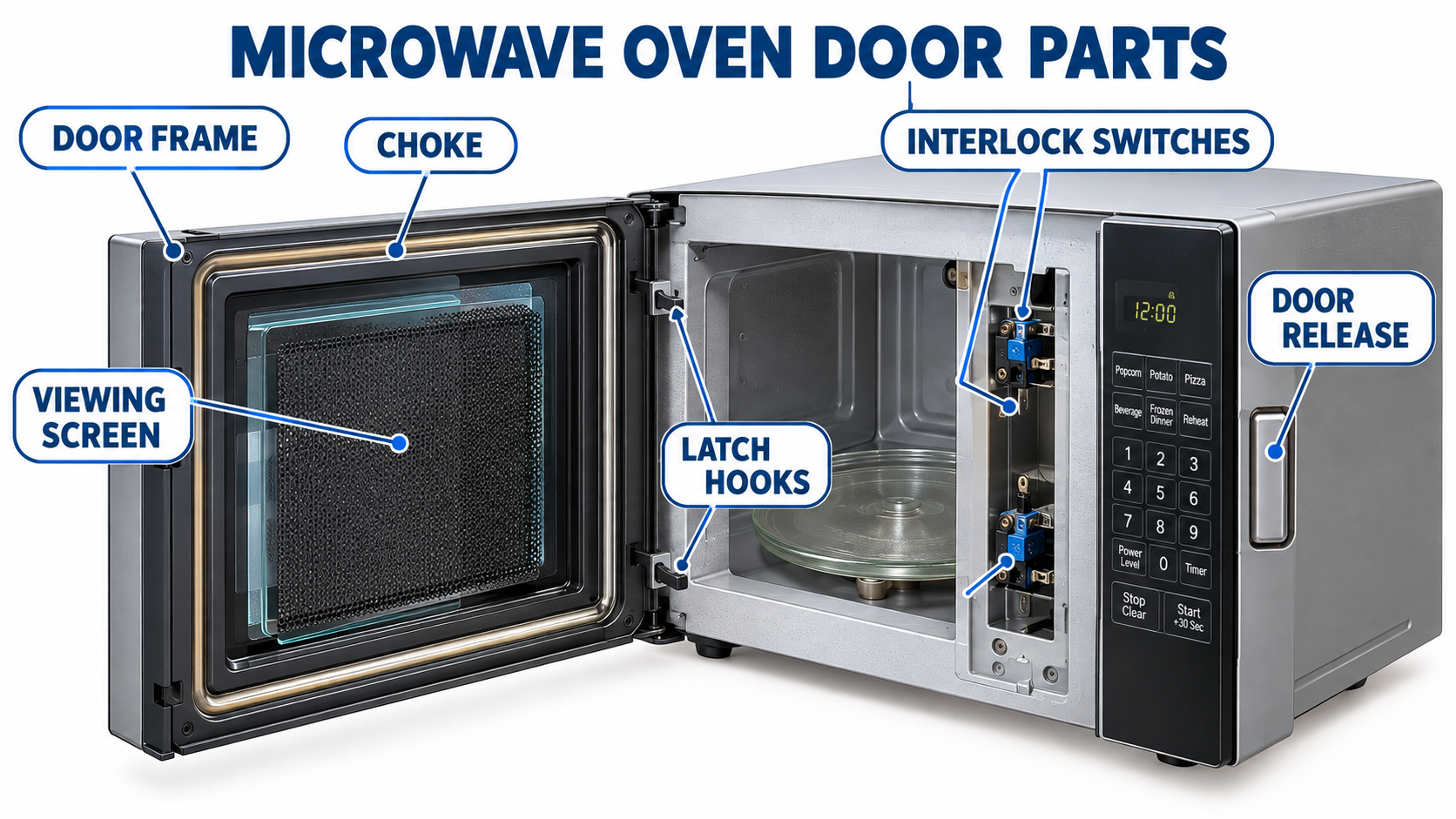
Six of the parts of a microwave oven make up the door assembly, from the frame to the switches behind it. A countertop door is about 12 to 16 inches wide.
Door Frame
Plastic and metal form the door frame, which is hinged on the left side of most countertop models. The outer face is plastic, and a metal panel lines the inside. Some models hinge the door at the bottom, so it drops open like a shelf.
Viewing Screen
A layered window fills the middle of the door. Two panes of glass or plastic surround a metal sheet punched with small holes. Each hole is far smaller than the 4.8-inch wavelength of the microwaves, so the screen reflects them while light passes through.
Choke
The choke is a metal-lined groove around the inside edge of the door, joined by a thin plastic seal. It closes the narrow gap between the door and the cabinet frame. A dirty choke leaves visible food residue along the frame.
Latch Hooks
Two or three plastic hooks project from the door’s edge and catch levers inside the front frame. Worn hooks let the door rattle in the frame.
Interlock Switches
Behind the latch slots in the front frame, two or three small switches are wired into the power line to the transformer. The primary and secondary switches open the circuit when the door opens. A monitor switch is wired to blow the fuse if the others fail.
Door Release
On the right side or under the control panel, a push button or a pull handle releases the door. A return spring inside it snaps the door open a few inches after each press.
Outer Case Parts
Three of the parts of a microwave oven form the outside of the case, and each is visible without opening the door.
Outer Case
A wraparound cover of painted or stainless steel forms the outer case over the top and sides, fastened by screws at the back edge. The cover also forms part of the metal shield around the cavity. Slotted openings along the sides and rear serve as vents.
Power Cord
At the back, the power cord is a three-prong grounded cable about 3 to 4 feet long, sized for a 120-volt outlet. It enters the case through a rubber strain relief. Full-size models draw 10 to 15 amps, so they need a dedicated circuit.
Rubber Feet
Four rubber or plastic feet under the corners of the base lift the case off the counter. Their pads grip the counter surface and leave an air gap for the underside vents.
Cooking Cavity and Turntable Parts
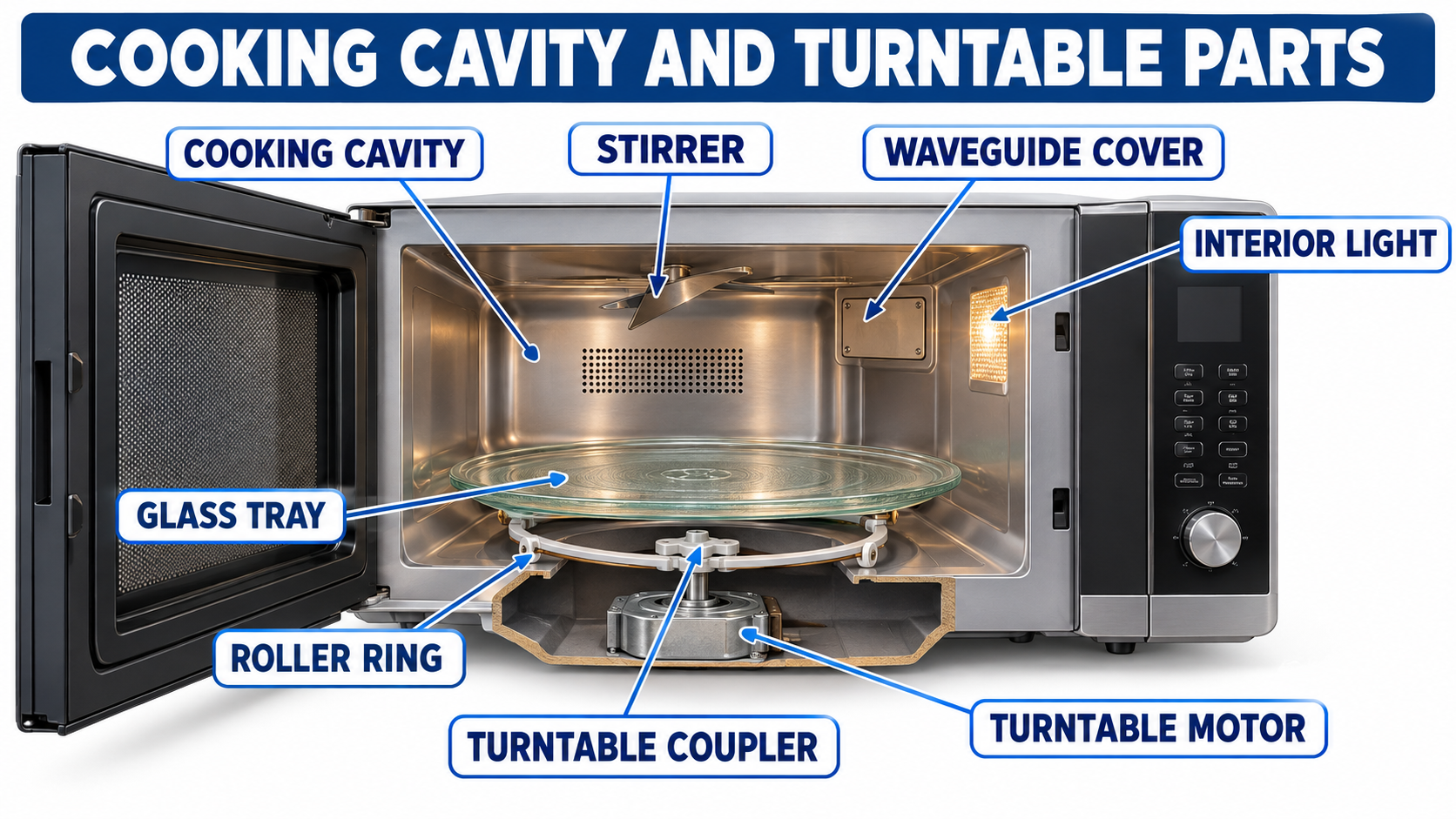
Eight of the parts of a microwave oven are inside the cooking cavity or directly under its floor. Countertop cavities measure from 0.7 to 2.2 cubic feet.
Cooking Cavity
The cooking cavity is a sheet-metal box behind the door, with walls of enamel-coated or stainless steel. The back wall has the vents, and one side wall or the ceiling has the waveguide opening. Its smooth, coated surface wipes off with a damp cloth.
Waveguide Cover
Screws hold a flat sheet of mica, the waveguide cover, over the waveguide opening in the cavity wall. Mica is a heat-resistant mineral that passes microwaves and blocks grease. Burn marks and a tan or brown color are its usual wear signs.
Stirrer
Some models have a stirrer, a small metal fan with angled blades near the waveguide exit, inside the cavity ceiling. A slow motor or the airflow from the cooling fan turns it. Its blades reflect the incoming waves in different directions.
Interior Light
A small incandescent or LED bulb behind a plastic lens lights the cavity through the side wall or ceiling. On many models a second wire connects it to the door switch. Older bulbs are 25 to 40 watts, and LED versions draw about one watt.
Glass Tray
The glass tray is a round plate of tempered glass, 10 to 16 inches across. It fits over the roller ring, and notches under its center match the coupler.
Roller Ring
A plastic ring with three or more small wheels, the roller ring, is seated on the cavity floor under the glass tray. The wheels ride in a circular track molded into the floor. Its shape centers the tray as it turns.
Turntable Coupler
At the center of the cavity floor, a three-lobed hub called the coupler fits over the motor’s shaft. It is molded from plastic or metal, and its lobes match the notches in the tray’s underside.
Turntable Motor
A small synchronous motor is mounted under the cavity floor, with its shaft passing through a hole in the center. It turns at about 5 to 6 revolutions per minute. Its case is a flat, round housing about 3 inches across.
Control and Cooling Parts
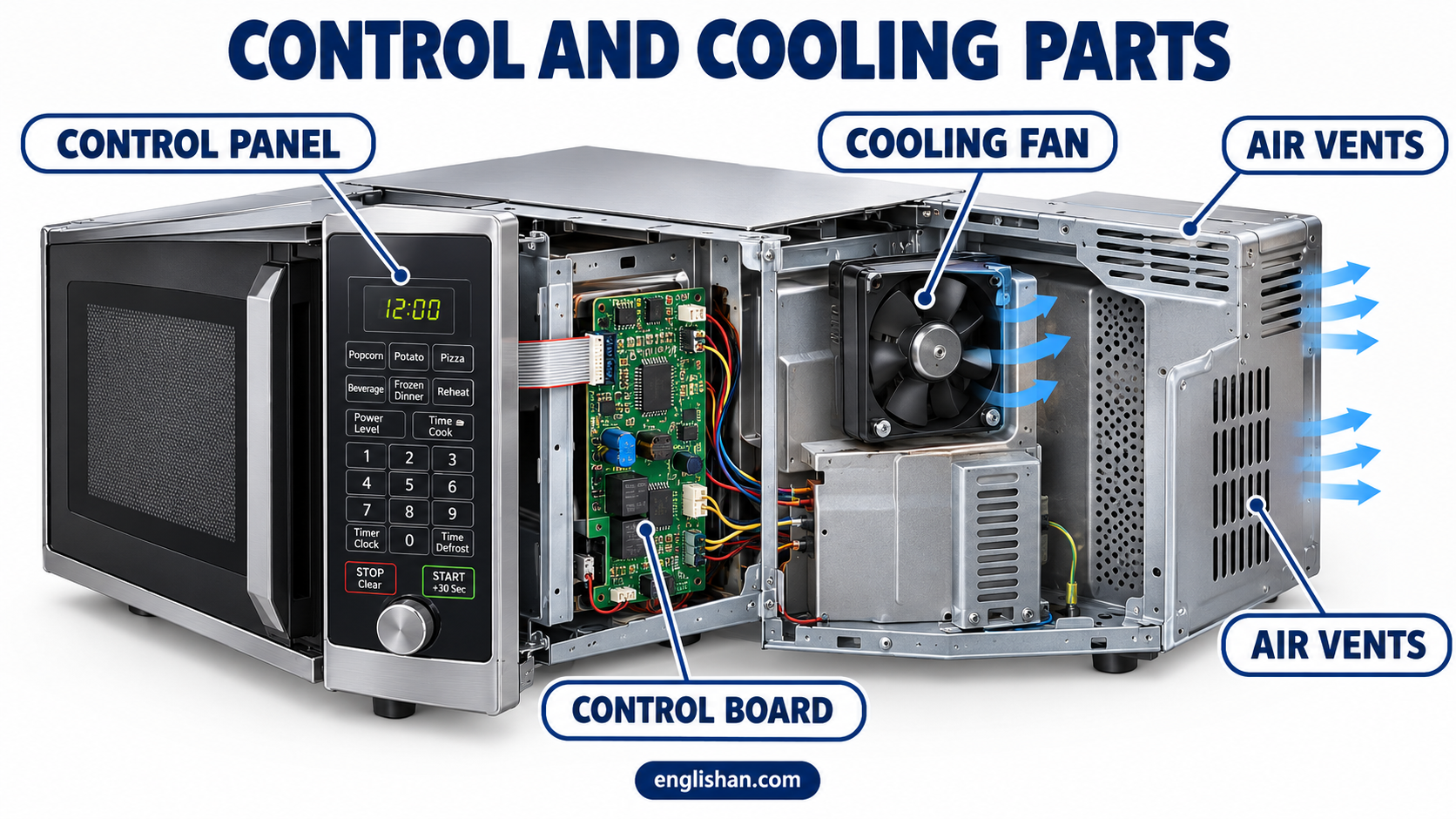
Four of the parts of a microwave oven are the control panel, the control board behind it, the cooling fan, and the air vents.
Control Panel
The control panel is a flat panel beside or under the door, with a membrane keypad or a set of buttons and a dial. A digital display or LED readout shows the time and power level.
Control Board
Behind the control panel, the control board is a green circuit board with a microcontroller, relays, and a buzzer. A ribbon cable links it to the keypad, and wire leads run to the transformer and the fan. A burned relay stops the oven from responding to the keypad.
Cooling Fan
At the back of the case, beside the magnetron, a small plastic-bladed fan about 3 to 4 inches across cools the electronics. Its motor is fastened to a metal bracket on the base plate, and dust on the blades makes it noisy.
Air Vents
Rows of narrow slots on the back and sides of the case form the air vents, and some models add slots under the base. The fan draws air in through the rear openings, so they need clearance.
Electrical Parts of a Microwave Oven
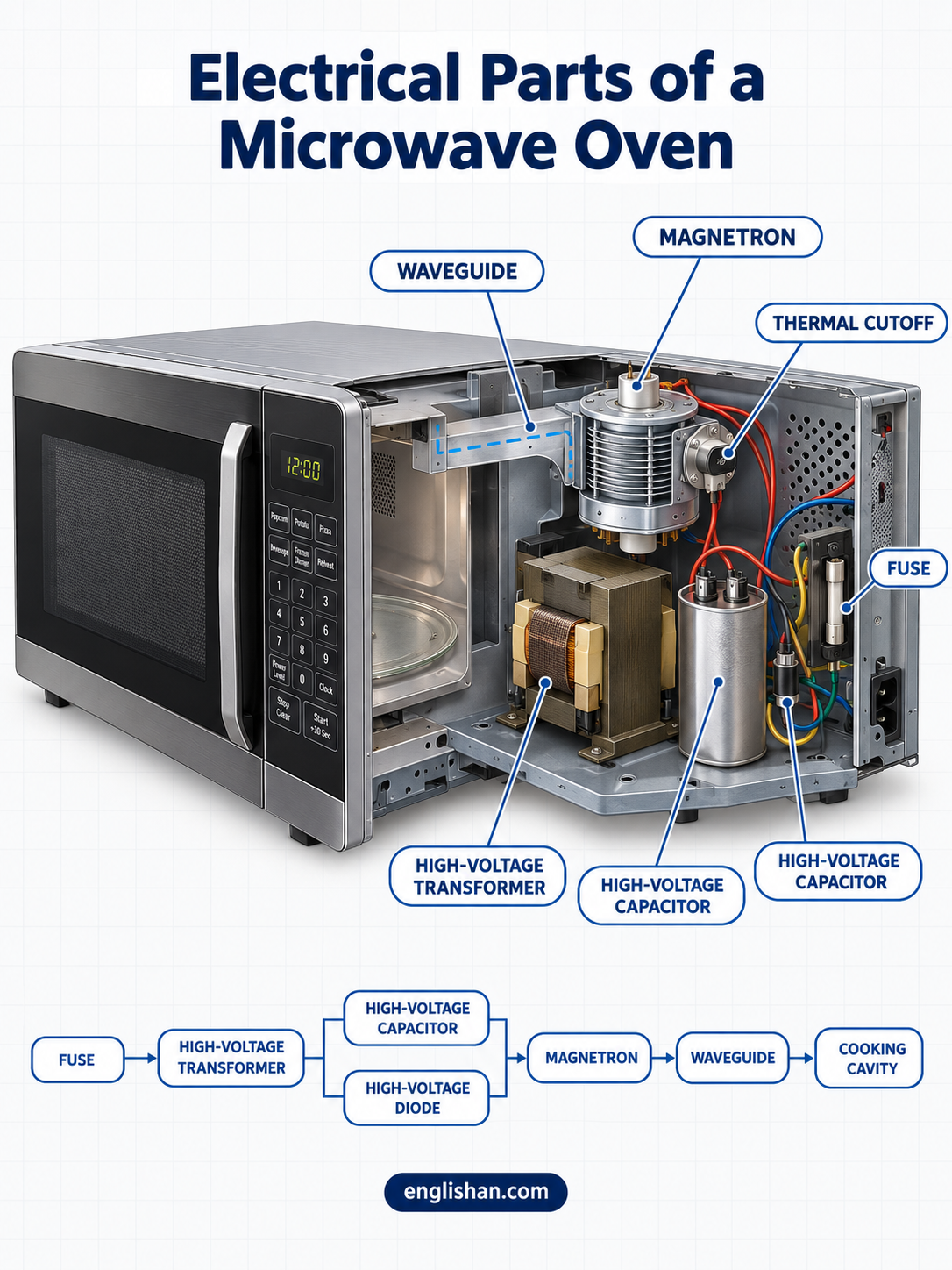
Seven of the parts of a microwave oven make up the electrical group. All of them are mounted in the space beside and behind the cavity.
Magnetron
The magnetron is a finned metal cylinder about 4 inches tall, bolted beside the cavity. Two ring magnets are fitted to its sides. A short antenna projects from its top into the waveguide, and two terminals stick out underneath.
Waveguide
The waveguide is a rectangular metal channel, about 3 inches wide, joining the magnetron’s antenna to the opening in the cavity wall. It is made of stainless or aluminized steel and is bolted to the cavity so that no gap shows.
High-Voltage Transformer
The high-voltage transformer is an iron-cored block, the heaviest part in the oven at about 5 pounds. It has three windings: a primary wired to the outlet, a secondary of about 2,000 volts, and a filament winding of about 3 volts.
High-Voltage Capacitor
The high-voltage capacitor is an oval or round metal case with two terminals, mounted near the transformer. A small bleeder resistor is soldered across its terminals. Its rating is about 1 microfarad and 2,100 volts, and a swollen case shows it has failed.
High-Voltage Diode
A small black or gray cylinder about an inch long, with a lead at each end, forms the high-voltage diode. It is fastened to a bracket beside the capacitor and connected in series with it.
Thermal Cutoff
A thermal cutoff is a small disc, about the size of a nickel, bolted to the magnetron’s body. A second one is fastened to the cavity. Each is a temperature switch that opens the circuit if the part overheats.
Fuse
The fuse is a glass or ceramic cartridge, rated about 20 amps and 250 volts, held in a clip near the power inlet. It protects the power line to the transformer. A blown fuse leaves the display lit but the oven cold.
Over-the-Range Microwave Parts
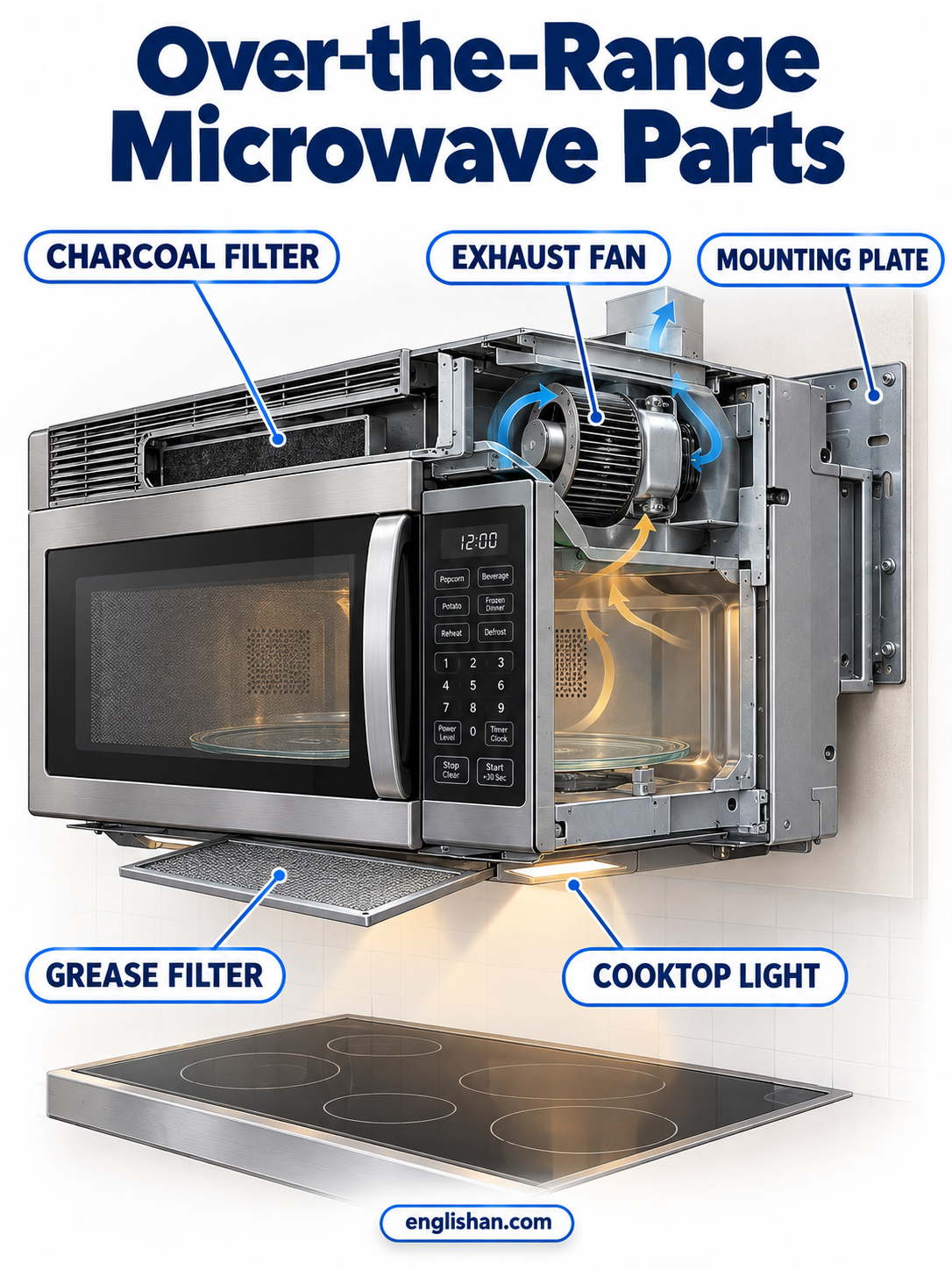
Five extra parts of a microwave oven belong to over-the-range models, which mount over a stove and are about 30 inches wide.
Mounting Plate
A steel bracket bolted to the wall studs, the mounting plate, supports the unit. The microwave hooks onto the plate at the back, and long bolts through the cabinet over it fasten the top. Its holes line up with the stud spacing.
Exhaust Fan
The exhaust fan is a blower with its own motor and a plastic or metal fan wheel, mounted in the top of the case. The blower has two speeds and vents through a duct in the top or the back, or it recirculates air through the front grille.
Grease Filter
Under the front of the unit, the grease filter is a flat panel of aluminum mesh that slides out through a slot. Its frame is metal, and the mesh washes in warm soapy water.
Charcoal Filter
On recirculating models, a charcoal filter is a pad of activated carbon wrapped in a frame, fitted behind the vent grille over the cavity. It cannot be washed and needs replacement about every six months.
Cooktop Light
Under the front of the unit, one or two small bulbs light the cooktop through plastic lenses. Halogen and LED bulbs are the standard types, and both are switched from the control panel.
FAQs
Q1. What are the parts of a microwave oven and their functions?
The door, latch hooks, and interlock switches close the cavity and cut power when it opens. The magnetron makes the microwaves, and the waveguide routes them into the cavity. The transformer, capacitor, and diode power the magnetron, and the turntable spins the food.
Q2. What are the internal parts of a microwave oven?
The internal parts are the cooking cavity, waveguide cover, turntable, magnetron, waveguide, transformer, capacitor, diode, cooling fan, and control board. Most of them are mounted beside and behind the cavity, inside the steel case.
Q3. What part of a microwave oven protects against radiation?
The metal walls of the cavity, the punched metal screen in the door window, and the choke around the door edge protect against radiation. The interlock switches also cut power the moment the door opens.
Q4. Which component of a microwave oven generates microwaves?
The magnetron generates the microwaves, and it is a finned metal cylinder beside the cavity. The high-voltage transformer, capacitor, and diode power it, and the waveguide routes the waves into the cooking cavity.
Q5. What are the main parts of a microwave oven?
The main parts are the magnetron, the waveguide, the high-voltage transformer, the cooking cavity, the turntable, and the cooling fan. The door, control panel, and power cord complete the outside.
Q6. What are the parts of a microwave oven door?
A microwave oven door has a frame, a viewing screen, a choke, latch hooks, and a release button or handle. The interlock switches are fitted behind the latch slots in the front frame.
Q7. What are the electrical parts of a microwave oven?
The electrical parts are the magnetron, the high-voltage transformer, the capacitor, the diode, the thermal cutoff, and the fuse. The control board switches them, and the power cord supplies a 120-volt outlet.
You May Also Like