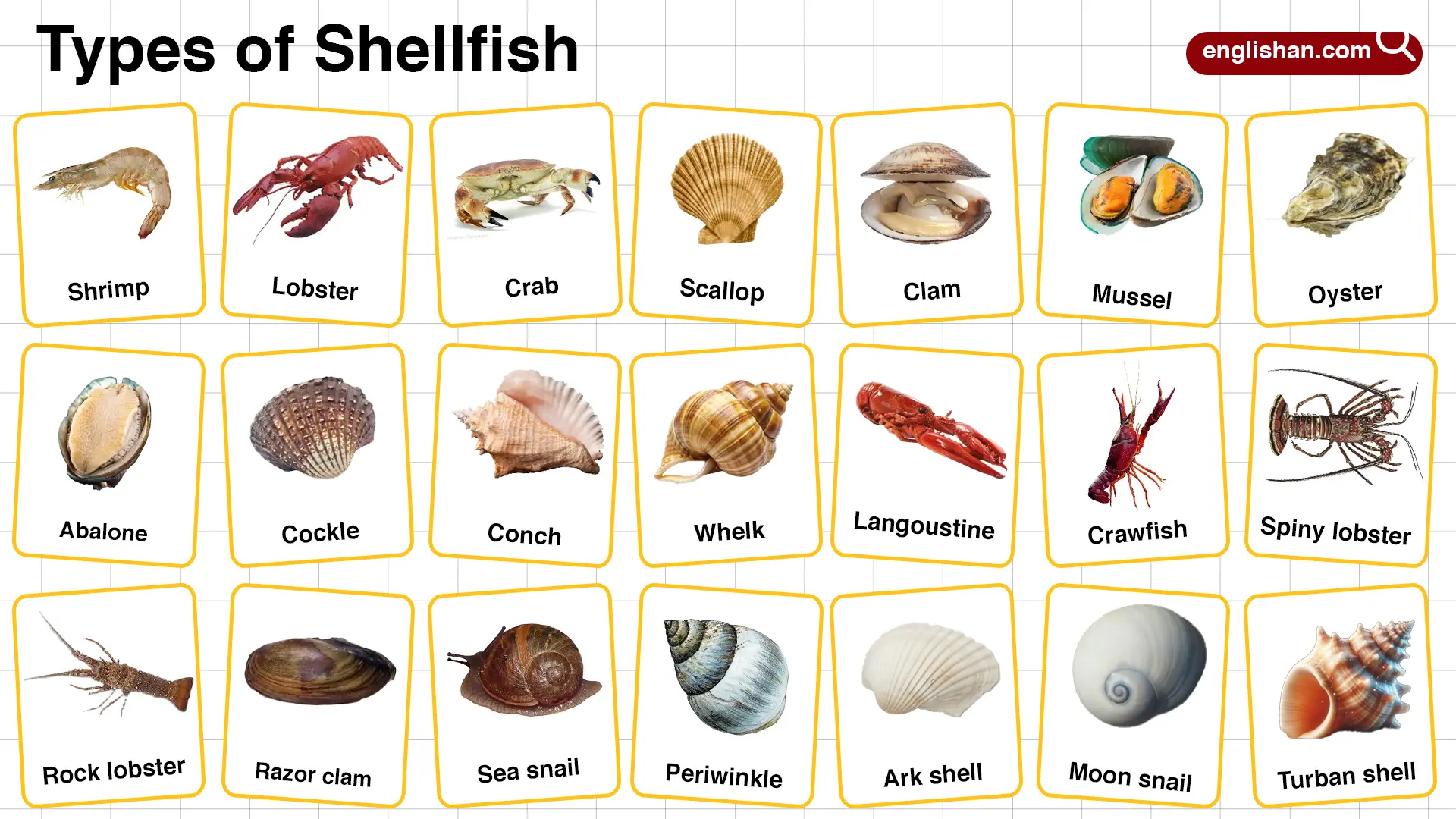
Shellfish is a kitchen and menu label rather than a single family of animals. The types of shellfish sold as food come from three separate groups: crustaceans, mollusks and echinoderms. Because of that split, a shell-less octopus counts as shellfish while a scaled fish never does. Placing a name in one of those groups tells you what its shell does, and whether the animal was caught wild or farmed.
Types Of Shellfish With Pictures And Names
The shell and the body decide which group any shellfish goes in. Crustaceans have a jointed exoskeleton they moult as they grow, along with walking legs and antennae. Mollusks have soft unsegmented bodies, and the shell is either two hinged halves, one coil, a thin internal blade, or gone altogether. Echinoderms have a spiny fused case and no limbs.
| Group | What identifies it | Named examples |
|---|---|---|
| Crustaceans | Jointed exoskeleton, legs, antennae | Crab, lobster, shrimp, crayfish |
| Bivalves | Two hinged shells, no head | Oyster, mussel, clam, scallop |
| Gastropods | One coiled or conical shell, single foot | Abalone, whelk, conch, limpet |
| Cephalopods | No external shell, arms and tentacles | Squid, cuttlefish, octopus |
| Echinoderms | Spiny fused case, no limbs | Sea urchin, sea cucumber |
Bivalves, gastropods and cephalopods are all mollusks, which is why some kitchens flatten the whole set into two words. The three-way split earns its place at a fish counter, because it predicts shell shape, texture and price across the types of shellfish far better than the two-way one does.
Crustacean Shellfish Types
Crustaceans are the shellfish with armour on the outside. Every one of them grows by shedding that armour and hardening a larger replacement underneath, which is why a lobster shell arrives at the table brittle rather than solid rock. The group turns red or orange when cooked, since heat destroys the proteins masking a pigment already in the shell.
Types Of Crab
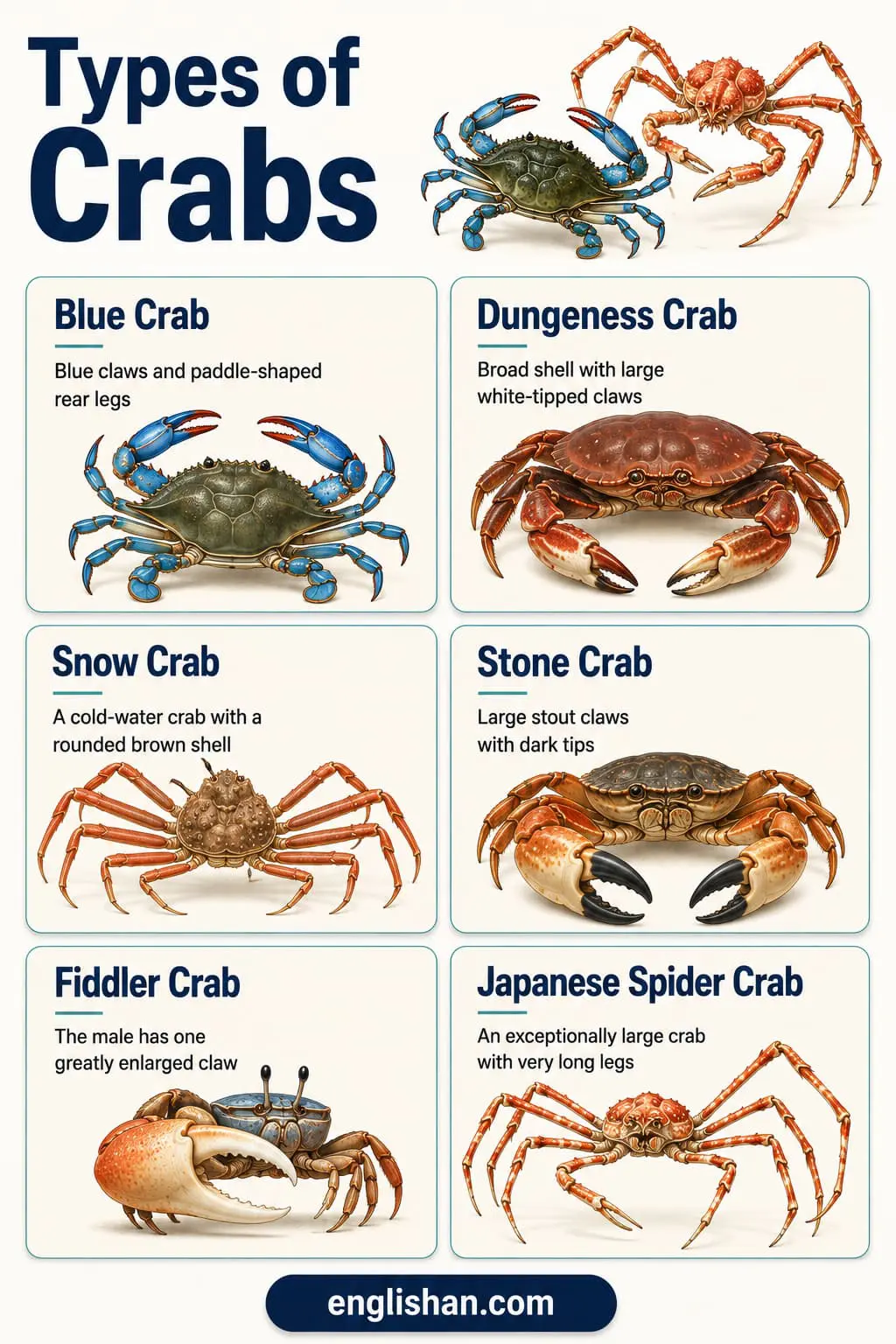
- Blue crab: Named for its sapphire claws, this Atlantic swimmer supplies most of the picked crab meat on the US east coast, and soft-shell crab is the same animal caught days after a moult.
- Dungeness crab: Landed from Alaska down to northern California, with roughly a quarter of its body weight edible, a high yield for a crab.
- Red king crab: The Bering Sea giant reaches a leg span near 1.8 metres, and its thick leg meat is what a menu means by king crab legs.
- Snow crab: Long slender legs and a shell no wider than a hand make it the easiest crab to pick, which is why supermarket clusters are almost always snow crab.
- Stone crab: Florida fisheries take one claw and return the crab alive, since it regrows the limb within a season.
- Brown crab: Britain’s largest commercial crab, oval-shelled with a pie-crust edge, valued for the dark meat inside the body rather than the claw meat.
- Mud crab: Mangrove estuaries from Sri Lanka to Queensland produce it, and its outsized crushing claw is the reason it became the crab of Singapore chilli crab.
- Horseshoe crab: Not a true crab but a distant relative of spiders, with a domed shell and a spiked tail. Its roe is eaten in parts of Thailand and Malaysia.
Related:
Types Of Lobster
- American lobster: The heaviest crustacean ever recorded, fished from Maine to Nova Scotia, with the two front claws giving up the sweetest meat.
- European lobster: Darker blue in the shell and smaller than its American cousin, and priced well above it across Europe.
- Spiny lobster: No large front claws at all, just a heavily spined shell and long whip antennae. Warm-water fisheries from Florida to Western Australia sell it as rock lobster.
- Slipper lobster: Flattened, shovel-nosed and clawless, this deep-water oddity reaches Japanese and Australian markets under half a dozen regional names.
Shrimp And Prawn Types
- Whiteleg shrimp: Pond farms in Ecuador, India and Vietnam made this Pacific species the most traded shellfish on earth.
- Northern shrimp: Cold Atlantic and Arctic waters produce this small pink shrimp, cooked and peeled at sea and sold ready to eat.
- Brown shrimp: No bigger than a thumbnail, brown raw and grey-pink once boiled, and potted in spiced butter along the English and Dutch coasts.
- Giant tiger prawn: Dark bands across the shell name it, and at 30 centimetres it is the largest prawn on a fish counter.
- Kuruma prawn: Japanese aquaculture built its reputation, and it is the prawn served live as odori ebi.
- Giant river prawn: Rivers and estuaries across South and Southeast Asia produce this long-clawed freshwater prawn, farmed heavily in Bangladesh and Thailand.
Types Of Crayfish
- Red swamp crayfish: Louisiana rice fields and ponds produce it by the tonne for boils, and the same animal has turned invasive across Europe and China.
- Signal crayfish: Larger than the native European crayfish, marked by a pale patch at the claw hinge, and now dominant across British rivers after displacing much of the original population.
Unusual Crustacean Types
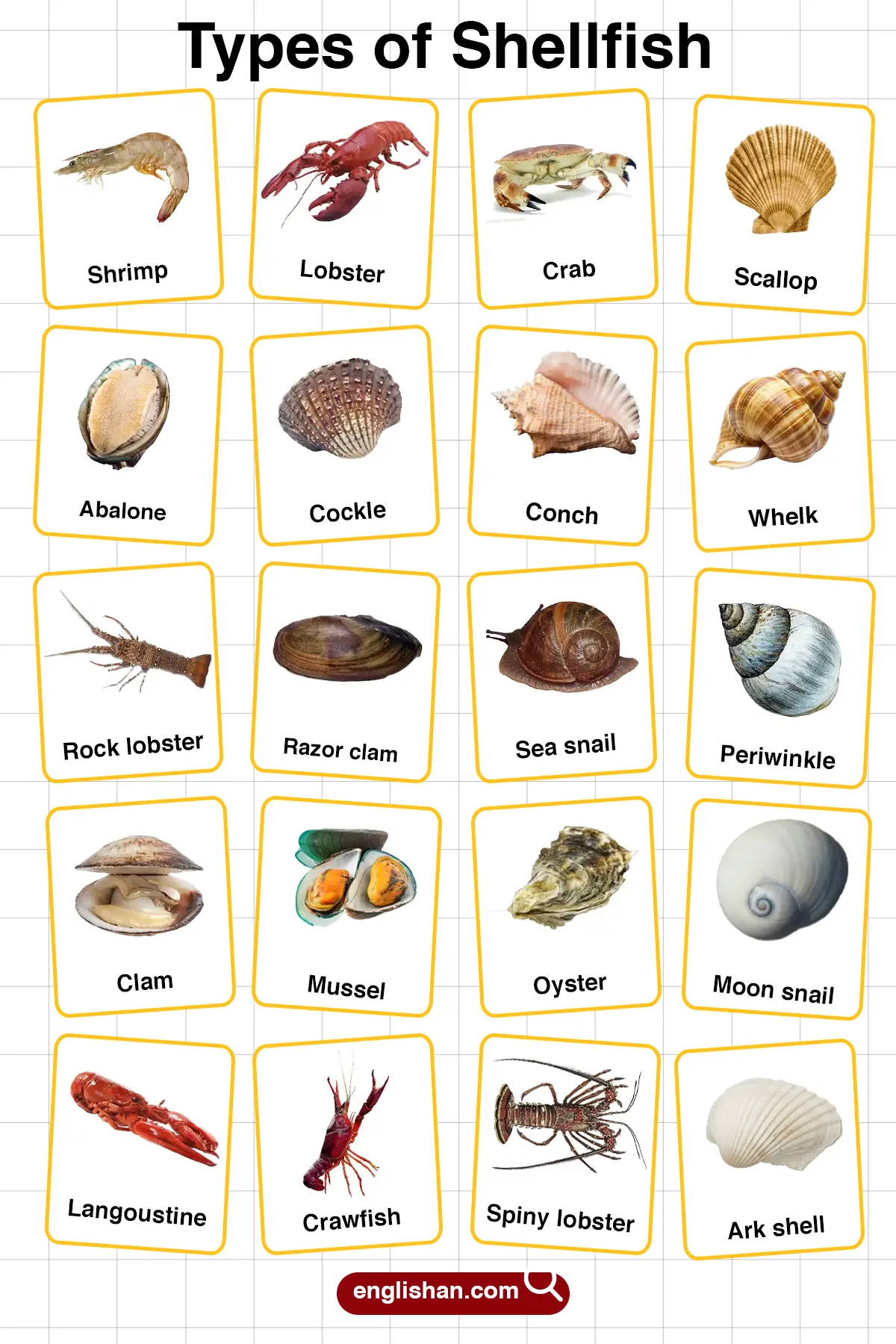
- Langoustine: A slim pale-orange lobster relative from cold Atlantic water, sold as scampi in Britain and Ireland and as langoustine in France.
- Mantis shrimp: Not a shrimp at all, but a separate order whose club or spear limb strikes hard enough to crack aquarium glass. Japan and southern China eat it as shako.
- Goose barnacle: Anchored to wave-battered rock by a leathery stalk and prised off at genuine risk to life along the Galician coast, where it sells as percebes at some of the highest shellfish prices in Europe.
- Antarctic krill: Finger-length and swarming in numbers that make up the largest single-species biomass on the planet, processed mainly into oil and feed rather than eaten whole.
- Spanner crab: Named for its flattened wrench-like claws, taken off Queensland and Western Australia and sold across Asia as frog crab.
A crustacean has its shell on the outside and walks on jointed legs. The mollusks that follow do neither, and they divide three ways by what happened to the shell.
Bivalve Shellfish Types
A bivalve has two shells hinged along one edge, a muscle strong enough to clamp them shut, and no head whatsoever. Almost all of them feed by drawing water through the body and filtering it, which makes them the cheapest shellfish to farm and the fastest to reflect the water they grew in. If shell shape interests you beyond seafood, the wider set of animals that have shells runs well past the edible ones.
- Blue mussel: Rope-grown across northern Europe and Atlantic Canada, blue-black outside and apricot inside, and the cheapest shellfish on most menus.
- Green-lipped mussel: New Zealand waters produce it, and the bright green shell margin makes it the one mussel identifiable at a glance.
- Freshwater mussel: River and lake species across North America and Europe, barely eaten today, though many were harvested historically for pearls and shell buttons.
- Pacific oyster: The workhorse of world oyster farming, deeply fluted and fast-growing, taken from Japan to farms on every continent except Antarctica.
- Eastern oyster: Atlantic reefs from Canada to the Gulf produce it, and its flavour shifts so noticeably between bays that it is sold by place name rather than by species.
- Sydney rock oyster: Smaller and far slower-growing than the Pacific, farmed in New South Wales estuaries and priced accordingly.
- Sea scallop: The large deep-water scallop of the North Atlantic, sold as one thick white muscle with the shell thrown away.
- Bay scallop: Small, inshore and taken from US Atlantic bays, sweeter than the sea scallop and sold by the dozen.
- Queen scallop: Rounder and smaller than a king scallop, with an orange roe left attached in British and Manx cooking and removed almost everywhere else.
- Hard clam: The east-coast chowder clam, renamed by width as it grows, and called a quahog once it passes the largest size.
- Soft-shell clam: A thin brittle shell that never closes fully around the protruding siphon, steamed in New England as a steamer.
- Razor clam: Long and straight, shaped like an old cut-throat razor, and dug from wet sand at low tide across Europe, Asia and the Pacific coast.
- Geoduck: A giant burrowing Pacific Northwest clam with a siphon several times longer than its shell, shipped live and sliced raw in Chinese and Japanese kitchens.
- Cockle: Small, round and deeply ribbed, raked off tidal flats and sold pickled in Britain, steamed in Spain and dried across Southeast Asia.
- Blood clam: Also called ark shell, and named for the red fluid in its tissue, eaten widely along the coasts of China, Korea and Malaysia.
- Asian clam: Farmed in Japan and Korea for miso soup stock, this small freshwater bivalve is now established in rivers across North America and Europe.
Where a bivalve seals itself behind two shells, the next group solved the same problem with one.
Gastropod Shellfish Types
Gastropods are the sea snails: one shell, coiled or conical, and one muscular foot the animal both walks on and eats with. That foot is the edible part, and because it is worked muscle rather than filter tissue, almost every gastropod needs either long slow cooking or physical pounding before it turns tender.
- Red abalone: The largest abalone on earth, taken off California, with a foot dense enough that it needs beating flat before it will cook soft.
- Green abalone: Smaller than the red, taken off California and Baja, and wanted for the green iridescence inside the shell as much as for the meat.
- Common whelk: Thick, drab and tightly spiralled, boiled and sold by the cupful at British seaside stalls for well over a century.
- Knobbed whelk: The knob-shouldered Atlantic whelk of the US east coast, sliced thin and served as scungilli in Italian American cooking.
- Queen conch: A heavy pink-lipped Caribbean shell whose white foot goes into fritters and salad, and whose harvest is now restricted across much of its range.
- Horse conch: Florida’s state shell and the largest gastropod in American waters, orange-fleshed and occasionally turned into chowder.
- Common periwinkle: Black, no bigger than a thumbnail, and picked out with a pin along the Atlantic coasts of Europe and eastern North America.
- Limpet: A single conical shell clamped tight to rock, grilled in the Azores and Madeira as lapas.
- Moon snail: Globe-shaped and predatory, it drills neat round holes through clam shells, and it reaches Korean and Japanese plates regularly.
- Turban shell: Thick-spiralled with a stony lid over the opening, cooked inside its own shell in Japan as tsubo-yaki.
Two mollusk groups down, and both still have a shell to show. The third gave it up.
Cephalopod Shellfish Types
Squid, cuttlefish and octopus are all shellfish, and the reason is that they are mollusks. Cephalopods traded the external shell for speed: squid keep it as a thin transparent blade inside the body, cuttlefish as a chalky plate, and octopus as nothing whatsoever. Food law and allergy testing class all three as mollusk shellfish, which is why a boneless, shell-less octopus turns up on a shellfish menu.
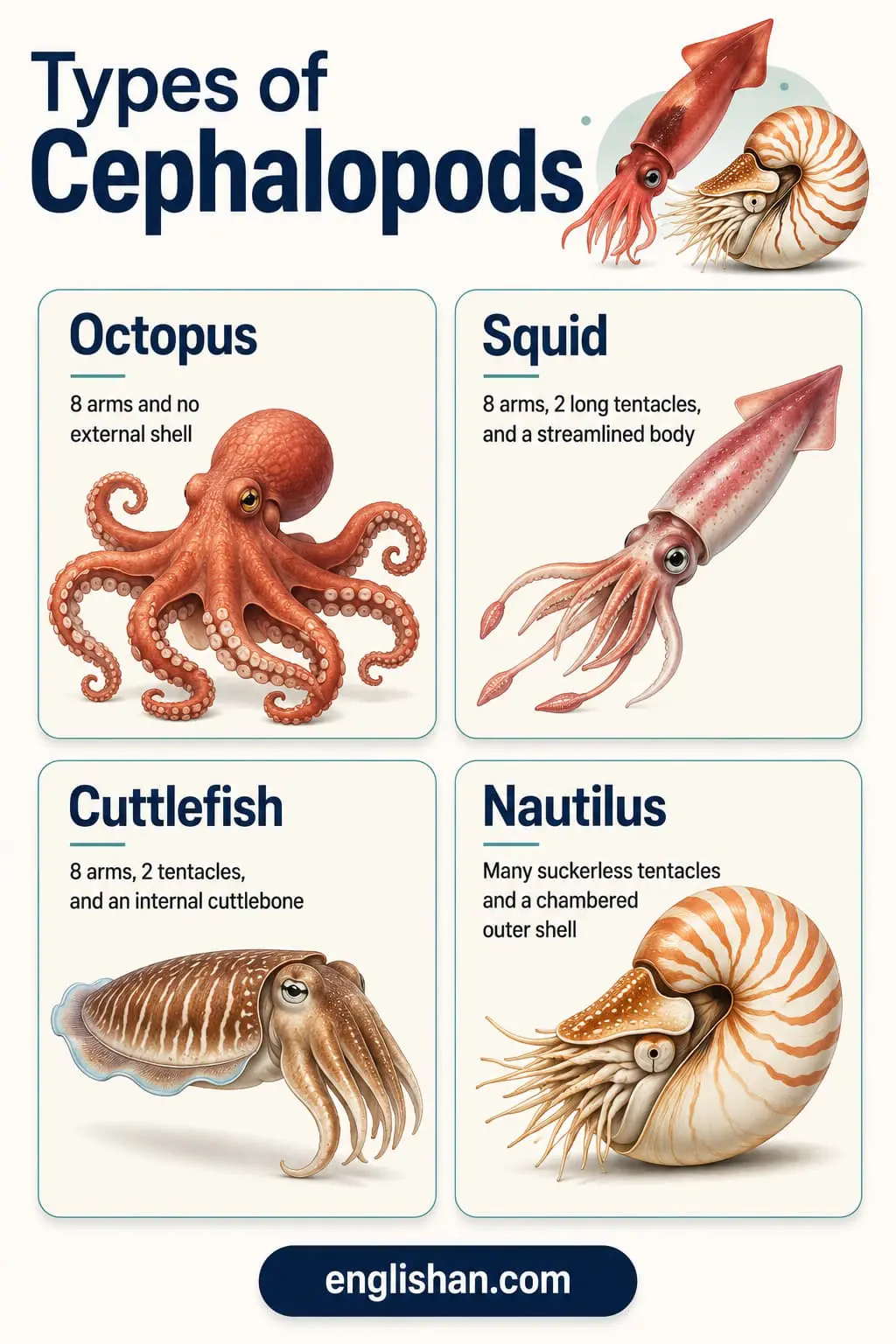
- European squid: A slender torpedo body with two triangular tail fins, sold whole for grilling or cut into rings and fried as calamari.
- Humboldt squid: Reaching a metre in length, landed in enormous volume off Peru and Chile, tenderised and sold as squid steak.
- Common cuttlefish: Broader and flatter than any squid, with a chalky internal plate and the dark ink that colours black pasta and black rice.
- Common octopus: Eight arms, no shell, and the largest brain in the group. Mediterranean and Japanese kitchens simmer or grill it.
- Bobtail squid: Rounded and no longer than a thumb, deep-fried whole in Japan and along parts of the Mediterranean.
Echinoderm Shellfish Types
Echinoderms are the outliers that make the two-group model fail. They have no legs, no hinge and no coil, just a rigid fused case built from calcium plates in five-part symmetry. Only the reproductive organs and the body wall are eaten, and both command high prices.
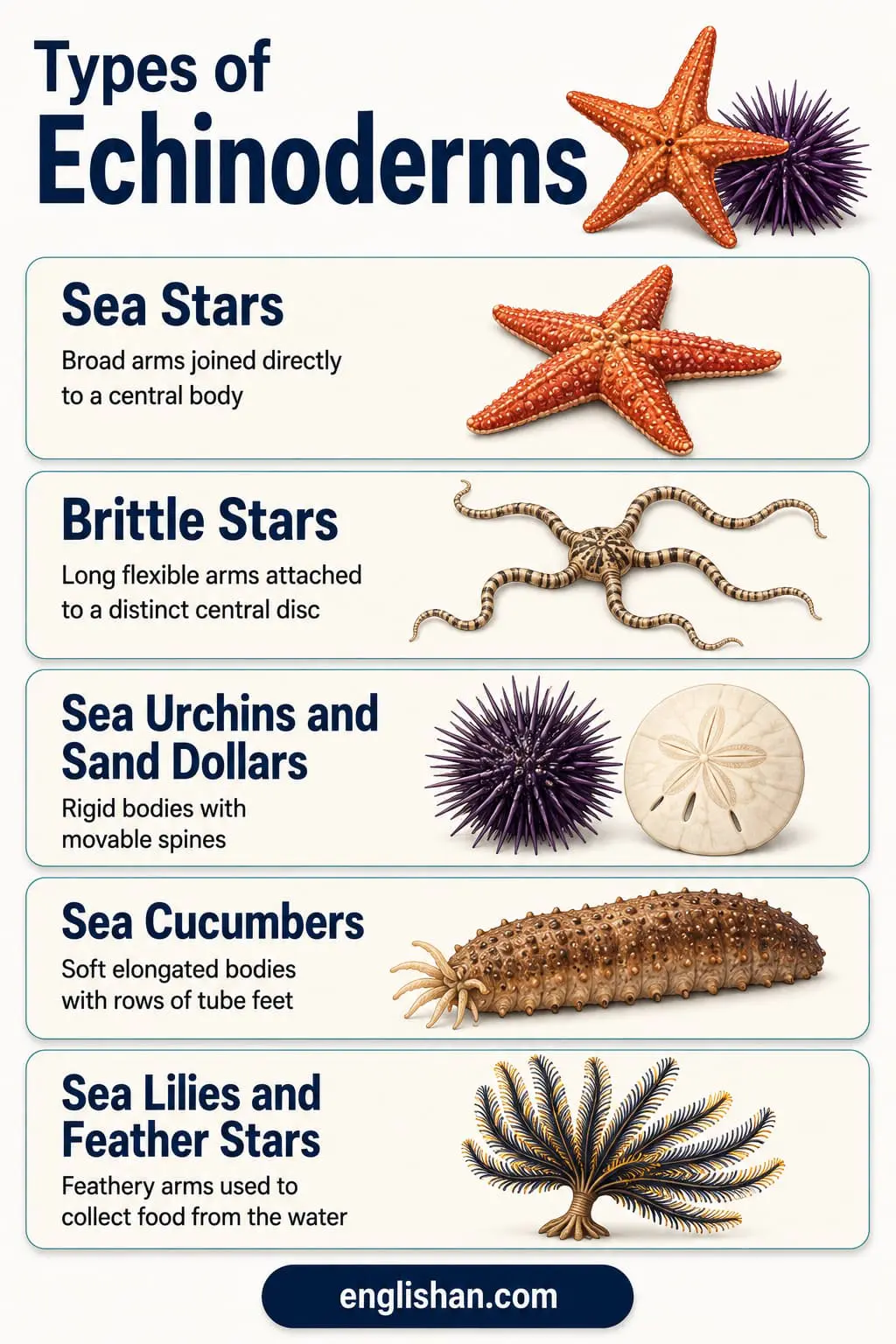
- Green sea urchin: Short-spined and cold-water, from the North Atlantic and North Pacific, opened for the five orange roe strips sold as uni.
- Purple sea urchin: The small dark Mediterranean urchin, eaten straight from the shell with bread along the French and Italian coasts.
- Red sea urchin: The largest urchin of all, taken off the Pacific coast of North America and supplying most of the uni served in North American sushi bars.
- Sea cucumber: A leathery sausage-shaped animal with neither shell nor spines, dried and slowly rehydrated as a luxury ingredient across China and Southeast Asia.
Those five groups account for every shellfish name on a counter. The same set also divides three other ways, by water, by farming and by price.
Saltwater And Freshwater Shellfish
Salinity does more than fix an address. It sets how mineral a shellfish tastes, how fast it grows and how long it survives out of water, which is why a fishmonger stocks almost nothing from fresh water. The same divide shapes the wider set of aquatic animals beyond the edible ones.
Saltwater shellfish account for nearly everything sold commercially:
- Oysters, mussels, scallops, clams and cockles, all of which taste saltier the more exposed the bed they grew on.
- Whelks, conch, abalone and limpets, worked off rock and reef rather than dredged from sand.
- Lobsters, langoustine, brown crab, king crab and most shrimp species.
- Squid, cuttlefish, octopus, sea urchin and sea cucumber.
Freshwater shellfish are a much shorter set, milder in flavour and lower in mineral content:
- Crayfish, the only freshwater crustacean eaten in real volume anywhere.
- Giant river prawn, farmed in rivers and brackish ponds across South Asia.
- Freshwater mussel and Asian clam, the second farmed for soup stock in East Asia.
- Freshwater snails, eaten across Southeast Asia and in French provincial cooking.
Farmed And Wild Shellfish
Which types of shellfish get farmed and which stay wild comes down to temperament and diet rather than to demand.
Farmed shellfish are almost all bivalves, because a filter feeder needs no feeding at all and never leaves its rope or tray:
- Blue mussel and green-lipped mussel, grown on suspended ropes.
- Pacific oyster, Eastern oyster and Sydney rock oyster, grown in trays, bags and on trestles.
- Hard clam, Asian clam and bay scallop.
- Abalone, fed farmed kelp in land-based tanks.
- Whiteleg shrimp and giant river prawn, the two crustaceans that pond-farm successfully.
Wild shellfish are the ones that resist captivity, mostly crustaceans and mobile mollusks:
- Lobster, langoustine, brown crab, king crab, snow crab and spanner crab, all territorial and prone to eating each other in a tank.
- Whelk, conch, razor clam and goose barnacle, harvested by hand or by dredge.
- Squid, octopus and cuttlefish, which grow too fast and die too young to farm at scale.
- Sea urchin and Antarctic krill, both taken entirely from the wild.
Most Expensive Shellfish Types
Price across this whole set answers to four things: how slowly the animal grows, how dangerous it is to collect, how short its legal season runs, and how little edible weight comes off it.
- Goose barnacle: The highest price of any shellfish in Europe, earned by harvesters working exposed rock between waves.
- Red abalone: Ten years to reach market size, then strict quotas after decades of overfishing.
- Geoduck: Hand-dug one clam at a time, and shipped live to a market that pays for texture.
- Sea urchin roe: Five thin strips per animal, hand-lifted, and worthless within a day of opening.
- Red king crab: Its Bering Sea season runs short and gets worked in the worst weather of the year.
- Queen conch: Restricted harvests across the Caribbean after populations collapsed.
- Sea cucumber: Dried, graded and traded like a commodity, with top grades reaching several hundred dollars a kilo.
- Langoustine: Fragile enough that most of the catch is frozen at sea, so the live ones command a premium.
Shellfish Types On Menus
Menus rarely use species names, and the substitutions are traditional rather than deceptive. These are the ones worth decoding before you order.
| On the menu | What arrives |
|---|---|
| Calamari | Squid, floured and fried in rings |
| Scampi | Langoustine in Britain and Ireland, a shrimp dish in the US |
| Uni | Sea urchin roe |
| Percebes | Goose barnacle |
| Scungilli | Sliced knobbed whelk |
| Coquille Saint-Jacques | Scallop, roe attached |
| Littleneck or cherrystone | Hard clam, sized by width |
| Soft-shell crab | Blue crab caught just after moulting |
| Rock lobster | Spiny lobster tail |
| Lapas | Grilled limpets |
Crustaceans And Mollusks Compared
| Feature | Crustaceans | Mollusks |
|---|---|---|
| Shell | External and jointed, moulted | Two halves, one coil, internal, or absent |
| Body | Segmented | Soft and unsegmented |
| Movement | Walking and swimming legs | Muscular foot, jet propulsion, or fixed |
| Colour when cooked | Turns red or orange | Stays close to its raw colour |
| US allergen label | Must be declared by name | Not required |
That last row decides what a label tells you. Shrimp, crab, lobster and crayfish must be named on US packaged food, while clam, oyster, squid and octopus reach an ingredient panel with no allergen warning attached.
Shellfish Names That Get Confused
Four name pairs cause more trouble than any scientific term in shellfish naming, because in each one the everyday usage and the biology disagree.
Prawn against shrimp: prawns have branching gills with claws on three pairs of legs, shrimp have plate-like gills with claws on two. British English calls most of them prawns and American English calls most of them shrimp.
A prawn is just a large shrimp. ❌
Prawn and shrimp name two different crustacean groups. ✅
Crayfish against crawfish: one animal, three regional words. Louisiana says crawfish, much of the US says crawdad, and Britain and Australia say crayfish.
Crawfish and crayfish are two different animals. ❌
Crawfish, crayfish and crawdad name the same freshwater crustacean. ✅
Scampi against langoustine: scampi never was a species, and the word means different food on each side of the Atlantic.
Scampi is a species of shellfish. ❌
Scampi means langoustine in Britain and Ireland, and a garlic-butter shrimp dish in the United States. ✅
Quahog against hard clam: one Atlantic bivalve, renamed four times as it widens.
A quahog and a hard clam are separate clams. ❌
Quahog and hard clam name the same bivalve, with littleneck, topneck and cherrystone below it by size. ✅
How To Pronounce Shellfish Names
Half the names for the types of shellfish in English arrived from French, Spanish, Japanese or Chinook, and none of them behaves the way its spelling suggests.
| Name | IPA | Say it as |
|---|---|---|
| Abalone | /ˌæbəˈloʊni/ | ab-uh-LOH-nee |
| Conch | /kɒŋk/ | konk |
| Whelk | /welk/ | welk |
| Scallop | /ˈskɒləp/ | SKOL-up |
| Quahog | /ˈkoʊhɒɡ/ | KO-hog |
| Geoduck | /ˈɡuːiːdʌk/ | GOO-ee-duck |
| Langoustine | /ˌlæŋɡʊˈstiːn/ | lang-guh-STEEN |
| Periwinkle | /ˈperɪwɪŋkl/ | PERR-ee-wing-kul |
| Crustacean | /krʌˈsteɪʃn/ | kruss-TAY-shun |
| Mollusk | /ˈmɒləsk/ | MOL-usk |
| Cephalopod | /ˈsefələpɒd/ | SEF-uh-luh-pod |
| Echinoderm | /ɪˈkaɪnədɜːm/ | ih-KY-nuh-durm |
Shellfish never takes an -s: one shellfish, two shellfish, a plate of shellfish. Squid works the same way, American English keeps shrimp unchanged where British English writes shrimps, and octopus takes octopuses.
FAQs
The three types of shellfish are crustaceans, mollusks and echinoderms. Crustaceans are the jointed-shell animals such as crab, lobster and shrimp. Mollusks are the soft-bodied animals such as oyster, whelk, squid and octopus. Echinoderms are the spiny-cased sea urchins and sea cucumbers.
Yes, shrimp is a shellfish, and specifically a crustacean. Its jointed exoskeleton, ten legs and pair of antennae place it beside crab, lobster and crayfish rather than beside any fish.
Squid is a shellfish rather than a fish. It is a mollusk, in the cephalopod group alongside octopus and cuttlefish, and its shell survives only as a thin internal blade called a pen. Fish have backbones and gills; squid has neither.
The difference is anatomical, and everyday speech ignores it. Prawns have branching gills with small claws on three pairs of legs, while shrimp have plate-like gills with claws on two pairs. British English calls most of them prawns and American English calls most of them shrimp.
Shrimp is the most widely eaten shellfish and the most valuable seafood in world trade, with farmed whiteleg shrimp accounting for the largest share. By farmed weight rather than value, oysters and clams are produced in even greater volume across East Asia.
Crustacean shellfish cause the most reactions, with shrimp ahead of crab and lobster. Mollusk shellfish such as clam, oyster, squid and octopus trigger fewer, and an allergy to one group does not guarantee an allergy to the other. The Food Allergy Research and Education organisation reports that around 2% of the US population has a shellfish allergy.