A cement mixer is a steel drum on a tilting frame, with a motor beside it and a wheeled stand under it. Cement is only one ingredient in the batch, so US builders call the same machine a concrete mixer.
The parts of a cement mixer fall into three groups: the drum that spins, the frame that tilts, and the stand that stays fixed.
Parts of a Cement Mixer Diagram Labeled by Group
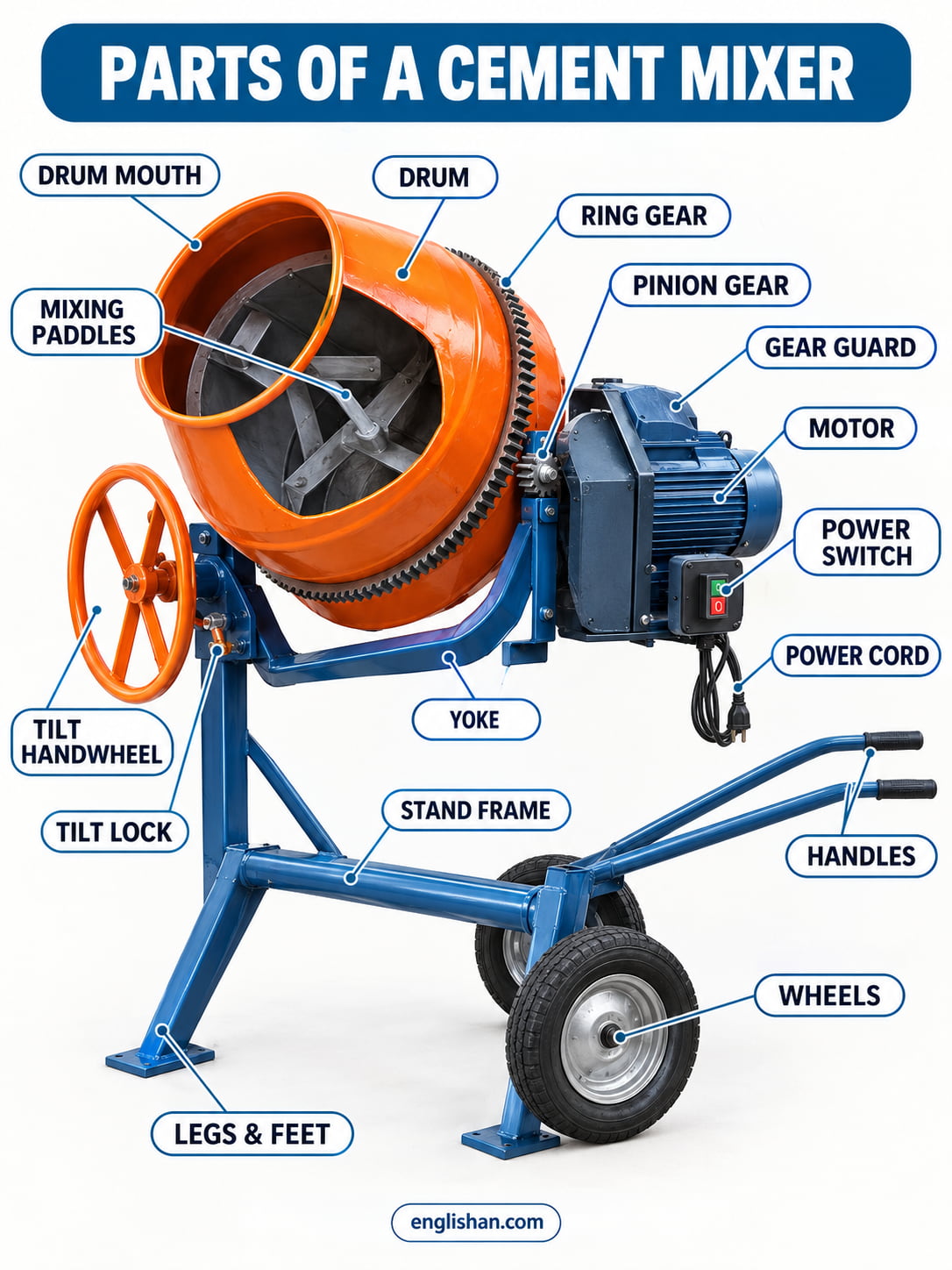
A portable cement mixer is a round steel drum with an open mouth tilted upward. A toothed ring gear circles the drum body, and a motor with a small pinion gear turns it. A handwheel on the side tilts the drum on its frame. Two legs and two wheels form the stand, and two handles are fixed at the rear. These are the parts of a cement mixer on a standard portable unit.
| Part | Where you find it |
|---|---|
| 1. Drum | Round steel or plastic bowl on the frame |
| 2. Drum mouth | Wide opening at the front of the drum |
| 3. Mixing paddles | Steel fins on the inside wall of the drum |
| 4. Ring gear | Toothed steel band around the drum body |
| 5. Yoke | U-shaped steel frame that supports the drum |
| 6. Motor | Cylinder bolted to the yoke |
| 7. Pinion gear | Small toothed wheel on the motor shaft |
| 8. Gear guard | Curved shield over the ring gear and pinion |
| 9. Power switch | Rocker or push button on the motor housing |
| 10. Power cord | Three-prong cable leaving the motor |
| 11. Tilt handwheel | Round steel wheel on the side of the stand |
| 12. Tilt lock | Pin or latch beside the handwheel |
| 13. Stand frame | Welded tubular steel frame under the yoke |
| 14. Legs and feet | Splayed steel legs on one side of the stand |
| 15. Wheels | Two rubber wheels on the other side of the stand |
| 16. Handles | Rubber-wrapped steel grips at the rear of the stand |
| 17. Tow bar | Steel arm and coupler on a trailer mixer |
| 18. Charging hopper | Steel funnel at the rear top of a truck drum |
| 19. Discharge chute | Swinging steel trough at the rear of a truck |
| 20. Water tank | Cylinder mounted on the frame of a truck |
| 21. Spiral blades | Steel ribbons welded inside a truck drum |
| 22. Mixing pan | Flat round steel pan on a pan mixer |
| 23. Mixing arms | Rotating paddle arms over the pan floor |
| 24. Discharge gate | Sliding door in the floor of a pan |
Main Parts of a Cement Mixer
Seven of the parts of a cement mixer mix, drive, and move the batch. The rest guard the gears, control the power, or extend the reach of a larger machine.
- Drum: The steel or plastic bowl, 3 to 12 cubic feet, that holds the batch.
- Mixing paddles: The fixed steel fins inside the drum that fold the mix.
- Ring gear: The toothed steel band around the drum that the pinion turns.
- Motor or engine: The electric motor or gas engine that drives the drum, at 1/2 to 6.5 horsepower.
- Tilt handwheel: The crank that tips the drum forward to pour.
- Stand: The steel frame that supports the mixer at working height.
- Wheels: The two wheels that move the mixer like a wheelbarrow.
Cement Mixer Drum Parts
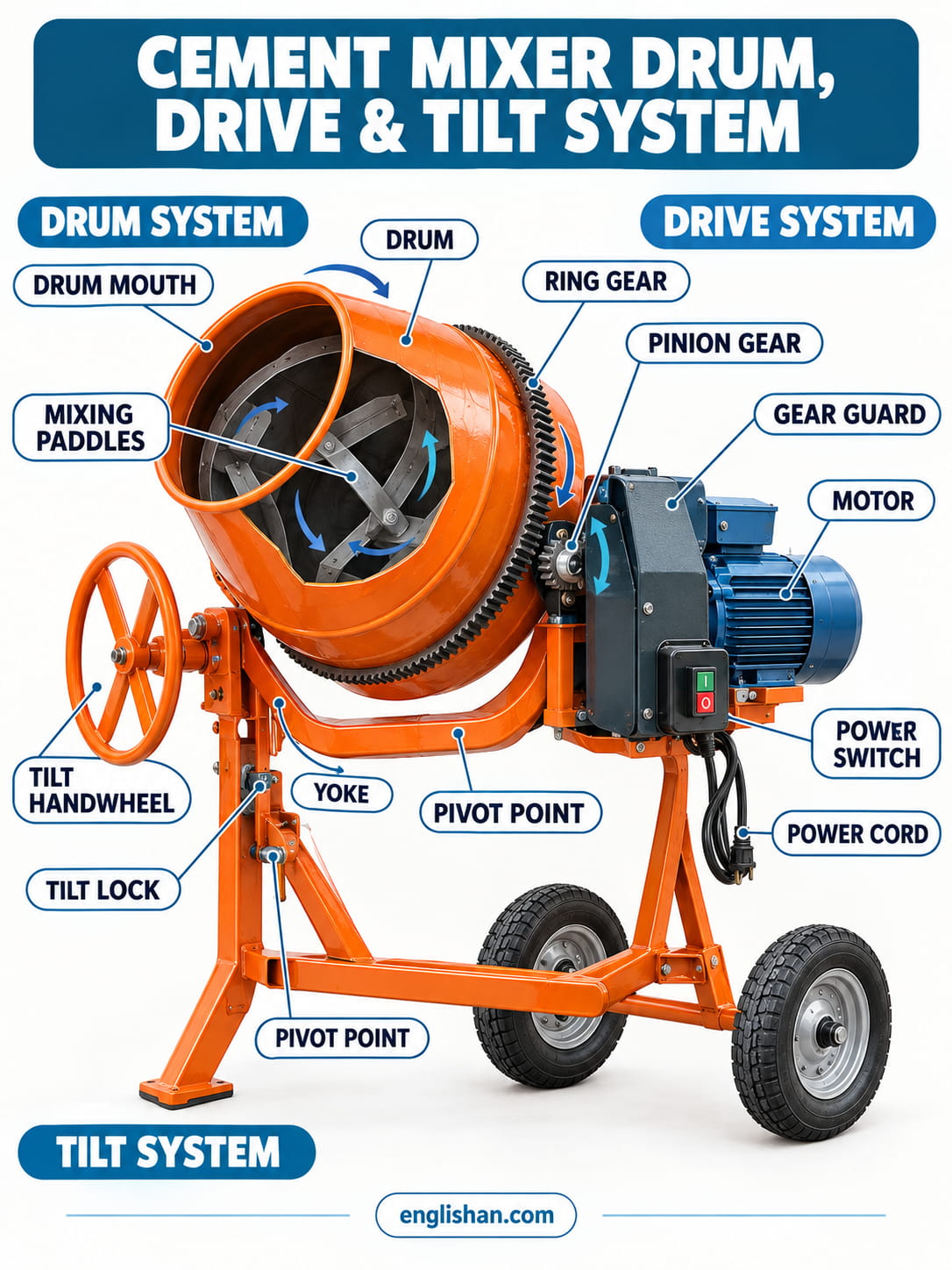
Four of the parts of a cement mixer spin with the drum. They are the drum, its mouth, the mixing paddles, and the ring gear.
Drum
The drum is a round bowl of steel or heavy plastic, 20 to 30 inches across. It has a wide mouth at the front and a closed cone at the back. A 3.5 cubic foot drum mixes about 2.5 cubic feet of concrete. The shell is painted orange, blue, or red.
Drum Mouth
The drum mouth is the round opening at the front of the drum, 12 to 16 inches wide, edged with a rolled steel rim. Sand, gravel, cement, and water are loaded through it. The batch pours out of it when the drum tilts.
Mixing Paddles
The mixing paddles are two to four steel fins, 2 to 4 inches tall, welded or bolted to the inside wall of the drum. They are angled and curved. Some have rubber tips that scrape the wall.
Ring Gear
The ring gear is a toothed steel band, painted black or coated in grease, fixed around the body of the drum. Its teeth mesh with the pinion gear. A worn ring gear shows flat, shiny teeth.
Cement Mixer Motor and Tilt Parts
Eight of the parts of a cement mixer tilt together with the drum. They are mounted on the yoke, the frame that pivots on the stand.
Yoke
The yoke is a U-shaped steel frame, welded from thick plate or tube, at the back of the drum. Two pivot pins join it to the stand. The drum shaft passes through it, and the motor is bolted to it.
Motor
The motor is an electric unit of 1/2 to 1 horsepower on 120 volts, about 8 inches long, bolted to the yoke. It is a black or gray cylinder with a cooling fan at one end. On larger mixers, a gas engine of 5.5 to 6.5 horsepower replaces it, much like a lawn mower engine. It adds a fuel tank and a pull-start handle.
Pinion Gear
The pinion gear is a small toothed steel wheel, 2 to 3 inches across, fixed to the motor shaft. Its teeth mesh with the ring gear and turn the drum at about 25 rpm. Some models add a belt and pulley between the motor and the pinion.
Gear Guard
The gear guard is a curved shield of steel or plastic, painted black or orange, over the ring gear and the pinion. A cutout leaves the drum free to turn. It covers the meshing teeth.
Power Switch
The power switch is a rocker or push-button switch, red or black, in a small housing on the motor. It has On and Off positions. A rubber boot covers it against splashes.
Power Cord
The power cord is a three-prong cable, 6 to 10 feet long, that leaves the motor housing. It is orange or black. A gas mixer has none, and a generator supplies power at remote sites, as described in the generator parts page.
Tilt Handwheel
The tilt handwheel is a round steel wheel, 6 to 8 inches across, on the side of the stand. Turning it tips the drum from upright to a pouring angle. Some mixers use a lever with a locking pin in place of a wheel.
Tilt Lock
The tilt lock is a steel pin or a spring latch beside the handwheel. It fixes the drum at the chosen angle. Its knob is red or black.
Cement Mixer Stand Parts
Four of the parts of a cement mixer stay fixed while the drum spins and tilts. They form the stand, and the yoke pivots on it.
Stand Frame
The stand frame is a welded tubular steel frame in an A shape, 24 to 36 inches tall. The yoke pivots on two pins at its top. A cross brace joins its sides.
Legs and Feet
Two splayed steel legs are fixed on one side of the stand frame. Each ends in a flat steel or rubber foot. The feet brace the mixer on the ground while the drum turns.
Wheels
The wheels are two round wheels, 8 to 10 inches across, of solid rubber or an air-filled tire. They turn on a steel axle at the base of the stand. Lifting the handles raises the leg side and puts the weight on them.
Handles
The handles are two tubular steel grips, wrapped in rubber, at the rear of the stand. They tip the mixer onto its wheels for moving. A finished 3.5 cubic foot mixer weighs 100 to 140 pounds.
Cement Mixer Types and Their Parts
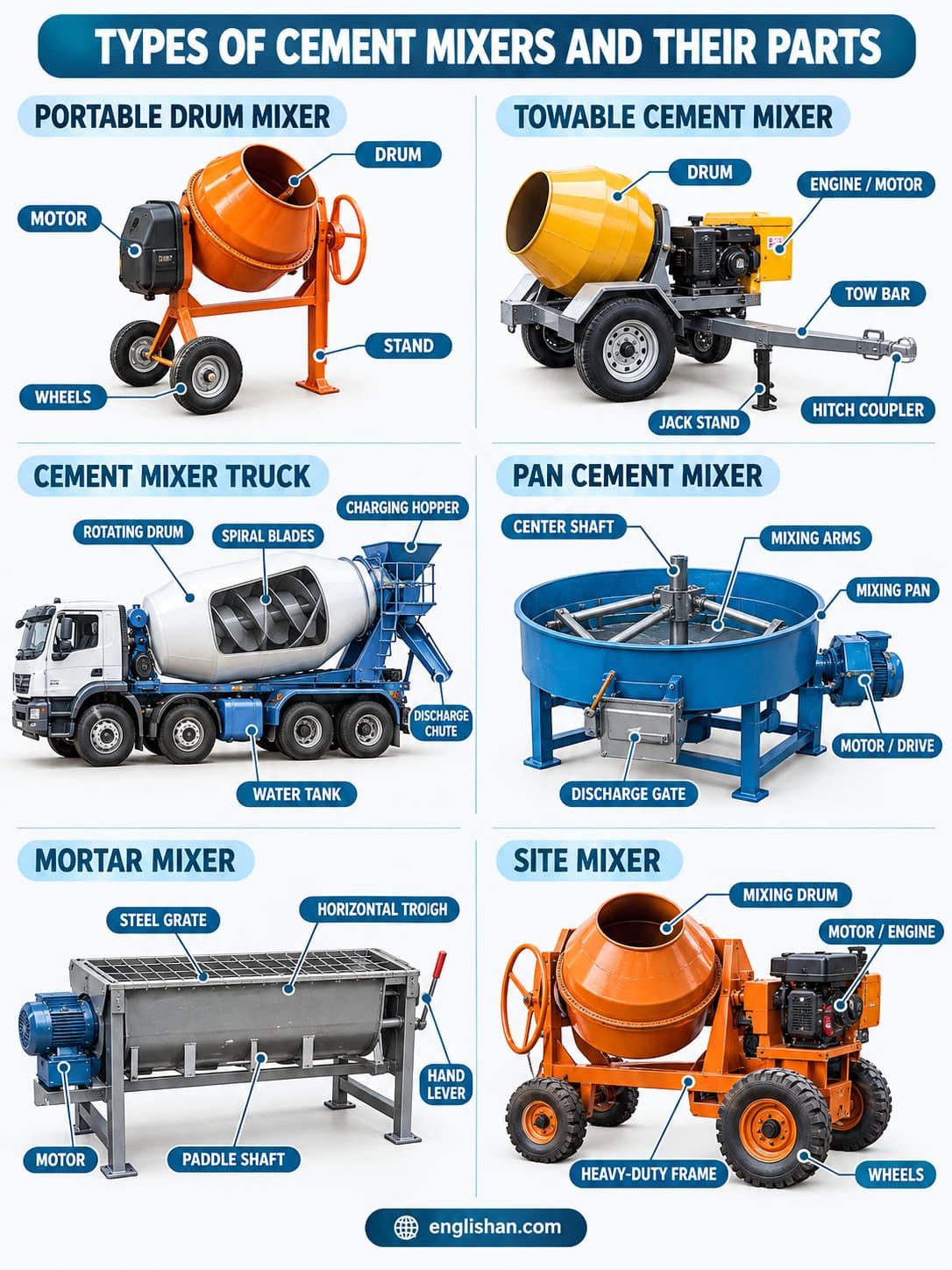
The parts of a cement mixer change with the type. Five types cover home, site, and plant work.
Portable Drum Cement Mixer
The portable drum cement mixer is the standard home and site type, from 3 to 9 cubic feet. It has a drum, a yoke, a motor, a stand, and wheels. Electric models suit small jobs, such as footings for a deck, and gas models suit remote sites.
Towable Cement Mixer
The towable cement mixer is a 9 to 12 cubic foot drum on a two-wheel trailer axle. A tow bar with a hitch coupler and a jack stand are fixed at the front. A gas engine of 5.5 to 6.5 horsepower turns the drum.
Cement Mixer Truck
The cement mixer truck has a conical rotating drum of 8 to 12 cubic yards, with two spiral blades welded inside. A charging hopper is at the rear top, and a discharge chute swings out at the rear. A water tank, a hydraulic motor, and two support rollers complete the parts. It is also called a transit mixer.
Pan Cement Mixer
The pan cement mixer is a flat round steel pan, 3 to 6 feet across. Two to four paddle arms rotate on a center shaft. Fixed scrapers line the wall. A discharge gate opens in the floor of the pan.
Mortar Mixer
The mortar mixer is a horizontal steel trough of 6 to 9 cubic feet, with a paddle shaft along its length. A steel grate covers the top, and a hand lever tips the trough to empty it. A 1 horsepower motor or a gas engine drives the shaft.
FAQs
Q1. What are the parts of a cement mixer?
The parts of a cement mixer are the drum, mixing paddles, ring gear, yoke, motor, pinion gear, tilt handwheel, stand, wheels, and handles. The drum group spins, the yoke group tilts, and the stand stays fixed.
Q2. What is the spinning part of a cement mixer called?
The spinning part of a cement mixer is the drum. The mixing paddles and the ring gear turn with it. The pinion gear on the motor shaft drives the ring gear.
Q3. What is the back part of a cement mixer called?
The back part of a cement mixer drum is the back cone, the closed tapered end opposite the mouth. The yoke and the drum shaft are at that end. The motor is bolted to the yoke.
Q4. Is it a cement mixer or a concrete mixer?
Both names describe the same machine, but concrete mixer is the trade term. The batch holds sand and gravel as well as cement. Cement mixer is the everyday name for the same drum unit.
Q5. What are the parts of a cement mixer truck?
A cement mixer truck has a rotating conical drum, spiral blades, a charging hopper, a discharge chute, and a water tank. It also has a hydraulic motor, support rollers, and a chassis. The blades are welded inside the drum.
Q6. What are the parts of an electric cement mixer?
An electric cement mixer has a drum, mixing paddles, a ring gear, and a 1/2 to 1 horsepower motor. It also has a pinion gear, a gear guard, a power switch, and a power cord. A stand with wheels supports it.
Q7. How does a cement mixer work?
The motor turns a pinion gear, which drives the ring gear and rotates the drum at about 25 rpm. The mixing paddles lift and fold the batch until it is uniform. The tilt handwheel then tips the drum to pour.
You May Also Like