

A portable generator is a steel-framed unit with a gasoline engine at one end and an alternator at the other. The parts of a generator line up along one shaft, with the control panel and the frame around it.
Inverter, standby, diesel, and DC models change the engine end or the alternator end but keep the same plan.
Parts of a Generator Diagram for a Portable Unit
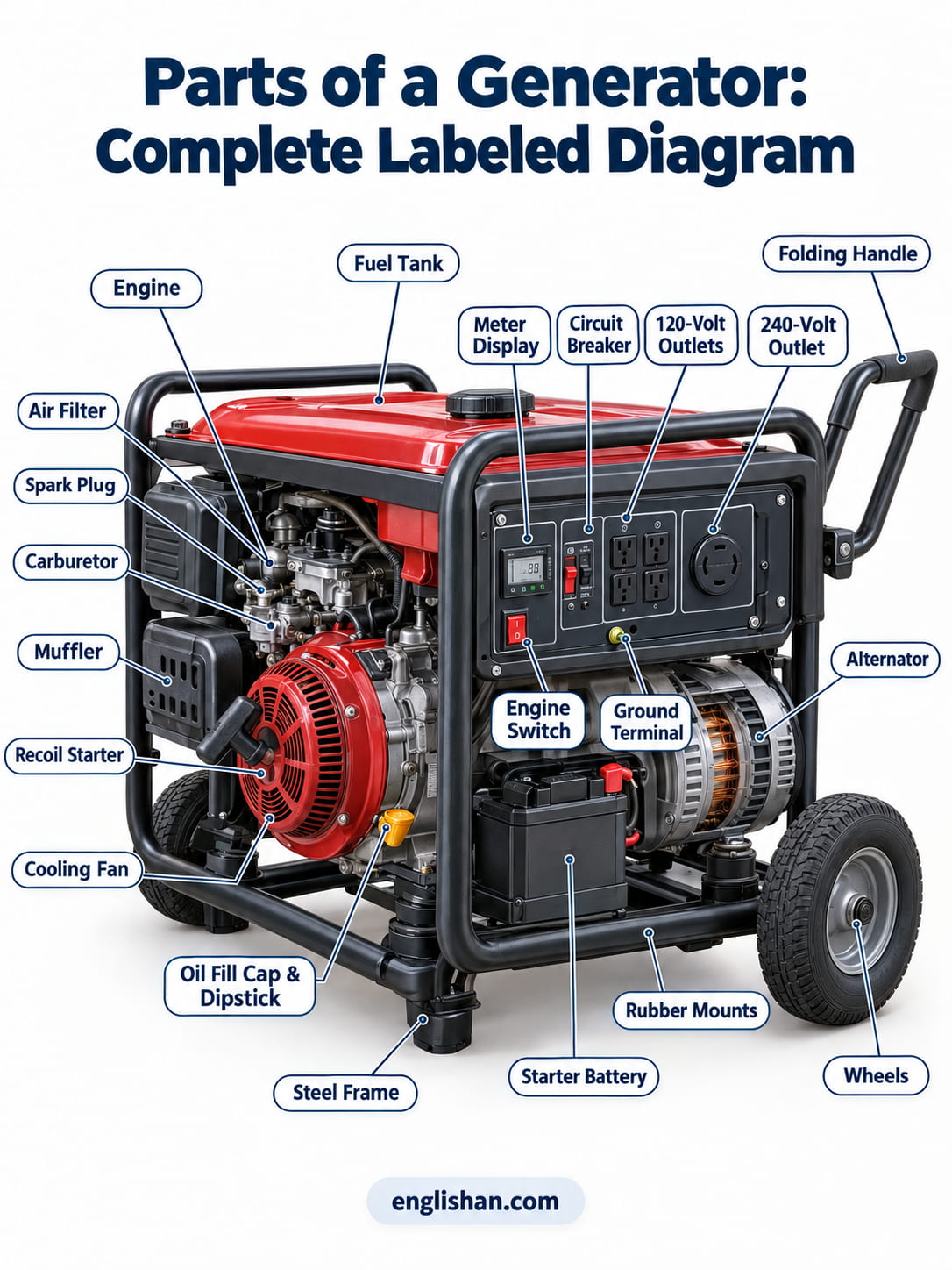
A portable generator has a tank on top of the engine and a muffler and air filter on its sides. The control panel is on the front, with outlets, breakers, and an engine switch. A pull cord and handle are on the engine side, and a tubular handle and two wheels are on the frame. The alternator is a round housing at the far end. This diagram of the parts of a generator is numbered from the engine end to the frame.
| Part | Where you find it |
|---|---|
| 1. Engine | Air-cooled gasoline motor at one end of the frame |
| 2. Fuel tank | Steel or plastic tank on top of the engine |
| 3. Air filter | Foam or paper cartridge under a cover on the engine side |
| 4. Carburetor | Cast metal fuel mixer behind the air filter |
| 5. Spark plug | Ceramic plug under a rubber boot on the cylinder head |
| 6. Recoil starter | Pull cord and handle on the engine side |
| 7. Oil fill cap and dipstick | Yellow or black plug on the crankcase |
| 8. Muffler | Perforated steel canister on the exhaust side |
| 9. Cooling fan | Plastic or metal wheel behind a steel shroud |
| 10. Starter battery | Small sealed battery on electric-start models |
| 11. Alternator | Round housing at the far end of the shaft |
| 12. Rotor | Rotating wire-wound core inside the alternator |
| 13. Stator | Fixed copper winding around the rotor |
| 14. Voltage regulator | Small module in the alternator housing or behind the panel |
| 15. 120-volt outlets | Round-hole sockets on the control panel |
| 16. 240-volt outlet | Twist-lock socket on the control panel |
| 17. Circuit breaker | Push-button reset switch on the panel |
| 18. Engine switch | Rocker or ignition switch on the panel |
| 19. Ground terminal | Threaded metal stud on the panel |
| 20. Meter display | Small LCD or dial meter on the panel |
| 21. Steel frame | Tubular cradle around the engine and alternator |
| 22. Wheels | Two rubber wheels at one end of the frame |
| 23. Folding handle | Steel bar at the opposite end of the frame |
| 24. Rubber mounts | Isolator blocks between the engine and the frame |
Main Parts of a Generator
Ten main parts make up every engine-driven generator. The sections that follow name each visible piece of them.
- Engine: The gasoline, propane, or diesel motor that turns the shaft.
- Alternator: The round housing that turns the spinning shaft into 60 Hz alternating current.
- Voltage regulator: The module that keeps the output near 120 volts.
- Fuel system: The tank, valve, filter, and carburetor or injector that feed the engine.
- Cooling system: The fan and fins on an air-cooled engine, or the radiator on a diesel.
- Exhaust system: The muffler and pipe that route the hot gas away from the engine.
- Lubrication system: The crankcase oil, fill cap, and dipstick.
- Starter and battery: The pull cord, or an electric motor with a 12-volt battery.
- Control panel: The outlets, breakers, and switch on the front.
- Frame: The steel cradle, wheels, and handle.
Generator Engine End Parts
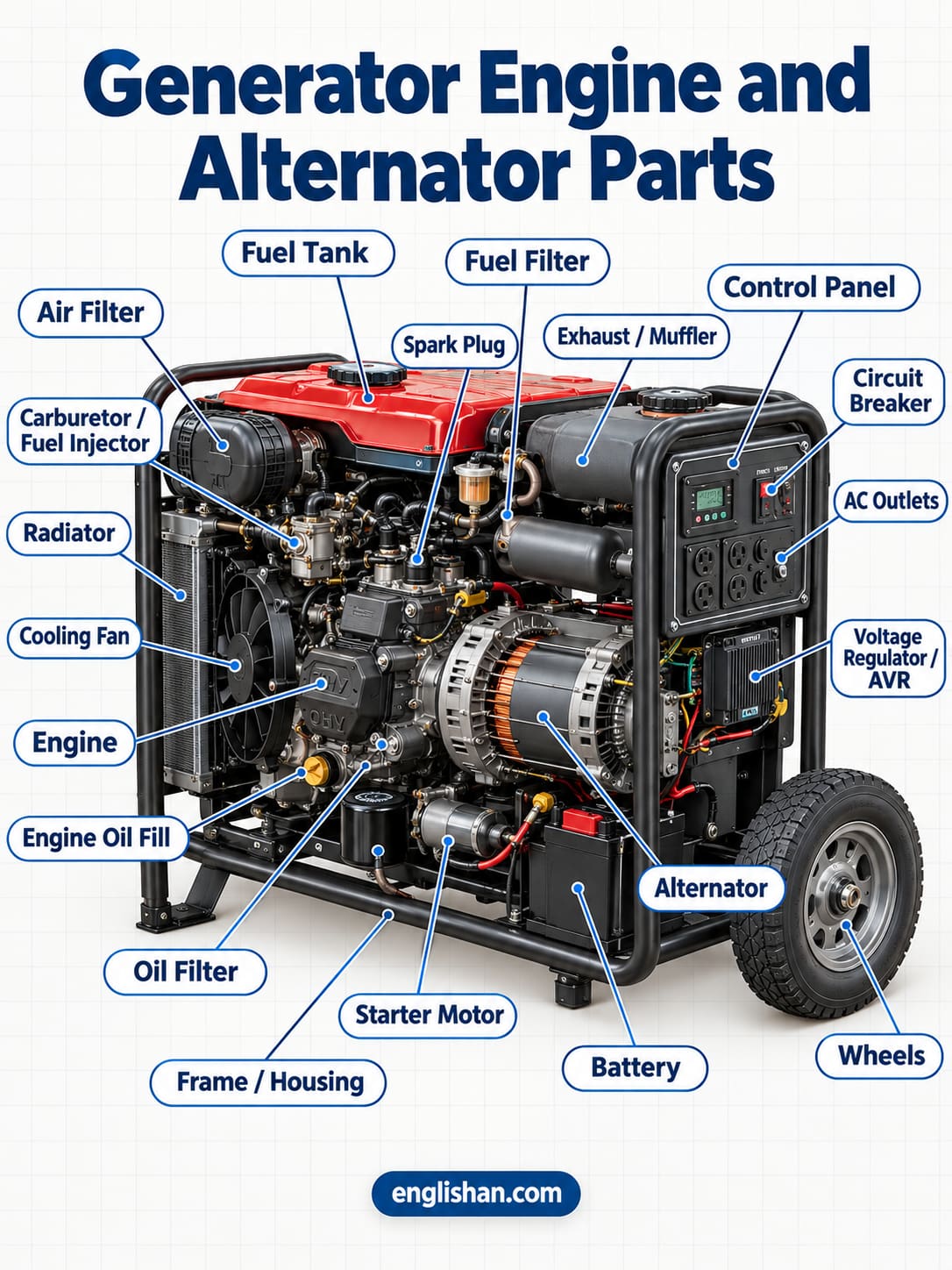
Ten of the parts of a generator are on the engine end. They store the fuel, mix it with air, and turn the shaft.
Engine
The engine is a one- or two-cylinder gasoline motor of 100 to 700 cc. It is mounted at one end of the frame, like the small engine on a lawn mower. Its black metal block is ribbed with cooling fins. The shaft faces the alternator.
Fuel Tank
The fuel tank is a steel or plastic tank on top of the engine, from 1 to 8 gallons on a portable model. A screw cap seals the filler neck, and a gauge or red float marks the level. Its shell is painted red, black, or gray.
Air Filter
The air filter is a foam sleeve or a pleated paper cartridge under a plastic cover on the engine side. Wing nuts or clips fasten the cover. The filter is white, cream, or orange.
Carburetor
The carburetor is a small aluminum block behind the air filter, with a bowl at the base and a choke lever on the side. A fuel line runs to it from the tank. Fuel injection replaces it on some larger models.
Spark Plug
The spark plug is a ceramic and steel plug, about 3 inches long with its boot, screwed into the cylinder head. A rubber boot and a wire cover its top. A small access cap on the engine cover exposes it.
Recoil Starter
The recoil starter is a plastic housing with a rope and a molded handle on the engine side. Pulling the rope spins a spring-loaded pulley on the engine shaft. The rope is 3 to 4 feet long. Among the parts of a generator, it is the one you handle at every start.
Oil Fill Cap and Dipstick
The oil fill cap is a yellow or black plug on the side of the crankcase, with a dipstick attached. The stick is marked with Full and Add lines. The crankcase takes 0.5 to 1.5 quarts of oil.
Muffler
The muffler is a perforated steel canister, 4 to 8 inches long, bolted to the exhaust port. A steel spark arrestor screen is fitted at the outlet, and a heat shield covers the shell. It is the hottest part on the outside of the unit.
Cooling Fan
The cooling fan is a plastic or cast metal wheel on the engine shaft behind a steel shroud. It draws air across the cooling fins. Slots in the shroud let the air in.
Starter Battery
Electric-start models add a sealed 12-volt battery in a box on the frame, with a red and a black cable. A push button or the ignition switch starts the engine. The battery is about 5 inches long.
Generator Alternator End Parts
Four of the parts of a generator are on the alternator end. They turn the spinning shaft into 60 Hz alternating current, and they are the electrical parts of a generator.
Alternator
The alternator is a round or barrel-shaped housing of steel or aluminum at the far end of the shaft, 8 to 12 inches wide. Vents are cut into its rear cap. A bundle of wires leaves it toward the control panel.
Rotor
The rotor is a rotating assembly of copper wire wound on an iron core, fixed to the engine shaft. It spins inside the alternator at 3,600 rpm on standard models. Its magnetic field induces the current in the stator.
Stator
The stator is a fixed ring of iron plates wound with heavy copper wire, fastened to the alternator housing. It surrounds the rotor with a narrow gap. Its output leads run to the control panel.
Voltage Regulator
The voltage regulator is a small electronic module or capacitor pack fixed inside the alternator housing or behind the panel. It keeps the output near 120 volts as the load changes. It is a black or gray box about 3 inches wide.
Generator Control Panel Parts
Six of the parts of a generator are on the control panel. It is a molded plastic or steel face on the front or side of the frame, and every outlet and switch is labeled.
120-Volt Outlets
The 120-volt outlets are two or four round-hole duplex sockets rated at 20 amps. Many have a GFCI button pair marked Test and Reset. They run a refrigerator, lights, or power tools.
240-Volt Outlet
The 240-volt outlet is a round twist-lock socket rated at 30 amps, in the NEMA L14-30R style. It feeds a transfer switch or a home inlet. RV models add a 30-amp RV outlet with three flat blades.
Circuit Breaker
The circuit breaker is a push-button reset switch, about half an inch wide, on the panel. One breaker covers each outlet group. It trips when the load passes its 15 to 30 amp rating.
Engine Switch
The engine switch is a rocker or a three-position ignition switch on the panel. Its positions are marked Off, On, and Start. Some models add a fuel valve lever beside it.
Ground Terminal
The ground terminal is a threaded metal stud with a wing nut, marked with a ground symbol. A wire runs from it to a ground rod. It is on the lower edge of the panel.
Meter Display
The meter display is a small LCD or dial gauge on the panel. It shows volts, hertz, and running hours. Older units use an analog voltmeter.
Generator Frame Parts
Four of the parts of a generator make up the frame. They support the engine and alternator and protect them during moves.
Steel Frame
The steel frame is a cradle of round or square tube, welded and painted black or red. The engine and alternator are bolted to it. A portable frame is open on the sides so the unit cools freely.
Wheels
The wheels are two solid rubber or foam-filled tires, 6 to 10 inches across, on one axle at one end of the frame. A cotter pin fastens each wheel.
Folding Handle
The folding handle is a bar of tubular steel with a rubber grip at the opposite end of the frame. It folds flat against the unit for storage, and pins lock it upright.
Rubber Mounts
The rubber mounts are short cylindrical isolators, four, between the engine, the alternator, and the frame. They are black rubber with a steel stud at each end, and they reduce vibration.
Generator Types and Their Parts
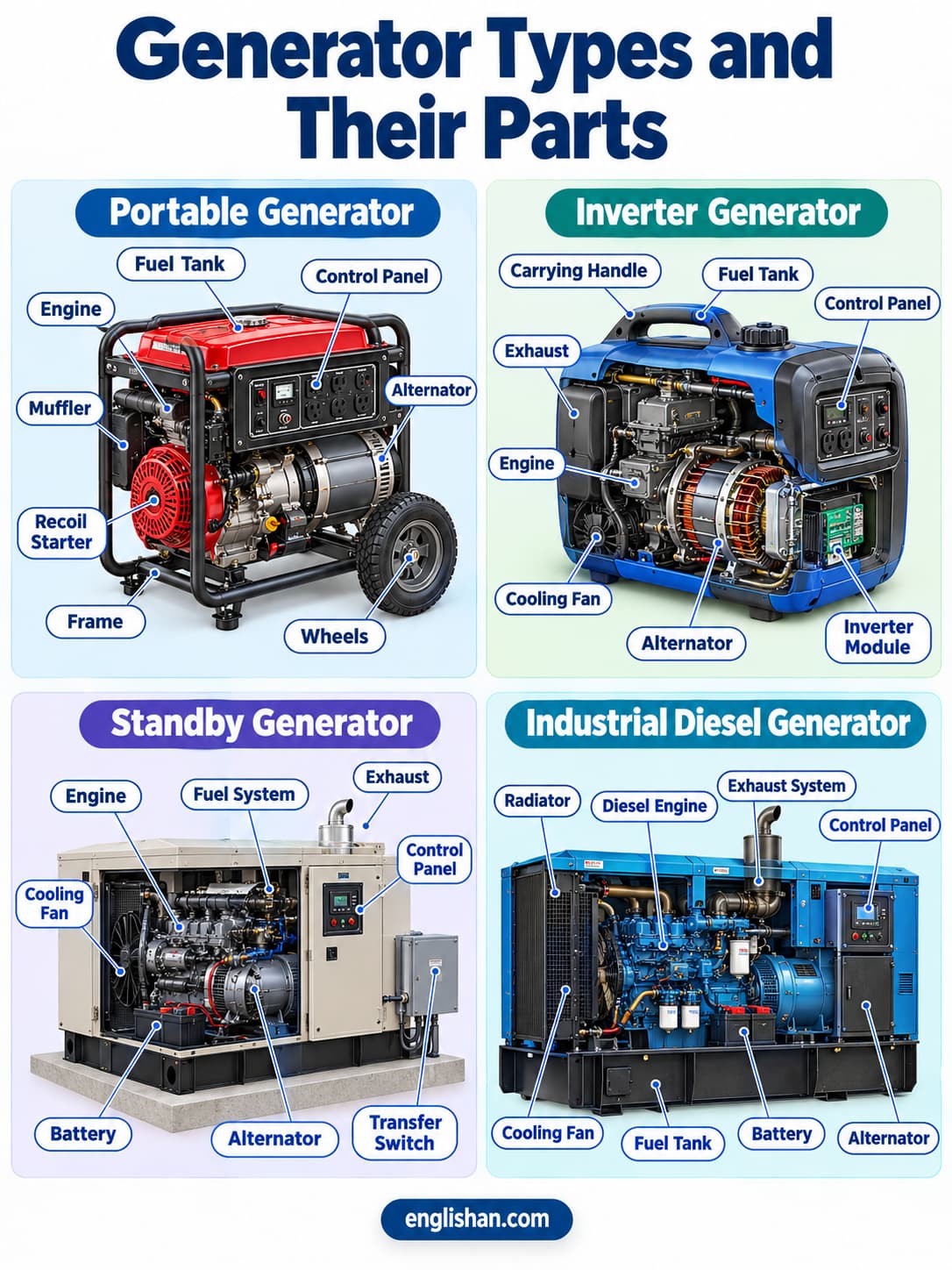
The parts of a generator change with the type. Four types cover most homes and job sites in the US.
Portable Generator
The portable generator is the open-frame unit described earlier, rated 2,000 to 12,000 watts. It has a pull-start engine, a 1 to 8 gallon tank, and a control panel on the front. It weighs 50 to 250 pounds.
Inverter Generator
The inverter generator is a compact unit in a molded plastic case, rated 2,000 to 4,500 watts. It adds an inverter module, a black metal box with cooling fins, between the alternator and the outlets. Its small alternator uses permanent magnets, and its case muffles the engine.
Standby Generator
The standby generator is a permanent unit on a concrete pad beside the house, in a steel or aluminum enclosure. It is rated 7,000 to 24,000 watts and runs on natural gas or propane. It adds an automatic transfer switch and a gas line, and it powers an air conditioner or a furnace.
Diesel Generator
The diesel generator has no spark plug or carburetor. It has fuel injectors, glow plugs, a fuel filter, and a radiator with liquid coolant. Its steel enclosure or open frame is larger than a gasoline unit.
DC Generator Parts
A DC generator is a machine in which a coil spins in a magnetic field. A commutator turns its alternating current into direct current. Five of the parts of a generator of this type are named in physics and engineering courses.
Armature
The armature is a steel shaft with a cylinder of laminated iron plates and copper coils wound in slots. It spins between the field poles. One end has the commutator.
Field Poles
The field poles are two or four iron blocks with copper coils, bolted to the inside of the yoke. They face the armature across a narrow gap. Their coils create the magnetic field.
Commutator
The commutator is a cylinder of copper segments, insulated from each other with mica, fixed to one end of the armature. Its surface is smooth and brown or copper-colored. It reverses the connections twice per turn.
Brushes
The brushes are blocks of carbon, pressed against the commutator by springs, in metal holders. They wear down slowly, and two wires lead from them to the output terminals.
Yoke
The yoke is the outer frame of cast steel or iron, shaped as a ring or a cylinder. The field poles are bolted to it. It closes the magnetic path between the poles.
FAQs
Q1. What are the parts of a generator?
The parts of a generator are the engine, alternator, fuel tank, air filter, spark plug, muffler, control panel, outlets, circuit breaker, and frame. The engine end burns fuel, and the alternator end makes power. The panel and frame complete the set.
Q2. What are the main parts of a generator?
The ten main parts are the engine, alternator, voltage regulator, fuel, cooling, exhaust, and lubrication systems, the battery, the control panel, and the frame. The engine and alternator make the power. The other eight support and control them.
Q3. What are the parts of a generator and their functions?
The engine turns the shaft, and the alternator converts that rotation into electricity. The voltage regulator keeps the output steady, and the fuel tank feeds the engine. The muffler quiets the exhaust, and the breaker cuts power on an overload.
Q4. What are the parts of a diesel generator?
A diesel generator has an engine, alternator, fuel tank, fuel injectors, glow plugs, radiator, battery, and control panel. It has no spark plug or carburetor. The radiator cools the engine with liquid coolant.
Q5. What are the parts of a DC generator?
A DC generator has an armature, field poles, a commutator, brushes, and a yoke. The armature spins between the poles. The commutator and brushes turn the alternating current into direct current.
Q6. What are the parts of an AC generator?
An AC generator has a rotor, a stator, slip rings, and brushes, or a brushless exciter in place of them. The rotor spins inside the stator. The stator produces the alternating current.
Q7. Does a generator have a spark plug?
Yes, a gasoline generator has a spark plug in the cylinder head of its engine. A diesel generator has no spark plug and uses glow plugs and injectors. On a gasoline unit the plug is under a rubber boot.
You May Also Like
- Parts of a Lawn Mower
- Parts of an Electric Fan
- Parts of an Air Conditioner
- Parts of a Refrigerator
- Parts of a Vacuum Cleaner