

A cooling tower is a tall box of fiberglass or steel, with louvered sides and a round fan opening on top. A water basin fills the base. The tower rejects heat from a chiller or an industrial plant.
The parts of a cooling tower fall into three layers from the outside in: the shell, the fill, and the fan drive.
Parts of a Cooling Tower Diagram Labeled by Layer
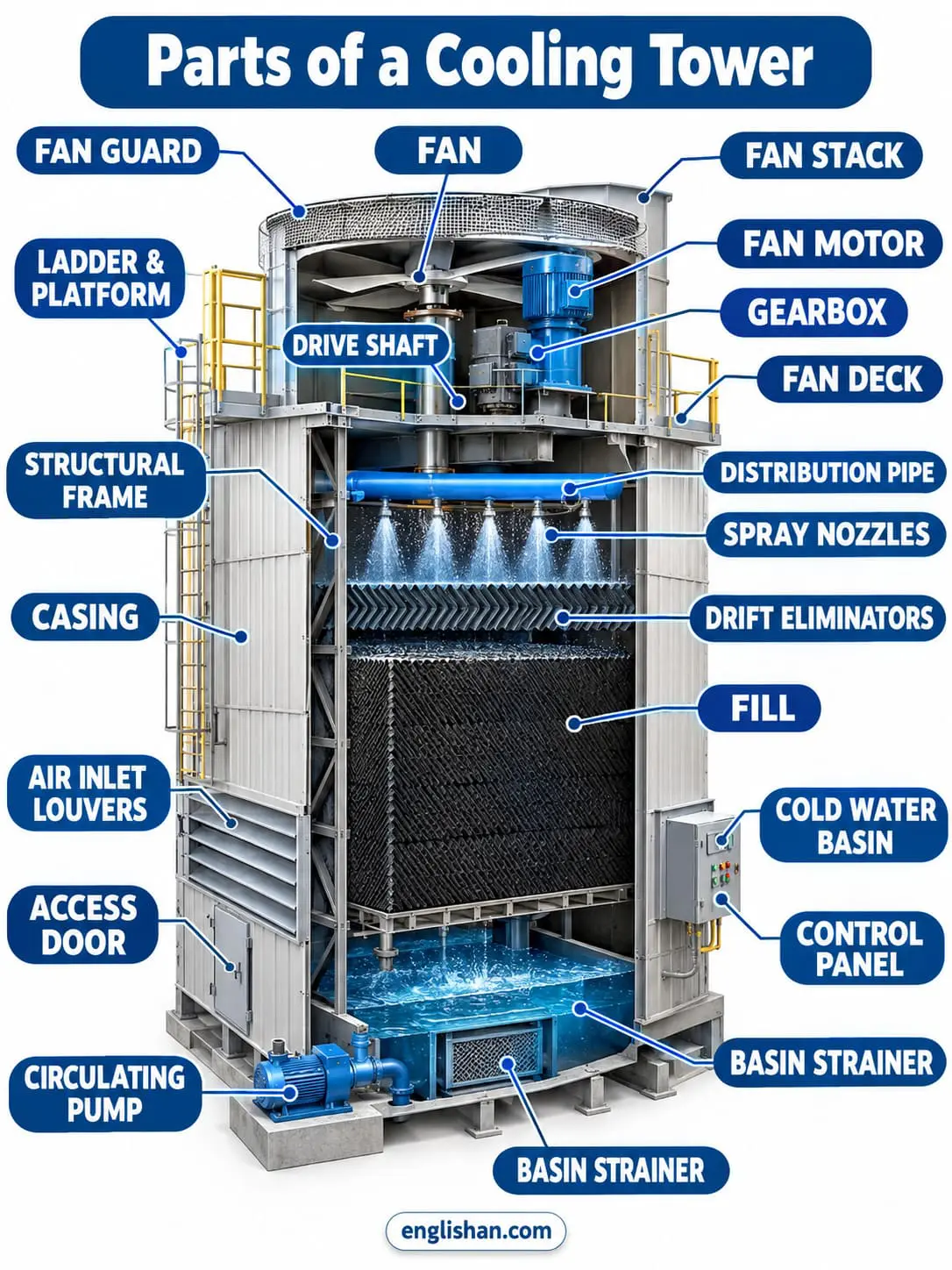
A mechanical draft cooling tower is a rectangular box on a concrete or steel base. Slanted louvers cover its sides, and an access door is cut into the casing. A ladder runs up one wall to the fan deck. A round fan stack rises from the deck, with a wire guard across its top. A basin under the fill collects the water, and a pump is beside it. These are the parts of a cooling tower on a counterflow unit.
| Part | Where you find it |
|---|---|
| 1. Structural frame | Steel or fiberglass posts and beams inside the walls |
| 2. Casing | Ribbed outer wall panels bolted to the frame |
| 3. Air inlet louvers | Slanted slats on the air intake faces |
| 4. Access door | Square hinged panel in the casing near the base |
| 5. Ladder and platform | Rungs on the outside wall and a railed deck on top |
| 6. Cold water basin | Shallow tank under the fill |
| 7. Basin strainer | Perforated screen over the basin outlet |
| 8. Make-up valve | Float valve on the basin wall |
| 9. Blowdown valve | Ball valve on the drain line from the basin |
| 10. Hot water basin | Shallow trough on top of a crossflow fill |
| 11. Distribution pipe | Header with branch arms over a counterflow fill |
| 12. Spray nozzles | Plastic cones screwed into the pipe or set in the basin floor |
| 13. Fill | Block of ridged plastic sheets in the middle of the tower |
| 14. Drift eliminators | Wavy blades between the nozzles and the fan |
| 15. Fan deck | Flat platform around the fan stack on top |
| 16. Fan stack | Round cylinder fixed on the fan deck |
| 17. Fan | Propeller with four to eight blades inside the stack |
| 18. Fan guard | Wire grid across the top of the stack |
| 19. Gearbox | Cast housing under the fan hub |
| 20. Drive shaft | Hollow tube between the motor and the gearbox |
| 21. Fan motor | Finned electric motor on the deck beside the stack |
| 22. Circulating pump | Horizontal pump on a steel base beside the basin |
| 23. Control panel | Gray steel box with a hinged door on the frame |
| 24. Variable frequency drive | Wall-mounted box with a keypad |
| 25. Hyperbolic shell | Curved concrete tower of a natural draft unit |
| 26. Coil bundle | Tube coil under the nozzles of a closed-circuit unit |
| 27. Centrifugal fan | Squirrel-cage blower at the base of a forced draft unit |
Main Parts of a Cooling Tower
Seven of the main cooling tower parts cool the water. The others support the tower, drive the fan, or control the pump.
- Fill: The block of ridged plastic sheets that spreads the water into thin films.
- Drift eliminators: The wavy blades that catch water droplets before the air leaves.
- Spray nozzles: The plastic cones that spray the water onto the fill.
- Fan: The propeller in the fan stack that pulls air through the tower.
- Casing: The outer wall panels that close the sides.
- Air inlet louvers: The slanted slats that admit the air.
- Cold water basin: The tank at the base that collects the cooled water.
The spare parts of a cooling tower are the wear parts: fill sheets, nozzles, drift eliminators, fan blades, and gearbox seals.
Cooling Tower Shell Parts
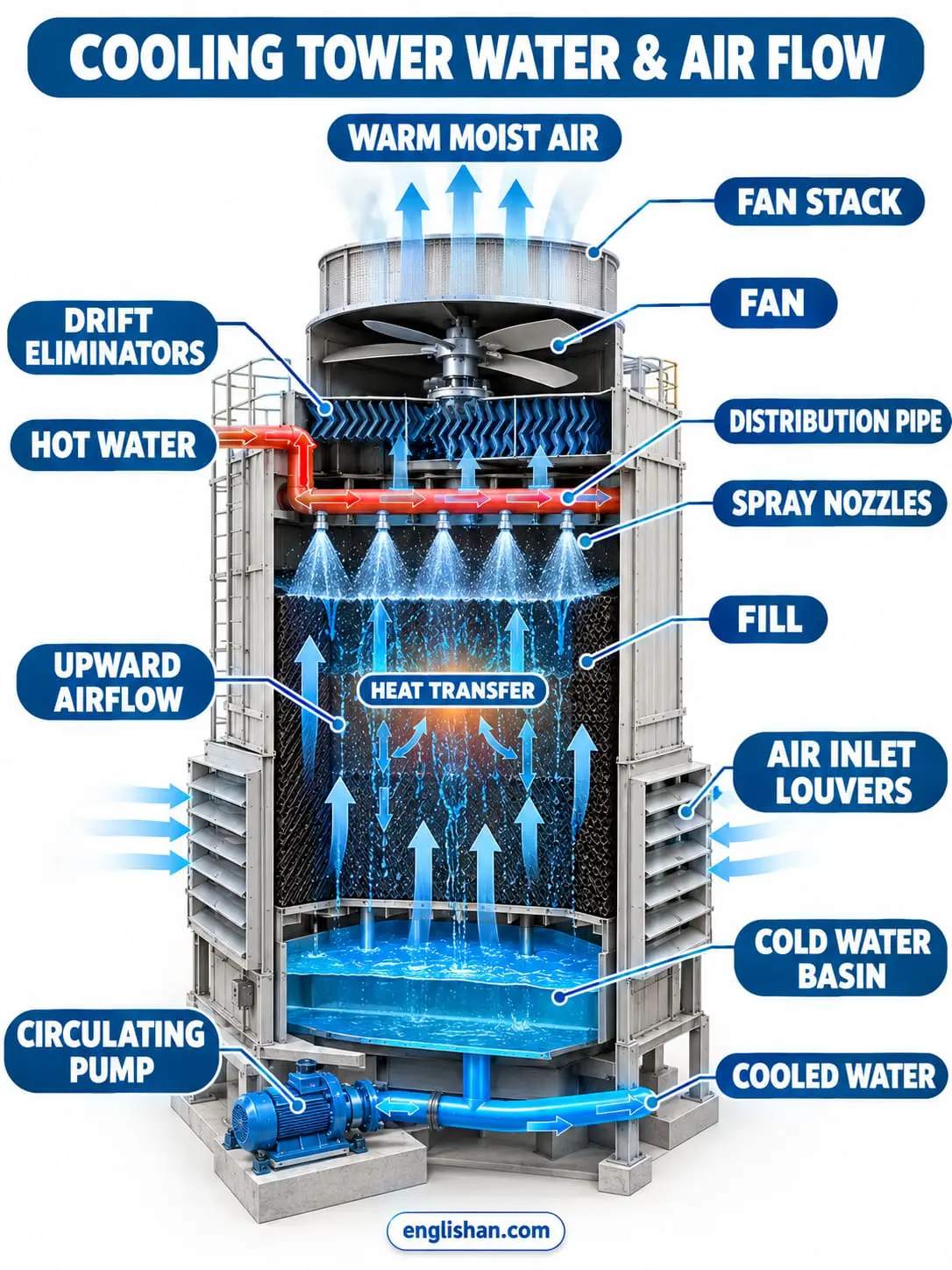
Nine of the parts of a cooling tower form the shell. They frame the tower, close its walls, and collect the water at the base.
Structural Frame
The structural frame is a grid of galvanized steel, stainless steel, or fiberglass posts and beams. It sets the tower height, 10 to 40 feet for a commercial cell. Older towers use redwood posts.
Casing
The casing is the outer wall of the tower, built of ribbed fiberglass panels or galvanized steel sheets bolted to the frame. It is gray, white, or tan. FRP means fiberglass-reinforced plastic, and wood towers use redwood boards. On a crossflow tower, it closes the two end walls.
Air Inlet Louvers
The air inlet louvers are slanted slats of PVC or fiberglass on the air intake faces of the tower. A counterflow tower has them low on the sides. Their slope stops water from splashing out.
Access Door
The access door is a hinged or bolted panel, about 2 feet square, in the casing near the base. It opens onto the basin and the lower fill. A latch or a ring of bolts closes it.
Ladder and Platform
The ladder is a galvanized steel or fiberglass ladder, 16 inches wide, bolted to the outside wall. A safety cage circles it on towers taller than 20 feet. A platform with a 42-inch railing is fixed at the fan deck.
Cold Water Basin
The cold water basin is a shallow tank under the fill, 1 to 3 feet deep, of concrete, galvanized steel, or stainless steel. It collects the cooled water. An outlet at one end leads to the pump. Among the parts of a cooling tower, it is the base.
Basin Strainer
The basin strainer is a perforated stainless steel screen, box-shaped or conical, over the outlet in the basin. It stops leaves and debris. Its holes are about 1/8 inch wide.
Make-Up Valve
The make-up valve is a brass or plastic float valve, 1 to 2 inches wide, on the basin wall. A floating ball on an arm operates it. It opens the water line when the basin level falls.
Blowdown Valve
The blowdown valve is a bronze or PVC ball valve on a 1- to 2-inch drain line from the basin. Opening it sends some water to the sewer. On larger towers, a timer or a meter controls it.
Cooling Tower Fill Parts
Five of the parts of a cooling tower are packed into the middle layer. They spread the water and catch the drops.
Hot Water Basin
The hot water basin is a shallow trough, 6 to 12 inches deep, on top of the fill of a crossflow tower. Its floor is drilled with rows of holes or fitted with nozzles. A pipe from the return line fills it.
Distribution Pipe
The distribution pipe is a PVC or steel header, 6 to 12 inches wide, with branch arms over the fill of a counterflow tower. Nozzles are threaded into its underside. A flange joins it to the return line.
Spray Nozzles
The spray nozzles are polypropylene or brass cones, 2 to 4 inches wide. They are screwed into the distribution pipe or set in the basin floor. Each sprays a wide circle onto the fill. Some makers call them sprinkler heads.
Fill
The fill is a block of thin PVC sheets, 2 to 5 feet tall, packed in the middle of the tower. The sheets are ridged, black or gray, and spaced about 1/2 inch apart. Splash fill uses rows of slats or bars in place of sheets.
Drift Eliminators
The drift eliminators are rows of wavy PVC or fiberglass blades, spaced about 1 inch apart, between the nozzles and the fan. They catch water droplets in the moving air. They are white or gray.
Cooling Tower Fan Drive Parts
Seven of the parts of a cooling tower are on the top deck. They form the fan drive, the set that moves the air. These are the mechanical parts of a cooling tower.
Fan Deck
The fan deck is a flat platform of fiberglass or galvanized steel plate on top of the tower. It surrounds the fan stack. Its surface is ribbed for grip.
Fan Stack
The fan stack is a round cylinder of fiberglass, 3 to 8 feet tall, fixed on the fan deck over the fill. Its inside surface is smooth, and its inlet is flared. It houses the fan.
Fan
The fan is an axial propeller with four to eight blades of fiberglass or aluminum, 4 to 30 feet across. The blades are fixed to a central hub. It turns inside the stack with a gap of about 1 inch at the tips. Each blade has a root, a tip, and a clamp bolted to the hub. It resembles a large industrial electric fan.
Fan Guard
The fan guard is a welded galvanized wire grid across the top of the fan stack. Its openings are about 2 inches wide. It covers the fan opening.
Gearbox
The gearbox is a right-angle gear housing of cast iron or aluminum, about 2 feet wide, under the fan hub. It reduces the motor speed from 1,800 rpm to about 200 rpm at the fan. The housing has an oil sight glass, a vent, and a drain plug. Small towers use a belt or direct drive in its place.
Drive Shaft
The drive shaft is a hollow carbon fiber or steel tube, 1 to 6 feet long, with a flanged coupling at each end. It joins the motor to the gearbox.
Fan Motor
The fan motor is a totally enclosed electric motor, 5 to 200 horsepower on 460 volts, on the fan deck beside the stack. It is gray, blue, or green, with cooling fins on its casing.
Cooling Tower Pump and Control Parts
Four of the parts of a cooling tower are outside the tower body. They circulate the water, set the fan speed, and add protection.
- Circulating pump: A horizontal centrifugal pump of 5 to 100 horsepower, on a steel base beside the basin. Its parts are a volute casing, an impeller, a shaft seal, and a motor.
- Control panel: A gray steel box with a hinged door, fixed on the frame or a wall. It has the switches and lights for the pump and the fan.
- Variable frequency drive: A wall-mounted box with a keypad and a display that sets the fan motor speed.
- Accessories: A basin heater, a vibration switch, and a water level sensor, fitted on the basin and the fan deck.
Cooling Tower Types and Their Parts
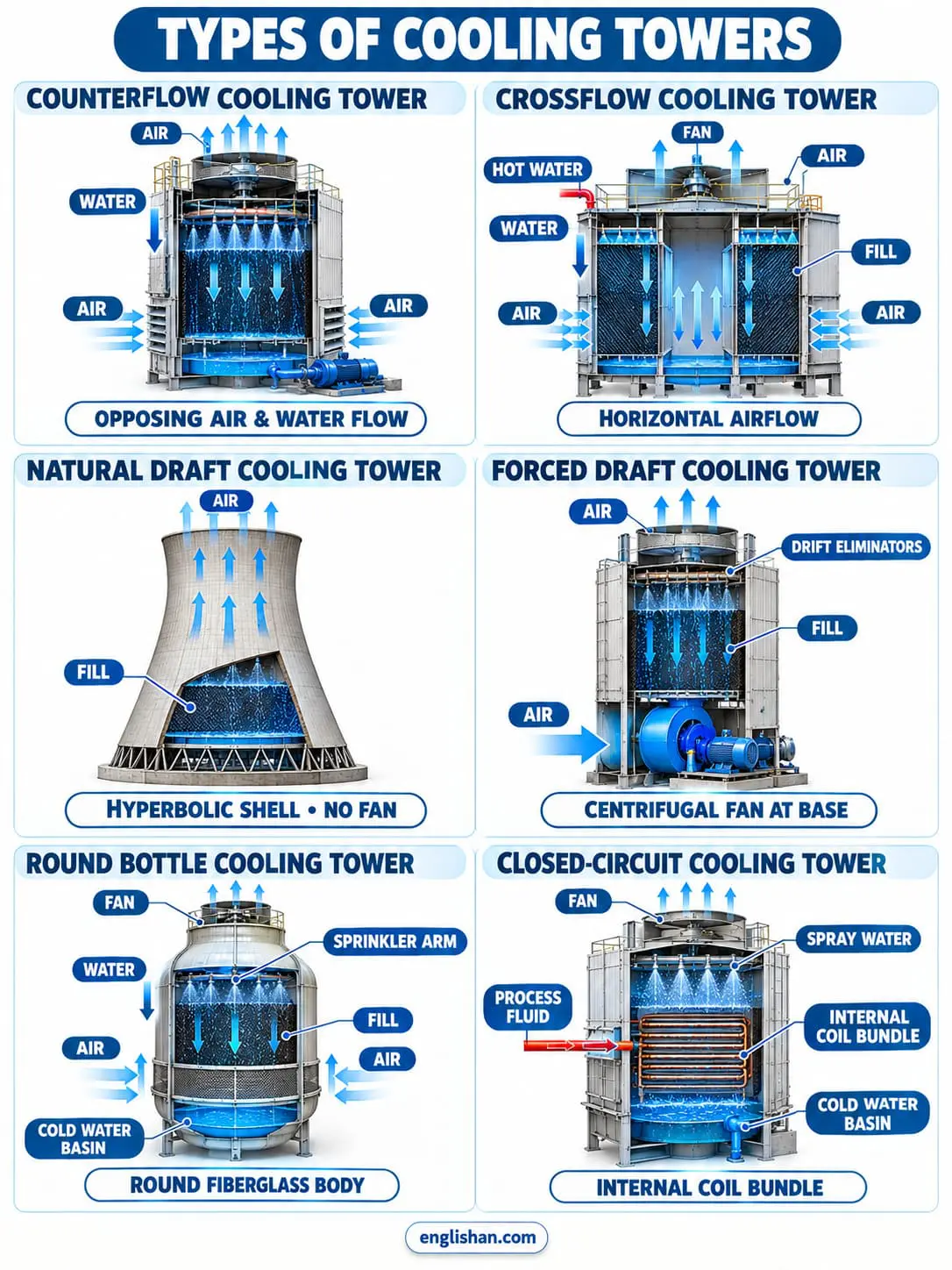
The parts of a cooling tower change with the type. Package towers ship in one piece, and field-erected towers are built on site. Counterflow, crossflow, and forced draft towers are mechanical draft designs, since a fan moves the air. Six types cover the common designs.
Counterflow Cooling Tower
The induced draft counterflow cooling tower is a tall box with louvers low on the sides and fill in the middle. A distribution pipe with nozzles is over the fill, and the fan is on top. A cell is 10 to 40 feet tall and 50 to 1,000 tons.
Crossflow Cooling Tower
The induced draft crossflow cooling tower has fill on both sides of a hollow center. A hot water basin covers the top of each fill bank. Louvers face the fill, and the fan on top pulls air through the hollow center.
Natural Draft Cooling Tower
The natural draft cooling tower is a hyperbolic concrete shell, 300 to 600 feet tall, at a power plant. Fill is packed inside its wide open base. It has no fan, and the shell narrows near the top.
Forced Draft Cooling Tower
The forced draft cooling tower is a compact box with a centrifugal fan and a motor at the base. The fan housing is a steel scroll case on the air inlet side. The fill and the drift eliminators are over it, with an open top.
Round Bottle Cooling Tower
The round bottle cooling tower is a small fiberglass cylinder, 3 to 10 feet tall, narrowed at the top like a bottle. Fill is packed inside, and a rotating sprinkler arm is fixed over it. A fan and a motor are on top, and a basin is at the base.
Closed-Circuit Cooling Tower
The closed-circuit cooling tower is a box with a coil bundle of steel or copper tubes under the spray nozzles. It is also called a fluid cooler. The process fluid stays inside the tubes. A fan, a basin, and a pump complete the parts.
FAQs
Q1. What are the parts of a cooling tower?
The parts of a cooling tower are the frame, casing, louvers, fill, drift eliminators, spray nozzles, cold water basin, fan, gearbox, and motor. The shell layer frames the tower. The fill layer spreads the water, and the fan drive moves the air.
Q2. What are the cooling tower parts and their functions?
The fill spreads the water into thin films, and the nozzles spray it onto the fill. The drift eliminators catch the droplets. The fan pulls the air through, and the basin collects the cooled water. The pump returns it to the system.
Q3. How does a cooling tower work?
A cooling tower cools water by evaporating a small part of it. The nozzles spray the warm water over the fill, and the fan pulls air through the fill. The cooled water drops into the basin and returns to the chiller or plant.
Q4. What are the parts of a cooling tower fan?
A cooling tower fan has a propeller with four to eight blades, a hub, a fan stack, and a wire guard. A gearbox, a drive shaft, and a motor drive it. The stack and the deck support the assembly.
Q5. Is a cooling tower part of HVAC?
Yes, a cooling tower is part of the HVAC system in buildings with a water-cooled chiller. It rejects the heat that the chiller removes from the building. An air-cooled air conditioner has no cooling tower.
Q6. What does the inside of a cooling tower look like?
The inside of a cooling tower has a block of ridged plastic fill in the middle. Nozzles are over it, and a basin is under it. The internal parts of a cooling tower are the fill, the nozzles or hot water basin, the drift eliminators, and the basin.
Q7. What are the types of cooling towers?
The types of cooling towers are counterflow, crossflow, natural draft, forced draft, round bottle, and closed-circuit. Counterflow and crossflow towers use an induced draft fan on top. Natural draft towers use a tall hyperbolic shell and no fan.
You May Also Like
- Parts of an Air Conditioner
- Parts of an Air Cooler
- Parts of an Electric Fan
- Parts of a Refrigerator
- Parts of a Water Heater
