

A pressure cooker is a heavy pot with a lid that clamps on tight and will not come off while steam is trapped inside. A rubber ring around the lid edge closes every gap. One small opening on top lets steam out in a controlled way, and two more open only if something goes wrong.
Nearly every part of a pressure cooker belongs to one of those two groups. Some parts close the pot tight, and the rest let the pressure out again.
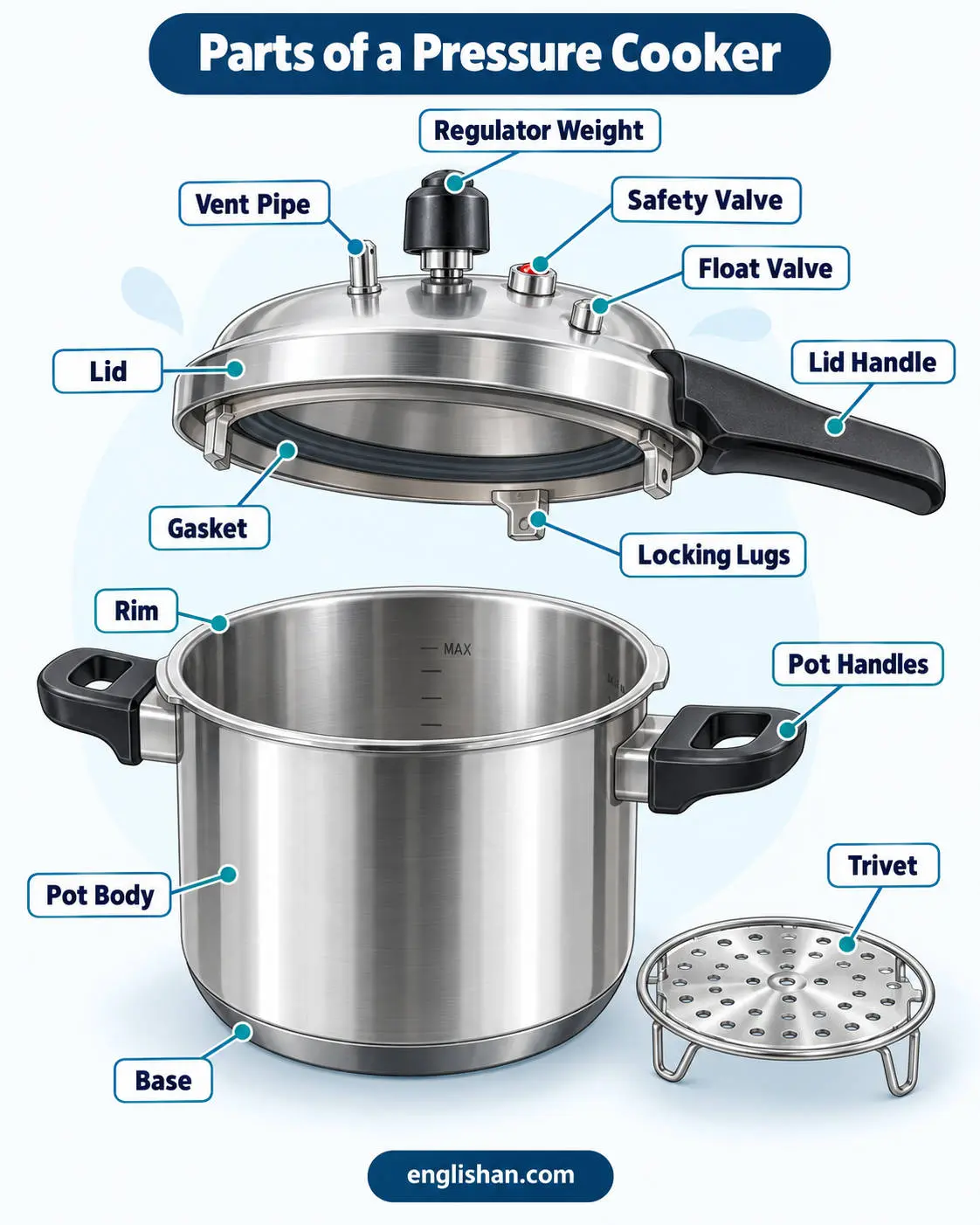
Parts of a Pressure Cooker Labeled
The pot holds the food and the lid locks onto it. A gasket fills the join between them, and locking lugs hold the lid against the push of the steam. On top of the lid, a weight or a spring valve sets the pressure. A safety valve and a float valve cover the faults.
| Part | Where you find it |
|---|---|
| 1. Pot body | The pan itself, holding the food |
| 2. Base | Thick disc under the pot |
| 3. Pot handles | Long handle and helper grip |
| 4. Rim | Top edge the lid meets |
| 5. Lid | Cover that locks onto the pot |
| 6. Lid handle | Grip used to turn the lid on |
| 7. Gasket | Rubber ring under the lid edge |
| 8. Locking lugs | Tabs that grip the pot rim |
| 9. Vent pipe | Short tube through the lid |
| 10. Regulator weight | Metal cap over the vent pipe |
| 11. Spring valve | Sprung version of the regulator |
| 12. Safety valve | Backup vent in the lid |
| 13. Overpressure plug | Rubber plug that blows out |
| 14. Float valve | Pin that rises with pressure |
| 15. Lid interlock | Catch that stops the lid turning |
| 16. Anti-block shield | Cap guarding the vent from food |
| 17. Steam release handle | Switch venting an electric model |
| 18. Inner pot | Removable bowl in an electric cooker |
| 19. Heating element | Coil under the inner pot |
| 20. Control panel | Buttons and display on the front |
| 21. Condensation cup | Small cup clipped to the back |
| 22. Trivet | Wire rack for the food |
| 23. Steamer basket | Perforated bowl above the water |
The Pot and Its Lid
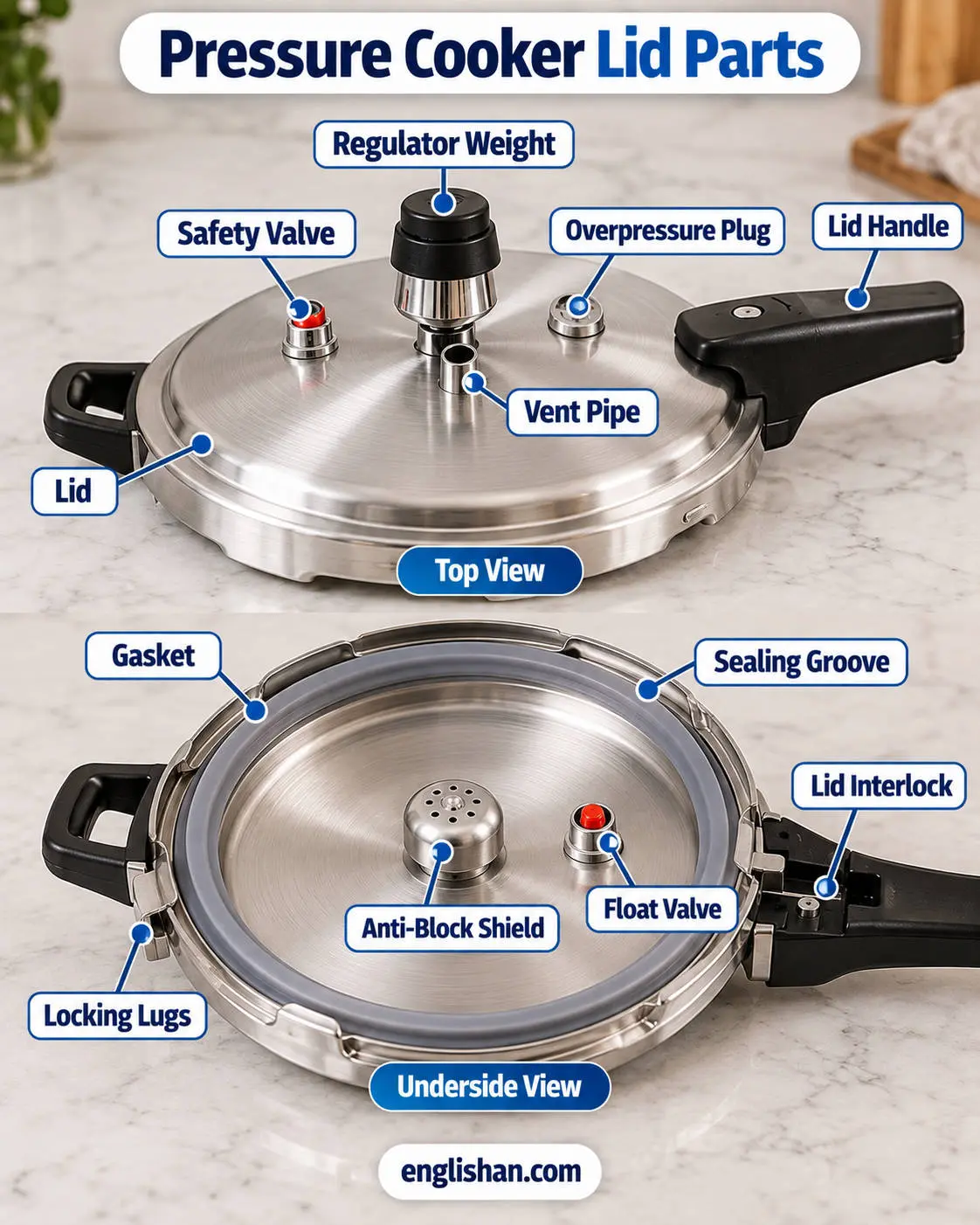
These parts of a pressure cooker are the ones a cook washes after every meal. Both are built far heavier than the walls of an ordinary pan.
Pot Body
A pressure cooker’s pot body is the pan that takes the food and the water. Its walls are thicker than a saucepan’s because the steam inside pushes outward on every surface. Most pots are stainless steel for that strength, while aluminium heats faster and dents more easily.
Base
Under the pot, a thick disc of metal forms the base. Many cookers sandwich aluminium or copper between two layers of steel. That core spreads the heat instead of letting one hot ring scorch the food. A thin base is the reason a cheap cooker burns rice.
Pot Handles
Two grips are riveted to the pot: a long handle on one side and a short helper grip on the other. Both are riveted rather than screwed, since a screw would work loose under repeated heating. A full cooker is heavy enough that the second grip earns its place at the sink.
Lid
The lid is heavy, locks onto the pot, and carries almost every working part. Lids close in one of two ways. A bayonet lid drops inside the rim and turns until its lugs catch. A clamp lid presses down instead, while a lever pulls the edges tight.
Lid Handle
The lid handle is the grip you twist the cover into place with. On most cookers it lines up with the pot handle once the lid is locked, which gives a quick check before the heat goes on. Find it out of line and the lugs have not caught.
The Sealing Parts
Nothing else on the cooker counts if the pot leaks. Three parts of a pressure cooker close every gap between lid and pan.
Gasket
A gasket of rubber or silicone fits into the rim of the lid, and it is also called the sealing ring. Steam pushes it outward against the pot wall, so the harder the cooker runs, the tighter that ring presses. Rubber hardens with age and loses its grip, which is why a gasket is replaced every year or two.
Sealing Groove
Inside the lid rim, a channel called the sealing groove takes that gasket. Food trapped in that groove ruins the fit and lets steam whistle out sideways. Washing that groove after every meal is the step most owners skip.
Locking Lugs
Locking lugs are the tabs around the lid edge that catch under the pot rim. They take the full push of the steam, which reaches hundreds of pounds of force across a lid that size. Bent or worn lugs are a reason to retire a cooker rather than repair it.
Parts That Control the Pressure
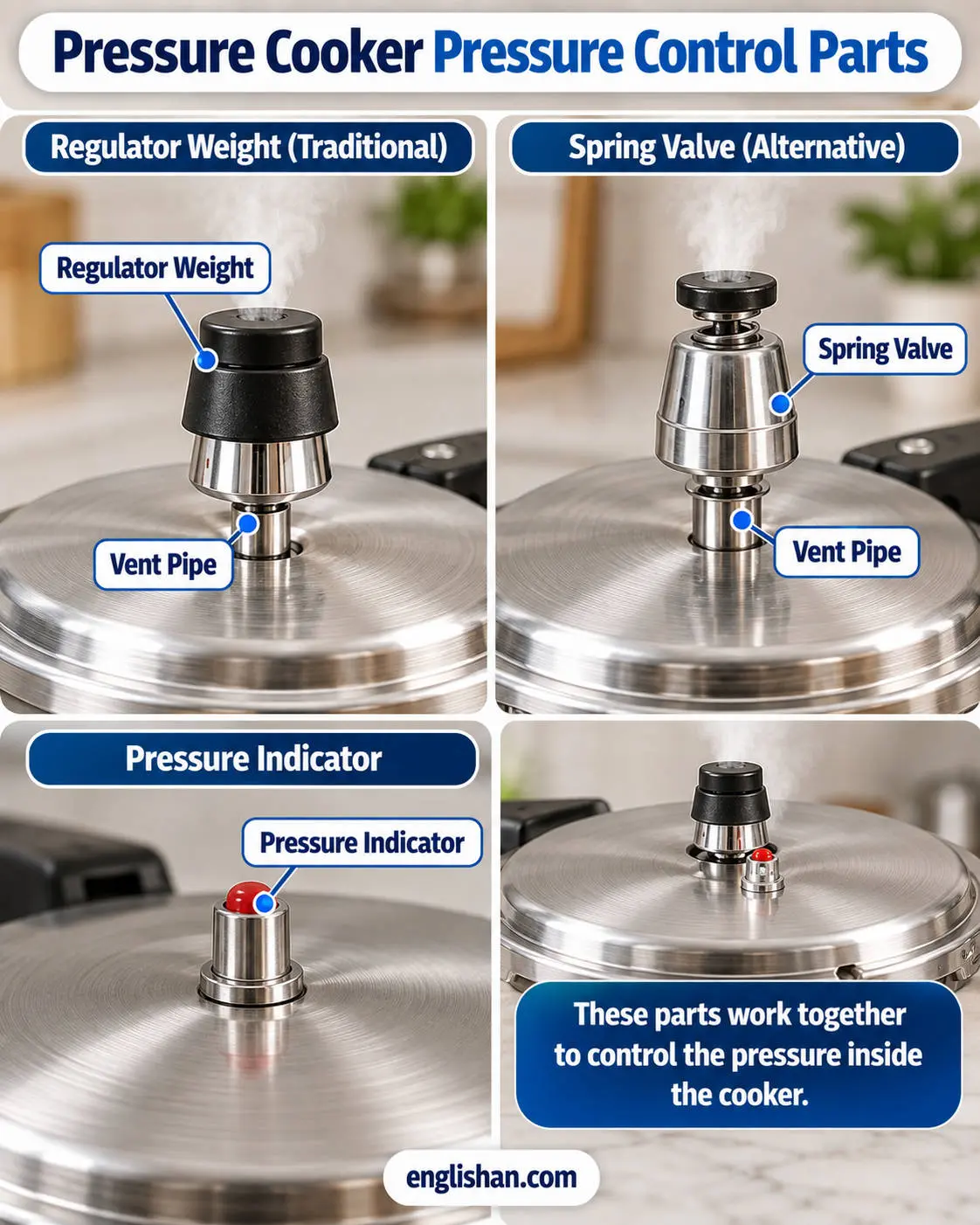
One opening in the lid decides how much pressure builds up, and these parts of a pressure cooker all work through it.
Vent Pipe
A short metal tube through the top of the lid, the vent pipe, lets the steam out. Its bore is narrow, so a grain of rice or a split lentil skin will plug it. Look through the pipe before every use, and poke it out if daylight does not show.
Regulator Weight
Over that vent pipe drops the regulator weight, a metal cap. Steam lifts it once the pressure underneath grows strong enough, and the weight rocks and hisses as it bleeds off the excess. Most weights are set for 15 psi, which is the pressure nearly every recipe assumes.
Spring Valve
A spring valve replaces the weight on many modern cookers. Pressure pushes a piston up against a spring inside the housing, and a coloured indicator rises as it climbs. Spring cookers run quietly and let you pick a lower pressure, though a weight washes more easily.
Pressure Indicator
The pressure indicator is a coloured pin or ring showing how far the pressure has risen. Two rings showing means full pressure on many European cookers, and one ring means the lower setting. Reading the rings saves guessing from the hiss of the vent.
The Safety Parts
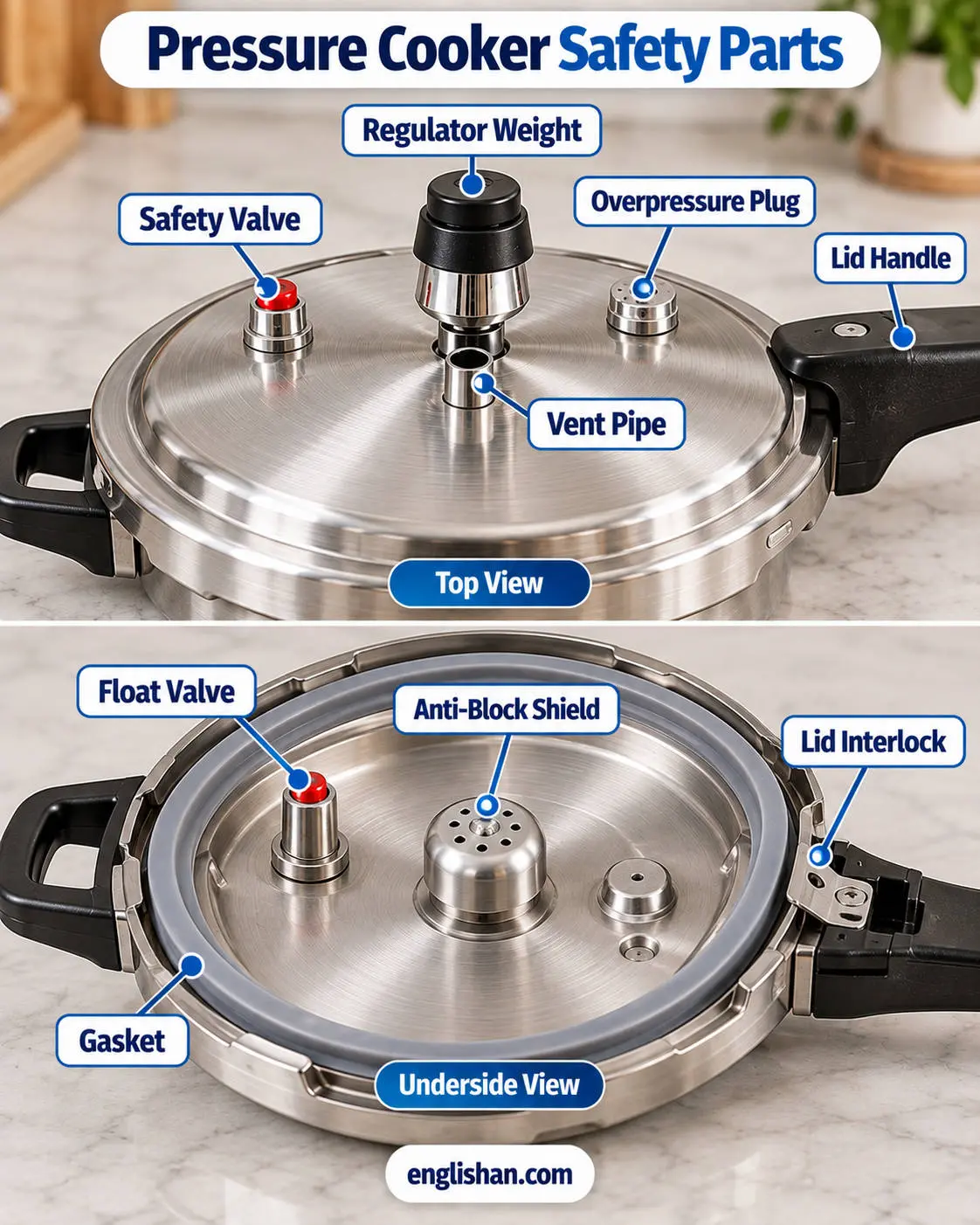
Every pressure cooker carries backups for the moment the main vent fails. These parts of a pressure cooker exist for a blockage that should never happen.
Safety Valve
A safety valve opens the steam a second way out, held shut by a spring until the pressure climbs too high. A clogged vent pipe forces the steam here instead, and the valve opens with a sharp hiss. The valve reseats itself once the pressure inside has dropped.
Overpressure Plug
An overpressure plug is fitted through the lid as a last resort, in rubber or soft metal. Heat and pressure push it out of its hole, which dumps the steam in one burst. A blown plug is replaced before the cooker is used again.
Float Valve
Near the lid handle, a small pin called the float valve rises once pressure builds. Seeing that pin raised means the cooker has closed up and is working. It also bars the lid, so the pin has to drop before the cooker will open.
Lid Interlock
A lid interlock jams the lid shut while steam is trapped inside. Older cookers had none, and opening one under pressure threw boiling contents across the kitchen. The interlock frees the lid only after the float valve has dropped.
Anti-Block Shield
An anti-block shield clips over the vent opening inside the lid. Foam from beans or rice hits the shield rather than the pipe, so the vent stays open. It pulls off for washing, and plenty of them vanish down the sink.
Parts of an Electric Pressure Cooker
An electric cooker adds its own heat source and its own controls, so several parts of a pressure cooker change shape or disappear.
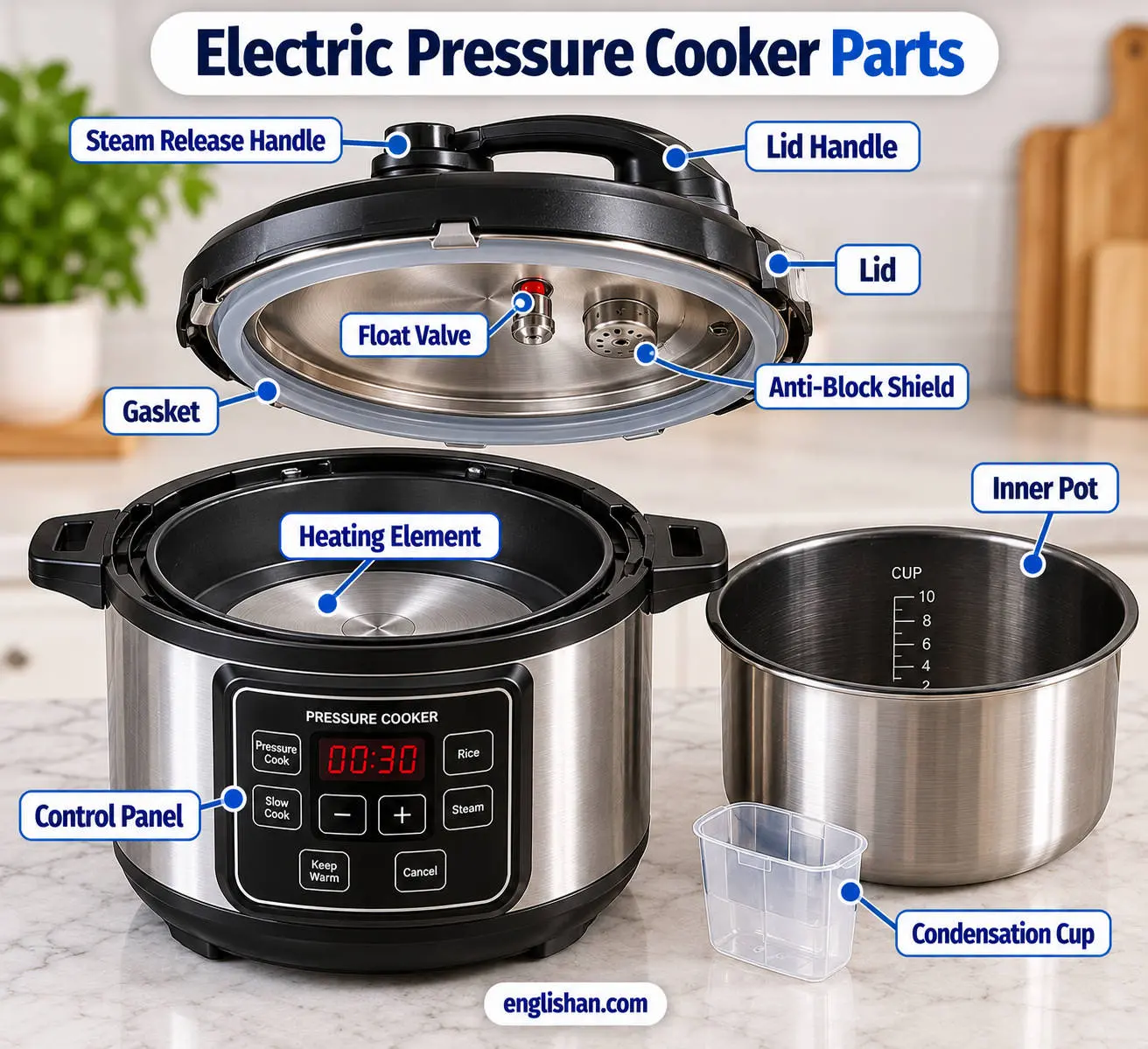
Inner Pot
The inner pot is a removable stainless bowl, and the food goes into it. Taking it out leaves the housing dry, and the bowl washes in the sink like any pan. Food never goes into the outer housing under any circumstances.
Heating Element
Under that bowl, a heating coil warms it from below. A sensor beside it reads the base temperature and switches the coil on and off. That is how the cooker keeps one pressure without a flame to adjust.
Control Panel
Buttons and a small display on the front make up the control panel. Programmes on it set a time and a pressure rather than a temperature. Pressure cooking, slow cooking, sautéing, and keeping food warm are the settings nearly every model carries.
Steam Release Handle
A steam release handle on the lid vents the cooker by hand. Flicking it to venting opens the valve and sends out a jet of steam, which is the quick release. Leaving it shut lets the pressure fall slowly instead, which is the natural release.
Condensation Cup
Clipped to the back of the housing, a small plastic cup catches condensation. Steam that collects in the lid rim drains into it rather than running down the outside. Emptying it takes a moment and stops a puddle on the counter.
What Goes Inside the Pot
Two more parts of a pressure cooker keep food out of the water, and both come with most cookers.
Trivet
A trivet is the wire rack that keeps food above the water in the bottom of the pot. Steam circulates underneath, so a dish on the trivet cooks in steam rather than boiling in liquid. Most trivets have handles that fold up for lifting a hot dish out.
Steamer Basket
The steamer basket is a perforated bowl that raises vegetables above the water line. Holes around the sides and base let the steam through from every direction. Basket and trivet do similar work, though the basket suits loose food and the trivet suits a dish or a whole cut of meat.
FAQs
Q1. What are the parts of a pressure cooker called?
The parts of a pressure cooker are the pot body with its base and handles, and the lid that locks onto it. The lid carries the gasket, the locking lugs, the vent pipe with its regulator weight, a safety valve, and a float valve. Electric models add an inner pot, a heating element, and a control panel.
Q2. What are the parts of a pressure cooker lid?
A pressure cooker lid carries the gasket in its rim, the locking lugs around the edge, and the lid handle. Through the lid pass the vent pipe with its weight or spring valve, the safety valve, the float valve, and the anti-block shield. An electric lid adds a steam release handle beside the float valve.
Q3. What is the weight on top of a pressure cooker for?
The weight sets the pressure inside the pot. Steam raises it once the pressure below grows strong enough, and the weight rocks and hisses while it bleeds the excess away. Most are made for 15 psi, the figure nearly every recipe assumes.
Q4. What is the gasket in a pressure cooker?
The gasket is the rubber or silicone ring that seals the join between the lid and the pot, also called the sealing ring. Steam presses it against the pot wall, so the fit tightens as the pressure climbs. Replace it every year or two, since old rubber hardens and leaks.
Q5. What stops a pressure cooker exploding?
Three separate parts guard against it. The safety valve opens if the vent pipe clogs, and the overpressure plug blows out if that valve fails too. The lid interlock jams the lid shut while pressure remains inside.
Q6. What are the parts of an electric pressure cooker?
An electric pressure cooker has an outer housing with a heating element and a control panel, and a removable inner pot for the food. Its lid carries a gasket, a float valve, an anti-block shield, and a steam release handle. A condensation cup clips to the back of the housing.
Q7. What is the pin that pops up on a pressure cooker?
That pin is the float valve, and it rises once pressure has built inside the pot. Seeing that pin raised means the cooker has closed up. It drops again as the pressure falls, and only then will the lid turn.
You May Also Like