

An oven is an insulated steel box with a hinged glass door in front and a bake element in the floor. A broil element runs across the ceiling, and racks slide into the side walls.
The parts of an oven fall on seven faces. Those are the ceiling, floor, back wall, side walls, door, control panel, and cooktop.
Oven Parts Labeled With Their Names
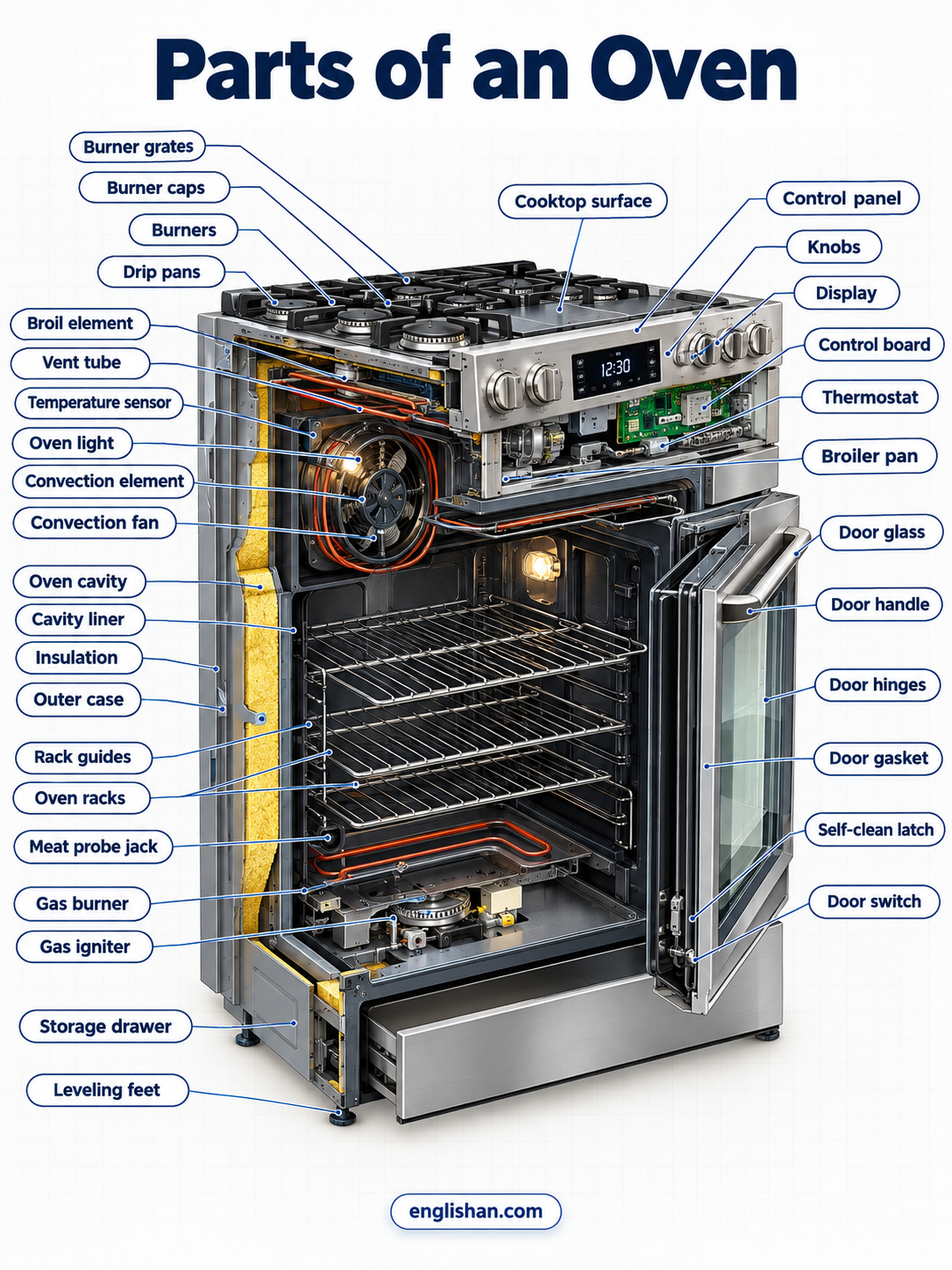
Behind the glass door is the cavity, a speckled black or gray enameled box. A broil element is bolted to the ceiling, next to a small vent tube, and a bake element lies in the floor. On the back wall are the convection fan, a thin temperature sensor, and the oven light. Wire racks slide onto rack guides pressed into the side walls, and the door has its own gasket, hinges, and handle. The knobs and display are on the control panel, on the backguard of a range or over the door of a wall oven. On top of the range, the cooktop has burners, caps, and grates. These are the parts of an oven, inside and out, in a gas or electric model.
| Part | Where you find it |
|---|---|
| 1. Oven cavity | Insulated steel box behind the door |
| 2. Cavity liner | Enamel coating on the inside of the cavity |
| 3. Insulation | Fiberglass blanket between the cavity and the case |
| 4. Outer case | Painted steel shell around the cavity |
| 5. Leveling feet | Screw-in feet under a freestanding range |
| 6. Broil element | Heating coil across the ceiling |
| 7. Vent tube | Metal duct at the top of the cavity |
| 8. Bake element | Heating coil along the floor |
| 9. Hidden bake plate | Enameled cover over a concealed element |
| 10. Gas burner | Slotted metal tube on the floor of a gas oven |
| 11. Gas igniter | Ceramic bar beside the burner |
| 12. Storage drawer | Pull-out drawer under the cavity |
| 13. Convection fan | Metal blade behind a cover on the back wall |
| 14. Convection element | Ring-shaped coil around the fan |
| 15. Temperature sensor | Thin metal rod at the top of the back wall |
| 16. Oven light | Bulb in a glass cover on the back wall |
| 17. Oven racks | Wire shelves on the side walls |
| 18. Rack guides | Pressed ribs or wire rails on each side wall |
| 19. Meat probe jack | Socket on the front edge of the cavity |
| 20. Broiler pan | Two-piece pan and grate that slides onto a rack |
| 21. Door glass | Tempered glass panes inside the door |
| 22. Door handle | Bar across the top of the door |
| 23. Door hinges | Spring-loaded arms at the bottom of the door |
| 24. Door gasket | Woven seal around the door opening |
| 25. Self-clean latch | Metal hook at the top of the door frame |
| 26. Door switch | Small plunger in the frame beside the door |
| 27. Control panel | Flat panel with the knobs and display |
| 28. Knobs | Round dials on the panel |
| 29. Display | Digital screen with the clock and settings |
| 30. Control board | Circuit board behind the panel |
| 31. Thermostat | Bulb-and-tube switch on a mechanical model |
| 32. Burners | Gas heads or electric coils on the cooktop |
| 33. Burner caps | Round metal discs on gas burner bases |
| 34. Burner grates | Cast-iron or steel frames over the burners |
| 35. Drip pans | Shallow pans under electric coil burners |
| 36. Cooktop surface | Flat top of the range, 30 inches wide |
Oven Cavity Parts
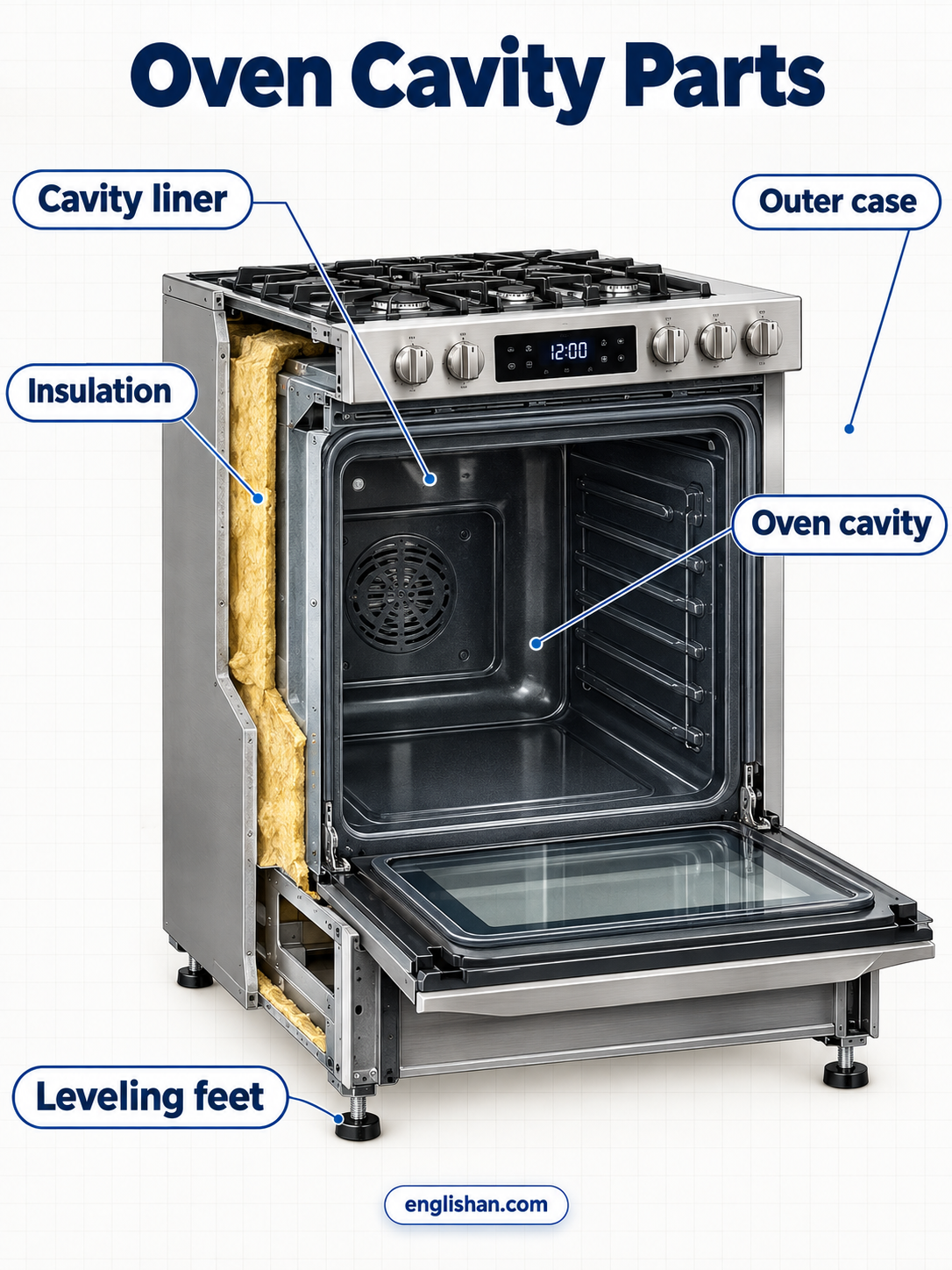
Five of the parts of an oven form its body: the cavity, the liner, the insulation, the case, and the feet. A 30-inch range has a cavity of 4.8 to 6.0 cubic feet.
Oven Cavity
The oven cavity is the largest of the parts of an oven. It is the box behind the door, formed from steel sheet folded and spot-welded at the corners. It is about 24 inches wide, 16 inches tall, and 18 inches deep in a 30-inch range. Its front is an open frame, and a lip around the frame meets the door gasket.
Cavity Liner
The cavity liner is the porcelain enamel fired onto the steel walls, ceiling, and floor. It is a glassy black or gray finish, flecked with white. Its surface is hard and slightly rough, and the corners are rounded.
Insulation
Between the cavity and the outer case is a blanket of fiberglass. The blanket is 1 to 2 inches thick and wraps around the cavity on all sides but the front. It is a fluffy yellow or white mat held by wire clips or foil tape. Wall ovens have an extra layer at the top.
Outer Case
The outer case is the painted or stainless steel shell around the cavity and insulation. Its sides are flat panels, and its back is a stamped sheet with holes for the wiring and the vent. A range case is 30 inches wide and 36 inches tall.
Leveling Feet
Two to four leveling feet are screwed into the base of a freestanding range, on threaded bolts. Their bases are round pads of steel or plastic. A wall oven has none, since it is fitted in a cabinet frame.
Oven Ceiling Parts
Two of the parts of an oven are fastened to the ceiling of the cavity: the broil element and the vent tube. Both are made of metal and run from front to back.
Broil Element
The broil element is a long heating coil bolted to the ceiling. It is bent into a loop or a zigzag that covers most of the ceiling’s width. A steel tube surrounds the coil, and two ceramic terminals join it to the wiring at the back. It glows orange, and its rating is about 3,000 watts. The broil element, also called the broiler, is the hottest part of an oven in broil mode, at 500 to 550°F.
Vent Tube
The vent tube is a short metal duct in the top of the cavity, near the back, with a small round or slotted opening. It runs to a vent under the control panel or behind the door. Its opening is 1 to 2 inches across.
Oven Floor Parts
The floor has up to five of the parts of an oven, depending on the fuel. Electric models have a bake element, and gas models have a burner and an igniter.
Bake Element
The bake element is the main heat source among the parts of an oven. It is a coil in a steel tube, bent into a wide loop along the floor of the cavity. It measures 3,000 to 3,500 watts on a full-size electric oven, and a pair of ceramic terminals join it to the wiring. Its tube is dark gray and turns red when hot. In bake mode, the lower rack level is the hottest part of the oven.
Hidden Bake Plate
The hidden bake plate is a flat enameled cover, laid over a concealed element in the floor. It is a smooth panel with a raised edge and two small locating tabs. A concealed element gives the floor a flush surface.
Gas Burner
The gas burner is a slotted steel tube under the floor of a gas oven, at the bottom rear. A row of small ports runs along its top, and a round air shutter is fixed at its front end. A thin metal baffle covers it and spreads the heat.
Gas Igniter
The gas igniter is a small ceramic bar with a metal bracket, mounted beside the burner tube at the rear. It is gray, about 3 inches long, and wired to the range with two thin leads. A silicon carbide tip glows orange when it is on.
Storage Drawer
The storage drawer is a shallow pull-out drawer of enameled or stainless steel under the cavity, on side glides. It is about 24 inches wide and 6 inches tall, with a handle across its front. This drawer is the bottom part of an oven, under the cavity floor. Gas ranges use it as a broiler drawer, and some electric ranges use it for storage or warming.
Oven Back Wall Parts
Four of the parts of an oven are on the back wall: the convection fan, the convection element, the temperature sensor, and the light. The rear panel is stamped with cover plates for each.
Convection Fan
Among the parts of an oven, the convection fan is a flat metal blade on a short shaft behind a perforated cover plate. It is near the center of the back wall. A motor is bolted to the outside of the case and turns the blade through the wall. Only convection models have it.
Convection Element
The convection element is a ring-shaped heating coil around the fan, on the back wall of the cavity. It is a steel tube, bent into a circle 6 to 8 inches across. Two ceramic terminals join it to the wiring on the back.
Temperature Sensor
The temperature sensor is a thin steel rod, about 6 inches long, that projects from the top of the back wall. Its base is a small plate with two screws, and a two-wire lead runs to the control board. The rod is about a quarter inch across.
Oven Light
The oven light is a 25- to 40-watt appliance bulb in a glass cover, on the back wall or the side wall. A metal socket is fixed behind the cover, and a wire clip or a threaded ring secures the glass. The bulb is heat-rated and has a small frosted or coated globe.
Oven Side Wall Parts
The two side walls have four of the parts of an oven: the racks, the rack guides, the probe jack, and the broiler pan. Everything on them is removable except the guides.
Oven Racks
Oven racks are the loose parts of an oven. They are flat wire shelves of chrome-plated or enameled steel, about 24 inches wide and 16 inches deep. A stop bend at each rear corner catches the rack before it leaves the cavity. Most ovens ship with two or three racks.
Rack Guides
Rack guides are the pressed ribs or wire rails on each side wall, five to seven pairs, spaced about 1.5 inches apart. Ribs are stamped into the enamel, and wire guides are welded to a steel frame. Each pair is numbered by position from the bottom.
Meat Probe Jack
The meat probe jack is a small socket in the front frame of the cavity, near the top corner. It is a round metal receptacle with two pin holes, and a plastic cover protects it. A cord of braided steel with a pointed tip plugs into it.
Broiler Pan
The broiler pan is a two-piece set: a shallow enameled pan and a slotted grate that is set on it. The set is about 16 by 12 inches, dark gray or black, and slides onto a rack. The slots are about a half inch wide.
Oven Door Parts
Six of the parts of an oven are on the door: the glass, the handle, the hinges, the gasket, the latch, and the switch. A door is 24 to 30 inches wide and drops down from the bottom.
Door Glass
The door glass is two to four panes of tempered glass, stacked inside a steel frame with small air gaps between them. The outer pane has a dark tint, and the inner panes are transparent. A panel of foil or fiberglass insulates the edges.
Door Handle
The door handle is a bar of stainless steel, painted steel, or plastic across the top of the door. Two screws through the front fix it, and its length is 20 to 30 inches. The shape is round, flat, or angled.
Door Hinges
Two hinge arms of stamped steel are bolted to the bottom edge of the door, each with a coil spring. A hook at the end of each arm slides into a slot on the range front. The hinges are hidden behind a trim strip.
Door Gasket
The door gasket is a woven rope of fiberglass, about a half inch thick, around the edge of the door opening. It is white or gray. Some ovens have only a partial gasket, across the top and sides, and a few have none.
Self-Clean Latch
The self-clean latch is a metal hook at the top of the door frame. It is a stamped steel arm, with a motor-driven or heat-driven lever behind it. A slot in the top of the door meets it.
Door Switch
The door switch is a small plunger switch, in the front frame beside the door. It has a red or black plastic button that the closed door presses in. Two wires run from it to the light and the fan.
Oven Control Parts
Five of the parts of an oven make up its controls: the panel, the knobs, the display, the board, and the thermostat. All five are behind or on the control panel.
Control Panel
The control panel is a flat plate of glass, brushed steel, or painted metal. It is fitted on the backguard of a range or over the door of a wall oven. It is 3 to 6 inches tall. Printed labels mark each knob and button.
Knobs
Knobs are the most handled of the parts of an oven. They are round dials of plastic or metal, one for each burner and one or two for the oven. Each has a flat side on its stem and a raised mark. A range has five to seven of them.
Display
The display is a digital screen of LED or LCD on the panel, 2 to 4 inches wide. It has segments or a dot matrix that show the clock and temperature. Touch keys are printed on the glass beside it.
Control Board
The control board is a green circuit board behind the panel, about 6 by 8 inches. It has relays, a microcontroller, and wire connectors. A ribbon cable joins it to the display.
Thermostat
The thermostat is a temperature switch in a mechanical oven, with a thin copper tube and a small metal bulb. The tube runs from the back of the knob to the bulb in the cavity. A fluid inside fills the bulb, and the switch is a small disc with two terminals.
Oven Top Parts
Five of the parts of an oven range are on the cooktop, the flat top of the case. They are the burners, the caps, the grates, the drip pans, and the surface.
Burners
Burners are the heat sources on the cooktop, five on a 30-inch range. A gas burner is a round base of aluminum or brass with a ring of small ports. An electric coil is a spiral steel tube, 6 or 8 inches across, and a smooth-top burner is a heating ring under glass.
Burner Caps
A burner cap is a round disc of enameled or brushed metal that covers the base of a gas burner. It is 2 to 4 inches across, in black or brass, and its flat top has a small lip. It centers on a pin at the middle of the base.
Burner Grates
The burner grates are the heavy frames over the burners, where the pots are placed. They are cast iron or steel with a black enamel finish. A range has two or three grates, and each frame has raised fingers around every burner.
Drip Pans
Drip pans are shallow round pans of chrome-plated or black steel under each electric coil. Each pan has a center hole for the coil terminals. A pan is 6 or 8 inches across and matches its burner.
Cooktop Surface
The cooktop surface is the flat top of the range, made of stainless steel, enameled steel, or black glass-ceramic. It is 30 inches wide and 25 inches deep. Gas models have raised burner wells, and glass models are flush.
Oven Parts FAQs
Q1. What are the parts of an oven called?
The parts of an oven are the cavity, liner, racks, bake element, broil element, door, and control panel. The inside parts of an oven also include the vent tube, temperature sensor, oven light, and door gasket. The inside of an oven is called the cavity.
Q2. What are the parts of an oven and their functions?
The bake element heats the floor and the broil element heats the ceiling. The convection fan moves the air, and the temperature sensor reads the heat. The racks support the pans, the gasket seals the door, and the knobs or display set the temperature.
Q3. What are the parts of an electric or gas oven?
An electric oven has a bake element, a broil element, and a temperature sensor. A gas oven swaps the bake element for a burner tube, an igniter, and a gas valve. Both share the racks, light, door with gasket, and controls.
Q4. What is the hottest part of an oven?
The hottest part of an oven is the broil element at the ceiling, which reaches 500 to 550°F in broil mode. In bake mode, the hottest part is the lower rack level near the bake element. In a gas oven, it is the floor over the burner. A convection fan evens out the heat.
Q5. What are the top and bottom parts of an oven called?
The top part inside an oven is the ceiling, with the broil element and the vent tube. The bottom part is the floor, with the bake element or the gas burner. Under the floor is a storage drawer or a broiler drawer.
Q6. What are the parts of an oven door?
An oven door has glass panes, a handle, two hinges, a gasket, and a latch. The panes are stacked in a steel frame, and the hinges secure the door at the bottom. A door switch in the frame beside the opening controls the light.
Q7. What are the parts of an oven top?
The oven top, also called the cooktop, has burners, burner caps, and grates where the pots are placed. Coil models add drip pans, and smooth-top models have a glass-ceramic surface over the burners. The knobs are on the front or the backguard.
You May Also Like
- Parts of a Kitchen
- Parts of a Refrigerator
- Parts of a Pressure Cooker
- Parts of a Grill
- Parts of a Kettle
- Parts of a Toaster
- Parts of a Microwave Oven