Roof water arrives at the eaves in a sheet. From there it has about two seconds to be caught, turned sideways, dropped down a pipe, and thrown well past the foundation. Twenty-six separate parts of a gutter system do that work on an ordinary house.
Most of them cost a few dollars each. A failed end cap or a loose hanger will still rot a fascia board long before anyone thinks about the gutters. The names below follow an aluminum K-style rain gutter, the kind on most American homes. British installers call the whole assembly guttering and change several of the names with it.
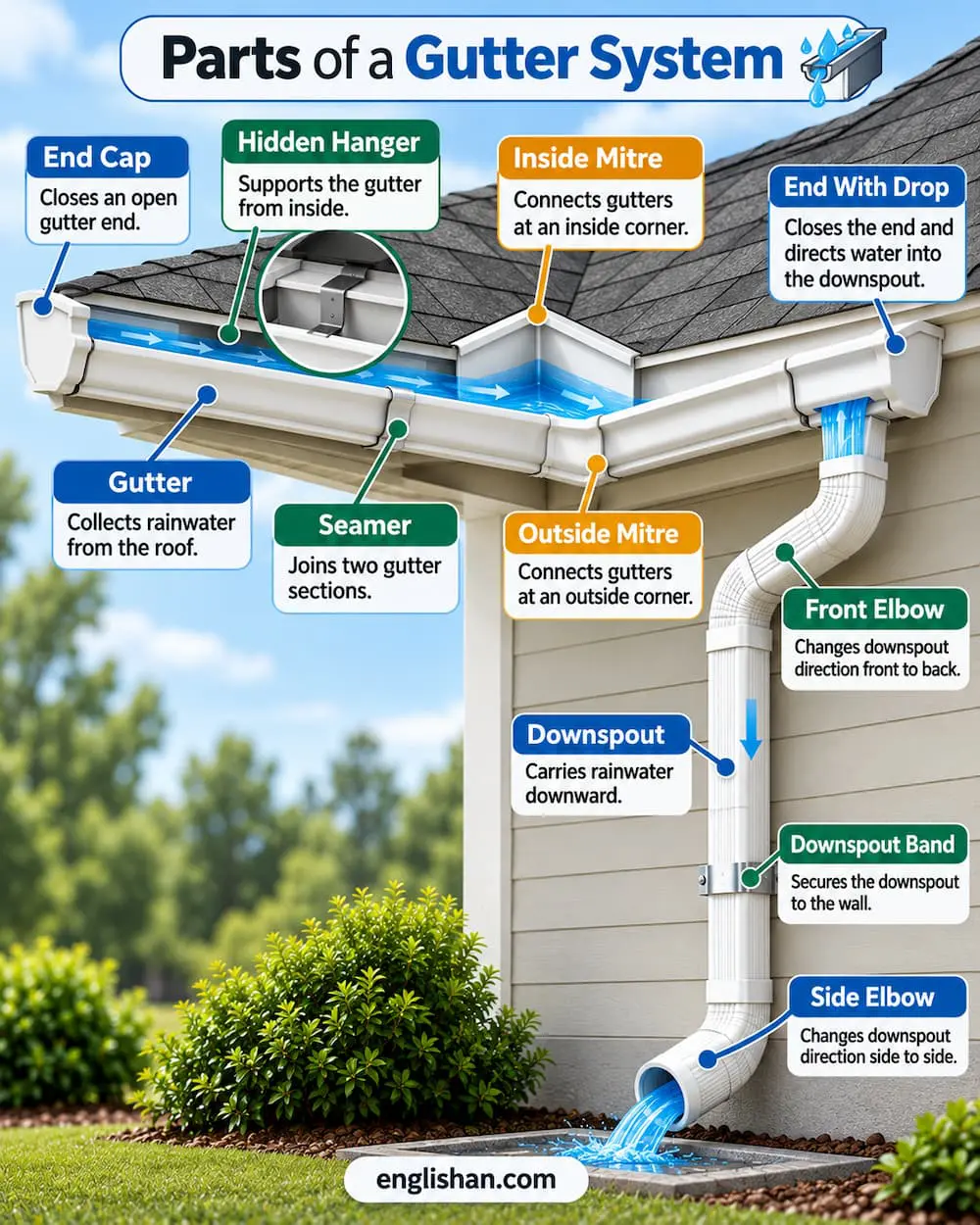
What Are the Parts of a Gutter System Called?
The trough along the roof edge is the gutter itself, held up by hangers screwed into the fascia. Miters take it around corners and end caps seal it at the ends. A drop outlet in its floor feeds the downspout, elbows steer that downspout to the wall and away again, and a splash block spreads the water at the bottom.
| Part | Where you find it |
|---|---|
| 1. Gutter trough | Along the roof edge, on the fascia |
| 2. Gutter face | Front wall of the trough |
| 3. Gutter lip | Rolled top edge of the face |
| 4. Back wall | Rear of the trough, against the fascia |
| 5. Seam | Joint between two trough sections |
| 6. Hidden hanger | Inside the trough, every 2 feet |
| 7. Spike and ferrule | Through the face on older systems |
| 8. Fascia bracket | Outside the trough on half-round runs |
| 9. Gutter wedge | Behind the hanger on angled fascia |
| 10. End cap | Closing each open end |
| 11. Outside miter | Where two runs meet at an outside corner |
| 12. Inside miter | Where two runs meet at an inside corner |
| 13. Drop outlet | Hole in the trough floor |
| 14. Downspout | Vertical pipe down the wall |
| 15. Elbow | Bend at the top and bottom of the pipe |
| 16. Downspout strap | Clamping the pipe to the wall |
| 17. Splash block | On the ground under the outlet |
| 18. Downspout extension | Pipe leading further from the wall |
| 19. Downspout adapter | Joint to an underground drain |
| 20. Underground drain | Buried line carrying water off |
| 21. Gutter guard | Over the trough opening |
| 22. Downspout strainer | In the drop outlet |
| 23. Splash guard | Inside the trough below a valley |
| 24. Fascia board | Board the whole system hangs on |
| 25. Drip edge | Roof flashing above the trough |
| 26. Soffit | Underside of the eave behind it |
The Gutter Trough and Its Parts
From the ground a trough looks like one strip of folded metal. The trade names each fold separately, since a leak is always described by the fold it started in. Everything here is visible from the drive, and a homeowner looking up at the roof edge sees these parts of a gutter system and little else.
Gutter Trough
Of all the parts of a gutter system, the trough is the one people mean when they say gutter. It is the open channel fixed along the roof edge, 5 or 6 inches wide on a domestic house. That channel is rolled from aluminum at 0.027 or 0.032 gauge on most houses, with copper and steel used on more expensive work. Installers hang it on a slope of about a quarter inch for every 10 feet. That fall is too slight to see from the ground, and it is enough to move standing water toward the outlet.
Gutter Face
Facing the street is the gutter face, the front wall of the trough and the only surface visible from the ground. On a K-style gutter the face is not flat: it curves in an ogee profile copied from the crown moulding used indoors, which is where the shape came from. K-style gutter parts are sized to that profile, so half-round fittings will not fit one. Half-round gutters show one smooth curved wall instead.
Gutter Lip
The gutter lip is the rolled or folded top edge of the face, turning back on itself along the whole run. That fold stiffens a thin strip of aluminum enough to stay straight across 30 feet, and hidden hangers clip under it. A lip bent out of shape by a ladder leaves the hangers with nothing to grip.
Back Wall
Behind the trough, its flat back wall presses against the fascia board. Its top edge rises higher than the front, so water sheeting off the roof would have to rise over the taller side to escape. Screws from the hangers pass through this wall into the fascia behind it.
Seam
A seam is the joint where two lengths of trough meet, sealed with gutter caulk and joined with a slip connector or rivets. Seamless gutters skip them entirely, since the trough is rolled to length on site from a coil, so the only joints left are at corners and ends. Every seam is a leak in waiting, which is why seamless runs took over the market.
Hardware That Holds the Gutter Up
A gutter supports none of its own weight. Fixing the trough to the house and setting the slope it drains on falls to the four fittings below.
Hidden Hanger
Hidden hangers are short metal brackets standing inside the trough, clipping under the front lip and screwing through the back wall into the fascia. They are the only parts of a gutter system doing structural work. Installers place one about every 2 feet along a run, tightening to 18 inches in snow country. Fitted that way, a hanger shows nothing from the ground, which is where the name came from. A trough sagging between two fixings has a hanger pulled loose behind it.
Spike and Ferrule
The older mounting method, a spike and ferrule, is still in place on plenty of houses. The ferrule is a metal tube standing inside the trough, and the spike is a long nail driven through the gutter face, through that tube, and into the fascia. Without the tube the nail would crush the trough as it tightened.
Temperature swings work a spike loose over the years. A gutter pulling away from the house is nearly always hanging on spikes rather than hangers.
Fascia Bracket
Fascia brackets are curved straps screwed to the fascia outside the trough, with the gutter dropped into them. Half-round systems depend on them, since a half-round trough has no square lip for a hidden hanger to grip. Each bracket has to go up before the trough drops into it.
Gutter Wedge
A gutter wedge is a small angled block fitted behind a hanger where the fascia board is not vertical. Older houses have fascia tilted with the roof pitch, and hanging a gutter flat against that tilt would pour water over the front edge. The wedge takes up the angle so the trough hangs level.
Corner and End Fittings
Three fittings work harder per inch than anything else on the roof edge. Where a run stops or changes direction, water leaves the trough unless one of them seals the gap. Every part in this group is sealed with caulk as well as fastened.
End Cap
An end cap is a stamped aluminum cover sealing the open end of a run, crimped over the profile and sealed behind. Those stamped profiles are handed, so a left cap will not fit a right end. Among the parts of a gutter system it is the smallest and the likeliest to drip. Once the caulk behind one dries out, the cap drips steadily onto whatever lies below, commonly a doorway or a path.
Outside Miter
Outside miters join two runs around an external corner of the house, the kind you see at the corner of a garage. Box miters arrive preformed as a whole corner, and the two runs slide into them. Every one of its four seams needs sealant, since a corner collects more water per minute than any straight run.
Inside Miter
An inside miter takes a run around an internal corner, where two roof planes meet in a valley above. Water arrives here in volume, especially in heavy rain, which makes the inside corner the first place a system overflows. Strip miters, thin sleeves covering the joint rather than replacing it, are the cheaper alternative for either corner.
Downspout Parts
Everything so far has moved water sideways. Four more parts of a gutter system take it down the wall.
Drop Outlet
The drop outlet joins the two halves of a gutter system. It is an opening cut into the floor of the trough, rimmed with a short collar that the downspout slips over. Its size has to match the downspout exactly, and pop rivets anchor it to the trough floor. A single outlet drains up to about 35 feet of gutter, so a long roof edge needs two.
Downspout
The downspout is the vertical pipe taking water down the wall, rectangular in shape and 2 by 3 inches on most houses. Larger roofs and wetter climates call for the 3 by 4 inch size. That larger size moves more than twice the water of the smaller one. Round downspouts are measured by diameter instead, and they pair with half-round troughs.
Elbow
An elbow is a short bent length of downspout. Two at the top bring the pipe back against the wall, and one or two at the bottom throw the water outward. A-style elbows bend across the broad face of a rectangular pipe, and B-style elbows bend across the narrow face. Those letters matter at the counter, since ordering the wrong one leaves a pipe that will not meet the wall.
Downspout Strap
Downspout straps are metal bands wrapping the pipe and screwing into the siding or masonry behind it, known also as pipe cleats. Straps go on about every 6 feet, and the top one takes the hardest load, since wind pushing on a full pipe pivots it there. Few parts of a gutter system fail as loudly. A downspout swinging free in a storm tears the outlet out of the trough.
Where the Water Lands
Water leaving the bottom elbow still has to get away from the house, and the last few feet are where most foundations are lost.
Splash Block
A splash block is a concrete or plastic pad about 2 feet long, laid on the ground under the downspout with its channel sloping away from the wall. Water hits it and spreads instead of digging a hole in the soil. Splash blocks are the cheapest parts of a gutter system, and a missing one costs a foundation. Concrete versions last for decades, while plastic ones drift out of position once the soil settles.
Downspout Extension
Downspout extensions are lengths of pipe added to the bottom elbow, taking water 4 to 6 feet out from the wall. Hinged and roll-out versions fold away for mowing. Anything shorter than about 4 feet leaves water soaking the backfill soil against the foundation, which is exactly the soil that settles.
Downspout Adapter
A downspout adapter is the transition fitting joining a rectangular downspout to a round drainage pipe. It clamps over the pipe end and steps down to a smooth round socket. Without one, the connection is taped or forced, and it separates the first time the line chokes.
Underground Drain
An underground drain is the buried pipe taking water from the adapter well away from the house. It ends at a pop-up emitter in the lawn or at a dry well. Solid pipe moves water faster than perforated pipe, so a drain meant to carry roof water away uses solid line. Roots and silt close these lines over the years, and a choked drain backs water up the downspout.
Add-Ons Fitted to the System
Nothing in this group comes as standard, and each part answers a problem the plain system leaves open.
Gutter Guard
Gutter guards are screens, mesh panels, or curved hoods fitted over the trough opening, keeping leaves out while letting water in. Micro-mesh panels catch fine debris such as pine needles, and reverse-curve designs let water wrap over a lip while leaves fall past. No guard ends cleaning altogether, since debris still gathers on top of one. Of all the parts of a gutter system, it is the only one bought to cut maintenance rather than to move water.
Downspout Strainer
The downspout strainer is a wire or plastic basket dropped into the drop outlet, catching leaves before they enter the pipe. Clearing a strainer is a moment’s work, while clearing a choked downspout needs a hose, a rod, and a dismantled elbow. On a roof under trees a strainer clogs within a season, and emptying one is a short job on a ladder.
Splash Guard
Splash guards are small metal plates fastened inside the trough at an inside corner, below a roof valley. Water coming down a valley arrives in a jet fast enough to shoot straight over the front lip, and the guard turns it back into the trough. A stained streak on the wall below one corner is what it exists to prevent.
Roofline Parts the Gutter Depends On
Three parts belong to the roof rather than the gutter. Every other part of a gutter system is either bolted to them or fed by them.
Fascia Board
The fascia board is the flat board fixed along the roof edge, capping the ends of the rafters. Every hanger, spike, and bracket screws into it, so the parts of a gutter system above all hang on this one board. Water from a leaking gutter soaks that board first, and soft fascia is the reason many gutter jobs become carpentry.
Drip Edge
Tucked under the roof shingles at the eave, the drip edge is L-shaped metal flashing with its lower leg bent out over the trough. Roof water travels down the shingles, crosses the flashing, and drops into the gutter rather than curling back under the roof edge. Codes require it on new roofs.
Soffit
The soffit is the panel finishing the underside of the eave, between the fascia and the wall. Vents in it let air into the roof space, and those vents are where water gets in when an overflowing gutter spills backward. Peeling soffit paint below a gutter is a sign of a blockage directly above it.
FAQs
Q1. What are the parts of a roof gutter system called?
The parts of a gutter system start with the trough and the hangers holding it to the fascia. End caps seal its ends, miters take it around corners, and a drop outlet opens through its floor. Below that come the downspout with its elbows and straps, then a splash block on the ground. Guards, strainers, and splash guards are added to that core set, and catalogs list all of them together as gutter parts.
Q2. What are the parts of a downspout called?
A downspout is made up of the pipe itself and an elbow at each end. The top elbow connects it to the drop outlet, and the bottom one turns water away from the wall. Straps hold the pipe against the house between them. An extension or splash block moves the water on from there.
Q3. What holds a gutter to the house?
Hidden hangers hold most gutters, clipping under the front lip and screwing through the back wall into the fascia board. Older systems use spikes driven through a ferrule, and half-round gutters rest in fascia brackets mounted outside the trough.
Q4. What is the hole in the gutter called?
The hole in the bottom of a gutter is the drop outlet, and it is where water leaves the trough for the downspout. A strainer drops into it on many houses to keep leaves out of the pipe below.
Q5. What is the difference between a gutter and a downspout?
Of the parts of a gutter system, these two carry the most water. The gutter is the horizontal trough along the roof edge, and the downspout is the vertical pipe taking water from it to the ground. Water travels along the gutter to a drop outlet, then falls down the downspout.
Q6. What is the corner piece of a gutter called?
A miter is the corner fitting joining two gutter runs, with outside miters for external corners and inside miters for internal ones. Box miters are preformed corners, and strip miters are thin sleeves covering the joint.
Q7. Is the fascia part of the gutter system?
The fascia board belongs to the roof rather than the gutter, though every hanger screws into it and the whole system hangs from it. Rotten fascia holds no fastener, so gutter work on an older house starts with replacing that board.
You May Also Like