A wind generator is a tall tower with three long blades on a hub at the top. An electric generator is enclosed in a housing directly behind the hub. Utilities and US manufacturers call the same machine a wind turbine or a wind power generator.
The parts of a wind generator follow one vertical line, from the rotor at the top to the ground equipment at the base.
Wind Generator Diagram With Parts Named
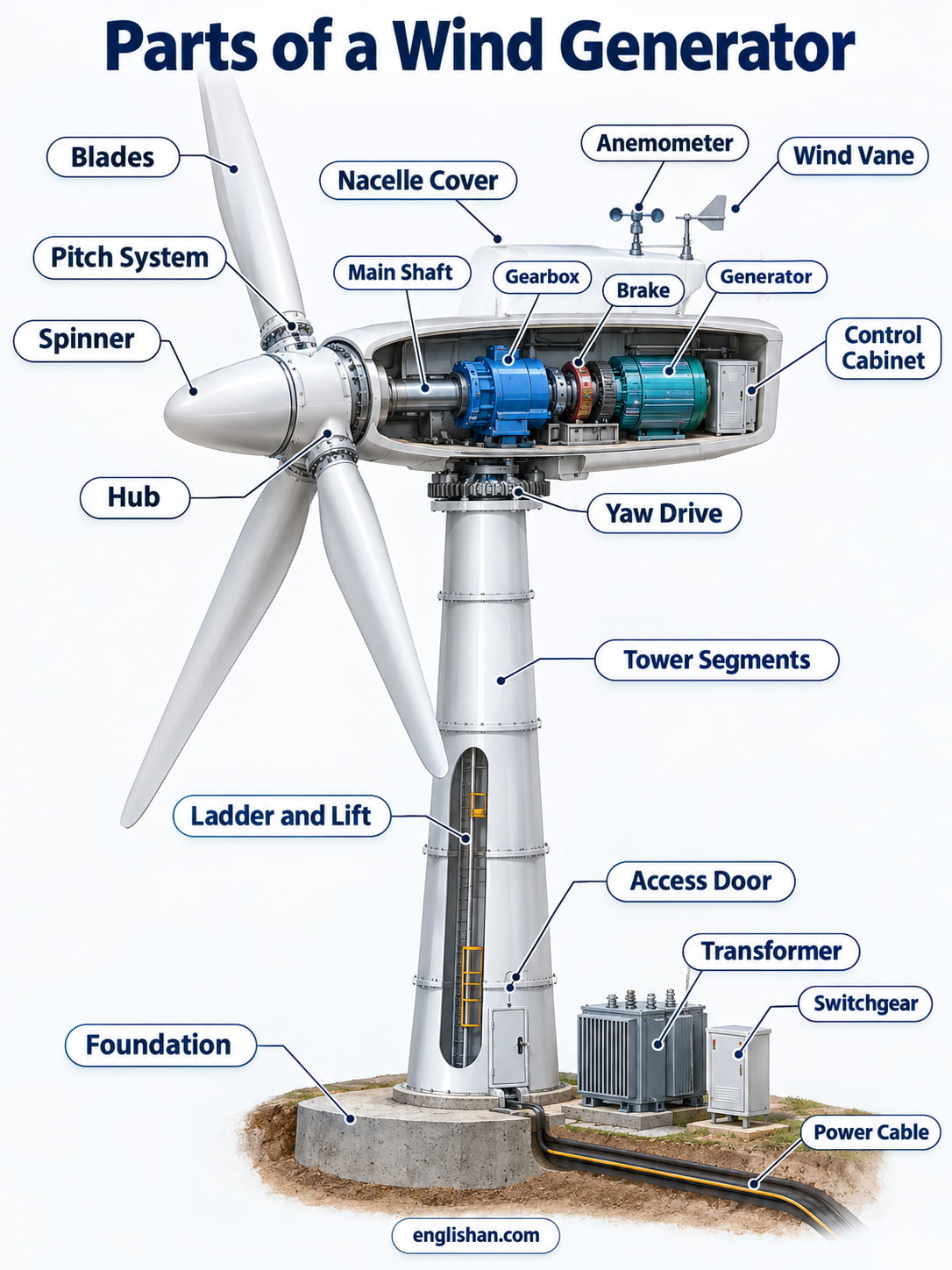
Three white blades fan out from a round hub capped by a smooth spinner. A long boxy nacelle, the housing for the drive train, is mounted behind the hub. A small wind vane and an anemometer are fixed on its roof. A tapered steel tower rises from a concrete foundation to the nacelle, and a steel transformer box is beside the base. These are the parts of a wind generator on a utility-scale unit.
| Part | Where you find it |
|---|---|
| 1. Blades | Three long fiberglass arms on the hub |
| 2. Hub | Steel center of the rotor |
| 3. Spinner | Smooth cone over the front of the hub |
| 4. Pitch system | Drives at the root of each blade, inside the hub |
| 5. Nacelle cover | Boxy housing at the top of the tower |
| 6. Main shaft | Thick steel shaft behind the hub |
| 7. Gearbox | Large gear housing behind the main shaft |
| 8. Generator | Steel cylinder at the rear of the drive train |
| 9. Brake | Disc and calipers on the fast shaft |
| 10. Yaw drive | Motors and gear ring at the top of the tower |
| 11. Anemometer | Spinning cups on the nacelle roof |
| 12. Wind vane | Small fin on the nacelle roof |
| 13. Control cabinet | Steel cabinet on the nacelle floor |
| 14. Tower segments | Tapered steel tubes bolted end to end |
| 15. Access door | Steel door at the base of the tower |
| 16. Ladder and lift | Rungs and a cage platform inside the tower |
| 17. Foundation | Reinforced concrete pad under the tower |
| 18. Transformer | Steel box on a pad beside the tower |
| 19. Switchgear | Metal cabinet at the tower base |
| 20. Power cable | Buried cable from the base to the grid |
| 21. Tail vane | Long fin at the rear of a small turbine |
| 22. Charge controller | Wall box between a small turbine and its batteries |
| 23. Vertical rotor | Upright shaft with curved blades |
| 24. Monopile | Steel tube driven into the seabed |
| 25. Transition piece | Yellow steel collar between the monopile and the tower |
Main Parts of a Wind Generator
The seven main parts of a wind generator turn wind into current. The rest measure the wind, brake the rotor, or connect the machine to the grid.
- Blades: Fiberglass arms, 150 to 250 feet long on a utility unit, that catch the wind.
- Hub: The steel center that joins the blades to the main shaft.
- Nacelle: The boxy housing at the top of the tower that encloses the drive train.
- Gearbox: The gear housing that raises the shaft speed to 1,500 to 1,800 rpm.
- Generator: The 1.5 to 5 megawatt cylinder that produces the electricity.
- Yaw drive: The ring of motors that turns the nacelle to face the wind.
- Tower: The tapered steel tube, 260 to 330 feet tall, that lifts the rotor into steadier wind.
Rotor Assembly of a Wind Generator
The rotor is the assembly that faces the wind. Four parts make it up: the blades, the hub, the spinner, and the pitch system.
Blades
Blades are the longest of the parts of a wind generator, 150 to 250 feet on a utility unit. Each is a hollow shell of fiberglass and epoxy, white or light gray, shaped like an airplane wing. A blade has a thick root at the hub, a body, and a thin tip. Its rounded leading edge faces the wind. Small metal discs along the tip receive lightning strikes.
Hub
The hub is a rounded casting of steel or cast iron, 10 to 13 feet wide, at the center of the rotor. The three blades bolt to its outer face, and the main shaft bolts to its rear. It is hollow, with a hatch for a technician.
Spinner
A smooth fiberglass cone covers the front of the hub. It is called the spinner or the nose cone. It measures 10 to 15 feet long and is painted white to match the blades.
Pitch System
Inside the hub, one electric or hydraulic drive per blade turns the blade on its own axis, through 90 degrees. Each drive is a motor with a toothed ring at the blade root. Pitch is the angle of the blade to the wind.
Inside the Nacelle of a Wind Generator
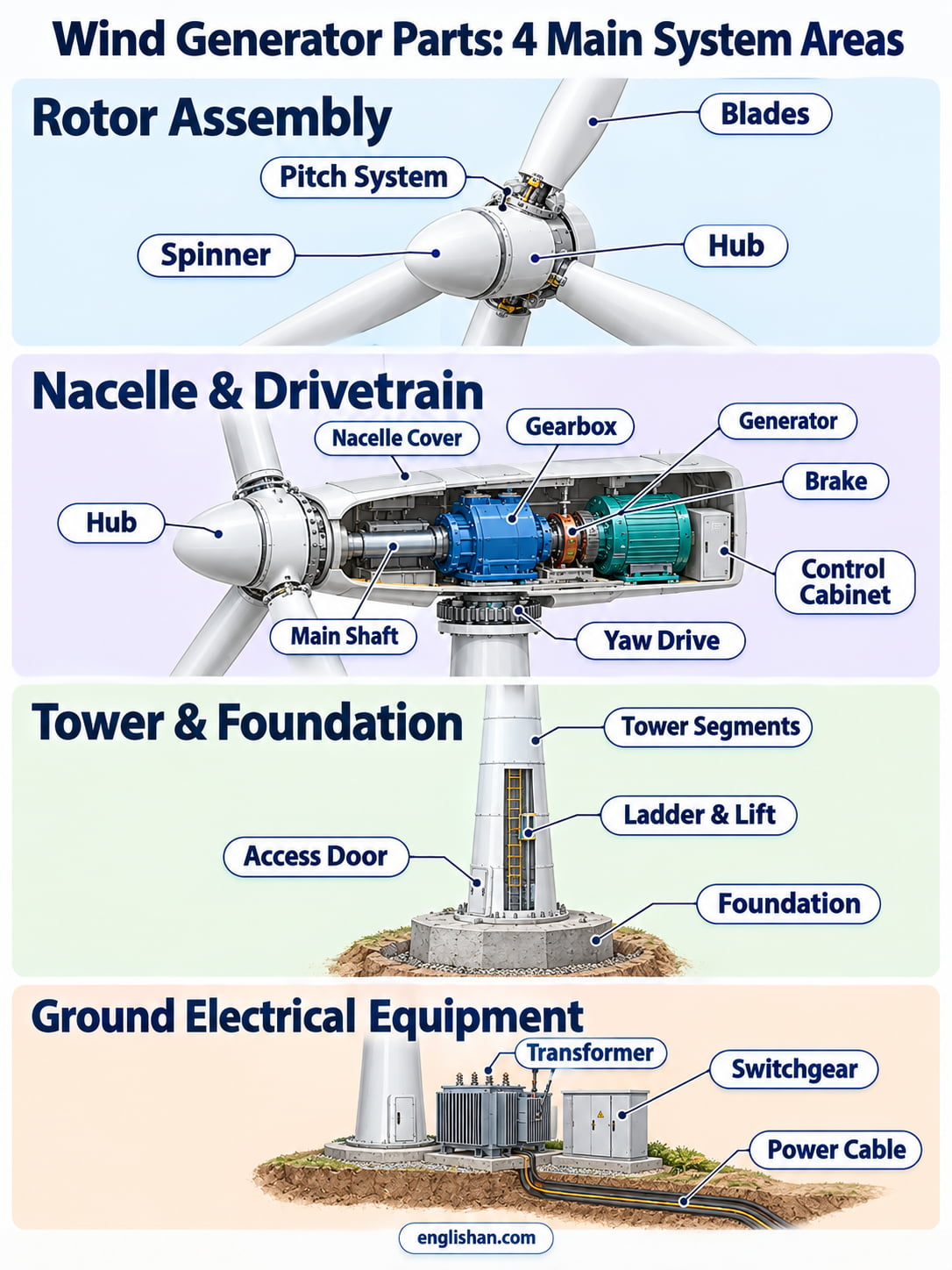
The nacelle is the boxy housing at the top of the tower, about the size of a city bus, 40 to 55 feet long. It weighs 60 to 100 tons with its equipment, and nine of the parts of a wind generator are inside or on it.
Nacelle Cover
A shell of fiberglass or steel, white or gray, closes the nacelle. Hatches in its roof open for crane lifts. The floor is a heavy steel bedplate under the drive train.
Main Shaft
The main shaft is a forged steel shaft, 2 to 3 feet wide, that leaves the back of the hub. It turns slowly, at 10 to 20 rpm. Its far end joins the gearbox.
Gearbox
Behind the main shaft is a cast steel housing about the size of a small car, weighing 15 to 25 tons. It contains a set of planetary and helical gears. The gears raise the speed from 10 to 20 rpm to 1,500 to 1,800 rpm. Among the parts of a wind generator in the nacelle, it is the largest. A cooling tower fan uses a smaller right-angle version. Direct-drive models have no gearbox.
Generator
Rated at 1.5 to 5 megawatts, the generator is a steel cylinder 6 to 8 feet long, with cooling fins on its casing. It is at the rear of the drive train, and its output is 690 volts. It is the same kind of machine as the one in a portable generator, only far larger.
Brake
A steel disc, 2 to 3 feet wide, is fixed to the fast shaft between the gearbox and the generator. Hydraulic calipers clamp it to stop the rotor. A steel pin locks the rotor during service. Among the parts of a wind generator, the brake is the one that holds it still.
Yaw Drive
Yaw means side-to-side turning, and the yaw drive turns the nacelle to face the wind. It is a ring of four to eight electric motors, each with a small pinion gear. The ring is at the joint between the nacelle and the tower. The pinions mesh with a large toothed ring bolted to the tower top.
Anemometer
An anemometer is a wind speed gauge. On a wind generator, it is a set of three spinning cups on a short mast on the nacelle roof. Some units use an ultrasonic sensor with no moving parts.
Wind Vane
Beside the anemometer is a wind vane, a small fin on a pivot. It swings with the wind and sends the wind direction to the controller. The yaw drive follows that reading.
Control Cabinet
A gray steel cabinet, about 6 feet tall, is bolted to the nacelle floor, with a second cabinet at the tower base. It has a computer, relays, and a display panel. It reads the sensors and sends commands to the pitch and yaw drives.
Wind Generator Tower and Foundation
The tower lifts the nacelle to a hub height of 260 to 330 feet on a utility unit. Four parts of a wind generator form the tower structure.
Tower Segments
The tower is made of three to five steel tubes called segments. Each is 60 to 100 feet long, and ring flanges join them end to end. It tapers from about 14 feet wide at the base to 8 feet at the top, like a lighthouse. The paint is white or light gray.
Access Door
A locked steel door, about 3 feet wide and 6 feet tall, is cut into the tower wall at the base. It opens onto a small landing. A steel plate with a warning label is fixed beside it.
Ladder and Lift
Inside the tower, a steel ladder with a safety cable runs up to the nacelle. Taller towers add a service lift, a small cage platform on a rail. Landings break the climb every 30 feet or so.
Foundation
A reinforced concrete pad, about 60 feet wide and 10 feet deep, is poured around a ring of steel anchor bolts. The lowest tower segment bolts to that ring. Only the top edge of the pad shows at ground level.
Ground Equipment Beside a Wind Generator
Three more parts of a wind generator are on the ground beside the tower. They raise the voltage and link the machine to the grid. With the generator and the control cabinet, they form the electrical generation system of the turbine.
- Transformer: A gray or green steel box, 6 to 8 feet tall, on a concrete pad beside the tower. It raises 690 volts to 34.5 kilovolts.
- Switchgear: A metal cabinet with breakers and a disconnect handle, at the tower base or beside the transformer.
- Power cable: A buried medium-voltage cable, 3 to 4 feet underground, that connects the tower to the collection line.
Types of Wind Generators and Their Parts
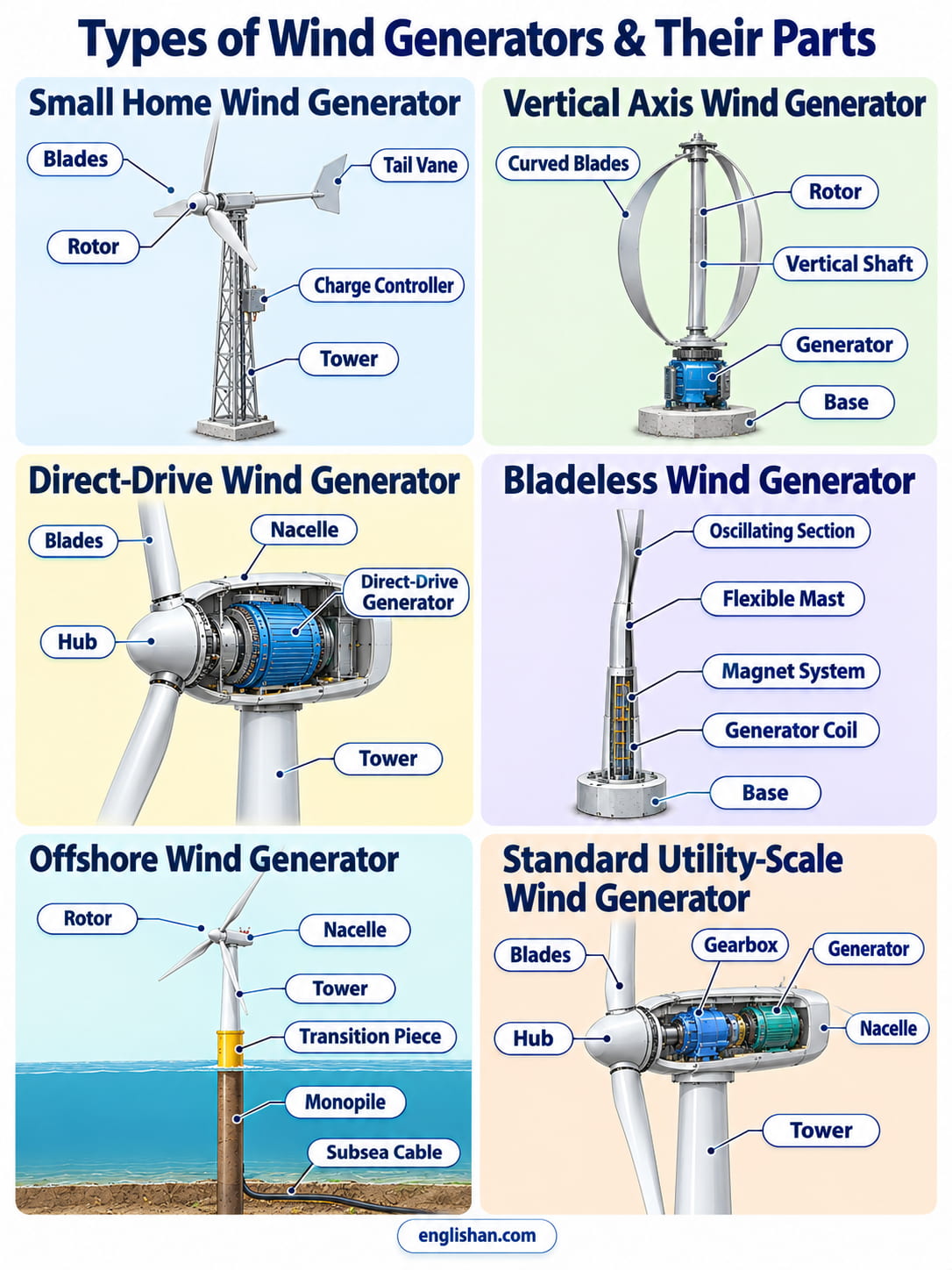
The utility-scale horizontal axis unit is the standard. Five other types change or replace some of its parts.
Small Home Wind Generator
The parts of a home wind generator are fewer. A rotor of two to five blades, 3 to 23 feet across, is on a compact body with a long tail vane. It is rated at 400 watts to 10 kilowatts. The tail vane, 3 to 5 feet long, steers the rotor into the wind, so there is no yaw drive. A guyed or free-standing tower, 60 to 120 feet tall, supports it. A charge controller, a battery bank, and an inverter complete the system. A homemade wind generator uses the same parts. Its alternator is a permanent magnet unit, taken from a car or a bicycle hub motor. Blades are cut from PVC pipe or wood, and a tail vane, a mast, and a charge controller complete it.
Vertical Axis Wind Generator
The parts of a wind generator change on a vertical axis unit, where the rotor turns on an upright shaft. The Darrieus type has curved eggbeater blades, and the Savonius type has S-shaped scoops. The generator is at the base, and the rotor takes wind from any direction, so it has no yaw drive or tail vane. It is rated at 200 watts to 10 kilowatts.
Direct-Drive Wind Generator
The parts of a direct-drive wind generator differ only in the drive train. It has no gearbox. A ring-shaped generator with neodymium permanent magnets, 15 to 20 feet wide, is fixed directly to the hub. It turns at rotor speed. The nacelle is shorter as a result.
Bladeless Wind Generator
The parts of a wind generator shrink to a mast and a magnet ring on a bladeless unit. It has no rotor, gearbox, or yaw drive. It is a slim mast of fiberglass or carbon fiber, 6 to 40 feet tall, that sways in the wind. A ring of magnets and a coil at the base convert the motion into current. The mast is its only moving part.
Offshore Wind Generator
An offshore wind generator is a utility-scale unit of 8 to 15 megawatts on a marine foundation. Its rotor, nacelle, and tower match the parts of a wind generator on land. A steel monopile, 20 to 33 feet wide, is driven into the seabed. A yellow transition piece joins it to the tower and has a boat landing and a work platform. A subsea cable leaves the base.
FAQs
Q1. What are the parts of a wind generator?
The parts of a wind generator are the blades, hub, spinner, nacelle, gearbox, generator, yaw drive, tower, foundation, and transformer. A windmill has blades and a tower too, but it turns a millstone or a pump instead of a generator.
Q2. What are the parts of a wind turbine and their functions?
The blades catch the wind, and the hub joins them to the main shaft. The gearbox raises the speed, and the generator makes the electricity. The yaw drive turns the nacelle to face the wind. The tower lifts the rotor, and the transformer raises the voltage.
Q3. What part of a wind turbine generates electricity?
The generator generates the electricity. It is a steel cylinder at the rear of the drive train in the nacelle. It converts the rotation of the shaft into 690-volt current, and the transformer at the base raises the voltage.
Q4. What are the internal parts of a wind turbine?
The internal parts of a wind turbine are the main shaft, gearbox, brake, generator, yaw drive, and control cabinet in the nacelle. The pitch system is inside the hub. The ladder and lift are inside the tower.
Q5. What are the parts of a vertical axis wind turbine?
A vertical axis wind turbine has an upright shaft, two or three curved or S-shaped blades, and a frame. The generator is at the base. It has no yaw drive and no tail vane.
Q6. What are the parts of an offshore wind turbine?
An offshore wind turbine has the same rotor, nacelle, and tower as a land unit. It adds a steel monopile, a transition piece, a boat landing, a work platform, and a subsea cable. Its blades are 350 feet long or more.
Q7. Which parts of a wind turbine are recyclable?
The steel tower, the copper cable, the gearbox, and the generator are recyclable as scrap metal, which is most of the machine’s weight. Fiberglass blades are harder to recycle. They are cut into pieces and used as feedstock in cement kilns.
You May Also Like
- Parts of a Generator
- Parts of an Electric Fan
- Parts of a Cooling Tower
- Parts of a Lighthouse
- Parts of a Chimney