

An electric clothes iron is a hand-held appliance with a flat heated plate on the bottom. A steam model adds a water tank in its body. An ironing board is a padded, tapered work surface on folding legs.
The parts of an iron and an ironing board fall into three groups by what they touch. Those are the fabric, the hand, and the floor or outlet.
Iron and Ironing Board Diagram Labeled
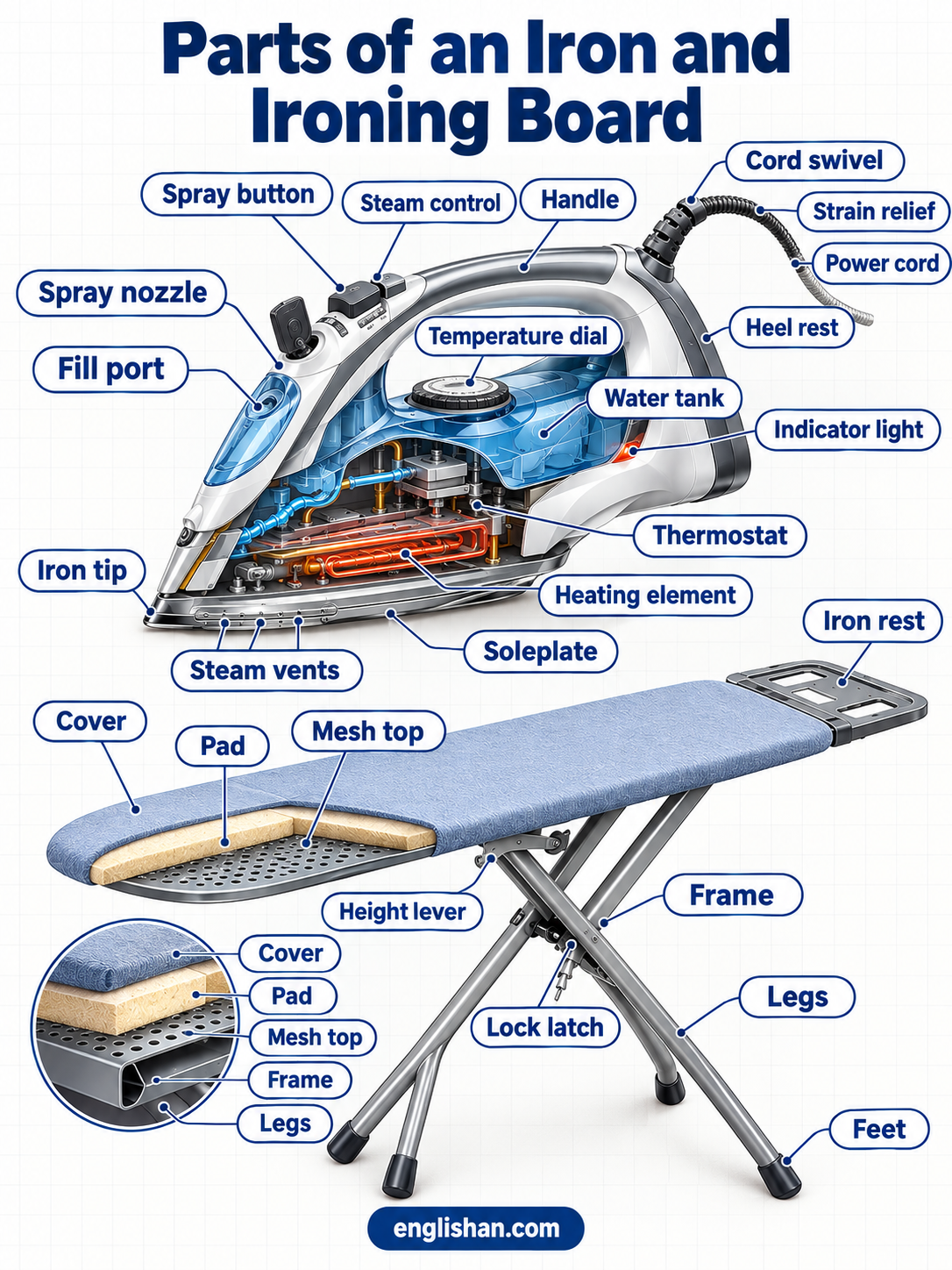
At the bottom of the iron is a flat metal soleplate with rows of steam vents, and it ends in a pointed tip. A molded plastic handle arches over the body, with the temperature dial, steam buttons, and fill port within reach of the thumb. The cord leaves the rear through a swivel. The board has a perforated steel top under a foam pad and a fitted cover, and a steel frame with folding legs supports it. These are the parts of an iron and its board, from the surface that touches the fabric to the feet that touch the floor.
| Part | Where you find it |
|---|---|
| 1. Soleplate | Flat metal plate on the bottom of the iron |
| 2. Steam vents | Rows of holes through the soleplate |
| 3. Iron tip | Pointed front end of the soleplate |
| 4. Heating element | Metal-sheathed coil pressed against the soleplate |
| 5. Thermostat | Bimetal strip near the heating element |
| 6. Mesh top | Perforated steel sheet forming the board surface |
| 7. Pad | Foam or felt layer over the mesh |
| 8. Cover | Fitted fabric jacket over the pad |
| 9. Handle | Molded arch on top of the iron |
| 10. Temperature dial | Rotary knob near the front of the handle |
| 11. Steam control | Slider or knob beside the dial |
| 12. Spray button | Small push button near the dial |
| 13. Spray nozzle | Fine opening just behind the tip |
| 14. Water tank | Translucent reservoir inside the body |
| 15. Fill port | Hinged flap on the front of the iron |
| 16. Indicator light | Small lamp on the handle or body |
| 17. Height lever | Release handle under the board top |
| 18. Iron rest | Metal or silicone shelf at the narrow end of the board |
| 19. Heel rest | Flat rear base of the iron |
| 20. Power cord | Cable leaving the back of the iron |
| 21. Cord swivel | Rotating collar where the cord enters |
| 22. Strain relief | Flexible sleeve around the cord at the swivel |
| 23. Frame | Steel tubes and braces under the mesh top |
| 24. Legs | Two pairs of hollow steel tubes under the frame |
| 25. Lock latch | Spring-loaded hook at the center of the frame |
| 26. Feet | Rubber or plastic caps on the leg ends |
Fabric Contact Parts of an Iron and Ironing Board
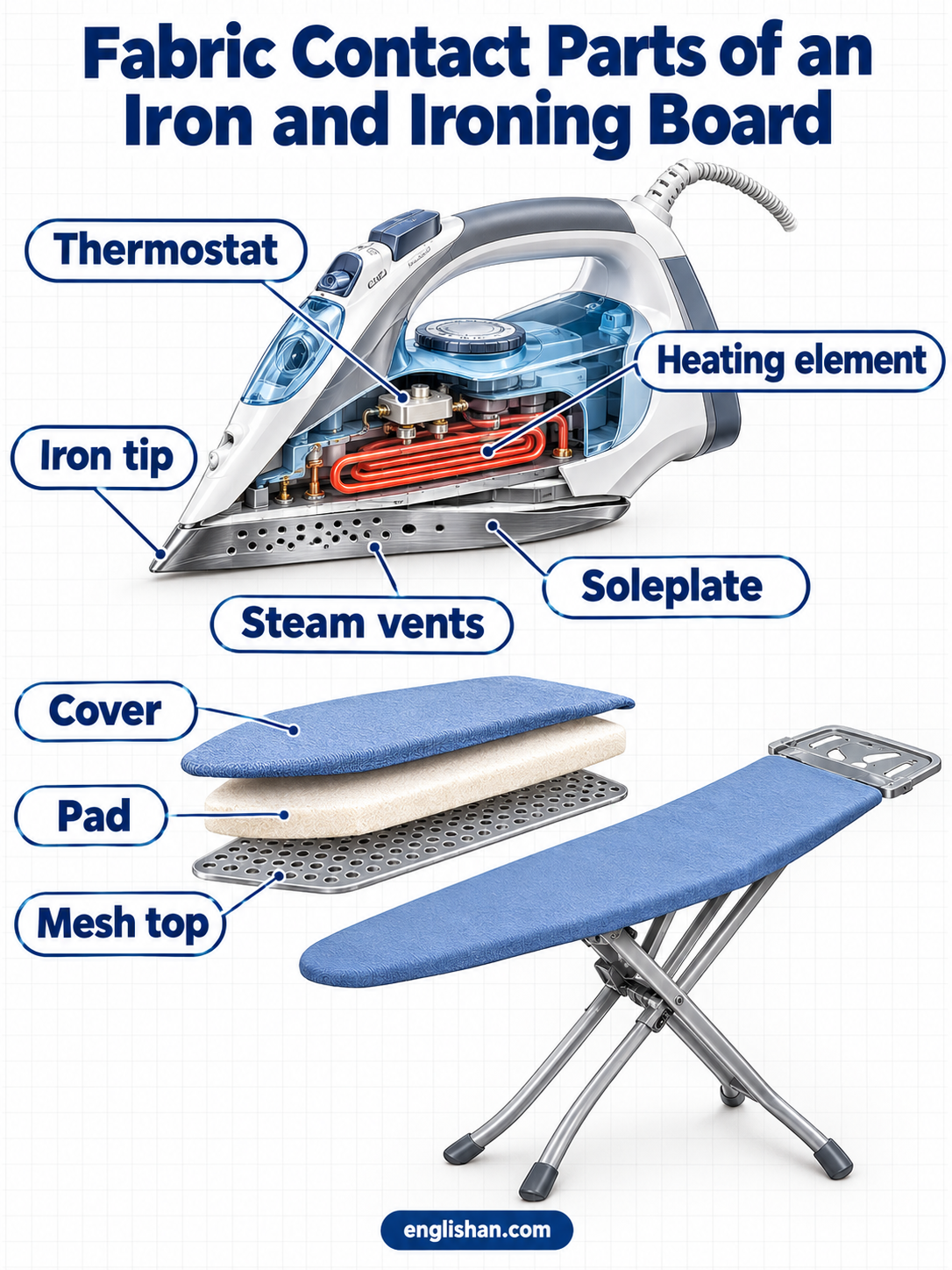
Eight of the parts of an iron and its board touch the garment or lie directly under the surface that does. On the iron they are the soleplate, the steam vents, the tip, the heating element, and the thermostat. On the board they are the mesh top, the pad, and the cover.
Soleplate
The soleplate is the hottest part of an iron: a flat plate on the bottom, cast from aluminum or stamped from stainless steel. Many plates have a non-stick or ceramic coating. Its face is smooth and slightly curved up at the front, with a narrow groove along one side for shirt buttons. Steel plates are silver, while coated plates are gray, gold, or dark.
Steam Vents
Steam vents are small holes drilled through the soleplate, from 20 on a travel iron to 400 on a large household model. They run in rows along the edge and down the center of the plate. The holes near the tip are larger than the ones at the heel.
Iron Tip
The tip is the pointed front end of the soleplate, tapered to a narrow point. Its edge is beveled, so it slides under pleats and around buttons. On a dry iron the tip is a plain smooth curve, and on a steam iron it has the first row of vents.
Heating Element
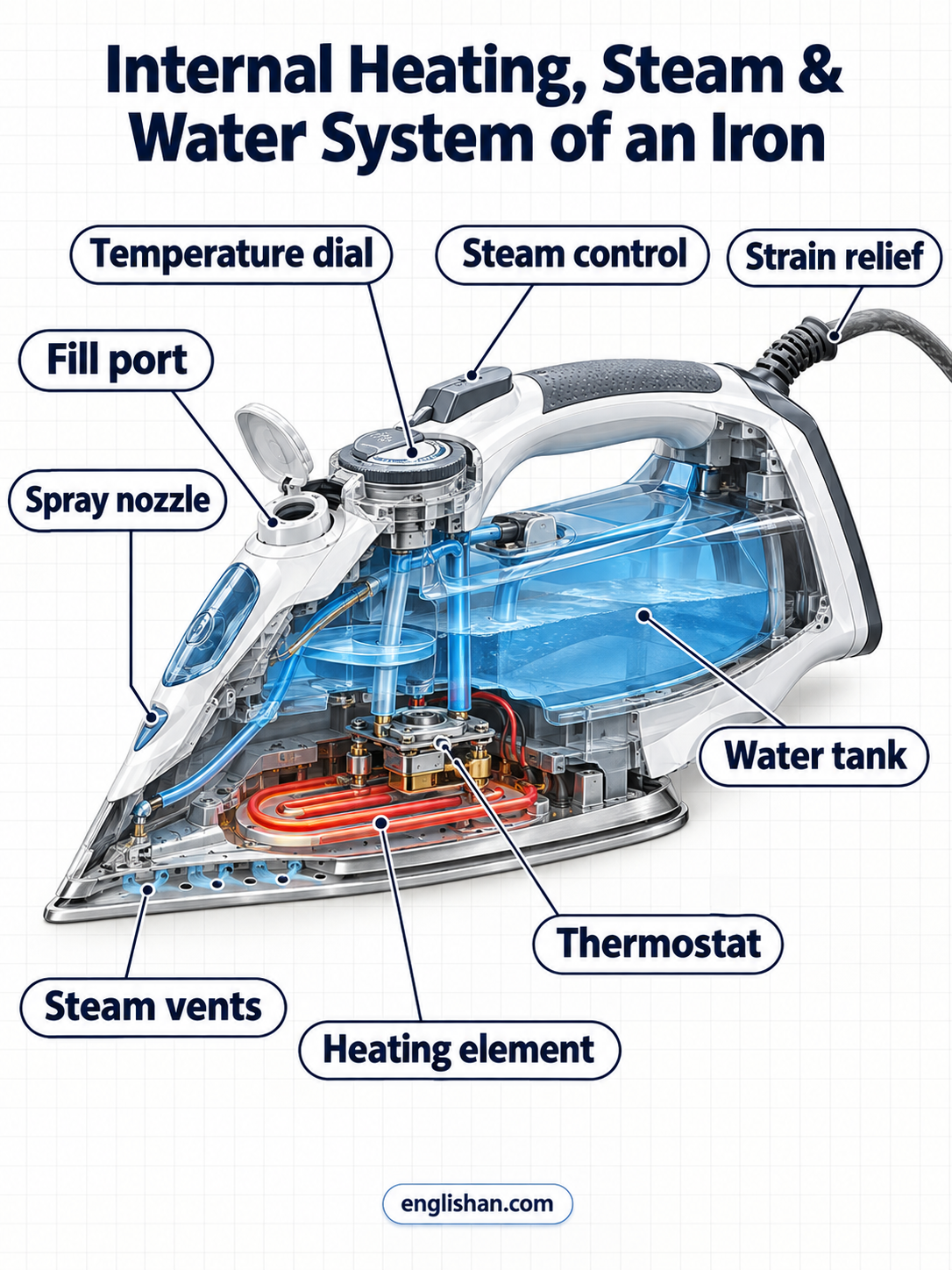
The heating element is one of the internal parts of an iron. It is a coil of nichrome wire, an alloy of nickel and chromium, sealed inside a metal tube. The tube is pressed into the underside of the soleplate, and a ceramic insulator separates it from the tank. Household irons draw 1,200 to 1,800 watts on a 120-volt outlet.
Thermostat
The thermostat is a bimetal strip, two metals bonded into one narrow blade. It is fixed against the soleplate near the heating element. A small ceramic peg links it to the temperature dial, and its contacts are silver-plated.
Mesh Top
The mesh top, also called the face, is the perforated steel sheet that forms the board surface. It is broad at one end and tapered to a narrow nose at the other. A full-size board measures about 54 inches long and 15 inches wide, and slots or holes cover its entire length.
Pad
The pad is a layer of foam, felt, or cotton batting laid over the mesh, about a quarter to a half inch thick. Some pads add a metallized layer that looks like silver foil. The pad is thickest at the center and thinner at the edges.
Cover
The cover is a fitted jacket of cotton, polyester, or silicone-coated canvas. It stretches over the pad and gathers under the board with an elastic cord or metal clips. Printed covers come in stripes, florals, and solid colors.
Hand Contact Parts of an Iron and Ironing Board
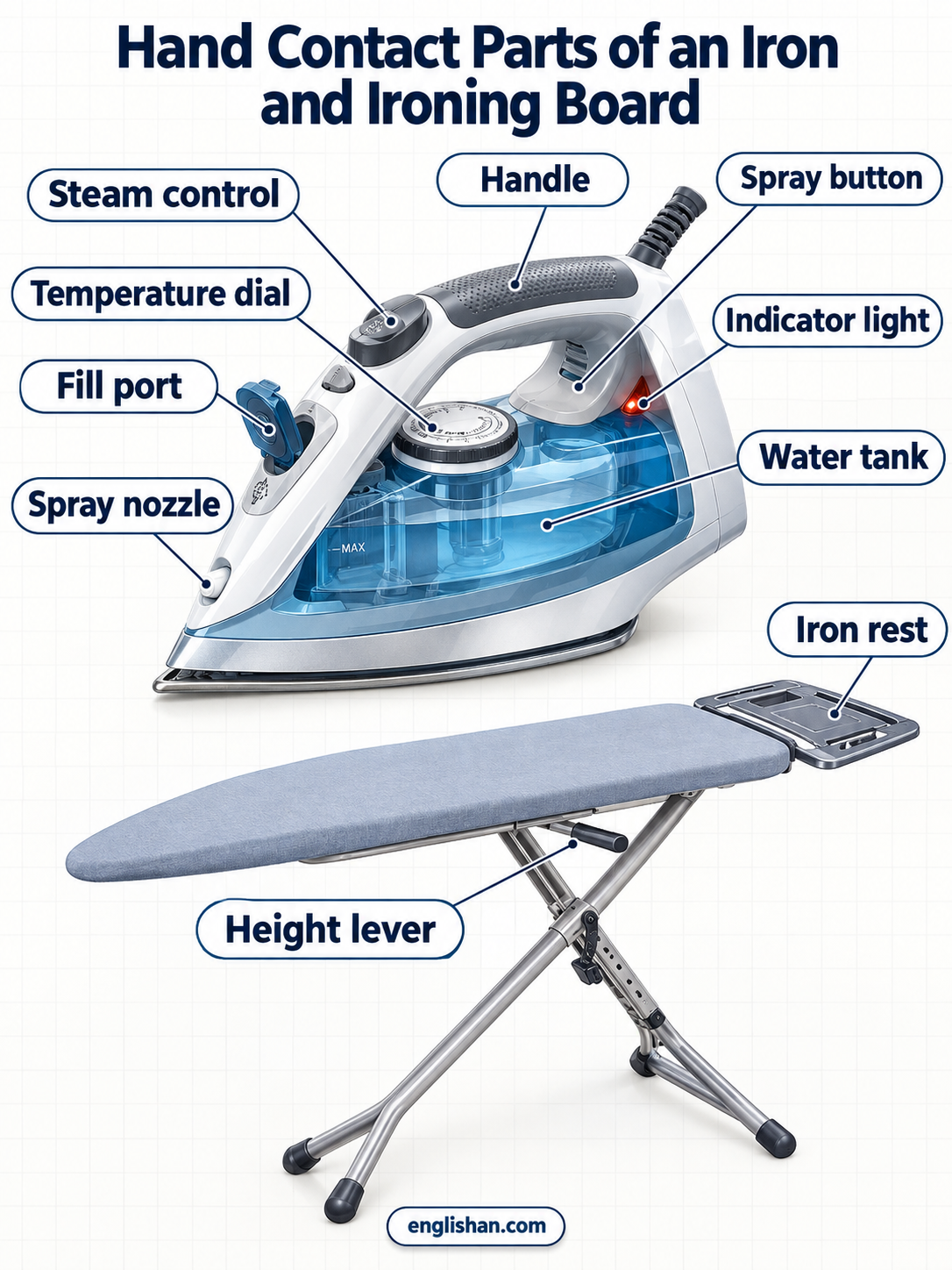
The hand touches or adjusts ten of the parts of an iron and its board. Eight are on the iron, and two are on the board frame.
Handle
The handle is a molded plastic arch over the top of the iron, with a rubber or textured grip. Screws at the front and rear fasten it to the body. A thumb rest curves along its inner edge.
Temperature Dial
The temperature dial is a rotary knob on the top or side of the iron near the front of the handle. Its ring is printed with fabric names, from synthetic and silk to cotton and linen, and a raised pointer marks the setting.
Steam Control
Among the parts of an iron, the steam control is a slider or knob beside the dial. It is marked with a droplet symbol. Many models add a steam burst button, a small rectangular push button, next to it, and both are molded in plastic.
Spray Button
The spray button is a small round push button near the dial, molded in a contrasting color. A droplet or spray icon is printed on its face. A spring under the button returns it after each press.
Spray Nozzle
Just behind the tip is the spray nozzle, a small plastic cap with a fine opening at its center. Its dome is smooth, and it is one of the smallest of the parts of an iron that you see from the front.
Water Tank
The water tank is a hollow reservoir of translucent plastic inside the back half of the iron, under the handle. It has a capacity of 8 to 13 ounces. Level marks are molded into its side, and a window in the body lets you read them.
Fill Port
The fill port is a hinged flap or sliding cover on the front of the iron. It opens to a small funnel-shaped mouth rimmed with a silicone gasket. Some irons add a molded lip on the flap for pouring.
Indicator Light
Next to the dial, on the handle or the body, the indicator light is a small LED or neon lamp. Its color is amber or red on most irons, behind a translucent plastic window.
Height Lever
The height lever is a release handle of steel under the board top, with a molded plastic grip. Its notched track locks the legs at one of six or seven heights, from about 22 to 36 inches. It is fastened to the frame with a bolt and a washer.
Iron Rest
The iron rest is a shelf of wire, steel, or heat-resistant silicone at the narrow end of the board. Its far edge is angled up, its surface is ridged or perforated, and screws fasten it to the frame.
Floor and Outlet Parts of an Iron and Ironing Board
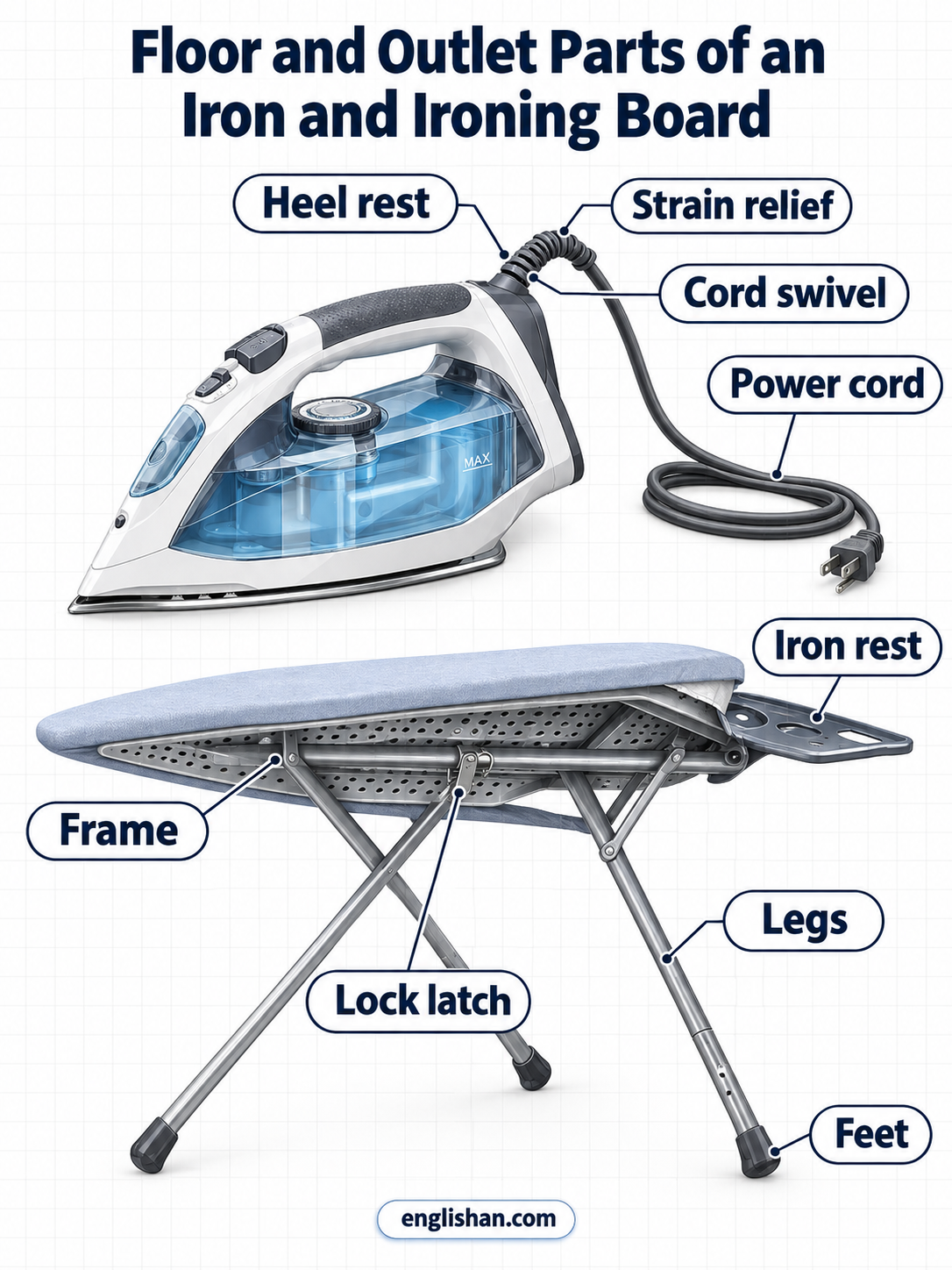
Eight of the parts of an iron and its board connect to the floor, a counter, or a wall outlet. The heel rest and the cord belong to the iron, and the rest are on the board.
Heel Rest
At the rear of the iron, the heel rest is a broad plastic or metal plate with two rubber pads. The iron is set on it end-up when it is not in use. Its underside is smooth, and its edge is rounded.
Power Cord
Six to eight feet long, the power cord is a flexible cable wrapped in fabric or rubber insulation. It leaves the back of the iron and ends in a two-prong or three-prong plug for a 120-volt outlet. Cordless irons swap it for a charging base.
Cord Swivel
The cord swivel is a rotating collar of hard plastic at the rear of the iron, where the cord enters. It turns through a full 360 degrees, and a metal ring inside it fastens it to the housing.
Strain Relief
The strain relief is a short tapered sleeve of rubber that wraps the cord at the swivel, with ribs molded along its outside. It is the stiffest length of the cord.
Frame
Under the mesh top, the frame is a set of steel tubes and cross braces bolted in place. Its tubes are round or oval, coated in black or white powder paint. The hinges for the legs are riveted to its ends.
Legs
The legs are two pairs of hollow steel tubes, crossed in an X or fixed in a T shape. Each pair is hinged at its crossing, and both fold flat against the frame. A T-shaped base is more compact, and an X-shaped base is wider.
Lock Latch
The lock latch is a spring-loaded metal hook at the center of the frame. It catches a crossbar on the legs when the board is folded, and a small tab releases it.
Feet
The feet are rubber or plastic caps on the bottom of the legs, ribbed underneath and molded in gray or black. Some boards add a threaded foot that screws in or out to level the board.
Iron Parts FAQs
Q1. What are the parts of an iron called?
The different parts of an iron are the soleplate, steam vents, tip, heating element, thermostat, handle, temperature dial, and steam control. A steam model adds a water tank, a fill port, and a spray nozzle. The cord, cord swivel, and heel rest complete it.
Q2. What are the parts of an electric iron and their functions?
The soleplate presses the fabric, and the heating element warms it. The thermostat keeps the set temperature, and the dial sets it. The steam vents release steam from the tank, and the spray nozzle mists the garment.
Q3. What are the parts of an ironing board and their uses?
The mesh top and the pad form the pressing surface, and the cover protects the pad. The frame and legs support the board, and the height lever sets its height. The iron rest gives the hot iron a safe spot at the narrow end.
Q4. What is the metal part of an ironing board called?
The metal part of an ironing board is the mesh top, a perforated steel sheet under the pad. The frame and legs are also steel. The mesh top lets steam pass through, while the frame and legs support the board.
Q5. What are the parts of an iron box?
Iron box is a regional name for a clothes iron, so its parts are the soleplate, heating element, thermostat, handle, temperature dial, and cord. A steam model adds a water tank, vents, and a spray nozzle. An old charcoal model replaces the heating element with a hinged lid and a coal chamber.
Q6. What are the parts of an iron diagram?
An iron diagram labels the soleplate, steam vents, tip, handle, dial, steam control, spray button, water tank, fill port, cord, and swivel. The heating element and thermostat are drawn under the soleplate. A board diagram adds the mesh top, pad, cover, frame, legs, and feet.
Q7. What is the anatomy of an ironing board?
The anatomy of an ironing board has three layers on top and a steel base under them. The layers are the mesh top, the pad, and the cover. The base is a frame with folding legs, a height lever, a lock latch, and feet.
You May Also Like
- Parts of a Toaster
- Parts of a Kettle
- Parts of an Electric Fan
- Parts of a Blender
- Parts of a Microwave Oven