

Indefinite pronouns are pronouns such as “someone”, “many”, and “none” that refer to people or things without naming them. Every indefinite pronoun has a number, and a verb after it as the subject agrees with that number, so “everyone is” and “several are” follow the same rule as “she is” and “they are“.
Most indefinite pronouns are always singular, five are always plural, and the indefinite pronouns singular or plural by meaning take their number from the noun after “of”. Any later pronoun that refers back to the indefinite pronoun takes the same number, which is why the choice between “his or her” and “their” after “everyone” is also a question of agreement.
What Is Indefinite Pronoun Agreement?
Indefinite pronoun agreement is the match in number between an indefinite pronoun and the words that depend on it. These are the verb that follows it as the subject and any later pronoun that refers back to it. A singular indefinite pronoun takes a singular verb, and a plural indefinite pronoun takes a plural verb.
In the present simple, a singular subject takes the verb with “-s” and the forms “is”, “was”, “has”, and “does”. A plural subject takes the base form of the verb with “are”, “were”, “have”, and “do”.
- Somebody wants to speak to the manager.
- Nothing was missing from the suitcase.
- Does anyone have a phone charger?
- Few were ready when the bus arrived.
- Several of our neighbors have already signed the petition.
Indefinite pronoun agreement is one part of pronoun and verb agreement, which also applies to personal pronouns such as “she” and “they”. In a question or a negative, the auxiliary verb agrees with the indefinite pronoun, so a singular pronoun takes “does” and “doesn’t”.
Do anybody know the way to the station? ❌
Does anybody know the way to the station? ✅
The subject “anybody” is singular, so the auxiliary is “does”.
List Of Singular And Plural Indefinite Pronouns
By number, an indefinite pronoun is always singular, always plural, or singular or plural depending on the noun it refers to. A word from the first two lists always takes the same verb form, while a word from the third list takes its verb form from the noun after “of”.
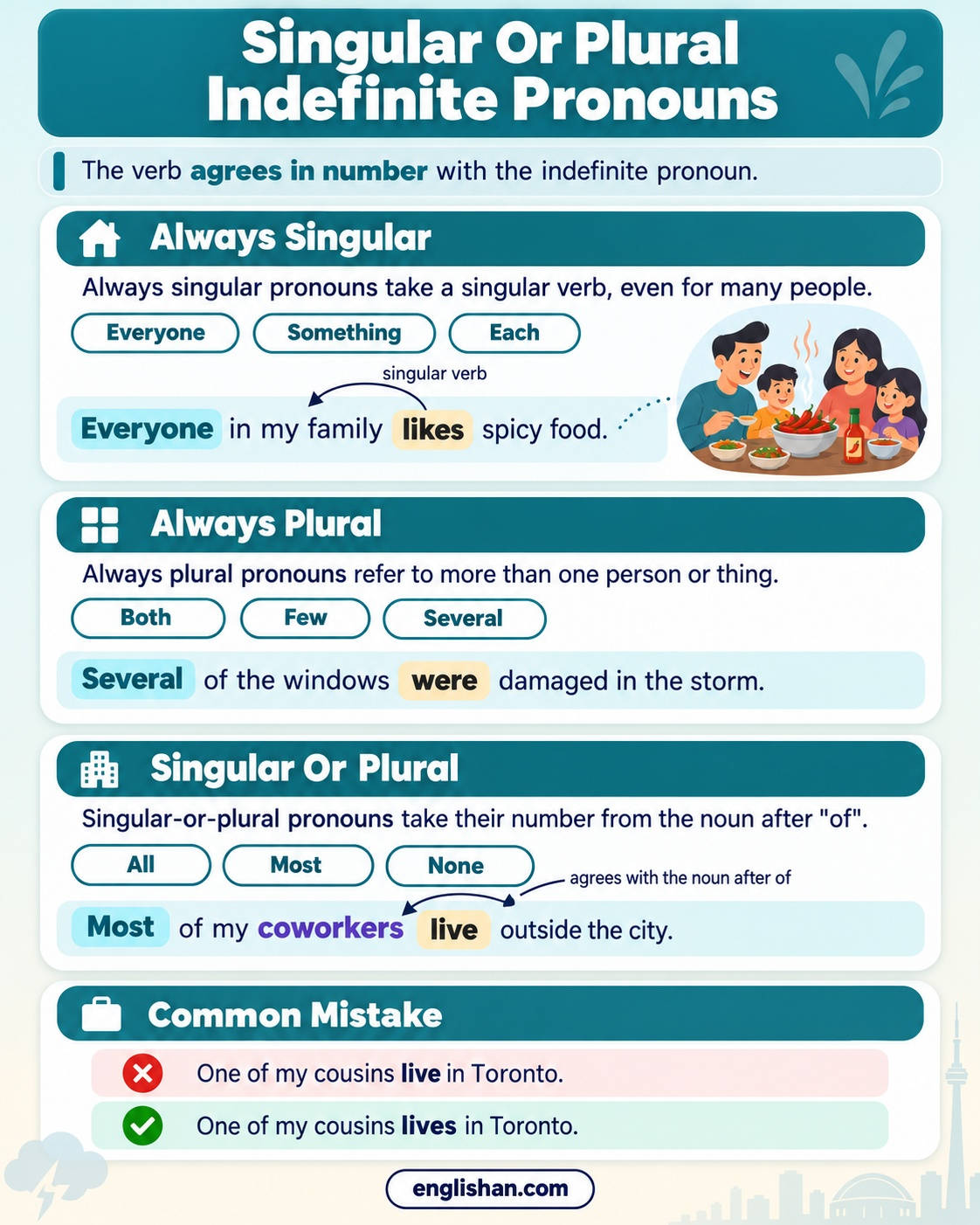
Indefinite Pronouns That Are Always Singular
Indefinite pronouns that are always singular take a singular verb, even when they refer to many people, as “everyone” and “everybody” do. Most of them are compound words formed from “any”, “every”, “no”, or “some” and the endings “-one”, “-body”, and “-thing”.
| With “one” | With “body” | With “thing” | Other words |
|---|---|---|---|
| Anyone | Anybody | Anything | Each |
| Everyone | Everybody | Everything | Either |
| No one | Nobody | Nothing | Neither |
| Someone | Somebody | Something | One |
- Everyone in my family likes spicy food.
- Something smells strange in the fridge.
- Is anybody sitting here?
- No one has replied to my message yet.
- Each of the hotel rooms has a balcony.
The singular verb stays when “of” and a plural noun come between the pronoun and the verb. With “each”, “either”, “neither”, and “one”, the verb agrees with the pronoun, not with the plural noun in the “of” phrase. The words “each”, “either”, and “neither” are also distributive pronouns, which refer to the members of a group one at a time.
In everyday speech, “either of” and “neither of” before a plural noun often take a plural verb, as in “Neither of my parents are coming”, but the singular verb is the rule in formal writing.
One of my cousins live in Toronto. ❌
One of my cousins lives in Toronto. ✅
The subject is “one”, not “cousins”, so the verb takes “-s”.
Indefinite Pronouns That Are Always Plural
Indefinite pronouns that are always plural refer to more than one person or thing, so they take a plural verb. Their meanings differ in amount.
| Indefinite pronoun | Meaning |
|---|---|
| Both | Two people or things together |
| Few | A small number, with the meaning ‘not many’ |
| Many | A large number |
| Others | Other people or things |
| Several | More than two, but not a large number |
- Both of the answers are correct.
- Few know the reason he resigned.
- Many of the shops close early on Sundays.
- Several of the windows were damaged in the storm.
- Some guests went home, but others are still dancing.
The form “a few” is plural as well, as in “A few of us are working late tonight”. It means ‘some’, while “few” alone means ‘not many’.
The others students went home early. ❌
The other students went home early. ✅
The pronoun “others” replaces a noun, so it never comes before one; before a noun, the word is “other”, with no “-s”.
Indefinite Pronouns That Can Be Singular Or Plural
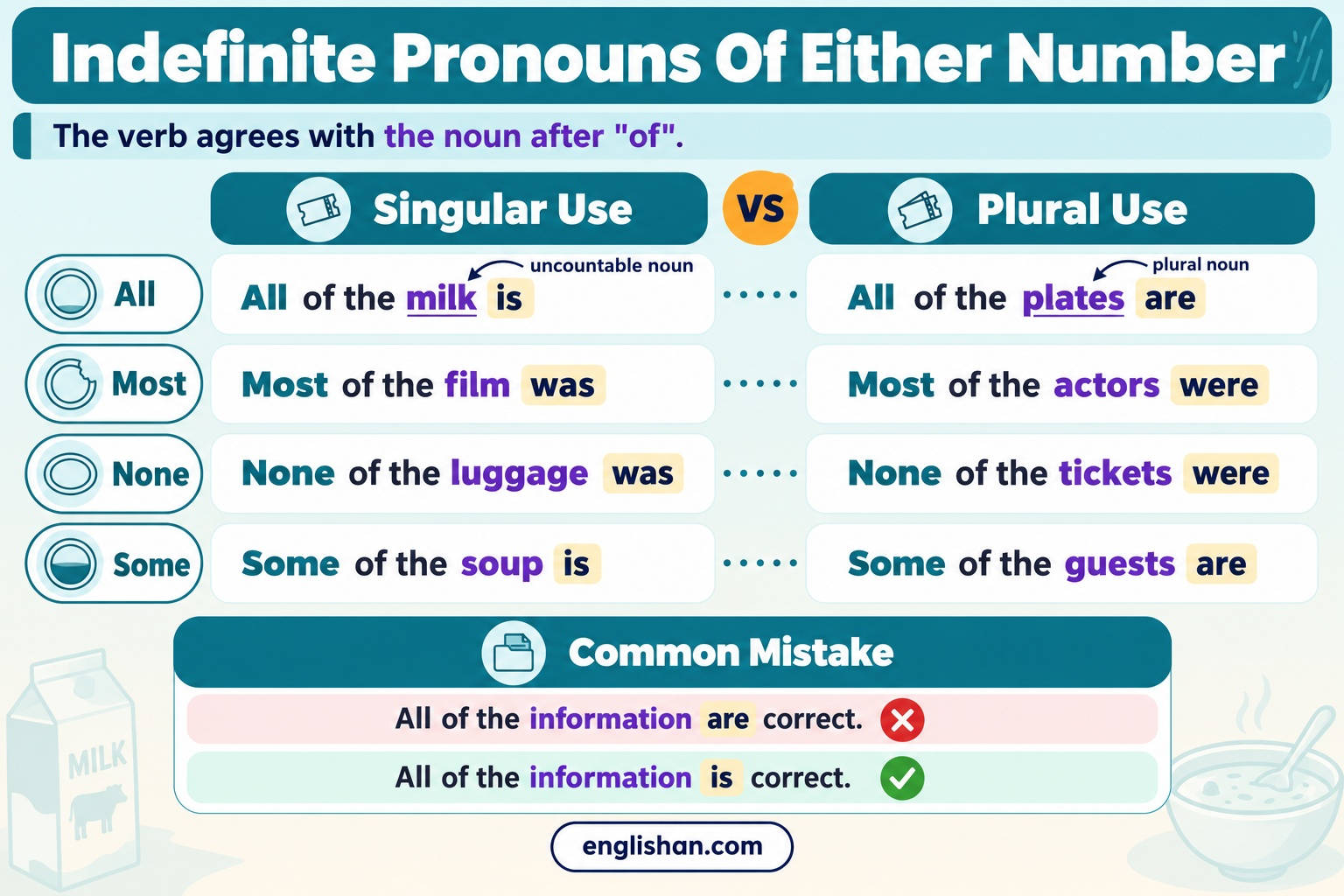
The indefinite pronouns singular or plural by meaning take their number from the noun they refer to, and that noun usually comes after “of”. An uncountable noun or a singular noun takes a singular verb, and a plural noun takes a plural verb.
| Indefinite pronoun | Singular use | Plural use |
|---|---|---|
| All | All of the milk is | All of the plates are |
| Any | Is any of the bread | Are any of the seats |
| More | More of the work is | More of the players are |
| Most | Most of the film was | Most of the actors were |
| None | None of the luggage was | None of the tickets were |
| Some | Some of the soup is | Some of the guests are |
| Such | Such was the result | Such are the rules |
- All of the furniture is new.
- Most of my coworkers live outside the city.
- Some of the paint has dried already.
- Are any of these seats taken?
When no “of” phrase follows, the pronoun takes its number from a noun earlier in the sentence. Alone, “all” means ‘everything’ with a singular verb and ‘everyone’ with a plural verb.
- The pizza arrived an hour ago, and most is gone.
- The guests came at eight, and most have left.
- All is quiet in the building after ten.
- All are welcome at the open day.
The pronoun “such” does not take an “of” phrase. It comes before a form of “be” and agrees with the noun after the verb, as in “Such was the result” and “Such are the rules”.
All of the information are correct. ❌
All of the information is correct. ✅
The noun “information” is uncountable, so “all of the information” takes a singular verb.
None With Singular Or Plural Verbs
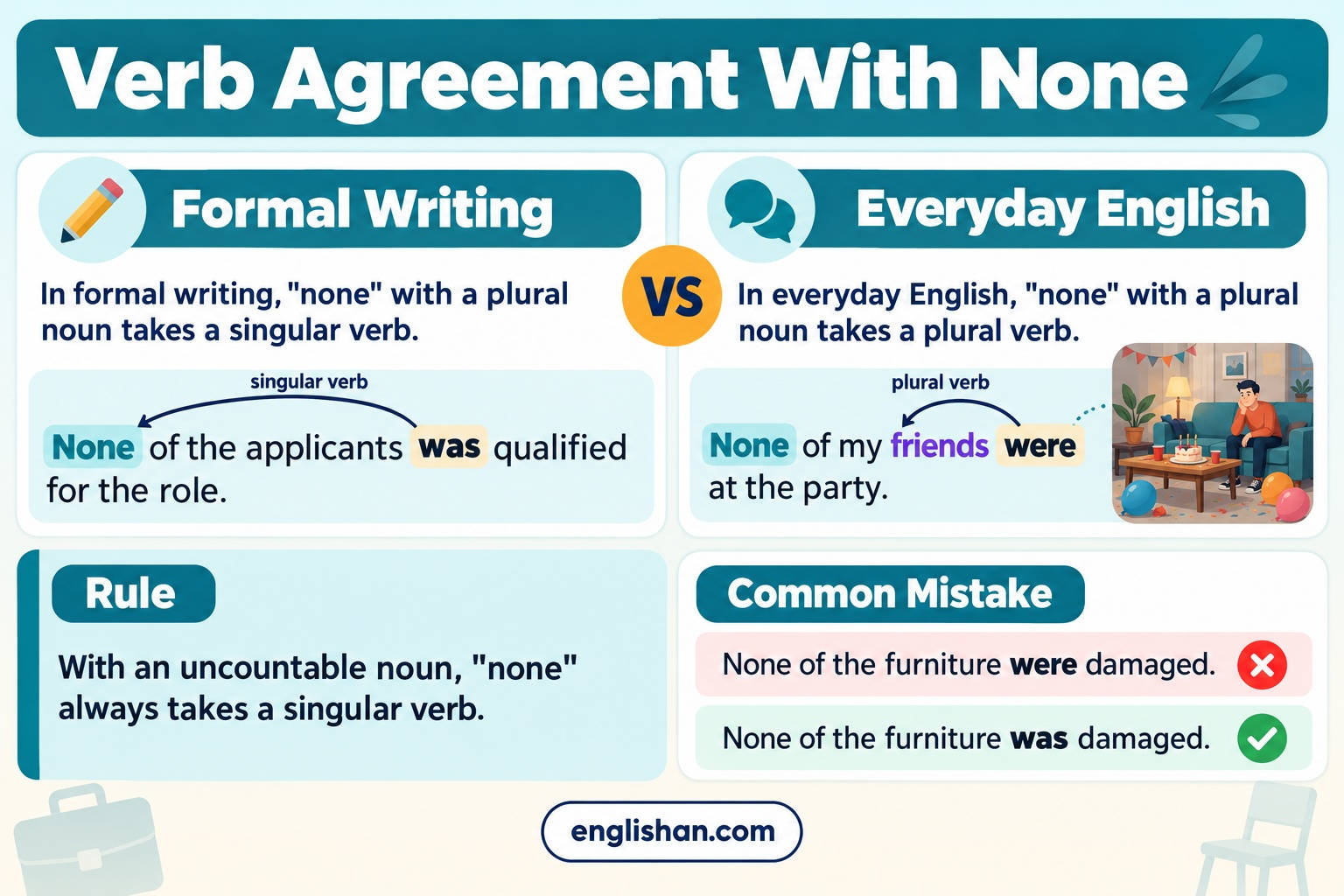
The pronoun “none” means ‘not one’ or ‘not any’, and with an uncountable noun it always takes a singular verb. With a plural noun or pronoun, “none” takes a singular verb in formal writing and a plural verb in everyday English, and both forms are correct.
- None of the coffee was left by noon.
- None of the applicants was qualified for the role. (formal writing)
- None of my friends were at the party. (everyday English)
- None of us are perfect. (everyday English)
A pronoun later in the sentence agrees with the verb you choose: “his or her” or “its” after a singular verb, and “they” or “their” after a plural verb, as in “None of the drivers have lost their licenses”.
None of the furniture were damaged. ❌
None of the furniture was damaged. ✅
The noun “furniture” is uncountable, so “none of the furniture” takes a singular verb.
Pronoun Agreement With Indefinite Pronouns
A pronoun that refers back to an indefinite pronoun agrees with it in number, so “Several of the trees lost their leaves” takes “their” and “Something fell, and it broke” takes “it”. A singular indefinite pronoun for people, such as “everyone” or “someone”, takes “his or her” in formal writing and “their” in everyday English. The full rules are on the page on pronoun antecedent agreement.
The verb after the indefinite pronoun stays singular even when “their” follows, so “everyone has” does not change to “everyone have”.
Everyone have their own locker. ❌
Everyone has their own locker. ✅
The pronoun “everyone” is singular, so its verb is “has”, even though “their” comes later in the sentence.
FAQs
Indefinite pronouns are pronouns that refer to people, things, or amounts in general, without saying exactly who or what. Common ones are "someone", "anything", "everybody", "both", "many", and "some". Several of the same words also come before a noun as determiners, as in "some milk", and then they are not pronouns.
Yes, an indefinite pronoun can be the subject of a sentence, as in "Nobody called", and then the verb agrees with it. Indefinite pronouns also function as objects, as in "I saw someone", and after a preposition, as in "a gift for everyone". In those positions the pronoun does not change the verb, which agrees with its own subject.
Yes, "one" is an indefinite pronoun when it means ‘a person in general’ or ‘one person or thing from a group’. In both uses it is singular: "One needs a passport to cross the border" and "One of the lights is flickering". In formal English, the pronoun "one" takes "one’s" and "oneself" as its later forms.
Yes, "everyone" and "everybody" have the same meaning, and both take a singular verb: "Everyone is here" and "Everybody is here". The same pairing holds for "someone" and "somebody", "anyone" and "anybody", and "no one" and "nobody".
Related:
- Pronouns
- Pronoun Rules and Correct Usage
- Types of Pronouns
- Singular and Plural Pronouns
- Countable and Uncountable Nouns
- Common Pronoun Errors
