

A pronoun is a word that replaces a noun or a noun phrase, as “she” replaces “my sister” in “She called last night.” There are eight main types of pronouns, and emphatic, distributive, and dummy pronouns bring the total to eleven.
Emphatic pronouns are identical in form to reflexive pronouns, distributive pronouns are a small part of the indefinite pronouns, and dummy pronouns replace no noun at all. Several common words belong to more than one type, so the type of a pronoun depends on its job in its own sentence.
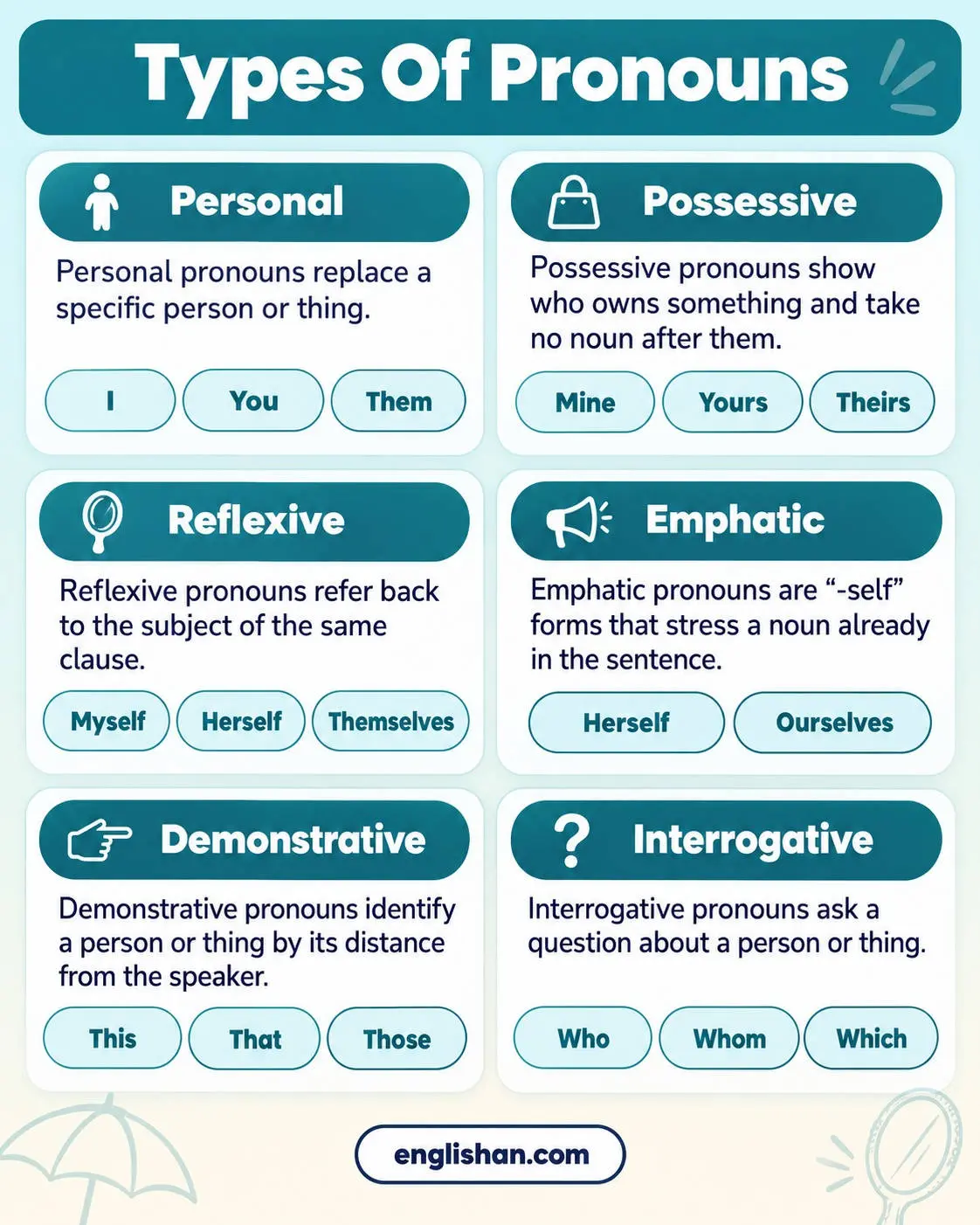
What Are The Types Of Pronouns?
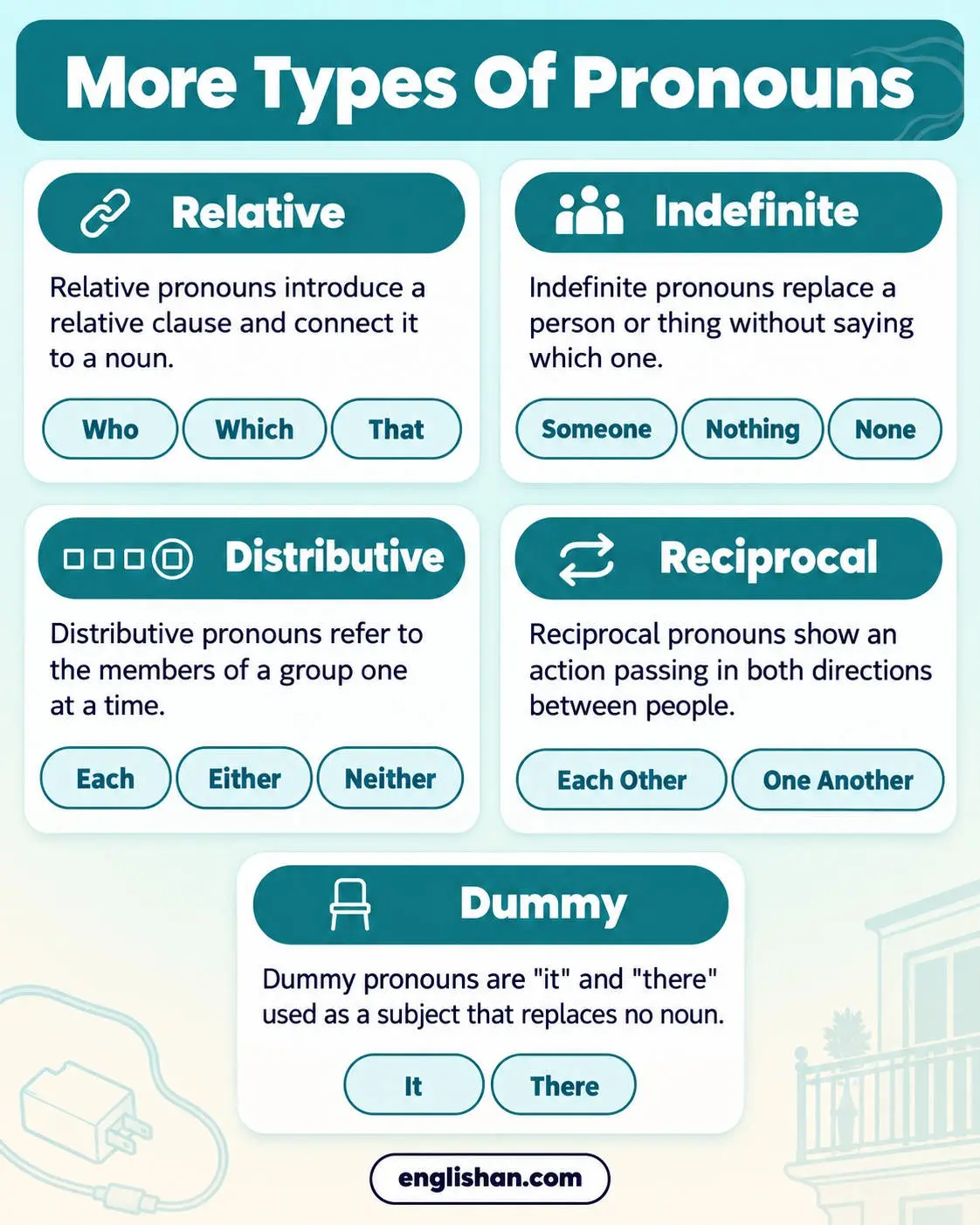
The types of pronouns differ in the job of their words in a sentence. Within a type, the words follow the same grammar rule, such as the case they take or the verb they agree with.
Personal Pronouns
Personal pronouns are pronouns that replace a specific person or thing and change form for person, number, and case. The subject forms are “I”, “you”, “he”, “she”, “it”, “we”, and “they”, and the object forms are “me”, “you”, “him”, “her”, “it”, “us”, and “them”.
- They booked a table for eight.
- The manager thanked us after the meeting.
A personal pronoun after a preposition takes the object form, even when it comes second in a pair.
Between you and I, the price is too high. ❌
Between you and me, the price is too high. ✅
The word “between” is a preposition, so the pronoun after it is the object form “me”.
Possessive Pronouns
Possessive pronouns are pronouns that show who owns something and have no noun after them: “mine”, “yours”, “his”, “hers”, “ours”, and “theirs”. They replace a whole noun phrase, so “mine” replaces “my umbrella”.
- That umbrella is mine.
- Our flat is smaller than theirs.
The forms “yours”, “hers”, “ours”, and “theirs” take no apostrophe, although they end in “s”.
Is this charger your’s? ❌
Is this charger yours? ✅
Possessive pronouns are complete forms, and an apostrophe belongs to possessive nouns such as “Sam’s”.
Reflexive Pronouns
Reflexive pronouns are pronouns that end in “-self” or “-selves” and refer back to the subject of the same clause: “myself”, “yourself”, “himself”, “herself”, “itself”, “oneself”, “ourselves”, “yourselves”, and “themselves”.
- Nadia taught herself to code.
- The children dressed themselves for school.
A reflexive pronoun refers to a subject in its own clause, so it cannot replace “me” in a request where “I” is not the subject.
Please send the file to myself. ❌
Please send the file to me. ✅
The subject of the request is “you”, so the object form “me” is correct after “to”.
Emphatic Pronouns
Emphatic pronouns, also called intensive pronouns, are the “-self” and “-selves” forms used to stress a noun or pronoun already in the sentence. Their forms are the same as the reflexive forms, but the sentence is complete without them.
- The chef herself served the dessert.
- We painted the kitchen ourselves.
To find the type of a “-self” word, take it out of the sentence: an emphatic pronoun leaves a complete sentence behind, and a reflexive pronoun leaves a verb with no object.
Demonstrative Pronouns
Demonstrative pronouns are pronouns that identify a specific person or thing by its distance from the speaker: “this” and “these” for something near, and “that” and “those” for something farther away. The singular forms are “this” and “that”, and the plural forms are “these” and “those”.
- This is my desk, and those are the spare chairs.
- Can you pass me that?
A demonstrative pronoun has no noun after it, and with a noun after it, as in “this desk”, the same word is a determiner.
Interrogative Pronouns
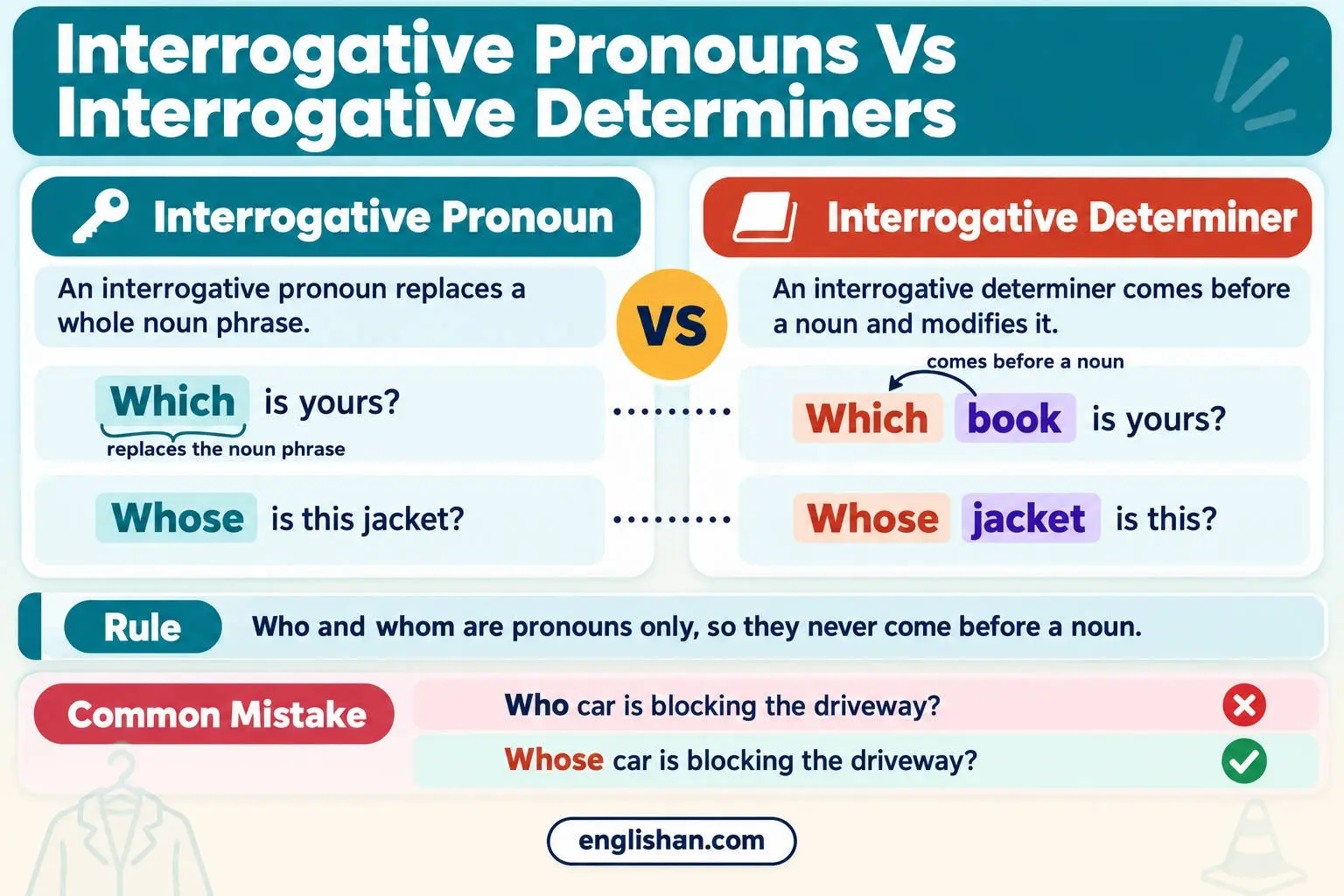
Interrogative pronouns are pronouns that ask a question about a person or thing: “who”, “whom”, “whose”, “what”, and “which”. In formal writing, “who” is the subject form and “whom” is the object form, and in everyday speech “who” is usual in both positions.
- Who left the lights on?
- Which of these coats is yours?
Relative Pronouns
Relative pronouns are pronouns that introduce a relative clause and connect it to a noun earlier in the sentence: “who”, “whom”, “whose”, “which”, and “that”. The pronoun “who” refers to people, “which” to things, and “that” to people or things.
- The nurse who helped us was very kind.
- I lost the charger that came with my phone.
In American English, “that” usually introduces a clause that identifies the noun, and “which” introduces extra information after a comma, as in “My phone, which is new, has no charger.”
Indefinite Pronouns
Indefinite pronouns are pronouns that replace a person, thing, or amount without saying which one, such as “someone”, “everybody”, “nothing”, “all”, “some”, “many”, and “none”. The ones ending in “-one”, “-body”, and “-thing” take a singular verb, even when they mean a large number of people.
- Someone is waiting at the door.
- Several of the trains were late.
Everybody in my class like the new teacher. ❌
Everybody in my class likes the new teacher. ✅
The pronoun “everybody” is singular, so the verb takes the “-s” form of the present simple.
Distributive Pronouns
Distributive pronouns are pronouns that refer to the members of a group one at a time: “each”, “either”, and “neither”. The pronouns “either” and “neither” refer to one of two, and as subjects all three take a singular verb.
- Each of the rooms has a balcony.
- I liked both jackets, but neither was in my size.
Reciprocal Pronouns
Reciprocal pronouns are pronouns that show an action passing in both directions between people or things: “each other” and “one another”. They refer back to a plural noun or pronoun, because at least two people or things take part in the action.
- Tom and Ana text each other every morning.
- The players congratulated one another after the match.
A reciprocal pronoun and a reflexive pronoun change the meaning of the same sentence:
The twins blamed themselves. (each twin blamed himself or herself) ✅
The twins blamed each other. (each twin blamed the other) ✅
Dummy Pronouns
Dummy pronouns are “it” and “there” used as the subject of a sentence when they replace no noun. The pronoun “it” is the subject of sentences about weather, time, and distance, and “there” introduces something that exists.
- It is almost midnight.
- There are two seats by the window.
After “there”, the verb agrees with the noun that follows it, so “two seats” takes “are”.
Is very cold today. ❌
It is very cold today. ✅
In standard English, a statement has a subject, so the dummy subject “it” comes before “is”.
Types Of Pronouns Chart
The types of pronouns each have a fixed set of words, and several words appear in more than one type.
| Type | Words | Job In The Sentence |
|---|---|---|
| Personal | I, me, you, he, him, she, her, it, we, us, they, them | Replaces a specific person or thing |
| Possessive | Mine, yours, his, hers, ours, theirs | Shows the owner, with no noun after it |
| Reflexive | Myself, yourself, himself, herself, itself, oneself, ourselves, yourselves, themselves | Refers back to the subject |
| Emphatic | The reflexive forms | Stresses a noun already in the sentence |
| Demonstrative | This, that, these, those | Shows something near or far |
| Interrogative | Who, whom, whose, what, which | Asks a question |
| Relative | Who, whom, whose, which, that | Introduces a relative clause |
| Indefinite | Someone, anyone, everyone, no one, somebody, anybody, everybody, nobody, something, anything, everything, nothing, all, some, none, both, few, many, several | Replaces an unnamed person, thing, or amount |
| Distributive | Each, either, neither | Refers to members one at a time |
| Reciprocal | Each other, one another | Shows a two-way action |
| Dummy | It, there | Acts as the subject and replaces no noun |
Pronoun Forms
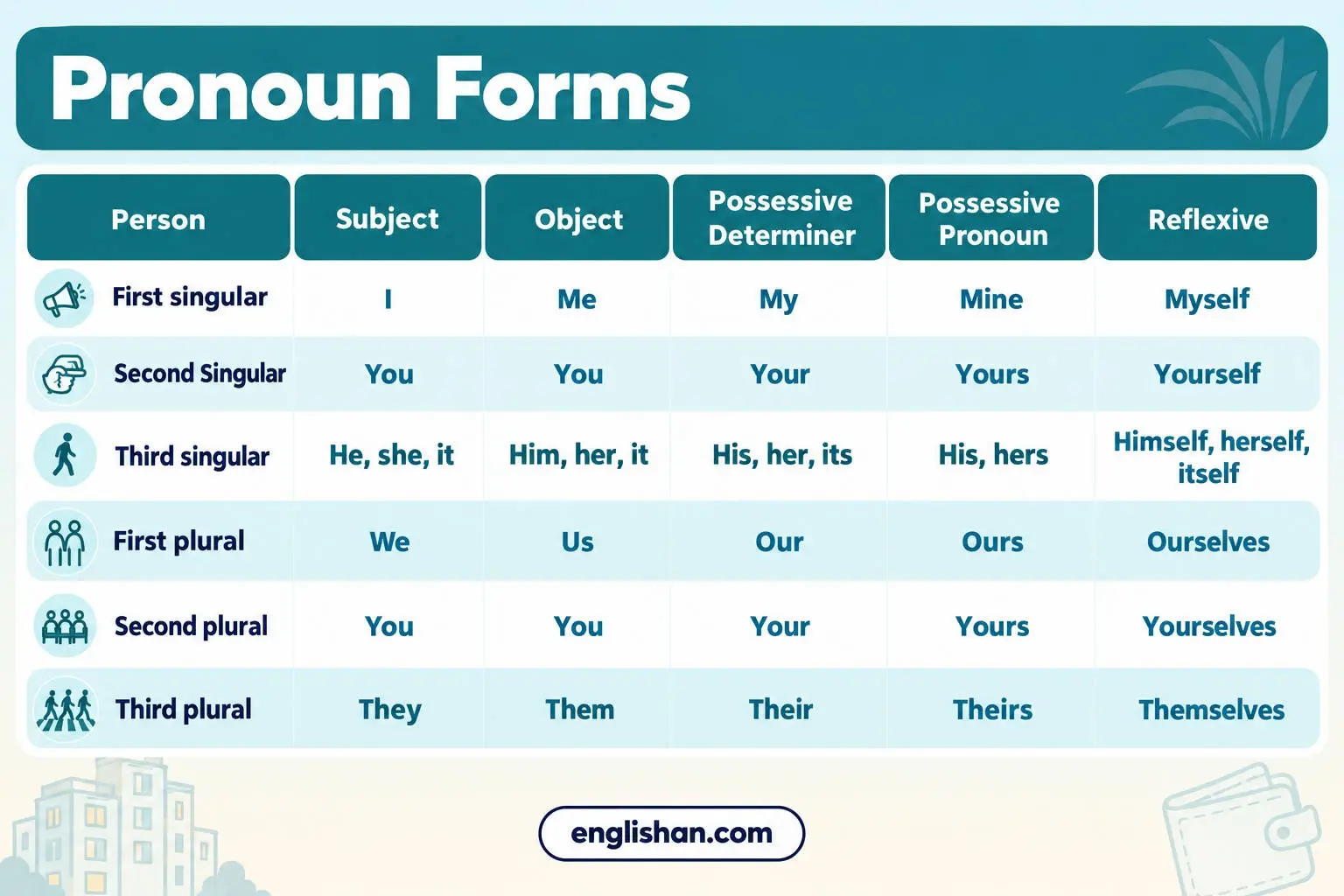
Personal pronouns change form for case, so each person has a subject form, an object form, two possessive forms, and a reflexive form.
| Person | Subject | Object | Possessive Determiner | Possessive Pronoun | Reflexive |
|---|---|---|---|---|---|
| First singular | I | Me | My | Mine | Myself |
| Second singular | You | You | Your | Yours | Yourself |
| Third singular | He, she, it | Him, her, it | His, her, its | His, hers | Himself, herself, itself |
| First plural | We | Us | Our | Ours | Ourselves |
| Second plural | You | You | Your | Yours | Yourselves |
| Third plural | They | Them | Their | Theirs | Themselves |
The subject form comes before the verb, and the object form comes after a verb or a preposition. Pronouns of other types can be subjects as well, as in “Everyone agreed” and “Who called?”
- She sent the invoice on Monday.
- The client paid her on Friday.
Type Of Pronoun By Word
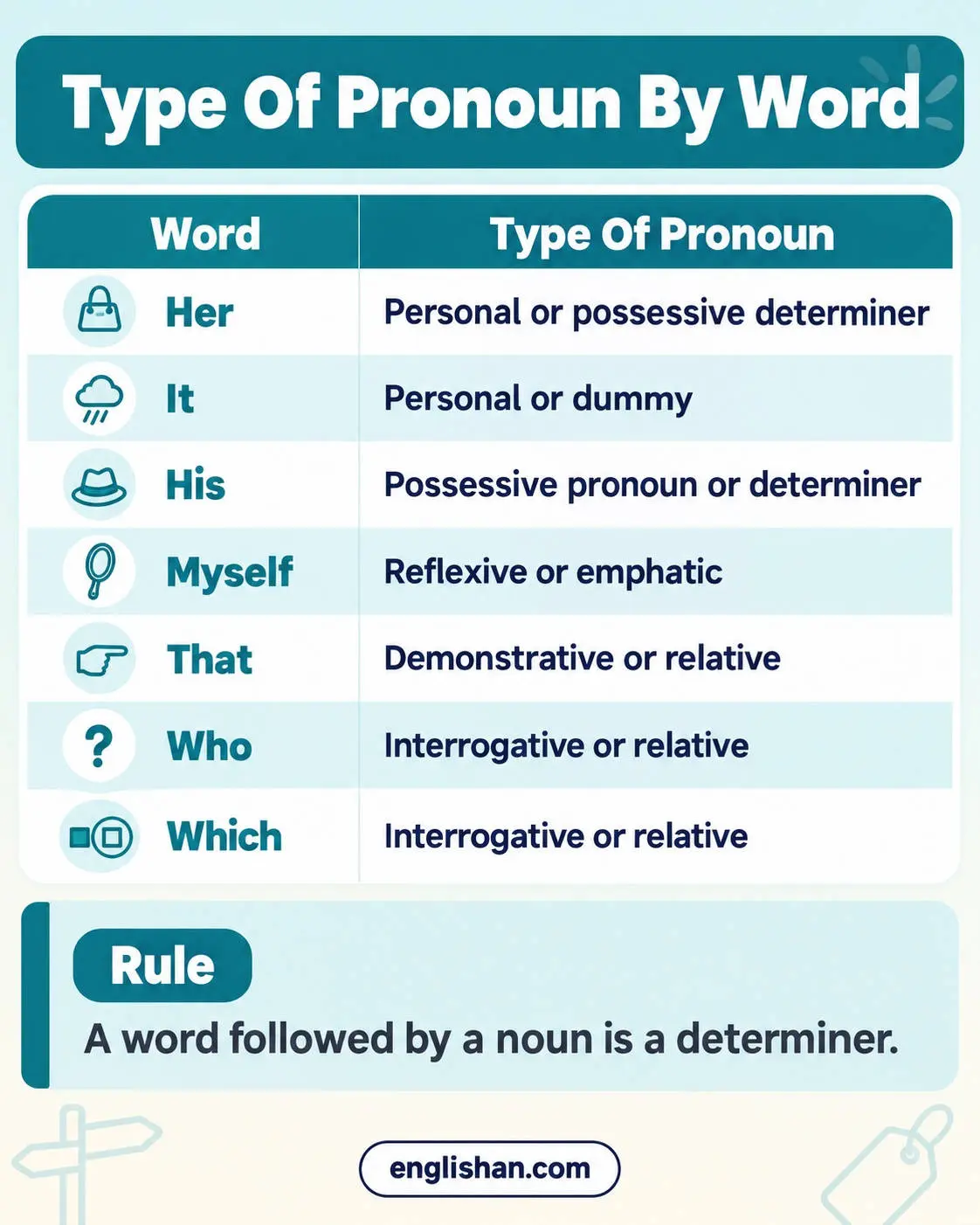
Most pronouns belong to one type, and a few common words, such as “that” and “who”, belong to two.
| Word | Type Of Pronoun | Note |
|---|---|---|
| I, me | Personal | First person singular, subject and object |
| We, us | Personal | First person plural, subject and object |
| You | Personal | Same form as subject and object |
| He, him, she | Personal | Third person singular |
| Her | Personal or possessive determiner | Personal after a verb; determiner before a noun |
| It | Personal or dummy | Dummy when it replaces no noun |
| They, them | Personal | Third person plural; also replaces “someone” or “everyone” |
| My, your, its, our, their | Possessive determiners | Come before a noun; also called possessive adjectives |
| His | Possessive pronoun or determiner | Same form with or without a noun after it |
| Mine, yours, hers, ours, theirs | Possessive | No noun after them |
| Myself, yourself, himself, herself, themselves | Reflexive or emphatic | Reflexive as an object; emphatic for stress |
| This, these, those | Demonstrative | Determiner when a noun follows |
| That | Demonstrative or relative | Relative after a noun with a clause |
| Who | Interrogative or relative | Interrogative in a question; relative after a noun |
| Whose | Interrogative or relative | Shows the owner in both uses |
| Which | Interrogative or relative | Relative after a noun with a clause |
| Everyone, someone | Indefinite | Take a singular verb |
| Each | Distributive | Takes a singular verb |
| Each other | Reciprocal | Two-way action |
| There | Dummy | Introduces something that exists |
Where a word has two possible types, look at the words around it. A word followed by a noun is a determiner, a word that introduces a clause after a noun is a relative pronoun, and “who”, “whose”, or “which” at the start of a direct question is interrogative.
Pronouns And Determiners
Several pronoun words also function as determiners, but a pronoun replaces a noun phrase and a determiner comes before a noun. Words such as “this”, “that”, “which”, “each”, “some”, and “many” are pronouns when they have no noun after them and determiners when a noun follows them.
- I’ll take this. (pronoun)
- I’ll take this bag. (determiner)
- Which do you want? (pronoun)
- Which bus goes downtown? (determiner)
Before a noun, “this” and “my” are determiners, also called demonstrative adjectives and possessive adjectives. The possessive determiners “my”, “your”, “our”, and “their” always come before a noun, and “mine”, “yours”, “ours”, and “theirs” are the pronouns that replace the whole phrase.
This pen is my. ❌
This pen is mine. ✅
The word “my” comes before a noun, so a pronoun with no noun after it takes the form “mine”.
FAQs
There are eight main types of pronouns, and eleven when emphatic, distributive, and dummy pronouns are counted as types. A count of seven leaves out reciprocal pronouns, and a count of twelve splits personal pronouns into subject pronouns and object pronouns.
No, a pronoun is a separate part of speech, although it functions as a subject, object, or complement in the same way as a noun phrase. Unlike a noun, a pronoun rarely takes an article or an adjective before it, so "the tall woman" is correct but "the tall she" is not.
No, many pronouns refer to things, animals, places, and ideas. The pronouns "it", "which", "something", and "nothing" usually replace things, while "who" and "whom" replace people.
Indefinite pronouns ending in "-one", "-body", and "-thing" are always singular, along with "each", "either", "neither", "one", and "another". In formal English they take a singular verb, as in "Neither of the answers is correct."
The indefinite pronouns "both", "few", "many", "several", and "others" are always plural, and so are "we", "these", "those", and "ourselves". The pronouns "some", "all", "any", "most", and "none" take a singular or a plural verb depending on the noun they replace, as in "Some of the cake is left" and "Some of the guests are late."
Related:
- Personal Pronouns Examples
- Possessive Pronouns Examples
- Reflexive Pronoun Examples
- Reflexive and Intensive Pronouns
- Indefinite Pronouns Examples
- Relative Clauses
- Who’s vs Whose
- Whoever vs Whomever
- Common Pronoun Errors
- Object Pronouns
- Pronoun Case
- Pronoun vs Adjective