

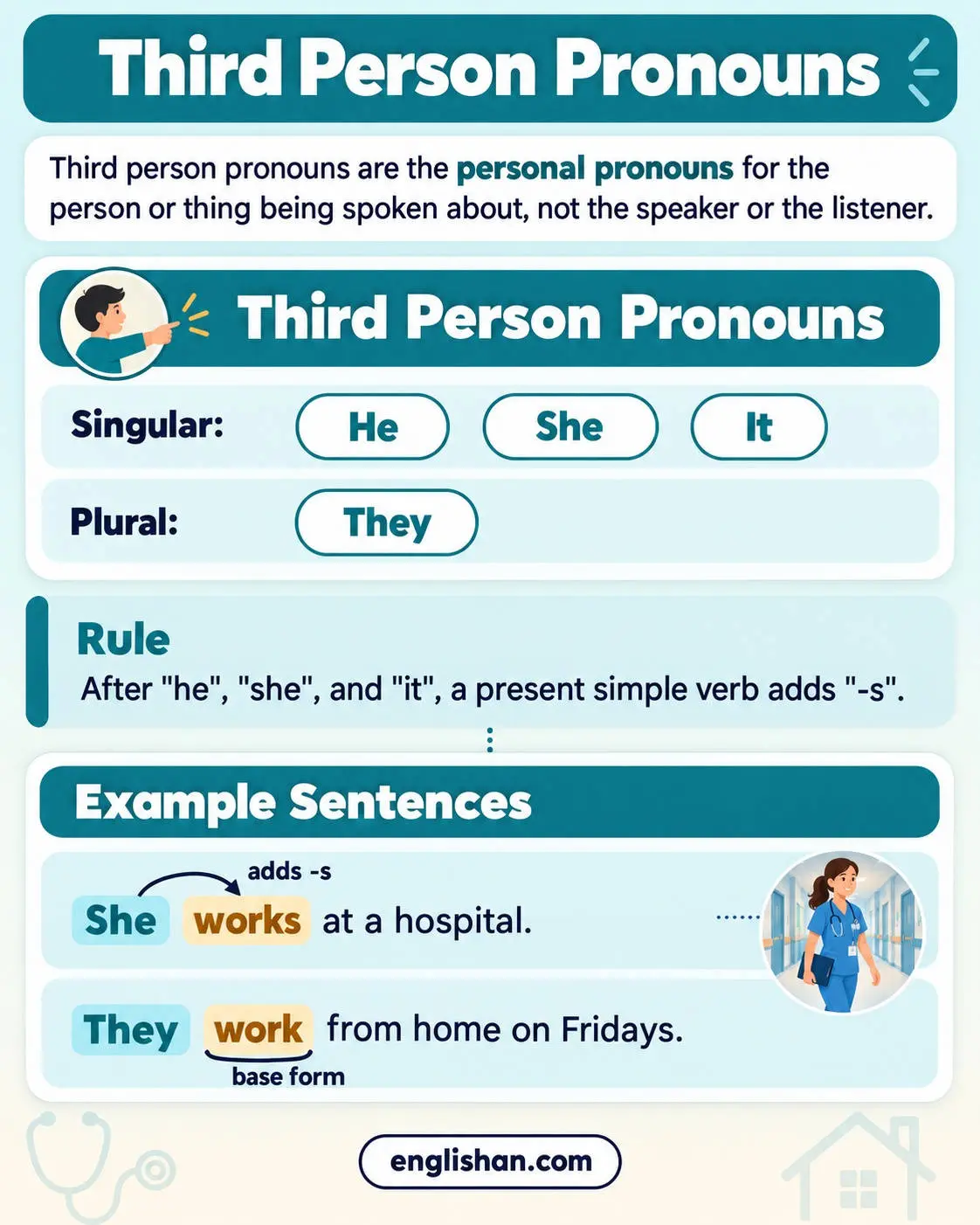
Third person pronouns are the personal pronouns for the person or thing being spoken about, not the speaker or the listener. The singular forms are “he”, “she”, and “it”, and the plural form is “they”. Like other personal pronouns, they change form for the object, the possessive, and the reflexive, so “he” becomes “him”, “his”, and “himself”.
In “Maya called her brother, and he answered at once”, the pronoun “he” replaces “her brother”, the person Maya is talking about. The choice between “he”, “she”, “it”, and “they” depends on the noun the pronoun replaces: its number and, in the singular, whether it names a man, a woman, or a thing.
What Are Third Person Pronouns?
Third person pronouns are pronouns that refer to someone or something other than the speaker and the listener. In grammar, “person” shows who is involved in the conversation: the first person is the speaker (“I”, “we”), the second person is the listener (“you”), and the third person is everyone and everything else.
A third person pronoun usually replaces a noun that the listener already knows, called its antecedent. The antecedent can come earlier in the same sentence or in a sentence before it.
- My neighbor has a new puppy, and she walks it twice a day.
- The printer is jammed again. It needs a new part.
- Leo and Ana were late because they missed the bus.
- Did the plumber say when he would come back?
The pronoun replaces the noun, so the noun and the pronoun do not both function as the subject of the same verb.
My sister she lives in Denver. ❌
My sister lives in Denver. ✅
The subject of “lives” is already “my sister”, so a second subject “she” is not needed.
List Of Third Person Pronouns
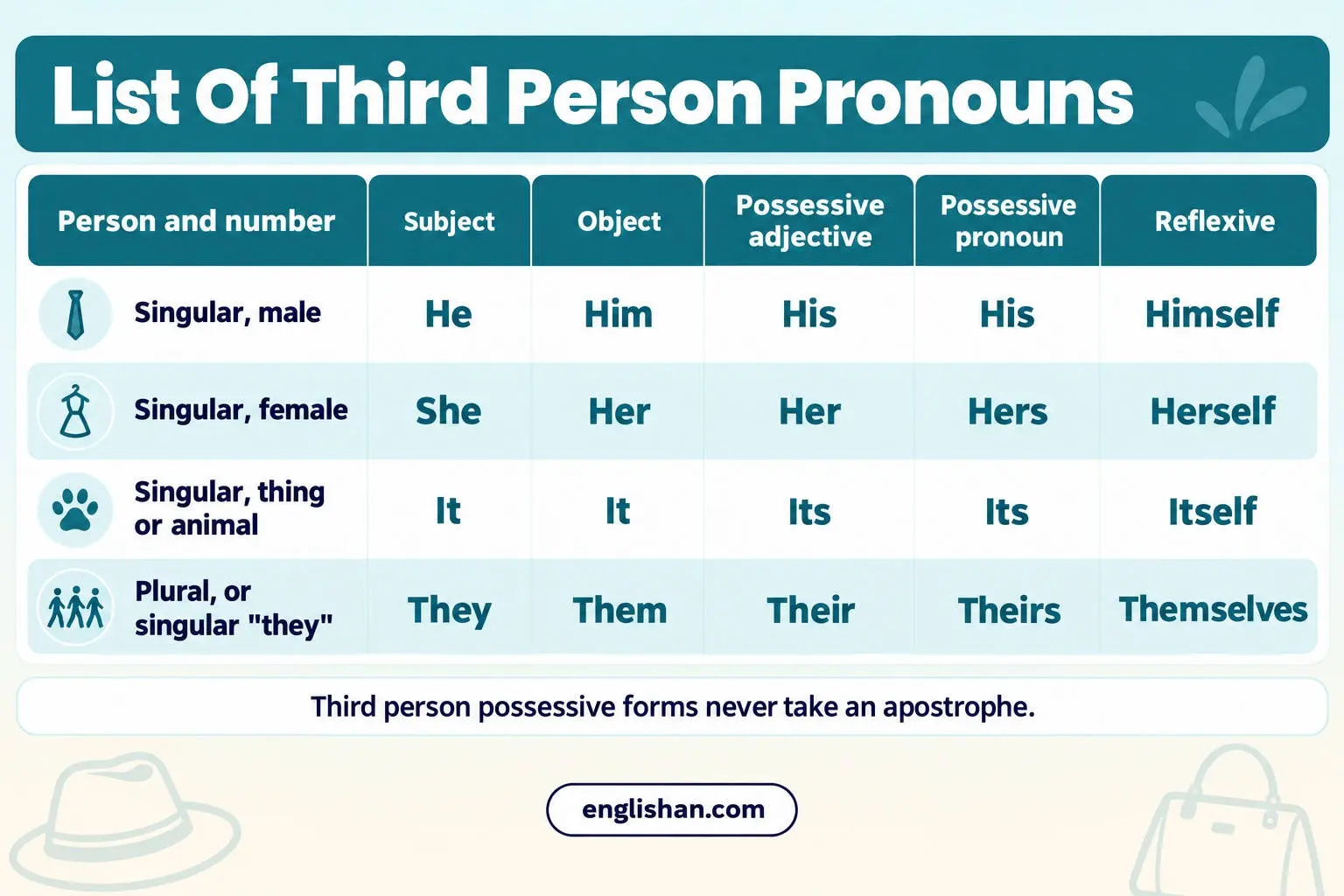
Third person personal pronouns have five forms, and the form depends on the function of the pronoun in the sentence.
| Person and number | Subject | Object | Possessive adjective | Possessive pronoun | Reflexive |
|---|---|---|---|---|---|
| Singular, male | He | Him | His | His | Himself |
| Singular, female | She | Her | Her | Hers | Herself |
| Singular, thing or animal | It | It | Its | Its (rare) | Itself |
| Plural, or singular “they” | They | Them | Their | Theirs | Themselves |
The examples come from one family moving house.
- She packed the kitchen boxes on Friday.
- The movers lifted them onto the truck.
- Tom wrote his name on the lamp box.
- The blue suitcase is hers.
- Our cat hid under the bed, and its bowl stayed in the car.
- The children carried the toys themselves.
The pronoun “it” has the same subject and object form, and “her” functions both as the object and as the possessive adjective. In both cases, the position in the sentence shows the function: “her” before a noun is possessive (“her keys”), and “her” after a verb is the object (“I called her”).
Third Person Singular Pronouns
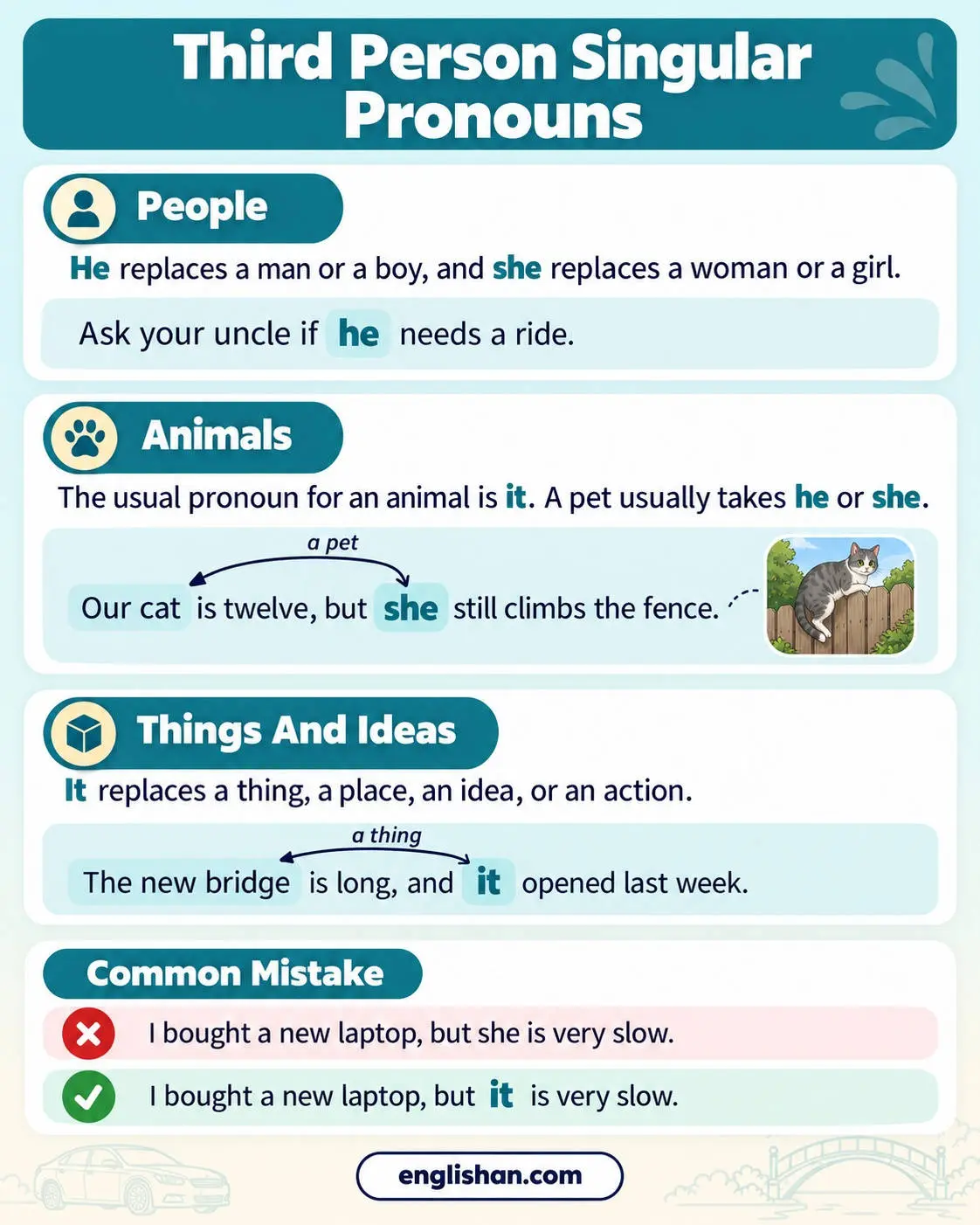
Third person singular pronouns replace one person, animal, or thing, and there are three of them: “he”, “she”, and “it”.
People: The pronoun “he” replaces a man or a boy, and “she” replaces a woman or a girl.
- Ask your uncle if he needs a ride.
- My manager said she would call back after lunch.
Animals: The usual pronoun for an animal is “it”. A pet, or any animal whose sex you know, usually takes “he” or “she”.
- A spider built its web across the window.
- Our cat is twelve, but she still climbs the fence.
Things and ideas: The pronoun “it” replaces a thing, a place, an idea, or an action.
- The new bridge is long, and it opened last week.
- Learning to drive was hard, but it was worth the effort.
Nouns for things have no gender in English, so a laptop, a city, or a table takes “it”.
I bought a new laptop, but she is very slow. ❌
I bought a new laptop, but it is very slow. ✅
The noun “laptop” names a thing, and a thing takes “it”.
Third Person Plural Pronouns
The third person plural pronoun is “they”, with the forms “them”, “their”, “theirs”, and “themselves”. The same plural pronoun replaces “he”, “she”, and “it” alike, so a group of women, a group of men, and a pile of books all take “they”.
- My parents are retired, so they travel a lot.
- These shoes hurt, so I gave them to my brother.
- The players and their coach flew home on Sunday.
- Are the keys in the drawer, or did you leave them in the car?
The pronoun “them” functions only as an object. Before a noun, the demonstrative for things farther away is “those”.
Them boxes are heavy. ❌
Those boxes are heavy. ✅
The plural noun “boxes” takes the demonstrative “those” before it.
Singular They As A Third Person Pronoun
Singular “they” is the use of “they”, “them”, and “their” for one person whose gender is unknown or not stated. It usually replaces a word such as “someone”, “anyone”, “a student”, or “the caller”.
- Someone left their umbrella by the door.
- If a customer calls, ask them to leave a number.
- The winner will receive their prize on Friday.
- Whoever booked the room forgot to sign their name.
Singular “they” takes a plural verb, like plural “they”, even when it refers to one person. The verb forms are “they are”, “they were”, “they have”, and “they work”.
My new roommate says they is from Ohio. ❌
My new roommate says they are from Ohio. ✅
The verb agrees with the form “they”, so it is “are” for one person or for several.
The reflexive of singular “they” is usually “themselves”, as in “Someone hurt themselves on the stairs”, and “themself” is also used for one person.
Third Person Subject And Object Pronouns
Third person subject pronouns function as the subject of a verb, and third person object pronouns function as the object of a verb or a preposition. The subject forms are “he”, “she”, “it”, and “they”, and the object forms are “him”, “her”, “it”, and “them”.
- He called her last night.
- They invited him to the wedding.
- The package on the stairs is for them.
- She sat between Ana and him at dinner.
A pronoun joined to a noun with “and” keeps the form it would have alone: “He went fishing”, so “He and Leo went fishing”.
Him and Leo went fishing. ❌
He and Leo went fishing. ✅
The pronoun is part of the subject, so it takes the subject form “he”.
The change from “he” to “him” is called pronoun case. Among the third person pronouns, only “it” has one form for subject pronouns and object pronouns.
Third Person Possessive Pronouns
Third person pronouns have two possessive forms. A possessive adjective comes before a noun (“his car”, “her desk”, “its roof”, “their house”), and a possessive pronoun replaces the noun (“his”, “hers”, “theirs”).
- That jacket is hers, not mine.
- The car is his, but the bikes are theirs.
- Their garden is bigger than ours.
- The hotel changed its name last year.
The word “his” is the same before a noun and alone, as in “his bag” and “The bag is his”. The possessive “its” almost always comes before a noun as a possessive adjective.
Third person possessive forms never take an apostrophe, so “hers” and “theirs” are correct and “her’s” and “their’s” are not.
The company lost it’s biggest client. ❌
The company lost its biggest client. ✅
The form “it’s” is short for “it is” or “it has”, and the possessive is “its” with no apostrophe.
Third Person Reflexive Pronouns
Third person reflexive pronouns end in “-self” in the singular (“himself”, “herself”, “itself”) and “-selves” in the plural (“themselves”). We use them when the object is the same person or thing as the subject, or to emphasize the subject.
- Jake cut himself while he was cooking.
- The door locks itself at night.
- My grandmother built the shed herself.
- The kids made breakfast themselves.
The forms “himself” and “themselves” are built on the object forms “him” and “them”, so “hisself” and “theirselves” are not standard English.
He taught hisself to play the guitar. ❌
He taught himself to play the guitar. ✅
The reflexive for “he” is “himself”, formed from “him”.
Verb Agreement With Third Person Pronouns
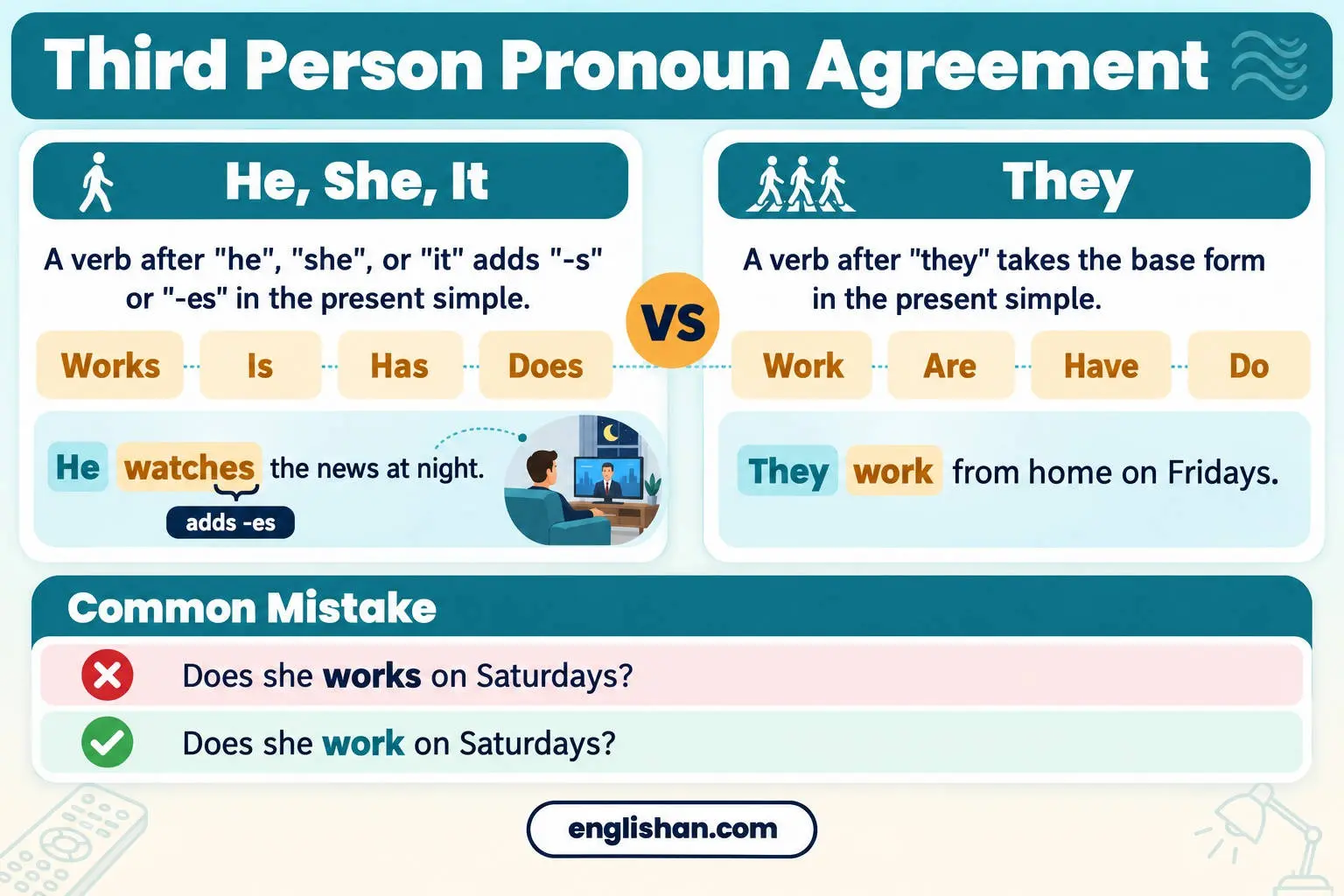
In the present simple, a verb after “he”, “she”, or “it” adds “-s” or “-es”, and a verb after “they” takes the base form.
- She works at a hospital.
- He watches the news at night.
- It rains a lot here in April.
- They work from home on Fridays.
My brother live in Texas. ❌
My brother lives in Texas. ✅
The subject “my brother” is third person singular, like “he”, so the verb adds “-s”.
The verbs “be”, “have”, “do”, and “go” change form after “he”, “she”, and “it”.
| Verb | He, she, it | They |
|---|---|---|
| Be (present) | Is | Are |
| Be (past) | Was | Were |
| Have | Has | Have |
| Do | Does | Do |
| Go | Goes | Go |
In present simple negatives and questions, the auxiliary “does” takes the “-s”, so the main verb stays in its base form.
- She doesn’t eat meat.
- Does he drive to work?
Does she works on Saturdays? ❌
Does she work on Saturdays? ✅
The auxiliary “does” already shows the third person singular, so “work” has no “-s”.
In the past simple and with modal verbs, the verb has one form for every person, as in “she worked”, “they worked”, and “he can swim”. The one exception is the past of “be”: “he was” but “they were”.
Third Person Nouns And Pronouns
Nouns are third person, so a noun subject takes the same verb form as the pronoun that replaces it: “My brother lives in Texas” and “He lives in Texas”. Most other pronouns are third person too, including indefinite pronouns such as “someone” and “nothing”, demonstrative pronouns such as “this”, and “who” in questions.
- Everyone knows the answer.
- Somebody has taken my seat.
- Nothing was missing from the bag.
- This is my favorite song.
- Who wants more coffee?
Indefinite pronouns ending in “-one”, “-body”, and “-thing” take a singular verb, although “everyone” means many people.
Everyone have finished the test. ❌
Everyone has finished the test. ✅
The pronoun “everyone” is third person singular, so it takes “has”.
The personal pronouns that are not third person are the pronouns for the speaker and the listener. First person pronouns (“I”, “me”, “we”) are the forms for the speaker. Second person pronouns (“you”, “your”, “yours”) are the forms for the listener, singular or plural.
FAQs
No, "we" is a first person plural pronoun, because it includes the speaker. The pronoun "you" is not third person either, since it refers to the listener or listeners. The third person plural pronoun is "they".
There are four third person subject pronouns: "he", "she", "it", and "they". With their object, possessive, and reflexive forms, the full set has sixteen different words, from "he" and "him" to "theirs" and "themselves".
Yes, "their" is the third person plural possessive, and it is also the possessive of singular "they". It comes before a noun, as in "their car", so it is a possessive adjective. The form that replaces the noun is "theirs".
Yes, "it" is the third person singular pronoun for a thing, an animal, or an idea, as in "The printer is broken, so it needs a new part". It takes a singular verb, and its forms are "it", "its", and "itself".
Related:
- Types of Pronouns
- Singular and Plural Pronouns
- Common Pronoun Errors
- Pronoun Antecedent Agreement
- Pronoun and Verb Agreement
- Subject vs Object Pronouns
- Pronoun Shift