

Pronoun case is the form a pronoun takes to show its function in a sentence: the subject, the object, or the owner of something. There are three cases in English: the subjective case, the objective case, and the possessive case, so one person can appear as “I”, “me”, or “my” depending on the job of the word.
Only the personal pronouns, “who”, and “whoever” have separate forms for these jobs. Most other pronouns keep one form as subject and object, which is why case mistakes nearly always involve pairs such as “I” and “me”, “he” and “him”, or “who” and “whom”. The choice between those pairs depends on the function of the pronoun in its own clause.
What Is Pronoun Case?
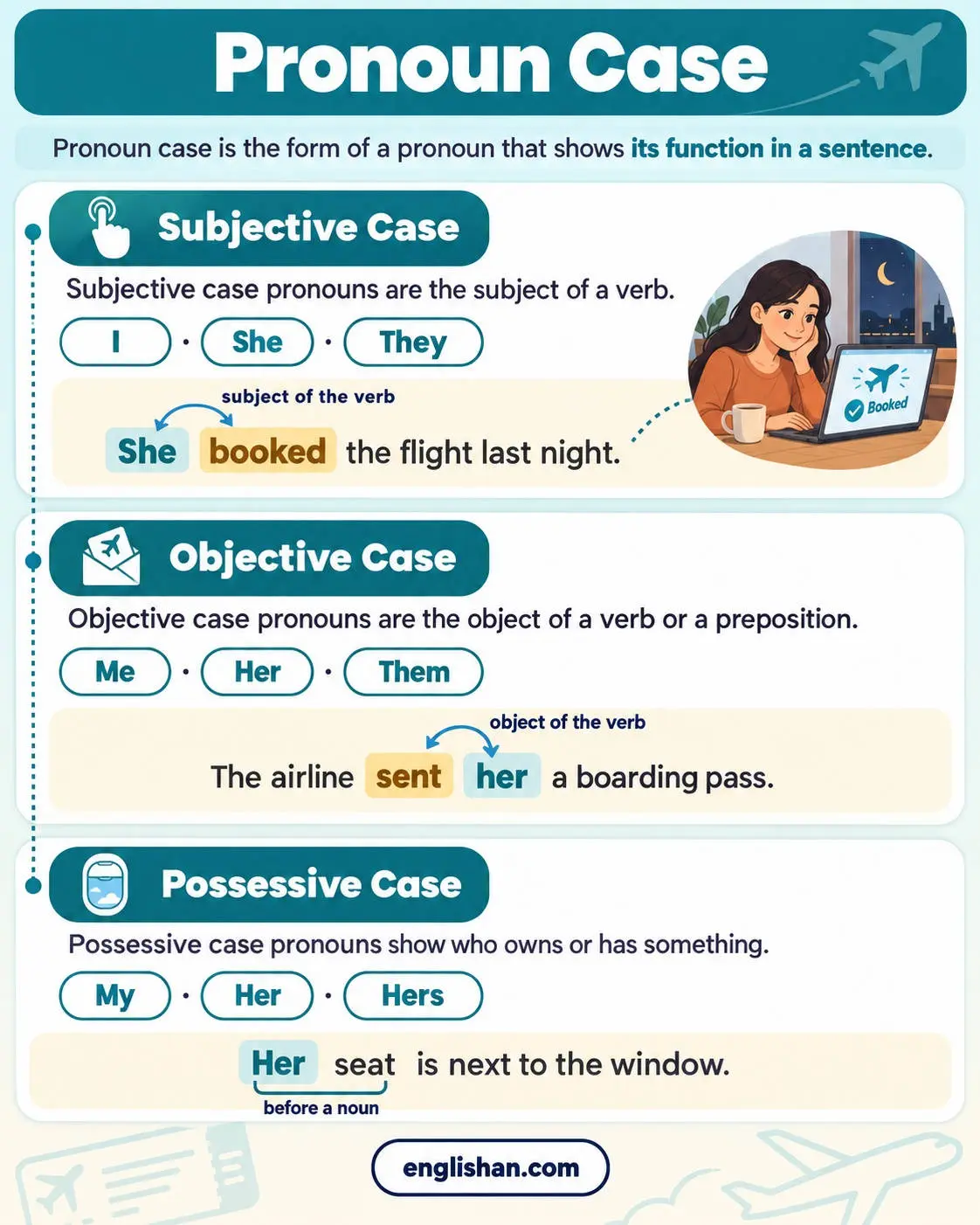
Pronoun case depends on the function of the pronoun in the clause, not on the person it refers to. The subject of a verb is in the subjective case, and the object of a verb or a preposition is in the objective case. A pronoun that names the owner is in the possessive case. The same person takes all three forms in one short scene at an airport:
- She booked the flight last night.
- The airline sent her a boarding pass.
- Her seat is next to the window.
Word order alone does not tell you the case. In “Did she book the flight?”, the pronoun “she” comes after the auxiliary “did”, but it is still the subject of “book”, so it keeps the subjective form.
Pronoun Case Chart
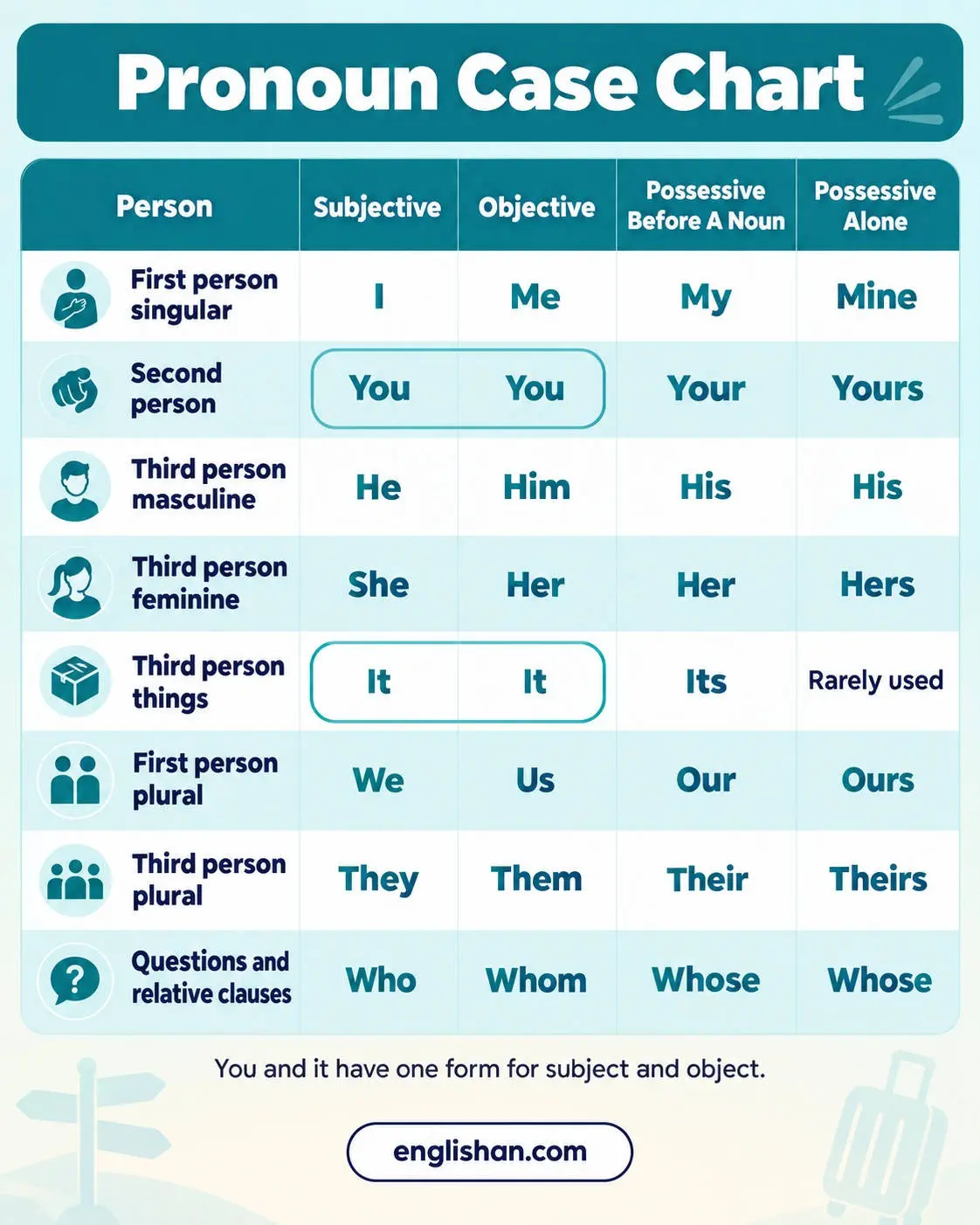
The personal pronouns and “who” are the pronouns with a full set of pronoun case forms:
| Person and number | Subjective case | Objective case | Possessive before a noun | Possessive standing alone |
|---|---|---|---|---|
| First person singular | I | Me | My | Mine |
| Second person, singular and plural | You | You | Your | Yours |
| Third person singular, masculine | He | Him | His | His |
| Third person singular, feminine | She | Her | Her | Hers |
| Third person singular, things | It | It | Its | Rarely used |
| First person plural | We | Us | Our | Ours |
| Third person plural | They | Them | Their | Theirs |
| Questions and relative clauses | Who | Whom | Whose | Whose |
The pronouns “you” and “it” have one form for both the subjective and the objective case, so they change only in the possessive. The form “her” is in two columns: it is the object in “I called her” and the possessive in “her phone”, and only the noun after it shows the difference.
Most other pronouns have no separate subject and object forms. The demonstratives “this” and “that”, the question words “what” and “which”, and indefinite pronouns such as “someone” and “everybody” stay the same in both positions. Indefinite pronouns form the possessive with an apostrophe and “s”, as in “someone’s umbrella”.
Subjective Case Pronouns
Subjective case pronouns, also called subject pronouns, are the forms “I”, “you”, “he”, “she”, “it”, “we”, “they”, and “who” when the pronoun is the subject of a verb. They usually come before the verb in a statement and after the auxiliary in a question:
- We moved to Denver in March.
- They haven’t replied to the invitation.
- Will he need a ride to the station?
Objective Case Pronouns
Objective case pronouns, also called object pronouns, are the forms “me”, “you”, “him”, “her”, “it”, “us”, “them”, and “whom” when the pronoun is the object of a verb or of a preposition. The pronoun can be a direct object, an indirect object, or the object after words such as “to”, “for”, “with”, and “between”:
- The coach picked me for the final.
- Could you send us the address?
- Rosa sat next to them at the concert.
Possessive Case Pronouns
Possessive case pronouns show who owns or has something, and the possessive case has two kinds of forms. The forms “my”, “your”, “his”, “her”, “its”, “our”, “their”, and “whose” come before a noun and modify it, so they function like adjectives and are also called possessive adjectives. The forms “mine”, “yours”, “his”, “hers”, “ours”, and “theirs” stand alone and replace the whole noun phrase, and these are the possessive pronouns.
- Our neighbors painted their fence green.
- The red bike is mine, and the blue one is yours.
- Whose charger is plugged in by the sofa?
Only the standalone form can end a clause:
This seat is my. ❌
This seat is mine. ✅
At the end of a clause, with no noun after it, the possessive case takes the standalone form.
Rules For Pronoun Case
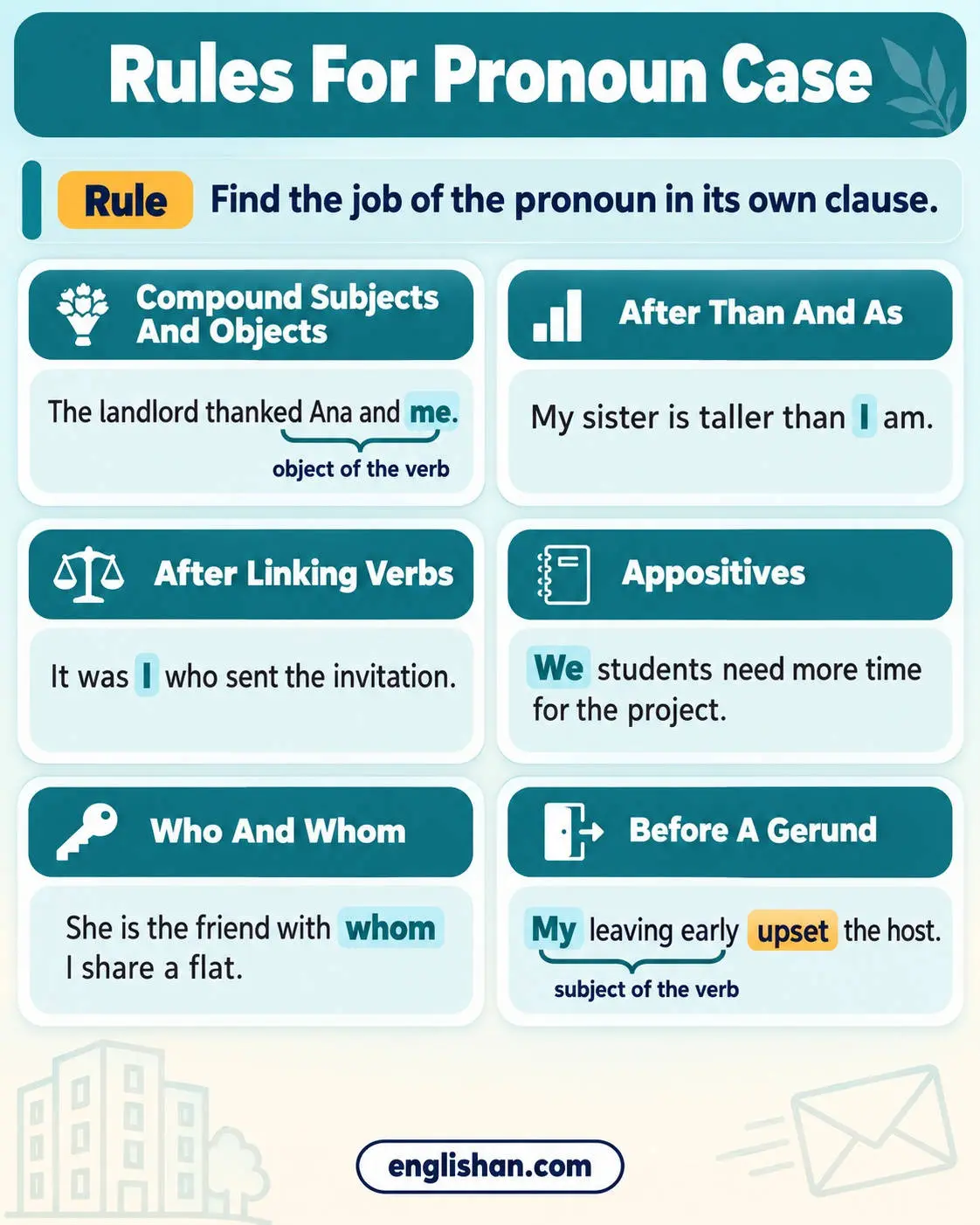
The rule for choosing a pronoun case is to find the job of the pronoun in its own clause. A subject takes the subjective case, an object of a verb or a preposition takes the objective case, and an owner takes the possessive case. The rule is plain in a short sentence such as “She called me”. It is harder to apply when other words separate the pronoun from its verb, or when the verb is left out.
Pronoun Case In Compound Subjects And Objects
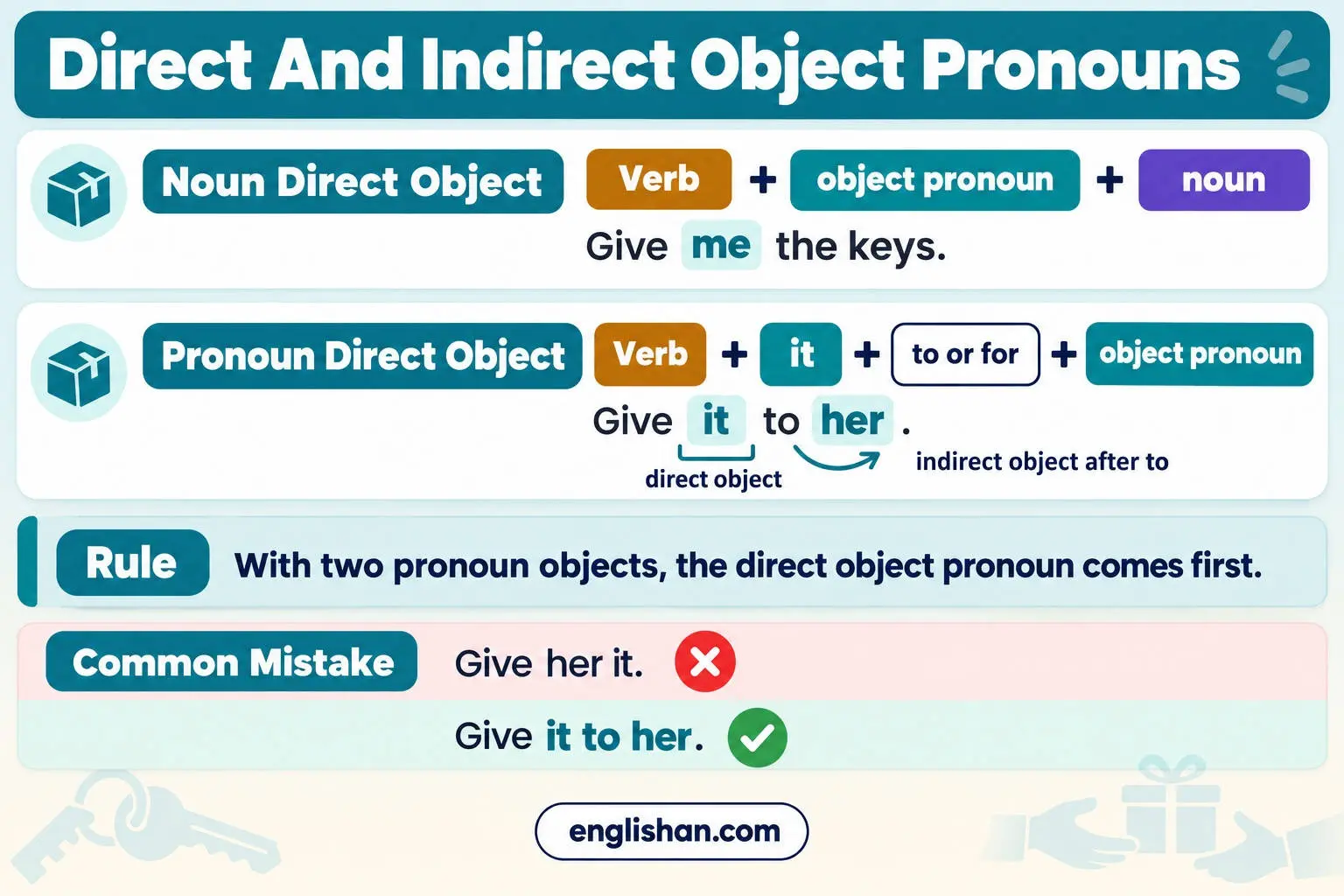
A compound subject or object is two or more nouns or pronouns joined by “and” or “or”, and each pronoun in it takes the case it would take alone:
- Ana and I painted the hallway.
- He and I share an office on the third floor.
- The landlord thanked Ana and me.
- Between you and me, the meeting ran too long.
To choose the form, remove the other person and read the sentence again. The sentences “I painted the hallway” and “The landlord thanked me” both show the correct case.
Me and Ana painted the hallway. ❌
Ana and I painted the hallway. ✅
The pronoun is part of the subject of “painted”, so it takes the subjective case.
The opposite error, “I” after a verb or a preposition, is a habit of avoiding “me” after “and” in every position:
The manager sent the report to Ravi and I. ❌
The manager sent the report to Ravi and me. ✅
The pronoun is the object of the preposition “to”, so it takes the objective case, just as in “sent the report to me”.
Pronoun Case After Than And As
After “than” and “as” in a comparison, the pronoun takes the case it would have in the full clause, even when the verb is left out. In formal writing, a pronoun that is the subject of the missing verb takes the subjective case:
- My sister is taller than I am.
- Nobody on the team trains as hard as she does.
- Nobody on the team trains as hard as her. (everyday English)
When a verb follows the pronoun, only the subjective case is correct, so “taller than I am” is standard and “taller than me am” is not. Without the verb, “taller than me” is standard in everyday speech and most informal writing, while “taller than I” is the formal choice.
The case changes the meaning when the verb before “than” has an object:
- Lena trusts Marco more than I do. (more than I trust Marco)
- Lena trusts Marco more than me. (more than she trusts me)
In a sentence like this, add the verb after the pronoun, because the full clause shows the meaning without doubt.
Pronoun Case After Linking Verbs
After a linking verb such as “be”, the pronoun is a subject complement, a word that renames the subject. A subject complement takes the subjective case in formal writing and the objective case in everyday speech, and both forms are standard in their own settings:
- It was I who sent the invitation. (formal)
- This is she. (formal, on the phone)
- It’s me. Open the door. (everyday)
- That was him in the blue coat. (everyday)
A “who” clause after the pronoun is the position where the subjective form is most common, as in “It was I who sent the invitation”.
Pronoun Case With Appositives
An appositive is a noun or noun phrase placed next to another noun or pronoun to rename it. When “we” or “us” comes directly before a noun, as in “we students” or “us drivers”, the pronoun takes the case of the whole phrase:
- We nurses work long shifts in winter.
- The new schedule affects us nurses most.
- Two people, Mia and I, stayed to clean up.
- The coach chose two players, Mia and me.
To choose between “we” and “us”, drop the noun after the pronoun. The sentences “We work long shifts” and “The new schedule affects us” show the correct forms.
Us students need more time for the project. ❌
We students need more time for the project. ✅
The phrase “we students” is the subject of “need”, so the pronoun takes the subjective case.
Pronoun Case Of Who And Whom
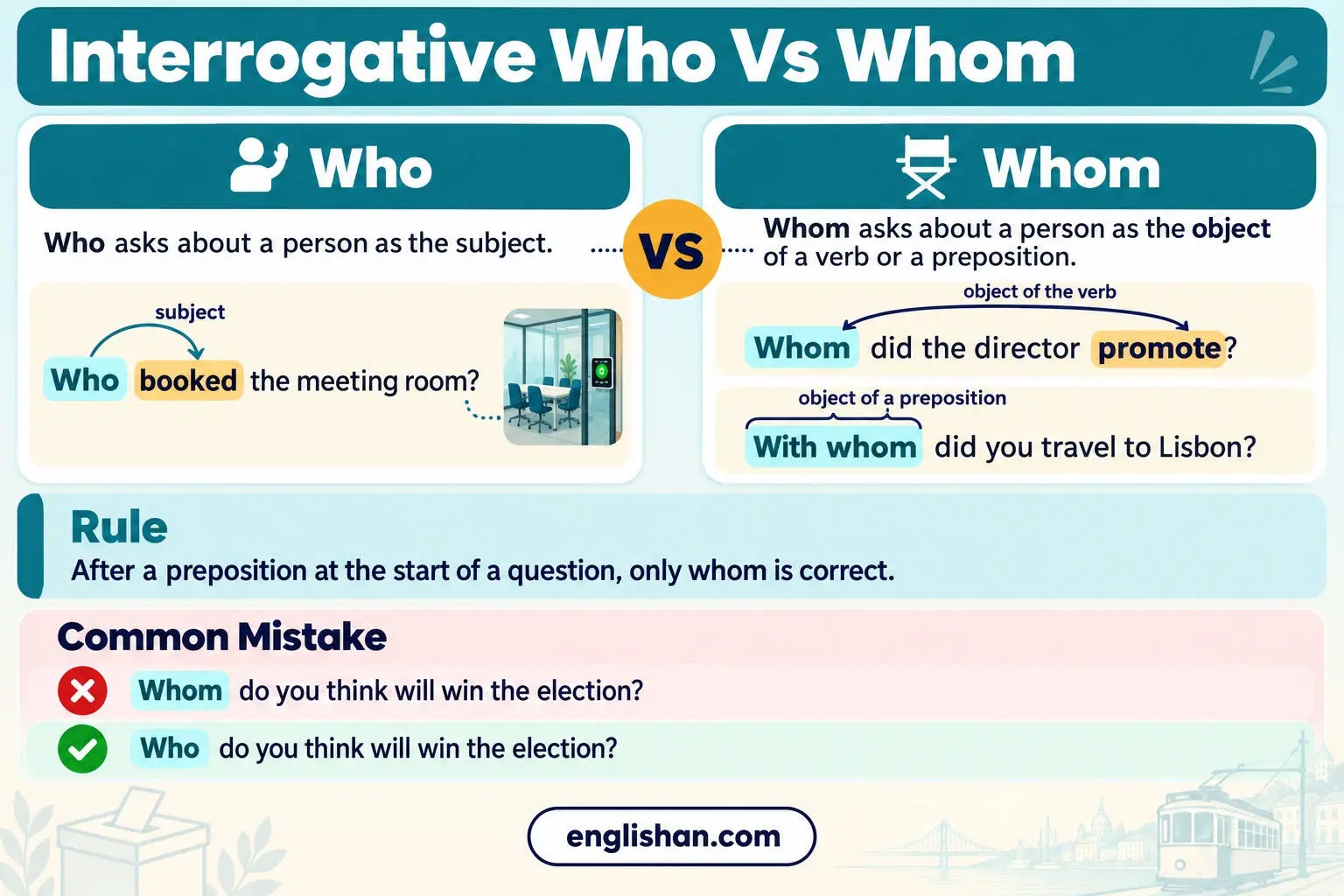
The pronoun “who” is the subjective case, “whom” is the objective case, and “whose” is the possessive case. The choice follows the function of the pronoun in its own clause, in questions and in relative clauses:
- Who fixed the printer? (subject)
- The neighbor whom we invited brought a cake. (object, formal)
- The neighbor who we invited brought a cake. (object, everyday)
- Whose keys are on the table? (possessive)
In everyday speech and writing, “who” is standard in the object position, while “whom” is the usual choice in formal writing. Directly after a preposition, only “whom” is correct.
She is the friend with who I share a flat. ❌
She is the friend with whom I share a flat. ✅
The pronoun is the object of the preposition “with”, so it takes the objective case.
Pronoun Case Before A Gerund
A gerund is the “-ing” form of a verb used as a noun, as in “Swimming relaxes me”. Before a gerund, the standard pronoun case in formal writing is the possessive, and the objective case is common in everyday English:
- The host didn’t mind my leaving early. (formal)
- The host didn’t mind me leaving early. (everyday)
- We appreciated your helping with the move.
- His arriving late delayed the whole meeting.
At the start of a sentence, the gerund phrase is the subject of the verb, and the possessive is the standard form before it:
Me leaving early upset the host. ❌
My leaving early upset the host. ✅
The phrase “my leaving early” is the subject of “upset”, so the pronoun before the gerund takes the possessive case.
The possessive is wrong when the “-ing” word is not a gerund. After verbs such as “see”, “hear”, and “watch”, the pronoun is the object of the verb and the “-ing” form describes it, as in “I watched him leaving the building”. Here “him” is the object of “watched”, so “his” does not fit.
FAQs
Yes, "nominative case" is another name for the subjective case, and "genitive case" is another name for the possessive case. Both names describe the same forms, so "I", "he", "she", "we", "they", and "who" are nominative pronouns as well as subjective case pronouns.
The possessive case of "it" is "its", with no apostrophe, as in "The company changed its logo." The form "it’s" is a contraction of "it is" or "it has", not a possessive. The possessive "its" usually comes before a noun, because the standalone possessive of "it" is rarely used.
Nouns have only one case form apart from the base form: the possessive, formed by adding an apostrophe and "s", as in "the doctor’s office". A noun keeps the same form as subject and object, so "The doctor called" and "I called the doctor" use one word. This is why case errors happen with pronouns and not with nouns.
A pronoun case error is the use of the wrong form of a pronoun for its function, such as an objective form for a subject or a subjective form for an object. Common examples are "Me and Ana painted the hallway" instead of "Ana and I", and "between you and I" instead of "between you and me".
Related:
- Pronouns
- Pronoun Rules and Correct Usage
- Types of Pronouns
- First Person Pronouns
- Second Person Pronouns
- Third Person Pronouns
- Interrogative Pronouns
- Subject Complement
- Appositive Phrase
- Object of Preposition
- Common Pronoun Errors
- Whoever vs Whomever
- Subject vs Object Pronouns