

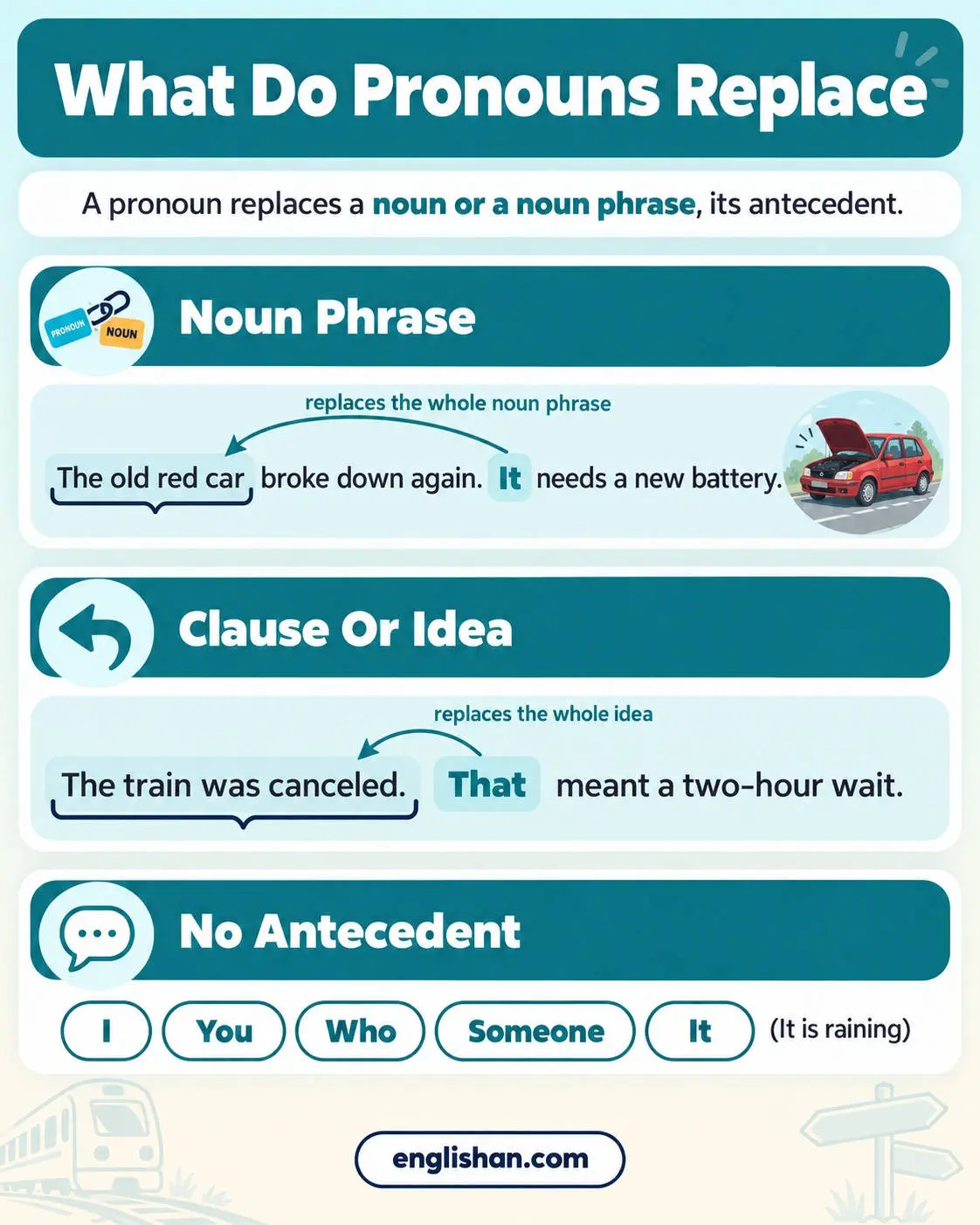
A pronoun is a word that replaces a noun or a noun phrase, the noun together with the words that describe it. In the pair “The old red car broke down again” and “It needs a new battery”, the pronoun “it” replaces all of “the old red car”, not only the noun “car”.
The answer to what do pronouns replace is usually a noun phrase, called the antecedent, which comes before the pronoun in most sentences. Some pronouns replace more than a noun phrase, and “which” after a comma can replace a whole clause, while a few replace nothing at all. For the ordinary case, the pronoun you choose depends on the person, number, and gender of the noun phrase it replaces.
Nouns And Noun Phrases Replaced By Pronouns
Pronouns replace nouns and noun phrases. A noun phrase is a noun with the words that describe or limit it: “a”, “the”, “my”, an adjective, or a prepositional phrase after the noun. The pronoun replaces all of those words together:
- Sam is late. He missed the bus.
- My neighbor’s two dogs barked all night, and they woke the baby again.
- I bought a jacket with a hood last week, but it doesn’t fit.
- The woman at the front desk was very patient. Did you thank her?
- Running before breakfast is hard, but I enjoy it.
A name like “Sam” is a one-word noun phrase, but most antecedents are longer. In the last example, “it” replaces “running before breakfast”, a gerund phrase that functions as a noun phrase.
The pronoun takes the place of the whole noun phrase, so the noun phrase and the pronoun do not both appear as the subject of one verb. Repeating the subject this way is a common learner error, and it is also heard in casual speech:
My brother he works at the airport. ❌
My brother works at the airport. ✅
The subject of “works” is either “my brother” or “he”, never both.
A noun can take “the” or an adjective before it, as in “the tall man”, but a personal pronoun usually stands alone, so “the tall he” is not possible. The full comparison of the two word classes is under noun vs pronoun.
The Antecedent Of A Pronoun
The antecedent of a pronoun is the noun or noun phrase that the pronoun replaces. The antecedent usually comes before the pronoun, in the same sentence or in an earlier one, so the listener already knows who or what the pronoun means:
- Priya called while she was on the train.
- The new printer jams on thick paper, so we don’t use it for cards.
- Ask the twins if they want pizza tonight.
- Our manager liked the plan and approved it the same day.
The antecedents are “Priya”, “the new printer”, “the twins”, and “the plan”, and the listener has heard each one before the pronoun.
The antecedent can come after the pronoun when a dependent clause opens the sentence. The pronoun then refers to a noun phrase that comes later, in the main clause:
- Before his interview, Omar read the job description twice.
- When she got home, Lena called her mother.
A pronoun agrees with its antecedent in person, number, and gender, so a plural antecedent such as “the twins” takes “they”. Pronoun antecedent agreement has the full rules, including indefinite antecedents such as “everyone”.
Pronouns That Replace A Clause Or An Idea
Some pronouns replace a whole clause or idea instead of a noun phrase. The demonstrative pronouns “this” and “that”, the pronoun “it”, and the relative pronoun “which” can refer back to everything a clause says:
- The train was canceled. That meant a two-hour wait.
- Prices went up again in March. This surprised most customers.
- Jonah missed the meeting, and I only heard about it later.
- Nadia passed her driving test, which surprised everyone.
In the first example, “that” replaces the idea “the train was canceled”, not the noun “train”. The listener understands the whole event as the antecedent, so no single noun in the sentence before has to match the pronoun.
A pronoun can also replace a noun clause, a clause that functions as a noun, as in “What he said was true, and everyone knew it.” The pronoun “it” replaces “what he said was true” as the object of “knew”.
A “which” that replaces a whole clause follows a comma in writing, because its clause adds a comment on the idea before it. Without the comma, “which” refers to the noun just before it:
She lent me her laptop which was kind of her. ❌
She lent me her laptop, which was kind of her. ✅
With the comma, “which” replaces the whole idea “she lent me her laptop”, not the noun “laptop”.
Pronouns With No Antecedent
For most pronouns, the answer to what do pronouns replace is an antecedent in the text, but some pronouns have no antecedent. First-person pronouns and second-person pronouns name the speaker and the listener, so “I” and “you” need no noun before them:
- I need a coffee before the meeting.
- Can you send me the address?
Interrogative pronouns such as “who” and “what” have no antecedent, because they stand for the answer the speaker does not know yet: “Who took my charger?”
Indefinite pronouns such as “someone”, “everything”, and “nobody” replace an unknown or general person or thing, so they need no antecedent either: “Someone left the lights on.”
Dummy pronouns replace nothing at all. In “It is raining” and “There is a problem with the heater”, “it” and “there” function as the subject only because an English statement must have a subject.
Steps To Replace A Noun With A Pronoun
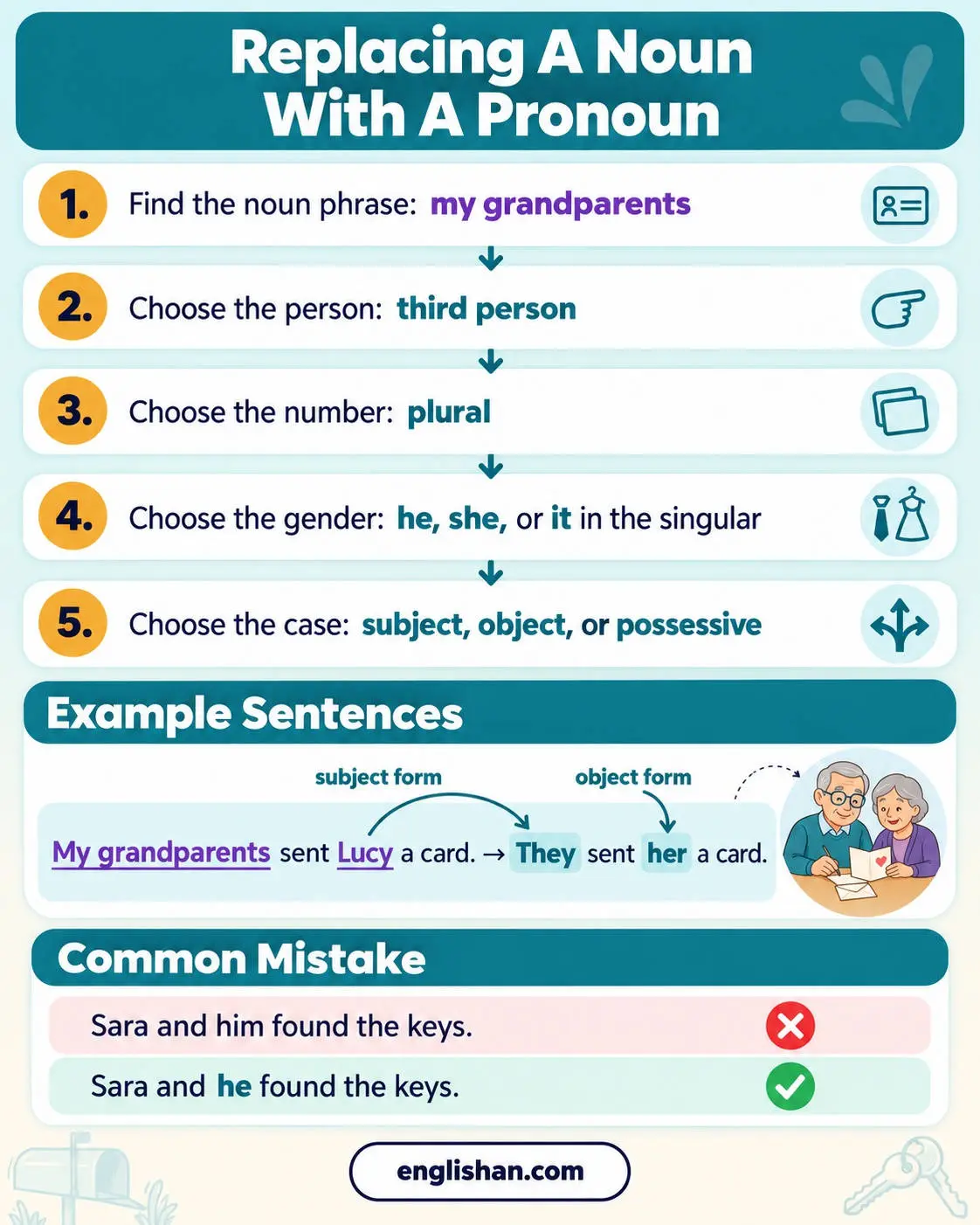
To replace a noun with a pronoun, you find the noun phrase and then choose the pronoun by person, number, gender, and case. Case depends on the pronoun’s position in the new sentence, so you choose it after the other three:
- Find the noun phrase. Mark the whole phrase the pronoun will replace, including “a”, “the”, “my”, and any adjectives, such as “my grandparents”.
- Choose the person. A noun phrase is third person unless it includes the speaker (“my sister and I” becomes “we”) or the listener (“you and your team” becomes “you”).
- Choose the number. A singular noun phrase takes a singular pronoun, and a plural noun phrase or two nouns joined by “and” take a plural pronoun, so “my grandparents” becomes “they”.
- Choose the gender. In the third person singular, use “he” for a man or boy, “she” for a woman or girl, and “it” for a thing. “They” also replaces one person whose gender is not stated.
- Choose the case. Use the subject form before the verb, the object form after a verb or a preposition, and the possessive form for ownership.
The same noun phrase changes form with its position in the sentence:
- My grandparents sent Lucy a card. → They sent her a card.
- Lucy thanked my grandparents. → Lucy thanked them.
- The kitchen light keeps flickering. → It keeps flickering.
- I met Dan and his wife at the market. → I met them at the market.
- Is this my grandparents’ car? → Is this their car?
A pronoun takes its case from its new position, not from the noun phrase it replaces, and a pronoun after “and” still takes the form of its position:
Sara and him found the keys. ❌
Sara and he found the keys. ✅
The pronoun is part of the subject, so it takes the subject form “he”, even after “and”.
Number follows the grammar of the noun, not the number of objects in the real world:
I bought new headphones, but it stopped working. ❌
I bought new headphones, but they stopped working. ✅
The noun “headphones” is plural, so the pronoun that replaces it is plural too, although it names one object.
Unclear antecedent: A pronoun replaces a noun clearly only when one noun phrase before it matches. In “Leo told Sam that he had won”, “he” can mean Leo or Sam, so the noun stays: “Leo told Sam that Sam had won.” Two possible antecedents of the same person, number, and gender call for the noun instead of the pronoun.
FAQs
Yes, a pronoun can replace a proper noun, the name of a person, a city, or a river. After "Maya" or "the Hudson River" has been named once, "she" or "it" replaces the name in the sentences that follow. The name is usually mentioned before the pronoun, so the listener knows who "she" means.
No, the answer to what do pronouns replace is a noun, a noun phrase, or a clause, never an adjective or a verb on its own. A repeated verb is replaced by the auxiliary "do" instead, as in "Sam cooks more often than I do." The word "do" in that sentence is an auxiliary verb, not a pronoun.
Yes, another pronoun can be the antecedent. In "Someone left their umbrella here", "their" replaces "someone", and in "We did our best", "our" replaces "we". A reflexive pronoun also replaces a pronoun earlier in the clause, as in "She taught herself Spanish."
A possessive pronoun replaces a possessive word and the noun after it. The pronoun "mine" replaces "my" plus a noun, so "Your phone is newer than my phone" becomes "Your phone is newer than mine." The noun is already known from earlier in the sentence, which is why "mine", "yours", "his", "hers", "ours", and "theirs" stand alone.
A relative pronoun replaces a noun phrase inside a relative clause and links that clause to its antecedent. In "The woman who lives next door is a nurse", "who" replaces "the woman" as the subject of "lives". In "The book that I lent you is overdue", "that" replaces "the book" as the object of "lent".
Related:
- Pronouns
- Types of Pronouns
- Subject Pronouns
- Object Pronouns
- Pronoun Case
- Second Person Pronouns
- Vague Pronoun Reference